Why Search for Restaurant Ruse When You’ve Seen This?

McKinney is full of mysteries. And they just keep piling on. How could the City Council possibly be entertaining spending money looking for a place to put the infamous Restaurant Row when they have a place right in front of their faces? Even Councilman Day spoke to it in a public meeting. He said there are only two viable places: 1) Downtown McKinney and 2) Gateway.

Gateway is where the City has already invested untold $millions. How many $millions? A citizen compiled a list totaling over $70 million, and I’ve yet to hear anybody say her numbers are wrong.

Ask any City official who ought to know. If they don’t know, why haven’t they asked? If they do know and won’t say, why would they take that position? If they do know and tell you, then why would they invest so much in one property and then pretend they aren’t sure if it is a good spot for Restaurant Ruse after making such an investment? Have they decided it is a money pit and don’t want to keep throwing good money after bad?

Here is why I point out the need to question the rationale for pushing a Restaurant Row, especially if it is to compete with an already presumably good property.

Please download and look at the Gateway Project plan that was being prepared by Lincoln Properties. Placed adjacent to the Emerson Campus, the Collin College Center, the Gateway Hotel and Conference Center are the following:

Office Site: 5.50 acres.
Office Site: 4.95 acres.
Office Site: 6.30 acres.
Office Site: 6.83 acres with 4 story building.
Office Site: 4.94 acres Class A, 10 stories with parking garage.
Restaurant Pads: 3.32 acres for two restaurants.
Restaurant Pads: 4.31 acres for three restaurants, making a total of five – IN A ROW!
Office Site: 7.44 acres with two Class A buildings, one 6 stories and one 8 stories.
Park Site: 2.03 acres.

There is a mystery as to why Lincoln Properties got this far to prepare a brochure with a plan and expected availability of Spring 2017 (the brochure is dated in September 2015) and then pulled out. I understand a key person at Lincoln Property passed away about this time. But I also heard that the numbers just didn’t work out for them to be able to develop a profitable project.

And why would that be the case? No market demand? If so, then how could that be with 74,401 people within 3 miles and 180,898 people within 5 miles? How could that be with daytime employment being 25,650 within 3 miles and 63,495 within 5 miles? How could that be with Average Household Income of $96,991 within 3 miles and $102,973 within 6 miles? How could that be with 103,000 vehicles per day coming down US 75 and 30,000 vehicles per day coming down Eldorado Parkway?

Nevermind that you can’t see this property when driving north on US 75. Nevermind that if you exit Eldorado Parkway when you when you do get a glimpse of the property, you can’t turn onto the property. But tall buildings will help with the identity some day, and it is not the worse location in the region with sites near clover leafs.

Or is it? Has anybody fessed up to this being the worst location in McKinney after sinking so much money in the property?

More mysteries. So many mysteries. Why won’t anybody come forth and tell the citizens? We can handle the truth. We just can’t handle mysteries and the reasons behind the mysteries.

But let’s go back to the brochure you’ve downloaded.

Why aren’t we starting with this plan and moving forward? If we are going to spend money (more money), what would it cost to rule out this site first before we looked elsewhere? That would make more sense.

Better yet, why wouldn’t we spend a little pocket change in relation to the money already spent to have a valid market study done – or for existing marketing studies to be updated? Why isn’t the MEDC on fire to turn this into a big winner given they own all or most of the property?

Or does this fall into the category of “Perfect But Not Now.” Ouch! My guess is that some of the biggest deals in the region have come about because of patience Plano and Frisco officials and developers have had in the past that is a foreign concept in McKinney. What is McKinney willing to sacrifice to have something on a major corner other than grass when the truly big deal is a few years away. We only have so many prime corners in McKinney.

The single biggest economic development tool cities had for years before incentive agreements, EDCs and  CDCs were allowed (worse laws ever created!) was the proper investment in the roadway and utility infrastructure that opened the paths to private investment. Oh wait, that’s not very sexy and is without the ribbon cutting and photo ops. That’s way too basic. Even though that is possibly the biggest way to be investing today to be ready when it’s McKinney’s time at some point in the future. There’s nothing McKinney can do in a grand way to compete with Plano, Allen and Frisco by wearing the change dispenser belt.

Yet, the Highway 5 Corridor, the Airport (the single item no adjacent city has) can be a game-changer. Lots of open land to the north, but the traffic counts are on the southern central side now.

In the meantime, houses can be built, and yes they are – everywhere. Even though no incentives are needed, McKinney has granted some developers with the use of MUDs with little concern about how that is going to play out in the future.

The famous management consultant, Peter Drucker wrote a book in 1954 and then wrote dozens of books that followed a central theme: “Build On Your Strengths!” Don’t waste resources on trying to fix all of your weaknesses.

If Gateway is not one of the handful of our strengths, then McKinney needs to fess up and declare it so, place it in mothballs and wait for a better day. If it is one of the major strengths, then build on it.

And instead of sprinkling money here and there, think about consolidating the resources to be placed into transportation, infrastructure corridors and things that will matter in the future. Think investment. And patience.

Council, MEDC, if you have a clue as to where we are going and how we are going to get there, please declare it so and shine the light so no mysteries exist. LFM


A Code of Ethics & Conduct McKinney Citizens Should Push To See Happen Now!

I made an Open Records Request for a document that sets forth a Code of Ethics & Conduct for the McKinney City Council and all Boards & Committees. I received a very legalistic document that appears to apply to everyone except the City Council. I recall there was an attempt to create something meaningful with some teeth in the last couple of years. It started out with a councilmember taking a stab at one. I haven’t watched the video lately from back then, but it seemed like most on the Council saw no need for one. I believe it was left with the Mayor and then Mayor Pro-Tem to follow up with, which I think was code for “wooden stake and mallet time.”  I haven’t heard this subject mentioned since then unless I just missed it.

I would like to suggest one that would be solid and with the mandate from the McKinney Citizens by amending the Charter emphasize the importance and the high expectations. There are many of these from other cities on the Web, which eliminates the necessity of starting from scratch. This one was written to make it sound and feel personal as if genuinely embraced by each Councilmember. There was even a pledge form required to make it an annual and ongoing covenant between the Council and the Citizens. I excluded that part. I also added a few of my own words and phrases as you might expect me to if you follow my blogs.

Since we have the possibility of almost a brand new Council by the 2017 elections, I suggest our current City Council move immediately to make this happen. It is a no-brainer. It could be passed now and left for Citizen endorsement and enforcement at the 2017 ballot box. I cannot imagine an argument for not taking this important step. LFM


THE CITY OF McKinney
CODE OF ETHICS AND CONDUCT
ADOPTED __________

 The people of the City of McKinney, at an election held on _________________, approved an amendment to the City Charter of the City of McKinney which states: “The City of McKinney shall adopt a Code of Ethics and Conduct for elected officials and members of appointed boards, commissions, and committees to assure public confidence in the integrity of local government elected and appointed officials.” Consistent with the vote of the people, the following Code of Ethics and Conduct is hereby adopted by the City of McKinney to ensure effective and fair operation of the local government of the City of McKinney.

I.        PREAMBLE

It is the intent of this code to achieve fair, ethical, and accountable local government for the City of McKinney. The people of McKinney expect public officials, both elected and appointed, to comply with both the letter and the spirit of the laws of the State of Texas, the United States of America, and the Charter, Municipal Code, and established policies of the City of McKinney affecting the operations of local government. In addition, public officials are expected to comply with the provisions of this Code of Ethics and Conduct established pursuant to the expressed will of the people. All persons covered by this code will aspire to meet the highest ethical standards in the conduct of their responsibility as an elected or appointed official of the City of McKinney.

This code addresses various aspects related to the governance of the City of McKinney and supplements, but does not supplant other laws and rules that prescribe the legal responsibilities of City officials. These include, but are not limited to, the Federal and State Constitutions, various provisions of the Texas Local Government Code and Other State Laws, and the City of McKinney Charter and Municipal Code. Elected and appointed officials are expected to be familiar with these laws to ensure that they exercise their public responsibilities in a proper fashion.

While it is not possible to anticipate and provide a rule of conduct and ethics for all situations that public officials may face, this Code of Ethics and Conduct is designed to provide a framework to guide public officials in their daily duties.

II.  SCOPE

The provisions of this Code of Ethics and Conduct shall apply to the Mayor and members of the City Council, and to all members of the Boards, Commissions, and Committees appointed by the Mayor and City Council, including any ad hoc committees. Further, the provisions of this Code of Ethics and Conduct shall only apply to these officials and members acting in their official capacities and in the discharge of their duties.

III. CORE VALUES

Attitudes, words, and actions should demonstrate, support, and reflect the following qualities and characteristics for the well-being of our community. The five core values and expressions that reflect these core values are as follows:

INTEGRITY/ HONESTY

  • I am honest with my fellow elected officials, the public and others.
  • I do not promise what I believe to be unrealistic.
  • I am prepared to make unpopular decisions when my sense of the public’s best interests requires it.
  • I credit others’ contributions to moving our community’s interests forward.
  • I do not knowingly use false or inaccurate information to support my position or views.
  • I safeguard the ability to make independent, objective, fair and impartial judgments by scrupulously avoiding financial and social relationships and transactions that may compromise, or give the appearance of compromising, objectivity, independence, and honesty.

RESPONSIBILITY/PROTECTING THE PUBLIC’S INTERESTS

  •  I do not accept gifts, services or other special considerations because of my public position.
  • I excuse myself from participating in decisions when my or my immediate family’s financial interests may be affected by my agency’s actions.
  • I do not give special treatment or consideration to any individual or group beyond that available to any other individual.
  • I refrain from disclosing confidential information concerning litigation, personnel, property, or other affairs of the City, without proper legal authority, nor use such information to advance my financial or other personal interests.

FAIRNESS/ACCOUNTABILITY

  •  I promote meaningful public involvement in the agency’s decision-making processes.
  • I treat all persons, claims and transactions in a fair and equitable manner; I make decisions based on the merits of the issue.
  • If I receive substantive information that is relevant to a matter under consideration from sources outside the public decision-making process, I publicly share it with my fellow governing board members and staff.
  • I work to contribute to a strong organization that exemplifies transparency and open communication.
  • I will not meet privately with any kind of special interests seeking favor from the City unless those meetings are held in City facilities in offices and conference rooms designated by the City.
  • I will not meet directly or indirectly with any form of Walking Quorum to discuss or solicit the direction of decisions being formed by other members of the City Council or any Board or Commission.
  • I will encourage as much discussion as possible to be conducted by special interests in the public forums that allow all parties, including the public to better understand the need, purpose, rationale and technical information surrounding a potential City action.

RESPECT FOR FELLOW ELECTED OR APPOINTED OFFICIALS, STAFF, AND THE PUBLIC

  •  I treat my fellow officials, staff and the public with patience, courtesy and civility, even when we disagree on what is best for the community.
  • I work towards consensus building and gain value from diverse opinions.
  • I understand and support and pledge to adhere by the Council-Manager form of government as required by City Charter. I respect the distinction between the role of office holder and staff;
  • I involve staff in meetings with individuals, those with business before the agency, officials from other agencies and legislators to ensure proper staff support and to keep staff informed.
  • I conduct myself in a courteous and respectful manner at all times during the performance of my official City duties.
  • I encourage full participation of all persons and groups; I am aware and observe important celebrations and events which reflect the values of our diverse population.

PROPER AND EFFICIENT USE OF PUBLIC RESOURCES

  •  I do not use public resources, such as agency staff time, equipment, supplies or facilities, for private gain or personal purposes. This includes taking up valuable staff time for special questions that I can send in writing and ask that they be answered during designated Council briefing opportunities.
  • I make decisions after prudent consideration of their financial impact, taking into account the long-term financial needs of the agency, especially its financial stability.
  • I demonstrate concern for the proper use of agency assets (such as personnel, time, property, equipment, funds) and follow established procedures.
  • I am a prudent steward of public resources and actively consider the impact of my decisions on the financial and social stability of the City and its residents.

IV. IMPLEMENTATION AND ENFORCEMENT

City of McKinney elected and appointed officials of the various boards, commissions and committees have the primary responsibility to assure that ethical standards are understood and met, and that the public can continue to have full confidence in the integrity of government. This Code of Ethics and Conduct will be most effective when the elected and appointed officials are thoroughly familiar with it and embrace its provisions.

Upon adoption of this Code, all current elected or appointed officials shall be given a copy of the Code and asked to affirm in writing that they have received the code, understand its provisions, and pledge to conduct themselves by the code. All new members of the City Council, upon election or reelection, and members of Boards, Commissions, and Committees appointed by the City Council, upon appointment or reappointment, shall be given a copy of the Code and are required to affirm in writing they have received the code and understand its provisions, and pledge to conduct themselves by the code.

Additionally, all members of the City Council, boards, commissions, and committees, as part of their annual orientation and training, shall be provided additional training clarifying the provisions and application of this code. The City Attorney, or his/her designee, shall serve as a resource person to those persons covered by the code to assist them in determination of appropriate actions consistent with the code.

A periodic review of the code shall be conducted to ensure that the Code is an effective and vital document.

This Code of Ethics and Conduct is intended to be a reflection of the community’s values as articulated by the Mayor and City Council as they represent the will of the people of the City of McKinney.

Captain Obvious To The Country of Oblivious: The Math Won’t Compute Forever!

I am approaching my ten-year anniversary of writing about a subject that causes me to feel like Captain Obvious speaking to the Country of Oblivious. Some of us are numbers people, some picture people and others word people. I like all three and try to use every tool to communicate. There are five charts below. Let me see if I can summarize them succinctly.

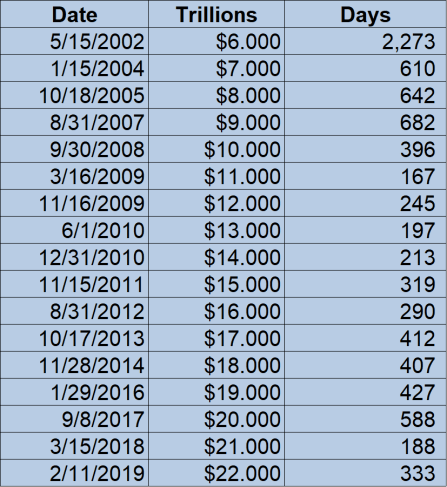
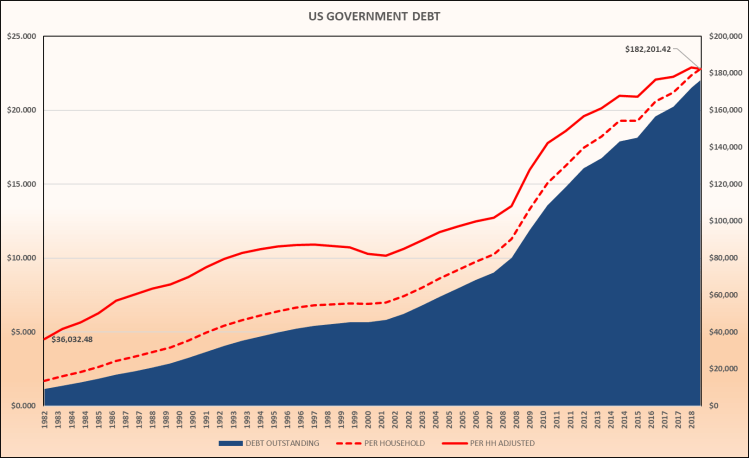
Chart I shows the US outstanding debt from the early 1980s through September 30, 2016. Think Presidents Reagan through Obama. We now owe $19,573,444,713,936.79 in debts. To place $19.6 trillion into a proper perspective,  I have shown this mountain of debt on a per household basis and then adjusted for inflation. The load has risen from $33,017 to $164,695 per household for 4.99x over the relatively short chart period.

This does not include the present value of Social Security and Medicare, which have estimates of over $100 trillion according to the Dallas Federal Reserve. This does not include your personal debt, nor any state, county, city, ISD or special district debt, including the present value of retirement benefits.

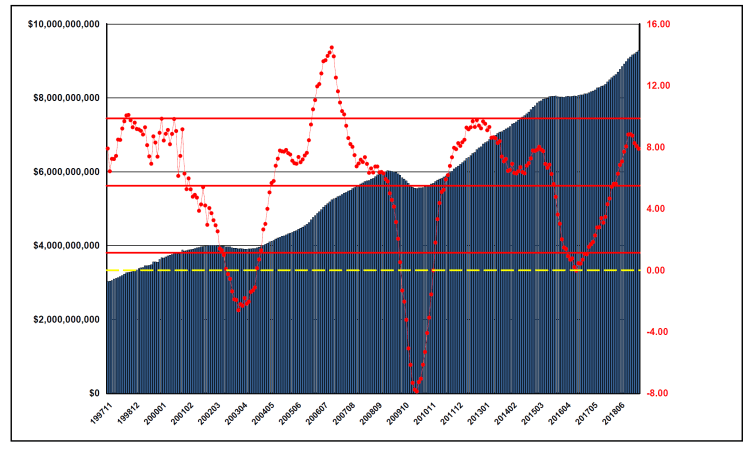
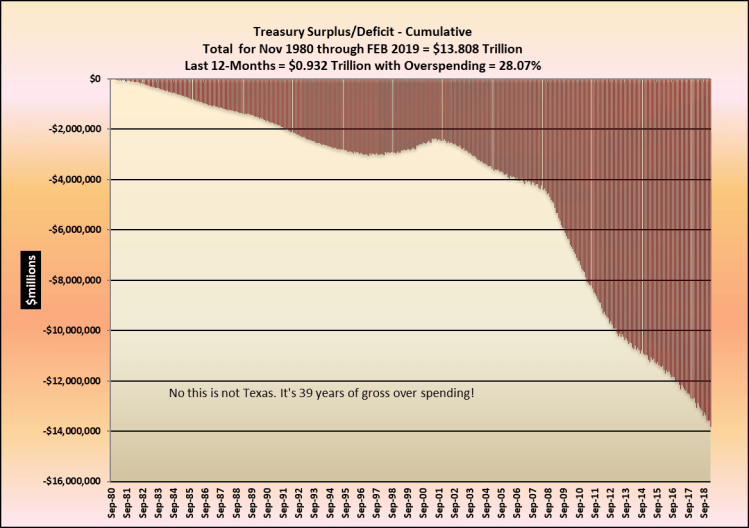
Chart II looks like a portion of Texas. It’s the cumulative amount of debt attributable to operating deficits. Here is a recap (in $millions).

               The Total Deficit as of 9/30/1980              $     907,707.
               Deficit Spending Since                                  $11,822,278.
               Debt Sub-total                                                $12,729,985.
               Debt Outstanding at 9/30/2016                 $19,873,445.
               Difference (Off Books???)                            $  7,143,460.

Yes, the debt has soared. By every President and every sitting Congressional Member no matter the party in control since 1980. Chart II also shows the percentage of overspending on the disclosed operating budget. Right now we are at about 17.98% and have averaged about 20% over the chart period. One way this metric could be interpreted is to say that revenues would need to be raised or expenditures cut (or a combination thereof) by 20% to just breakeven on the disclosed budget and probably about another 10-15% to cover the Off-Books spending. That might stop debt from growing but not pay off a penny of the $19 trillion. Raise your hand if you believe either will happen.

I’m pretty sure my 8th grade granddaughter is working story problems more difficult than this one to figure out where things are heading.

 Charts III and IV give us an idea about how we are pushing the limits on what we can expect to be milked from the overall potential revenue base. All you have to know is that every dollar of our annual Gross National Product totals about $19 trillion. And the US government revenue base is $3.3 trillion. Logic would say that if the federal government is taking in 17.20% of the GNP, that’s big no matter how you measure it. Again, layer the state, county, ISDs and other special districts and … you just have to appreciate reasonable limits.

 Chart V is just one of the fabricated and dangerous aspects to the reason we haven’t collapsed since I started predicting so ten years ago. The inflation and interest rates can be manipulated by the Federal Reserve. It has now been so long that many of the newer families and employees don’t realize what has happened. To control rising Social Security costs and to lower the amount the US government pays on interest toward this staggering amount of debt, Chart V shines the light on the gimmick.

Interest rates on US Debt have been lowered from 8.23% in 1988 to 2.21% in 2016. The eye can figure out quite quickly the impact if we were dealing with true interest rates, rates that took real inflation and real risk into consideration. With an expenditure base of about $3.856 trillion, the interest expense of $0.433 trillion is about 11.22%. What would the 2016 disclosed budget operating deficit of about $0.588 trillion have looked like if interest costs were in the 5% range? Close to double. See the motivation our leaders have to manipulate the numbers?

There is another big issue here. Retired people hoping to make it on their 401k and Social Security benefits are getting shafted. The tendency at that age and stage is to be conservative and safe. And for the last several years that kind of thinking will earn retirees very close to zero. I never thought I would  hear serious discussions and see real actions to drive interest rates below zero. But here we are.

To be fair, many Social Security recipients and almost all Medicare beneficiaries are receiving much more out of the system than they ever put into the system – another faulty math problem that has led to the big deficits and debt.

 Conclusion.

The perfect storm is coming as it relates to the sustainability of gimmicks and outright massive spending to keep things afloat. One of the ways the Federal Government has taken advantage of low rates is to move to shorter term instruments. The problem with that is like having a 6-month mortgage instead of 15+ years. You and the lender come face to face frequently, always with the possibility that the lender doesn’t want to reinvest.

The lenders of the $19 trillion are first the government itself. The Social Security funds temporally on hand, for instance, have been used by the Federal Government to pay for operations. Those funds held by foreign countries are not a small part of the lender base. Yes, we are viewed as a safe haven, but that’s mostly because other countries are worse.

 And isn’t that a sound footing to be on? Especially as we want it all, we want it now, and we want somebody else to pay for everything. Good luck, Country of Obvious. That arithmetic is eventually going to catch up with us! LFM

 Chart I.

charti 

Chart II.

 chartii

Chart III.

chartiiiChart IV.

chartiv

Chart V.

chartv

Looking at Accounting Fundamentals for a Company Called CopSync

Introduction.

There is an Addison-based company called CopSync (NASDAQ: COYN) that has had my attention for the last couple of years. I first got interested because of their connection to AG Ken Paxton. While his world was falling to pieces over securities violations related to a company called Servergy, which appears to finally be going to trial, I got interested in CopSync. Paxton owns or at least owned a sufficient number of shares in CopSync for him to be one of the handful of stockholders disclosed in financial filings. My curiosity was whether AG Paxton was the recipient of shares of CopSync for the same reason he was for Servergy, and that was to be compensated for promoting the firm.

I’m still curious about the Paxton connection, but my attention has drifted to other aspects of CopSync. One has to do with service. However, I cannot find anything derogatory in the public domain regarding their product or services. And I’m glad. That would be my concern if so since CopSync serves local governments, which I do consider to be my bailiwick. CopSync serves a number of local governments, almost all very small.

For instance, a recent press release for CopSync states that the City of Helotes has joined their network of customers. The number of customers appears to be quite large, 530 agencies in fact. That would include thousands of police officers in 15 states across the US. I believe I have seen numbers in previous press releases of approximately 670, so I’ve got some questions about the customer base. However, 530 agencies would be an impressive number.

Yellow Flags.

I have seen some caution signs. The public relations firm for CopSync must be very effective in that I receive a Google Alert multiple times each week. One example states CopSync’s network “is the nation’s only system connecting law enforcement officers and agencies nationwide, and provides access to a national database of non-adjudicated law enforcement information and real-time communication capability to connected agencies, even those thousands of miles apart.” That just seems strange to be the ”only” system in the nation, but I could let that pass my filter. I always watch for words like “best,” but I guess that would be redundant if you are the only one out there.

My curiosity expanded when the news alerts for CopSync included highlights like “The Company is conducting pilot programs with the San Antonio PD and with the Sheriff’s Office for Bexar County.” Whoa, Baby! In my 42 years of working with local governments, the one thing I have grown to appreciate is that tricky little thing called scale. It’s the garden hose vs fire hydrant kind of scale. Nevertheless, I wish CopSync well and hope it all works out.

Although advertising hype is absorbed and discounted in most of our daily lives, that’s not the case when it comes to publicly traded companies. So then came another announcement from CopSync that caught my eye and caused me more worry. The headline in caps said “FIRST MAJOR TEXAS METROPOLITIAN AREA POLICE DEPARTMENT JOINS COPSYNC NETWORK.” Dang! Who might that be?

The subheading said “CITY OF LANCASTER, SCHOOL DISTRICT POLICE DEPARTMENT BEGAN USING COPSYNC THIS SCHOOL YEAR.”

So, which one is it? The City of Lancaster? The Lancaster ISD? Both? It would appear to be both. Until you read deeper where after a confusing “The City of Lancaster Independent School District,” paragraph (an animal that does not exist) speaks only about LISD. I contacted the City of Lancaster Police Chief to confirm it is LISD but not the City. Honest mistake? Maybe. But strange for a company born in Texas and is being raised in Texas by Texans.

Red Flag.

Being a numbers person is both a blessing and a curse. When a stock price gets too high for some investors, it is not unusual to have a 2:1 or 3:1 split. The reverse is also true. You have to be a certain size stock price to be traded on the primary exchanges or be eligible for the big institutional buyers. However, on October 13, 2015, CopSync announced a 1-for-50 reverse stock split. Wow! Now, that will get your attention.

However, all did not go well apparently. This penny-stock only reached a high of $9.55 between when the CopSync shareholders approved the reverse split and when it became effective. But what happened after the peak of $9.55? As you can see from the chart below, the CopSync stock has steadily declined to a low or $0.70 on October 6, 2016. Since then it closed at $0.7780 last Friday. That doesn’t look very promising.

copsync

Bigger Red Flag.

What do the stockholders know that most people do not know, including the purchaser of CopSync’s goods and services? I was also puzzled by the CopSync news alerts that appeared to be nothing but good news. I saw a headline that said CopSync’s Gross Profit Margin was 29.00%. That’s when I started doing some digging. In fact, I went back to the beginning and started comparing financial statements and SEC filings for the last ten years. I was more than a little shocked. It is not at all unusual for a start-up company to have a few years of losses.

To be sustainable (a “going concern” in accounting vernacular), a business must eventually make a profit unless two things happen: 1) somebody loans them money from a bottomless well and/or 2) stockholders keep putting money in the company in hopes that they will not only get their money back but make a profit.

Since 2008, CopSync has had revenues of $28,989,455 and Cost of Revenues (mostly hardware and software costs) of $21,256,922 for a Gross Profit of $7,732,533. But that is just the first line of value on the Income Statement. Yep, if you are going to choose one number to highlight, there you go.

But wait, as the late night Veggie-Matic commercial goes, there’s more. There are three big other expenses for General & Administrative, Research & Development and Sales & Marketing. These three big guys have totaled $36,292,758 since 2008.

That means the Loss From Operations totaled $28,560,225 since 2008! Another deduction for Other Expenses such as Interest Expense totals $4,139,400 for a total loss since 2008 of $32,699,525.

How does a company that has a Net Loss of $32,699,525 since 2008 stay in business? Especially when the losses from 2012 through 2015 are -$4,287,930; -$3,839,856; -$4,328,467; and -$6,505,422. And then it gets worse as the first six months of 2016 show a loss of -$5,314,063.

The answer to that question is a variety of loans from vendors, owners and spouses of owners. There is even a footnote about a big loan from the Pharr, TX EDC that was later hoped to be turned into a grant. Vendors have apparently been paid in stock.  There is a much larger part of cash that has come from additional stock issues and the stock Uplist, presumably from the reverse split.

Conclusion.

My concern is not about CopSync. I hope they make it, but I personally don’t see how the financial arithmetic is going to work out. If their plan is to sell their base of customers to an outside firm, it would seem to me that income from the sale of equipment and services is going to have to double to break even.

If CopSync is hoping to land the big one – as their PR suggests – then two questions come to mind. Are they planning to price their incremental services to subsidize the current base of small guys? Also, there are absolutely tons of stories in the business world of companies that are doing well (making a profit) at a certain level that then collapse when they jump to a higher scale of business. Are they geared to make that happen? If it happens?

My concern is for the 530 (or whatever the number is) of agencies, mostly in Texas if CopSync can’t continue to get funding. If fact, I can’t imagine what group of knowledgeable stockholders would put $30+ million into a company that is losing money big time – and with losses that are growing.

I actually don’t understand how CopSync has withstood the eye of the SEC and even the NASDAQ? And even the securities’ analysts that supposedly rate CopSync. Are they independent? I read the transcript of a recent earnings conference call and the questions seemed like softballs considering a company that is losing so much money.

In any case, for any of my readers considering CopSync products, kick the tires on their products and services to be satisfied there is a good fit. But also ask about how they are going to turn around multi-million dollar losses year after year. LFM


Are We Seeing “The Abilene Paradox” Being Played Out In McKinney

Introduction.

It was within my first year or two in municipal government that I heard The Abilene Paradox Story introduced by a consultant leading a manager training series at the City of Garland. It’s a story I will never forget. With the help of an abbreviated version found in Wikipedia, I’ll share this gem:

The term was introduced by another management expert Jerry B. Harvey in his 1974 article “The Abilene Paradox: The Management of Agreement.” The name of the phenomenon comes from an anecdote in the article which Harvey uses to elucidate the paradox:
On a hot afternoon visiting in Coleman, Texas, the family is comfortably playing dominoes on a porch, until the father-in-law suggests that they take a trip to Abilene [53 miles north] for dinner. The wife says, “Sounds like a great idea.” The husband, despite having reservations because the drive is long and hot, thinks that his preferences must be out-of-step with the group and says, “Sounds good to me. I just hope your mother wants to go.” The mother-in-law then says, “Of course I want to go. I haven’t been to Abilene in a long time.”
The drive is hot, dusty, and long. When they arrive at the cafeteria, the food is as bad as the drive. They arrive back home four hours later, exhausted.
One of them dishonestly says, “It was a great trip, wasn’t it?” The mother-in-law says that, actually, she would rather have stayed home, but went along since the other three were so enthusiastic. The husband says, “I wasn’t delighted to be doing what we were doing. I only went to satisfy the rest of you.” The wife says, “I just went along to keep you happy. I would have had to be crazy to want to go out in the heat like that.” The father-in-law then says that he only suggested it because he thought the others might be bored.
The group sits back, perplexed that they together decided to take a trip which none of them wanted. They each would have preferred to sit comfortably, but did not admit to it when they still had time to enjoy the afternoon.
Ronald Sims writes that the Abilene paradox is similar to groupthink, but differs in significant ways, including that in groupthink individuals are not acting contrary to their conscious wishes and generally feel good about the decisions the group has reached. According to Sims, in the Abilene paradox, the individuals acting contrary to their own wishes are more likely to have negative feelings about the outcome. In Sims’ view, groupthink is a psychological phenomenon affecting clarity of thought, where in the Abilene paradox thought is unaffected.
Like groupthink theories, the Abilene paradox theory is used to illustrate that groups not only have problems managing disagreements, but that agreements may also be a problem in a poorly functioning group.
I Think This Is Happening in McKinney.

Twice I have seen a bizarre setting, and I’ve blogged about both. See http://www.citybaseblog.com for my perspectives. The first was what appeared to be an out-of-the blue request by Councilmembers Branch and Rogers. The request was for the Council to entertain a proposal from an outside firm to privatize our most significant ball park to be used primarily for tournament leagues. It was not well thought-out nor was it feasible. But the bizarre aspect of the pitch is that the entire council went along with the drawn out discussion and even acted as if they might initiate a study to evaluate the proposal. 

As I listened, my first reaction was why are Councilmembers meeting with a single company on this topic when you’d have to be dumb as a stump to think the idea would fit McKinney and to possibly signal to a business they had an inside track? My bigger question, however, is why doesn’t a Councilmember make a motion to stop the asinine discussion and at least table it. By table the item, I mean take out a wooden stake, grab a mallet and drive said stake deep into the heart of a dumb, time-wasting idea?

The Gift That Keeps On Giving.

And now comes this suggestion of the need for a Restaurant Row in McKinney, the thing stopping major corporations from moving to McKinney, according to the brand-spanking new Mayor-Tem Randy Pogue. This vision came to him days after annointment. I listened to the August meeting today for the third time. There’s something strange about the meeting. First, Mr Pogue got this telepathic message from a number of businesses, it seems. Yet I can’t find where any of the other six Councilmembers got the same message. At least they aren’t trying to share the spotlight with Mr Pogue. Even the loyalists aren’t waving the Pom-Poms.

And just exactly how many businesses have been hounding Mr Pogue. More than 30? Under five? Mr Pogue, since you have set in motion almost single-handedly an initiative that is going to lead to a considerable amount of money just to study this item to death, would you please state the number of reasonably serious businesses that have told you they ain’t coming until they see a Restaurant Row? And provide those names to an independent party to vouch those are real companies without divulging any names?

Here again, it seems to me that we have an Abilene Paradox. Watch the video of the meeting closely. It’s malfunctioning agreement in action. To all of the remaining six Councilmembers, I’d like to ask that you individually state publicly that the time is right and this is a good idea to spend staff resources and eventually taxpayer money to study these issues presented at the August meeting. I dare you! I’ll provide the stakes and mallets. 

Conclusion.

The conclusion I have come to is simple. There is not a single Councilmember who fully understands the Council-Manager form of government, nor do they want to know, nor do they plan to allow that form of government work in McKinney. I cannot for the life of me figure out why the City Attorney has not explained this to them AND stepped up to enforce it. It is clear after having revolving door city managers that you, the Council, assure failure for our form of government you continue to ignore. 
I even challenge the Sheep-Citizens to be insistent and vocal to support the Council-Manager form of government. We have more of a The term was introduced by management expert Jerry B. Harvey in his 1974 article “The Abilene Paradox: The Management of Agreement.”[3] The name of the phenomenon comes from an anecdote in the article which Harvey uses to elucidate the paradox:
On a hot afternoon visiting in Coleman, Texas, the family is comfortably playing dominoes on a porch, until the father-in-law suggests that they take a trip to Abilene [53 miles north] for dinner. The wife says, “Sounds like a great idea.” The husband, despite having reservations because the drive is long and hot, thinks that his preferences must be out-of-step with the group and says, “Sounds good to me. I just hope your mother wants to go.” The mother-in-law then says, “Of course I want to go. I haven’t been to Abilene in a long time.”
The drive is hot, dusty, and long. When they arrive at the cafeteria, the food is as bad as the drive. They arrive back home four hours later, exhausted.
One of them dishonestly says, “It was a great trip, wasn’t it?” The mother-in-law says that, actually, she would rather have stayed home, but went along since the other three were so enthusiastic. The husband says, “I wasn’t delighted to be doing what we were doing. I only went to satisfy the rest of you.” The wife says, “I just went along to keep you happy. I would have had to be crazy to want to go out in the heat like that.” The father-in-law then says that he only suggested it because he thought the others might be bored.
The group sits back, perplexed that they together decided to take a trip which none of them wanted. They each would have preferred to sit comfortably, but did not admit to it when they still had time to enjoy the afternoon.
Ronald Sims writes that the Abilene paradox is similar to groupthink, but differs in significant ways, including that in groupthink individuals are not acting contrary to their conscious wishes and generally feel good about the decisions the group has reached.[4] According to Sims, in the Abilene paradox, the individuals acting contrary to their own wishes are more likely to have negative feelings about the outcome. In Sims’ view, groupthink is a psychological phenomenon affecting clarity of thought, where in the Abilene paradox thought is unaffected.[5]
Like groupthink theories, the Abilene paradox theory is used to illustrate that groups not only have problems managing disagreements, but that agreements may also be a problem in a poorly functioning group.[6]Commision form of government. Either change the Charter or abide by the Charter. I believe 95% of McKinney’s problems are tied to this violation of our form of government. LFM

Are We Chasing Our Re-Tails Too Much?

Are We Chasing Our Re-Tails Too Much?

By Lewis F. McLain, Jr.
President, CityBase.Net
lfm@CityBase.Net

Introduction.

The borders for Retail shopping are disappearing with the exponential increases in online sales. My wife is within a fraction of a percentage point of buying all of our Christmas items online. In fact, we’re close to 100% of all purchases being via the Internet with the exception of food. The red flag was actually raised a few years ago as not just old malls, but relatively new malls have been torn down. We don’t even have time to get nostalgic about a mall before they head toward bankruptcy or the wrecking ball. Worse, when blight attacks strip centers way before the neighborhoods around them, we have a different world to face. You know things are different when there is a Web site called http://www.deadmalls.com.

I’ve been intrigued with the number of studies being conducted in search of Retail Leakage to adjacent communities. We even have all kinds of illogical connections being made in my own City of McKinney where a mayoral candidate is convinced that if we create a Restaurant Row, businesses will be beating down our door to move to our swell town. This is a particularly bizarre movement since McKinney is not without restaurants, and many of them are in areas that fit the definition of a Restaurant Row.

When lunching with a colleague recently, our conversation turned to this concept of chasing pretty things like Retail. His community has an exceptionally large portion of warehouses. You know, those ugly boxes. Those boxes that have a very attractive amount of property tax revenues with a minimal amount of demand on public services. However, if you look closer, there is also an impressive amount of sales taxes that may be associated with inelegant structures in your city.


Let’s Look At Some Data.

Below is a recap of Texas cities with a population of greater than 50,000. It is helpful to look at these kinds of numbers before you get dizzy with excitement over some study numbers that give the impression that there are $billions within your grasp if only you know who to chase. You don’t need to spend a lot of money to get a relatively good picture of where your expectations might be reasonably placed. The average of these cities below is $185.94 on a per capita basis placed on a one-penny equivalent. The median is $169.82 on the same basis.

Yes, there are some wide variances. And without a doubt the main consumer-driven sources make a difference. However, don’t overlook that some of the above-average results are coming from cities with a large portion of business- driven transactions. Remember that the actual correct label is not just Sales Taxes; it is Sales & Use Taxes.

The bottom line is that you need both to have a healthy income stream for both Sales Taxes and Property Taxes. In all cases, realize that there is just so much that can be squeezed out of the consumer. And when squeezed too much (credit cards, HELOCs), a painful recoil is just a matter of time. Before you celebrate that a new Kroger has just opened, realize that you might be seeing an equivalent size grocery store closing within a couple of years. You might be just seeing a zero-sum situation except now you have to figure out what to do with an empty grocery store.

c1


Where did I get the Consumer/Business allocation data? Actually, from two places. Similar but different. The first review was from the top level categories as compiled by exact information I have from over 25 cities of all sizes (total population of about 3.5 million in population and with collections of about $872 million in the last year) across the state based on NAICS codes that I have cleaned up. By cleaned up, I mean that many of the codes used by the State are in error. Apple Stores, for instance are classified as Manufacturing vs Retail.

A summary of the scrubbed data is in the table below. To no surprise, the dominant consumer categories are on top. However, you might be surprised at the level of sales tax that comes from Wholesale and Manufacturing and others.

c2

Second, I took each of the cities in my first table and allocated into Consumer vs Businesses groups based on data that can be obtained from the state for all cities and then used my judgment to allocate. It is not scrubbed, but the accuracy should be sufficient to make a meaningful comparison. My allocations are in the table below. No doubt you and I might allocate the Categories a little differently. However, this is the best I can do with the public data I have.

c3

Conclusion.

It seems pretty obvious to me that many cities may be chasing the wrong things for sales tax purposes. It is acknowledged that I am focused only on sales taxes and not the production of property taxes nor on the number pf pure jobs and the pay levels for jobs. I can’t resist being Captain Obvious here by saying go for everything that helps provide a healthy balance in your revenue base.

However, now that Amazon and most of the prominent companies do in fact collect sales taxes and remit based on the city from which the order is placed, the potential for a city to get a substantial amount of retail sales taxes whether you have a business located in your jurisdiction has changed in your favor if you care to have your citizens’ money out of pocket coming back to their home city.

Don’t overlook the other Categories that are likely to generate a substantial amount of revenue and actually be more stable over time. LFM


Is Texas Charging A Hidden Tax To Local Governments & Citizens?

Introduction.

I fully understand that all local governments (counties, cities, transit authorities and special districts) in Texas are subdivisions of the state. One way to look at that fact is say everything you have, children, is because we gave it to you out of our generosity. Be grateful, stop complaining and leave me alone.

But that is not how I see it.

Local governments are taking a beating from the State in many ways. In small General Law cities (under 5,000 population), the State says we will give you the Charter. You can’t do anything unless the State law says you can. In Home Rule cities (mostly those over 5,000), the State says you can do anything you want unless the State law specifically says you can’t.

Perhaps with at least some justifiable reasons, the State continues to take away local control from cities. Their actions are actually pretty insulting in that the treatment is as if the cities aren’t accountable to the local voters. Again, you are too dumb and evil to be trusted, local governments, so we have to step in to throttle you back as we see fit for the sake of your citizens.

The net result involves several areas of constraints, but the biggest is revenue caps. If we can cut off your oxygen, local governments, we can reform you into good soldiers in our self-professed image.

It’s Two-Faced.

This blog is about an example of how the State is two faced. The mantra is taxes are bad. Actually, that translates into your taxes are bad, local governments, but ours are okay. In fact, here is a deal for you, ungrateful local governments, we will let you charge a sales tax up to 2.00%. This will be added to the State sales tax of 6.25%. Oh, by the way, even though we are collecting sales taxes for us anyway, we will collect and remit your portion. For this privilege, we will charge you 2.00% of your take. We will call it a service fee.

A fee implies there is some rational nexus (logical connection) to the effort it takes to provide a service. Logic would say that the State should charge the local governments about 2.00%/8.25% of the actual cost of the service. The State would recognize (in a logical business setting) that the State’s portion to bear is 6.25%/8.25%.

If the amount paid by local governments is well above the cost of services, then it is a tax.

Whoa, buddy! There goes that nasty word.

So are you saying, Lewis, that the State is taxing the local governments and their citizens?

Well, Let’s See.

Do we want to look at the State’s true cost of service first or the amount that is taxed by the State to the local governments?

I have tried to get the actual cost of service for the Sales Tax Division from the Comptroller’s Web site. It does not appear to be separated. There may be a good reason for that. If you can get me a good number, please send it to me.

Meanwhile, let’s approach this junior high story problem a different way. How much are local governments paying to the State for collecting the local portion of sales tax? I am so glad you asked, because I happen to have that number to the penny.

In the last 12 months, the local governments have paid the State $164,148,777 to handle those collections. In a fair cost allocation model that would mean the entire cost is $164,148,777 divided by 2.00% times 8.25% or $677,113,707.

Do you think it costs the State $677,113,707 to collect sales taxes every year?

I don’t either. To say that is a lot of money is the understatement of the century.

Conclusion.

So, if our State leaders are so emphatic about cutting taxes for the citizens of Texas, as all of their campaign rhetoric states as well as the continuing mantra they chant to local governments, why not do the noble thing:

1)     Determine the real cost of service for sales tax collections.

2)     Charge local governments for their proper share, which is the simple calculation of 2.00% divided by 8.25%.

Otherwise, the State of Texas is imposing a tax disguised as a cost-based fee to the citizens of Texas.

Below is the recap of the annual tax charged to local governments along with the Top 50 payers.

ENTITY GROSS COLLECTIONS 2% SERVICE FEE
GRAND TOTAL

$8,207,438,785

$164,148,777

HOUSTON MTA

$706,588,797

$14,131,776

HOUSTON

$649,877,508

$12,997,550

DALLAS MTA

$549,512,086

$10,990,242

SAN ANTONIO

$326,024,050

$6,520,481

DALLAS

$286,439,874

$5,728,797

AUSTIN MTA

$224,847,374

$4,496,947

AUSTIN

$207,111,910

$4,142,238

SAN ANTONIO MTA

$139,467,030

$2,789,341

FORT WORTH

$139,043,247

$2,780,865

ARLINGTON

$103,856,316

$2,077,126

EL PASO

$84,544,840

$1,690,897

PLANO

$79,127,702

$1,582,554

FRISCO

$76,561,830

$1,531,237

AMARILLO

$76,188,475

$1,523,770

CORPUS CHRISTI

$73,886,344

$1,477,727

FORT WORTH MTA

$69,078,582

$1,381,572

ROUND ROCK

$67,996,147

$1,359,923

LUBBOCK

$66,316,817

$1,326,336

IRVING

$66,009,062

$1,320,181

FORT WORTH CRIME CTRL DIST

$65,433,451

$1,308,669

SAN ANTONIO ATD

$63,220,054

$1,264,401

MCALLEN

$61,739,232

$1,234,785

MIDLAND

$54,979,855

$1,099,597

SUGAR LAND

$53,198,028

$1,063,961

GRAND PRAIRIE

$51,143,821

$1,022,876

MCKINNEY

$46,632,047

$932,641

EL PASO COUNTY

$45,826,233

$916,525

MESQUITE

$43,412,130

$868,243

GRAPEVINE

$42,358,646

$847,173

CONROE

$42,325,549

$846,511

EL PASO CTD

$41,951,196

$839,024

ABILENE

$41,233,710

$824,674

TYLER

$40,309,897

$806,198

ODESSA

$39,931,872

$798,637

BEAUMONT

$39,684,062

$793,681

LAREDO

$39,468,031

$789,361

ALLEN

$37,741,460

$754,829

WACO

$37,621,206

$752,424

BROWNSVILLE

$37,556,119

$751,122

LEWISVILLE

$35,782,795

$715,656

CARROLLTON

$35,274,253

$705,485

RICHARDSON

$33,472,183

$669,444

COPPELL

$33,098,877

$661,978

CORPUS CHRISTI MTA

$32,885,321

$657,706

PASADENA

$32,755,524

$655,110

MIDLAND COUNTY

$32,588,281

$651,766

ECTOR CO HOSP DIST

$31,148,828

$622,977

BRAZORIA COUNTY

$31,121,946

$622,439

DENTON

$30,871,972

$617,439

LONGVIEW

$30,430,549

$608,611

Blessing Pay to Play in the City of McKinney

Introduction.

There is one problem when lawsuits get settled. You never know how the outcome would have been in front of a judge and jury. Guilty or innocent? The facts put forth in a lawsuit may or may not be accurate. Again, the trial is about substantiating the facts through documents, witnesses, experts and cross-examination.

One interesting lawsuit occurred in McKinney in 2009. It has been conveniently forgotten. In spite of the shallow news coverage in McKinney, there were some decent reports in the newspapers. The lawsuit was filed by a developer from out of state involved in the early stages of Gateway. The suit was against 1) the City of McKinney; 2) the McKinney Community Development Corporation; 3) the McKinney Economic Development Corporation; 4) then Former Councilmember Thad Helsley; and then Councilman Bill Cox.

The first three defendants were being sued due to an alleged breach of contract on the Gateway Hotel Project. The last two defendants allegedly extorted $50,000 from the out of state developer. My blog is about the second part of the lawsuit.

What Happened?

A ground breaking ceremony was set for February 28, 2008. The Developer Principals traveled from California to McKinney the day before to finalize agreements. While meeting with MEDC and City officials on February 27, 2008, McKinney City Council Members Thad Helsley and Bill Cox asked to speak privately with one of the Developer Principals. In the Council Chambers at City Hall, the two Councilmembers told the Principal that in order to finalize the agreements and break ground on the Hotel Project, the Developer had to “contribute” $50,000 to the McKinney Veterans Memorial Park Fund.

Prior to the meeting, this Fund was never mentioned, the lawsuit states. However, faced with potential breaches of the timing requirements to start the project, the Developer had no choice but to capitulate to the Council Members’ extortion request. The lawsuit says the Developer agreed to write the check. Also, the Developer was required to make an announcement about the “gift” at the groundbreaking ceremony the next day.

A copy of the cancelled check made payable to the City of McKinney/MCDC was Exhibit A in the lawsuit.

The lawsuit goes on to say the proposed park was situated within Craig Ranch, a competing developer’s project.

What Was The Outcome?

It was reported in the McKinney Courier Gazette n October 2, 2009 that Helsley and Cox filed a motion to dismiss the lawsuit parts pertaining to them. The lawsuit by the Developer included assertions of racketeering and extortion. The same newspaper reports on December 4, 2009 that the Developer responded to the motion to dismiss.

Ultimately, the brawl between the Developer and the City, including the charges against Mr. Helsley and Mr. Cox, were part of a large settlement of multiple suits. Therefore, we don’t actually know how the Developer and the two Councilmembers would have been judged by a jury.

But, you know what? It doesn’t matter to me.

In asking around with knowledgeable city officials, there is no argument that the $50,000 check happened. The only argument offered is that the check may have been voluntary and not coerced.

Whoa! That is not a good answer. If Helsley and Cox approached a Developer and asked, pretty please, would you mind giving $50,000 for a park on another developer’s property, who authorized them to make that request? And what developer on Planet Earth would just willingly pay that kind of money? There would certainly be an appearance Helsley and Cox were acting in their official capacity of elected officials for the City of McKinney.

Did the remaining and subsequent Councilmembers weigh in on this event? Did they censure Mr. Helsley and Mr. Cox for the taint this placed on the McKinney’s reputation? The Developer’s lawsuit actually stated, “Upon information and belief, the City has also extorted money from others similarly situated.” I wouldn’t give any weight to that statement except it is also not the first time I’ve heard similar comments even before I knew of this particular lawsuit.

So, where can we find Mr. Helsley and Mr. Cox now? While I should be surprised, I’m not. They are part of the McKinney good ole boys that continue to be circulated from one board and commission to another. Mr. Helsley was on the Stormwater Committee and is now on the Comprehensive Planning Committee. Bill Cox is on the powerful Planning & Zoning Commission and Reinvestment Zone 1.

Conclusion.

Where is the outrage on the audacious action of taking $50,000 from an out of state developer’s pocket to put into a local developer’s project?

Did it ever occur to the City Councils since 2008 (and especially today) that you can have a Restaurant Row that stretches for miles, but that pales in comparison to an image that all developers are treated equally and fairly in McKinney?

It seems to me now that US 75 improvements are done and Sam Rayburn has been wide open for quite some time, the biggest impairments to the commercial growth the McKinney Elite profess to want and need are the very ones putting up blocks to take care of their own?

Why would this kind of mindset happen in 2008 and not still be evident today when the same actors are still being appointed by the City Council?

These kinds of stories need to be told and retold. Many don’t want to look into the past. And we know exactly what happens when we don’t. The stewards of McKinney’s past have failed us.

This will never change as long as the McKinney Citizen-Sheep continue to graze while the McKinney Elite manipulate the key decisions. Let’s end the Blessing of Pay to Play in McKinney. LFM


A Complaint to the District Attorney and Texas Ethics Commission Regarding Certain McKinney Council Members

Lewis F. McLain, Jr.
4906 Morning Glory Way
McKinney, TX 75070-5273
214-793-7729 / lfm@citybase.net


(Updated for date corrections, items inadvertently omitted and additional commentary)

August 27, 2016

Collin County District Attorney Greg Willis
2100 Bloomdale Rd Suite 100
McKinney, TX 75071

Texas Ethics Commission
Natalia Luna, Executive Director
201 East 14th St 10th Floor
Austin, TX 78701

Subject: Complaint of an elected official abusing his position and violating the Texas Open Meetings Act and Public Information Act.

Dear Sir and Madam:

I would like to make a complaint against an elected official and request that you look into the actions of McKinney City Council member Rainey Rogers. I have included a string of texts and email correspondence between several council members that point to the likelihood of Texas Open Meeting Act violations regarding Walking Quorums. Also, I believe Mr. Rogers has lied and failed to comply with an Open Records Request in violation of the PFIA.

The McKinney City Council consists of Mayor Brian Loughmiller; Current Mayor Pro-Tem Randy Pogue; Former Mayor Pro-Tem Travis Ussery; and Council Members Don Day, Tracy Rath, Rainey Rogers and Chuck Branch.

Current Mayor Pro-Tem Randy Pogue announced on about May 21, 2016, that he was going to run for Mayor in May 2017 even though the official filing date is not until February 1, 2017. However, 17 days later at the scheduled appointment of the Mayor Pro-Tem decision at the June 7, 2016 Council meeting, an action occurred that I believe was the result of a Walking Quorum.

It was pretty much expected within the community that Travis Ussery would be reappointed for his fourth term as Mayor Pro-Tem. He is termed out after one more year serving on the City Council. However, there had to be discussions between Councilmembers prior to the meeting. Documents show that discussions must have occurred right up to 26 minutes before the meeting started on June 7. Below you will find text and emails obtained from my Open Record Requests that show Council member Rainey Rogers polling Randy Pogue on June 6 to ask if his vote, presumably the swing vote, would help Mr. Pogue in his run for Mayor.

Mr. Rogers further and unequivocally documents that he is using his Council position to influence an election. He writes Travis Ussery at 5:04 before the 5:30 meeting to give him a heads up that his vote will be for Randy Pogue instead of Mr. Ussery. Here is Mr. Rogers’ rationale:

“I just see this as a move so that I do not have to work with someone that I do not see as mayor material.”

This reference can only be pointed toward the other mayoral candidate to announce, George Fuller.

There is nothing wrong with one council member helping another council member run for office. However, I believe this is an egregious breach of ethical behavior to use a Council procedure to elevate the advantages of a sitting council member at the expense of an opponent for an election many months away. Common sense tells you that being Mayor Pro-Tem will be a distinct advantage. I am sure the future campaign signs will include the Mayor Pro-Tem title.

Even if Mr. Pogue did not orchestrate this political move, which he says did not happen, there is also no evidence that out of respect and concern for appearance that he discouraged this action. In that regard, I believe he should be stripped of that title so the playing field can be leveled. Before his announcement for the office of Mayor and his Shakesperean ambition (he actually did an in-your-face to the Mayor Loughmiller and Travis Ussery upon being made Mayor Pro-Tem by reannouncing his candidacy at the dias!) got the best of him and was revealed, he has always been gentlemanly and respectful at least for the public’s eye.

Mr. Pogue has also recently initiated a movement to create a Restaurant Row in McKinney that dozens of people I have talked to agree is the most bizarre action in both content and timing. Incentive restuarnts to come and corporations will follow! Nobody is buying this “economic” brainchild of Mr. Pogue. It is clearly an attempt to campaign from the dias showing as many mayoral traits as possible. I have blogged about this event and other conflicts of interest at http://www.citybaseblog.net.

Further, my view is that there is another related legal violation. I requested all correspondence between Council members regarding the discussion of the Mayor Pro-Tem decision. Mr. Rogers said he had none. Yet two council members complied with my ORR showing they had received messages from Mr. Rogers. He has lied and is not in compliance with the law. While I am not a lawyer, I’ve been in municipal government for 43 years and have had the PFIA and TOMA explained to me dozens of times by numerous attorneys. I even have a course certificate from the Texas Municipal League from attending their training.

Related, the City supplied responses from all Council members with the exception of the conspicuous absense of any reponse from Chuck Branch – not even a statement that he did not have any records. In the transmittal letter from the City’s Attorney, this statement was included: “Per the Act, governmental entities are not required to answer fact questions posed as part of a request. Nevertheless, the City is providing all documents responsive to your request …” I have full expectations that Mr. Branch had correspondence with other Council members. I also have full expectations that if either of your offices were to ask Mr. Branch and other Council members under oath if they submitted all correspondence in compliance with my ORR, you will likely get a different response than I did. My guess is that they would not tell you Council members don’t have to answer fact questons.

In conclusion, I request that you investigate this matter. I am a regular citizen, but you have the ability to obtain testimony under oath. I feel certain you are going to find my complaint has merit, with a conspiracy to influence an election abusing his role as an elected official that will lead you to actions taken against Mr. Rainey Rogers. I also request you investigate Current Mayor Pro-Tem Pogue for his unethical behavior veiled in the actions of his supportive council members.

Thank you.

Lewis F. McLain, Jr.

—————————————————————————————————————————————

Date: May 1, 2016 11:38 AM
From: Travis Ussery
To: Brian Loughmiller

Brian,

[LFM Note: there was a part of the message redacted since it had to do with a personal family welfare topic.]

Somewhat related in a twisted way I find myself challenged in ways I didn’t think possible in the public service arena. I fully understand being second guessed and addressing those who don’t agree with decisions. But to have colleagues with some I serve undermining my integrity and effectively my ethics in the area which has elected me three times is unfathomable. Further, I was never included on any part of the discussion. I have not acted in a manner discreditable to the city or myself. And this is done to what end? The betterment of the city as a whole? I think not.

The allure of power and minimizing one who has earned the respect of the community is, unfortunately, the only answer I can determine.

You know of my heredity and my father’s service here. I offer, perhaps again, I shared an office with former Mayor Bill Finney. Finney Park is in his remembrance. I was mentored in some way by the Whisenant family who can lay claim to two mayors. James Steward another former banker and council member with my father was always there when I needed him (I have [a] story about his personally financing a couple of my duplexes I will share). There are others I can add but for brevity only I will leave off this list. With this history I can say firmly I have a 70 year perspective of McKinney governance.

I realize the area has changes and along with the local culture. But after much extended thought and revisiting a few documents I can safely say I don’t think there has been a group more focused on personal glory and standing at the expense of others (at least one being me) and to the exclusion of the civic and moral expectations of public office. I have no reason as of this writing to believe personal financial gain has occurred although I do believe the allure of that forbidden fruit is dangling closer than it should. I know firsthand some of the cheap shots you have received and I am sure there are more that I have not seen. I have gladly supported you in every way I can not only because it is the duty to do so given my upbringing but I know you act with sincerity and for the greater good of the community.

While I will not waver from this I will not lower myself to the deceitful underground of disparagement others find amusing. I do, however, believe when asked I will address the questionable antics of some in my own discreet, William Buckley-ish manner. Not to provide you a heads-up would be less than professional and unbecoming of one respectful of what McKinney has been historically and should be.

—————————————————————————————————————————————

Date: May 1, 2016 11:38 AM
From: Brian Loughmiller
To: Travis Ussery
Subject: Re: higher ground

Challenging times ahead for sure. Tracey asked me who I was nominating for Mayor Pro Tem. I told her that it was going to be you. No further comment was made so it will be interesting to see what unfolds from the group.

—————————————————————————————————————————————-

Date: June 6, 2016 4:42 PM
From Rainey Rogers
To: Randy Pogue

Randy, I have been struggling with what to do about the MPT position. The only reason I have not to support Travis is that I want to do what I can to help you be our mayor next year. But most anyone I speak to doesn’t that is much help in becoming mayor and it really only has any meaning to those on the council. So right now I am leaning to supporting Travis unless you think it would be helpful to your campaign. What would be your council [sic] to me be?

[LFM Note: I asked Randy Pogue about his response since it was not in the message he sent me. He said “I did not respond with anything but a verbal that I was not going to be involved, and for him to do what he thought to be best.”]

—————————————————————————————————————————————

Date: June 7, 2016 5:04 PM.
From: Rainey Rogers
To: Travis Ussery

Travis, I wanted to give you a heads up, after giving it a lot of thought I think I would like to see Randy as MPT. It has nothing to do with not supporting you as much as I really see it helping Randy become our next mayor. Someone asked me today if you have been a good mayor PT and I said without a doubt Travis has been a great stand in for the mayor, In every way you have served in this position well. I just see this as a move so that I do not have to work with someone that I do not see as mayor material. Last year I fully supported you and even seconded the move to have you serve as MPT. I do not know what will happen tonight but I didn’t want to surprise you with my direction.

———————————————————————————————————————————————–

Date June 7, 2016 5:06 PM.
From: Travis Ussery
To: Rainey Rogers

I understand and thank you for the heads up. As I mentioned previously for me this is ultimately about Brian and respect for him. I hope you understand.

————————————————————————————————————————————————

Date: June 7, 2016 5:09 PM.
From: Rainey Rogers
To: Travis Ussery

Absolutely, I uderstand and I too have the concern that someone might think that I would do not support Brian in some way, nothing could be further from the truth.

————————————————————————–

June 7, 2016 10:41 PM
From Randy Pogue
To: Travis Ussery
I know tonight must have been tough for you, and I apologize for the way in which it all came down.

I want to truly thank you for your service to McKinney. I know that you have always been there for Brian, and the City.

I hope to fill your shoes from that perspective.

————————————————————————–

Date: June 7, 2016 10:41 PM.”
From Travis Ussery
To: Randy Pogue

Honestly I know in your mind you mean well but …

I will say whatever I have to say in person. It the only way I know given my upbringing and mentoring by former mayors before your time including my father. Hand of God be with all from the grandson of a Baptist minister.

——————————————————————————————————————————————

Date: August 3, 2016 7:51 PM
From Don Day
To: Mark Houser
Subject: Re: McLain PIA
Mark: I do not have any such correspondence regarding this subject. Don Day.

—————————————————————————————————————————————

Date: August 4, 2016 8:54 PM
From Tracy Rath
To Mark Houser
Subject: Re: McLain PIA

Mark: Just to confirm, I have completed a search of all texts, emails and written notes and do not have anything that fits this request. Thanks Mark.

McKinney City Council, Let’s Be Adults About Conflicts of Interest

Dear City Council:

Please be mindful of true independence in conjunction with conflicts of interests regarding your decisions to appoint, reappoint or remove members from all they key boards and commissions next Monday night. In particular, I ask that you remove Mr. Robbie Clark from the MEDC. See my previous blog for a more complete explanation: https://citybaseblog.net/2016/03/21/mckinney-city-council-raise-the-bar-lower-the-boom-on-mr-mckinney/

But I want to expand on an issue that goes beyond a single person. It has to do when there is an acknowledged conflict of interest, real or perceived, and a councilmember or board member “steps down.” That all looks good for the camera, but stepping down means you go into another room that has a speaker where you can listen. Actually, that’s not necessary since the down-stepper can simply watch the video the next day to catch the non-verbals.

Let’s be adults about this. It is fully expected that people likely to be on the council or boards will at least occasionally have a conflict. But in reality, everybody usually understands the conflict. Yet most people in governance would realize that if the remaining members vote against the item of interest, woe to the wicked, Sancho, the next time the no-votes want something passed. After 43 years in the business, I don’t need a lecture on politics. But I have also seen the genuinely brave and principled individuals who won’t sell their soul to be elected.

So, what is to be done about this conflict dilemma? It’s up to the voters to decide if a candidate for election or re-election can be independent. While I say that, I think it would make a difference if the citizens knew how many times a councilmember has had to step down. A couple of times a year would not raise a red flag. A couple of times a month would.

The joke of all times was when Councilman Pogue takes the Mayor Pro-Tem position away from Travis Ussery and then on Mr. Pogue’s first meeting to be the titular head of the Council, he has a conflict. So what does he do? He does an in-your-face to Councilman Ussery and asks him to handle the agenda item while he steps down.  By the way, just how many times has Mr. Pogue had to step down due to a conflict compared to the other council members since Mr. Pogue was elected? It should be an election issue for anyone running for City Council.

Or appointed to any of the boards and commissions.

Of all the Councilmembers who have attended P&Z, MEDC, MCDC and Airport board meetings, how many have sat in a closed session when there was an item discussed that conflicted or was to be a conflict after the meeting? Nobody is dumb enough to pretend people in the room can’t influence others just by being there.

I don’t blame you for wanting to reward a supporter by appointing them to a prominent board. All I ask is that you select the ones with the best judgement, knows how to make a business decision and is the least likely to have a problem with independence from using their influence to help anyone in general but you on the Council in particular.

Everyone on Planet Earth knows that the best way to get your way is to have a board you can influence to do the work for you. That’s not just McKinney, that’s everywhere.

I ask you to raise the bar. Throw out the good ole boys and the McKinney way of peddling influence. You know as well as I do that it has been way more prominent in the past than it should be. Be different. Be independent. Be transparent in every sense of the word, just like you promised when elected and generally use liberally in your daily public statements.

Many thanks! LFM