A Turning Point in Heaven’s Light

A collaboration between Lewis McLain and AI
(Please distribute widely if you believe this writing is worthy)


Canto I – The Rise

In northern towns where prairies sprawl,
A boy first heard conviction’s call.
Not bred of wealth, nor crowned by birth,
Yet stirred by fire of higher worth.

With restless zeal, he seized his chance,
Where most saw chaos, he saw stance.
He stood on stages, sharp and plain,
A mind inflamed, a heart unchained.

No parchment crown, no ivy’s grace,
Yet destiny had marked his place.
And in the halls where doubters throng,
He forged his faith, he found his song.

From early days, the watchers knew,
This voice could shake, this word was true.
And those who heard, both young and old,
Would tell in time the tale retold.


Canto II – The Mission

He raised a banner, bold, untorn,
And Turning Point that cause was born.
Not ink alone, but flesh and flame,
The title spoke, became his name.

Through campuses where youth reside,
He lit conviction far and wide.
The student found a voice to speak,
The timid heart grew strong, not meek.

He carried faith from hall to hall,
And many bowed beneath its call.
For when he spoke, the air grew still,
He moved the mind, he bent the will.

And praise arose, like thunder’s roll,
From college steps to nation’s soul.
The farmer, teacher, preacher too,
Admired the fire his spirit drew.

And at his side, in kinship near,
The President lent voice sincere.
For Trump himself would often say:
“This Kirk inspires, he lights the way.”


Canto III – The Trial

But every prophet, every seer,
Must taste the weight of scorn and sneer.
His foes were many, fierce, and loud,
Yet still he stood before the crowd.

They mocked his youth, they scorned his creed,
Yet millions felt their spirits freed.
For each sharp jeer, a cheer was raised,
And countless souls their voices praised.

The college freshman, shy, unknown,
Would write, “He helped me find my own.”
The seasoned statesman, gray with years,
Would nod and say, “His strength appears.”

And when the storm grew dark with hate,
Admiring voices held the gate.
From kitchen table to marble dome,
They claimed his words, they called him home.

Like Daniel firm amidst the roar,
Like David standing once before
A giant’s sneer, a sharpened blade,
So Kirk in courage never swayed.

And praise, once whispered, now was sung,
From every heart, from every tongue.
And now, forever, shall it be—
His name remembered, praised, set free.


Canto IV – The Martyrdom

The hall grew hushed, the night grew cold,
As Charley spoke with courage bold.
He answered questions, sharp and grave,
And called the fearful hearts to brave.

But shadows stirred, a shot rang clear,
The silence broke with sudden fear.
From rooftop’s height the bullet came,
And darkness sought to quench his flame.

The students wept, the faithful cried,
The nation’s pulse was torn inside.
And yet, in Heaven’s courts above,
The gates flung wide with holy love.

For Christ, who bore the cross alone,
Received dear Charley to His throne.
No longer mocked, no longer tried,
The martyr lives, the saint has died.

And voices rose, both near and far,
“His life was bright, a guiding star.”
From college dorms to Washington,
The praise poured out: “Well done, well done.”


Canto V – The Legacy

Now history bends at this sharp turn,
A Turning Point where all must learn.
Not only name of cause he led,
But symbol where his blood was shed.

For Charley’s fight shall not be stilled,
His words endure, his hope fulfilled.
The youth he moved will yet arise,
And carry fire that never dies.

The farmer, worker, preacher, friend,
Will guard his mission to the end.
And even presidents will claim
The echo of proud Charley’s name.

For though the man lies still in rest,
His spirit marches, strong, confessed.
And now and evermore shall ring
The heaps of praise that people sing.


Epilogue: A Prayer

O Lord of mercy, Lord of light,
Embrace Your servant in Your sight.
Bless Charley’s kin, console their pain,
Let hope and comfort still remain.

Guard his dear wife, his circle near,
Dry every anguished, falling tear.
And for our land, so bruised, so torn,
Let healing in Your grace be born.

Turn wrath to peace, turn hate to love,
Rain down Your mercy from above.
Unite this nation, fractured, sore,
In faith and freedom evermore.

Through Jesus Christ, whose cross we raise,
Receive our thanks, our prayer, our praise.
Amen.
Servant Leadership: From Hermann Hesse to Robert Greenleaf and Beyond

Inspired by Dan Johnson, Written by AI, Guided and Edited by Lewis McLain

I. Hermann Hesse: Life and Vision

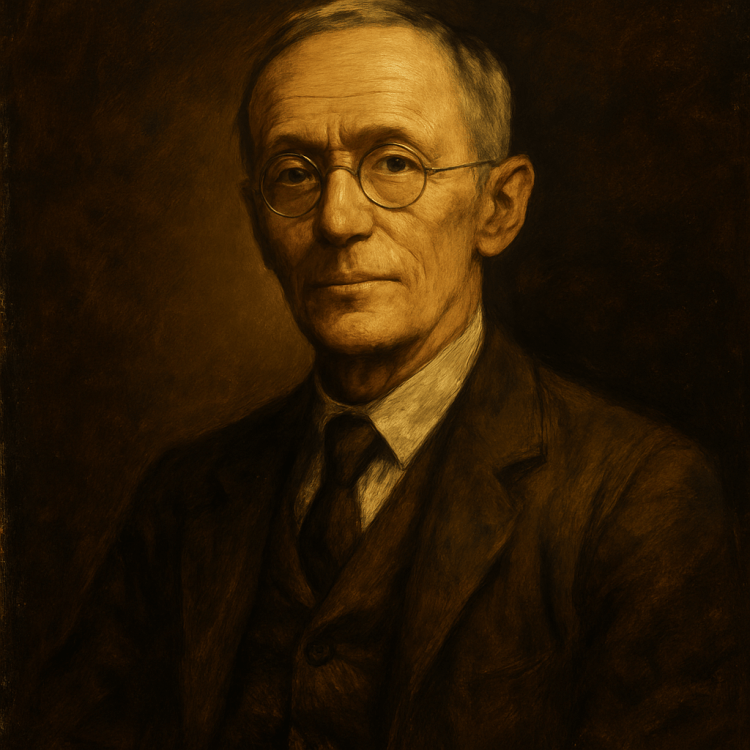
Hermann Hesse (1877–1962) was one of the twentieth century’s most influential literary figures, a seeker whose novels became guideposts for millions navigating the crises of modernity. Born in Calw, in the Black Forest of Germany, Hesse was the son of Christian missionaries. His childhood was steeped in pietism and biblical devotion, but also in conflict—he struggled against the rigidity of his family’s expectations and endured mental health crises that shaped his outlook. When I read many of his books, there were two recurring personal notes in his diaries: he had bad eyesight and complained about how much his eyes hurt. He also traded letters with friends that include small water paintings sent and received. Those pictures seemed to be pleasing to Hesse. If you start seeing pictures (with the help of AI), my motivation comes from Mr. Hesse. LFM


Herman Hesse

For Hesse, writing was both therapy and spiritual exploration. His early novels reflected the tensions of his life: the desire for freedom against the weight of tradition, the search for authenticity in a rapidly industrializing world.

  • In Demian (1919), Hesse explored inner duality, freedom, and the necessity of self-discovery beyond societal norms.
  • In Siddhartha (1922), he imagined a man’s journey to enlightenment in ancient India, fusing Western existential doubt with Eastern philosophy.
  • In Steppenwolf (1927), he dramatized the loneliness of the modern intellectual and the quest for transcendence amid despair.
  • In The Glass Bead Game (1943), his Nobel Prize–winning masterpiece, he conjured a future order devoted to the synthesis of knowledge, beauty, and spirituality.

Amid these great novels stands a shorter but profoundly symbolic tale: The Journey to the East (1932). Though brief, it contains one of Hesse’s most enduring insights—leadership is not power, but service.


II. The Journey to the East: The Servant and the Master

The novella tells the story of a secret brotherhood called the League, a timeless spiritual fellowship that undertakes a pilgrimage “to the East.” The East is never fully defined—it is both place and symbol, representing wisdom, transcendence, and the fulfillment of human longing.

The narrator, H.H., joins the League’s pilgrimage. Along the way he describes a mysterious assortment of travelers: historical figures, literary characters, and seekers from all walks of life. The journey unites them in pursuit of a higher goal.


Leo

Yet the true heart of the story is a man named Leo. Leo appears to be nothing more than a cheerful servant. He tends to the pilgrims, carries their bags, prepares their meals, and sings songs that lift their spirits. He is ordinary, unnoticed—yet indispensable.

Then one day Leo disappears. Without him, the pilgrims falter. Discord and division creep in, and the League dissolves. H.H. falls into despair, convinced the journey has failed.

Years later, in a twist of revelation, H.H. learns the truth: Leo was not simply a servant. He was in fact a leader of the League, the embodiment of the very wisdom the pilgrims were seeking. The pilgrimage fell apart because the group failed to recognize that true leadership had been in their midst all along.

Hesse’s parable is at once mystical and practical: it insists that authentic leadership flows not from domination but from humble service. In the inversion of roles—servant as master, master as servant—Hesse revealed a paradox at the heart of human community.


Greenleaf

III. Robert Greenleaf and the Birth of Servant Leadership

Decades later, in the United States, Robert K. Greenleaf (1904–1990), an executive at AT&T, was searching for a new way to understand leadership. He had witnessed firsthand how corporate hierarchies often crushed initiative, fostered fear, and alienated workers. After 40 years in management, he turned to teaching and writing, determined to challenge the prevailing model of top-down authority.

In the 1950s, Greenleaf read The Journey to the East, and Leo’s example struck him like lightning. Here was the vision he had been seeking: the leader is great not because of command but because of service. Out of this insight, he developed the philosophy he called servant leadership.

In his seminal 1970 essay, The Servant as Leader, Greenleaf wrote:

“The servant-leader is servant first… It begins with the natural feeling that one wants to serve, to serve first. Then conscious choice brings one to aspire to lead. The difference manifests itself in the care taken to make sure that other people’s highest priority needs are being served.”

Greenleaf’s framework reshaped modern leadership thinking. He identified qualities that distinguish servant leaders:

  • Listening and Empathy – Understanding others deeply before acting.
  • Awareness and Foresight – Seeing beyond immediate demands to future consequences.
  • Healing and Stewardship – Caring for individuals and institutions as trust, not possessions.
  • Commitment to Growth – Helping others become wiser, healthier, and freer.
  • Building Community – Nurturing belonging, not simply extracting productivity.

Unlike traditional leadership, which seeks power to direct, servant leadership seeks responsibility to care. Greenleaf insisted that the true test of leadership was not organizational success but human flourishing: “Do those served grow as persons?”


IV. Servant Leadership in Today’s World

Although Greenleaf’s vision emerged from corporate disillusionment, servant leadership has spread far beyond the boardroom. Its influence can be traced across diverse spheres today:

1. Faith-Based Institutions

  • Many Christian organizations and seminaries explicitly teach servant leadership, grounding it in the life of Jesus.
  • Pope Francis has often invoked its spirit, urging leaders to be “shepherds who smell of the sheep.”
  • Evangelical colleges and Catholic universities alike offer leadership courses built around Greenleaf’s principles.

2. Education

  • Universities such as Gonzaga, Indiana Wesleyan, and Regent have made servant leadership central to their leadership programs.
  • In secular contexts, “inclusive leadership” and “transformational leadership” often echo servant leadership’s core values of empathy and empowerment.

3. Healthcare and Caring Professions

  • Hospitals and nursing schools apply servant leadership to patient-centered care.
  • Nursing theory highlights Greenleaf’s ideas of empathy and stewardship as essential to healing.
  • Systems like Cleveland Clinic and Mayo Clinic promote leadership cultures rooted in service.

4. Nonprofits and Social Enterprises

  • Global NGOs like Habitat for Humanity and World Vision emphasize leadership through service to the vulnerable.
  • Social entrepreneurs adopt servant leadership as a model for organizations aimed at social good.

5. Business

  • Southwest Airlines and TDIndustries are classic case studies of servant leadership cultures in practice.
  • The rise of “conscious capitalism” and stakeholder-driven business models reflects a growing embrace of servant-leadership values.

6. Military and Public Service

  • Though hierarchical, parts of the U.S. military stress servant leadership: officers as stewards of their soldiers’ welfare.
  • Police and fire departments in some communities incorporate the philosophy for community trust.

7. Global Reach

  • In Africa, servant leadership resonates with Ubuntu (“I am because we are”), highlighting shared humanity.
  • In Asia, it has influenced leadership practices in Singapore and the Philippines, where communal values are strong.
  • In Scandinavia, egalitarian management structures mirror Greenleaf’s call for humility and shared responsibility.

In today’s world of political polarization, corporate scandals, and institutional mistrust, servant leadership remains both countercultural and urgently relevant. Where command-and-control leadership often falters, servant leadership builds trust, resilience, and long-term sustainability.


V. Conclusion: The Servant as the True Leader

Hermann Hesse, writing in a fractured Europe, offered a parable of a servant who was secretly a master. Robert Greenleaf, confronting the failures of mid-century corporate America, found in that story the spark for a radical rethinking of leadership.

Together, they remind us that the deepest authority is not rooted in command but in service. Leadership is not the pursuit of followers but the care of souls. Institutions endure not because of power structures but because of communities sustained by humility, empathy, and stewardship.

In an age that often celebrates strength as dominance, Hesse and Greenleaf point to another way: that the one who carries the bags may in fact be the one who carries the truth.

Acts 21 – Expository Study (NIV)


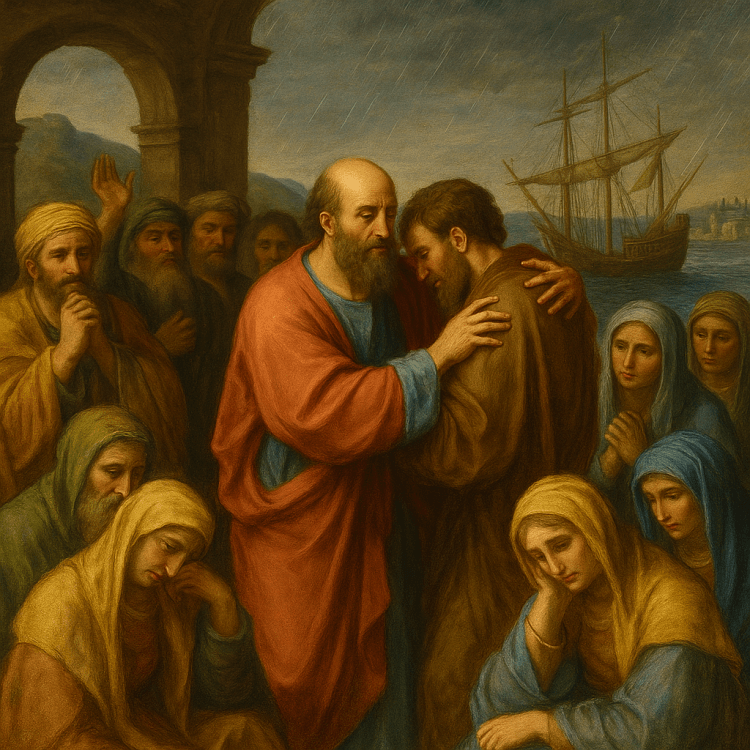
🔹 Section 1: Paul Travels Toward Jerusalem (Verses 1–16)

Summary
Paul continues his journey from Miletus toward Jerusalem, stopping in several cities where believers urge him not to go due to prophetic warnings of suffering. Despite this, Paul remains determined. At Caesarea, the prophet Agabus vividly predicts Paul’s arrest by binding himself with Paul’s belt. The local disciples and Paul’s companions plead with him to reconsider, but Paul insists he is ready not only to be bound, but even to die for the name of the Lord Jesus. The group ultimately surrenders to the will of the Lord.


📜 NIV Text – Acts 21:1–16

1 After we had torn ourselves away from them, we put out to sea and sailed straight to Cos. The next day we went to Rhodes and from there to Patara.
2 We found a ship crossing over to Phoenicia, went on board and set sail.
3 After sighting Cyprus and passing to the south of it, we sailed on to Syria. We landed at Tyre, where our ship was to unload its cargo.
4 We sought out the disciples there and stayed with them seven days. Through the Spirit they urged Paul not to go on to Jerusalem.
5 When it was time to leave, we left and continued on our way. All of them, including wives and children, accompanied us out of the city, and there on the beach we knelt to pray.
6 After saying goodbye to each other, we went aboard the ship, and they returned home.
7 We continued our voyage from Tyre and landed at Ptolemais, where we greeted the brothers and sisters and stayed with them for a day.
8 Leaving the next day, we reached Caesarea and stayed at the house of Philip the evangelist, one of the Seven.
9 He had four unmarried daughters who prophesied.
10 After we had been there a number of days, a prophet named Agabus came down from Judea.
11 Coming over to us, he took Paul’s belt, tied his own hands and feet with it and said, “The Holy Spirit says, ‘In this way the Jewish leaders in Jerusalem will bind the owner of this belt and will hand him over to the Gentiles.’”
12 When we heard this, we and the people there pleaded with Paul not to go up to Jerusalem.
13 Then Paul answered, “Why are you weeping and breaking my heart? I am ready not only to be bound, but also to die in Jerusalem for the name of the Lord Jesus.”
14 When he would not be dissuaded, we gave up and said, “The Lord’s will be done.”
15 After this, we started on our way up to Jerusalem.
16 Some of the disciples from Caesarea accompanied us and brought us to the home of Mnason, where we were to stay. He was a man from Cyprus and one of the early disciples.

Questions & Answers

  1. Why did believers along the way urge Paul not to go to Jerusalem?
    ➤ Through the Spirit, they sensed danger awaited Paul and expressed human concern. Their plea wasn’t disobedient but protective.
  2. How does Paul respond to these warnings?
    ➤ Paul remains resolute. He interprets the warnings not as detours, but as confirmations of what God had already told him.
  3. What does this teach about discernment and obedience?
    ➤ The Spirit may reveal future suffering, but courage and calling often require enduring it. True obedience surrenders to God’s will, even when it’s costly.

🔹 Section 2: Paul Arrested in the Temple (Verses 17–36)

Summary
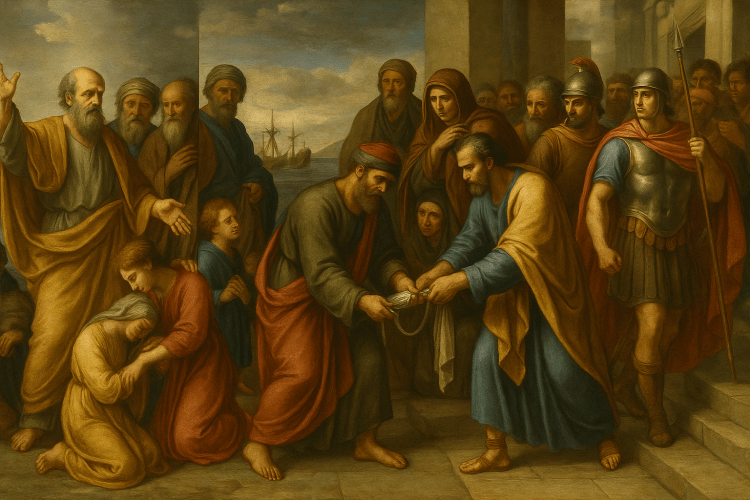
Upon arriving in Jerusalem, Paul meets with James and the elders. They rejoice in Paul’s missionary work but express concern about rumors that Paul teaches Jews to abandon the Law. To counter this, they advise Paul to participate in a purification rite with four men. Paul complies, but while in the temple, some Jews from Asia stir up a crowd by falsely accusing him of defiling the temple. The city erupts in chaos. Paul is seized, beaten, and nearly killed before Roman soldiers intervene. The commander arrests Paul and tries to determine what he has done.

📜 NIV Text – Acts 21:17–36

17 When we arrived at Jerusalem, the brothers and sisters received us warmly.
18 The next day Paul and the rest of us went to see James, and all the elders were present.
19 Paul greeted them and reported in detail what God had done among the Gentiles through his ministry.
20 When they heard this, they praised God. Then they said to Paul: “You see, brother, how many thousands of Jews have believed, and all of them are zealous for the law.
21 They have been informed that you teach all the Jews who live among the Gentiles to turn away from Moses, telling them not to circumcise their children or live according to our customs.
22 What shall we do? They will certainly hear that you have come,
23 so do what we tell you. There are four men with us who have made a vow.
24 Take these men, join in their purification rites and pay their expenses, so that they can have their heads shaved. Then everyone will know there is no truth in these reports about you, but that you yourself are living in obedience to the law.
25 As for the Gentile believers, we have written to them our decision that they should abstain from food sacrificed to idols, from blood, from the meat of strangled animals and from sexual immorality.”
26 The next day Paul took the men and purified himself along with them. Then he went to the temple to give notice of the date when the days of purification would end and the offering would be made for each of them.
27 When the seven days were nearly over, some Jews from the province of Asia saw Paul at the temple. They stirred up the whole crowd and seized him,
28 shouting, “Fellow Israelites, help us! This is the man who teaches everyone everywhere against our people and our law and this place. And besides, he has brought Greeks into the temple and defiled this holy place.”
29 (They had previously seen Trophimus the Ephesian in the city with Paul and assumed that Paul had brought him into the temple.)
30 The whole city was aroused, and the people came running from all directions. Seizing Paul, they dragged him from the temple, and immediately the gates were shut.
31 While they were trying to kill him, news reached the commander of the Roman troops that the whole city of Jerusalem was in an uproar.
32 He at once took some officers and soldiers and ran down to the crowd. When the rioters saw the commander and his soldiers, they stopped beating Paul.
33 The commander came up and arrested him and ordered him to be bound with two chains. Then he asked who he was and what he had done.
34 Some in the crowd shouted one thing and some another, and since the commander could not get at the truth because of the uproar, he ordered that Paul be taken into the barracks.
35 When Paul reached the steps, the violence of the mob was so great he had to be carried by the soldiers.
36 The crowd that followed kept shouting, “Get rid of him!”

Questions & Answers

  1. Why does Paul agree to participate in a purification ritual?
    ➤ To demonstrate goodwill and to dispel false rumors about his disregard for the Law, showing he respects Jewish customs for the sake of unity.
  2. What does the crowd falsely accuse Paul of?
    ➤ They claim he brought Gentiles into the temple and teaches against the Jewish people and Law, none of which is true.
  3. How is Paul rescued from death?
    ➤ Roman soldiers intervene just in time, showing how God uses even secular powers to protect His servants.


🔹 Section 3: Paul Speaks to the Commander and the Crowd (Verses 37–40)

Summary
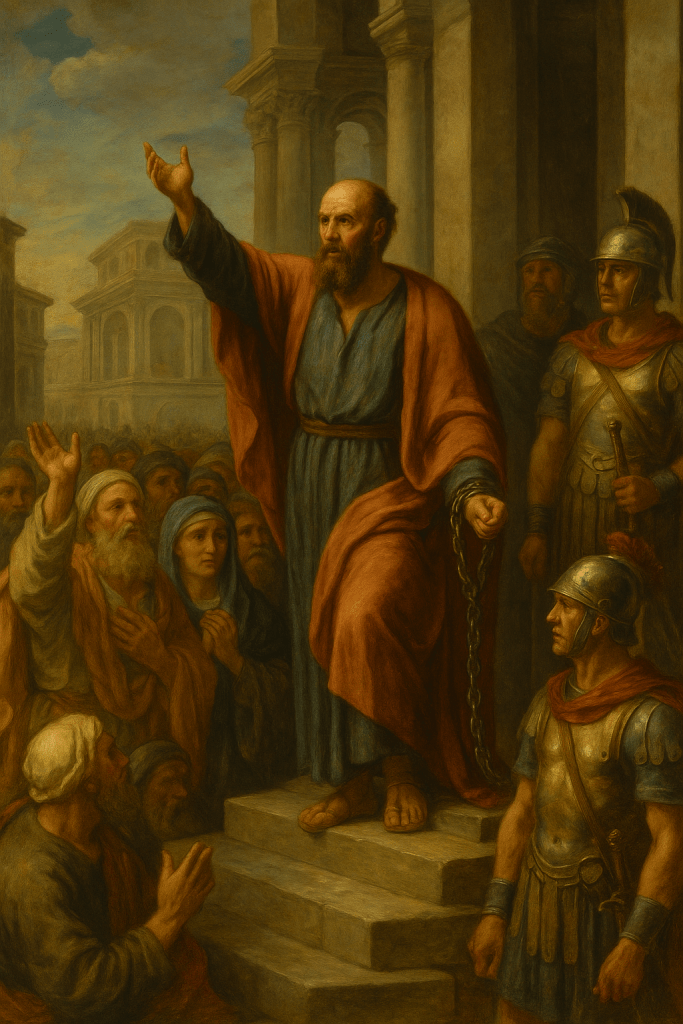
As Paul is about to be taken into the barracks, he asks the Roman commander for permission to speak. The commander is surprised Paul speaks Greek and initially thinks Paul is the Egyptian rebel who led a revolt. Paul identifies himself as a Jew from Tarsus and requests to address the crowd. Standing on the steps, Paul motions for silence and prepares to speak to the hostile crowd in their own language.

📜 NIV Text – Acts 21:37–40

37 As the soldiers were about to take Paul into the barracks, he asked the commander, “May I say something to you?”
“Do you speak Greek?” he replied.
38 “Aren’t you the Egyptian who started a revolt and led four thousand terrorists out into the wilderness some time ago?”
39 Paul answered, “I am a Jew, from Tarsus in Cilicia, a citizen of no ordinary city. Please let me speak to the people.”
40 After receiving the commander’s permission, Paul stood on the steps and motioned to the crowd. When they were all silent, he said to them in Aramaic:

Questions & Answers

  1. Why does the commander mistake Paul for an Egyptian rebel?
    ➤ The city was in chaos, and Paul had been seized by a mob. The commander assumes he is a dangerous agitator without verifying facts.
  2. Why does Paul emphasize his identity and citizenship?
    ➤ Paul uses wisdom. His background (Tarsus, a major Roman city) grants him legal and rhetorical credibility.
  3. Why is it significant that Paul speaks in Aramaic?
    ➤ He speaks the crowd’s native tongue to connect with them culturally and spiritually. It’s a strategic act of empathy and persuasion.

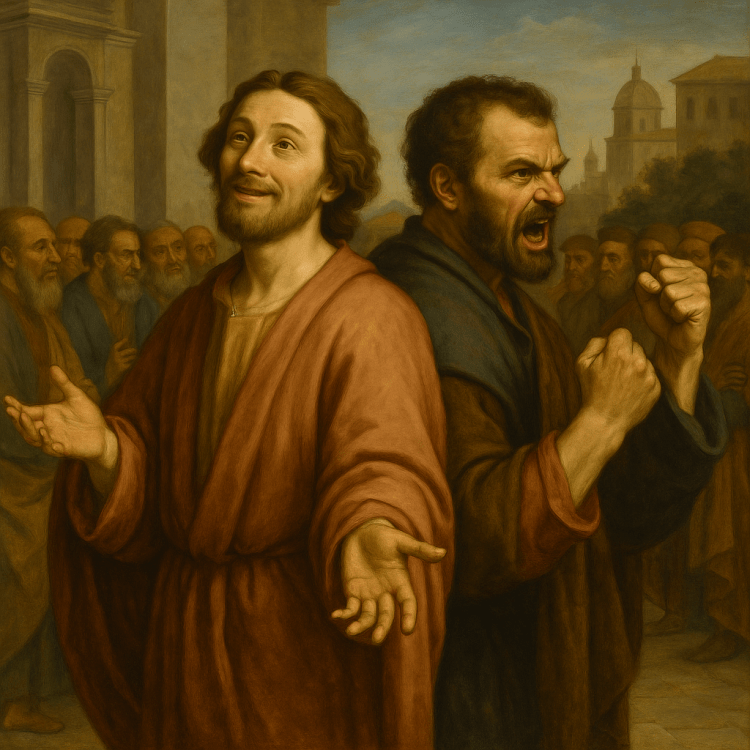
🎭 Poetic Dialogue: Winds Before the Chains

Agabus (the prophet):
The belt you wear will bind your hands—
The Spirit spoke; the crowd commands.
Yet still you walk into the flame,
To suffer loss for Jesus’ name.

Paul:
You break my heart with honest tears,
But greater still is love than fear.
I go not blind, but bold and free—
To preach the Christ who died for me.

Disciples (in sorrow):
We tried to shield you from the blow,
But now we bow and let you go.
Let God decide what must be done,
And bring you home when race is run.

The Commander (confused):
I thought you stirred the rebel flame,
But now you plead in wisdom’s name.
Who are you, man of grief and grace?
Why do they strike you in this place?

The Lord (above all):
My servant speaks before the throne,
He stands though bruised, yet not alone.
This path will pass through chains and rod—
But ends with joy and rest in God.

History vs. Heritage Are Two Different Things

This essay did not begin in isolation. It is the product of a long friendship and professional journey with my colleague and friend of 45 years, Dan Johnson. Dan is a retired city manager whose career I followed closely from start to finish. Though he often insists that I have been something of a mentor to him, being nearly eight years his senior, I have long considered him one of my most outstanding mentors.

Dan is unusually gifted: bright, articulate, persuasive, and approachable. He earned his undergraduate degree at a liberal arts school (Austin College) before completing a Master of Public Administration (UNT). Those experiences shaped his mind into a rare blend of philosophy and pragmatism. He thinks differently than most—able to reflect deeply on ideas while also commanding numbers, budgets, and analytics with clarity.


Dan & Lewis

This essay reflects the influence of his way of thinking. It was born from our conversations, his insights, and the questions he raises about how we remember the past. While I take responsibility for shaping and editing the writing, the heart of this piece owes so much to him. Dan is more than a co-writer in spirit—he is the spark that brought these ideas to life.

What follows, then, is not just an intellectual exploration. It is also a tribute to the kind of mentoring friendship that spans decades. Together we wrestled with how societies record events (history) and how they preserve meaning (heritage). Out of that dialogue came this essay, which I now offer with both gratitude and humility.


History: Chronos and the Record of Events

History lives in chronos, the measured unfolding of time. It examines cause and effect, documents and data, victories and failures. This approach often feels detached or clinical. A history textbook might describe the Great Depression in terms of unemployment rates and legislative acts, but not the emotions of the families who lived through it.

Yet this precision is valuable. By stripping away bias, history protects against myth and distortion. In the secular world, this means confronting injustices such as slavery, colonial exploitation, or political corruption. In the biblical world, this meant preserving accurate accounts of Israel’s rebellion as well as its faithfulness. As Ecclesiastes reminds us, “For everything there is a season, and a time for every matter under heaven” (Ecclesiastes 3:1). History shows us those seasons with clarity.


Heritage: Kairos and the Power of Memory

Heritage lives in kairos—the meaningful, sacred moments (the aha moment of the prodigal son) that transcend mere sequence. It is less about what happened and more about what still matters. Heritage is the story told at a family table, the song sung on a national holiday, the heirloom preserved with reverence.

For secular society, heritage might mean fireworks on Independence Day, memorial ceremonies at Ground Zero, or festivals that preserve immigrant traditions. These moments are powerful because they stir emotion—pride, grief, gratitude, belonging.

Scripture also emphasizes heritage. God commanded Israel to remember His works not only with words but with rituals and symbols. Joshua set up twelve stones by the Jordan so that when future generations asked, “What do those stones mean to you?” the story of God’s deliverance would be told (Joshua 4:6–7). In the church, Communion is heritage as well as history—“Do this in remembrance of me” (1 Corinthians 11:24).


Individual and Collective Memory

History often surveys nations and systems; heritage lives closer to home. For a historian, immigration may be a set of numbers. For a family, it is a recipe, a language, a story of survival. Both are true, but they speak differently.

Psalm 78 reminds us, “We will tell the next generation the praiseworthy deeds of the Lord.” Secular society echoes this impulse when it says, “Never forget” after national tragedy. Whether sacred or secular, heritage moves us beyond knowledge to identity.


Risks on Both Sides

Neither history nor heritage is sufficient on its own.

  • History without heritage risks being lifeless. Facts alone rarely inspire sacrifice or unity. A society that only analyzes but never remembers can grow cynical or rootless.
  • Heritage without history risks distortion. Pride and nostalgia can drift into myth, or worse, propaganda. Jesus warned against traditions that obscure truth (Matthew 15:6). In secular life, we see this when heritage clings to symbols without acknowledging the injustices tied to them.

Both truth and meaning are needed.


Chronos and Kairos Together

The ancient categories of time help explain this balance. Chronos is measured, sequential time—where history operates. Kairos is meaningful, appointed time—where heritage thrives. Secular societies and faith communities alike need both.

  • Chronos ensures we know what happened.
  • Kairos ensures we feel why it matters.

Germany’s reckoning with the Holocaust illustrates this balance. History preserved the sterile record—dates, numbers, documents. Heritage shaped memorials, ceremonies, and vows of “Never Again.” Without one, memory would be incomplete.


Bridging for Today

The healthiest societies, whether secular or religious, integrate both.

  • Education should combine historical facts with heritage storytelling, so students not only learn but also connect.
  • Memorials should preserve accurate history while also stirring reverence. A wall engraved with names is history; the silence of those who stand before it is heritage.
  • Families and churches should preserve both genealogies (history) and testimonies (heritage), ensuring truth and meaning pass together from generation to generation.

Reverence as the Key to Balance

Reverence is the posture that unites history and heritage. It is more than respect; it is a deep humility before the weight of memory. Reverence does not strip away facts, but it refuses to treat them as dry data. It does not idolize tradition, but it cherishes it with gratitude.

Reverence is what makes a classroom moment of silence powerful. It is what causes a museum visitor to lower their voice instinctively. It is what compels families to handle an heirloom carefully or churches to guard their sacraments with solemnity. Reverence bridges the gap between head and heart.

Without reverence, history becomes cold, reduced to statistics on a page. Without reverence, heritage becomes sentimentality or even manipulation. But when reverence surrounds both, truth gains depth, and memory gains integrity. Reverence allows us to honor both the accuracy of history and the meaning of heritage without confusing the two.


Case Study: Jericho as History and Heritage

Few places capture the interplay of history and heritage as vividly as Jericho.

History (Chronos)
Archaeologically, Jericho is one of the oldest inhabited cities in the world. Excavations at Tell es-Sultan reveal settlement layers stretching back 10,000 years, including stone fortifications and one of the earliest known towers. Modern historians can date, map, and measure its ancient walls and subsequent occupations by empires ranging from Canaanite to Roman to Islamic. This is history in its most ordered form—facts, chronology, and evidence preserved across millennia.

Heritage (Kairos)
For Jews and Christians, however, Jericho is more than stratigraphy. It is the city where God gave Israel victory, where walls fell not by human strength but by obedience and faith. That story is heritage—retold in sermons, children’s lessons, pilgrimages, and songs. In the New Testament, Jericho also becomes the setting where Zacchaeus climbed the sycamore tree to see Jesus, a moment that has been remembered not just as fact but as a symbol of personal transformation. Heritage makes Jericho alive with meaning long after the stones themselves have crumbled.

Reverence
Reverence ties these together. Visitors lower their voices at Tell es-Sultan, not just because of history, but because of what the site represents. Pilgrims stand in awe before the sycamore tree or ride the cable car up to the Mount of Temptation. Reverence prevents history from being reduced to ruins, and it prevents heritage from slipping into sentimentality. It anchors both truth and memory in humility before something greater.

Governance and Culture Over Time
Jericho also illustrates how governance and culture can change while heritage persists. Over its long history, Jericho has been ruled by Canaanite kings, Israelite tribes, Persians, Greeks, Romans, Byzantines, Muslim caliphates, Crusaders, Ottomans, the British, Jordanians, and now the Palestinian Authority. Its culture shifted accordingly—from Canaanite religion to Israelite worship, Byzantine Christianity, Islamic traditions, and today’s Palestinian Arab identity. Yet through all these changes, Jericho remained a living settlement, famed for its oasis agriculture and symbolic meaning. Its continuity as one of the world’s oldest inhabited cities shows how history records change while heritage preserves significance.

Jericho Today
Modern Jericho is a Palestinian city of about 20,000 people in the West Bank. It is both an archaeological site of global importance—now UNESCO-listed—and a living community with markets, schools, and festivals. It stands as a meeting point of history’s chronos and heritage’s kairos, where the past is carefully studied and yet continually re-experienced.


Conclusion

“History vs. Heritage are two different things.” History is truth-seeking, analytical, rooted in chronos. Heritage is meaning-making, emotional, rooted in kairos. History without heritage becomes detached; heritage without history becomes distorted. Together, they give us memory that is accurate and alive.

For the Christian, this balance echoes God’s call to remember His mighty acts with both truth and love. For the secular world, it reflects the need to learn from facts while also cherishing identity. In both, the lesson is the same: we must carry forward the past with clarity of mind and depth of heart.

Justice at the City Gate: The Bible’s Model for Civic Leadership

Introduction: The City Gate as Civic Heart

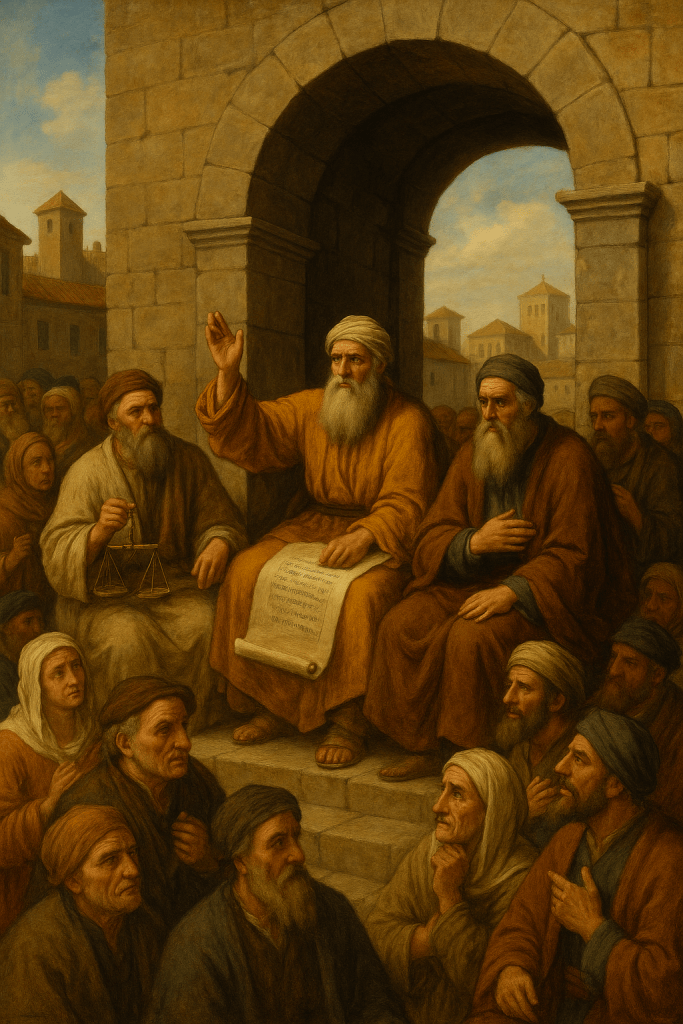
In the ancient world, the city gate was more than a stone arch or wooden doors. It was the civic, social, and spiritual heart of the community. Here trade was conducted, disputes were resolved, leaders rendered decisions, and prophets raised their voices. In Ruth 4:1–2, Boaz sealed his redemption of Ruth at the city gate before witnesses. In Jeremiah 17:19–20, the prophet was commanded to proclaim God’s word at the gates of Jerusalem. Kings themselves often received news and judged cases at the gate (2 Samuel 18:24).


The gate symbolized more than access—it symbolized justice, accountability, and leadership. It was the visible intersection of daily life and divine law. To uphold justice at the gate was to keep a city strong; to allow corruption at the gate was to invite decay.

Today, while we no longer gather at fortified gates, our societies still have civic spaces—councils, courts, and public forums—where truth must be spoken and justice upheld. The biblical model offers timeless lessons for leaders and citizens alike.


Biblical Vision of Justice at the Gate

The Old Testament consistently emphasizes the link between justice and the gate:

  • Ruth 4:1–2 — Boaz redeems Ruth at the gate, before the elders. Justice is made public and accountable.
  • Deuteronomy 21:18–21 — Difficult family cases were brought to the elders at the gate. The community upheld standards openly.
  • Proverbs 31:23 — The noble woman’s husband is known at the gates, sitting among respected leaders.
  • Amos 5:12, 15 — The prophet condemns those who oppress the poor and take bribes at the gate, calling instead to “Hate evil, love good; maintain justice in the courts.”

Justice at the gate was not abstract philosophy. It was visible, daily, and local. It ensured that decisions were made before witnesses, that leaders were accountable to their people, and that God’s law was upheld in plain sight.


Historical Parallels: Public Squares Through the Ages

The civic gate in Israel parallels many other traditions:

  • Greek Agora & Areopagus: Open-air marketplaces where trade mingled with debate. At the Areopagus in Athens (Acts 17), Paul proclaimed the gospel, demonstrating how truth entered the civic square.
  • Roman Forum: A bustling center of speeches, trials, and decrees—visible governance rather than hidden chambers.
  • Medieval Town Halls: Citizens gathered in open assemblies to make decisions and hold rulers accountable.
  • American Town Halls: Early New England communities continued this biblical pattern of public, local, accountable governance.

Each of these models affirms the principle: justice thrives in the open and fails when hidden.


Christian and Conservative Reflections

Theologically, justice at the gate reflects God’s character. He is righteous, impartial, and merciful. Leaders are stewards of His justice, accountable to Him as much as to their people.

From a conservative viewpoint, the gate represents subsidiarity—the principle that decisions should be made at the lowest competent level, closest to the people affected. Local responsibility preserves accountability and resists the overreach of distant power. Just as the gate kept decisions grounded in daily life, so too should modern governance empower local families, churches, and councils.

When leadership drifts from the gate—when decisions are hidden in bureaucracies or swayed by special interests—the vulnerable suffer first. The widow, the orphan, and the foreigner—so often named in Scripture—lose their advocates. To restore justice at the gate is to restore confidence in society itself.


Modern “City Gates”

What are the equivalents today?

  • City Councils and Courthouses: Our literal gates where ordinances, budgets, and verdicts shape daily life. Citizens must engage, not retreat, if justice is to remain upright.
  • Media Platforms: Though virtual, they shape public thought. Like the gates of old, they are places of influence, yet vulnerable to manipulation.
  • Churches and Families: The first gates of moral formation. If these falter, corruption soon seeps into public life.

The prophets’ words echo still: “Let justice roll on like a river, righteousness like a never-failing stream!” (Amos 5:24).


Responsibilities of Leaders and Citizens

  • For Leaders: Uphold impartiality, refuse bribery, defend the weak, and ensure decisions are made openly. Insist on civility – more than demonstration – a change in the heart.
  • For Citizens: Engage the gate. Speak truth, vote responsibly, serve in local roles, and refuse cynicism. Accept the call to genuine civility. Silence allows injustice to thrive.

Like Paul in Athens, Christians must enter the gate—whether physical council chambers or digital platforms—with both courage and humility, speaking truth in love but refusing compromise with corruption.


Reflection Questions

  1. What are the “gates” in your community where justice is shaped?
  2. Do you see signs of accountability or corruption at these gates?
  3. How can you and your family engage more intentionally at these civic gates?
  4. In what ways does your church help form values that influence public life?
  5. How can local governance reflect both biblical justice and conservative principles of accountability and subsidiarity?

Conclusion: Restoring Justice at the Gate

The city gate was never just architecture. It was the place where truth was tested, justice was upheld, and leaders proved their worth. When justice ruled there, the city flourished. When injustice crept in, prophets cried out, and judgment soon followed.

Our communities today need leaders who will guard the gates with integrity—and citizens who will not abandon their responsibility to watch, question, and participate. Justice at the gate is justice in the light, where truth cannot hide and power must answer to principle.

If nations are to endure, their gates must once again be strong. For it is at the gate, before the people and before God, that societies reveal their true character.

The Weight of Words: When Speech Shapes Destiny

Introduction

From the opening chapters of Scripture, words hold power. God spoke creation into being: “And God said, ‘Let there be light,’ and there was light” (Genesis 1:3). The entire cosmos came into existence not by hammer or flame, but by a word. That same pattern continues throughout the biblical story—words bless, words curse, words bind, words heal.

Proverbs teaches: “Death and life are in the power of the tongue” (Proverbs 18:21). James calls the tongue “a restless evil, full of deadly poison” (James 3:8). Jesus warned, “By your words you will be acquitted, and by your words you will be condemned” (Matthew 12:37). In short, words are never neutral. They carry eternal weight.

In our age of microphones, cameras, podcasts, and viral clips, words travel faster and linger longer than at any point in history. The responsibility to use them wisely has never been greater.


Words in Scripture: Creation, Covenant, and Consequence

The Bible presents a consistent theology of speech:

  • Creation: God’s voice orders chaos into cosmos. His Word is life.
  • Covenant: God binds His people through words—promises, commands, blessings. At Sinai, the Ten Commandments were not just laws but rather the terms of a covenant relationship.
  • Consequence: Misuse of words brings judgment. The serpent’s lie in Eden unleashed sin. The Tower of Babel scattered humanity through the confusion of language. James compares the tongue to a spark that can ignite a forest fire.

Speech reveals the heart. What we say cannot be detached from who we are. When Christians speak, we bear witness—either faithfully or unfaithfully—to the One whose Word is truth.


The Double-Edged Sword of Rhetoric

Speech directs thought, shapes culture, and determines destiny.

Examples of Life-Giving Speech:

  • Winston Churchill’s wartime speeches gave hope when Britain stood alone against Nazi aggression.
  • Martin Luther King Jr.’s “I Have a Dream” speech elevated America’s conscience and called a nation to live up to its founding ideals.
  • Ronald Reagan’s speeches framed freedom as a moral calling and helped inspire the end of the Cold War.

Examples of Destructive Speech:

  • Adolf Hitler rose to power not through military might but through rhetoric that stirred resentment, fear, and blind loyalty.
  • Communist regimes perfected propaganda—lies repeated until they reshaped whole nations.
  • Today, misinformation spreads across the internet, dividing families, communities, and even churches.

Speech is a double-edged sword. It can build a nation or tear it apart. It can lead souls to God or away from Him.


The Christian Call to Speech

Christians are not free to use words carelessly. Paul exhorts believers: “Let your conversation be always full of grace, seasoned with salt, so that you may know how to answer everyone” (Colossians 4:6).

Key principles for Christian speech:

  • Truth: Our words must align with God’s Word, not with convenience or fear.
  • Grace: Even when confronting error, speech should aim to restore, not merely to win.
  • Courage: Silence in the face of evil can be as destructive as outright lies.
  • Order: Freedom of speech is a gift that requires responsibility. Christian liberty does not mean license to slander or manipulate.

The Political Call to Responsible Speech

Healthy republics depend on honest, principled speech just as the church depends on truthful proclamation. In a democracy, rhetoric is the bloodstream of self-government. Campaigns, debates, editorials, and legislative arguments all shape the direction of policy and the trust of citizens.

  • Honesty: Political speech should inform rather than manipulate. Without truth, public trust erodes.
  • Civility: Sharp disagreement is necessary in free societies, but respect must remain.
  • Accountability: Leaders must remember that promises are words, and broken promises corrode confidence in institutions.
  • Restraint: Free speech must be exercised with discipline—slander, exaggeration, and reckless accusations undermine liberty rather than protect it.

From a conservative perspective, the Founders understood this well. They enshrined free speech in the First Amendment not to encourage recklessness but to secure a space for truth, conscience, and accountability. The survival of liberty rests not only on what is said but how it is said.


Words in the Digital Square and the Areopagus

Today’s digital world multiplies the reach of speech. Tweets, podcasts, YouTube clips, and live streams have become the new “public square.” In biblical terms, it resembles the Areopagus of Athens—an open forum where thinkers, philosophers, and ordinary citizens gathered to debate ideas (see Acts 17:19–34).

When Paul stood at the Areopagus, he neither shrank back nor spoke recklessly. He engaged respectfully, quoting poets familiar to his audience, yet clearly proclaiming Christ as Lord. His model is instructive: engage culture on its own turf, but always direct the conversation back to truth.

Our digital Areopagus is chaotic—full of noise, competing voices, and sometimes hostility. Yet it remains a place where destinies are shaped daily by words. Christians and conservatives are called not to abandon it, but to enter it with wisdom, clarity, and courage.


Charlie Kirk and the Modern Rhetorical Arena

Figures like Charlie Kirk illustrate how modern rhetoric shapes culture. On college campuses, Kirk asks pointed questions that expose contradictions in progressive ideologies. His method—firm, articulate, unapologetic—shows the importance of confidence in public dialogue.

Yet his approach also raises questions. Strong rhetoric can embolden the like-minded but risk alienating opponents. The balance between conviction and persuasion, boldness and bridge-building, remains a challenge for all Christians engaging in public debate.

Kirk represents a broader principle: in a fragmented age, those willing to speak clearly and consistently often shape the direction of conversation. Silence cedes the field to others.


Reflection Questions

  1. Which words spoken to you—encouragements or criticisms—still shape your identity today?
  2. How do you test whether your speech reflects truth, grace, and responsibility?
  3. How can you use social media or digital platforms to build others up rather than tear them down?
  4. What examples of courageous, life-giving speech inspire you? How can you model them in your family, church, or community?
  5. Where are you tempted to remain silent when words of truth are most needed?
  6. In political conversations, do your words clarify truth and invite reasoned debate, or do they simply mimic the noise of partisanship?

Conclusion

Words are never weightless. They carry the power to create or destroy, to build up or to break down, to bless or to curse. Scripture reminds us that every careless word will be judged (Matthew 12:36). History testifies that nations rise and fall on the power of words. And our own lives bear the marks of things spoken long ago.

For Christians, the calling is to speak words of truth and grace that reflect Christ. For citizens, the calling is to speak responsibly, with honesty and civility, guarding the republic from the corruption of careless speech. In both spheres, the weight of words shapes destiny.

In a world drowning in noise, the faithful word—grounded in Scripture, shaped by love, disciplined by truth, and spoken with courage—can still change hearts and nations.


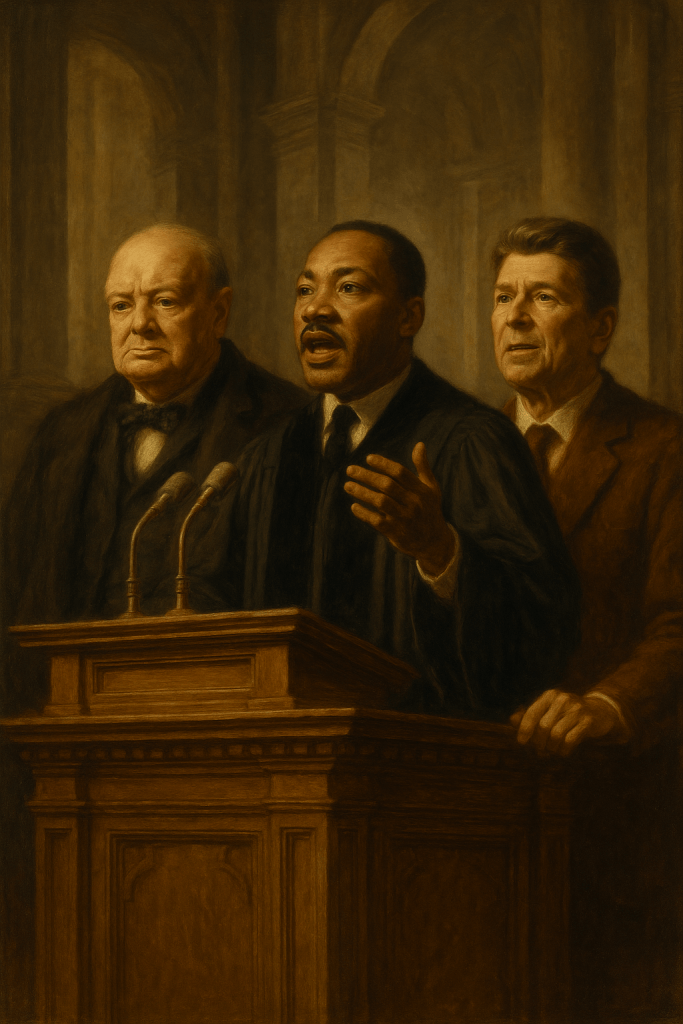
A Collaborative Plea: Churchill, King, and Reagan

Winston Churchill might thunder:
“In every age, civilization itself has hung upon the slender thread of speech. Words have been our armor and our rallying cry in the darkest hours. Let us, then, wield them with courage and precision—not as reckless shouts in the void, but as clarion calls to defend truth, freedom, and human dignity.”

Martin Luther King would then lift the vision higher:
“Yet words must be more than weapons. They must be instruments of justice and of love. A people divided by careless tongues cannot stand, but a people united by righteous speech can march together toward the Promised Land. Let us speak not only to win arguments but to awaken conscience, to stir compassion, to bend that long arc of the moral universe toward justice.”

Ronald Reagan would seal the appeal with hope:
“And let us never forget that words can light a candle in the darkest night. When spoken with faith and fidelity, they remind us that freedom is not fragile but enduring, because it rests upon truth. Let us speak in such a way that future generations say: here were men and women who did not waste their words, but used them to call a people back to God, back to courage, and back to hope.”


Closing Thought

Together, their voices would remind us: the weight of words is real. Spoken in fear, they can enslave. Spoken in truth and love, they can set a people free.

LFM Note: Even if I forgot to include. All of my posts of 2025 and beyond are collaborations between LFM and AI. While I am at it, please go to http://www.citybaseblog.net to see all of my posts in recent years.

The Porch Conversation

Scene: Two old friends, Harold and Frank, sit on a creaky porch, rocking chairs in rhythm. The cicadas are buzzing. Both are hard of hearing, but neither will admit it.


Harold: (leaning in) Frank, you remember the summer of ’62 when we went fishing down at Lake Benton?

Frank: (cupping his ear) What’s that? Went wishing for a baked ham?

Harold: (rolling his eyes) No, fishing at Lake Benton. We caught that big catfish.

Frank: (snapping his fingers) Ah, right! The cat. Scratched your leg something awful.

Harold: (sputtering) Not a cat! A catfish! In the lake!

Frank: (nodding, satisfied) Sure, sure. Mean old tabby. Always hung around the bakery.


Harold: (sighing) Anyway, that was the day you fell out of the boat.

Frank: (outraged) What? I never fell out of a coat! Fit me just fine!

Harold: The boat, Frank. You tipped the boat over!

Frank: (grinning proudly) Oh, yes, yes. That wool coat tipped me right over. Heavy as an ox in July.

Harold: (muttering) If you say so.


Frank: You still got those suspenders from that trip?

Harold: (perks up) Defenders? Oh, sure, I still believe in strong defense.

Frank: (shakes his head) Not defenders—suspenders! You hauled me out by ‘em. Nearly stretched to Kansas.

Harold: (snorts) And nearly pulled my back out too. You were kicking like a mule.

Frank: (offended) Mule? I never kissed a mule in my life!

Harold: (chuckling) Not kissing, kicking! You looked like you were swimming for the Olympics.

Frank: (relieved) Ah. Well. Good. Rumors get around in a small town.


Harold: Speaking of the town, you remember the county fair that year?

Frank: (nodding) Oh, yes, the one where you lost your hair.

Harold: (touching his bald head) My hair? I lost my hare—the rabbit race. Mine ran the wrong way.

Frank: (squints) Thought it looked fast. Shame it was made of fur.

Harold: (snorts) That’s not how races work, Frank.


Frank: What about the dance afterward? You asked Millie Thompson to waltz.

Harold: (confused) Waltz? I asked her to wash! Why would she wash me?

Frank: (grinning) She turned you down flat. Said you had two left feet.

Harold: No, no. She said I had two left boots! Mismatched shoes. Brand new, both for the left foot. Couldn’t hardly walk straight.

Frank: (laughing so hard he wheezes) And you tried to dance in ‘em! Looked like a turkey on stilts.


Harold: At least I tried. You were too scared to ask anyone.

Frank: (puffs his chest) Nonsense! I danced with Betty Lou.

Harold: (snorts) You danced with a barbecue?

Frank: Betty Lou, Harold! The preacher’s niece.

Harold: Ohhh. I thought you said brisket. Would’ve made more sense.


Frank: You remember our army days?

Harold: (smiling) Sure do. You were in the kitchen, peeling potatoes.

Frank: (confused) I was in the mission, stealing tomatoes?

Harold: (laughing) Well, that too probably.

Frank: (indignant) Hey now, I only borrowed them. They put ‘em back in the stew later.

Harold: (grinning) Yeah, after you ate half of ‘em raw.


Frank: You still go to church every Sunday?

Harold: (earnest) Oh yes, never missed a sermon. Pastor’s words keep me steady.

Frank: (nods) Same here. Those donuts in the foyer keep me ready.

Harold: (squints) Donuts? I said sermons!

Frank: (shrugs) Six of one, half dozen of the other.


Harold: You know, Frank, we remember things awfully different.

Frank: (smiling) Yep. That’s what keeps it interesting.

Harold: You ever wonder which of us has the story right?

Frank: (chuckles) Nope. I just assume it was better my way.

Harold: (laughing) Figures.

Frank: (leans back, sipping coffee) Harold, you and I may not hear so well anymore, but we still talk better than most folks do these days.

Harold: (nodding slowly) That’s the truth. Even if half of it’s wrong.


Epilogue: The Wives

(Inside the house, two women sit at the kitchen table drinking iced tea. They are listening to Harold and Frank through the open window as the old men keep rocking and swapping their muddled memories.)

Martha (Harold’s wife): (shaking her head) You hear those two out there? Harold’s got Frank falling out of boats again.

Evelyn (Frank’s wife): (rolling her eyes) Oh, I heard. If you ask Frank, he never even owned a boat. Said it was a heavy wool coat!

Martha: And the fair! Harold’s talking about losing rabbits. You and I both know he lost his paycheck at the ring toss.

Evelyn: (chuckling) And don’t get me started on Millie Thompson. Neither of them ever danced with her. She was too busy chasing the dentist’s boy.

Martha: (smiling wryly) Truth is, between the two of them, they couldn’t remember their own names without us.

Evelyn: (laughing) And yet, somehow, they think they’re the wise ones.

(The women clink their iced tea glasses, listening as Harold and Frank burst into laughter outside for no apparent reason.)

Martha: Let ‘em talk. Half of it’s wrong, but it keeps ‘em happy.

Evelyn: (nodding) And after fifty years, that’s what matters.

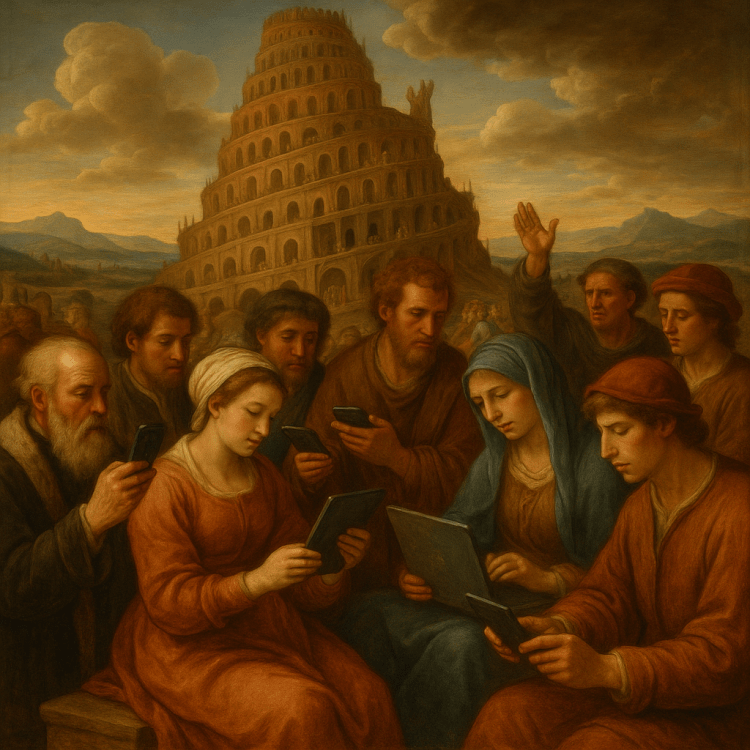
The Digital Babel Consideration

Introduction: The First Babel

In Genesis 11, after the flood, humanity gathered with one purpose. They said, “Come, let us build ourselves a city, with a tower that reaches to the heavens, so that we may make a name for ourselves and not be scattered over the face of the whole earth.” The Tower of Babel was more than stone—it was a symbol of human pride, a declaration of independence from God. In their unity, people sought security, identity, and glory apart from Him.


God’s response was measured and purposeful. Rather than destroy, He confused their language, (the source for our words like “babbling”) scattering them across the earth. His judgment was both a limit and a mercy. By dividing their speech, He prevented prideful ambition from becoming oppressive tyranny. The lesson of Babel is that human invention, when unmoored from God’s order, leads not to flourishing but to fragmentation.

Today, our “digital towers” look different. Instead of bricks, we use pixels. Instead of mortar, we use code. The internet, social media, and artificial intelligence represent extraordinary tools—capable of blessing families, spreading truth, and even carrying the gospel to the ends of the earth. Yet, like Babel, these same tools can be bent toward pride and self-exaltation. The challenge is not to reject technology, but to constrain it within God’s design for community, truth, and order.


The Promise of Technology

Before we critique, we must acknowledge the good. Technology has reunited families across oceans, put Scripture into nearly every language, and given churches the ability to reach far beyond their walls. Missionaries use smartphones for translation. Isolated believers stream services in real time. Local leaders connect with constituents directly.

From a conservative standpoint, technology also reflects innovation and opportunity—values that can strengthen free societies. Properly directed, it allows enterprise and creativity to flourish, lifting people from poverty, broadening access to education, and advancing liberty. Christians, too, have reason to be thankful: the Great Commission now travels on fiber optic cables as surely as on sailing ships.


The Reality of Fragmentation

Yet blessings come with limits. Just as God restrained Babel to protect humanity, we too must set boundaries when technology divides more than it unites. Algorithms curate news feeds that isolate rather than connect. Political rhetoric grows harsher as groups live in separate “realities.” Even in the church, online preachers and influencers sometimes foster theological silos that erode shared biblical grammar.

The danger is not that technology is evil, but that it is not neutral. Left unchecked, it bends toward division. Like fire, it can warm a home or burn it down.


Biblical Parallels and Guidance

The Babel story warns us that scattering apart from God leads to confusion. Pentecost shows the opposite: the Spirit uniting diverse tongues to proclaim one gospel. Together, they reveal this principle—unity is only life-giving when grounded in God’s truth.

For Christians and conservatives, this principle means:

  • We respect the limits of human invention rather than assuming all progress is good.
  • We strengthen enduring institutions—family, church, and local community—that anchor us against digital drift.
  • We guard free speech and diverse voices while also calling for moral responsibility in how those voices are used.

Building a Shared Story in a Digital Age

To redeem technology, we must actively channel it toward what is true, good, and life-giving:

  • Scripture as shared language: God’s Word must remain the foundation, not one voice among many, but the truth by which all other voices are measured.
  • Embodied community: Online fellowship is valuable, but it can never replace face-to-face worship, service, and local engagement.
  • Discernment training: Parents, pastors, and teachers must equip the next generation to see through manipulation, resist division, and pursue truth.
  • Narrative stewardship: The church must retell the gospel as a grand story—creation, fall, redemption, restoration—stronger than any digital narrative.

Reflection Questions

  1. What examples in your own life show technology at its best—connecting, informing, or blessing?
  2. When have you noticed digital feeds pulling you away from truth or shared community?
  3. How can Christians today serve as “interpreters,” helping bridge the fractured dialects of our digital world?
  4. What practices—Scripture reading, fellowship, civic service—help you stay rooted in reality while engaging the digital age?

Conclusion

The Tower of Babel warns us that human pride unchecked leads to confusion. The digital Babel of our own day brings both promise and peril. Technology can serve families, churches, and civic life when rightly constrained—but without God’s order, it fragments into endless dialects of meaning.

The Christian task is not retreat but redemption. Like fire, technology must be kept within the hearth if it is to bring warmth. By grounding our digital lives in Scripture, community, and truth, we can resist Babel’s scattering and instead model Pentecost’s gathering: many voices, one Spirit, one story.


More on the Babel Story

The biblical account is found in Genesis 11:1–9. It emphasizes the confusion of languages and the scattering of peoples rather than the physical collapse of the tower. Later Jewish traditions describe fire, wind, or earthquake striking it, while some say only part was destroyed. Christian interpreters often saw the “fall” of Babel as spiritual pride, not literal rubble. The Qur’an does not tell the Babel story directly but contains echoes in Pharaoh’s tower-building arrogance (Surah 28:38, 40:36–37).

Historically, many scholars connect Babel with the ziggurat of Babylon known as Etemenanki (“House of the Foundation of Heaven and Earth”), a massive, stepped temple likely standing hundreds of feet tall. Ruins of Babylon near modern Hillah, Iraq, still contain remnants of such structures, though none can be definitively identified as “the” Tower of Babel.

The Heart and Soul of a Street Preacher

Linda and I were fortunate enough to assist French Teacher Diana Thelen take up to 106 Christian students, teachers and administrators to the UK and Europe over a 10-year period around the turn of this century. On one of our trips to London, we ended up at Picadilly Circus. If you haven’t been there, think Times Square in NYC. Busy. Flashy and memory-making.

At a distance, I could hear and see a street preacher. I remember him more clearly than anything else. While I can’t remember his exact words, his enthusiasm was heard and felt. More people walked past him than paused to listen. I thought to myself how they perhaps caught a word or phrase that stuck with them.

In our Bible Study group, as I’ve wrote a few days ago, we are delving into the Book of Acts. It is fascinating to read about Peter and Paul as they are at their very first steps of street preaching. You can easily feel their lightheadedness as they rise from a sitting position to share Gospel. Christ came to show us the way, died for our sins and then rose to join His Heavenly Father. Believe in Him, and you will have everlasting life.

So, based on these two images, today’s essay is again a collaboration between AI and me. LFM

Introduction

I am a street preacher. Some people admire me; others dismiss me as a nuisance. But my voice, my presence, and my message come from a place deeper than opinion—it is a calling from God. Behind every word I speak in the open air lies a journey of conviction, struggle, and faith, one that connects me to prophets, apostles, and countless heralds before me.


My Calling

I did not choose this work for comfort or convenience. The Lord placed His word in my heart, and it burns there like fire in my bones. I cannot hold it in. He has called me to the streets to speak of His Son, not because I am worthy, but because He chose me for this task before I was born (Jeremiah 1:5).

I go where the people are—bus stops, markets, sidewalks—because I am commanded to go into all the world and preach the gospel to every creature. I cannot wait for them to come to me. Life is short, eternity is real, and the message is urgent. My heart breaks for the lost, and I carry their burden as my own.


My Motivation

I obey because He commands it, even when obedience costs me my comfort, reputation, or safety. I preach because love compels me—not love in word only, but the kind that risks rejection to rescue a soul. I stand in public where all can see, because even those who will not listen must be reminded that there is truth beyond the noise of life. My life is not my own. My time, my voice, and my reputation belong to Christ.


My Struggles

This calling comes with a cost. I have walked alone more than I can say. Many brothers and sisters in Christ do not understand my methods, and so the fellowship is sometimes thin. I have been mocked, cursed, and shoved. I have fought the temptation to answer in anger, and I have prayed for my heart to stay soft toward those who hate me.

The battles are not just outside—they rage in my mind. The enemy whispers that my words are wasted, that I am doing more harm than good. There are days when my body aches from standing, my voice strains from speaking, and my heart feels empty from pouring out. Yet I rise again, because the message is not mine to withhold.


A Day in My Life

I rise before the sun, my first thoughts turning to prayer. I open the Scriptures, looking for the day’s anchor—a word from God to carry into the streets.

I gather my tools: a small speaker, gospel tracts, a wooden cross, water, and a sign that says, Christ Died for the Ungodly. I know the weather may turn, but rain is no excuse to be silent.

At the bus terminal, I raise my voice above the hum of engines and footsteps. Most pass me by, but one man lingers, sharing the pain of his dying brother. We pray together, the noise of the city around us.

Later, teenagers jeer and throw trash. My flesh wants to snap back, but I remember my Lord’s example. I answer with gentleness and keep speaking.

Alone on a bench at midday, I fight the thought that nothing I do matters. I remind myself that I plant and water, but God gives the growth.

In the afternoon, a young man on a bike remembers what I said last week and confides his guilt over past sins. We talk. Seeds are planted.

By evening, I am weary, but I deliver one final message in a plaza. Someone watches from across the street for several minutes before disappearing into the crowd. I do not know if I will see him again, but I leave with hope.


My Place in History

I do not stand alone. I walk a path worn by those who came before me:

  • Noah, a preacher of righteousness.
  • Jeremiah, proclaiming truth at the temple gate.
  • Jonah, warning Nineveh in the streets.
  • John the Baptist, crying in the wilderness.
  • Jesus, preaching from hillsides, seashores, and city streets.
  • Peter, speaking to thousands in Jerusalem.
  • Paul, reasoning daily in marketplaces.

I share in the legacy of Francis of Assisi, the Lollards, Martin Luther, George Fox, Whitefield, Wesley, and countless others who took the gospel beyond the church walls. Their voices still echo through time, and mine is but one more in the same song.


My Creed

I am called, not by man, but by the voice of the Living God.
Before I was formed in the womb, He knew me; before I was born, He set me apart. My commission is not a career but a cross, not a choice of convenience but a mandate of obedience.

I will proclaim the truth in the open air,
as the prophets did in the gates of the city,
as John cried in the wilderness,
as Christ preached on hillsides and by the sea,
as the apostles spoke in marketplaces and in the streets.

I will not measure my work by the size of the crowd,
the applause of men,
or the absence of scorn.
I will measure it only by my faithfulness to the message entrusted to me.

I will endure the loneliness of this calling
knowing my Lord was despised and rejected,
a man of sorrows, acquainted with grief.
When they mock me, they mock Him;
when they reject me, they reject the One who sent me.

I will guard my heart from pride,
remembering I am a beggar showing other beggars where to find bread.
The power is not in my voice, my skill, or my presence—
but in the Gospel, which is the power of God unto salvation.

I will love those before me, even if they hate me.
My words may wound, but only as the surgeon’s knife wounds to heal.
I will remember that every face I see is a soul that will one day stand before God.

I will not be silenced by fear, fatigue, or failure.
The enemy may bruise me with insults,
the law may restrain me with fines,
the weather may beat me with rain—
but I will rise again, for the message is not mine to withhold.

I will pray before I speak, and after I speak.
For without prayer, my words are wind.
But with prayer, the Spirit may carry a single sentence into the heart
and awaken the dead to life.

I stand in the tradition of the faithful—
from Noah to Paul, from Francis to Wesley, from Whitefield to nameless saints whose voices echoed through streets and alleys the world forgot.
Their reward was never here, and neither shall mine be.

And when my voice is silenced at last,
may it be said that I spent my final breath in obedience to the One who called me—
not as a celebrity, not as a scholar,
but simply as a herald, crying in the streets:
“Be reconciled to God.”


Conclusion

This is my life, my labor, and my love. I know the cost. I have felt the loneliness. But I also know the One who walks beside me, and His presence is worth more than the approval of the world.

So tomorrow, and the day after, I will take my place again in the streets. Not for applause. Not for recognition. But for obedience—and for the hope that even one will hear and live.

Generational and Political Dynamics in Municipal Government

I am in the second class of the early Baby Boomers (1946-1964) with my work life still going with no plans to stop. My son and daughter-in-law are in mid-career. Our grandchildren are either just now joining the workforce or will be in the next four years. I don’t have any employees, so I don’t know what it is like these days to manage people. When I did, most of my employees were self-motivated and worked (almost) as hard (some harder) as I did. Still, I talk to my peers and those in mid to top level management. A lot. I’m not a patient person, so I could never be in management again. This essay is shaped by many of my clients and colleagues. I used AI to help compose this essay with my guidance and editing. LFM


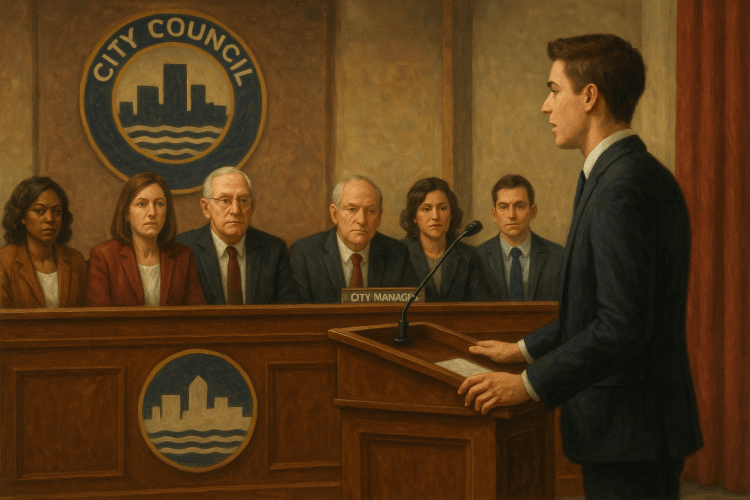
Municipal governments are unusual workplaces because they bring together four very different generational mindsets, each carrying its own approach to urgency, planning, and achievement. Baby Boomers are often nearing retirement but remain the guardians of institutional knowledge. Gen X employees sit in mid-career roles, providing steadiness and pragmatism. Millennials and Gen Z staff bring technical skills, fresh perspectives, and a desire for meaningful impact. Over all of this hovers the council chamber, where elected officials with two- to four-year terms demand quick, visible results they can bring back to their voters. The interplay among these groups defines how city hall functions day to day.


Work Centrality and Urgency

For Baby Boomers, work has long been a central piece of identity. In municipal offices, that commitment shows up in a willingness to stay late until a council packet is complete or to double-check a utility billing run down to the penny. For them, urgency is not negotiable — it is part of their professional ethic.

Gen Z, by contrast, tends to look for structure and clarity in order to summon urgency. Younger employees often ask: “What does this deadline really mean?” A city analyst in their twenties may not feel the pressure of filing a revenue report until a supervisor explains that missing it will delay sidewalk repairs or park maintenance. They need to see how their task connects to resident outcomes before they embrace urgency with the same vigor as their older peers.

Council members occupy an entirely different space. Their urgency is political. They want to show constituents visible results within their limited terms. Even while reviewing long-term comprehensive plans, they lean forward in meetings to ask: “What have you done for me lately?” This mindset drives them to demand both the grand vision and the small, near-term deliverables that can be touted on campaign flyers or in town halls.


Tenure and Institutional Knowledge

Boomers typically stay with an organization for decades, and that tenure provides the city with memory and continuity. A veteran finance director or city clerk knows instinctively that missing a Truth-in-Taxation filing can derail the city’s entire budget process. That awareness creates an ingrained sense of urgency.

Gen Z staff, on the other hand, are more transient. Many stay only two or three years before moving on to graduate school or for a few bucks more in a similar municipal job. To them, a missed filing may seem like routine paperwork rather than a red flag that could trigger a state audit or expose the council to criticism. Without deliberate mentoring, the political and legal weight of such details can be lost.

Council members fall somewhere else entirely. With limited terms and frequent turnover, most do not retain the historical memory that long-serving staff carry. They may not appreciate why a master drainage plan has been on the books for twenty years, but they will press for what is visible and politically rewarding now — a groundbreaking ceremony, a grant announcement, or the repaving of a road their voters drive every day.


Achievement and Career Paths

For Boomers, achievement was tied to climbing the ladder. Moving from budget officer to finance director or from city engineer to public works director marked professional success. Titles and promotions were the visible proof of a career.

Gen Z defines achievement differently. They find satisfaction in project-based wins, skill certifications, and visible impact. A young GIS analyst may beam with pride after launching an interactive zoning map or automating pothole reporting, even if they have no desire to supervise a department.

Council members define achievement in yet another way. For them, success is measured in the short window of their term. They need evidence of change that voters can see and touch — new playground equipment, lower crime statistics, or faster permitting. Achievement is not what happens in twenty years but what is realized in time for the next election.


Planning Horizons and Future Thinking

Baby Boomers are comfortable thinking decades ahead. They embrace twenty- to thirty-year master plans, long-term bond financing, and phased capital improvements. Their approach is steady and deliberate, with a priority on compliance and fiscal security. They know exactly how fast a decade or two can go by.

Gen Z tends to thrive in short cycles. They want to pilot a new communications campaign or launch a mobile app that shows immediate value to residents. This emphasis on agility and visibility is energizing. But without guidance, it can overlook the structural foundation required for compliance and sustainability.

Council members straddle both worlds. They will dutifully review the 2045 comprehensive plan but will quickly pivot to ask, “What will residents see this year?” They want to be able to tell voters that congestion will ease at a key intersection or that park improvements will be visible before the next election. Their enthusiasm for a five-year bond program wanes if their individual pet projects won’t be started until the third or fourth year.


Engagement and Expectations

Boomers learned to operate in a “figure it out” culture, where direction was often implicit and completing the task without fanfare was expected. Gen Z, however, seeks clarity and regular feedback. Without explicit expectations, their sense of urgency weakens.

Council members communicate expectations in broad, sometimes vague terms. They declare priorities such as “reduce crime,” “fix the roads,” or “cut red tape.” Staff must translate those slogans into actionable projects with timelines, budgets, and measurable results. That translation requires both urgency and political astuteness.


Municipal Examples

In the budget office, a Boomer finance director focuses on adopting a balanced budget and protecting the city’s bond rating. A Gen Z analyst may be more excited about building a dashboard that shows residents how each tax dollar is spent. Council members, meanwhile, demand quick budget talking points: “Did we cut the tax rate? How much is in fund balance?”

In public works, a Boomer supervisor thinks in terms of phased capital projects spanning decades. A young engineer-in-training wants digital project boards and shorter sprint cycles. The council simply wants to know how many potholes were filled this week and whether residents can see progress on the ground.

In the city clerk’s office, a Boomer clerk never misses a statutory notice deadline. A Gen Z deputy clerk relies on structured reminders and may not appreciate the consequences of a missed posting. Council members, unaware of the statutory timelines, may ask why an ordinance was not on the agenda the prior week, not realizing the legal steps involved.


Recommendations for City Leaders

Leaders can bridge these horizons by pairing long-term initiatives with short-term wins. A master drainage plan can be complemented by a neighborhood pilot project. Deadlines should be translated into political stakes so that young staff understand that a missed report is not just a paperwork issue but a reputational risk for the council.

Visible “win boards” showing weekly metrics — permits issued, potholes filled, grants applied for — can serve both to motivate staff and to provide council with quick talking points.

When I was promoted from a paint maker to the purchasing department at Glidden years ago, I had a window painted so I wouldn’t be disturbed by the shift changes. I later noticed a small 1″x2″ rectangle of the paint was scratched clear.

At first, I was bothered. Then I realized they did that to see the shift production board past my office. The night shift wanted to track how they were doing compared to the day shift!

Finally, achievement should be reframed in terms of resident benefit. Rather than reporting “design is 80% complete,” staff should tell council that “traffic delays at Main and 380 will be cut by 25% within a year.”


Evaluating Gen X Employees: A Focus on Urgency and Engagement

Gen X workers, often in supervisory or mid-career roles, provide the balance between long-serving Boomers and tech-driven Gen Z. They are independent and pragmatic, but evaluations must probe whether they are sustaining urgency and engagement.

Questions for annual evaluations should include: Do you consistently complete assignments ahead of deadline, and how do you respond when unexpected issues arise? Can you share examples where your urgency prevented a delay or crisis? How engaged do you feel in your work, and have you taken initiative to improve efficiency or resident service? How do you work through periods of disillusionment?

Supervisors should ask whether Gen X employees communicate progress clearly, close out tasks without prompting, and set the pace for younger colleagues. They should also examine whether Gen X staff anticipate council questions and package their work so that both short-term progress and long-term outcomes are visible. Motivation and energy are crucial: do they show enthusiasm under pressure, and do they keep their teams energized during long projects? Finally, evaluators should probe how these employees prepare for future demands and avoid complacency after many years in the role.


Conclusion

Municipal governments thrive when each generation’s strengths are recognized and aligned with the realities of political leadership. Baby Boomers bring continuity and deep urgency rooted in institutional knowledge. Gen Z brings agility, tech savvy, and a desire for meaningful short-term impact. Gen X provides steadiness, independence, and the ability to bridge generational gaps. Council members inject political urgency, pressing for deliverables that can be seen within two to four years.

The challenge is not choosing one horizon over the other but weaving them together. By translating long-term plans into visible near-term wins, creating clarity around deadlines, and aligning staff achievement with resident impact, leaders can cultivate both urgency and engagement across the workforce while still meeting the immediate expectations of elected officials.

✅ Annual Evaluation Checklist: Gen X Employees

(Focus on Urgency & Engagement)

1. Urgency & Timeliness

  • Do you consistently complete assignments ahead of or on deadline?
  • How do you prioritize urgent tasks versus long-term projects?
  • When unexpected issues arise (e.g., a last-minute council request), how quickly do you respond?
  • Can you give an example of when your urgency prevented a delay or crisis?

2. Engagement & Initiative

  • How engaged do you feel in your work and the mission of the city?
  • Do you bring forward new ideas to improve efficiency or resident service?
  • Have you volunteered for projects outside your core role when needed?
  • Do you proactively track project progress without waiting for reminders?

3. Accountability & Follow-Through

  • Do you communicate status updates clearly, especially if deadlines are at risk?
  • How often do you close out tasks without being prompted?
  • Do you take ownership of mistakes and correct them quickly?
  • Do peers and supervisors see you as dependable under pressure?

4. Cross-Generational Collaboration

  • Do you model urgency and responsiveness for younger colleagues?
  • How do you engage with Boomers (institutional memory) and Gen Z (tech-focused) to keep projects on pace?
  • Have you mentored others in balancing speed with quality?

5. Responsiveness to Leadership & Council

  • When asked, “What have you done recently?” do you have clear, recent accomplishments ready?
  • Do you package your work so progress is visible in both short- and long-term outcomes?
  • Do you anticipate council or supervisor questions rather than reactively answering them?

6. Motivation & Energy

  • Do you show consistent enthusiasm even under pressure?
  • How do you keep yourself and your team energized during long or repetitive projects?
  • Are you setting an example of urgency and focus for the team?

7. Future Readiness

  • How are you preparing to maintain urgency and engagement under new conditions (tech, mandates, emergencies)?
  • What steps do you take to avoid complacency or “coasting”?
  • What professional development would help you stay sharp and engaged?