The Porch Conversation

Scene: Two old friends, Harold and Frank, sit on a creaky porch, rocking chairs in rhythm. The cicadas are buzzing. Both are hard of hearing, but neither will admit it.


Harold: (leaning in) Frank, you remember the summer of ’62 when we went fishing down at Lake Benton?

Frank: (cupping his ear) What’s that? Went wishing for a baked ham?

Harold: (rolling his eyes) No, fishing at Lake Benton. We caught that big catfish.

Frank: (snapping his fingers) Ah, right! The cat. Scratched your leg something awful.

Harold: (sputtering) Not a cat! A catfish! In the lake!

Frank: (nodding, satisfied) Sure, sure. Mean old tabby. Always hung around the bakery.


Harold: (sighing) Anyway, that was the day you fell out of the boat.

Frank: (outraged) What? I never fell out of a coat! Fit me just fine!

Harold: The boat, Frank. You tipped the boat over!

Frank: (grinning proudly) Oh, yes, yes. That wool coat tipped me right over. Heavy as an ox in July.

Harold: (muttering) If you say so.


Frank: You still got those suspenders from that trip?

Harold: (perks up) Defenders? Oh, sure, I still believe in strong defense.

Frank: (shakes his head) Not defenders—suspenders! You hauled me out by ‘em. Nearly stretched to Kansas.

Harold: (snorts) And nearly pulled my back out too. You were kicking like a mule.

Frank: (offended) Mule? I never kissed a mule in my life!

Harold: (chuckling) Not kissing, kicking! You looked like you were swimming for the Olympics.

Frank: (relieved) Ah. Well. Good. Rumors get around in a small town.


Harold: Speaking of the town, you remember the county fair that year?

Frank: (nodding) Oh, yes, the one where you lost your hair.

Harold: (touching his bald head) My hair? I lost my hare—the rabbit race. Mine ran the wrong way.

Frank: (squints) Thought it looked fast. Shame it was made of fur.

Harold: (snorts) That’s not how races work, Frank.


Frank: What about the dance afterward? You asked Millie Thompson to waltz.

Harold: (confused) Waltz? I asked her to wash! Why would she wash me?

Frank: (grinning) She turned you down flat. Said you had two left feet.

Harold: No, no. She said I had two left boots! Mismatched shoes. Brand new, both for the left foot. Couldn’t hardly walk straight.

Frank: (laughing so hard he wheezes) And you tried to dance in ‘em! Looked like a turkey on stilts.


Harold: At least I tried. You were too scared to ask anyone.

Frank: (puffs his chest) Nonsense! I danced with Betty Lou.

Harold: (snorts) You danced with a barbecue?

Frank: Betty Lou, Harold! The preacher’s niece.

Harold: Ohhh. I thought you said brisket. Would’ve made more sense.


Frank: You remember our army days?

Harold: (smiling) Sure do. You were in the kitchen, peeling potatoes.

Frank: (confused) I was in the mission, stealing tomatoes?

Harold: (laughing) Well, that too probably.

Frank: (indignant) Hey now, I only borrowed them. They put ‘em back in the stew later.

Harold: (grinning) Yeah, after you ate half of ‘em raw.


Frank: You still go to church every Sunday?

Harold: (earnest) Oh yes, never missed a sermon. Pastor’s words keep me steady.

Frank: (nods) Same here. Those donuts in the foyer keep me ready.

Harold: (squints) Donuts? I said sermons!

Frank: (shrugs) Six of one, half dozen of the other.


Harold: You know, Frank, we remember things awfully different.

Frank: (smiling) Yep. That’s what keeps it interesting.

Harold: You ever wonder which of us has the story right?

Frank: (chuckles) Nope. I just assume it was better my way.

Harold: (laughing) Figures.

Frank: (leans back, sipping coffee) Harold, you and I may not hear so well anymore, but we still talk better than most folks do these days.

Harold: (nodding slowly) That’s the truth. Even if half of it’s wrong.


Epilogue: The Wives

(Inside the house, two women sit at the kitchen table drinking iced tea. They are listening to Harold and Frank through the open window as the old men keep rocking and swapping their muddled memories.)

Martha (Harold’s wife): (shaking her head) You hear those two out there? Harold’s got Frank falling out of boats again.

Evelyn (Frank’s wife): (rolling her eyes) Oh, I heard. If you ask Frank, he never even owned a boat. Said it was a heavy wool coat!

Martha: And the fair! Harold’s talking about losing rabbits. You and I both know he lost his paycheck at the ring toss.

Evelyn: (chuckling) And don’t get me started on Millie Thompson. Neither of them ever danced with her. She was too busy chasing the dentist’s boy.

Martha: (smiling wryly) Truth is, between the two of them, they couldn’t remember their own names without us.

Evelyn: (laughing) And yet, somehow, they think they’re the wise ones.

(The women clink their iced tea glasses, listening as Harold and Frank burst into laughter outside for no apparent reason.)

Martha: Let ‘em talk. Half of it’s wrong, but it keeps ‘em happy.

Evelyn: (nodding) And after fifty years, that’s what matters.

The Digital Babel Consideration

Introduction: The First Babel

In Genesis 11, after the flood, humanity gathered with one purpose. They said, “Come, let us build ourselves a city, with a tower that reaches to the heavens, so that we may make a name for ourselves and not be scattered over the face of the whole earth.” The Tower of Babel was more than stone—it was a symbol of human pride, a declaration of independence from God. In their unity, people sought security, identity, and glory apart from Him.


God’s response was measured and purposeful. Rather than destroy, He confused their language, (the source for our words like “babbling”) scattering them across the earth. His judgment was both a limit and a mercy. By dividing their speech, He prevented prideful ambition from becoming oppressive tyranny. The lesson of Babel is that human invention, when unmoored from God’s order, leads not to flourishing but to fragmentation.

Today, our “digital towers” look different. Instead of bricks, we use pixels. Instead of mortar, we use code. The internet, social media, and artificial intelligence represent extraordinary tools—capable of blessing families, spreading truth, and even carrying the gospel to the ends of the earth. Yet, like Babel, these same tools can be bent toward pride and self-exaltation. The challenge is not to reject technology, but to constrain it within God’s design for community, truth, and order.


The Promise of Technology

Before we critique, we must acknowledge the good. Technology has reunited families across oceans, put Scripture into nearly every language, and given churches the ability to reach far beyond their walls. Missionaries use smartphones for translation. Isolated believers stream services in real time. Local leaders connect with constituents directly.

From a conservative standpoint, technology also reflects innovation and opportunity—values that can strengthen free societies. Properly directed, it allows enterprise and creativity to flourish, lifting people from poverty, broadening access to education, and advancing liberty. Christians, too, have reason to be thankful: the Great Commission now travels on fiber optic cables as surely as on sailing ships.


The Reality of Fragmentation

Yet blessings come with limits. Just as God restrained Babel to protect humanity, we too must set boundaries when technology divides more than it unites. Algorithms curate news feeds that isolate rather than connect. Political rhetoric grows harsher as groups live in separate “realities.” Even in the church, online preachers and influencers sometimes foster theological silos that erode shared biblical grammar.

The danger is not that technology is evil, but that it is not neutral. Left unchecked, it bends toward division. Like fire, it can warm a home or burn it down.


Biblical Parallels and Guidance

The Babel story warns us that scattering apart from God leads to confusion. Pentecost shows the opposite: the Spirit uniting diverse tongues to proclaim one gospel. Together, they reveal this principle—unity is only life-giving when grounded in God’s truth.

For Christians and conservatives, this principle means:

  • We respect the limits of human invention rather than assuming all progress is good.
  • We strengthen enduring institutions—family, church, and local community—that anchor us against digital drift.
  • We guard free speech and diverse voices while also calling for moral responsibility in how those voices are used.

Building a Shared Story in a Digital Age

To redeem technology, we must actively channel it toward what is true, good, and life-giving:

  • Scripture as shared language: God’s Word must remain the foundation, not one voice among many, but the truth by which all other voices are measured.
  • Embodied community: Online fellowship is valuable, but it can never replace face-to-face worship, service, and local engagement.
  • Discernment training: Parents, pastors, and teachers must equip the next generation to see through manipulation, resist division, and pursue truth.
  • Narrative stewardship: The church must retell the gospel as a grand story—creation, fall, redemption, restoration—stronger than any digital narrative.

Reflection Questions

  1. What examples in your own life show technology at its best—connecting, informing, or blessing?
  2. When have you noticed digital feeds pulling you away from truth or shared community?
  3. How can Christians today serve as “interpreters,” helping bridge the fractured dialects of our digital world?
  4. What practices—Scripture reading, fellowship, civic service—help you stay rooted in reality while engaging the digital age?

Conclusion

The Tower of Babel warns us that human pride unchecked leads to confusion. The digital Babel of our own day brings both promise and peril. Technology can serve families, churches, and civic life when rightly constrained—but without God’s order, it fragments into endless dialects of meaning.

The Christian task is not retreat but redemption. Like fire, technology must be kept within the hearth if it is to bring warmth. By grounding our digital lives in Scripture, community, and truth, we can resist Babel’s scattering and instead model Pentecost’s gathering: many voices, one Spirit, one story.


More on the Babel Story

The biblical account is found in Genesis 11:1–9. It emphasizes the confusion of languages and the scattering of peoples rather than the physical collapse of the tower. Later Jewish traditions describe fire, wind, or earthquake striking it, while some say only part was destroyed. Christian interpreters often saw the “fall” of Babel as spiritual pride, not literal rubble. The Qur’an does not tell the Babel story directly but contains echoes in Pharaoh’s tower-building arrogance (Surah 28:38, 40:36–37).

Historically, many scholars connect Babel with the ziggurat of Babylon known as Etemenanki (“House of the Foundation of Heaven and Earth”), a massive, stepped temple likely standing hundreds of feet tall. Ruins of Babylon near modern Hillah, Iraq, still contain remnants of such structures, though none can be definitively identified as “the” Tower of Babel.

The Heart and Soul of a Street Preacher

Linda and I were fortunate enough to assist French Teacher Diana Thelen take up to 106 Christian students, teachers and administrators to the UK and Europe over a 10-year period around the turn of this century. On one of our trips to London, we ended up at Picadilly Circus. If you haven’t been there, think Times Square in NYC. Busy. Flashy and memory-making.

At a distance, I could hear and see a street preacher. I remember him more clearly than anything else. While I can’t remember his exact words, his enthusiasm was heard and felt. More people walked past him than paused to listen. I thought to myself how they perhaps caught a word or phrase that stuck with them.

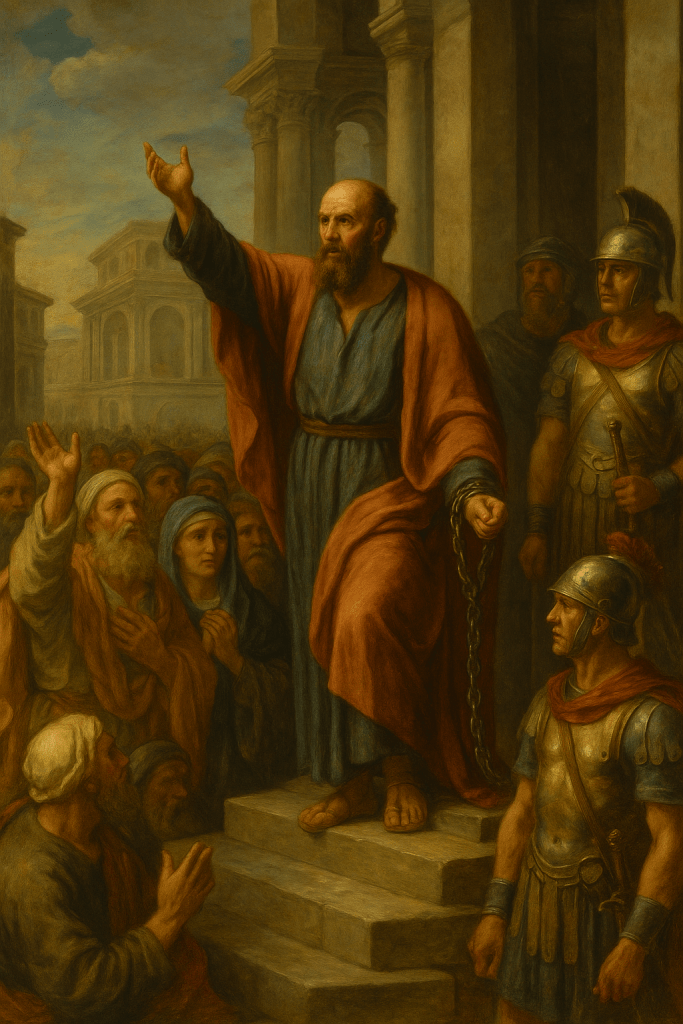
In our Bible Study group, as I’ve wrote a few days ago, we are delving into the Book of Acts. It is fascinating to read about Peter and Paul as they are at their very first steps of street preaching. You can easily feel their lightheadedness as they rise from a sitting position to share Gospel. Christ came to show us the way, died for our sins and then rose to join His Heavenly Father. Believe in Him, and you will have everlasting life.

So, based on these two images, today’s essay is again a collaboration between AI and me. LFM

Introduction

I am a street preacher. Some people admire me; others dismiss me as a nuisance. But my voice, my presence, and my message come from a place deeper than opinion—it is a calling from God. Behind every word I speak in the open air lies a journey of conviction, struggle, and faith, one that connects me to prophets, apostles, and countless heralds before me.


My Calling

I did not choose this work for comfort or convenience. The Lord placed His word in my heart, and it burns there like fire in my bones. I cannot hold it in. He has called me to the streets to speak of His Son, not because I am worthy, but because He chose me for this task before I was born (Jeremiah 1:5).

I go where the people are—bus stops, markets, sidewalks—because I am commanded to go into all the world and preach the gospel to every creature. I cannot wait for them to come to me. Life is short, eternity is real, and the message is urgent. My heart breaks for the lost, and I carry their burden as my own.


My Motivation

I obey because He commands it, even when obedience costs me my comfort, reputation, or safety. I preach because love compels me—not love in word only, but the kind that risks rejection to rescue a soul. I stand in public where all can see, because even those who will not listen must be reminded that there is truth beyond the noise of life. My life is not my own. My time, my voice, and my reputation belong to Christ.


My Struggles

This calling comes with a cost. I have walked alone more than I can say. Many brothers and sisters in Christ do not understand my methods, and so the fellowship is sometimes thin. I have been mocked, cursed, and shoved. I have fought the temptation to answer in anger, and I have prayed for my heart to stay soft toward those who hate me.

The battles are not just outside—they rage in my mind. The enemy whispers that my words are wasted, that I am doing more harm than good. There are days when my body aches from standing, my voice strains from speaking, and my heart feels empty from pouring out. Yet I rise again, because the message is not mine to withhold.


A Day in My Life

I rise before the sun, my first thoughts turning to prayer. I open the Scriptures, looking for the day’s anchor—a word from God to carry into the streets.

I gather my tools: a small speaker, gospel tracts, a wooden cross, water, and a sign that says, Christ Died for the Ungodly. I know the weather may turn, but rain is no excuse to be silent.

At the bus terminal, I raise my voice above the hum of engines and footsteps. Most pass me by, but one man lingers, sharing the pain of his dying brother. We pray together, the noise of the city around us.

Later, teenagers jeer and throw trash. My flesh wants to snap back, but I remember my Lord’s example. I answer with gentleness and keep speaking.

Alone on a bench at midday, I fight the thought that nothing I do matters. I remind myself that I plant and water, but God gives the growth.

In the afternoon, a young man on a bike remembers what I said last week and confides his guilt over past sins. We talk. Seeds are planted.

By evening, I am weary, but I deliver one final message in a plaza. Someone watches from across the street for several minutes before disappearing into the crowd. I do not know if I will see him again, but I leave with hope.


My Place in History

I do not stand alone. I walk a path worn by those who came before me:

  • Noah, a preacher of righteousness.
  • Jeremiah, proclaiming truth at the temple gate.
  • Jonah, warning Nineveh in the streets.
  • John the Baptist, crying in the wilderness.
  • Jesus, preaching from hillsides, seashores, and city streets.
  • Peter, speaking to thousands in Jerusalem.
  • Paul, reasoning daily in marketplaces.

I share in the legacy of Francis of Assisi, the Lollards, Martin Luther, George Fox, Whitefield, Wesley, and countless others who took the gospel beyond the church walls. Their voices still echo through time, and mine is but one more in the same song.


My Creed

I am called, not by man, but by the voice of the Living God.
Before I was formed in the womb, He knew me; before I was born, He set me apart. My commission is not a career but a cross, not a choice of convenience but a mandate of obedience.

I will proclaim the truth in the open air,
as the prophets did in the gates of the city,
as John cried in the wilderness,
as Christ preached on hillsides and by the sea,
as the apostles spoke in marketplaces and in the streets.

I will not measure my work by the size of the crowd,
the applause of men,
or the absence of scorn.
I will measure it only by my faithfulness to the message entrusted to me.

I will endure the loneliness of this calling
knowing my Lord was despised and rejected,
a man of sorrows, acquainted with grief.
When they mock me, they mock Him;
when they reject me, they reject the One who sent me.

I will guard my heart from pride,
remembering I am a beggar showing other beggars where to find bread.
The power is not in my voice, my skill, or my presence—
but in the Gospel, which is the power of God unto salvation.

I will love those before me, even if they hate me.
My words may wound, but only as the surgeon’s knife wounds to heal.
I will remember that every face I see is a soul that will one day stand before God.

I will not be silenced by fear, fatigue, or failure.
The enemy may bruise me with insults,
the law may restrain me with fines,
the weather may beat me with rain—
but I will rise again, for the message is not mine to withhold.

I will pray before I speak, and after I speak.
For without prayer, my words are wind.
But with prayer, the Spirit may carry a single sentence into the heart
and awaken the dead to life.

I stand in the tradition of the faithful—
from Noah to Paul, from Francis to Wesley, from Whitefield to nameless saints whose voices echoed through streets and alleys the world forgot.
Their reward was never here, and neither shall mine be.

And when my voice is silenced at last,
may it be said that I spent my final breath in obedience to the One who called me—
not as a celebrity, not as a scholar,
but simply as a herald, crying in the streets:
“Be reconciled to God.”


Conclusion

This is my life, my labor, and my love. I know the cost. I have felt the loneliness. But I also know the One who walks beside me, and His presence is worth more than the approval of the world.

So tomorrow, and the day after, I will take my place again in the streets. Not for applause. Not for recognition. But for obedience—and for the hope that even one will hear and live.

Generational and Political Dynamics in Municipal Government

I am in the second class of the early Baby Boomers (1946-1964) with my work life still going with no plans to stop. My son and daughter-in-law are in mid-career. Our grandchildren are either just now joining the workforce or will be in the next four years. I don’t have any employees, so I don’t know what it is like these days to manage people. When I did, most of my employees were self-motivated and worked (almost) as hard (some harder) as I did. Still, I talk to my peers and those in mid to top level management. A lot. I’m not a patient person, so I could never be in management again. This essay is shaped by many of my clients and colleagues. I used AI to help compose this essay with my guidance and editing. LFM


Municipal governments are unusual workplaces because they bring together four very different generational mindsets, each carrying its own approach to urgency, planning, and achievement. Baby Boomers are often nearing retirement but remain the guardians of institutional knowledge. Gen X employees sit in mid-career roles, providing steadiness and pragmatism. Millennials and Gen Z staff bring technical skills, fresh perspectives, and a desire for meaningful impact. Over all of this hovers the council chamber, where elected officials with two- to four-year terms demand quick, visible results they can bring back to their voters. The interplay among these groups defines how city hall functions day to day.


Work Centrality and Urgency

For Baby Boomers, work has long been a central piece of identity. In municipal offices, that commitment shows up in a willingness to stay late until a council packet is complete or to double-check a utility billing run down to the penny. For them, urgency is not negotiable — it is part of their professional ethic.

Gen Z, by contrast, tends to look for structure and clarity in order to summon urgency. Younger employees often ask: “What does this deadline really mean?” A city analyst in their twenties may not feel the pressure of filing a revenue report until a supervisor explains that missing it will delay sidewalk repairs or park maintenance. They need to see how their task connects to resident outcomes before they embrace urgency with the same vigor as their older peers.

Council members occupy an entirely different space. Their urgency is political. They want to show constituents visible results within their limited terms. Even while reviewing long-term comprehensive plans, they lean forward in meetings to ask: “What have you done for me lately?” This mindset drives them to demand both the grand vision and the small, near-term deliverables that can be touted on campaign flyers or in town halls.


Tenure and Institutional Knowledge

Boomers typically stay with an organization for decades, and that tenure provides the city with memory and continuity. A veteran finance director or city clerk knows instinctively that missing a Truth-in-Taxation filing can derail the city’s entire budget process. That awareness creates an ingrained sense of urgency.

Gen Z staff, on the other hand, are more transient. Many stay only two or three years before moving on to graduate school or for a few bucks more in a similar municipal job. To them, a missed filing may seem like routine paperwork rather than a red flag that could trigger a state audit or expose the council to criticism. Without deliberate mentoring, the political and legal weight of such details can be lost.

Council members fall somewhere else entirely. With limited terms and frequent turnover, most do not retain the historical memory that long-serving staff carry. They may not appreciate why a master drainage plan has been on the books for twenty years, but they will press for what is visible and politically rewarding now — a groundbreaking ceremony, a grant announcement, or the repaving of a road their voters drive every day.


Achievement and Career Paths

For Boomers, achievement was tied to climbing the ladder. Moving from budget officer to finance director or from city engineer to public works director marked professional success. Titles and promotions were the visible proof of a career.

Gen Z defines achievement differently. They find satisfaction in project-based wins, skill certifications, and visible impact. A young GIS analyst may beam with pride after launching an interactive zoning map or automating pothole reporting, even if they have no desire to supervise a department.

Council members define achievement in yet another way. For them, success is measured in the short window of their term. They need evidence of change that voters can see and touch — new playground equipment, lower crime statistics, or faster permitting. Achievement is not what happens in twenty years but what is realized in time for the next election.


Planning Horizons and Future Thinking

Baby Boomers are comfortable thinking decades ahead. They embrace twenty- to thirty-year master plans, long-term bond financing, and phased capital improvements. Their approach is steady and deliberate, with a priority on compliance and fiscal security. They know exactly how fast a decade or two can go by.

Gen Z tends to thrive in short cycles. They want to pilot a new communications campaign or launch a mobile app that shows immediate value to residents. This emphasis on agility and visibility is energizing. But without guidance, it can overlook the structural foundation required for compliance and sustainability.

Council members straddle both worlds. They will dutifully review the 2045 comprehensive plan but will quickly pivot to ask, “What will residents see this year?” They want to be able to tell voters that congestion will ease at a key intersection or that park improvements will be visible before the next election. Their enthusiasm for a five-year bond program wanes if their individual pet projects won’t be started until the third or fourth year.


Engagement and Expectations

Boomers learned to operate in a “figure it out” culture, where direction was often implicit and completing the task without fanfare was expected. Gen Z, however, seeks clarity and regular feedback. Without explicit expectations, their sense of urgency weakens.

Council members communicate expectations in broad, sometimes vague terms. They declare priorities such as “reduce crime,” “fix the roads,” or “cut red tape.” Staff must translate those slogans into actionable projects with timelines, budgets, and measurable results. That translation requires both urgency and political astuteness.


Municipal Examples

In the budget office, a Boomer finance director focuses on adopting a balanced budget and protecting the city’s bond rating. A Gen Z analyst may be more excited about building a dashboard that shows residents how each tax dollar is spent. Council members, meanwhile, demand quick budget talking points: “Did we cut the tax rate? How much is in fund balance?”

In public works, a Boomer supervisor thinks in terms of phased capital projects spanning decades. A young engineer-in-training wants digital project boards and shorter sprint cycles. The council simply wants to know how many potholes were filled this week and whether residents can see progress on the ground.

In the city clerk’s office, a Boomer clerk never misses a statutory notice deadline. A Gen Z deputy clerk relies on structured reminders and may not appreciate the consequences of a missed posting. Council members, unaware of the statutory timelines, may ask why an ordinance was not on the agenda the prior week, not realizing the legal steps involved.


Recommendations for City Leaders

Leaders can bridge these horizons by pairing long-term initiatives with short-term wins. A master drainage plan can be complemented by a neighborhood pilot project. Deadlines should be translated into political stakes so that young staff understand that a missed report is not just a paperwork issue but a reputational risk for the council.

Visible “win boards” showing weekly metrics — permits issued, potholes filled, grants applied for — can serve both to motivate staff and to provide council with quick talking points.

When I was promoted from a paint maker to the purchasing department at Glidden years ago, I had a window painted so I wouldn’t be disturbed by the shift changes. I later noticed a small 1″x2″ rectangle of the paint was scratched clear.

At first, I was bothered. Then I realized they did that to see the shift production board past my office. The night shift wanted to track how they were doing compared to the day shift!

Finally, achievement should be reframed in terms of resident benefit. Rather than reporting “design is 80% complete,” staff should tell council that “traffic delays at Main and 380 will be cut by 25% within a year.”


Evaluating Gen X Employees: A Focus on Urgency and Engagement

Gen X workers, often in supervisory or mid-career roles, provide the balance between long-serving Boomers and tech-driven Gen Z. They are independent and pragmatic, but evaluations must probe whether they are sustaining urgency and engagement.

Questions for annual evaluations should include: Do you consistently complete assignments ahead of deadline, and how do you respond when unexpected issues arise? Can you share examples where your urgency prevented a delay or crisis? How engaged do you feel in your work, and have you taken initiative to improve efficiency or resident service? How do you work through periods of disillusionment?

Supervisors should ask whether Gen X employees communicate progress clearly, close out tasks without prompting, and set the pace for younger colleagues. They should also examine whether Gen X staff anticipate council questions and package their work so that both short-term progress and long-term outcomes are visible. Motivation and energy are crucial: do they show enthusiasm under pressure, and do they keep their teams energized during long projects? Finally, evaluators should probe how these employees prepare for future demands and avoid complacency after many years in the role.


Conclusion

Municipal governments thrive when each generation’s strengths are recognized and aligned with the realities of political leadership. Baby Boomers bring continuity and deep urgency rooted in institutional knowledge. Gen Z brings agility, tech savvy, and a desire for meaningful short-term impact. Gen X provides steadiness, independence, and the ability to bridge generational gaps. Council members inject political urgency, pressing for deliverables that can be seen within two to four years.

The challenge is not choosing one horizon over the other but weaving them together. By translating long-term plans into visible near-term wins, creating clarity around deadlines, and aligning staff achievement with resident impact, leaders can cultivate both urgency and engagement across the workforce while still meeting the immediate expectations of elected officials.

✅ Annual Evaluation Checklist: Gen X Employees

(Focus on Urgency & Engagement)

1. Urgency & Timeliness

  • Do you consistently complete assignments ahead of or on deadline?
  • How do you prioritize urgent tasks versus long-term projects?
  • When unexpected issues arise (e.g., a last-minute council request), how quickly do you respond?
  • Can you give an example of when your urgency prevented a delay or crisis?

2. Engagement & Initiative

  • How engaged do you feel in your work and the mission of the city?
  • Do you bring forward new ideas to improve efficiency or resident service?
  • Have you volunteered for projects outside your core role when needed?
  • Do you proactively track project progress without waiting for reminders?

3. Accountability & Follow-Through

  • Do you communicate status updates clearly, especially if deadlines are at risk?
  • How often do you close out tasks without being prompted?
  • Do you take ownership of mistakes and correct them quickly?
  • Do peers and supervisors see you as dependable under pressure?

4. Cross-Generational Collaboration

  • Do you model urgency and responsiveness for younger colleagues?
  • How do you engage with Boomers (institutional memory) and Gen Z (tech-focused) to keep projects on pace?
  • Have you mentored others in balancing speed with quality?

5. Responsiveness to Leadership & Council

  • When asked, “What have you done recently?” do you have clear, recent accomplishments ready?
  • Do you package your work so progress is visible in both short- and long-term outcomes?
  • Do you anticipate council or supervisor questions rather than reactively answering them?

6. Motivation & Energy

  • Do you show consistent enthusiasm even under pressure?
  • How do you keep yourself and your team energized during long or repetitive projects?
  • Are you setting an example of urgency and focus for the team?

7. Future Readiness

  • How are you preparing to maintain urgency and engagement under new conditions (tech, mandates, emergencies)?
  • What steps do you take to avoid complacency or “coasting”?
  • What professional development would help you stay sharp and engaged?

The Work That Holds Us Together

🛠️ The Work That Holds Us Together

I was raised in a blue-collar family. It is the best thing that ever happened to me. My dad was a very hard worker. He was a mechanic (an electro-plater) at Braniff and then would work on cars many nights after he got home. He had calloused hands with grease that never completely disappeared no matter how hard he scrubbed.

I started working as a paper boy at the age of 13-ish. From the paper route, I eventually worked at Holiday Cleaners due to a friendship with the manager I talked to many days on my route. I even chose to get out of school at noon during my senior year to work there on a work program for some who did not plan to go to college. On my paper route, one of my customers asked me to come to work as an office boy at Glidden Paint Company.

I eventually got promoted to be a paint maker in the plant on the night shift. Later, I became the assistant purchasing agent. I did start college during this time but lost a year when I joined the Texas Air National Guard and became a “weekend warrior.” After Linda graduated from UNT and started teaching, I quit to complete my last two years of college. She also had worked non-stop from her younger years until she retired.

I’ve often said that I may not be the smartest person in the world, but I can outwork just about anyone. Like with many in this world, I find sheer enjoyment in working. To create something, to process something, to feel the satisfaction for a job well done is a reward alone.

So, Labor Day is a meaningful holiday for me. This is my salute. AI helped with some history. LFM


I. Labor Day’s Hidden Roots

Labor Day began not as a vacation but a declaration: Workers matter. The earliest advocates didn’t ask for applause—they asked for justice. The 19th-century labor movement arose in a crucible of exploitation: 14-hour workdays, unsafe mills, child labor, and wages that barely fed a family.

In 1882, 10,000 workers in New York marched—not to protest a war, but to demand dignity in the workplace. It wasn’t until the violent Pullman Strike in 1894, when workers shut down rail traffic across the nation and faced federal troops, that Congress finally acted, making Labor Day a national holiday.

But the meaning of the day has always gone deeper than rest. It has been a cry from the ground: Do you see us?


II. The Divine Rhythm of Work and Rest

Long before factories, strikes, and unions, God ordained labor. The first command given to humanity was to “work the ground and keep it” (Genesis 2:15). Work was not a punishment—it was a partnership. Adam and Eve were not idle in Eden; they were cultivators.

But even in paradise, there was a rhythm: six days of work, one of rest. God Himself rested—not out of exhaustion, but to show us how sacred rest is.

“The Sabbath was made for man, not man for the Sabbath.” — Mark 2:27

Work is dignified, but so is stopping. Rest is not laziness; it’s an act of faith. It says: I am not God. The world does not depend on my endless output.


III. The Laborers Jesus Saw

Throughout His ministry, Jesus moved among the working class. He did not call religious elites to be His disciples—He called fishermen. He Himself was a carpenter for most of His earthly life. When He told parables, He spoke of vineyard workers, shepherds, sowers, and servants.

And when He spoke to the weary, it was as a worker speaking to workers:

“Come to me, all you who labor and are heavy laden, and I will give you rest.” — Matthew 11:28

His kingdom values did not mirror the marketplace. The first were last. The widow’s mite outweighed the rich man’s gift. The one who serves is greatest of all.

What would it mean to bring that vision into our economy today?


IV. The Unfinished Work of Labor Justice

Too often, our systems still devalue the laborer. Some work until their bodies collapse. Others labor invisibly—caring for children, cleaning buildings, stocking shelves—without benefits, praise, or power.

Even in church spaces, we sometimes glorify “calling” only in terms of ministry or leadership. But the Bible does not separate the sacred and the secular that way. Paul writes:

“Whatever you do, work at it with all your heart, as working for the Lord, not for human masters.” — Colossians 3:23

Whether one teaches, welds, drives, prays, or sweeps, it all becomes holy when done with faithfulness.

But faithfulness does not mean accepting injustice. It means confronting it. Like the prophets, we must cry out when wages are withheld (James 5:4), when sabbaths are ignored (Exodus 20:10), when workers are crushed under greed (Amos 8:4–6).


V. Labor Day as Worship

What if Labor Day were not just a long weekend, but an altar? A day to honor those who build bridges, bandage wounds, answer phones, hammer nails, code websites, change diapers, and sweep floors.

What if we lifted up the invisible hands behind visible life?

What if we slowed down enough to give thanks—not just with words, but with wages, policies, and prayers?

What if we remembered that God Himself worked—and called it good?


🕊️ Final Reflection: A Poem for Labor Day

The Hands That Hold the World

Not just the stars or thrones endure,
But hands that scrape, and sew, and cure.
The ones who kneel to fix the gears,
Who mop the floors, who calm the fears.

The mother rocking past her shift,
The courier through rain and drift.
The silent saint behind the glass,
Who rings up joy as hours pass.

The teacher grading after dark,
The welder throwing up a spark.
The unseen hands, the whispered grace,
That hold the world in every place.

So bless the calloused, wrinkled, worn—
The laborers both praised and torn.
For in their work, a truth is shown:
No kingdom stands by kings alone.

And may we build, with justice wide,
A world where labor walks with pride.
Where rest is sacred, wages fair—
And every worker knows we care.

Labor Day, 2025

Dorm Faith Dialogue

A Collaboration Between AI and Lewis McLain

Josh closed the devotional in his lap, letting the pages fall together with a soft thump. The hum of campus life outside their dorm room faded into the background. He looked across the room, watching Marcus tap away at his video game controller. There was something on his heart, a stirring he couldn’t quite ignore any longer.

“Hey man,” Josh said, voice easy and calm, “Can I ask you something without it being weird?”

Marcus didn’t look away from the screen, but his tone was open. “Yeah, sure. What’s on your mind?”

Josh leaned forward slightly, elbows on his knees. “Do you ever miss it? Church, I mean. Not the rituals or the formality—just the whole experience. The community, the purpose, the peace of it all?”

Marcus paused his game, the screen freezing on some digital battlefield. He set the controller down and leaned back in his chair. “Sometimes, yeah. But not in the way people probably think. I don’t miss being told how to live. I miss the feeling of being part of something bigger. The laughter after youth group. The quiet during prayer. It felt… safe.”

Josh nodded slowly. “Yeah, I get that. For me, it wasn’t always the sermons. Half the time I was zoning out or drawing in the bulletin. I say that, but I know I was picking up on the stories and the lessons shared. But those moments when the worship hit just right, or the late-night campfire talks—that stuff stayed with me. Like wooing echoes.”

Marcus gave a small smile. “Funny you mention campfires. I actually got re-baptized at camp. Twice, actually. First when I was twelve, then again at sixteen. Thought maybe if I started fresh again, something would finally stick.”

Josh’s eyebrows lifted slightly. “I didn’t know that. That takes guts, man. What was it like for you the second time?”

Marcus stared up at the ceiling for a beat. “Hopeful, I think. Like I really wanted God to notice me. I was ready to mean it this time. But then I got back home, school picked up, friends changed… and I fell back into the same old routine. After a while it just felt like I was pretending.”

Josh’s voice was gentle, free of any judgment. “I think a lot of people feel that. I know I did. I used to think being a Christian meant being ‘on fire’ all the time. But now I see it more like an anchor. Even when I drift, I’m still tied to something unshakable.”

Marcus looked at him, curiosity softening his features. “But how do you stay with it? Like, really? College is wild. Nobody here seems to care about faith anymore. I know I don’t take advantage of church and Christian groups around campus, so I shouldn’t be complaining.”

Josh gave a wry smile. “Honestly? Sometimes I don’t feel like I’m doing a great job at it. But I keep coming back to Jesus. Not the idea of Him, but the person. I’ve seen what I become without Him. I get lost in distractions, numb to everything. But when I give Him space—even just a sliver—He shows up. In quiet ways.”

He paused for a moment, then added with a small laugh, “You know, one of the times I felt closest to God was actually at camp. There was this one night where we were all under the stars, no lights, just hundreds of us sitting on blankets and logs. And then out of nowhere, the speaker says, ‘We have a surprise guest tonight.’ And it was Michael W. Smith. I’m not even kidding. The real deal.”

Marcus blinked. “Wait, the Michael W. Smith? The worship guy?”

“Yep,” Josh said, eyes bright with memory. “He didn’t make it a big concert or anything. Just came out with a guitar and started playing Awesome God. And then the whole camp just stood up, arms raised, voices loud and cracking from emotion. It was raw. And holy. I think I cried without even realizing it. I felt so… known. Like God was right there.”

Josh softly recited the lyrics, almost like a prayer:

Our God is an awesome God
He reigns from heaven above
With wisdom, power, and love
Our God is an awesome God

He repeated them, his voice steadier:

Our God is an awesome God
He reigns from heaven above
With wisdom, power, and love
Our God is an awesome God

“Even now,” Josh continued, “when I feel distant, I go back to that night in my mind. It reminds me He hasn’t changed, even when I have.”

Marcus was quiet, visibly moved. “Man, I haven’t thought about that song in years. That brings back something.”

Josh nodded. “Music has a way of slipping past all the defenses. Sometimes all it takes is one lyric, one memory, and the door opens again.”

Marcus tilted his head. “But how do you know it’s actually Him? Like, not just your own thoughts or wishful thinking?”

Josh nodded slowly, recognizing the sincerity. “I used to ask that too. But over time, I started to notice patterns. Like peace showing up in chaos. Random moments of clarity that hit when I read a Scripture verse. Friends texting me exactly what I needed to hear without knowing it. It adds up. And the Bible—I used to think it was outdated. Now I read it and it’s like it knows me better than I know myself.”

Marcus looked down at his hands. “I wish I could believe like that again. But I feel fake. Like God’s moved on and I missed the last bus.”

Josh leaned in. “You’re not fake, and you’re definitely not too far gone. Jesus is drawn to the ones who feel furthest. He always went to the doubters, the outcasts, the ones who didn’t fit. You’re exactly who He came for.”

A half-smile crept onto Marcus’s face. “So you’re saying I’m a project case?”

Josh laughed. “I’m saying we all are. But God doesn’t see us as projects. He sees us as sons worth rescuing. We all come messy. That’s the point.”

Marcus grew quiet. The hum of his paused game filled the silence. “What do you do when you pray and it feels like no one’s listening? When it’s just silence or static in your heart?”

Josh sighed, then smiled gently. “I tell Him that. I don’t pretend. I’ll say, ‘God, I don’t even know if You’re there, but I’m showing up.’ And you know what? He honors that. I think He respects honesty of the heart more than performance.”

Marcus nodded slowly. “I used to talk to Him that way as a kid. It felt simple then. Now everything feels tangled, like I’m supposed to have all the answers before I even speak.”

Josh leaned back, his voice softer now. “What if He doesn’t need you to have answers? What if He just wants you? The real you. Doubts, questions, baggage and all.”

Marcus’s voice dropped, almost a whisper. “But where do I even start again? I can’t fake it.”

Josh’s eyes were kind. “You don’t have to fake anything. Just take one honest step. Even if it’s just saying, ‘God, I don’t know.’ That’s a beginning. That’s faith too.”

Marcus looked away for a long moment, then back. “Do you ever feel like you’re missing out by following Christ too closely? Like… other people get to live freer?”


Josh considered that. “Yeah, I’ve felt that. But then I look at what they’re chasing. I’ve seen people try everything to feel alive—parties, hookups, success—but they still end up empty. I’d rather miss out on the noise and have something that lasts. Real peace is better than cheap highs. In fact, my highest highs are when I’m totally surrendered by Christ.”

Marcus took a deep breath, voice fragile. “I want to try. Not to impress anyone. Just to see if I can open the door again. Maybe it’s not too late.”

Josh smiled deeply. “It’s never too late. And if you want to know what it takes to begin again—to really follow Christ—the Bible makes it pretty clear. Romans 10:9 says, ‘If you declare with your mouth, “Jesus is Lord,” and believe in your heart that God raised him from the dead, you will be saved.’ That’s it. It starts with belief and a simple confession.”

Marcus leaned forward slightly. “So it really is that simple?”

“Yeah,” Josh said. “And over time, your understanding grows. Your faith deepens. But the doorway is wide open to anyone who will walk through.”

He reached over to grab a wrinkled paper from his Bible. “This is something I memorized in confirmation class. It still centers me. It’s called the Apostles’ Creed. Want to hear it?”

Marcus nodded.

Josh recited it, quietly but clearly:

I believe in God, the Father Almighty,
Maker of heaven and earth.
And in Jesus Christ, His only Son, our Lord;
who was conceived by the Holy Spirit,
born of the Virgin Mary,
suffered under Pontius Pilate,
was crucified, dead, and buried;
He descended into death.
The third day He rose again from the dead;
He ascended into heaven,
and sits at the right hand of God the Father Almighty;
from there He shall come to judge the living and the dead.
I believe in the Holy Spirit,
the holy catholic (with a little c) Church,
the communion of saints,
the forgiveness of sins,
the resurrection of the body,
and the life everlasting. Amen.

“That’s beautiful,” Marcus said. “I forgot how solid and grounding that sounds. Like, this is what we believe. Not just feelings, but truth.”

Josh smiled. “Exactly. Truth that holds even when we feel lost.”

Marcus whispered, “Then maybe it’s time I came home.”

Josh nodded. “Let’s do it together. Doesn’t have to be a ceremony. Just a conversation. Want me to start?”

Marcus nodded, tears welling. “Yeah. Please. ”

Josh bowed his head, reverence settling in.
“God… it’s Josh here. And Marcus too. We’re not perfect. We’re not here with polished words. But we’re here. Thank You for never giving up on us. For chasing after us even when we wandered. Be near to Marcus. Make Yourself real to him again. Remind him he’s loved. Draw him home. And allow me to be part of the journey. Amen.”

Marcus swallowed hard, voice trembling.
“God… I don’t know what to say. I feel far. But if You’re still there and accepting of me… I want to come back. I want to feel You again. I want to start over, but this time for real. Help me. Please. I believe in You. And I believe in Jesus. I want to follow Him.”

Josh opened his eyes, heart full. “That was the most honest, beautiful prayer I’ve heard in a long time.”

Marcus wiped at his cheek, smiling through wet eyes. “Thanks for seeing me. For not preaching. Just listening. Just being here.”

Josh nodded. “This isn’t about converting you. It’s about walking with you. Because I believe Jesus is already closer than you think. And He’s not going anywhere.”

Gerrymandering in America: Race, Party, and the Battle Over Fair Maps

Research by AI; Guided by Questions from Lewis McLain


I. Origins & Etymology

Gerrymandering derives from early 19th-century Massachusetts: In 1812, Governor Elbridge Gerry approved a partisan redistricting plan so oddly shaped it resembled a salamander. A Boston Gazette cartoon coined the term “Gerry‑mander,” merging his name with the creature’s form.

At its core, gerrymandering refers to drawing district lines to benefit particular political interests—resulting in bizarre, contorted districts. While most people associate it with partisan trickery, the truth is more layered: racial bias and partisan bias often function in tandem.

  • Racial gerrymandering dilutes or overconcentrates minority voters, violating the Voting Rights Act of 1965 or the Equal Protection Clause of the 14th Amendment.
  • Partisan gerrymandering distorts maps to entrench the ruling party, regardless of overall vote share.

Though the two tactics are frequently inseparable in practice, the United States Supreme Court treats them differently:

Partisan gerrymandering is considered a nonjusticiable political question, outside the reach of federal courts, as established in Rucho v. Common Cause (2019).

Racial gerrymandering is subject to strict judicial scrutiny.


II. Why & How Gerrymandering Happens

Redistricting, conducted every ten years after each census, is meant to reflect population changes. However, when controlled by legislators, it often becomes a tool for cementing political advantage through two tactics:

  • Cracking divides opposing-group voters—often minorities or supporters of another party—across several districts so they cannot form a majority.
  • Packing concentrates those voters into a few districts where they win overwhelmingly, wasting their votes elsewhere.

These techniques are the foundational tools of both racial and partisan gerrymandering.

While all states redraw district lines, gerrymandering intensity varies—some use independent commissions (e.g., Arizona) to constrain manipulation, while others are deeply partisan.


III. Do All 50 States Gerrymander?

Technically, every state adjusts its electoral maps, but not all do so with partisan intent. Some, like Arizona, employ independent commissions to limit political influence.

Recent trends point to a redistricting “arms race”: Texas enacted a mid-decade map boosting Republican advantage, triggering lawsuits over minority vote dilution. Meanwhile, California, New York, and Utah (the latter with a court-ordered redraw) exemplify ongoing tensions.


IV. Supreme Court & Landmark Cases

Foundational Jurisprudence

  • Baker v. Carr (1962): Established that redistricting is justiciable under the Fourteenth Amendment’s Equal Protection Clause.
  • Wesberry v. Sanders (1964) & Reynolds v. Sims (1964): Reinforced “one person, one vote.”

Racial Gerrymandering Cases

  • Shaw v. Reno (1993): Race-based districts trigger strict scrutiny under Equal Protection.
  • Shaw v. Hunt (1996): Reinforced that race-dominated design must be narrowly tailored.
  • Miller v. Johnson (1995): Reaffirmed the unconstitutional nature of race-dominant districting.

Voting Rights Act Protections

  • Allen v. Milligan (2023): Required Alabama to add a second Black-majority district under Section 2 of the VRA.
  • Louisiana v. Callais (2025 Term): Now challenging whether creating race-conscious districts—even to prevent minority dilution—is constitutional. Oral arguments are scheduled for October 2025.

Partisan Gerrymandering Jurisprudence

  • Rucho v. Common Cause (2019): Declared partisan gerrymandering a nonjusticiable political question, preventing federal courts from intervening.

State-Level Reform & Independent Commissions

  • Arizona State Legislature v. Arizona Independent Redistricting Commission (2015): Upheld the right of voters to empower independent commissions for map-drawing under the Elections Clause.

V. Supreme Court Rejections of Partisan Gerrymandering Claims

The Supreme Court has consistently declined to address partisan gerrymandering claims:

  • Rucho v. Common Cause (2019): Held such cases are outside federal jurisdiction.
  • Lamone v. Benisek (2019): Declined to intervene in a Maryland case, affirming Rucho.
  • Gill v. Whitford (2018): Dismissed due to lack of standing, without addressing the merits.
  • Benisek v. Lamone: Another Maryland case rejected on procedural grounds.
  • Gaffney v. Cummings (1973): Upheld a Connecticut map, issuing that minor political imbalances don’t violate Equal Protection.

VI. If Courts Treated Partisan Bias Like Racial Bias

In current jurisprudence, racial gerrymandering is justiciable—courts routinely strike down districts when race is used as the predominant factor without sufficient justification. But in Rucho v. Common Cause, the Supreme Court held that federal courts cannot hear claims of partisan gerrymandering, declaring them political questions beyond their reach.

But what if that changed? If courts treated partisan bias the same way they treat racial bias—with strict scrutiny and intervention—many current maps would likely be invalidated. This shift in doctrine could dramatically rebalance political power in Congress.

Several prominent analyses help estimate the scale of potential change:

  • The Brennan Center (2024) found that current maps cost Democrats approximately 16 seats due to partisan gerrymandering.
  • A Center for American Progress (2012–2016) report found that up to 59 House seats were skewed in favor of Republicans through unfair redistricting.
  • A FiveThirtyEight simulation concluded that if all 50 states gerrymandered to their fullest extent, Republicans would gain roughly 30–35 extra seats.

In sum, correcting partisan bias through judicial oversight would likely flip between 16 and 59 seats from Republicans to Democrats, altering or even reversing the current House majority.


VII. State-by-State Breakdown: Where the Seats Would Shift

To understand how partisan gerrymandering distorts representation, it helps to look at specific states. Below are groupings based on how maps are drawn, their partisan bias, and expected seat shifts if redrawn under neutral or court-approved standards.

🟢 Independent Commissions (Low/Neutral Bias)

These states use nonpartisan or bipartisan commissions, reducing opportunities for political manipulation:

  • California: No bias; citizen-led process
  • Colorado: Competitive and balanced districts
  • Michigan: Commission adopted after 2018 reform
  • Arizona: Minor Democratic lean, but publicly accountable process

🟡 Moderate or Mixed Bias

States with recent court-drawn maps or commissions with imperfect balance:

  • Pennsylvania: Court intervention restored balance
  • Virginia: Map drawn after commission impasse
  • New Jersey: Tie-breaker rules favor incumbents; moderate Democratic lean

🔴 Extreme Republican Gerrymanders

These states are the largest contributors to Republican overrepresentation:

  • Texas: +6 to +9 seats due to cracking Latino and urban communities
  • Florida: +5 to +6 seats after DeSantis overturned a fairer court-approved map
  • Ohio, North Carolina, Wisconsin: Legislatures engineered consistent GOP advantages despite roughly even statewide vote shares
  • Georgia, Louisiana, Tennessee: Minority dilution and urban fracturing yield additional GOP gains

🔵 Extreme Democratic Gerrymanders

Though fewer, some Democratic-controlled states also engage in biased line-drawing:

  • Illinois and Maryland each net 1–2 seats by concentrating rural GOP voters or diluting their influence

This breakdown illustrates how partisan bias—especially in large, fast-growing, or swing states—can significantly shift congressional outcomes.


VIII. Independent Commissions vs. Legislative Control

When comparing states that use independent commissions to those that rely on legislature-controlled maps, a clear pattern emerges:

  • Independent commissions result in fairer, more proportional representation, with greater competitiveness and fewer legal challenges.
  • Legislature-led states, especially those with single-party dominance, tend to produce maps with significant bias, often preserving or expanding partisan advantage regardless of voter shifts.

This contrast reinforces the conclusion that reform through commissions, transparency, and public engagement is the most viable path to redistricting fairness.


IX. Summary of Projected Seat Shifts

These projections combine data from simulations, court filings, and voting behavior models. The following states are the most affected by partisan bias:

  • Texas: 6–9 seats to Democrats
  • Florida: 5–6 seats
  • Ohio: 3–4 seats
  • North Carolina: 2–3 seats
  • Wisconsin: 2 seats
  • Georgia: 1–2 seats
  • Louisiana: 1 seat (restoring a Black-majority district)
  • Tennessee: 1 seat
  • Illinois and Maryland: 2–3 seats might flip to Republicans under a neutral standard

Nationwide impact: Correcting partisan bias through judicial scrutiny could flip between 16 and 59 seats. Such a shift would not only affect House control but also committee leadership, federal legislation, and the national policy agenda.ould shift—enough to reverse the House majority and shape national policy for a decade.


X. Conclusion: One Standard, Two Outcomes

America currently applies two legal standards to what is often one strategy:

  • When race is the explicit factor in redistricting, courts scrutinize and often strike down maps.
  • When race is used as a proxy for party advantage, courts defer to the political process.

The result is a system where millions of voters—especially those in diverse, urban, or competitive regions—are systematically underrepresented, while entrenched state governments shield themselves from competition.

If courts treated partisan gerrymandering with the same seriousness as racial gerrymandering, it would transform American representation and restore fairness to the democratic process.

Begging the Question

✅ 1. Clarify the Core Question

Should the distribution of seats in the U.S. House of Representatives roughly reflect the ratio of votes cast for each party in presidential elections (or other statewide totals)?

This involves a deeper question:

  • Should representational fairness be tied to aggregate voter preference, or to district-level dynamics?

🧩 2. Define Evaluation Criteria

To weigh the pros and cons fairly, establish the principles or goals you care about. For example:

CriterionExplanation
Democratic FairnessDoes the system reflect the will of the people as expressed in their votes?
Constitutional IntegrityDoes the idea respect the U.S. system of government and its legal framework?
Representation QualityDoes it allow local communities to elect candidates who reflect their specific interests?
Feasibility & StabilityIs it workable, and does it produce stable, trusted outcomes?
Manipulation ResistanceDoes it reduce incentives or tools for gerrymandering?

⚖️ 3. Weigh Pros and Cons Under Each Criterion

CriterionPro-Alignment ArgumentAnti-Alignment Argument
Democratic FairnessVote-seat alignment ensures majority rule and legitimacySplit-ticket voting and turnout variation mean alignment may misrepresent intent
Constitutional IntegrityCould guide mapmakers without requiring reformThe Constitution guarantees single-member districts, not proportionality
Representation QualityPrevents distortions where 45% of voters get 20% of seatsHouse members serve local areas, not national party shares
Feasibility & StabilityEasy to measure; can inform fair redistricting practicesMay encourage radical reforms or undermine federalism if applied rigidly
Manipulation ResistancePresidential vote benchmarks expose gerrymanderingCould mask subtler forms of bias not captured in statewide totals

🧠 4. Synthesize: Which Principles Matter Most?

Ask:

  • Is vote-seat proportionality a core democratic value?
  • Or is local, district-based representation more important, even if it causes some mismatch?

If your priority is majoritarian fairness and anti-manipulation, you may favor alignment.
If your priority is constitutional tradition, localism, or district-level nuance, you may favor flexibility.


🧭 5. Conclusion: Nuanced Recommendation

You could logically conclude:

Presidential vote ratios should not rigidly dictate House representation, but they should serve as a diagnostic benchmark. When vote-share and seat-share diverge significantly, it often signals manipulation—not natural variation. Therefore, they should be used to identify potential gerrymanders, but not as a constitutional requirement.


Another Major Question: The Independence of Commissions?

Independent redistricting commissions are designed to reduce partisan influence—but they’re not immune to bias or manipulation. Here are the key ways that even these commissions can be bent to political advantage:


⚠️ 1. Commission Composition Can Be Politically Engineered

  • Who selects the commissioners? Often, political leaders (e.g., legislative leaders or governors) nominate or approve members.
  • This can lead to:
    • “Bipartisan collusion”: Democrats and Republicans may agree to protect incumbents rather than ensure fairness.
    • Hidden partisanship: Individuals labeled as “independent” may still have partisan loyalties or donor histories.

Example:
In New Jersey, the bipartisan commission includes a tie-breaking member chosen by both parties—often leading to deals that entrench both sides’ incumbents rather than create competitive maps.


⚠️ 2. Data and Criteria Can Be Manipulated

  • Commissioners choose how to interpret criteria like “compactness,” “communities of interest,” or “competitiveness.”
  • If partisan operatives influence data models, mapping software, or community testimony, the final map can reflect subtle bias.

Example:
In Arizona, although the commission is independent, critics argued that some early cycles were swayed by Republican-linked consultants who shaped how communities of interest were defined.


⚠️ 3. Deadlock or Commission Failure Can Default to Partisan Actors

  • Some commissions require supermajority or bipartisan approval. If they deadlock, the decision reverts to courts or legislatures, which reintroduces partisanship.

Example:
In Virginia, a bipartisan commission deadlocked in 2021. The state supreme court appointed two special masters, both tied to past partisan mapmakers, prompting concerns over impartiality.


⚠️ 4. Public Input Can Be Staged or Stacked

  • Open hearings are meant to encourage civic participation, but parties can mobilize supporters to dominate public comments, creating the illusion of grassroots consensus.

Example:
In Michigan, activists warned that coordinated testimony from party-aligned groups overwhelmed independent perspectives, subtly shaping the map outcomes.


⚠️ 5. Reform Language Can Be Vague

  • Some “independent commissions” are only advisory, with their proposals subject to legislative override.
  • Even binding commissions may be poorly defined, allowing backdoor political influence through legal loopholes.

✅ Summary: Commissions Reduce Risk—Not Eliminate It

WeaknessDescription
Composition biasSelection process favors party insiders
Data manipulationCriteria interpreted to favor outcomes
Deadlocks & defaultsProcess can revert to legislature/courts
Staged public inputManufactured testimony shapes perceptions
Weak enforcement“Independent” may lack legal authority

Conclusion:
Independent commissions are generally more fair than legislature-controlled redistricting—but they are not foolproof. Ensuring true independence requires transparency, oversight, citizen engagement, and strict conflict-of-interest rules.

Texas State vs Local Government Powers: A Struggle for Control in the Lone Star State

Introduction: The Central Tension

There are two major forms of government. There is the Federal Government, and State Government. Everything else is a subdivision of the state. This post was written with the help of AI while guided and edited by Lewis McLain.

In Texas, the tension between state power and local self-governance has deep roots and wide-reaching implications. From its early independence days through Reconstruction and into the 21st century, Texas has oscillated between fierce localism and assertive state control. Today, that struggle plays out in the form of state-imposed limits on local autonomy—through legislation, finance, judicial decisions, and bureaucratic mechanisms. Understanding this dynamic requires a detailed look at the history, structure, legal frameworks, fiscal policies, and political motivations that shape the relationship between the State of Texas and its local governments.


I. The Historical Backdrop: From Colonies to Constitution

1. Mexican Rule and Texian Rebellion

As early as 1832–1833, Texian settlers resisted central control from the Mexican government. Their political conventions were declared illegal by Mexican authorities, which insisted that petitions flow through the ayuntamientos (local councils). This early conflict introduced the lasting theme: local populations versus centralized power.

2. The Constitution of 1876

After Reconstruction, the 1876 Texas Constitution sought to sharply limit centralized authority. It fragmented the executive branch, constrained legislative power, and emphasized local control. Yet paradoxically, it also embedded structural dependence: counties and special districts have only the powers the state explicitly grants them, while only cities of 5,000+ population can adopt home-rule charters. Even home-rule cities are bound by laws of general application.

This setup hardwired state supremacy over counties and most special-purpose governments while allowing limited autonomy for larger municipalities.


II. The Architecture of Local Governance in Texas

1. Sheer Volume and Fragmentation

Texas has the most counties of any U.S. state—254 in total. In addition:

  • Over 1,200 municipalities, divided into general-law and home-rule cities
  • More than 1,100 independent school districts (ISDs)
  • Over 3,250 special-purpose districts (utility, water, MUDs, etc.)
  • An estimated 5,300 distinct local governments across the state

This staggering fragmentation leads to overlapping authority, duplication of services, and vastly differing levels of governance capacity.

2. Counties and Their Limits

Counties are administrative arms of the state: they manage jails, elections, public health, and roads—but cannot enact zoning laws or ordinances. Their governance is handled by a commissioners court, not a traditional executive council. They hold no inherent regulatory powers and rely entirely on statutory authorization for fees, facilities, or services.

3. Regional Councils of Governments (COGs)

In 1965, the Texas Legislature passed the Regional Planning Act, creating voluntary Councils of Governments (COGs). Today, there are 24 COGs serving as regional coordinating bodies. Two of the most significant are:

North Central Texas Council of Governments (NCTCOG)

  • Formed in 1966, NCTCOG is the largest, covering 16 counties, 169 cities, 19 school districts, and 24 special districts over 12,800 square miles.
  • Based in Arlington, NCTCOG facilitates transportation planning, environmental coordination, GIS mapping, emergency preparedness, and more—but has no taxing or regulatory power.
  • In 2025, NCTCOG allocated $3.5 million to rescue the Amtrak Heartland Flyer—stepping in where the Legislature had declined support.

Houston–Galveston Area Council (H-GAC)

  • Established in September 1966, H-GAC serves 13 counties over roughly 12,500 square miles, with a population exceeding 6 million.
  • Headquartered in Houston, H-GAC enables local governments to coordinate on transportation, air quality, economic and workforce development, emergency preparedness, and environmental planning.
  • It also functions as the Metropolitan Planning Organization (MPO) for eight core counties, overseeing federally funded transportation projects and regional emissions planning.
  • Its Board of Directors, composed of local elected officials, sets the organization’s policy direction through a General Assembly structure.

Both NCTCOG and H-GAC demonstrate the potential for regional cooperation—but also underscore the limits of voluntary, underfunded bodies without enforcement authority.


III. State Preemption: The Legal and Legislative Mechanics

1. Home-Rule vs Dillon’s Rule

While Texas allows home-rule cities greater self-governance, state law—and state courts—have held that state legislation overrides local ordinances unless local authority is explicitly protected. Courts traditionally require “unmistakable clarity” in legislative intent to uphold preemption, but recent laws have blurred those lines.

Texas operates under both a home-rule framework and the legal philosophy of Dillon’s Rule, which holds that local governments have only those powers: (1) expressly granted by the state, (2) necessarily or fairly implied from those express powers, or (3) essential to the purposes of the government. If there’s any doubt, the presumption is that the power does not exist.

Named after Iowa Supreme Court Justice John F. Dillon (1868), this rule is a bedrock principle in Texas constitutional law—especially for counties and general-law cities. Even home-rule cities, which have broad authority under Article XI of the Texas Constitution, are subordinate to state law in areas of general application.

Thus, while home-rule cities may regulate broadly in the absence of conflicting state laws, any new state law—such as HB 2127—can override them unless clearly unconstitutional. Counties, meanwhile, are strictly creatures of statute and can act only when authorized by state law.

2. The Death Star Bill – HB 2127 (2023)

HB 2127, known as the Texas Regulatory Consistency Act, severely restricts local governments from regulating labor, agriculture, natural resources, property, or finance unless state law expressly permits it.

  • It invalidated numerous local ordinances (e.g., paid sick leave, wage theft protections, tenant protections).
  • Lawsuits argue it violates the Texas Constitution’s home-rule provisions; though a lower court struck it down, it remains in effect pending appeal.

IV. Fiscal Shackles: How the State Controls Local Budgets

1. Revenue Caps & Rollback Elections

The Truth-in-Taxation framework restricts local tax hikes:

  • 3.5% above the previous year’s revenue is allowed without voter approval; 1% under proposed legislation.
  • Local governments face procedural burdens to raise revenue effectively.

2. Central Appraisal Districts (CADs) & Appraisal Caps

  • Property values are set uniformly by CADs—state-regulated but locally governed, limiting flexibility.
  • A 10% homestead appraisal cap restricts rapid valuation increases, compressing revenue potential.

3. Tax Abatement Loopholes and Reforms

  • Housing Finance Corporations (HFCs) and Public Facility Corporations (PFCs) had exploited loopholes to extend tax breaks across jurisdictions.
  • HB 21 (2025) closed the loophole, restricting housing finance agency activity to their constituents.

4. Robin Hood Plan – School Finance Recapture

  • Property-rich districts must transfer surplus tax revenue to the state for redistribution—more than $1.8 billion annually.

5. Chapter 313 Tax Agreements

  • Firms receive tax breaks in exchange for jobs; these abatements have cost local schools $10.8 billion (2006–2020).

6. Sales Tax Rebate Abuses and Reform

  • In recent years, some cities created sales tax rebate agreements allowing businesses to collect sales tax on transactions across the state, then receive a large percentage back—sometimes for decades.
  • These deals have allowed small cities to capture tax revenue from remote or online sales with no real economic connection to the transaction location.
  • While cities like Round Rock, which built costly infrastructure for Dell, argue for retaining those revenues, abuse by other jurisdictions led to public backlash.
  • In response, the state passed Senate Bill 878 (2025) to reform these incentives by:
    • Capping rebate agreements at 25 years
    • Requiring public hearings before approval
    • Mandating online transparency and reporting
    • Including performance metrics and clawback provisions

These reforms signal a new phase in the state’s effort to prevent local deals that distort statewide equity in tax policy.


V. State Actions Triggered by Local Abuses

  • The Tenaha asset forfeiture scandal involved law enforcement seizing money and property from drivers without charges—used locally without oversight—prompting state restrictions on civil forfeiture.
  • The Houston ISD takeover followed governance failures, prompting state intervention amid accusations of ethics violations.
  • Floodplain development and disasters exposed gaps in county zoning authority—fueling arguments for stronger centralized land-use regulation.

VI. Motivation: Why the State Seeks to Control Localities

  • Partisan Dynamics – Urban centers often pursue progressive policies that contrast sharply with conservative state leadership.
  • Business Interests & Uniformity – Corporations and developers favor consistent regulations across jurisdictions.
  • Legislative Efficiency – Texas’s biennial sessions incentivize centralized governance in place of a patchwork of local rule.
  • Corrective Oversight – High-profile local abuses have increased public tolerance for state intervention and financial limits.

Conclusion: Democracy in the Balance

Texas’s governance framework blends one of the most fragmented local government landscapes in the nation with robust state oversight and restriction. From NCTCOG and H-GAC to counties, school districts, and beyond, local governments face legal curbs and financial constraints even as citizen demands increase. At times, these constraints are reactions to real abuses—but often, they undermine local democracy, responsiveness, and innovation.

In a state that prides itself on independence, the real question becomes: Whose independence counts? The state’s? Or the people’s, acting through their cities, counties, and school boards?

Thoughts, Prayers, and Action: A Christian Response to Tragedy

Please Lord, watch over our community, especially our children.

When tragedy strikes—whether in a school, a church, or on the streets of our cities—Christians instinctively turn to prayer. We believe that God hears the cries of His people, and that no tear shed, no anguished word whispered in prayer is wasted. Yet in moments like the recent killings in Minneapolis, many voices rise in frustration, declaring, “thoughts and prayers are not enough.”

As a follower of Christ, I must confess that this critique deserves a hearing. If by “thoughts and prayers” we mean little more than polite condolences, quickly offered and soon forgotten, then indeed they are not enough. Scripture never intended prayer to be a substitute for action. James writes plainly: “Suppose a brother or sister is without clothes and daily food. If one of you says to them, ‘Go in peace; keep warm and well fed,’ but does nothing about their physical needs, what good is it?” (James 2:15–16). Prayer without action is incomplete; faith without works is dead.


The True Role of Prayer

Prayer is not meant to end our response; it is meant to begin it. Prayer is the act of bringing unbearable sorrow before the throne of God, confessing our weakness, and seeking divine strength. It is through prayer that we discern God’s heart for justice, compassion, and peace. It is through prayer that we ask for courage to move beyond words and into deeds.

Far from being empty, prayer acknowledges that human wisdom and political effort alone cannot heal the deepest wounds of the human heart. Prayer points us to the One who alone can turn hatred into love, despair into hope, violence into reconciliation. But if prayer never moves us to concrete acts of mercy and justice, then we have misunderstood its purpose.


Please Lord, Change the hearts of evil.

What Christians Ask for in Prayer After a Massacre

When we say we are praying for the families, school workers, and community after the massacre of children, we are not merely repeating empty phrases. We are interceding with specific and urgent pleas before God:

  • For the families of the children: that God would surround them with His comfort, the “peace that surpasses all understanding” (Philippians 4:7), when their world has collapsed. That He would give them strength to face the unthinkable days ahead—funerals, empty bedrooms, and grief that threatens to crush their very breath.
  • For the school workers and first responders: that God would bind up the trauma they carry in their bodies and minds after witnessing scenes that will never leave them. That He would guard them against despair, give them counselors and companions, and remind them that their labor to protect children is not in vain.
  • For the community: that God would heal the very soil of the city, that fear will not take root, that division and blame will not destroy neighbors, and that leaders would rise up who work for reconciliation and renewal. That the church would be a beacon of hope, providing food for the grieving, arms for the weary, and truth for the confused.

Prayer in such a moment is not resignation—it is petition. It is crying out to the Lord of heaven and earth to move in ways we cannot. It is asking Him to step into unbearable suffering and carry those who cannot walk.


What Can Be Done to Prevent Such Tragedies?

Christians must also look upstream: what can be done to prevent massacres like this from happening at all? While we cannot erase the reality of evil in a fallen world, there are faithful steps we can take:

  • Spiritual formation and discipleship: Our homes, churches, and schools must raise children in love, teaching them to value life, to resolve conflict with peace, and to find their worth in God rather than in violence or power.
  • Stronger communities: When young people are isolated, wounded, or neglected, seeds of destruction can grow. The church can invest in mentoring, after-school care, youth ministries, and safe spaces where children and families are supported.
  • Care for mental health: Christians can advocate for accessible counseling and trauma care, remembering that Jesus Himself ministered to the brokenhearted.
  • Moral courage in public life: We can encourage policies that protect human life and limit access to instruments of mass violence, while still affirming human dignity and responsibility.
  • Peacemaking witness: In a culture saturated with anger and division, Christians can model reconciliation—speaking truth with grace, rejecting hatred, and showing the world that the way of Christ is the way of peace.

No set of actions will completely eradicate violence. Yet, by God’s grace, we can restrain evil, cultivate peace, and create communities where tragedies are less likely to erupt.


Responding to the Critique

So when someone says, “thoughts and prayers are not enough,” my Christian response is not to be defensive but to agree in part. They are right: prayer is not enough if it remains mere sentiment. But they are also missing the deeper truth: prayer is more than words—it is the lifeblood of action. Without it, we risk striving in our own strength, detached from God’s wisdom and power.

As Christians, we should embrace both sides: authentic prayer that intercedes for the grieving and the broken, and faithful action that works for justice and peace. Prayer without action is hypocrisy, but action without prayer is arrogance. The world needs both.


A Prayer for the Families, School, and Community

Heavenly Father, our hearts are broken before You. Children have been taken in violence, and we struggle to even breathe under the weight of this loss. Lord, we lift up the families whose lives are torn apart. Hold them in Your arms as a mother holds her child. Give them strength to face the hours ahead and hope to believe that life is still worth living. Surround them with friends who will not leave, with churches that will not abandon, with a peace that does not vanish when the tears come at night.

We pray for the teachers, the school staff, and the first responders who saw the unthinkable. Lord, heal their minds, protect them from despair, and let their courage not be forgotten. Wrap them in Your love and remind them that their work is holy in Your sight.

We pray for the community of Minneapolis. Drive out fear, drive out division, and plant seeds of healing where the soil feels barren. Raise up leaders who will stand for peace and neighbors who will look after one another. May the church rise to its calling: to comfort the hurting, to weep with those who weep, and to shine the light of Christ in the darkest of nights.

And Lord, we pray not only for healing but for prevention. Teach us as a nation to value life as You value it. Lead us to build homes where love is strong, schools where children are safe, communities where the lonely are not abandoned. Show us how to break cycles of violence and how to offer young people hope before despair hardens into destruction.

Come, Lord Jesus. Heal our land. Let justice roll down like waters, and righteousness like a mighty stream. May Your kingdom come, and Your will be done, on earth as it is in heaven.

In the name of Jesus Christ, the Prince of Peace, we pray. Amen.Thoughts, Prayers, and Action: A Christian Response to Tragedy

When tragedy strikes—whether in a school, a church, or on the streets of our cities—Christians instinctively turn to prayer. We believe that God hears the cries of His people, and that no tear shed, no anguished word whispered in prayer is wasted. Yet in moments like the recent killings in Minneapolis, many voices rise in frustration, declaring, “thoughts and prayers are not enough.”

As a follower of Christ, I must confess that this critique deserves a hearing. If by “thoughts and prayers” we mean little more than polite condolences, quickly offered and soon forgotten, then indeed they are not enough. Scripture never intended prayer to be a substitute for action. James writes plainly: “Suppose a brother or sister is without clothes and daily food. If one of you says to them, ‘Go in peace; keep warm and well fed,’ but does nothing about their physical needs, what good is it?” (James 2:15–16). Prayer without action is incomplete; faith without works is dead.


The True Role of Prayer

Prayer is not meant to end our response; it is meant to begin it. Prayer is the act of bringing unbearable sorrow before the throne of God, confessing our weakness, and seeking divine strength. It is through prayer that we discern God’s heart for justice, compassion, and peace. It is through prayer that we ask for courage to move beyond words and into deeds.

Far from being empty, prayer acknowledges that human wisdom and political effort alone cannot heal the deepest wounds of the human heart. Prayer points us to the One who alone can turn hatred into love, despair into hope, violence into reconciliation. But if prayer never moves us to concrete acts of mercy and justice, then we have misunderstood its purpose.


What Christians Ask for in Prayer After a Massacre

When we say we are praying for the families, school workers, and community after the massacre of children, we are not merely repeating empty phrases. We are interceding with specific and urgent pleas before God:

  • For the families of the children: that God would surround them with His comfort, the “peace that surpasses all understanding” (Philippians 4:7), when their world has collapsed. That He would give them strength to face the unthinkable days ahead—funerals, empty bedrooms, and grief that threatens to crush their very breath.
  • For the school workers and first responders: that God would bind up the trauma they carry in their bodies and minds after witnessing scenes that will never leave them. That He would guard them against despair, give them counselors and companions, and remind them that their labor to protect children is not in vain.
  • For the community: that God would heal the very soil of the city, that fear will not take root, that division and blame will not destroy neighbors, and that leaders would rise up who work for reconciliation and renewal. That the church would be a beacon of hope, providing food for the grieving, arms for the weary, and truth for the confused.

Prayer in such a moment is not resignation—it is petition. It is crying out to the Lord of heaven and earth to move in ways we cannot. It is asking Him to step into unbearable suffering and carry those who cannot walk.


“Here I am, Lord, send me!” Isaiah 6:8

What Can Be Done to Prevent Such Tragedies?

Christians must also look upstream: what can be done to prevent massacres like this from happening at all? While we cannot erase the reality of evil in a fallen world, there are faithful steps we can take:

  • Spiritual formation and discipleship: Our homes, churches, and schools must raise children in love, teaching them to value life, to resolve conflict with peace, and to find their worth in God rather than in violence or power.
  • Stronger communities: When young people are isolated, wounded, or neglected, seeds of destruction can grow. The church can invest in mentoring, after-school care, youth ministries, and safe spaces where children and families are supported.
  • Care for mental health: Christians can advocate for accessible counseling and trauma care, remembering that Jesus Himself ministered to the brokenhearted.
  • Moral courage in public life: We can encourage policies that protect human life and limit access to instruments of mass violence, while still affirming human dignity and responsibility.
  • Peacemaking witness: In a culture saturated with anger and division, Christians can model reconciliation—speaking truth with grace, rejecting hatred, and showing the world that the way of Christ is the way of peace.

No set of actions will completely eradicate violence. Yet, by God’s grace, we can restrain evil, cultivate peace, and create communities where tragedies are less likely to erupt.


Responding to the Critique

So when someone says, “thoughts and prayers are not enough,” my Christian response is not to be defensive but to agree in part. They are right: prayer is not enough if it remains mere sentiment. But they are also missing the deeper truth: prayer is more than words—it is the lifeblood of action. Without it, we risk striving in our own strength, detached from God’s wisdom and power.

As Christians, we should embrace both sides: authentic prayer that intercedes for the grieving and the broken, and faithful action that works for justice and peace. Prayer without action is hypocrisy, but action without prayer is arrogance. The world needs both.


A Prayer for the Families, School, and Community

Heavenly Father, our hearts are broken before You. Children have been taken in violence, and we struggle to even breathe under the weight of this loss. Lord, we lift up the families whose lives are torn apart. Hold them in Your arms as a mother holds her child. Give them strength to face the hours ahead and hope to believe that life is still worth living. Surround them with friends who will not leave, with churches that will not abandon, with a peace that does not vanish when the tears come at night.

We pray for the teachers, the school staff, and the first responders who saw the unthinkable. Lord, heal their minds, protect them from despair, and let their courage not be forgotten. Wrap them in Your love and remind them that their work is holy in Your sight.

We pray for the community of Minneapolis. Drive out fear, drive out division, and plant seeds of healing where the soil feels barren. Raise up leaders who will stand for peace and neighbors who will look after one another. May the church rise to its calling: to comfort the hurting, to weep with those who weep, and to shine the light of Christ in the darkest of nights.

And Lord, we pray not only for healing but for prevention. Teach us as a nation to value life as You value it. Lead us to build homes where love is strong, schools where children are safe, communities where the lonely are not abandoned. Show us how to break cycles of violence and how to offer young people hope before despair hardens into destruction.

Come, Lord Jesus. Heal our land. Let justice roll down like waters, and righteousness like a mighty stream. May Your kingdom come, and Your will be done, on earth as it is in heaven.

In the name of Jesus Christ, the Prince of Peace, we pray. Amen.

The Hymns of Charles Wesley

Introduction

I was baptized at the age of six and grew up in the Baptist Church. When Linda and I got married, it was in her United Methodist Church. We worshipped and worked in the UMC until we moved to McKinney almost 20 years ago. At the invitation of our good friends, Don & Janice Paschal, we visited and quickly joined First Baptist Church here. Linda was baptized, and I was baptized again. It was good to be back in the Baptist family. We mostly watch online in recent years due to it being more difficult to get around with our bad backs.

While in our Methodist years, we started a new Sunday School Class. I forgot the name, but it was about the Poetry & Theology of Hymns. It was a little laughable since I know nothing about music and sing just loud enough to be a notch below those singing around me. The class was really slanted towards the stories behind the hymns as well as the Biblical correlations.

Our church today sings a few of the old Baptist hymns. However, we mostly sing lively praise music. I love the music. But any singing while worshiping the three Persons of God (God the Father, Jesus the Son of God, and God in the form of the Holy Spirit) is fine with me.

This essay is about the Hymns of Charles Wesley. The words are beautiful with heavy roots in Scripture in a wonderfully structured way. They are sung in churches of many Christian denominations. I hope you find these selections of value. I encourage you to dwell on the lyrics that can be found in the embedded links.

An interesting discussion our Bible Study group explored this week centered around the distinction between being baptized and becoming a Christian versus the moment that might come later when there is an experience of a deeper belief in your heart when you feel a different warmth. It could happen out of the blue like for C.S. Lewis when he was riding in the sidecar of a motorcycle riding down a dusty road. It might be at a Christian summer camp or a revival. Think back if you were so fortunate to know what I’m talking about. Note how the Wesley’s were already practicing Christians prior to a deeper transformation when they felt the Holy Spirit becoming a part of their lives. LFM


Charles Wesley Hymns
( Guided and edited by LFM; Compiled by ChatGPT)

The Wesley Brothers: Partners in Gospel and Song

John Wesley (1703–1791) and Charles Wesley (1707–1788) were raised in a devout Anglican household in Epworth, England. Their mother, Susanna Wesley, taught them discipline, prayer, and Scripture, shaping their lifelong devotion. At Oxford University, they joined with other earnest students to form the “Holy Club,” meeting regularly for prayer, fasting, study, and acts of service. Their methodical devotion led some to mock them as “Methodists” — a name that stuck and eventually gave birth to a movement.

Both brothers traveled to Georgia as missionaries in the 1730s, but those missions were largely discouraging. It was only after their return to London that they each experienced a profound encounter with the Holy Spirit. On May 21, 1738, Charles Wesley felt peace flood his soul as the Spirit “chased away the darkness of unbelief.” Just days later, on May 24, 1738, John Wesley attended a Moravian meeting on Aldersgate Street, where he famously recorded: “I felt my heart strangely warmed. I felt I did trust in Christ, Christ alone, for salvation; and an assurance was given me that He had taken away my sins, even mine, and saved me from the law of sin and death.” For both brothers, conversion was the direct work of the Holy Spirit — bringing assurance, peace, and freedom in Christ.

“I felt my heart strangely warmed. I felt I did trust in Christ, Christ alone, for salvation; and an assurance was given me that He had taken away my sins, even mine, and saved me from the law of sin and death.”

John went on to become the great organizer and preacher, traveling more than 250,000 miles and delivering over 40,000 sermons across Britain. Charles, though also a preacher, became best known as the “sweet singer of Methodism.” Over his lifetime he wrote more than 6,500 hymns, covering the entire range of Christian experience: birth, new birth, sanctification, suffering, resurrection, and eternal hope. John gave the movement structure; Charles gave it song.


John Wesley’s Directions for Singing (1761)


When John Wesley published Select Hymns with Tunes Annext in 1761, he included his now-famous directions for singing. These rules reveal his deep conviction that music is a means of grace, not mere ornament.

Sing all. Join with the congregation as often as you can; do not let weakness or weariness excuse you. Sing lustily and with good courage. Don’t sing as if half-asleep — raise your voice with strength and joy. Sing modestly. Don’t try to be louder than everyone else; blend your voice with the congregation. Sing in time. Keep together with the others; don’t drag or rush. Follow the leader and stay united. Above all, sing spiritually. Sing with your heart directed to God. Let every word be an offering, aiming to please Him more than yourself or others.

Wesley’s instructions remind us that singing was central to early Methodism. Hymns were sermons in song — meant to form doctrine, stir the heart, and knit believers together in worship.

Ten Great Hymns of Charles Wesley

1. Hark! The Herald Angels Sing (1739)

Context & Story:

Originally published as “Hymn for Christmas Day” in 1739, Charles Wesley began with the line, “Hark how all the welkin rings.” The term “welkin” meant “the heavens,” but it confused many. George Whitefield revised the phrase to “Hark! the herald angels sing,” which quickly took hold. Later, when Mendelssohn’s music was paired with the words, the hymn gained its triumphant character. Wesley’s text is more than seasonal cheer; it is rich theology in verse. The hymn proclaims the incarnation, reconciliation between God and humanity, and the new creation brought through Christ. In the Methodist revival, this was a doctrinal hymn — teaching that Christmas was not sentimental but deeply redemptive.

Scripture References: Luke 2:13–14; John 1:14; 2 Corinthians 5:19.

Excerpt:

“Hark! the herald angels sing,

‘Glory to the newborn King;

Peace on earth, and mercy mild,

God and sinners reconciled!’”

Reflection Questions:

How does this hymn connect the nativity to the larger story of redemption? Why is reconciliation central to the meaning of Christmas? In what ways can you join the “herald angels” in proclaiming Christ today?

Full Lyrics: Read here


2. And Can It Be That I Should Gain (1738)

Context & Story:

This hymn came out of Charles Wesley’s own conversion in May 1738. Having wrestled with doubt and illness, Charles found assurance in Christ’s saving work. The hymn expresses amazement that God’s Son would die for him personally — “Amazing love! how can it be?” The vivid imagery of chains breaking reflects Charles’ sense of liberation. This was not abstract theology but his personal testimony, which soon became the testimony of thousands of Methodists. For generations, it has remained one of the most powerful hymns of assurance and personal salvation.

Scripture References: Romans 5:6–8; Acts 16:26; Galatians 2:20.

Excerpt:

“My chains fell off, my heart was free,

I rose, went forth, and followed Thee.”

Reflection Questions:

Have you ever felt astonished by the depth of God’s grace? What “chains” — of sin, fear, or doubt — has Christ broken in your life? How can daily gratitude deepen your walk with Christ?

Full Lyrics: Read here


3. Love Divine, All Loves Excelling (1747)

Context & Story:

Published in 1747 in Hymns for Those that Seek and Those that Have Redemption, this hymn is a prayer for sanctification. Wesley longed for believers not just to be forgiven but to be perfected in love — a core Methodist teaching. The hymn borrows the phrase “love divine” from earlier poetry, but Charles makes it uniquely Methodist: a plea for God’s love to fill the believer and transform the church into a dwelling place for Christ. The final stanza looks ahead to heaven, but Wesley’s vision is that holiness begins here and now. For Methodists, this hymn was sung as both aspiration and declaration of God’s ongoing work.

Scripture References: Ephesians 3:17–19; 2 Corinthians 3:18; Revelation 21:3–4.

Excerpt:

“Love divine, all loves excelling,

Joy of heaven to earth come down;

Fix in us thy humble dwelling,

All thy faithful mercies crown.”

Reflection Questions:

How do you understand holiness — as obligation, or as perfecting love? Where in your life do you long for God’s love to “finish His new creation”? How does this hymn challenge you to see sanctification as joy, not duty?

Full Lyrics: Read here


4. O For a Thousand Tongues to Sing (1739)

Context & Story:

Written on the first anniversary of his conversion, Charles drew inspiration from Peter Böhler, a Moravian leader, who once said: “Had I a thousand tongues, I would praise Christ with them all.” Charles turned that thought into a hymn that celebrates conversion and joy in Christ. For Methodists, it became almost a doxology, often placed at the beginning of hymnals. Its many stanzas catalog the works of Christ — healing the deaf, giving sight, forgiving sins, and breaking chains. This hymn is both a personal testimony and a public anthem of gratitude.

Scripture References: Psalm 96:1; Philippians 2:10–11; Isaiah 35:5–6.

Excerpt:

“O for a thousand tongues to sing

My great Redeemer’s praise,

The glories of my God and King,

The triumphs of His grace!”

Reflection Questions:

What aspects of God’s character would you praise if you had “a thousand tongues”? How does communal singing amplify our witness to Christ’s grace? How might this hymn remind you to celebrate your own spiritual milestones?

Full Lyrics: Read here


5. Rejoice, the Lord Is King (1744)

Context & Story:

This hymn was written in 1744 at a time when Methodists were facing ridicule and persecution. Charles urges believers to rejoice, not in circumstances, but in the unshakable kingship of Christ. Sung often during Easter and Ascension, it links Christ’s resurrection and reign to the believer’s hope. Its repeated refrain “lift up your heart, lift up your voice” calls for corporate joy in Christ’s victory. For early Methodists, singing this hymn was an act of defiance against despair.

Scripture References: Philippians 4:4; Revelation 19:6; Hebrews 1:8.

Excerpt:

“Rejoice, the Lord is King!

Your Lord and King adore.”

Reflection Questions:

How can joy be both a gift and a spiritual discipline? How does Christ’s kingship sustain you in difficult times? Where might rejoicing be your most powerful witness today?

Full Lyrics: Read here


6. Christ the Lord Is Risen Today (1739)

Context & Story:

One of Wesley’s most triumphant hymns, this was published in Hymns and Sacred Poems in 1739 and sung at the very first Methodist chapel in London. The repeated “Alleluia” at the end of each line was added later, but it captures the Easter joy. The hymn does not merely celebrate an empty tomb; it proclaims the victory of Christ’s resurrection as the foundation of Christian hope. For Wesley, Easter was not a single day but the cornerstone of faith, and this hymn gave the revival a song of victory to sing to the world.

Scripture References: Matthew 28:6; 1 Corinthians 15:20; Revelation 1:18.

Excerpt:

“Christ the Lord is ris’n today, Alleluia!

Sons of men and angels say, Alleluia!”

Reflection Questions:

How does resurrection hope shape your daily life, not just Easter Sunday? Why is it important that this hymn is filled with “Alleluia”? How can resurrection joy be a witness to a weary world?

Full Lyrics: Read here


7. Jesus, Lover of My Soul (1740s)

Context & Story:

One of Wesley’s most intimate hymns, it likely arose from times of hardship and storm. The imagery of Jesus as refuge during danger and grief made it a hymn sung at funerals, revivals, and prayer meetings. Some critics in Wesley’s day thought it too emotional, but its tenderness gave voice to personal devotion that many longed for. Over time it became one of the most beloved hymns in the English-speaking world, sung in many denominations and languages. It shows Wesley’s gift for blending heartfelt poetry with Scripture.

Scripture References: Psalm 46:1; Matthew 8:23–27; John 6:37.

Excerpt:

“Jesus, lover of my soul,

Let me to Thy bosom fly.”

Reflection Questions:

What does it mean to you that Jesus is a place of refuge? Why do you think believers through the centuries have clung to this hymn in times of grief? How can you bring the intimacy of this hymn into your prayer life?

Full Lyrics: Read here


8. Soldiers of Christ, Arise (1749)

Context & Story:

First published in 1749, this hymn is based directly on Ephesians 6 and the “armor of God.” Charles wrote it to encourage believers facing persecution and social ridicule. Its martial tone was not about earthly battle but about spiritual warfare — courage, endurance, and faith in the face of hardship. It gave Methodists a sense of being part of God’s army, standing together in holiness. The hymn shows how Charles used song not only for praise but also for encouragement in trial.

Scripture References: Ephesians 6:11–17; 2 Timothy 2:3; 1 Corinthians 16:13.

Excerpt:

“Soldiers of Christ, arise,

And put your armor on.”

Reflection Questions:

What “battle” are you facing today that requires spiritual armor? Which part of the armor of God do you most need to strengthen? How might hymns like this shape courage in your community?

Full Lyrics: Read here


9. Come, Thou Long-Expected Jesus (1744)

Context & Story:

Written in 1744, this Advent hymn was inspired by the suffering Wesley saw in England, especially among orphans. It is both a cry for Christ’s first coming and a longing for His second coming. The hymn reflects the dual nature of Advent: memory and hope, lament and joy. Wesley draws on biblical promises that Christ brings freedom, rest, and the fulfillment of God’s kingdom. It has become one of the most enduring Advent hymns, sung across denominations.

Scripture References: Haggai 2:7; Luke 2:25; Matthew 11:28–30.

Excerpt:

“Come, Thou long-expected Jesus,

Born to set Thy people free.”

Reflection Questions:

What personal longings does this hymn give voice to in your life? How does Advent help us hold both sorrow and expectation? How do you live in the tension between Christ’s first coming and His promised return?

Full Lyrics: Read here


10. Ye Servants of God, Your Master Proclaim (1744)

Context & Story:

This hymn was composed during a time of persecution, when Methodists were often attacked for their preaching. It calls believers to boldly proclaim Christ as King, no matter the cost. Its global vision — praising Christ as ruler of all nations — made it a rallying song for Methodist missions. Early Methodists sang it in outdoor gatherings where ridicule and even violence were possible, and its confident refrain strengthened them to stand firm. Today it reminds us that worship is proclamation: declaring Christ’s kingdom in the face of the world’s opposition.

Scripture References: Psalm 113:3; Revelation 5:12–13; Philippians 2:10–11.

Excerpt:

“Ye servants of God, your Master proclaim,

And publish abroad His wonderful name.”

Reflection Questions:

How can your worship be a form of bold proclamation? Why is worship an act of courage in a hostile world? How does this hymn stretch your vision of God’s kingdom beyond your own context?

Full Lyrics: Read here

✨ Together, these hymns form not just a songbook, but a theology of grace, assurance, holiness, courage, and hope — the work of the Holy Spirit sung into the life of the church.