How to Hang a Picture Straight (and Other Lost Causes)

A collaboration between Lewis McLain & AI

An overly serious guide to surviving the smallest challenges in life — one crooked picture, dead battery, and existential dishwasher load at a time.



How to Hang a Picture Straight (Until Gravity Intervenes)

Step one: believe in yourself. Step two: realize that belief is misplaced. You begin with noble intentions — tape measure in hand, level app open, pencil behind your ear like a master craftsman. The first nail goes in perfectly. You step back, squint, tilt your head, and it’s crooked. You adjust. Now it’s more crooked. You consult the laws of physics, the spirit of Michelangelo, and finally your spouse, who declares it “fine.” You both nod in silence, knowing it’s not fine. The picture now leans like it’s whispering a secret to the floor. But here’s the truth: nothing is ever perfectly straight. Life, walls, and old houses all bend a little — and that’s where the charm hangs. You’ll pass by it tomorrow and think, maybe it’s the frame that’s off. You’ll leave it, knowing deep down that you’ve achieved something far more valuable than symmetry — peace through surrender.


How to Replace Batteries and Find the Remote Without Losing Faith in Humanity

First, accept that the remote has its own free will. It hides not out of malice but for sport. You’ll begin the search confident — couch cushions, coffee table, under the newspaper — and gradually devolve into muttering accusations at the cat. When you finally locate it (perhaps under a blanket or behind a decorative pillow), your victory is short-lived. The batteries are dead. You pry off the back cover, which instantly vanishes into another dimension, and dig through your junk drawer — a museum of expired warranties, old receipts, and exactly one AA battery. After aligning the mysterious + and – symbols, you press the button. Nothing. You flip them. Nothing again. You question the integrity of battery manufacturers and possibly the concept of hope itself. Finally, you find a new pair that works, and when the screen flickers back to life, it feels less like success and more like survival. The true moral: the remote controls you, not the other way around.


How to Assemble IKEA Furniture Without Destroying Your Marriage

It always begins the same way: optimism, an Allen wrench, and a relationship worth testing. The instructions are hieroglyphics drawn by someone who believes words are for the weak. Step one looks simple enough. By step five, you’re holding three dowels, two bolts, and a philosophical crisis. One of you insists on following the manual; the other claims to have “a system.” You take turns blaming the missing screw, the deceptive picture, and gravity itself. Hours later, you both stand over the completed furniture — slightly leaning, but functional — feeling as though you’ve survived a shared trauma. You swear never to shop there again, knowing full well you’ll be back by next weekend for a lamp named Flötsnörk. The furniture may wobble, but your love, against all odds, remains intact — loosely assembled, but holding.


How to Load a Dishwasher Correctly (According to Everyone Else)

The dishwasher is not an appliance — it’s a battleground of competing moral codes. The Pre-Rinsers believe every speck of food must be obliterated before loading, as if the machine requires purity. The Free-Loaders believe in faith alone: throw it in and let destiny decide. You hover between them, rearranging plates while pretending to be neutral. Forks go down, because safety; no, up, because sanitation. Cups must face inward for water flow, unless you’re married to someone who insists on “air efficiency.” By the end, you’re simply moving things for the illusion of control. You close the door with a satisfying click, hit “Start,” and hear the whoosh of reconciliation. In that moment, you realize the dishwasher doesn’t care who’s right — it just wants you both to stop arguing long enough for it to do its job.


How to Make Coffee Before You’re Awake

Before dawn, your brain negotiates with consciousness. You stumble toward the kitchen, guided only by instinct and caffeine withdrawal. You scoop grounds with the precision of someone performing brain surgery in mittens. Too much, and you’ll vibrate through space-time; too little, and the morning collapses. You pour water, forget the filter, remember too late, and baptize the counter in dark roast. The machine coughs, groans, and begins to hum like an angel warming up. That first drip hits the pot and fills the air with forgiveness. You take your first sip, feel your soul reboot, and briefly believe in the goodness of humanity. Then you realize you forgot to buy cream, and all faith is lost again. Coffee teaches humility: even perfection tastes bitter without balance.


How to Fold a Fitted Sheet (A Tragic Love Story)

The fitted sheet is proof that geometry has a sense of humor. You begin with optimism, clutching two corners like a bullfighter facing elastic destiny. You fold, twist, and tuck, determined to find logic in chaos. Somewhere along the way, you lose track of the corners — and yourself. You consult a YouTube tutorial, but the demonstrator’s hands move like divine beings beyond mortal comprehension. After twenty minutes, you accept defeat, roll the sheet into a soft cotton burrito, and declare victory. It’s not neat, but it fits in the closet, and that’s what matters. Like love, the fitted sheet cannot be tamed — only embraced, forgiven, and stored out of sight.



How to Decide What’s for Dinner Without Triggering a Family Civil War

Few negotiations in history are as fraught as the nightly dinner decision. It begins politely — “What do you want?” “I don’t know, what do you want?” — and descends quickly into stalemate. You scroll through takeout options like diplomats parsing a treaty, rejecting ideas not on merit but mood. Tacos sound good until someone remembers the cleanup. Pasta feels lazy. Salad sparks open rebellion. Thirty minutes later, you’ve burned more energy debating food than you would’ve spent cooking it. Eventually, pizza rises as the universal peace accord of modern civilization. It’s round, democratic, and no one has to wash dishes. The kitchen cools, the world steadies, and the family survives another night of culinary politics.



How to Leave a Party Gracefully (After Saying Goodbye 14 Times)

There’s no elegant exit — only stages of attempted escape. The first goodbye happens near the snacks, confident and cheerful. Then someone stops you with “Wait, before you go…” Twenty minutes later, you’re in the hallway, trapped in a conversation about podcasts. You edge toward the door, coat in hand, smile frozen in farewell fatigue. At the threshold, someone remembers a story you simply must hear. You stay, nodding, waiting for a natural pause that never comes. When you finally break free, you’ve achieved nothing short of diplomatic withdrawal. Driving home, you realize you left your casserole dish behind — and that you’ll have to return for it tomorrow, re-entering the social labyrinth anew.


How to Remember Why You Walked Into the Room

You stride in with purpose. You know you came for something — but what? You stand in silence, scanning the room like a detective in a crime scene, mentally retracing your steps. Was it your phone? Your keys? No, that’s too obvious. Perhaps it was your sense of direction, now gone forever. You backtrack to the kitchen, open a drawer you don’t remember opening, and — miracle — it comes to you! Then, by the time you reach the doorway again, you’ve forgotten why you remembered. Forgetfulness, like time, is circular. The best you can do is laugh and hope it comes back around before bedtime.



How to Use a Self-Checkout Without Being Judged by the Machine

The self-checkout promises efficiency and delivers psychological warfare. You scan your first item. Beep. You feel proud. Then it begins: “Unexpected item in bagging area.” Panic. You freeze, look at your hands as if they’ve betrayed you. You lift the bag, set it down again. “Remove item from bagging area.” The voice grows colder, the light flashes red, and the attendant approaches with that weary smile of someone who’s seen too much. You explain, they nod, and the machine resets — briefly. You reach for the next item, and it begins again. By the end, you’ve confessed to crimes you didn’t commit just to make it stop. You leave the store sweating, clutching your receipt like a pardon.


How to Set a Digital Clock on Your Microwave

It’s blinking 12:00. You try to ignore it, but it mocks you — a silent reminder that time itself has power over you. You press “Clock.” Nothing happens. You press “Set.” It resets the timer. You press “Cancel,” which erases your soul. The beeping grows smug. Eventually, you push random buttons until something changes, and for a brief, glorious moment, it shows the right time. Then there’s a power surge, and it blinks again. You surrender. The microwave has declared eternal midnight, and you are its obedient subject. Every time you glance at it, you’re reminded: control is an illusion, and punctuality is for the naïve.



How to Back Into a Parking Spot Like You Know What You’re Doing

You spot your space and line up your vehicle with the confidence of a seasoned stunt driver. The first attempt goes wide. The second sends your sensors screaming. You pretend it’s intentional, that you’re just “adjusting angles.” Onlookers pause, whispering. A line of cars forms behind you, the automotive equivalent of judgment. You finally slide in — slightly diagonal but close enough to legal — and sit in silence, pretending to check your phone while your heart rate stabilizes. When you exit, you nod to imaginary fans as though it were a deliberate flourish. You will never return to that parking lot again.


How to Pretend You Understand Modern Art at a Gallery

Walk slowly. Squint often. Tilt your head as if listening to the painting. Whisper phrases like “the tension between form and void” or “the artist’s relationship with entropy.” Never admit confusion; ambiguity is the currency of culture. If the piece looks like something your toddler could do, that’s when you lean in and murmur, “It’s a commentary on innocence.” Smile knowingly and move on before anyone asks questions. Remember, in the world of modern art, confidence is comprehension — and the more puzzled you are, the more profound you appear.


How to Look Busy on Zoom When You’ve Zoned Out Entirely

It’s 2:37 p.m., and your soul has left your body. The meeting drones on. You master the sacred trifecta: nod, squint, and furrow. Occasionally unmute to say “Yes, good point,” before quickly muting again to whisper apologies to your dog. Your eyes dart across fake spreadsheets as your brain replays childhood memories. When someone calls your name, you repeat their last three words in a thoughtful tone — a timeless survival technique. As the meeting ends, you smile, stretch, and pretend you’ve accomplished something meaningful. In truth, you’ve just earned an honorary degree in performance art.
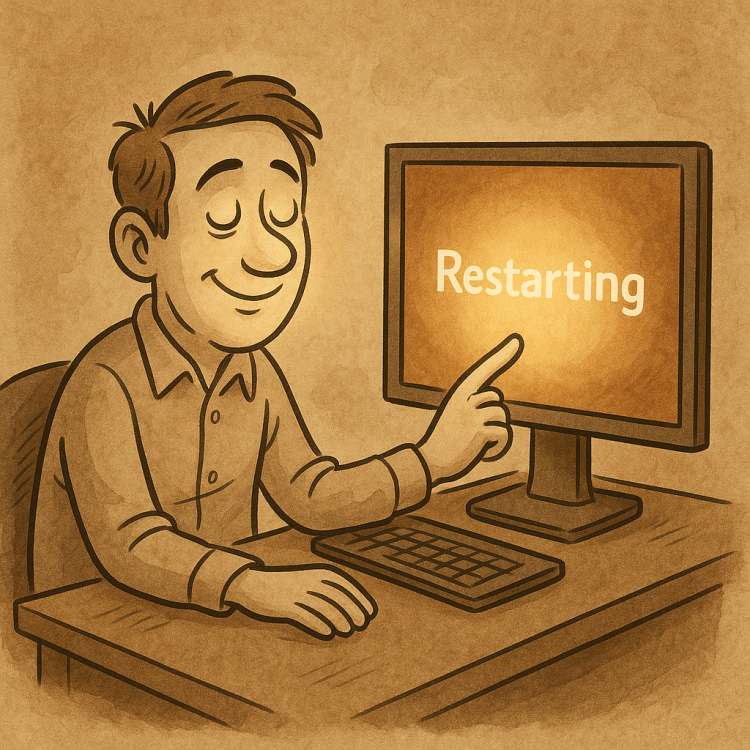


How to Restart Your Computer (and Your Life)

You’ve tried everything. The screen freezes, your patience collapses, and you begin negotiating with technology like an ancient priest. “Just one more click,” you plead. It ignores you. You sigh, press “Restart,” and watch the glowing circle spin — the modern mandala of surrender. In that moment, you realize the wisdom hidden in circuitry: sometimes you have to stop everything to start again. As your computer hums back to life, so do you. A clean desktop. A fresh start. Proof that even machines believe in resurrection.


Final Reflection: The Philosophy of the Everyday

Maybe the point isn’t to master these things at all. Maybe it’s to laugh through the mess — the crooked pictures, tangled cords, burnt toast, and blinking clocks. Life’s small struggles remind us that perfection is a myth and humility the only real user manual. We don’t conquer the domestic world; we dance awkwardly with it. So hang the picture, fold the sheet, make the coffee, and misplace the remote. You’re not failing — you’re participating in the grand comedy of being human. Somewhere, the universe is chuckling too, slightly crooked on its own cosmic nail.

The Mind of the Accountant and the Eye of the Auditor

A collaboration between Lewis McLain & AI

A study in order, vigilance, and the quiet guardianship of trust


I. The Architecture of Order

To the outside world, accounting may seem like the dry science of numbers.

To those who live within it, it is a living language — a world built from logic, discipline, and faith.

The accountant’s mind craves order. The ledger is not arithmetic; it is architecture. Each debit and credit forms the beams and walls of an invisible structure called trust.

There is beauty in that symmetry — the quiet satisfaction of a trial balance that ties, of a reconciliation that clears to the cent, of statements that make sense. Each finished report feels like completion, a sign that chaos has been subdued by precision.

The accountant’s calm arises not from perfection, but from alignment — when the columns stand straight, and truth, however complex, is at last in view.


II. The Moral Weight of Accuracy

Accounting is not merely technical work; it is moral work. The accountant is a steward of other people’s resources — the bridge between the seen and unseen, between what is earned and how it is reported.

Every line in a financial statement carries ethical weight. A misplaced zero, a deferred cost, an overlooked accrual — each can distort not only books but decisions, and ultimately lives. What do we own, and what do we owe? Where are all our assets?

Accuracy is therefore an act of stewardship, not pride. The numbers must not only add up; they must tell the truth. That truth, rendered in ink, becomes the permanent memory of what an organization once was.

The accountant’s quiet creed is simple: Be honest, even when no one is looking.


III. The Sixth Sense of What’s Missing

Over time, accountants develop a peculiar sixth sense — the instinct that something is missing. A pattern feels off. A variance doesn’t sit right. A vendor name repeats too perfectly. Nothing overtly wrong, yet something doesn’t breathe correctly.

This intuition is learned, not mystical — honed through repetition, reflection, and mistakes that left scars. The accountant listens not only to numbers, but to silence — to what’s absent.

When something doesn’t fit, they dig until it does. They follow the faintest ripple across spreadsheets and schedules until the hidden piece falls into place. The result is not triumph, but restoration. To the accountant, balance is not a convenience — it is peace.


IV. The Pulse of Pressure

The accountant’s life is lived in cycles of closure and renewal. Month-end closes are counted in days, not weeks. As soon as one period ends, the next begins.

There are always reconciliations to run, journal entries to post, accruals to adjust, and statements to explain. The calendar does not pause; neither does the ledger.

Accuracy must arrive on schedule. Reports must be both precise and timely. The weight of expectation grows with every fiscal deadline, until the close itself becomes ritual — long hours, weary eyes, and the satisfaction of seeing a system hold under pressure.

No one applauds. But the accountant doesn’t work for applause. They work for that quiet sense of completion — when order returns and chaos recede. And maybe professional recognition due to industry review of financial reports.


V. The Labyrinth of Rules

Accounting today is a living maze of evolving standards: FASB, GASB, IRS, and countless interpretations between.

The rules that once simplified have become their own language — one so technical that even accountants must reread their own work to ensure meaning.

Financial statements, intended to clarify, often obscure. The accountant must therefore be both technician and translator — explaining the spirit behind the rule, not just its wording. When NYC defaulted in 1975, who ultimately got the blame? The accountants. This is why GASB was formed, and the world was never to be the same.

The accounting professional is filled with scholars of ambiguity, reconcilers of theory and practice. For every new pronouncement, the local accountant must discern: Does this reveal truth, or merely rearrange it? They are strapped with an obligation called COMPLIANCE.


VI. The Technological Tightrope

The accountant’s tools have evolved from ledgers to laptops, from pencils to macros, from paper to code. Automation promises accuracy, but it cannot promise understanding.

A spreadsheet can reconcile thousands of entries, yet conceal the meaning behind them. A macro can balance accounts, yet balance the wrong ones perfectly.

The accountant’s role has shifted from doing to discerning — from entering data to questioning results. Technology performs; judgment interprets.

Machines count. Humans comprehend. That truth remains unaltered through every innovation.

The accountant’s gift is not calculation, but conscience and insightfulness.


VII. The Human Translator

Accounting is, at its core, communication — the translation of complexity into clarity.
Yet it is here that many accountants struggle most. They love numbers more than words. They trust balance sheets more than meetings. And management, for its part, often wants the time, not how the watch was made. They want results, not process; summaries, not stories.

The best accountant may find it difficult to explain why the numbers matter. They present truth, but their listeners may hear only totals. And when a city manager smiles and says, “Good job!” — not realizing that red flags lie just below the surface — the accountant’s chest tightens.

The greatest fear is not criticism, but false comfort. To be praised for what isn’t right is to stand silently in a burning room. For the accountant, understanding is the highest form of respect — and indifference, the deepest wound.


VIII. The Eye of the Auditor

If the accountant builds, the auditor examines. If the accountant assembles the structure, the auditor tests its strength. The auditor’s mind is trained in disciplined skepticism — trust, but verify; believe, but prove. They deal not in opinion, but in evidence. Every number must have a trail, and every trail, a source.

Auditors do not seek fault. They seek assurance. Their purpose is not to accuse, but to confirm — to restore public faith in what the numbers claim. They, too, bear a moral weight: independence is their virtue, consistency their craft, and integrity their highest calling.


IX. The Tension Between Builder and Examiner

And so, in the quiet late hours of an audit season, tension and humor coexist. The accountant, weary but proud, leans back and says:

“Don’t I ever get to make a hundred?”

The auditor smiles and replies:

“No — because in my boss’s eyes, I make zero then.”

It is a moment of mutual respect — tinged with fatigue, softened by truth. The accountant wants recognition, the auditor dreads mistakes. Both are bound by the same perfection no one can truly reach.

The accountant knows too much of human nature to be naïve. They know someone is stealing — right now — even as they stand there reading this essay. Not always through malice, but through opportunity, convenience, and rationalization.

They know who upgrades flights for miles, who calls lunch “training,” who writes off the small things as harmless. They know that internal controls, like separation of duties, often crumble under the weight of small staff. Sometimes one person must issue checks, reconcile the bank, and sign approvals — not from corruption, but necessity.

The accountant does not judge this lightly. They know the difference between intent and circumstance. Still, they remain vigilant — because integrity, once neglected, never drifts toward honesty on its own.


X. The Dance of Respect

Despite the tension, accountant and auditor share a rare kinship. They live on opposite sides of the same truth — one constructs it, the other tests it.

Their dialogue can be frustrating, but it is essential. Without the auditor’s challenge, the accountant’s work lacks confirmation. Without the accountant’s diligence, the auditor’s skepticism lacks foundation.

When the audit concludes, and the opinion reads “unqualified,” there is no celebration — only the shared exhale of relief. Truth has held. Trust endures another year.

It is not victory, but vindication.


XI. The Power of Ongoing Learning

Accounting is not static. It is a living discipline that evolves with every new rule, risk, and revelation. The best accountants reinvent themselves continuously — not merely to stay current, but to grow wiser. Training is not compliance; it is craftsmanship.

Each seminar, course, and standard update sharpens their mind and broadens their moral sense. They don’t just learn what changed — they ask why it changed, and who it protects. They know they need training, but they often question why they came only to learn about things they need to worry about.

But learning alone isn’t enough. The richest insight comes from conversation — the exchange of experience among peers who understand the same weight. Comparing practices, barriers, and solutions is not small talk; it is sustenance. In those conversations, the accountant rediscovers community. They realize that even in a profession of detail and solitude, wisdom is collective.

The accountant who invests in growth invests in endurance — in the ability to think, question, adapt, and still care.


XII. The Broader Meaning of the Profession

Accounting and auditing together form one of civilization’s oldest moral systems. The first ledgers of Mesopotamia recorded grain not for curiosity, but for fairness. To account was to prove that trust could be measured.

That same covenant endures. Every statement, every audit, is a renewal of that ancient vow: that truth can be documented, verified, and believed. Without accountants and auditors, no institution stands. They are the unseen guardians of every promise that requires proof.


XIII. The Quiet Triumph

When the final adjustments are made and the audit report signed, there is no crowd, no music, no medals. Just the stillness of the lamplight and the quiet hum of completed order. The accountant exhales; the auditor nods. They both know tomorrow it begins again — new data, new errors, new doubts. But for this night, the numbers rest, and so do they.

The world continues — steadied, unknowingly, by their invisible craft.


XIV. Reflection Poem: “The Ledger and the Light”

Numbers align where truth abides,
Ledgers breathe, the balance guides.
Through sleepless nights and endless dates,
The steward counts, the auditor waits.

One builds the story, one tests the frame,
Each bound to order, yet both aflame.
“Don’t I ever make a hundred?” one sighs with a grin,
“No,” says the other, “for I make zero — if I let error in.”

They both know what others never will see —
The thefts of trust, the frailty of duty.
Small staffs stretched thin, lines that blur,
The watchful hearts that still endure.

When managers praise what they don’t understand,
The accountant trembles, ledger in hand.
For truth untested is faith unearned,
And trust once lost is rarely returned.

So they study, they learn, they speak, they share,
They sharpen the craft through those who care.
When ink meets light and doubt gives way,
Their work, though quiet, holds the day.

For where they stand, the world can trust —
That numbers mean what numbers must.

Madagascar Current Events

Written by AI Based on Questions From Lewis McLain

Strategic Situation, Economic Profile, and Global Implications


Executive Summary

What is the deal with Madagascar? I wasn’t quite sure where it was until I heard about the military taking over the government today. I prepared this paper today as if I had been asked to brief an executive on any subject. As a student of government, I had questions. AI helped me get the answers, so here we go.

Madagascar stands at a turning point. After months of youth-led protests and a mutiny by the CAPSAT (1) elite military unit, President Andry Rajoelina was impeached and fled the country. A military council now governs and has suspended the courts and commissions, promising a new constitutional order within two years.

Commanding the Mozambique Channel, the island anchors the trade corridor linking Africa, the Middle East, and Asia. Its economy is built on vanilla, nickel, cobalt, ilmenite, and gold—resources that feed global supply chains from food flavoring to electric vehicles. The direction of its transition will determine whether the western Indian Ocean tilts toward democratic recovery or prolonged military dominance.


1 | Strategic Importance

Madagascar occupies a central position in the southwest Indian Ocean, east of Mozambique and west of Réunion and Mauritius.

Covering 587,000 km², it is roughly 45 percent larger than California or almost the size of Texas, with about 31 million inhabitants and the capital at Antananarivo.

Its location astride the Mozambique Channel gives it influence over one of the world’s busiest maritime arteries—used by oil tankers, container ships, and subsea cables. Whoever governs Madagascar shapes the security of sea-lanes vital to East Africa, the Persian Gulf, and South Asia.


2 | Historical Overview (1960 – 2025)

Independence and Early Instability (1960–1972)
Madagascar gained independence from France on 26 June 1960 under President Philibert Tsiranana, whose moderate, pro-French government preserved economic ties to Paris. By the early 1970s, discontent over inequality, rural neglect, and perceived neo-colonialism triggered strikes and mass protests. In 1972, Tsiranana ceded power to the army under Gen. Gabriel Ramanantsoa, inaugurating a cycle of military influence that still echoes today.

Authoritarian Experiment (1975–1991)
After a brief interim, Col. Richard Ratsimandrava was assassinated only six days into office. Admiral Didier Ratsiraka then consolidated control, founding the socialist-leaning Second Republic in 1975. His “Red Book” of revolutionary socialism nationalized industry and aligned Madagascar with the Soviet bloc and North Korea.

Initial enthusiasm faded as the economy collapsed under state planning, corruption, and isolation.

Democratic Opening and Backlash (1991–2002)
Mass demonstrations in 1991 forced political liberalization and the adoption of a new constitution. Albert Zafy became the first democratically elected president but was impeached in 1996 amid corruption allegations. Ratsiraka returned in 1997, attempting liberal reforms without restoring trust.

The disputed 2001 election between Ratsiraka and Marc Ravalomanana paralyzed the nation for months until the military again intervened—this time to back Ravalomanana, whose pro-business policies revived growth but widened inequality.

The 2009 Coup and Prolonged Transition (2009–2013)
When Ravalomanana’s popularity waned, opposition leader Andry Rajoelina, then mayor of Antananarivo, led protests backed by elements of the armed forces. The 2009 coup ushered in nearly five years of suspension from the African Union and crippling aid cuts.

Civilian Return and Renewed Fracture (2013–2025)

Elections in 2013 brought Hery Rajaonarimampianina to power, followed by Rajoelina’s return in 2018. Despite modest economic gains, corruption, weak infrastructure, and power shortages persisted.

By 2023, democratic fatigue was evident: turnout plunged, opposition parties boycotted, and urban frustration boiled over.

In 2025, the CAPSAT mutiny and street protests merged into a decisive rupture. Parliament impeached Rajoelina, the president fled, and Col. Michael Randrianirina declared a transitional government—Madagascar’s sixth regime change in sixty years.


3 | Current Political Situation (October 2025)

  • Presidency: Vacant; Rajoelina reportedly in exile.
  • Military: CAPSAT commands all branches and central administration.
  • Parliament: The National Assembly remains formally seated but powerless.
  • Judiciary: Courts and commissions suspended “pending reform.”
  • Transition Plan: Elections and a constitutional referendum promised within two years, though no binding schedule is in place.

4 | Economic and Trade Profile

Madagascar’s economy remains fragile and highly export-dependent.

Key products include nickel and cobalt (≈ USD 800 million annually), vanilla (≈ USD 389 million), cloves (≈ USD 340 million), gold (≈ USD 250 million), and textiles (≈ USD 170 million).

Exports flow mainly to China, India, Oman, France, and South Africa; imports come chiefly from China, Oman, France, India, and the UAE.
Major industrial anchors:

  • Ambatovy Nickel/Cobalt Mine (Sumitomo-led consortium).
  • QMM Ilmenite Mine (Rio Tinto joint venture).

5 | Education and Income

Adult literacy stands near 78 percent, while learning poverty—children unable to read by age 10—remains around 94 percent. Primary completion rates are roughly 57 percent for boys and 62 percent for girls.

The World Bank classifies Madagascar as Low-Income, with Gross National Income (GNI) per capita below USD 1,135 and nominal GDP per capita around USD 600.


6 | Defense and Security Forces

The defense establishment consists of an Army, Navy, Air Force, and internal Gendarmerie/Police.

The Army dominates politics and internal order.

The Navy’s few patrol vessels operate from Antsiranana, Nosy Be, and Mahajanga, policing the channel for illegal, unreported, and unregulated (IUU) fishing.

The Air Force possesses light transports and helicopters but minimal combat aircraft.

Foreign training and equipment arrive intermittently from France, the United States, and China.


7 | External Actors and Influence

  • France remains the legacy power, leveraging its territories in Réunion and Mayotte for military reach and EU diplomacy.
  • India, through its SAGAR (4) initiative, expands radar networks and port calls to secure Indian Ocean shipping.
  • China deepens ties via the BRI (2) and may exploit economic distress to gain long-term concessions.
  • Japan and South Korea safeguard their stakes in Ambatovy and could offer technical aid.
  • The United States focuses on maritime security, critical-mineral supply chains, and democratic governance.

Expect intensifying competition among France, India, and China over influence and access during the transition.


8 | Possible Futures (2025 – 2027)

Credible Transition:
A published election calendar, reopened courts, and donor engagement restore legitimacy. Exports stabilize, investment resumes, and tourism revives.

Managed Stagnation:
Delays and selective repression persist under a veneer of reform. Economic uncertainty and youth emigration rise.

Entrenchment or Fragmentation:
The junta hardens or fractures; AU/SADC (8) sanctions follow. Exports falter, humanitarian stress deepens, and external authoritarian actors gain ground.


9 | Policy Risks and Opportunities (U.S. Perspective)

Strategic Risks

  1. Resource Nationalism and Contract Risk
    The transitional regime may reopen or revoke agreements for Ambatovy, QMM, and smaller mining concessions. Western firms could face retroactive taxation or forced joint ventures, particularly if China offers bail-out financing.
  2. Democratic Backsliding and Human Rights Concerns
    Prolonged military rule risks entrenching authoritarian practices. Crackdowns on journalists and civil-society groups would isolate the country from donors and could trigger AU or U.S. sanctions.
  3. Migration and Humanitarian Pressure
    Political uncertainty and climate stress (cyclones, droughts) could push thousands toward Comoros, Réunion, and Mozambique, straining regional capacities and humanitarian budgets.
  4. Geopolitical Drift to Authoritarian Patrons
    Should Western aid pause, the junta may pivot toward Chinese or Russian security partners, trading resource access for political backing.
  5. Maritime Insecurity
    A weakened or politicized navy would hamper anti-IUU enforcement and open the channel to trafficking and piracy, threatening commercial shipping and U.S. maritime interests.

Opportunities for Constructive Engagement

  1. Governance Conditionality
    Tie all financial support to a transparent, dated transition roadmap endorsed by the African Union (AU) and Southern African Development Community (SADC).
  2. Maritime Partnerships
    Expand Maritime Domain Awareness cooperation, providing small-craft support, radar integration, and training to curb illegal fishing and improve search-and-rescue readiness.
  3. Humanitarian Assistance and Disaster Relief (HADR) (5)
    Cyclone-response and climate-resilience projects build goodwill and protect U.S. brand presence without direct political entanglement.
  4. Economic Resilience and Supply-Chain Diversification
    Convene U.S. buyers of vanilla and critical minerals to design contingency sourcing and fair-trade initiatives, insulating American firms from price spikes while supporting Malagasy producers.
  5. Multilateral Coordination
    Align with EU, France, India, and Japan to deliver a unified donor message. Coordinated diplomacy reduces space for opaque deals under the BRI and promotes transparent resource governance.

10 | Key Facts at a Glance

  • Population: ≈ 31 million (2025 est.)
  • Income Level: Low-income economy (GNI ≤ USD 1,135)
  • Adult Literacy: ≈ 78 %
  • GDP per Capita: ≈ USD 600 (nominal)
  • Main Exports: Nickel, Vanilla, Cloves, Gold, Textiles
  • Primary Partners: China, Oman, India, France, South Africa
  • Defense Branches: Army, Navy, Air Force, Gendarmerie, Police

Footnotes – Acronyms and Terms

  1. CAPSATCorps of Personnel, Administrative, and Technical Services (elite Malagasy military unit).
  2. BRIBelt and Road Initiative, China’s global infrastructure and finance program.
  3. IUU FishingIllegal, Unreported, and Unregulated fishing activities.
  4. SAGARSecurity and Growth for All in the Region, India’s Indian Ocean policy framework.
  5. HADRHumanitarian Assistance and Disaster Relief, disaster-response cooperation.
  6. GNIGross National Income, used for World Bank income classification.
  7. WB / IMF / EUWorld Bank, International Monetary Fund, European Union.
  8. AU / SADCAfrican Union and Southern African Development Community, regional bodies for governance and security.
  9. USDUnited States Dollar.

Wants vs. Needs: The Ancient Search for the Good Life

Influenced by Dan Johnson, Written by Lewis McLain & AI

“The hunger for truth is the only need that can quiet the hunger for more.”


Introduction – The Philosophers and the Question of Desire

Long before the modern world filled with advertising and endless choice, three Greek philosophers—Socrates, Plato, and Aristotle—asked a question that still shapes every generation: What do people truly need to live well, and what do they merely want?
These men lived in the fifth and fourth centuries before Christ, centuries before the New Testament and before the Hebrew Scriptures were widely known in Greek. The Old Testament had already been written, but it existed mainly in Hebrew. The first Greek translation—the Septuagint—would not appear until about 250 BC, long after their deaths.

Thus, any harmony between their philosophy and Scripture is not influence but convergence—the meeting of human reason and divine revelation along parallel paths of wisdom. Each of these men sought meaning in an age of moral confusion and spiritual hunger, tracing a journey from ignorance to illumination, from appetite to understanding, from want to need. They remind us that wisdom is not born in comfort, but discovered in questioning.


Socrates: The Questioner of the Soul

Socrates (469–399 BC) is often called the father of Western philosophy. He wrote nothing himself; instead, he taught through conversation, walking the streets of Athens and engaging anyone who would listen. He used what we now call the Socratic Method—a disciplined form of dialogue built on relentless questioning. For Socrates, teaching meant guiding others to uncover truth already within them.

He believed that wisdom begins not in knowledge but in humility—the honest recognition of one’s own ignorance. To know that one does not know, he said, is the beginning of wisdom. That attitude set him apart from the arrogant teachers and politicians of his day. His conversations often exposed the ignorance of the powerful, earning him both admiration and enemies.

When Athens put him on trial for “corrupting the youth” and “disrespecting the gods,” he refused to abandon his convictions. He was offered a chance to flee, but declined. Instead, he calmly drank the hemlock and died in peace, choosing truth over life itself. “The unexamined life,” he said, “is not worth living.” In those words, he transformed death into testimony.

His courage mirrors the timeless wisdom of Proverbs 4:7: “Wisdom is the principal thing; therefore get wisdom.” Though separated by centuries and culture, both Socrates and Scripture call humanity to put truth above comfort. He believed that wrongdoing came not from evil intent but from ignorance—because no one who truly knows the good would deliberately choose the bad. For him, virtue and knowledge were inseparable. Evil was a shadow cast by misunderstanding.

In that light, Socrates stands as the first great physician of the soul. He asked questions not to embarrass, but to heal. His method endures as a call to honest reflection: before we seek wealth, honor, or pleasure, we must first ask, What is right? What is true? And only then can we ask, What is enough?


Plato: The Philosopher of Light

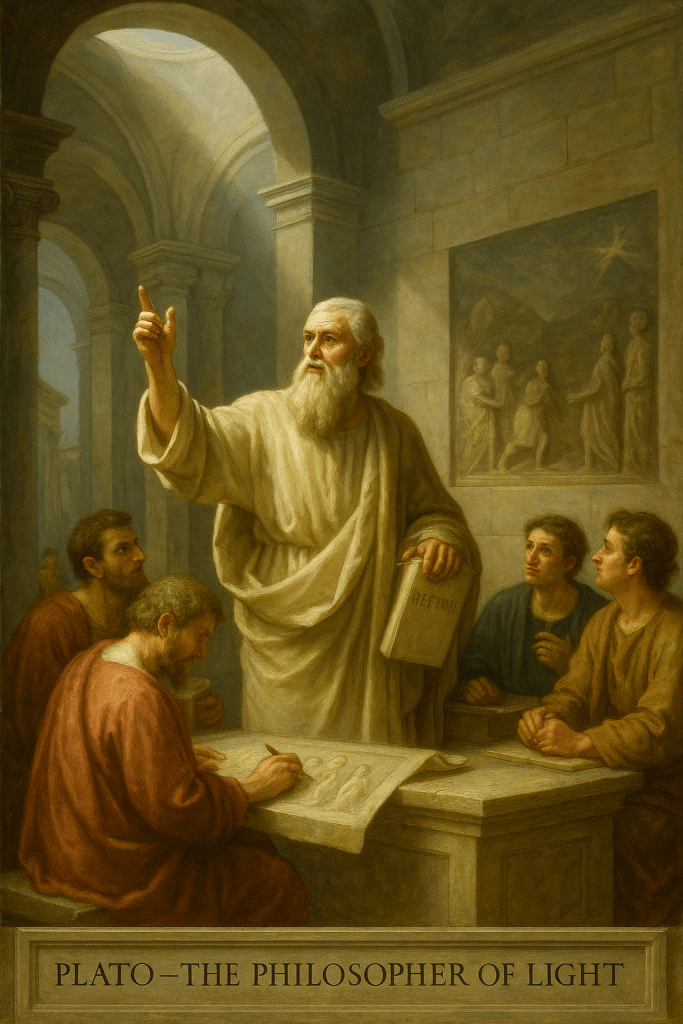
Plato (427–347 BC), Socrates’ most devoted student, inherited his teacher’s passion for truth and turned it into a philosophy of the eternal. He founded The Academy—the first great university of the Western world—and sought to understand the nature of reality itself. For Plato, everything visible was merely a reflection of something invisible, a shadow of a higher pattern he called a Form.

To Plato, this visible world was a realm of change and illusion, while the unseen world of Forms was eternal and perfect. Among these Forms, one stood above all: The Good—the source of all truth, beauty, and justice. Just as the sun allows the eye to see, the Good allows the mind to know. The human soul’s greatest need, Plato said, is to turn away from the shadows of appearance and face the light of the Good. Only then can it find peace.

This teaching finds a surprising parallel in Scripture: “Do not store up for yourselves treasures on earth, where moth and rust destroy, but store up treasures in heaven” (Matthew 6:19–21). Both urge us to look beyond temporary possessions toward what endures forever.


The Allegory of the Cave

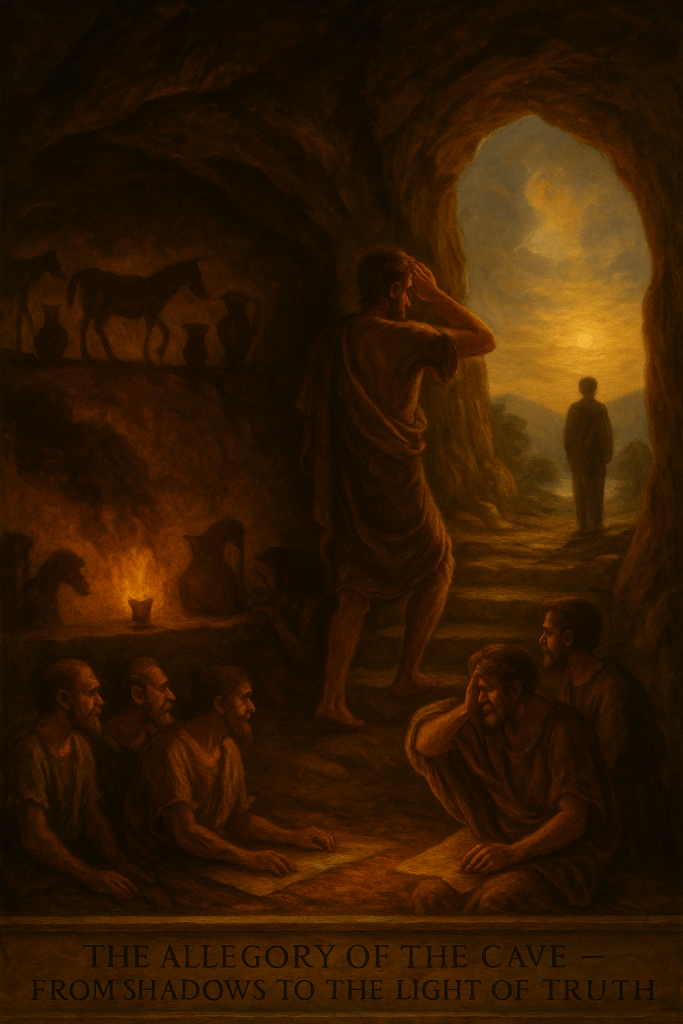
In his most famous story, Plato imagines a group of prisoners chained since birth in a dark cave. Behind them burns a fire, and between the fire and the prisoners, other people carry objects along a wall. The captives can see only the shadows cast on the wall before them—and to them, those shadows are reality. They have never seen the world beyond the cave.

Then one prisoner is freed. The light blinds him at first. The path upward is painful. But when he finally emerges into the sunlight, he sees the true world—trees, mountains, rivers, and the sun itself. He realizes that what he once thought was real was only an imitation. Filled with wonder, he returns to free the others, but they laugh, mock, and threaten him. They prefer the familiar comfort of darkness to the painful brightness of truth.

The cave is ignorance; the fire is illusion; the sun is the light of truth. Yet Plato’s story is not just intellectual—it is moral and emotional. The freed man must leave behind friends who are content with shadows. His return to the cave, only to be rejected, mirrors the prophet’s calling and Christ’s rejection by those who preferred darkness to light.

As Jesus said in John 8:12, “I am the light of the world. Whoever follows me will not walk in darkness, but will have the light of life.” The parallel is clear: both call humanity from illusion to reality, from fear to faith, from want to need. Plato’s freed prisoner is not merely a thinker; he is a convert, reborn by enlightenment.


Aristotle: The Philosopher of Balance

Aristotle (384–322 BC), Plato’s greatest student, was more practical than his master. Where Plato looked to heaven, Aristotle looked to the world around him. He believed that knowledge begins in experience, not abstraction. He saw nature as a teacher, and reason as humanity’s greatest tool for understanding it.

In Nicomachean Ethics, Aristotle asks what makes a life truly good. His answer is eudaimonia—a word meaning “flourishing” or “well-being.” True happiness, he argued, is not pleasure or wealth but the full development of virtue, the fulfillment of one’s purpose.

Every human, he said, has a telos, or end—a natural goal. Just as an acorn’s purpose is to become an oak, a human’s purpose is to live according to reason and virtue. Happiness is achieved not by accident but by consistent moral effort. It is a lifelong practice, not a passing mood. Virtue, Aristotle insisted, is a habit formed through discipline.

He also taught that virtue lies in balance—the Doctrine of the Mean. Every moral quality, he said, stands between two extremes. Courage is the balance between cowardice and recklessness. Generosity lies between stinginess and extravagance. Self-control lies between indulgence and indifference. The virtuous person does not destroy desire, but masters it. Reason is not the enemy of feeling—it is its guide.

Aristotle also divided life’s goods into three levels.
The first were external goods—wealth, reputation, and possessions—useful, but unstable. Fortune could give and take them away.
The second were bodily goods—health, rest, and safety—necessary, but not sufficient for happiness.
The third and highest were goods of the soul—virtue, wisdom, friendship, and contemplation. These are lasting, self-contained, and fulfilling. Only when these are cultivated can a person live well, regardless of circumstance.

This harmony of thought aligns beautifully with Philippians 4:11–13, where Paul writes: “I have learned to be content whatever the circumstances… I can do all things through Christ who strengthens me.” Both the philosopher and the apostle teach that contentment does not depend on abundance but on order—the soul’s alignment with truth.

Aristotle also reasoned that all motion must have a cause. Tracing this logic backward, he concluded that there must be a Prime Mover—a perfect being that moves all things without itself being moved. Centuries later, Thomas Aquinas identified this Prime Mover as God. Reason, Aristotle showed, is a lamp bright enough to reach the edge of revelation.


The Philosophical Continuity

Together, these three philosophers form one continuous ascent of thought. Socrates questioned falsehood and awakened conscience. Plato sought eternal reality and called the soul toward the light. Aristotle translated that vision into practice, showing how to live wisely in the world.

One generation asked the question, the next envisioned the answer, and the third applied it to daily life. They represent humanity’s climb toward wisdom—a spiritual evolution from ignorance to understanding, from confusion to clarity. Their ideas shaped not only philosophy but law, science, and faith. When early Christian theologians sought to express divine truth in rational form, they turned to the tools these men had forged.


Shared Wisdom and Biblical Harmony

Though they lived before Christ, Socrates, Plato, and Aristotle echoed the moral melody later perfected in Scripture. Socrates’ relentless pursuit of wisdom anticipates Proverbs 9:10: “The fear of the Lord is the beginning of wisdom.” Plato’s longing for unseen reality parallels 2 Corinthians 4:18: “We fix our eyes not on what is seen, but on what is unseen.” Aristotle’s insistence on moderation and moral character reflects Micah 6:8: “To act justly, to love mercy, and to walk humbly with your God.”

Their voices rise from different centuries and languages, but their harmony is unmistakable. Each saw that human desire must be ordered by a higher principle—that the path to fulfillment runs through discipline, reflection, and faith. Their shared message is timeless: wants are endless, but needs are purposeful.

Wants gratify; needs transform. Wants fade like shadows; needs form the soul.


The Meeting of Athens and Jerusalem

Centuries later, early Christian thinkers recognized that the light these philosophers glimpsed was the same light Scripture revealed. Justin Martyr and Clement of Alexandria, two of the earliest theologians to engage Greek philosophy, believed that reason itself was a divine gift that led humanity toward God. Justin called philosophy “the schoolmaster that leads the mind to Christ,” and Clement wrote that faith and reason are “two wings of the same truth.”

When the Septuagint—the Greek translation of Hebrew Scripture—was completed, it became a bridge between cultures. Athens could finally hear Jerusalem, and Jerusalem could answer Athens. What Socrates sought, what Plato imagined, and what Aristotle reasoned, the Gospel fulfilled in Christ, “the true Light that gives light to everyone” (John 1:9).


The Allegory in Life: From Shadows to Light

Every person, Plato might say, lives in some version of the cave—chained not by iron but by illusion. We mistake image for substance, approval for love, comfort for peace. The modern world projects its own shadows on our walls: screens glowing with distraction, news cycles that amplify fear, and wealth that masquerades as worth. Yet the call upward remains the same. The climb is steep, but the light is steady.

Faith completes what philosophy began. The light beyond the cave is not abstract Goodness—it is Christ Himself.

“For God, who said, ‘Let light shine out of darkness,’ made his light shine in our hearts” (2 Corinthians 4:6).

The soul’s journey from ignorance to illumination is not only the story of reason—it is the story of redemption.


Modern Reflection: Living Between Desire and Discipline

Socrates still whispers, “Question your assumptions.” Plato still calls, “Lift your eyes toward what is eternal.” Aristotle still teaches, “Live in balance and virtue.” And Scripture gathers their insights into a single command: “Seek first the kingdom of God and His righteousness, and all these things will be added to you” (Matthew 6:33).

In a culture of appetite, their words form an antidote. True happiness is not the freedom to want everything—it is the wisdom to need only what is good. Their combined witness forms a bridge from philosophy to faith, from knowledge to love.


Epilogue: The Climb Continues

Imagine Socrates questioning beneath the fig tree, Plato pointing upward toward the sunlight, and Aristotle sketching circles of balance upon the sand. Together they stand at the mouth of the cave as dawn breaks, their faces warmed by the same light that would later shine in Bethlehem. Their search for truth ends where revelation begins—in the light that does not fade.

In that light, wants fall silent. The soul finally rests, not in what it owns, but in Who it has found.


Reflective Poem – “The Light Beyond the Cave”

In the cave we chase our shadows,
mistaking flickers for the flame.
The chains we wear are woven of comfort,
our blindness praised by name.

But one climbs upward through the darkness,
eyes stung, heart stripped, soul torn.
He finds the sun, and trembling whispers,
“I see what I was made for, born.”

O Light of Lights, O Truth that calls,
unbind us from this clever grave.
Teach us to need what time can’t steal—
and seek the light beyond the cave.


Footnotes

  1. The Septuagint: The first major Greek translation of the Hebrew Scriptures, completed around 250 BC in Alexandria. It allowed Jewish and Greek intellectual worlds to meet, paving the way for the New Testament’s language and for Christian theology’s dialogue with Greek philosophy.
  2. Justin Martyr (100–165 AD): An early Christian apologist and philosopher born in Flavia Neapolis (modern Nablus). Originally a student of Greek philosophy, he converted to Christianity and defended it using reason. He was executed in Rome for refusing to renounce his faith.
    • “Martyr” was not his surname but an honorary title meaning “witness.” In Greek, μάρτυς (martys) described someone who testified to the truth, often unto death. Thus, “Justin Martyr” literally means “Justin the Witness.”
  3. Clement of Alexandria (c. 150–215 AD): A theologian and head of the catechetical school in Alexandria, Egypt. Deeply trained in philosophy, he taught that reason and revelation both come from God. Clement described philosophy as a “covenant gift,” preparing the Gentile world for Christ.

Concentric Circles of Concern

A collaboration between Lewis McLain & AI

Revisiting an influential book for me, fitting into the primary theme of my recent posts. LFM


Introduction: The Man Behind the Circles

William Oscar Thompson Jr. (1918–1980) lived a life that testified to the power of relationship. He was not a man of grand celebrity or global fame; rather, he was a pastor and evangelist whose impact spread quietly through students, parishioners, and colleagues who absorbed his conviction that the Christian life must be lived relationally, not institutionally.
After two decades of faithful pastoral work, Thompson became a professor of evangelism at Southwestern Baptist Theological Seminary in Fort Worth, Texas. It was there, during his own physical suffering and eventual battle with cancer, that he refined the model that would outlive him — a model that connected spiritual authenticity with human connection.

Thompson’s health declined even as his insight deepened. He realized that the gospel was never meant to travel primarily by microphone or mass event, but through people whose lives touched one another’s every day — in kitchens, workplaces, front porches, and hospital rooms. After his death in 1980, his wife, Carolyn Thompson Ritzmann, edited his unfinished manuscript, and evangelism teacher Claude V. King (best known for Experiencing God) later helped expand and republish it. The revised edition, Concentric Circles of Concern: Seven Stages for Making Disciples, was released in 1999 by Broadman & Holman, nearly two decades after the original 1981 publication.

The phrase “concentric circles” is not just a metaphor in Thompson’s hands; it is a theology of life. His belief was that the Christian’s influence for Christ begins not in distant mission fields but within the very relationships already entrusted to them. Evangelism, he argued, must ripple outward from the integrity of the inner life — from the soul that has been made right with God — until it touches every layer of community, from family to stranger. His framework provides a vision of discipleship that is both deeply personal and expansively missional, a reminder that faith spreads through people who love well.


The Concentric Circles and Their Living Logic

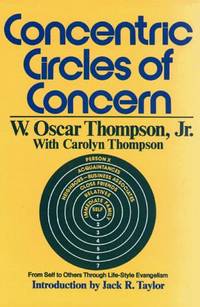
At the heart of the book lies a simple, unforgettable diagram: seven circles, each one nested inside the next, radiating outward from a center. The image, though deceptively modest, reshapes how one thinks about spiritual responsibility.

1. Self

The innermost circle, labeled Self, represents one’s own soul — the center of all relational and spiritual life. For Thompson, self-examination and humility before God are not indulgent acts but sacred ones. A Christian must first cultivate honesty with themselves and communion with their Creator. Spiritual neglect at this level produces hypocrisy; spiritual health here produces authenticity that naturally flows outward. He reminds his readers that “the most important word in the English language, apart from proper nouns, is relationship.” That relationship begins vertically — between oneself and God — and then extends horizontally into every human connection. Evangelism without integrity is noise; discipleship without inner renewal is hollow ritual.

2. Family

The second circle embraces one’s immediate family. It is easy, Thompson observed, to romanticize missions across oceans while ignoring ministry across the dinner table. The home is the first proving ground of grace. Faith that cannot be lived out among those who know us best will rarely stand in the wider world. A Christian who learns to forgive within marriage, to listen to their children, or to extend patience to aging parents is already practicing evangelism of the highest order. Family is the first “field” of discipleship, where love is tested daily and faith becomes tangible.

3. Relatives

The third circle includes extended family — the kin network that may stretch across states, generations, and emotional boundaries. These relationships are often complicated by history, misunderstanding, or absence. Thompson urges believers not to abandon these connections but to redeem them. The gospel’s reconciling power, he writes, often begins when a believer takes the initiative to heal an old wound or rekindle a neglected bond. A letter of apology, a phone call of encouragement, or an unexpected act of service within the extended family can become the spark of redemption.

4. Friends

Friends form the fourth circle — those we choose to walk beside in life. Unlike family, friendship is elective; it is built on mutual trust and shared affection. Thompson views friendship as one of the most powerful conduits of witness. Friends already see us unfiltered; they know our habits, hopes, and contradictions. When they witness genuine spiritual transformation in our character, they often feel it before they hear it. To live faithfully among friends is to let the gospel speak through laughter, loyalty, and long conversation.

5. Neighbors and Associates

Next come Neighbors and Associates — the people who share our routines but not necessarily our intimacy: colleagues, classmates, teammates, or the barista who knows our order by heart. Thompson believed these daily intersections were fertile soil for spiritual conversation, if approached with humility and care. Instead of seeing such relationships as mundane, he taught his students to see them as providential appointments. Every encounter, no matter how ordinary, carries the potential of divine significance.

6. Acquaintances

The sixth circle widens to include those we know only loosely — the casual relationships of community life. Here, evangelism takes the form of kindness and presence more than speech. Thompson often told his students that “you may be the only gospel someone ever reads,” meaning that one’s demeanor and compassion can preach where words cannot. Consistency — being gracious over time — often speaks louder than any tract or slogan.

7. Person X

Finally comes Person X — the unknown stranger, the person with no prior connection. Most evangelistic training begins here, teaching believers how to witness to strangers. Thompson deliberately places it last. He argues that the credibility built in inner circles prepares believers to approach outer ones with sincerity rather than anxiety. When a life already radiates peace and love, even a stranger senses authenticity. Evangelism to “Person X,” then, is not a special performance; it is the natural overflow of a life already aligned with God.

Thompson captured the urgency of this relational approach when he wrote, “Most of our lives are crucified between two thieves, yesterday and tomorrow. We never live today. But the time to live is now.” The concentric circles remind us that the mission field is not someday or somewhere else — it is here, in the people who already populate our lives.


The Seven Stages of Making Disciples

Thompson’s circles describe who we are called to influence; his seven stages explain how. The stages form a dynamic rhythm — not a rigid checklist but a living cycle of growth that repeats again and again.

Stage 1: Get Right

Spiritual influence begins with moral clarity. To “get right” is to confront sin, mend broken relationships, and align one’s will with God’s. Thompson likens unreconciled relationships to blockages in a pipe: until they are cleared, the Spirit’s flow is obstructed. Getting right means making amends, confessing pride, forgiving debts, and letting the Holy Spirit cleanse the inner life. This stage humbles the believer before they presume to guide another.

Stage 2: Survey

Once reconciled, the believer must “survey” their relational field — a prayerful mapping of the people God has already placed within reach. Thompson encouraged writing names in each circle, not as a project list but as a sacred responsibility list. The act of seeing these names laid out visually reawakens compassion. We begin to see that our lives are already mission fields bursting with divine opportunity.

Stage 3: Pray

Prayer, for Thompson, is the lifeblood of evangelism. He calls it “a guided missile — it always hits its target.” Prayer aligns the heart with God’s timing and opens doors that human persuasion cannot. The believer prays not only for conversion but for understanding, patience, and divine orchestration — that conversations will arise naturally, that the Spirit will prepare both speaker and listener. Without prayer, evangelism degenerates into salesmanship; with prayer, it becomes partnership with God.

Stage 4: Build Bridges

Bridge-building is the practical art of connection. It may involve hospitality, listening, volunteering, or sharing a meal. Thompson viewed every bridge as an act of incarnation — stepping into another’s world as Christ stepped into ours. Bridges require humility, empathy, and time. They often begin with small acts: remembering a name, showing up at a funeral, sending a card. Over time, these gestures form trust strong enough to carry the weight of truth.

Stage 5: Show Love

The fifth stage deepens bridge-building into tangible service. “Love that is not demonstrated is not credible,” Thompson warns. To show love means to meet needs: to feed the hungry, comfort the grieving, or simply listen without agenda. Genuine love expects nothing in return. When people experience that kind of care, they become open not merely to a message but to a Messenger. Thompson’s famous illustration of a student returning a stolen motorcycle mirror captures this stage perfectly: confession and restitution became a living sermon that words alone could not match.

Stage 6: Make Disciples

Having earned trust and demonstrated love, the believer can now share the gospel sincerely. But Thompson insists this is not the finish line — it is the midpoint. True discipleship involves walking with new believers as they learn to obey Christ, discover Scripture, and find community. Evangelism divorced from discipleship, he warned, produces orphans; discipleship joined with love produces heirs. Making disciples means nurturing growth until the new believer can, in turn, disciple others.

Stage 7: Begin Again

The cycle ends where it began — and then continues. The new disciple becomes a new center of concentric influence, applying the same seven stages to their own relationships. Thus, the gospel spreads organically, not by mass production but by multiplication — one circle at a time. Thompson’s model mirrors nature itself: seeds producing fruit that carries new seeds. Discipleship is the divine geometry of multiplication through love.


Theology and Heartbeat of the Model

At its core, Concentric Circles of Concern is a theology of incarnation. It declares that God’s mission moves through human relationships — not in spite of them. Christ entered history relationally, dwelling among us; His followers must do the same. The model ties spiritual maturity to relational responsibility. To be “right with God” without being reconciled to others is an illusion.

Thompson’s vision also bridges two great biblical commands: the Great Commission (“Go and make disciples”) and the Great Commandment (“Love your neighbor as yourself”). The circles remind believers that these are not separate mandates but two halves of the same calling. Evangelism divorced from love becomes manipulation; love without truth becomes sentimentality. The mature Christian practices both — speaking truth through relationships of genuine care.

Prayer anchors this balance. Thompson’s metaphor of prayer as a “guided missile” conveys both power and precision: prayer can reach where presence cannot. It can travel across distance, culture, and even hostility. When believers pray for those within each circle, their hearts become attuned to God’s compassion, and they see people not as projects but as souls.


Strengths, Challenges, and Contemporary Relevance

The enduring strength of Thompson’s model lies in its simplicity. It does not require technology, programs, or budgets — only attentiveness, humility, and perseverance. Yet its simplicity hides profound depth. The circles create a lifelong map for Christian influence, reminding believers that evangelism is less about campaigns and more about consistency.

In today’s world of fractured relationships and digital disconnection, Concentric Circles of Concern feels prophetic. Our social networks may have expanded, but our intimacy has shrunk. Thompson’s framework invites believers to slow down, notice, and invest. Modern adaptation can include digital circles — online friends, social followers, professional networks — but the principle remains unchanged: spiritual credibility flows through relationship.

Still, Thompson’s model demands balance. One must not become so inwardly focused that the outer circle, Person X, is forgotten. Nor should believers treat relationships as strategies for conversion. The goal is love, not leverage. When love is real, evangelism follows naturally. As Thompson might say, evangelism is not a project to complete but a person to become.


Memorable Quotations

“The most important word in the English language, apart from proper nouns, is relationship.”
“Intercessory prayer is like a guided missile — it always hits its target.”
“Most of our lives are crucified between two thieves, yesterday and tomorrow. We never live today.”
“Love that is not demonstrated is not credible.”
“You cannot lead someone closer to the Lord than you are yourself.”

These words capture his conviction that relational faith is both the method and the message of the gospel.


Reflective Poem — Ripples of Concern

I stand within the quiet center,
A soul restored, the heart made whole;
From this still place the circles widen,
Grace flows outward, soul to soul.

My home becomes the first frontier,
Where love must bloom before it’s taught;
And every quarrel, every silence,
Is soil where mercy must be sought.

Through friendship’s bridge and neighbor’s need,
Through acts of care that speak, not plead,
The gospel walks on human feet,
Love’s language stronger than a creed.

Beyond the known, to stranger’s face,
The ripples travel, still by grace;
Till every heart, in widening span,
Feels heaven’s pulse through human hands.

And when another life takes flame,
A new set of circles starts again;
From self to world, from love to light,
The pattern echoes Christ’s design.


Concentric Circles of Concern remains one of the clearest blueprints ever written for living out the Great Commission through the Great Commandment. Thompson’s wisdom continues to challenge believers to think relationally, act prayerfully, love tangibly, and live authentically — one circle at a time

The Shutdown That Won’t End: How America’s Fiscal Stalemate Became a Test of Creditworthiness

And Why the Bond Rating Agencies May Hold the Only Key to Ending It

By Lewis F. McLain, Jr.


I. The Standoff That Never Ends

Another fiscal year, another government shutdown.
The United States now governs by brinkmanship — running on a series of temporary spending bills that barely prevent collapse but never deliver stability. Each new “continuing resolution” buys only weeks of political truce.

In Washington, they call it negotiation. Everywhere else, it looks like a nation living paycheck to paycheck. It is actually worse than that. The U.S. has gotten by only by putting most of its excess on a credit card to the tune of $35,598,000 or $324,100 per taxpayer!

These short-term fixes, designed to “keep the lights on,” have become the defining symbol of America’s fiscal dysfunction. Lawmakers boast of avoiding disaster while guaranteeing the next one. The cost is not measured in missed paychecks alone, but in lost credibility — both with citizens and with the global markets that finance the republic.


II. Why the “Big Beautiful Bill” Didn’t Fix the Problem

When Congress passed the One Big Beautiful Bill Act (OBBBA) earlier this year, it was hailed as the long-awaited cure to America’s budget ills.
It was indeed a sweeping structural law — extending key tax cuts, revising welfare programs, and reshaping federal-state funding formulas.

But OBBBA was a policy framework, not an appropriations bill. It set the rules for how money could be spent but didn’t actually fund the government. The twelve annual spending bills that keep every agency running — from Defense to Education — remain incomplete.

Thus, the government shut down not because it lacked a vision, but because it lacked a functioning process. Even the worst person for financial management on planet earth could do better than the U.S. Government.


III. The Politics of Delay

Short-term CRs are not bureaucratic accidents; they are political strategy.

  1. They Preserve Leverage.
    A short CR allows each side to claim the next cliff as bargaining power.
  2. They Manufacture Urgency.
    By setting artificial deadlines, Congress ensures every debate becomes a crisis.
  3. They Diffuse Blame.
    Everyone claims partial credit for “keeping government open,” while no one takes responsibility for its paralysis.

This cycle — a patchwork of temporary lifelines — has become normalized. Yet in any other organization, such repeated failure to adopt a budget would be grounds for a downgrade, a leadership change, or both.


IV. The Rating Agencies: Watchful, But Timid

The major rating agencies — Fitch, Moody’s, and S&P — continue to issue cautious statements, but their restraint now borders on abdication. One must remember that they charge a fee to the governmental entity being rated, they represent the bondholders! The bondholders are the greatest constituency to be found. There are 350 billion U.S. citizens. Compare that to the $37 trillion “constituents” they represent.

  • Fitch warns that shutdowns “highlight governance challenges” but sees no immediate rating impact.
  • Moody’s, more decisive, already downgraded the U.S. from Aaa to Aa1 in May 2025, citing deficits and political dysfunction.
  • S&P notes that each week of shutdown could shave up to 0.2% from GDP growth but stops short of taking further action.
  • Scope Ratings in Europe calls the shutdowns a “negative signal of democratic decay.”

They are not wrong — just toothless.

Bond rating agencies are worthless when they only rattle sabers, if that.
Warnings without enforcement invite complacency, not reform. If a sovereign borrower can repeatedly risk default on its own operations without consequence, the rating system itself becomes performative — an echo chamber of polite disapproval.


V. The Garland Precedent: When Ratings Spoke Loudly

There is precedent for courage I am aware of. In the 1970s, the bond rating agency visited the City of Garland, Texas in person — not to offer advice, but to deliver a direct warning message.

The message was simple: “Stop playing tough on fiscal decisions. Balance your budget responsibly or face a likely immediate downgrade.”

The City Council took the warning seriously. By the next meeting, they had adopted corrective measures, and the city’s fiscal health stabilized. The visit worked not because Garland Council feared markets, but because it respected accountability.

It’s a story quietly echoed in other cities of that era, I’m sure — times when rating agencies acted like stewards of discipline, not commentators on chaos.


VI. The Case for Action Now

If such resolve worked in a Texas city half a century ago, imagine its effect on Washington today.
Bond rating agencies have the authority — and arguably the duty — to intervene decisively.

They could collectively declare this message before October 1:

“The United States has two weeks to fully reopen and fund the government, or face a downgrade of more than one notch.”

That single sentence would do what months of posturing cannot. Markets would react within hours.
Treasury yields would rise, the White House and congressional leaders would receive immediate pressure from financial institutions and state treasurers, and public attention would snap to the true cost of dysfunction. By the way, do you know how much of the $37 trillion is owned by foreign investors? What happens if the day comes for their $9 trillion in holdings to mature, they take the money, and decide to invest elsewhere? Go to http://www.debtclock.org to appreciate how fast it takes to rack up another $1 trillion in debt!

It would no longer be a debate about ideology — but about national credit survival.


VII. Why This Matters

Bond markets are not emotional. They reward stability and punish delay.
The United States retains its privileged position — as issuer of the world’s reserve currency — largely because investors still believe in its reliability.
But belief is not infinite. Every short-term CR and every unending shutdown erodes the myth of American infallibility.

A bold, time-bound ultimatum from the rating agencies would instantly clarify what is at stake:
that U.S. governance, not solvency, is now the chief risk to U.S. credit.


VIII. The Moral of the Shutdown Era

The nation’s fiscal problem is not a shortage of dollars — it is a shortage of discipline.
The Treasury and Federal Reserve can print money; it cannot print credibility.

Congress treats shutdowns as leverage. Presidents treat them as bargaining stages.
And the bond market, by refusing to act, has become the enabler of dysfunction.

The rating agencies have a choice: to remain cautious chroniclers of decline, or to be the mirror that forces reform. Their ratings are not just financial metrics — they are moral verdicts on governance.


IX. Conclusion: The Rating That Could Save a Republic

“Credit,” wrote Alexander Hamilton, “is the soul of a nation’s economy.”
But in our age, it may also be the conscience of a government that has lost its will to govern.

The bond rating agencies can end this stalemate — not by writing reports, but by drawing a line.
Two weeks. No more delays.
Reopen the government fully or face a downgrade severe enough to awaken both Wall Street and Main Street.

If they have the courage to act — as they once did in Garland, Texas — they could remind America that accountability still matters.

Because credibility, once lost, cannot be borrowed back.


Lewis is a municipal finance expert living in McKinney, Texas. While semi-retired (after 52 years), he was once the Garland Budget Director, the Dallas County Budget Officer (first in Texas) and then a VP in Public Finance for First National Bank in Dallas (now Bank of America). After his first ten years, he started consulting for local governments (about 40).

He still consults with about 16 entities such as DART, Brazoria County and the cities of Denton, Groves, Highland Village, Killeen, Leander, McKinney, Midland, Pearland, Richardson, Southlake, Stafford, Victoria and Wichita Falls. He has written several hundred articles, essays and blogs, most of which can be found at citybaseblog.net. He has also given hundreds of presentations at workshops all over Texas and other states, including a training session for young bond rating analysts in NYC years ago.

He was the Executive Director for the Government Finance Officers of Texas years ago and had an Ethics Award created in his name.

When Washington Stops, Cities Keep Going

Suggested by Jessica Williams, Written by Lewis McLain & AI

A Local Government Perspective on Federal Shutdowns

When the federal government grinds to a halt, television cameras point toward Washington, D.C. — toward empty offices, barricaded monuments, and finger-pointing press conferences. But the deeper story unfolds far from the Capitol. It takes place in city halls and neighborhoods where the real consequences of a shutdown ripple through families, local economies, and municipal balance sheets. While the federal government pauses, cities and towns must continue to serve, balancing fiscal prudence, compassion for affected residents, and the unshakable expectation that local government never stops.


I. The Federal-to-Local Connection

Local governments rarely make national headlines during a shutdown, yet their dependence on federal flow-throughs and reimbursements is significant. From Community Development Block Grants (CDBG) to HOME housing programs, from FAA airport reimbursements to FEMA disaster claims, federal funds support many city functions. The design of these programs compounds the risk: they are usually reimbursement-based rather than prepaid. When federal employees are furloughed, reimbursements stall — leaving cities to advance money from their own cash reserves to keep projects on track.

For instance, a housing rehabilitation program may already have contractors in the field and invoices pending. A delayed reimbursement from HUD can suddenly force a city to choose between advancing local dollars or halting work. Likewise, infrastructure projects tied to the FAA or Department of Transportation can stall midstream when the federal payment machinery freezes. Cities are left managing not only projects but expectations — of residents, contractors, and partner agencies.

Well-managed municipalities rely on robust fund balance policies and the ability to make interfund transfers. Yet even well-prepared finance directors find themselves navigating uncharted waters when multiple federal programs stop simultaneously. The lesson is clear: local governments bear real exposure to national political stalemates, even when they have done nothing wrong.


II. The Human Face of a Shutdown

A city’s greatest concern during a federal shutdown is not a spreadsheet but its people. In many communities, a meaningful share of the population works directly or indirectly for the federal government — postal workers, TSA agents, defense employees, and contractors. The economic fabric of a local government entity like McKinney, DART, or New Braunfels Utilities is interwoven with residents whose livelihoods depend on those paychecks.

When those checks stop, the impact is immediate and personal. Utility payments slow. Grocery budgets tighten. Local restaurants and retailers feel the chill. Within a week or two, the effects reach City Hall: rising delinquent water accounts, increased calls for payment extensions, and growing demand at local food pantries and nonprofits. The impact is felt across neighborhoods and income levels — from young families with mortgages to retirees on fixed incomes who supplement with part-time federal contract work.

Cities, being the most visible and accessible level of government, often absorb the frustration of residents caught in the crossfire. Even though the city did not cause the shutdown, it becomes the government people can still reach by phone or in person.


III. The Timing Challenge: Between Tax Deadlines and Utility Bills

Federal shutdowns often strike at awkward moments in the local fiscal cycle. In many Texas cities, property tax bills are just now being mailed as the federal government shutters. Most of the revenue from those bills will arrive over the next 90 days, which represents the most significant single inflow of cash for the entire year.

Fortunately, mortgage escrow requirements create a buffer. Because most homeowners make monthly escrow payments throughout the year, their mortgage servicers will remit property taxes to the city or county on schedule even if a federal shutdown temporarily disrupts their paychecks. This structural safeguard prevents an immediate collapse in property tax collections.

Yet not every taxpayer is escrowed. Small business owners, landlords, and those who pay directly can still delay payments — or struggle to meet their obligations if a shutdown drags into multiple months. For cities that rely heavily on prompt collections, this can create minor but measurable shortfalls that affect cash flow, particularly if compounded by reduced sales tax receipts and slowed utility payments.

Sales tax receipts, which arrive monthly, may dip if federal workers and contractors cut spending. The decline might not show up for several months, but the slowdown starts immediately in local commerce. At the same time, cities face delayed federal reimbursements and stable or rising service demand.

This combination stresses cash flow precisely when flexibility is most limited. For finance directors, this becomes a daily balancing act: ensuring payroll is met, capital projects stay funded, and reserves are used strategically without overreaction. A short-term shutdown may require little more than internal adjustments, but a prolonged one tests every line item in the budget.


IV. Managing the Municipal Response

During a shutdown, the most important city management function is communication. City managers and finance directors begin by identifying which programs rely on federal funds. Do those programs have enough local cash to bridge a temporary gap? Are any critical contracts or grants about to expire?

Departments review ongoing projects with federal reimbursements — airports, housing, transit, public safety, and disaster recovery. Some may need to slow their pace or reassign staff to prevent idle costs. Payroll and benefit obligations continue uninterrupted, of course, since city workers are paid locally.

At the same time, cities must consider how to support residents who suddenly face hardship. Utility departments might create temporary payment plans or defer disconnection notices for furloughed workers. Libraries, recreation centers, and community development offices may become gathering points for information and assistance. Some cities coordinate with local churches and nonprofits to help with rent and groceries.

The critical leadership challenge is tone: balancing fiscal discipline with empathy. Citizens need to see that their city understands their struggle — not through rhetoric, but through quiet, practical help.


V. The Broader Civic Consequences

Shutdowns carry a subtle but lasting cost to public trust. To the average citizen, “government” is a single concept — not layers of jurisdiction. When Washington falters, many lose confidence in all levels of government, including their city hall. This is unfair but inevitable.

Local government, therefore, has an opportunity and responsibility to demonstrate stability. Police still patrol, fire crews still respond, sanitation trucks still roll at dawn. This continuity becomes a visible reminder that while national politics may polarize, local service endures.

City leaders who communicate clearly — explaining which programs are affected and which are not — reinforce that trust. A well-crafted message from a mayor or city manager can calm uncertainty: “Your trash will still be picked up. Your water will keep running. City services are funded by your local taxes, not federal dollars.”

This reassurance may seem simple, but it strengthens the bond between residents and their local government at a time when faith in public institutions is fragile.


VI. The Financial Resilience Playbook

Each shutdown teaches cities to be more resilient. Smart local governments now build contingency plans much like those used for hurricanes or ice storms. The cause may be political, but the preparation is financial.

Key strategies include:

  • Building robust reserves. Fund balance policies that cover 90 to 120 days of operations give cities the flexibility to absorb delayed reimbursements or revenue slowdowns.
  • Diversifying revenue sources. Relying less on intergovernmental transfers and more on local revenue ensures stability.
  • Tracking exposure. Maintaining a database of all grants tied to federal agencies helps finance staff quickly assess risk when a shutdown begins.
  • Cross-training staff. If a federally funded program is paused, reassigned employees can temporarily assist in other departments, minimizing disruption.
  • Communicating with regional partners. Cities coordinate with counties, school districts, and COGs to align messages and pool resources for affected residents.

In Texas, where home-rule cities maintain broad authority, these actions demonstrate the spirit of local self-reliance that has long characterized municipal governance.


VII. The Emotional and Moral Dimension

Beyond numbers and policies lies the moral core of local government — compassion for neighbors. A shutdown reminds city employees why they serve. The clerk extending a payment plan to a furloughed resident, the firefighter delivering groceries to a struggling family, the librarian helping a laid-off contractor update a résumé — these quiet moments of service define a city’s heart.

They also embody what national politics often forgets: governance is not just the art of policy but the practice of care. Cities, precisely because they are close to the people, reflect the best instincts of government — to listen, to adapt, and to keep going.


VIII. Lessons for the Future

Each federal shutdown exposes the fragile seams of interdependence between national and local governments. For cities, the lesson is not merely to survive the next one, but to plan as though it were inevitable.

Cities should:

  1. Review and update financial contingency plans annually.
  2. Maintain relationships with federal and state partners to receive timely information.
  3. Incorporate shutdown scenarios into their cash-flow modeling.
  4. Develop citizen assistance programs that can be quickly activated.
  5. Use the experience as a teaching moment for civic education — showing residents how local finances truly work.

Ultimately, resilience is not only financial but cultural. A city that knows its role, understands its resources, and trusts its people will weather any temporary political storm.


IX. Conclusion – The Quiet Strength of Local Government

When Washington stops, cities keep going.
They pick up the trash, respond to fires, issue building permits, and answer 911 calls. They balance budgets in real time, not by ideology but by necessity. They hold the public trust not in headlines but in streetlights that stay on and water that keeps flowing.

The fiscal rhythm of a city continues — property tax bills just mailed, escrowed payments coming in from mortgage companies, and sales tax checks arriving monthly. The federal stalemate may cast a shadow, but local governments remain the steady pulse of everyday life.

A federal shutdown reveals more than dysfunction; it reveals the quiet strength of local government. It reminds citizens that the most dependable form of government is the one closest to home. Cities are the steady heartbeat of a nation whose higher powers may occasionally stumble.

And when the federal lights go out, it is the glow of City Hall that assures people the republic still stands — one water bill, one payroll, one act of service at a time.


Appendix A – Common-Sense Local Resilience Checklist

For Finance and Budget Officers

  1. Cash-Flow Modeling: Immediately model 30-, 60-, and 90-day liquidity scenarios assuming delayed federal reimbursements.
  2. Property Tax Timing: Track escrow remittances and direct-payer delinquencies separately to spot early stress points.
  3. Reserve Triggers: Define thresholds for when fund balance use requires council notification or resolution.
  4. Federal Program Audit: Identify active grants, agency contacts, and next reimbursement cycles.
  5. Deferred Spending: Postpone discretionary purchases and travel until normal operations resume.

For City Management and Departments
6. Communication Plan: Prepare clear public statements explaining what is and isn’t affected by the shutdown.
7. Utility Assistance: Create temporary payment plans for furloughed federal employees and contractors.
8. Community Coordination: Link with local churches, food banks, and nonprofits to share information and avoid duplication of aid.
9. Employee Flexibility: Reassign staff from federally funded projects to core services where possible.
10. After-Action Review: Once the shutdown ends, conduct a debrief and document lessons learned for future preparedness.

For City Leadership and Elected Officials
11. Maintain Calm Visibility: Hold briefings to assure residents that city services continue uninterrupted.
12. Avoid Partisanship: Keep communications focused on service continuity and citizen support, not blame.
13. Celebrate Resilience: Acknowledge employees who help residents through financial or emotional hardship.


Final Thought:
A federal shutdown may freeze the nation’s highest offices, but it cannot stop the heartbeat of a city. Local government remains the living proof that public service is not dependent on politics, but on people — the quiet guardians of continuity who keep faith, finance, and community moving forward.

Just As I Am: The Journey of the Altar

A collaboration between Lewis McLain & AI


I. The Altar — Meeting Place Between Heaven and Earth

From the earliest days of faith, the altar has been humanity’s meeting place with God. In Genesis, Noah built one in gratitude; Abraham laid his hopes upon one in obedience; and Jacob called his altar Bethel — “the house of God.” The altar marks the intersection of the divine and the human, the eternal and the ordinary.

In every age and every church, the altar still stands as a sacred center. Whether made of stone or wood, draped in linen or simply polished by years of prayer, it represents holy ground — a place of confession, covenant, and communion.

It is the heartbeat of the church: where infants are dedicated, believers are baptized, couples are joined, missionaries are sent, sinners are forgiven, and the saints are remembered. At its center lies one invitation that transcends time and tradition: “Come.”


II. The Altar of Beginning — Baptism and Dedication

“Just as I am, without one plea,
But that Thy blood was shed for me,
And that Thou bidd’st me come to Thee,
O Lamb of God, I come, I come.”

The first encounter many have with the altar comes at baptism — a moment of beginning and belonging. In some traditions, parents carry infants forward, dedicating them to God’s care. In others, such as Baptist and evangelical churches, baptism comes later, when faith has taken root and understanding has matured.

Young believers often attend classes to grasp the meaning of their decision — to understand repentance, forgiveness, and the public declaration of faith. Then, before family and congregation, they descend into the waters of baptism by immersion, a visible sign of dying to the old life and rising to newness in Christ.

The placement of the baptistry — often elevated behind or above the altar — reminds the congregation that baptism is central to the Christian life. It is both testimony and transformation. The water may shimmer under bright lights, but the moment itself is profoundly intimate: the old self buried, the new self raised, both embraced by the same grace that whispers, “Come to Me.”


III. The Altar of Union — Marriage and Covenant

“Just as I am, though tossed about
With many a conflict, many a doubt,
Fightings and fears within, without,
O Lamb of God, I come, I come.”

Years later, the same altar bears witness to another kind of covenant. A couple stands before it, hands trembling, hearts steady. They exchange vows — not promises of perfection but of perseverance, pledging to walk together through the “fightings and fears” within and without.

The altar is both witness and anchor. Here, love becomes covenant — sealed not by emotion alone, but by the presence of God. The congregation watches as two lives intertwine in divine partnership, bound by grace. Long after the music fades and the flowers wilt, the altar will still “remember.” Every Christian marriage, no matter how strong or tested, stands upon that moment of surrender — not to one another’s will, but to God’s sustaining love.


IV. The Altar of Communion — The Table of Remembrance

“Just as I am, poor, wretched, blind;
Sight, riches, healing of the mind;
Yea, all I need in Thee to find,
O Lamb of God, I come, I come.”

Between the milestones of life, believers return again and again to the altar for communion — the Lord’s Supper, the Eucharist, the breaking of bread.

This regular return to the altar renews the heart and re-centers the soul. The table is not merely ritual; it is relationship. It is where the church remembers the sacrifice that makes every other altar moment possible. The bread and cup are tangible grace — reminders that Christ’s body and blood were given not for the perfect, but for those who come “poor, wretched, blind.”

Communion teaches us that every approach to the altar — for baptism, marriage, confession, or mission — begins with gratitude for the One who first invited us. “Do this in remembrance of Me,” Jesus said, not as a command to repeat, but as a call to return — again and again, just as we are.


V. The Altar of Calling — Mission and Sending

“Just as I am, Thou wilt receive,
Wilt welcome, pardon, cleanse, relieve;
Because Thy promise I believe,
O Lamb of God, I come, I come.”

For some, the altar becomes a launching place — a threshold to mission. Here pastors are ordained, missionaries commissioned, and disciples sent forth to proclaim the gospel.

When Billy Graham preached, his altar calls were not only for conversion but for commission. His voice carried across stadiums, yet his invitation was profoundly personal: “You come, just as you are.” As the hymn filled the air, the aisles filled with people — young and old, doubting and desperate — each one trusting the promise: “Thou wilt receive.”

Many came to Christ for the first time; others came to give their lives to service — to teach, to heal, to go. The altar here becomes both an end and a beginning — the surrender of will, the start of purpose. It is the place where “Here am I, Lord” becomes more than words; it becomes life’s direction.


VI. The Altar of Surrender — The Call to Salvation

The heart of the altar experience is the call to salvation — the moment when pride yields, sin confesses, and grace embraces.

In churches large and small, the invitation is still given. The choir begins softly, the congregation prays silently, and the Spirit stirs unseen. One by one, hearts move before feet do. Then someone steps forward — the longest and shortest walk of a lifetime.

Billy Graham called it “the hour of decision.” The act of coming forward is not magic; it is movement — an outward sign of inward faith. It says, “I am done hiding. I need Jesus.”

This is the altar’s central truth: it is not the location that saves, but the Lord who meets us there. Yet that simple act of obedience — rising, walking, coming — has carried countless souls across the threshold of eternity.


VII. The Altar of Farewell — Funerals and Resurrection Hope

“Just as I am — Thy love unknown
Hath broken every barrier down;
Now to be Thine, yea, Thine alone,
O Lamb of God, I come, I come.”

Even at life’s final chapter, the altar remains the meeting place. Before it, families gather in grief and gratitude. The same altar that saw baptism’s joy and marriage’s promise now bears the weight of loss — yet not despair.

For believers, the funeral is not a farewell of defeat but of fulfillment. The love unknown that “breaks every barrier down” has already conquered death. The altar reminds us that every life lived in Christ ends not in darkness but in dawn. The one who once walked forward trembling now walks into glory with confidence, still saying, “I come.”


VIII. The Altar Eternal — The Invitation That Never Ends

Across centuries, the altar has remained constant — not as furniture, but as symbol. It calls us at every age and stage of life:

  • At birth, to be dedicated.
  • In youth, to be baptized.
  • In union, to be joined.
  • In mission, to be sent.
  • In communion, to be renewed.
  • In salvation, to be redeemed.
  • In death, to be received.

Every time we come, the invitation echoes: “Just as I am.”

The altar is not only a place in church — it is a rhythm of grace, a lifelong call to approach God honestly, humbly, and repeatedly. We never stop coming, and He never stops receiving.

So whether it is water or bread, a vow or a farewell, the altar stands — a reminder that God’s love meets us not when we are ready, but when we respond.

O Lamb of God, I come. I come.


Epilogue: The Altar That Never Closes

The altar is not just a place we visit — it is the shape of the Christian life. Every beginning, vow, calling, and farewell echoes one continuing invitation: “Come.”

In Scripture, the altar appears wherever God meets His people — in wilderness and temple, on mountaintops and upper rooms, in the heart of one who prays. The church altar stands as a symbol of that meeting, but the truth it proclaims reaches beyond its rail and candles. The altar, in the end, is wherever Christ reigns and the human heart responds.


The Altar of Daily Surrender

“If anyone would come after Me, let him deny himself and take up his cross daily and follow Me.” — Luke 9:23

Every morning, long before the church doors open, there are altars unseen — the kitchen table where a believer opens the Word, the quiet car before the day begins, the walk under sunrise whispered with prayer.

This altar of daily surrender is not lit by candles but by conviction. It is where worship leaves the sanctuary and enters the schedule. The posture is the same: bowed head, open hands, honest heart. In that stillness, grace meets routine and holiness becomes ordinary.


The Altar in the Home

“Impress these words on your children. Talk about them when you sit at home and when you walk along the road.” — Deuteronomy 6:7

Every home that prays together becomes a little church. The family table becomes an altar when bread is broken with gratitude. The living room becomes holy ground when Scripture is read aloud.

Faith is not preserved by programs but by presence — by seeing faith lived out in daily rhythm. Children learn to love the God their parents trust. At the altar of the home, worship is taught not in words alone, but in tone, laughter, forgiveness, and everyday grace.


The Altar in the World

“Whatever you did for one of the least of these brothers and sisters of mine, you did for Me.” — Matthew 25:40

When the faithful leave the church, the altar travels with them. The teacher’s desk, the hospital room, the job site, the homeless shelter — all can become altars when compassion and justice are offered in Christ’s name.

Here, worship becomes action. The same hands that once received the bread now extend it to the hungry. The same feet that once walked forward to the altar now go forward to serve. Every believer becomes a living sacrament — carrying God’s presence into places the sanctuary light cannot reach.


The Empty Altar — Heaven’s Completion

“Now the dwelling of God is with men, and He will live with them.” — Revelation 21:3

At last the altar stands empty, radiant, waiting. The candles are no longer needed, for the Lamb Himself is the light. Those who once knelt before the rail now stand before the throne, singing “Just As I Am” not as a plea, but as praise fulfilled.

No more coming forward — only abiding forever. The journey that began in water and bread ends in glory and grace.


Appendix A: The Story Behind “Just As I Am”

Charlotte Elliott (1789–1871): The Voice of Honest Faith

Charlotte Elliott was born in Clapham, England, into a devout but intellectually refined family. Her grandfather was a close friend of the hymnwriter Isaac Watts, and her brother, the Rev. H.V. Elliott, became a well-known clergyman and educator.

Charlotte herself was a gifted poet and musician, but her life was marked by chronic illness that left her bedridden for long seasons. In her youth, she wrestled deeply with doubt about her faith. She feared she was unworthy of God’s love — that her weakness and uncertainty disqualified her from salvation. When Rev. César Malan of Geneva asked if she knew Christ personally, she replied that she didn’t know how to come to Him. His answer pierced her heart:

“Come to Him just as you are.”

Years later, in 1835, still struggling with infirmity but clinging to grace, Charlotte wrote the words that would echo through generations:

“Just as I am, without one plea,
But that Thy blood was shed for me…”

The hymn appeared in The Christian Remembrancer that year and was later included in her collection The Invalid’s Hymn Book.

Though confined by illness, Charlotte Elliott’s simple honesty created one of Christianity’s most universal hymns — a melody of mercy that has carried millions to the altar of grace.


William B. Bradbury (1816–1868): The Tune of Invitation

The tune most commonly associated with “Just As I Am” was composed by William Batchelder Bradbury in 1849. Bradbury, known for “Jesus Loves Me” and “Sweet Hour of Prayer,” wrote a melody that moves with the same steady rhythm as the walk to the altar — step by step, forward, sincere.

Together, Elliott’s words and Bradbury’s music became the sound of surrender, humility, and homecoming.


Appendix B: Hymnic Lineage and Influence

Charlotte Elliott’s hymn “Just As I Am” arose from the same devotional stream as Isaac Watts (1674–1748), the father of English hymnody.
Like Watts, she believed hymns should be personal and Scriptural — carrying doctrine into daily devotion and prayer.

Isaac Watts’ Hymns That Shaped Her Era:

  • “When I Survey the Wondrous Cross”
  • “Joy to the World”
  • “O God, Our Help in Ages Past”

Her work stands as a continuation of that lineage: theology sung through human honesty — heaven’s truth whispered in earthly weakness.


Here Am I, Lord: The Call and Commission in Today’s World

A collaboration between Lewis McLain & AI


I. Introduction: The Prophet Who Heard the Voice

Among the great figures of the Old Testament, Isaiah stands tall as one of the most profound and poetic prophets ever called by God. Living and writing in the eighth century before Christ, during the reigns of Uzziah, Jotham, Ahaz, and Hezekiah—four kings of Judah—Isaiah witnessed both the spiritual decline of his nation and the political upheavals that threatened its very survival. His name, Yeshayahu, means “The Lord is salvation,” and indeed, his entire message weaves together judgment and redemption, despair and hope, sin and grace.

Isaiah’s writings form one of the most theologically rich books in all of Scripture—sixty-six chapters that stretch from visions of God’s holiness to prophecies of the coming Messiah. Scholars have called Isaiah “the fifth gospel” because it so vividly anticipates the life, suffering, and triumph of Christ centuries before His birth. Unlike many prophets who simply declared oracles of doom, Isaiah combined poetic beauty, moral clarity, and divine vision. He saw beyond the immediate history of Israel to the sweeping purposes of God for all nations.

What sets Isaiah apart is not only the grandeur of his language but the intimacy of his calling. His ministry begins not with action but with awe—with a vision that breaks and remakes him. In the year that King Uzziah died, Isaiah saw “the Lord, high and lifted up, and His train filled the temple.” He hears angelic voices crying, “Holy, holy, holy is the Lord of hosts; the whole earth is full of His glory.” Overwhelmed by divine holiness, Isaiah cries out, “Woe is me, for I am a man of unclean lips, and I dwell among a people of unclean lips.” Then, in a moment of grace, a seraph touches his lips with a live coal from the altar, saying, “Your guilt is taken away, and your sin atoned for.” Only then does Isaiah hear the divine question: “Whom shall I send, and who will go for us?” His response—simple, immediate, and wholehearted—has echoed through millennia: “Here am I; send me.”

II. The Original Moment: From Vision to Vocation

Isaiah’s encounter in the temple is one of the most profound calling narratives in Scripture because it reveals the entire arc of spiritual transformation—conviction, cleansing, and commission. Before Isaiah can speak for God, he must be purified by God. The coal that touches his lips symbolizes both pain and purification; it burns away unworthiness and ignites a new fire of purpose. Isaiah learns that divine service is not earned by merit but granted through mercy.

This moment defines prophetic ministry for all who follow. Isaiah does not volunteer because he feels capable; he volunteers because he has been forgiven. His “send me” is not a boast of strength but a surrender of will. It shows that readiness in God’s kingdom comes not from talent or position but from humility and obedience. The prophet’s call reminds every believer that God does not ask for perfection, only availability. He does not seek the qualified; He qualifies the willing.

III. The Voice That Still Calls: Modern Applications of “Send Me”

Though centuries separate us from Isaiah’s temple vision, the same question still echoes: “Whom shall I send?” The call of God is not a relic of ancient prophecy—it is a living summons to every generation. In every time and place, men and women hear this question in the quiet chambers of conscience and the crowded corridors of daily life. The divine call may not come through visions of angels, but it comes through needs that cry out to be met, through injustices that demand courage, through moments of compassion that ask for response.

A. The Personal Call: Faith in the Ordinary
In a world that prizes self-assertion, Isaiah’s answer is radical: availability over ability. “Here am I” means being present before God—before the noise of ambition or distraction drowns out His voice. For the modern believer, this call begins in small, faithful acts: showing kindness when it’s inconvenient, forgiving when it’s undeserved, speaking truth when it’s unpopular. It may mean teaching a Sunday school class, visiting the sick, mentoring a child, or simply standing up for integrity in one’s profession.
The modern application of Isaiah’s “send me” is less about geography and more about posture. You may never cross an ocean, but you can cross the street. You may not go into a pulpit, but you can live the Gospel at your desk, in your classroom, or around your dinner table. In every generation, God asks not “Who is talented?” but “Who is willing?”


B. The Public Call: Faith in the Civic and Professional Realm
Isaiah was not just a preacher in the temple; he was an adviser to kings and a voice in national affairs. His message reached palaces and public squares alike. Likewise, today’s disciples are called to bring righteousness into their professions—to be prophetic voices in civic life. Whether one serves in government, finance, education, or healthcare, the “send me” spirit calls for moral clarity amid compromise.
In municipal councils, corporate meetings, or courtrooms, there is still a need for those who say, “Here am I” not to their own advancement but to the cause of truth and justice. The Isaiah spirit is the courage to stand for what is right even when it costs reputation or comfort—to call nations back to integrity, to defend the vulnerable, to remind leaders that power must serve people. In every public servant who leads with humility, in every teacher who shapes conscience, in every judge who loves mercy, the voice of Isaiah lives on.

C. The Global Call: Faith Beyond Borders
Isaiah’s vision of God’s glory filling the whole earth anticipates the Great Commission of Christ. “Send me” is a global phrase—it transcends race, nation, and time. In our interconnected world, the mission field is both next door and around the globe. It includes the refugee, the orphan, the imprisoned, the forgotten. To say “send me” today is to accept the responsibility of love in a wounded world.
It might mean serving on a mission trip, supporting a humanitarian cause, or developing technology that uplifts rather than exploits. It can mean using one’s influence, wealth, or voice for those who have none. The modern missionary is not only the preacher or doctor abroad, but also the scientist working for sustainable solutions, the artist telling redemptive stories, and the citizen advocating for peace and dignity.


IV. The Obstacles to Saying “Send Me”

Many never reach Isaiah’s moment of surrender because they stop at his first confession: “Woe is me.” Fear, inadequacy, and distraction paralyze potential prophets. The world today offers endless reasons to delay obedience—busyness, cynicism, self-doubt, or the illusion that someone else will go. The modern heart is often over-informed but under-committed.

Yet the secret of Isaiah’s response lies in trust. He did not know where he would be sent, what he would face, or whether he would succeed. God revealed only the call, not the destination. And still he said yes. The modern disciple must learn this same holy courage—the faith to say “yes” before knowing the cost. Real obedience precedes full understanding.

We also face cultural barriers. The age of irony mocks conviction; the age of comfort avoids sacrifice. But God still calls amid the noise. Every generation must rediscover the sacred simplicity of Isaiah’s answer: to stand up when called, to speak when it’s easier to stay silent, to go when it’s safer to stay home.


V. The Transformation of the Willing Heart

The power of Isaiah’s response lies in transformation. He entered the temple burdened by guilt and left commissioned by grace. The same God who cleansed his lips also shaped his life. Service becomes the fruit of forgiveness. Every believer who says “send me” enters this same pattern: encounter, cleansing, and calling.

Modern discipleship is not a part-time endeavor but a lifelong response. When we offer ourselves to God’s purposes, He transforms both us and the world around us. A single “send me” can ripple through generations. One teacher who sees their classroom as a mission field, one civic leader who governs with justice, one artist who creates with reverence—each becomes a vessel through which God’s light reaches others.

In this way, Isaiah’s call is not a moment but a movement. It is the continual surrender of the heart that says, “Use me, Lord, wherever You will.”

VI. Conclusion: The Call Continues

Isaiah’s cry, “Here am I, Lord; send me,” remains one of the purest expressions of faith in all of Scripture. It is both an answer and a challenge. Across the centuries, prophets, apostles, and saints have echoed it in their own tongues—Moses before Pharaoh, Mary before the angel, Peter beside the sea, Paul on the Damascus road. And still the question comes: “Whom shall I send?”

Every believer must decide whether to remain a spectator in the temple or to become a servant in the field. The call may come through Scripture, through conscience, or through the cry of human need. The answer must come from the heart: “Here am I.” In those three words lies the essence of Christian discipleship—the surrender of self to the will of God.

In a fractured world that hungers for hope, the echo of Isaiah’s voice is needed more than ever. The Lord still seeks those who will go—into classrooms, hospitals, city halls, neighborhoods, and nations—to live out His message of redemption. To every willing soul, He still asks the ancient question. And to every heart brave enough to respond, He still gives divine purpose.

“Here am I, Lord; send me.” May it not be only Isaiah’s prayer—but ours.


Reflective Prayer: “Here Am I, Lord”

O Lord, high and lifted up,
whose glory fills the earth and whose mercy touches even the most unworthy lips,
we come before You with humbled hearts.

We have heard Your question echo through the ages —
“Whom shall I send, and who will go for us?”
And though the world grows noisy with fear and distraction,
still Your voice breaks through.

Touch our lips as You touched Isaiah’s,
burn away our pride, our hesitation, our excuses.
Cleanse what is unclean,
renew what is weary,
and make our hearts burn again with holy purpose.

When the needs of the world seem too vast, remind us:
You do not ask us to save the world, only to serve in it.
You do not need our strength, only our surrender.
You do not require our perfection, only our presence.

So here we stand, O Lord —
in our cities, our classrooms, our homes, our workplaces.
Here we are, with our small voices and open hands.
Send us where love is lacking.
Send us where truth is silenced.
Send us where hope has grown dim.

And when we go, go with us —
that every act may carry the mark of Your grace,
and every word may bear the weight of Your holiness.

We pray this not in our own name,
but in the name of Jesus Christ,
the One who was sent and who sends us still.

Amen.


Searching for God’s Plan Is Part of God’s Plan

🕯️ A collaboration between Lewis McLain & AI


🕯️ Searching for God’s Plan Is Part of God’s Plan

A meditation on divine purpose, patience, and the gentle guidance of the Holy Spirit


Introduction — The God Who Is Three in One

When we speak of God’s plan, we must first understand who God is.
All of Scripture — and every whisper of divine purpose — flows from the mystery of the Holy Trinity, the eternal truth that God is One in essence and Three in person: God the Father, God the Son, and God the Holy Spirit.

From the first pages of the Bible, God reveals Himself not as solitary but as relational. In Genesis 1:26, the Creator declares, “Let Us make mankind in Our image, in Our likeness.” This “Us” is not the language of royalty but of communion — a glimpse into the fellowship that has always existed within the Godhead.

God the Father is the Creator and Sustainer of all things, the One who spoke light into being and still speaks purpose into creation. He is the source from which all love, justice, and wisdom flow.

God the Son, Jesus Christ, is the Word made flesh — “the image of the invisible God” (Colossians 1:15). Fully divine and fully human, He entered time so that eternity could enter us. Through His life, death, and resurrection, He revealed the Father’s heart and opened the way for humanity to live in communion with God once more.

God the Holy Spirit is the living presence of God with us — the Comforter Jesus promised in John 14:26, the One who guides, convicts, empowers, and renews. The Spirit does not simply move around us but dwells within us, breathing life where there was none and transforming belief into becoming.

Together, the Father, the Son, and the Holy Spirit are one God — distinct in person, united in essence, perfect in love. The Father wills, the Son reveals, the Spirit indwells. This divine harmony is not a concept to be solved but a communion to be entered — the eternal dance of love that invites us to join.

To seek God’s plan, then, is to be drawn into the life of the Holy Trinity itself — to hear the Father’s call, to follow the Son’s example, and to walk in the Spirit’s guidance. Every act of faith, every search for purpose, begins and ends within that holy fellowship of love.


🌅 I. The Longing to Know

Every soul, at some quiet moment, comes to the edge of its own mystery and whispers,
Why am I here?
What am I meant to do?
How will I know when I’ve found it?

These are not small questions, nor are they unspiritual ones. They are the pulse of eternity within human clay — the proof that we were made by a purposeful God who designed us to long for Him. As the writer of Ecclesiastes says, “He has set eternity in the human heart.” (Ecclesiastes 3:11). That longing, that inward ache for meaning, is not a flaw in the system — it is the invitation itself.

Before we ever lift our eyes toward heaven, the Holy Spirit has already stirred the waters of our hearts. It is He who awakens the desire to seek, to question, to yearn for direction. We imagine that we begin the search, but in truth, we are responding to One who has already begun calling our name. “Before I formed you in the womb, I knew you,” says the Lord (Jeremiah 1:5). The search is not the beginning of God’s plan — it is the awakening to it.

We live in a world that tells us to chase identity through productivity — to define purpose by what we do. Yet the Spirit teaches us to begin with who we are: beloved, chosen, formed for good works prepared in advance (Ephesians 2:10). When we start from belovedness, direction becomes less about achievement and more about alignment. The question shifts from “What is my plan for my life?” to “What is God’s life doing through me?”

There are times the longing feels like a burden — like a hunger that won’t be filled. But that hunger is holy. It is the echo of Eden within us, the part of the soul that still remembers walking with God in the cool of the day. Every time we ask “Why am I here?” we are really asking, “Lord, where are You?” And the Spirit answers softly in the dark: “Closer than you think.”

The longing to know is not a sign that we are lost; it is proof that we are loved. God hides His purposes not to frustrate us but to form us. Like a sunrise that slowly brightens the horizon, His plan is not a flash of lightning but a gentle unveiling. And as we watch for the light, we come to see — the search itself is sacred. The seeking heart is already standing within the circle of His will.


🌾 II. The Restless Heart

“As the deer pants for streams of water, so my soul pants for You, my God.”Psalm 42 : 1
“It is God who works in you to will and to act in order to fulfill His good purpose.”Philippians 2 : 13

There is a restlessness that runs through the human spirit — a holy discomfort that keeps us from settling for less than what God intended. We call it anxiety, ambition, or uncertainty, but beneath those names lies a deeper truth: the soul was not designed for stagnation. The Spirit keeps us moving because life in Christ is a pilgrimage, not permanence.

The restlessness of the heart is a divine stirring. It is what moved Abraham to leave Ur without a map, Moses to wander through desert silence, and Paul to cross seas with only the Spirit’s whisper, “Go.” None of them saw the full plan, but each trusted that the One who called would lead.

When the Holy Spirit “woos” the soul, He does not always comfort first; sometimes He unsettles. He loosens our grip on comfort so that we might reach for calling. The Spirit’s invitation is often disguised as discomfort — not to harm us, but to stretch us toward holiness.

We often mistake that tension as something to escape. But restlessness can be sacred ground if we let it drive us to prayer instead of panic. The heart that refuses to grow numb, that dares to ask “Is there more?” is already being moved by the Breath of God.

If you feel restless today, take courage. The ache itself is evidence that the Spirit is alive within you — awakening desire, stirring purpose, leading you toward something truer than you can yet name.


🌊 III. The Hidden Path

“Your word is a lamp for my feet, a light on my path.”Psalm 119 : 105
“Trust in the Lord with all your heart and lean not on your own understanding; in all your ways submit to Him, and He will make your paths straight.”Proverbs 3 : 5–6

We wish God would hand us the map. Instead, He gives us a lamp.

Faith does not come with a blueprint; it comes with a Person. The Holy Spirit does not reveal the entire road — He reveals the next step. That is why the lamp is at our feet, not miles ahead. If God showed us everything at once, we would no longer need faith; we would manage life by sight.

The hidden path is the training ground of trust. We take one obedient step, and the next is revealed. Guidance in Scripture always comes to those who are already moving: Abraham stepping out, Peter stepping onto the water, Paul stepping toward Macedonia. Divine direction is discovered in motion.

Discernment grows in stillness and obedience. God speaks through His Word, through the peace that follows prayer, through the wise voices He plants around us. The Holy Spirit confirms through alignment — when Scripture, conscience, and peace all point in the same direction.

We are not asked to see far, only to walk faithfully where the light falls. The Spirit’s guidance often turns like a lighthouse beam — rhythmic, partial, but consistent. The light always returns.


IV. The Stillness of Trust

“Be still, and know that I am God.”Psalm 46 : 10
“Though it linger, wait for it; it will certainly come and will not delay.”Habakkuk 2 : 3

The hardest obedience is not movement — it is stillness.
We can act, plan, or work; but to be still and trust feels like doing nothing. Yet Scripture reveals that stillness is not inactivity; it is surrender.

Stillness says, “God, You do not need my panic to accomplish Your promise.”
It is a holy resting of the soul, a decision to stop wrestling for control.

When Elijah fled to the cave, God was not in the wind, earthquake, or fire, but in the gentle whisper (1 Kings 19:12). Jesus, too, embodied that peace — sleeping through a storm that terrified seasoned fishermen. Both moments show the same truth: the presence of chaos does not mean the absence of God.

In a world that rewards busyness and noise, stillness is an act of rebellion. It is spiritual warfare against hurry, fear, and self-sufficiency. To be still is to declare that God’s timing is trustworthy, His sovereignty complete.

Waiting is not wasted time. It is the slow shaping of faith into maturity. What we think is delay is often design. And while we wait, the Holy Spirit breathes courage into our quiet — a courage that does not demand proof, only Presence.


🌤 V. The Mystery of Hindsight

“You do not realize now what I am doing, but later you will understand.”John 13 : 7
“And we know that in all things God works for the good of those who love Him.”Romans 8 : 28

God’s handwriting is easiest to read backwards.

Joseph understood his suffering only after the famine was over. Ruth saw redemption only after returning from Moab. Peter grasped the grace of denial only after resurrection morning. Each could have cried in the middle, “What possible good could come of this?” — yet each found that God had been writing something beautiful in invisible ink.

The Spirit is the Interpreter of the Past. He helps us re-read our pain through the lens of providence. What once looked like abandonment becomes preparation. What once felt like punishment becomes protection.

When hindsight meets humility, gratitude is born. We begin to thank God not only for what He gave but for what He withheld. The fog clears, and we realize that every step, even the missteps, were guided by mercy.

In time, revelation becomes remembrance — and remembrance becomes worship.


🕯️ VI. Living Inside the Plan

“He has shown you, O mortal, what is good. And what does the Lord require of you? To act justly and to love mercy and to walk humbly with your God.”Micah 6 : 8
“You will seek Me and find Me when you seek Me with all your heart.”Jeremiah 29 : 13

To live inside God’s plan is not to solve a puzzle; it is to live in relationship.
We seek His will not as detectives chasing clues but as children trusting a Father.

The will of God is not a distant treasure buried under mystery; it is the life of Christ formed in us through faith. Every decision, every act of love, every moment of humility becomes the shaping of divine purpose.

When we walk in love, we are already in the center of His will. When we forgive, serve, give, and trust — we are fulfilling His design more than we realize.

Faith is not a destination but a direction. The Spirit leads not by shouting orders but by indwelling presence. To live “in the plan” is to live with the Planner — daily, presently, obediently.

We spend so much time asking, “Am I in God’s will?”
Perhaps heaven’s better question is, “Am I walking with God?”

The seeker who walks with God is never off the map.


🕊️ VII. The Seeker’s Prayer

Lord of the journey,
You who shape the tides and light the stars,
teach me to trust the mystery of Your plan.
When I cannot see the shoreline,
let me rest in the rhythm of Your waves.

When my heart cries, “Why am I here?”
whisper back, “You are Mine.”
When I ask, “What should I do?”
remind me to keep the lamp trimmed,
to walk one faithful step at a time.

Holy Spirit, gentle Companion,
thank You for stirring my questions
and for meeting me inside them.
Let Your whisper rise above the wind,
Your peace outshine my fear.

I do not ask for the full map —
only the courage to follow the next light.
For even my searching belongs to You.
Every longing, every delay, every unanswered prayer
is already written in Your design.

Keep me seeking.
Keep me trusting.
And when the dawn finally breaks,
may I find that the path I wandered
was the one You planned all along.

Amen.


🌅 VIII. Epilogue — The Morning of Understanding

The first light slips across the sea. The storm has passed. Whether one stands on a balcony or kneels beside a bed, there comes a moment when striving ceases and trust begins.

The questions that once pressed hard against the heart grow quiet.
We do not have every answer—only peace. The waiting, the wondering, the wandering — all reveal themselves as the Spirit’s slow choreography toward surrender.

Below us, life continues — tides rise and fall, plans shift and change. Yet above all, God remains steady. His plan, mysterious and merciful, unfolds with perfect rhythm.

In that awareness the soul finds rest.
The search, it turns out, was never about discovering a destination but discovering Him.

The Spirit still whispers over the waters:
Be still and know that I am God.

And the heart that listens understands at last —
to search for God’s plan was always to walk within it.
The light was never lost;
it was leading all along.