When Washington Stops, Cities Keep Going

Suggested by Jessica Williams, Written by Lewis McLain & AI

A Local Government Perspective on Federal Shutdowns

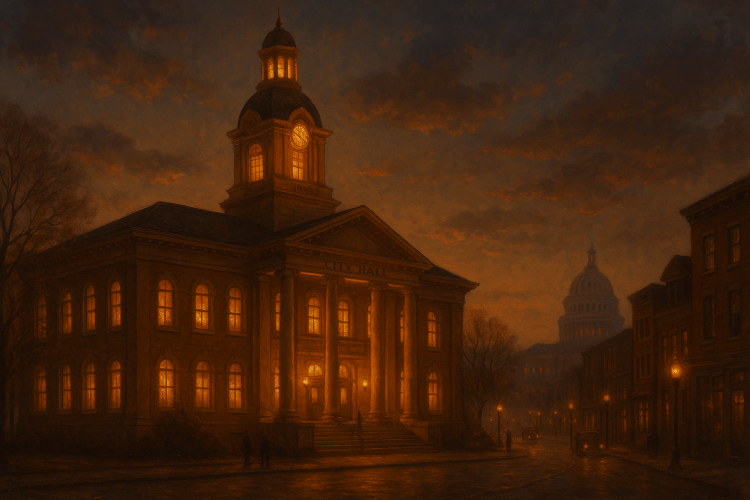
When the federal government grinds to a halt, television cameras point toward Washington, D.C. — toward empty offices, barricaded monuments, and finger-pointing press conferences. But the deeper story unfolds far from the Capitol. It takes place in city halls and neighborhoods where the real consequences of a shutdown ripple through families, local economies, and municipal balance sheets. While the federal government pauses, cities and towns must continue to serve, balancing fiscal prudence, compassion for affected residents, and the unshakable expectation that local government never stops.


I. The Federal-to-Local Connection

Local governments rarely make national headlines during a shutdown, yet their dependence on federal flow-throughs and reimbursements is significant. From Community Development Block Grants (CDBG) to HOME housing programs, from FAA airport reimbursements to FEMA disaster claims, federal funds support many city functions. The design of these programs compounds the risk: they are usually reimbursement-based rather than prepaid. When federal employees are furloughed, reimbursements stall — leaving cities to advance money from their own cash reserves to keep projects on track.

For instance, a housing rehabilitation program may already have contractors in the field and invoices pending. A delayed reimbursement from HUD can suddenly force a city to choose between advancing local dollars or halting work. Likewise, infrastructure projects tied to the FAA or Department of Transportation can stall midstream when the federal payment machinery freezes. Cities are left managing not only projects but expectations — of residents, contractors, and partner agencies.

Well-managed municipalities rely on robust fund balance policies and the ability to make interfund transfers. Yet even well-prepared finance directors find themselves navigating uncharted waters when multiple federal programs stop simultaneously. The lesson is clear: local governments bear real exposure to national political stalemates, even when they have done nothing wrong.


II. The Human Face of a Shutdown

A city’s greatest concern during a federal shutdown is not a spreadsheet but its people. In many communities, a meaningful share of the population works directly or indirectly for the federal government — postal workers, TSA agents, defense employees, and contractors. The economic fabric of a local government entity like McKinney, DART, or New Braunfels Utilities is interwoven with residents whose livelihoods depend on those paychecks.

When those checks stop, the impact is immediate and personal. Utility payments slow. Grocery budgets tighten. Local restaurants and retailers feel the chill. Within a week or two, the effects reach City Hall: rising delinquent water accounts, increased calls for payment extensions, and growing demand at local food pantries and nonprofits. The impact is felt across neighborhoods and income levels — from young families with mortgages to retirees on fixed incomes who supplement with part-time federal contract work.

Cities, being the most visible and accessible level of government, often absorb the frustration of residents caught in the crossfire. Even though the city did not cause the shutdown, it becomes the government people can still reach by phone or in person.


III. The Timing Challenge: Between Tax Deadlines and Utility Bills

Federal shutdowns often strike at awkward moments in the local fiscal cycle. In many Texas cities, property tax bills are just now being mailed as the federal government shutters. Most of the revenue from those bills will arrive over the next 90 days, which represents the most significant single inflow of cash for the entire year.

Fortunately, mortgage escrow requirements create a buffer. Because most homeowners make monthly escrow payments throughout the year, their mortgage servicers will remit property taxes to the city or county on schedule even if a federal shutdown temporarily disrupts their paychecks. This structural safeguard prevents an immediate collapse in property tax collections.

Yet not every taxpayer is escrowed. Small business owners, landlords, and those who pay directly can still delay payments — or struggle to meet their obligations if a shutdown drags into multiple months. For cities that rely heavily on prompt collections, this can create minor but measurable shortfalls that affect cash flow, particularly if compounded by reduced sales tax receipts and slowed utility payments.

Sales tax receipts, which arrive monthly, may dip if federal workers and contractors cut spending. The decline might not show up for several months, but the slowdown starts immediately in local commerce. At the same time, cities face delayed federal reimbursements and stable or rising service demand.

This combination stresses cash flow precisely when flexibility is most limited. For finance directors, this becomes a daily balancing act: ensuring payroll is met, capital projects stay funded, and reserves are used strategically without overreaction. A short-term shutdown may require little more than internal adjustments, but a prolonged one tests every line item in the budget.


IV. Managing the Municipal Response

During a shutdown, the most important city management function is communication. City managers and finance directors begin by identifying which programs rely on federal funds. Do those programs have enough local cash to bridge a temporary gap? Are any critical contracts or grants about to expire?

Departments review ongoing projects with federal reimbursements — airports, housing, transit, public safety, and disaster recovery. Some may need to slow their pace or reassign staff to prevent idle costs. Payroll and benefit obligations continue uninterrupted, of course, since city workers are paid locally.

At the same time, cities must consider how to support residents who suddenly face hardship. Utility departments might create temporary payment plans or defer disconnection notices for furloughed workers. Libraries, recreation centers, and community development offices may become gathering points for information and assistance. Some cities coordinate with local churches and nonprofits to help with rent and groceries.

The critical leadership challenge is tone: balancing fiscal discipline with empathy. Citizens need to see that their city understands their struggle — not through rhetoric, but through quiet, practical help.


V. The Broader Civic Consequences

Shutdowns carry a subtle but lasting cost to public trust. To the average citizen, “government” is a single concept — not layers of jurisdiction. When Washington falters, many lose confidence in all levels of government, including their city hall. This is unfair but inevitable.

Local government, therefore, has an opportunity and responsibility to demonstrate stability. Police still patrol, fire crews still respond, sanitation trucks still roll at dawn. This continuity becomes a visible reminder that while national politics may polarize, local service endures.

City leaders who communicate clearly — explaining which programs are affected and which are not — reinforce that trust. A well-crafted message from a mayor or city manager can calm uncertainty: “Your trash will still be picked up. Your water will keep running. City services are funded by your local taxes, not federal dollars.”

This reassurance may seem simple, but it strengthens the bond between residents and their local government at a time when faith in public institutions is fragile.


VI. The Financial Resilience Playbook

Each shutdown teaches cities to be more resilient. Smart local governments now build contingency plans much like those used for hurricanes or ice storms. The cause may be political, but the preparation is financial.

Key strategies include:

  • Building robust reserves. Fund balance policies that cover 90 to 120 days of operations give cities the flexibility to absorb delayed reimbursements or revenue slowdowns.
  • Diversifying revenue sources. Relying less on intergovernmental transfers and more on local revenue ensures stability.
  • Tracking exposure. Maintaining a database of all grants tied to federal agencies helps finance staff quickly assess risk when a shutdown begins.
  • Cross-training staff. If a federally funded program is paused, reassigned employees can temporarily assist in other departments, minimizing disruption.
  • Communicating with regional partners. Cities coordinate with counties, school districts, and COGs to align messages and pool resources for affected residents.

In Texas, where home-rule cities maintain broad authority, these actions demonstrate the spirit of local self-reliance that has long characterized municipal governance.


VII. The Emotional and Moral Dimension

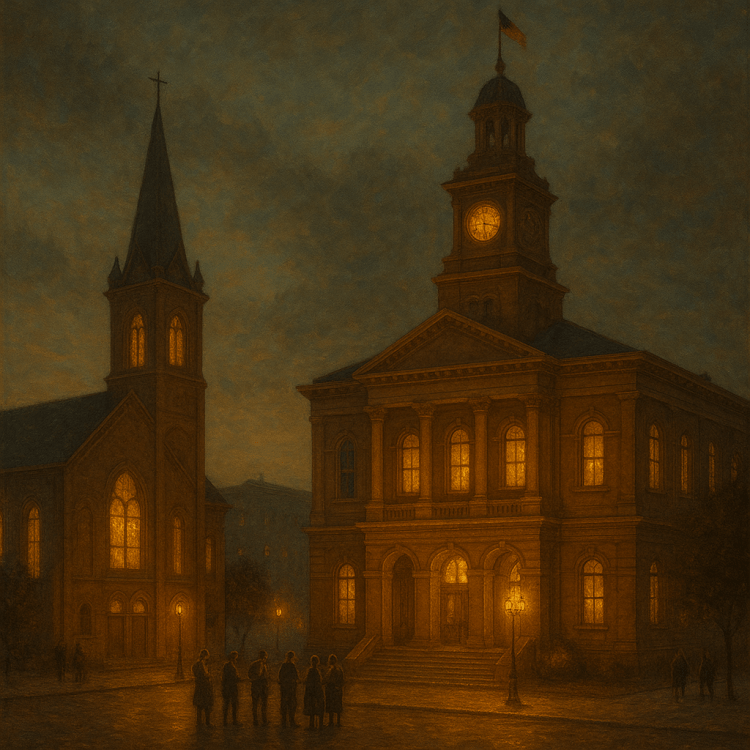
Beyond numbers and policies lies the moral core of local government — compassion for neighbors. A shutdown reminds city employees why they serve. The clerk extending a payment plan to a furloughed resident, the firefighter delivering groceries to a struggling family, the librarian helping a laid-off contractor update a résumé — these quiet moments of service define a city’s heart.

They also embody what national politics often forgets: governance is not just the art of policy but the practice of care. Cities, precisely because they are close to the people, reflect the best instincts of government — to listen, to adapt, and to keep going.


VIII. Lessons for the Future

Each federal shutdown exposes the fragile seams of interdependence between national and local governments. For cities, the lesson is not merely to survive the next one, but to plan as though it were inevitable.

Cities should:

  1. Review and update financial contingency plans annually.
  2. Maintain relationships with federal and state partners to receive timely information.
  3. Incorporate shutdown scenarios into their cash-flow modeling.
  4. Develop citizen assistance programs that can be quickly activated.
  5. Use the experience as a teaching moment for civic education — showing residents how local finances truly work.

Ultimately, resilience is not only financial but cultural. A city that knows its role, understands its resources, and trusts its people will weather any temporary political storm.


IX. Conclusion – The Quiet Strength of Local Government

When Washington stops, cities keep going.
They pick up the trash, respond to fires, issue building permits, and answer 911 calls. They balance budgets in real time, not by ideology but by necessity. They hold the public trust not in headlines but in streetlights that stay on and water that keeps flowing.

The fiscal rhythm of a city continues — property tax bills just mailed, escrowed payments coming in from mortgage companies, and sales tax checks arriving monthly. The federal stalemate may cast a shadow, but local governments remain the steady pulse of everyday life.

A federal shutdown reveals more than dysfunction; it reveals the quiet strength of local government. It reminds citizens that the most dependable form of government is the one closest to home. Cities are the steady heartbeat of a nation whose higher powers may occasionally stumble.

And when the federal lights go out, it is the glow of City Hall that assures people the republic still stands — one water bill, one payroll, one act of service at a time.


Appendix A – Common-Sense Local Resilience Checklist

For Finance and Budget Officers

  1. Cash-Flow Modeling: Immediately model 30-, 60-, and 90-day liquidity scenarios assuming delayed federal reimbursements.
  2. Property Tax Timing: Track escrow remittances and direct-payer delinquencies separately to spot early stress points.
  3. Reserve Triggers: Define thresholds for when fund balance use requires council notification or resolution.
  4. Federal Program Audit: Identify active grants, agency contacts, and next reimbursement cycles.
  5. Deferred Spending: Postpone discretionary purchases and travel until normal operations resume.

For City Management and Departments
6. Communication Plan: Prepare clear public statements explaining what is and isn’t affected by the shutdown.
7. Utility Assistance: Create temporary payment plans for furloughed federal employees and contractors.
8. Community Coordination: Link with local churches, food banks, and nonprofits to share information and avoid duplication of aid.
9. Employee Flexibility: Reassign staff from federally funded projects to core services where possible.
10. After-Action Review: Once the shutdown ends, conduct a debrief and document lessons learned for future preparedness.

For City Leadership and Elected Officials
11. Maintain Calm Visibility: Hold briefings to assure residents that city services continue uninterrupted.
12. Avoid Partisanship: Keep communications focused on service continuity and citizen support, not blame.
13. Celebrate Resilience: Acknowledge employees who help residents through financial or emotional hardship.


Final Thought:
A federal shutdown may freeze the nation’s highest offices, but it cannot stop the heartbeat of a city. Local government remains the living proof that public service is not dependent on politics, but on people — the quiet guardians of continuity who keep faith, finance, and community moving forward.

Just As I Am: The Journey of the Altar

A collaboration between Lewis McLain & AI


I. The Altar — Meeting Place Between Heaven and Earth

From the earliest days of faith, the altar has been humanity’s meeting place with God. In Genesis, Noah built one in gratitude; Abraham laid his hopes upon one in obedience; and Jacob called his altar Bethel — “the house of God.” The altar marks the intersection of the divine and the human, the eternal and the ordinary.

In every age and every church, the altar still stands as a sacred center. Whether made of stone or wood, draped in linen or simply polished by years of prayer, it represents holy ground — a place of confession, covenant, and communion.

It is the heartbeat of the church: where infants are dedicated, believers are baptized, couples are joined, missionaries are sent, sinners are forgiven, and the saints are remembered. At its center lies one invitation that transcends time and tradition: “Come.”


II. The Altar of Beginning — Baptism and Dedication

“Just as I am, without one plea,
But that Thy blood was shed for me,
And that Thou bidd’st me come to Thee,
O Lamb of God, I come, I come.”

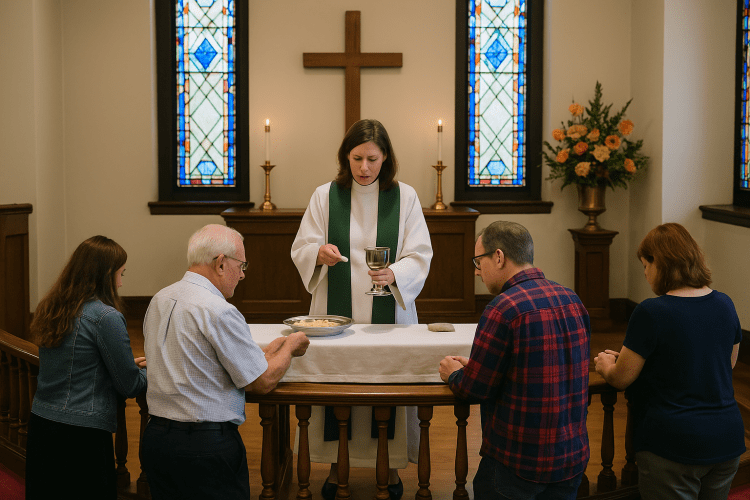
The first encounter many have with the altar comes at baptism — a moment of beginning and belonging. In some traditions, parents carry infants forward, dedicating them to God’s care. In others, such as Baptist and evangelical churches, baptism comes later, when faith has taken root and understanding has matured.

Young believers often attend classes to grasp the meaning of their decision — to understand repentance, forgiveness, and the public declaration of faith. Then, before family and congregation, they descend into the waters of baptism by immersion, a visible sign of dying to the old life and rising to newness in Christ.

The placement of the baptistry — often elevated behind or above the altar — reminds the congregation that baptism is central to the Christian life. It is both testimony and transformation. The water may shimmer under bright lights, but the moment itself is profoundly intimate: the old self buried, the new self raised, both embraced by the same grace that whispers, “Come to Me.”


III. The Altar of Union — Marriage and Covenant

“Just as I am, though tossed about
With many a conflict, many a doubt,
Fightings and fears within, without,
O Lamb of God, I come, I come.”

Years later, the same altar bears witness to another kind of covenant. A couple stands before it, hands trembling, hearts steady. They exchange vows — not promises of perfection but of perseverance, pledging to walk together through the “fightings and fears” within and without.

The altar is both witness and anchor. Here, love becomes covenant — sealed not by emotion alone, but by the presence of God. The congregation watches as two lives intertwine in divine partnership, bound by grace. Long after the music fades and the flowers wilt, the altar will still “remember.” Every Christian marriage, no matter how strong or tested, stands upon that moment of surrender — not to one another’s will, but to God’s sustaining love.


IV. The Altar of Communion — The Table of Remembrance

“Just as I am, poor, wretched, blind;
Sight, riches, healing of the mind;
Yea, all I need in Thee to find,
O Lamb of God, I come, I come.”

Between the milestones of life, believers return again and again to the altar for communion — the Lord’s Supper, the Eucharist, the breaking of bread.

This regular return to the altar renews the heart and re-centers the soul. The table is not merely ritual; it is relationship. It is where the church remembers the sacrifice that makes every other altar moment possible. The bread and cup are tangible grace — reminders that Christ’s body and blood were given not for the perfect, but for those who come “poor, wretched, blind.”

Communion teaches us that every approach to the altar — for baptism, marriage, confession, or mission — begins with gratitude for the One who first invited us. “Do this in remembrance of Me,” Jesus said, not as a command to repeat, but as a call to return — again and again, just as we are.


V. The Altar of Calling — Mission and Sending

“Just as I am, Thou wilt receive,
Wilt welcome, pardon, cleanse, relieve;
Because Thy promise I believe,
O Lamb of God, I come, I come.”

For some, the altar becomes a launching place — a threshold to mission. Here pastors are ordained, missionaries commissioned, and disciples sent forth to proclaim the gospel.

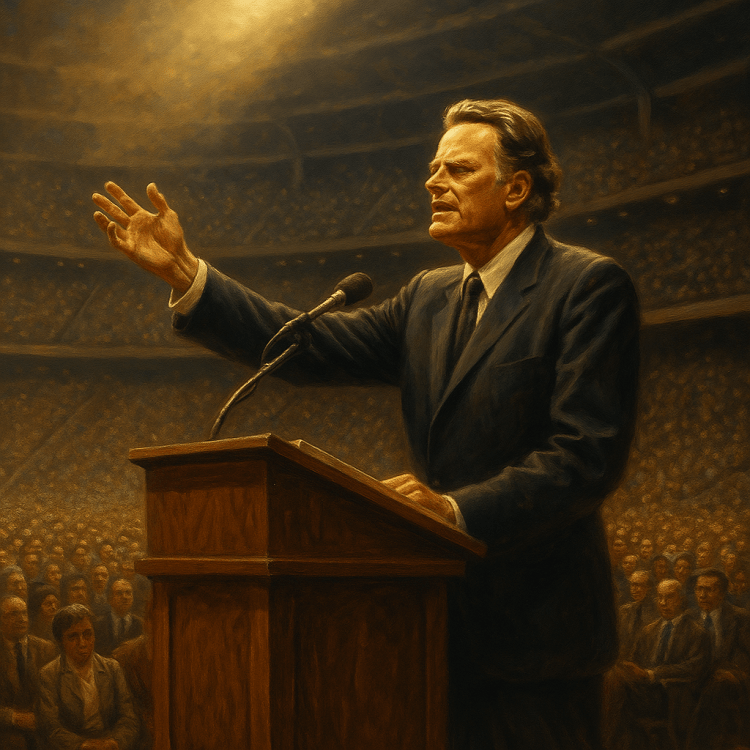
When Billy Graham preached, his altar calls were not only for conversion but for commission. His voice carried across stadiums, yet his invitation was profoundly personal: “You come, just as you are.” As the hymn filled the air, the aisles filled with people — young and old, doubting and desperate — each one trusting the promise: “Thou wilt receive.”

Many came to Christ for the first time; others came to give their lives to service — to teach, to heal, to go. The altar here becomes both an end and a beginning — the surrender of will, the start of purpose. It is the place where “Here am I, Lord” becomes more than words; it becomes life’s direction.


VI. The Altar of Surrender — The Call to Salvation

The heart of the altar experience is the call to salvation — the moment when pride yields, sin confesses, and grace embraces.

In churches large and small, the invitation is still given. The choir begins softly, the congregation prays silently, and the Spirit stirs unseen. One by one, hearts move before feet do. Then someone steps forward — the longest and shortest walk of a lifetime.

Billy Graham called it “the hour of decision.” The act of coming forward is not magic; it is movement — an outward sign of inward faith. It says, “I am done hiding. I need Jesus.”

This is the altar’s central truth: it is not the location that saves, but the Lord who meets us there. Yet that simple act of obedience — rising, walking, coming — has carried countless souls across the threshold of eternity.


VII. The Altar of Farewell — Funerals and Resurrection Hope

“Just as I am — Thy love unknown
Hath broken every barrier down;
Now to be Thine, yea, Thine alone,
O Lamb of God, I come, I come.”

Even at life’s final chapter, the altar remains the meeting place. Before it, families gather in grief and gratitude. The same altar that saw baptism’s joy and marriage’s promise now bears the weight of loss — yet not despair.

For believers, the funeral is not a farewell of defeat but of fulfillment. The love unknown that “breaks every barrier down” has already conquered death. The altar reminds us that every life lived in Christ ends not in darkness but in dawn. The one who once walked forward trembling now walks into glory with confidence, still saying, “I come.”


VIII. The Altar Eternal — The Invitation That Never Ends

Across centuries, the altar has remained constant — not as furniture, but as symbol. It calls us at every age and stage of life:

  • At birth, to be dedicated.
  • In youth, to be baptized.
  • In union, to be joined.
  • In mission, to be sent.
  • In communion, to be renewed.
  • In salvation, to be redeemed.
  • In death, to be received.

Every time we come, the invitation echoes: “Just as I am.”

The altar is not only a place in church — it is a rhythm of grace, a lifelong call to approach God honestly, humbly, and repeatedly. We never stop coming, and He never stops receiving.

So whether it is water or bread, a vow or a farewell, the altar stands — a reminder that God’s love meets us not when we are ready, but when we respond.

O Lamb of God, I come. I come.


Epilogue: The Altar That Never Closes

The altar is not just a place we visit — it is the shape of the Christian life. Every beginning, vow, calling, and farewell echoes one continuing invitation: “Come.”

In Scripture, the altar appears wherever God meets His people — in wilderness and temple, on mountaintops and upper rooms, in the heart of one who prays. The church altar stands as a symbol of that meeting, but the truth it proclaims reaches beyond its rail and candles. The altar, in the end, is wherever Christ reigns and the human heart responds.


The Altar of Daily Surrender

“If anyone would come after Me, let him deny himself and take up his cross daily and follow Me.” — Luke 9:23

Every morning, long before the church doors open, there are altars unseen — the kitchen table where a believer opens the Word, the quiet car before the day begins, the walk under sunrise whispered with prayer.

This altar of daily surrender is not lit by candles but by conviction. It is where worship leaves the sanctuary and enters the schedule. The posture is the same: bowed head, open hands, honest heart. In that stillness, grace meets routine and holiness becomes ordinary.


The Altar in the Home

“Impress these words on your children. Talk about them when you sit at home and when you walk along the road.” — Deuteronomy 6:7

Every home that prays together becomes a little church. The family table becomes an altar when bread is broken with gratitude. The living room becomes holy ground when Scripture is read aloud.

Faith is not preserved by programs but by presence — by seeing faith lived out in daily rhythm. Children learn to love the God their parents trust. At the altar of the home, worship is taught not in words alone, but in tone, laughter, forgiveness, and everyday grace.


The Altar in the World

“Whatever you did for one of the least of these brothers and sisters of mine, you did for Me.” — Matthew 25:40

When the faithful leave the church, the altar travels with them. The teacher’s desk, the hospital room, the job site, the homeless shelter — all can become altars when compassion and justice are offered in Christ’s name.

Here, worship becomes action. The same hands that once received the bread now extend it to the hungry. The same feet that once walked forward to the altar now go forward to serve. Every believer becomes a living sacrament — carrying God’s presence into places the sanctuary light cannot reach.


The Empty Altar — Heaven’s Completion

“Now the dwelling of God is with men, and He will live with them.” — Revelation 21:3

At last the altar stands empty, radiant, waiting. The candles are no longer needed, for the Lamb Himself is the light. Those who once knelt before the rail now stand before the throne, singing “Just As I Am” not as a plea, but as praise fulfilled.

No more coming forward — only abiding forever. The journey that began in water and bread ends in glory and grace.


Appendix A: The Story Behind “Just As I Am”

Charlotte Elliott (1789–1871): The Voice of Honest Faith

Charlotte Elliott was born in Clapham, England, into a devout but intellectually refined family. Her grandfather was a close friend of the hymnwriter Isaac Watts, and her brother, the Rev. H.V. Elliott, became a well-known clergyman and educator.

Charlotte herself was a gifted poet and musician, but her life was marked by chronic illness that left her bedridden for long seasons. In her youth, she wrestled deeply with doubt about her faith. She feared she was unworthy of God’s love — that her weakness and uncertainty disqualified her from salvation. When Rev. César Malan of Geneva asked if she knew Christ personally, she replied that she didn’t know how to come to Him. His answer pierced her heart:

“Come to Him just as you are.”

Years later, in 1835, still struggling with infirmity but clinging to grace, Charlotte wrote the words that would echo through generations:

“Just as I am, without one plea,
But that Thy blood was shed for me…”

The hymn appeared in The Christian Remembrancer that year and was later included in her collection The Invalid’s Hymn Book.

Though confined by illness, Charlotte Elliott’s simple honesty created one of Christianity’s most universal hymns — a melody of mercy that has carried millions to the altar of grace.


William B. Bradbury (1816–1868): The Tune of Invitation

The tune most commonly associated with “Just As I Am” was composed by William Batchelder Bradbury in 1849. Bradbury, known for “Jesus Loves Me” and “Sweet Hour of Prayer,” wrote a melody that moves with the same steady rhythm as the walk to the altar — step by step, forward, sincere.

Together, Elliott’s words and Bradbury’s music became the sound of surrender, humility, and homecoming.


Appendix B: Hymnic Lineage and Influence

Charlotte Elliott’s hymn “Just As I Am” arose from the same devotional stream as Isaac Watts (1674–1748), the father of English hymnody.
Like Watts, she believed hymns should be personal and Scriptural — carrying doctrine into daily devotion and prayer.

Isaac Watts’ Hymns That Shaped Her Era:

  • “When I Survey the Wondrous Cross”
  • “Joy to the World”
  • “O God, Our Help in Ages Past”

Her work stands as a continuation of that lineage: theology sung through human honesty — heaven’s truth whispered in earthly weakness.


Here Am I, Lord: The Call and Commission in Today’s World

A collaboration between Lewis McLain & AI


I. Introduction: The Prophet Who Heard the Voice

Among the great figures of the Old Testament, Isaiah stands tall as one of the most profound and poetic prophets ever called by God. Living and writing in the eighth century before Christ, during the reigns of Uzziah, Jotham, Ahaz, and Hezekiah—four kings of Judah—Isaiah witnessed both the spiritual decline of his nation and the political upheavals that threatened its very survival. His name, Yeshayahu, means “The Lord is salvation,” and indeed, his entire message weaves together judgment and redemption, despair and hope, sin and grace.

Isaiah’s writings form one of the most theologically rich books in all of Scripture—sixty-six chapters that stretch from visions of God’s holiness to prophecies of the coming Messiah. Scholars have called Isaiah “the fifth gospel” because it so vividly anticipates the life, suffering, and triumph of Christ centuries before His birth. Unlike many prophets who simply declared oracles of doom, Isaiah combined poetic beauty, moral clarity, and divine vision. He saw beyond the immediate history of Israel to the sweeping purposes of God for all nations.

What sets Isaiah apart is not only the grandeur of his language but the intimacy of his calling. His ministry begins not with action but with awe—with a vision that breaks and remakes him. In the year that King Uzziah died, Isaiah saw “the Lord, high and lifted up, and His train filled the temple.” He hears angelic voices crying, “Holy, holy, holy is the Lord of hosts; the whole earth is full of His glory.” Overwhelmed by divine holiness, Isaiah cries out, “Woe is me, for I am a man of unclean lips, and I dwell among a people of unclean lips.” Then, in a moment of grace, a seraph touches his lips with a live coal from the altar, saying, “Your guilt is taken away, and your sin atoned for.” Only then does Isaiah hear the divine question: “Whom shall I send, and who will go for us?” His response—simple, immediate, and wholehearted—has echoed through millennia: “Here am I; send me.”

II. The Original Moment: From Vision to Vocation

Isaiah’s encounter in the temple is one of the most profound calling narratives in Scripture because it reveals the entire arc of spiritual transformation—conviction, cleansing, and commission. Before Isaiah can speak for God, he must be purified by God. The coal that touches his lips symbolizes both pain and purification; it burns away unworthiness and ignites a new fire of purpose. Isaiah learns that divine service is not earned by merit but granted through mercy.

This moment defines prophetic ministry for all who follow. Isaiah does not volunteer because he feels capable; he volunteers because he has been forgiven. His “send me” is not a boast of strength but a surrender of will. It shows that readiness in God’s kingdom comes not from talent or position but from humility and obedience. The prophet’s call reminds every believer that God does not ask for perfection, only availability. He does not seek the qualified; He qualifies the willing.

III. The Voice That Still Calls: Modern Applications of “Send Me”

Though centuries separate us from Isaiah’s temple vision, the same question still echoes: “Whom shall I send?” The call of God is not a relic of ancient prophecy—it is a living summons to every generation. In every time and place, men and women hear this question in the quiet chambers of conscience and the crowded corridors of daily life. The divine call may not come through visions of angels, but it comes through needs that cry out to be met, through injustices that demand courage, through moments of compassion that ask for response.

A. The Personal Call: Faith in the Ordinary
In a world that prizes self-assertion, Isaiah’s answer is radical: availability over ability. “Here am I” means being present before God—before the noise of ambition or distraction drowns out His voice. For the modern believer, this call begins in small, faithful acts: showing kindness when it’s inconvenient, forgiving when it’s undeserved, speaking truth when it’s unpopular. It may mean teaching a Sunday school class, visiting the sick, mentoring a child, or simply standing up for integrity in one’s profession.
The modern application of Isaiah’s “send me” is less about geography and more about posture. You may never cross an ocean, but you can cross the street. You may not go into a pulpit, but you can live the Gospel at your desk, in your classroom, or around your dinner table. In every generation, God asks not “Who is talented?” but “Who is willing?”


B. The Public Call: Faith in the Civic and Professional Realm
Isaiah was not just a preacher in the temple; he was an adviser to kings and a voice in national affairs. His message reached palaces and public squares alike. Likewise, today’s disciples are called to bring righteousness into their professions—to be prophetic voices in civic life. Whether one serves in government, finance, education, or healthcare, the “send me” spirit calls for moral clarity amid compromise.
In municipal councils, corporate meetings, or courtrooms, there is still a need for those who say, “Here am I” not to their own advancement but to the cause of truth and justice. The Isaiah spirit is the courage to stand for what is right even when it costs reputation or comfort—to call nations back to integrity, to defend the vulnerable, to remind leaders that power must serve people. In every public servant who leads with humility, in every teacher who shapes conscience, in every judge who loves mercy, the voice of Isaiah lives on.

C. The Global Call: Faith Beyond Borders
Isaiah’s vision of God’s glory filling the whole earth anticipates the Great Commission of Christ. “Send me” is a global phrase—it transcends race, nation, and time. In our interconnected world, the mission field is both next door and around the globe. It includes the refugee, the orphan, the imprisoned, the forgotten. To say “send me” today is to accept the responsibility of love in a wounded world.
It might mean serving on a mission trip, supporting a humanitarian cause, or developing technology that uplifts rather than exploits. It can mean using one’s influence, wealth, or voice for those who have none. The modern missionary is not only the preacher or doctor abroad, but also the scientist working for sustainable solutions, the artist telling redemptive stories, and the citizen advocating for peace and dignity.


IV. The Obstacles to Saying “Send Me”

Many never reach Isaiah’s moment of surrender because they stop at his first confession: “Woe is me.” Fear, inadequacy, and distraction paralyze potential prophets. The world today offers endless reasons to delay obedience—busyness, cynicism, self-doubt, or the illusion that someone else will go. The modern heart is often over-informed but under-committed.

Yet the secret of Isaiah’s response lies in trust. He did not know where he would be sent, what he would face, or whether he would succeed. God revealed only the call, not the destination. And still he said yes. The modern disciple must learn this same holy courage—the faith to say “yes” before knowing the cost. Real obedience precedes full understanding.

We also face cultural barriers. The age of irony mocks conviction; the age of comfort avoids sacrifice. But God still calls amid the noise. Every generation must rediscover the sacred simplicity of Isaiah’s answer: to stand up when called, to speak when it’s easier to stay silent, to go when it’s safer to stay home.


V. The Transformation of the Willing Heart

The power of Isaiah’s response lies in transformation. He entered the temple burdened by guilt and left commissioned by grace. The same God who cleansed his lips also shaped his life. Service becomes the fruit of forgiveness. Every believer who says “send me” enters this same pattern: encounter, cleansing, and calling.

Modern discipleship is not a part-time endeavor but a lifelong response. When we offer ourselves to God’s purposes, He transforms both us and the world around us. A single “send me” can ripple through generations. One teacher who sees their classroom as a mission field, one civic leader who governs with justice, one artist who creates with reverence—each becomes a vessel through which God’s light reaches others.

In this way, Isaiah’s call is not a moment but a movement. It is the continual surrender of the heart that says, “Use me, Lord, wherever You will.”

VI. Conclusion: The Call Continues

Isaiah’s cry, “Here am I, Lord; send me,” remains one of the purest expressions of faith in all of Scripture. It is both an answer and a challenge. Across the centuries, prophets, apostles, and saints have echoed it in their own tongues—Moses before Pharaoh, Mary before the angel, Peter beside the sea, Paul on the Damascus road. And still the question comes: “Whom shall I send?”

Every believer must decide whether to remain a spectator in the temple or to become a servant in the field. The call may come through Scripture, through conscience, or through the cry of human need. The answer must come from the heart: “Here am I.” In those three words lies the essence of Christian discipleship—the surrender of self to the will of God.

In a fractured world that hungers for hope, the echo of Isaiah’s voice is needed more than ever. The Lord still seeks those who will go—into classrooms, hospitals, city halls, neighborhoods, and nations—to live out His message of redemption. To every willing soul, He still asks the ancient question. And to every heart brave enough to respond, He still gives divine purpose.

“Here am I, Lord; send me.” May it not be only Isaiah’s prayer—but ours.


Reflective Prayer: “Here Am I, Lord”

O Lord, high and lifted up,
whose glory fills the earth and whose mercy touches even the most unworthy lips,
we come before You with humbled hearts.

We have heard Your question echo through the ages —
“Whom shall I send, and who will go for us?”
And though the world grows noisy with fear and distraction,
still Your voice breaks through.

Touch our lips as You touched Isaiah’s,
burn away our pride, our hesitation, our excuses.
Cleanse what is unclean,
renew what is weary,
and make our hearts burn again with holy purpose.

When the needs of the world seem too vast, remind us:
You do not ask us to save the world, only to serve in it.
You do not need our strength, only our surrender.
You do not require our perfection, only our presence.

So here we stand, O Lord —
in our cities, our classrooms, our homes, our workplaces.
Here we are, with our small voices and open hands.
Send us where love is lacking.
Send us where truth is silenced.
Send us where hope has grown dim.

And when we go, go with us —
that every act may carry the mark of Your grace,
and every word may bear the weight of Your holiness.

We pray this not in our own name,
but in the name of Jesus Christ,
the One who was sent and who sends us still.

Amen.


Searching for God’s Plan Is Part of God’s Plan

🕯️ A collaboration between Lewis McLain & AI


🕯️ Searching for God’s Plan Is Part of God’s Plan

A meditation on divine purpose, patience, and the gentle guidance of the Holy Spirit


Introduction — The God Who Is Three in One

When we speak of God’s plan, we must first understand who God is.
All of Scripture — and every whisper of divine purpose — flows from the mystery of the Holy Trinity, the eternal truth that God is One in essence and Three in person: God the Father, God the Son, and God the Holy Spirit.

From the first pages of the Bible, God reveals Himself not as solitary but as relational. In Genesis 1:26, the Creator declares, “Let Us make mankind in Our image, in Our likeness.” This “Us” is not the language of royalty but of communion — a glimpse into the fellowship that has always existed within the Godhead.

God the Father is the Creator and Sustainer of all things, the One who spoke light into being and still speaks purpose into creation. He is the source from which all love, justice, and wisdom flow.

God the Son, Jesus Christ, is the Word made flesh — “the image of the invisible God” (Colossians 1:15). Fully divine and fully human, He entered time so that eternity could enter us. Through His life, death, and resurrection, He revealed the Father’s heart and opened the way for humanity to live in communion with God once more.

God the Holy Spirit is the living presence of God with us — the Comforter Jesus promised in John 14:26, the One who guides, convicts, empowers, and renews. The Spirit does not simply move around us but dwells within us, breathing life where there was none and transforming belief into becoming.

Together, the Father, the Son, and the Holy Spirit are one God — distinct in person, united in essence, perfect in love. The Father wills, the Son reveals, the Spirit indwells. This divine harmony is not a concept to be solved but a communion to be entered — the eternal dance of love that invites us to join.

To seek God’s plan, then, is to be drawn into the life of the Holy Trinity itself — to hear the Father’s call, to follow the Son’s example, and to walk in the Spirit’s guidance. Every act of faith, every search for purpose, begins and ends within that holy fellowship of love.


🌅 I. The Longing to Know

Every soul, at some quiet moment, comes to the edge of its own mystery and whispers,
Why am I here?
What am I meant to do?
How will I know when I’ve found it?

These are not small questions, nor are they unspiritual ones. They are the pulse of eternity within human clay — the proof that we were made by a purposeful God who designed us to long for Him. As the writer of Ecclesiastes says, “He has set eternity in the human heart.” (Ecclesiastes 3:11). That longing, that inward ache for meaning, is not a flaw in the system — it is the invitation itself.

Before we ever lift our eyes toward heaven, the Holy Spirit has already stirred the waters of our hearts. It is He who awakens the desire to seek, to question, to yearn for direction. We imagine that we begin the search, but in truth, we are responding to One who has already begun calling our name. “Before I formed you in the womb, I knew you,” says the Lord (Jeremiah 1:5). The search is not the beginning of God’s plan — it is the awakening to it.

We live in a world that tells us to chase identity through productivity — to define purpose by what we do. Yet the Spirit teaches us to begin with who we are: beloved, chosen, formed for good works prepared in advance (Ephesians 2:10). When we start from belovedness, direction becomes less about achievement and more about alignment. The question shifts from “What is my plan for my life?” to “What is God’s life doing through me?”

There are times the longing feels like a burden — like a hunger that won’t be filled. But that hunger is holy. It is the echo of Eden within us, the part of the soul that still remembers walking with God in the cool of the day. Every time we ask “Why am I here?” we are really asking, “Lord, where are You?” And the Spirit answers softly in the dark: “Closer than you think.”

The longing to know is not a sign that we are lost; it is proof that we are loved. God hides His purposes not to frustrate us but to form us. Like a sunrise that slowly brightens the horizon, His plan is not a flash of lightning but a gentle unveiling. And as we watch for the light, we come to see — the search itself is sacred. The seeking heart is already standing within the circle of His will.


🌾 II. The Restless Heart

“As the deer pants for streams of water, so my soul pants for You, my God.”Psalm 42 : 1
“It is God who works in you to will and to act in order to fulfill His good purpose.”Philippians 2 : 13

There is a restlessness that runs through the human spirit — a holy discomfort that keeps us from settling for less than what God intended. We call it anxiety, ambition, or uncertainty, but beneath those names lies a deeper truth: the soul was not designed for stagnation. The Spirit keeps us moving because life in Christ is a pilgrimage, not permanence.

The restlessness of the heart is a divine stirring. It is what moved Abraham to leave Ur without a map, Moses to wander through desert silence, and Paul to cross seas with only the Spirit’s whisper, “Go.” None of them saw the full plan, but each trusted that the One who called would lead.

When the Holy Spirit “woos” the soul, He does not always comfort first; sometimes He unsettles. He loosens our grip on comfort so that we might reach for calling. The Spirit’s invitation is often disguised as discomfort — not to harm us, but to stretch us toward holiness.

We often mistake that tension as something to escape. But restlessness can be sacred ground if we let it drive us to prayer instead of panic. The heart that refuses to grow numb, that dares to ask “Is there more?” is already being moved by the Breath of God.

If you feel restless today, take courage. The ache itself is evidence that the Spirit is alive within you — awakening desire, stirring purpose, leading you toward something truer than you can yet name.


🌊 III. The Hidden Path

“Your word is a lamp for my feet, a light on my path.”Psalm 119 : 105
“Trust in the Lord with all your heart and lean not on your own understanding; in all your ways submit to Him, and He will make your paths straight.”Proverbs 3 : 5–6

We wish God would hand us the map. Instead, He gives us a lamp.

Faith does not come with a blueprint; it comes with a Person. The Holy Spirit does not reveal the entire road — He reveals the next step. That is why the lamp is at our feet, not miles ahead. If God showed us everything at once, we would no longer need faith; we would manage life by sight.

The hidden path is the training ground of trust. We take one obedient step, and the next is revealed. Guidance in Scripture always comes to those who are already moving: Abraham stepping out, Peter stepping onto the water, Paul stepping toward Macedonia. Divine direction is discovered in motion.

Discernment grows in stillness and obedience. God speaks through His Word, through the peace that follows prayer, through the wise voices He plants around us. The Holy Spirit confirms through alignment — when Scripture, conscience, and peace all point in the same direction.

We are not asked to see far, only to walk faithfully where the light falls. The Spirit’s guidance often turns like a lighthouse beam — rhythmic, partial, but consistent. The light always returns.


IV. The Stillness of Trust

“Be still, and know that I am God.”Psalm 46 : 10
“Though it linger, wait for it; it will certainly come and will not delay.”Habakkuk 2 : 3

The hardest obedience is not movement — it is stillness.
We can act, plan, or work; but to be still and trust feels like doing nothing. Yet Scripture reveals that stillness is not inactivity; it is surrender.

Stillness says, “God, You do not need my panic to accomplish Your promise.”
It is a holy resting of the soul, a decision to stop wrestling for control.

When Elijah fled to the cave, God was not in the wind, earthquake, or fire, but in the gentle whisper (1 Kings 19:12). Jesus, too, embodied that peace — sleeping through a storm that terrified seasoned fishermen. Both moments show the same truth: the presence of chaos does not mean the absence of God.

In a world that rewards busyness and noise, stillness is an act of rebellion. It is spiritual warfare against hurry, fear, and self-sufficiency. To be still is to declare that God’s timing is trustworthy, His sovereignty complete.

Waiting is not wasted time. It is the slow shaping of faith into maturity. What we think is delay is often design. And while we wait, the Holy Spirit breathes courage into our quiet — a courage that does not demand proof, only Presence.


🌤 V. The Mystery of Hindsight

“You do not realize now what I am doing, but later you will understand.”John 13 : 7
“And we know that in all things God works for the good of those who love Him.”Romans 8 : 28

God’s handwriting is easiest to read backwards.

Joseph understood his suffering only after the famine was over. Ruth saw redemption only after returning from Moab. Peter grasped the grace of denial only after resurrection morning. Each could have cried in the middle, “What possible good could come of this?” — yet each found that God had been writing something beautiful in invisible ink.

The Spirit is the Interpreter of the Past. He helps us re-read our pain through the lens of providence. What once looked like abandonment becomes preparation. What once felt like punishment becomes protection.

When hindsight meets humility, gratitude is born. We begin to thank God not only for what He gave but for what He withheld. The fog clears, and we realize that every step, even the missteps, were guided by mercy.

In time, revelation becomes remembrance — and remembrance becomes worship.


🕯️ VI. Living Inside the Plan

“He has shown you, O mortal, what is good. And what does the Lord require of you? To act justly and to love mercy and to walk humbly with your God.”Micah 6 : 8
“You will seek Me and find Me when you seek Me with all your heart.”Jeremiah 29 : 13

To live inside God’s plan is not to solve a puzzle; it is to live in relationship.
We seek His will not as detectives chasing clues but as children trusting a Father.

The will of God is not a distant treasure buried under mystery; it is the life of Christ formed in us through faith. Every decision, every act of love, every moment of humility becomes the shaping of divine purpose.

When we walk in love, we are already in the center of His will. When we forgive, serve, give, and trust — we are fulfilling His design more than we realize.

Faith is not a destination but a direction. The Spirit leads not by shouting orders but by indwelling presence. To live “in the plan” is to live with the Planner — daily, presently, obediently.

We spend so much time asking, “Am I in God’s will?”
Perhaps heaven’s better question is, “Am I walking with God?”

The seeker who walks with God is never off the map.


🕊️ VII. The Seeker’s Prayer

Lord of the journey,
You who shape the tides and light the stars,
teach me to trust the mystery of Your plan.
When I cannot see the shoreline,
let me rest in the rhythm of Your waves.

When my heart cries, “Why am I here?”
whisper back, “You are Mine.”
When I ask, “What should I do?”
remind me to keep the lamp trimmed,
to walk one faithful step at a time.

Holy Spirit, gentle Companion,
thank You for stirring my questions
and for meeting me inside them.
Let Your whisper rise above the wind,
Your peace outshine my fear.

I do not ask for the full map —
only the courage to follow the next light.
For even my searching belongs to You.
Every longing, every delay, every unanswered prayer
is already written in Your design.

Keep me seeking.
Keep me trusting.
And when the dawn finally breaks,
may I find that the path I wandered
was the one You planned all along.

Amen.


🌅 VIII. Epilogue — The Morning of Understanding

The first light slips across the sea. The storm has passed. Whether one stands on a balcony or kneels beside a bed, there comes a moment when striving ceases and trust begins.

The questions that once pressed hard against the heart grow quiet.
We do not have every answer—only peace. The waiting, the wondering, the wandering — all reveal themselves as the Spirit’s slow choreography toward surrender.

Below us, life continues — tides rise and fall, plans shift and change. Yet above all, God remains steady. His plan, mysterious and merciful, unfolds with perfect rhythm.

In that awareness the soul finds rest.
The search, it turns out, was never about discovering a destination but discovering Him.

The Spirit still whispers over the waters:
Be still and know that I am God.

And the heart that listens understands at last —
to search for God’s plan was always to walk within it.
The light was never lost;
it was leading all along.

Beacons at the Edge of the World: The Timeless Allure of Lighthouses

A collaboration between Lewis McLain & AI

“The light shines in the darkness, and the darkness has not overcome it.” *
John 1:5


LFM note: Paintings throughout do not necessarily align with lighthouses mentioned.

There is something profoundly stirring about a lighthouse. Rising solitary and steadfast at the edge of land and sea, it holds a mystique that transcends mere utility. For centuries, lighthouses have been both practical guardians of mariners’ lives and profound symbols of guidance, hope, and endurance. Their beauty lies not only in their structure but in the stories they whisper—of storms endured, ships saved, and the eternal human longing for light amid darkness.


The Architecture of Solitude


Lighthouses are born of necessity but shaped by poetry. They rise where no one would choose to live—on cliffs battered by spray, on reefs that vanish at high tide, on islands that taste of salt and wind.

The Cape Hatteras Lighthouse in North Carolina embodies that defiant grandeur. First built in 1803, rebuilt in 1870, and then—astonishingly—moved brick by brick in 1999 to escape the encroaching sea, it stands as both sentinel and survivor. Its black-and-white spiral stripes, gleaming above the dunes, seem to twist with time itself—a monument to human determination that the light must move, but it must never go out.

To gaze upon such a tower is to feel the romance of solitude—a reminder that even in the loneliest places, there can be purpose and dignity.


Light as Metaphor


Lighthouses are sermons in stone. They preach endurance without words, steadfastness without sound. Each lens, each turning prism of light, speaks the same message: I am here.

The ancients understood this. The Pharos of Alexandria, one of the Seven Wonders of the Ancient World, guided ships safely into Egypt’s harbor for nearly fifteen centuries before earthquakes brought it down. Yet its radiance lingers in language itself: pharos became the root for “lighthouse” in many tongues—a word that still glows with memory.

To tend the light, whether with oil lamp, Fresnel lens **, or electric beam, is to participate in the sacred act of pushing back the night.


Stories of Endurance

Behind every light stands a keeper—a human being who lived within its echoing walls, marking time not by clocks but by tides and storms.


Ida Lewis of Newport, Rhode Island, began her duties as a teenager at Lime Rock Light. Time and again she rowed through fog and fury to rescue those doomed by the sea. Newspapers hailed her as “America’s Bravest Woman,” and her lantern became a symbol of courage that outshone any medal.


Across the Atlantic, Grace Darling of the Farne Islands rowed with her father through hurricane winds in 1838 to save nine shipwrecked souls. Her quiet valor inspired poems, ballads, and generations of young women who learned that heroism can live in gentleness.

And far to the northwest, the keepers of Tillamook Rock Lighthouse—grimly nicknamed Terrible Tilly—faced isolation so absolute that supplies sometimes came only once a month. Waves shattered windows; lightning scorched its dome; yet through it all, the light endured until automation silenced it in 1957.

Each of these stories shines like the lanterns they kept: fragile, human, and eternal.


The Modern Fascination

Today, satellites trace invisible paths across the sky, but no digital signal can move the heart like a beam of light piercing the fog.


Tourists flock to Portland Head Light in Maine to feel its wind-whipped poetry, to Pigeon Point Light in California to watch the Pacific shimmer beneath its glass crown, or to Split Rock Lighthouse above Lake Superior, where the inland sea itself seems to bow in respect. Photographers chase those fleeting dawns when light, water, and memory merge into a single luminous chord.

Even in obsolescence, lighthouses command reverence. They remind us that guidance once required vigilance, and that safety once depended on someone staying awake.

The great Fresnel lens, invented in 1822, still feels miraculous—turning a single flame into an empire of light. Each concentric glass ring multiplied hope itself. **


A Symbol for the Soul

A lighthouse is a monument to faith—faith that light matters, faith that someone is out there searching for it. Its flame burns not for itself but for others.

We are, each of us, lighthouses in miniature—built to stand through storm, to offer direction, to keep a humble watch. We may never know the sailors who find safe harbor by our light, yet still we shine.


A Closing Hymn to the Lighthouse

On the edge of the world where the dark waves roar,
A tower stands, steady forevermore.
Its flame is a prayer in the midnight deep,
A vow it has sworn: the watch I will keep.

Through centuries long and tempests untold,
Through winds that howl and waters cold,
It whispers to sailors who wander the foam:
“Fear not the storm—you are guided home.”

So may we, like lighthouses, shine through the night,
Steadfast in truth, unwavering in light.
For though seas may rage and horizons bend,
The beacon endures till journey’s end.


Lessons from the Lightkeeper

  1. Constancy: Keep your post even when unseen.
  2. Selflessness: Shine for others, not for glory.
  3. Endurance: Weather the storm, not because it is easy, but because it is right.


Keeper’s Log — November 12, 1898

(Written as a diary and love letter to the lighthouse)

My dearest Light,

The storm has come again. I can feel it before it arrives—the air thickens, the sea grows restless, and the lantern glass begins to quiver with a faint, trembling song. Now, as the wind batters the shutters and the surf claws at the rocks below, it is only you and I awake in this furious night.

You creak like an old soul when the wind strikes you just right—your timbers groan, your spiral stairs hum, and somewhere deep within your heart a low moan rises, as if you too feel the strain of standing against such wrath. But you do not bend, my steadfast one. You never do.

The rain lashes your windows like handfuls of nails, and yet your light keeps turning—faithful, calm, and sure. I’ve trimmed the wick twice already; the flame dances bravely in its glass crown. I swear it beats like a living pulse, and I feel it inside me, keeping time with my own heart.

I have known the company of many storms, but never one that felt like this—a symphony of roar and whisper, fury and devotion. The iron railing shudders under my hand, the stones breathe cold through my boots, and still, your light cuts through the blackness as if to say, “Here. I am still here.”

When I first came to tend you, I thought of you as duty—stone and oil and obligation. But tonight I know better. You are more than beacon; you are beloved. You hold me in your constant gaze as surely as I keep you alive with mine. The sea may rage, the thunder may roll, but within your circle of light, there is a holiness I cannot name.

If ever I am taken by these waves, let them find me reaching toward you, my tower of grace. For even when the world goes dark, you will shine—and we will always be one.

Your friend and partner,
— The Keeper


* Context of John 1:5 — This verse belongs to the prologue of the Gospel of John (1:1–18), where Christ is introduced as the eternal Word (Logos) of God —the divine source of life and light. “Light” in this passage refers to the revelation and holiness of God made visible in Jesus Himself; “darkness” signifies sin and separation from God. The verse affirms that the divine light of Christ entered a fallen world and that no power of evil or unbelief can extinguish or comprehend it. Using this verse symbolically in reference to a lighthouse honors its meaning only when the metaphor points back to Christ as the true and eternal Light of the world.

** The Fresnel Lens — Invented in 1822 by the French physicist Augustin-Jean Fresnel, this revolutionary lens transformed lighthouse illumination worldwide. Unlike a single thick piece of glass, the Fresnel lens used concentric rings of prismatic glass, each bent at a precise angle to capture and refract more light with less material. It could project a single flame’s glow over twenty miles of sea. Fresnel’s design was so efficient that mariners called it “the invention that saved a million ships.” Many keepers described its operation as almost sacred: tending the lamp within the great glass cathedral of prisms felt like standing in a temple of light.

One famous story comes from the first keeper at Cordouan Lighthouse (France), who said that when the new lens was lit, the entire tower “breathed differently” — the light shimmered across the ocean like a living thing. Modern restorers still marvel at the craftsmanship: thousands of individual glass segments, hand-ground and set with the precision of jewelry, revolving silently on mercury bearings so the beam never faltered. Even today, Fresnel lenses remain one of the most brilliant and elegant intersections of science, art, and devotion ever created.


Imaginary Job Position (hey, just for fun!): Lighthouse Keeper

Location: Edge of the world.
Hours: Continuous. The light never sleeps.

Summary:

Seeking a person of steady hand and quiet heart to tend a solitary light where sea meets sky. Must be able to endure long silences, fierce storms, and the company of one’s own thoughts. The successful applicant will be entrusted with the guardianship of the light — a flame that keeps ships from ruin and men from despair.


Responsibilities:

  • Maintain the Beacon:
    Trim wicks, polish lenses, refill oil, wind clockwork, and ensure the light never fails — not for wind, nor wave, nor weariness.
  • Keep the Watch:
    Record weather, tides, and passing vessels. Note the comings and goings of fog and gull, the changing moods of sea and sky.
  • Stand Against the Storm:
    Remain calm when the tower trembles. Maintain vigilance even when thunder deafens and waves strike the glass.
  • Preserve the Silence:
    Live with dignity and patience amid isolation. Understand that some prayers are spoken with oil and flame rather than words.

Required Qualifications:

  • Courage enough to stay when others would flee.
  • Eyes that can read darkness as well as dawn.
  • Hands steady enough to mend a lens and gentle enough to save a life.
  • A heart attuned to rhythm of tides — faithful, unhurried, enduring.

Preferred Experience:

  • Previous familiarity with solitude, reflection, or faith.
  • Ability to distinguish between loneliness and peace.
  • Experience keeping journals or writing letters never sent.

Compensation:

  • Sunrises and sunsets without equal.
  • The sound of the wind as hymn and companion.
  • The knowledge that unseen lives are safer because of your light.

Closing Note:

This is not merely a job, but a calling. The keeper’s light is both duty and devotion — a sermon without words, a prayer that burns through the storm. Those who apply must be willing to give the sea their years, and in return, receive the quiet immortality of those who guard the light.

The Fragile Balance: The Supreme Court, the Presidency, and the Deep Machinery of Power


A collaboration between Lewis McLain & AI

Introduction: The Return of the Old Question

Every generation of Americans must rediscover a truth the founders assumed self-evident: power left unchecked eventually seeks to rule. The United States Constitution was built upon friction—the deliberate tension among the legislative, executive, and judicial branches—because the framers knew that virtue without restraint would decay into tyranny.

In 2025, that fragile balance is once again being tested. The Supreme Court’s recent term has thrust the nation into a constitutional reckoning over the limits of presidential authority, the independence of federal agencies, and the reach of a bureaucracy so vast that it has become a government unto itself (The Deep State). Beneath the headlines of court cases and executive orders lies an older struggle: who governs America—the people, their elected president, or the permanent state that outlasts them both?


I. The Pendulum of Power: From George Washington to Donald Trump

American history is a chronicle of oscillating authority. George Washington set the precedent of restraint, rejecting monarchy and leaving office after two terms. Andrew Jackson defied the Supreme Court, daring Chief Justice John Marshall to enforce his rulings. Abraham Lincoln suspended habeas corpus in wartime, later admitting he had stretched the Constitution “as far as I dared.”

Franklin Roosevelt, frustrated by a conservative Court blocking his New Deal, proposed expanding its membership—an audacious plan that failed politically but succeeded psychologically: the Court soon bent toward broader federal power. Nixon’s abuse of executive privilege provoked the congressional and judicial pushback of the 1970s, creating the Independent Counsel Act and sunshine laws.

Then came the Reagan-Bush revival of the unitary executive theory, seeking to reclaim presidential control over a bureaucracy that had become increasingly independent since the 1930s. By the time Donald Trump entered office, this constitutional pendulum had already swung through centuries of tension between energetic leadership and institutional resistance. Trump’s presidency merely accelerated the rhythm—reviving the oldest American argument of all: Can one man truly govern the government?


II. The New Flashpoint: Trump v. Slaughter and the Unitary Executive

At the center of today’s storm is Trump v. Slaughter, a case challenging whether the President may remove a Federal Trade Commission commissioner “without cause.” The stakes are profound. For ninety years, Humphrey’s Executor v. United States (1935) has protected independent agencies like the FTC, SEC, and Federal Reserve from direct political interference. Commissioners could be dismissed only for misconduct or neglect, ensuring a measure of stability across changing administrations.

The Trump administration contends that such protections violate Article II’s command that “the executive Power shall be vested in a President.” Their argument—the unitary executive theory—holds that all officers who exercise executive functions must answer to the President alone. Anything less fragments accountability and undermines electoral legitimacy.

Critics respond that independence is the only safeguard against politicized enforcement, crony capitalism, and authoritarian control. The Supreme Court’s eventual ruling will determine whether the alphabet soup of federal agencies remains semi-autonomous or becomes an extension of the Oval Office. Either outcome will redefine the machinery of governance for decades.
(Holland & Knight, Sept 2025)


III. The Deep State and the Administrative Leviathan

Beneath this legal argument lies a deeper cultural suspicion—that a Deep State of career officials, regulators, and policy staff wields power beyond democratic reach. The term is controversial, often misused, but it points to a real structural dilemma.

Since the Progressive Era, Congress has delegated vast lawmaking authority to expert agencies. Today, more than 430 departments and commissions issue rules, adjudicate disputes, and spend trillions—often with minimal congressional oversight. Presidents come and go; the civil service endures. Policies shift at the margins, but the bureaucracy’s gravitational pull tends toward self-preservation.

To many Americans, that permanence feels like insulation from accountability. They see unelected administrators shaping environmental, labor, financial, and education policy with little input from voters. To others, this continuity is what keeps the system functioning—a professional corps that tempers political extremes and maintains order.

The Supreme Court’s willingness to let presidents reassert control over this structure represents both a correction and a risk. Reining in an unresponsive bureaucracy may restore responsiveness—or, if unchecked, it could replace quiet inertia with politicized command. The choice is between two dangers: the tyranny of permanence or the tyranny of immediacy.


III-A. The Necessary Reckoning with Waste, Fraud, and Abuse

For all the rhetoric, there is truth behind the charge that Washington’s bureaucracy has grown beyond effective oversight. Auditors and inspectors general routinely document programs that continue long after their purpose has vanished—subsidies whose beneficiaries no longer exist, grant streams that duplicate one another, and contracts written to sustain offices rather than results.

Calling that “Deep State” may sound inflammatory, but confronting it is an act of stewardship, not sabotage. Every dollar misspent in procedural self-defense is a dollar not serving the public good. The search for waste, fraud, and abuse is therefore not a crusade against government itself but a demand for integrity within it.

Reform, however, must distinguish between pruning and burning. Some functions deserve close study before reduction—scientific research, national security intelligence, and infrastructure oversight, for example, where expertise matters. Others, such as overlapping compliance offices, outdated subsidy programs, or redundant regional authorities, can be consolidated or sunset with minimal harm.

What the system most lacks is a decision maker. Endless committees defer, delay, and dilute. Real accountability requires someone willing to decide and accept responsibility for the outcome. Whether one admires or dislikes Donald Trump, it is undeniable that his governing style re-centered attention on presidential decisiveness—the notion that leadership means choosing, not perpetually consulting. That instinct, properly harnessed within constitutional limits, is not authoritarian; it is executive in the truest sense of the word. A republic cannot function indefinitely on autopilot.


IV. The Shadow Docket: Power by Emergency

Compounding the uncertainty is the Supreme Court’s increased use of its “shadow docket”—emergency orders issued without full briefing or oral argument. Once rare, such rulings have become routine. This summer, the Court quietly allowed the administration’s sweeping agency reorganization plan to proceed, overturning lower-court injunctions issued to protect employees and contractors.
(JURIST, July 2025)

Justice Elena Kagan once warned that “we are deciding the law for the country on the basis of hasty midnight filings.” Her dissent now reads as prophecy. The emergency docket was meant for imminent harm—war, executions, public health crises. It has become a backdoor policy tool, shaping immigration, environmental, and administrative law without written justification. If presidential terms were like those of Congress, unlimited, perhaps the urgency to implement executive change and improvements would be different.

Supporters defend it as necessary speed in a paralyzed age. Critics see it as the quiet erosion of due process. Either way, the Court’s silence has become a new form of speech.


V. Other Cases, Same Question

Beyond Slaughter, the pattern repeats. In Trump v. CASA, the administration seeks to limit “universal injunctions”—nationwide orders from single district judges blocking federal policy. Such injunctions, once rare, multiplied during the pandemic and immigration battles. Restricting them would expand executive momentum but shrink judicial brakes.
(CBS News, Oct 2025)

Meanwhile, the Court recently allowed the government to strip Temporary Protected Status from more than 300,000 Venezuelan migrants.
(AP News, Oct 2025)
And it appears ready to overturn Colorado’s ban on “conversion therapy” for minors, citing free-speech concerns—another signal that the current majority favors constitutional literalism over regulatory paternalism.
(The Guardian, Oct 2025)

Each case shares the same undercurrent: whether authority lies with elected officials, appointed experts, or unelected judges.


VI. The Philosophies Behind the Bench

Understanding the conflict requires examining the competing philosophies that guide the Court itself.

  • The Unitary Executive View—championed by Justices Thomas and Alito—reads Article II as granting the President direct control over all executive functions. It promises clarity and democratic accountability: voters can blame or reward one person.
  • The Separation-with-Independence View—favored by Justices Kagan, Sotomayor, and Jackson—warns that unfiltered power breeds abuse; some insulation is essential to rule-of-law governance.
  • The Pragmatic Center—Chief Justice Roberts and Justice Barrett often balance between them, seeking institutional legitimacy above ideology.

This mixture means outcomes hinge not just on constitutional text but on trust—trust that one branch will not devour the others.


VII. The Bureaucracy’s Defense: Expertise and Continuity

Defenders of the administrative state remind critics that modern society is too complex for Congress to micromanage. Food safety, nuclear regulation, cybersecurity—these require technical competence. The civil service system was born from the Pendleton Act of 1883 precisely to eliminate the old patronage corruption.

Yet competence easily hardens into arrogance. When experts treat elected oversight as interference, they risk confirming the populist narrative of an unaccountable elite. The challenge is not to abolish bureaucracy but to restore transparency—sunlight as disinfectant, not fire as weapon.


VIII. The Moral Logic of Restraint

The separation of powers is not a bureaucratic diagram; it is a moral philosophy rooted in realism about human nature. James Madison wrote in Federalist 51: “If men were angels, no government would be necessary.” The founders distrusted concentrated virtue as much as concentrated vice.

Restraint, not efficiency, is the soul of republican government. When Congress delegates away its authority, when presidents govern by emergency order, when courts legislate from chambers, each betrays that founding humility. The system was designed to frustrate power—because liberty grows in the space where power collides with itself. Yet one has to realize that gridlock, the resulting governance we have now, is a ridiculous way to operate.


IX. The New Trilemma: Efficiency, Independence, and Accountability

The old two-way tug between Congress and the President has become a three-way struggle that includes the permanent bureaucracy. Each now claims to represent the public good:

  • Presidents promise decisiveness.
  • Congress claims deliberation.
  • Bureaucrats insist on expertise.

But none alone can secure liberty. Efficiency without oversight becomes autocracy; oversight without execution becomes paralysis; expertise without accountability becomes technocracy. The genius of the American system, some claim, is not that it balances these perfectly, but that it never stops trying.


X. What Lies Ahead

The 2025–2026 Supreme Court term will determine whether the executive branch consolidates or diffuses. Watch for:

  • The fate of Trump v. Slaughter and whether Humphrey’s Executor survives.
  • Legislative counter-measures—perhaps a new “Agency Independence Act.”
  • Public trust in the judiciary, already polarized by perception of partisanship.
  • The bureaucratic response: quiet resistance or adaptation under new command.

Every ruling will ripple through daily life—from antitrust enforcement to social-media regulation, from labor standards to immigration policy. The question is not academic. It is existential: who governs when no one agrees who should?


XI. Conclusion: Freedom Needs Responsible Friction But Not Gridlock

The founders built a government that creaks on purpose. Its slowness is its safeguard. In an age addicted to immediacy—executive orders, viral outrage, and emergency rulings—patience itself has traditionally become a form of patriotism. But how could our founders have anticipated the U.S. in 2025?

If presidents claim unlimited control in the name of accountability, if bureaucrats entrench themselves in the name of expertise, if Congress yields its authority for the sake of convenience, and if courts extend their reach in the name of justice, the republic will not be ruled by tyranny but by something quieter and just as dangerous — expedience without principle. When every branch forgets its limits, all branches lose their legitimacy.


Sources and Further Reading

  • The Uncertain Future of the Separation of Powers, Regulatory Review (Aug 2025)
  • Supreme Court May Restructure the FTC, Holland & Knight (Sept 2025)
  • US Supreme Court Allows Trump’s Agency Reorganization, JURIST (July 2025)
  • Shadow Docket Explained, SCOTUSblog (Aug 2025)
  • Trump v. CASA and Nationwide Injunctions, CBS News (Oct 2025)

Guns, Common Sense, and the Search for Realistic Solutions


A collaboration between Lewis McLain & AI

I don’t own a gun, and I don’t want a gun. I haven’t shot a gun in over 60 years. Nevertheless, I think it is essential to discuss the topic.

America has long struggled with the question of firearms. Few issues bring together as much history, culture, law, and raw emotion as the debate over guns.

Commentators such as Charlie Kirk argued that there is a fundamental lack of common sense in the belief that guns could simply be “taken off the streets.” His point resonates with millions of Americans who view guns not only as a constitutional right but also as a deeply embedded feature of national identity.

Yet the counterpoint is equally compelling to appreciate: a nation with more civilian-owned firearms than people also suffers from disproportionately high levels of gun violence, homicide, and suicide. In fact, the United States has the 7th most gun-related deaths of any country. Texas has the 16th most gun-related deaths out of the 50 states. Any serious effort to address the problem requires facing both the legal realities and the practical constraints—without illusions, but also without fatalism.


The Constitutional and Historical Framework

At the heart of the gun debate lies the Second Amendment to the U.S. Constitution: “the right of the people to keep and bear Arms, shall not be infringed.” End of story? Yes, to a large extent, except let’s explore further.

For much of American history, courts left the exact meaning of that provision vague, but in the past two decades the Supreme Court has clarified its scope. In District of Columbia v. Heller (2008), the Court recognized an individual right to possess firearms for self-defense, striking down a handgun ban in Washington, D.C.

In McDonald v. Chicago (2010), that protection was extended to state governments. More recently, in New York State Rifle & Pistol Association v. Bruen (2022), the Court held that carrying a handgun in public for self-defense is constitutionally protected.

These rulings set important boundaries: broad bans on ownership or possession of common firearms are unlikely to survive judicial scrutiny. The federal government and states may regulate, but only within limits consistent with historical tradition.

Thus, the law itself makes the idea of “taking guns off the streets” highly improbable and impossible in practice. Please re-read this sentence.


The Divergent Perspectives

The American debate over guns is not simply legal—it is cultural and moral.

On one side, gun-rights advocates stress the necessity of firearms for self-defense and as a deterrent against both crime and government overreach. They argue that firearms save lives daily, pointing to instances where citizens or concealed-carry permit holders prevent assaults or robberies.

To them, gun bans not only violate constitutional rights but also place law-abiding citizens at the mercy of criminals who will inevitably obtain weapons through illegal means. If every law-abiding citizen voluntarily gave up their guns, there would be no change for the criminals possessing or wanting to acquire a gun.

On the other side, gun-control advocates emphasize the human toll: tens of thousands of firearm-related deaths annually, including suicides, homicides, and mass shootings. They call for “common-sense” regulations such as universal background checks, restrictions on “assault weapons” and high-capacity magazines, and “red-flag” laws that allow temporary removal of guns from individuals deemed dangerous. I could buy into this notion.

They note that countries with stricter gun laws—Australia, the United Kingdom, Japan—experience far lower rates of gun violence.

In the middle lies a large group of Americans who are neither absolutists nor ideologues. They may support background checks and stronger enforcement but recoil at outright bans. Again, that is me.

For them, the phrase “common sense” is highly contested—gun owners hear it as a euphemism for confiscation, while gun-control advocates invoke it to mean pragmatic safeguards.


The NRA and the Organized Defense of Gun Rights

No discussion of America’s gun debate is complete without addressing the role of the National Rifle Association (NRA).

Founded in 1871 to promote marksmanship and firearms training, the NRA evolved into the nation’s most powerful gun-rights lobby. After the internal “Cincinnati Revolt” of 1977, its focus shifted from sporting culture to constitutional defense.

The NRA’s position rests on three principles:

  1. Individual Rights: The Second Amendment protects an individual’s right to own and carry firearms for lawful purposes, especially self-defense.
  2. Enforcement over Expansion: Existing laws should be enforced consistently rather than replaced by new restrictions that mostly burden lawful owners.
  3. Cultural Heritage and Responsibility: Firearms symbolize independence and citizenship; they carry moral responsibility but not collective guilt.

In policy terms, the NRA supports national concealed-carry reciprocity, opposes bans on so-called assault weapons or large-capacity magazines, and urges tougher penalties for criminals who use guns illegally.

It maintains that mental-health failures—not firearms—are the key drivers of mass violence, and it advocates armed school resource officers and stronger security rather than new prohibitions on ownership.

Critics fault the NRA for blocking compromise and opposing universal background checks even when public support is overwhelming. Supporters counter that such measures often become registration systems that lead toward confiscation.

Whatever one’s view, the NRA’s influence is undeniable: it helped shape the constitutional reasoning behind Heller and Bruen and continues to frame the issue not merely as legislation but as a question of American identity—whether citizens will remain armed and self-reliant or dependent and disarmed.


The Scale and Shape of Gun Violence

In 2024, about 49,000 people in the U.S. died from firearm-related causes. Roughly 56 percent were suicides, 41 percent were homicides, and the remainder were accidental or undetermined. The perspective is 146 deaths per 1,000,000 people, even though every single life is precious.

While gun ownership continues to rise, homicide rates have fluctuated by city and region—falling in some urban centers and rising in others—showing that cultural, economic, and mental-health factors matter as much as access itself.


Gang and Illegal-Immigrant Violence

While national data resist precise tabulation, analysts agree that gang-related violence contributes significantly to homicide totals in many urban areas, and cross-border or noncitizen perpetrators appear in a modest but serious number of cases.

Federal operations have intercepted unlawfully present noncitizens charged with murder or assault, and noncitizen defendants represent a measurable share of federal sentences—about 21,000 out of 61,000 cases in 2024, with roughly 89 percent identified as illegal aliens.

At the same time, broader research shows that U.S.-born individuals commit the majority of weapons offenses, and legal immigrant populations as a whole do not display a higher rate of violent crime.

This nuance should not be used to dismiss the issue; rather, it underscores that illegal involvement, gang networks, and trafficking cells demand direct attention alongside broader societal factors.

Comprehensive policy must target both mainstream and fringe drivers of gun violence: organized gangs that weaponize poverty and territory, and unlawful actors who exploit border loopholes or false identification to traffic firearms.


Practical Realities on the Ground

Beyond constitutional theory and political slogans lies a stubborn reality: there are more than 400 million civilian-owned firearms already in circulation in the United States. Yes, more than 1 for every man, woman, and child in the U.S.

No government program could realistically eliminate them.

Consider Australia’s experience. After a 1996 mass shooting in Port Arthur, the government enacted sweeping reforms and a buyback that removed about 650,000 guns.

Gun deaths fell and mass shootings became rare, but Australia had a fraction of the guns and a different constitutional framework. Attempting something similar in the U.S. would be logistically impossible and politically untenable.

Domestically, Chicago offers another example. Despite some of the strictest gun laws in the country, the city continues to face high homicide rates because illegal trafficking across state lines undermines local controls.


Illegal Guns and the Border Problem

A further complicating factor is international and cross-border trafficking.

While much attention focuses on U.S.-origin firearms flowing south into Mexico—where hundreds of thousands are recovered or traced to American dealers each year—there is also a persistent flow of illegally imported guns, parts, and unmarked “ghost-gun” components moving into the United States.

These illicit pipelines exploit customs gaps, shipping loopholes, and unregulated parts markets. Because such weapons often lack serial numbers, they evade tracing and fuel underground markets that are extremely difficult to detect or disrupt.

Any serious control strategy must therefore combine border interdiction, bilateral enforcement partnerships, and better regulation of imported components alongside domestic anti-trafficking efforts to reduce the “dark” firearm supply entering circulation.


Urban and Rural Realities

Gun violence looks different depending on where one lives.

Urban areas struggle with concentrated crime, gang conflicts, and illegal trafficking networks.

Rural areas face higher per-capita rates of suicide and accidental shootings.

A one-size-fits-all national law fails to address these contrasts; policy must be tailored to local causes, not just symptoms.


Federal vs. State Approaches

The gun debate also reflects America’s federal structure.

California and New York have enacted some of the strictest laws in the nation—limiting magazine capacity, banning certain semi-automatics, and requiring detailed permits.

After Bruen, New York restricted carrying guns in “sensitive places” such as subways and churches, though courts have struck down parts of that law.

By contrast, Texas and other southern states moved in the opposite direction, adopting permitless “constitutional carry” and focusing on armed school protection after the Uvalde tragedy.

The result is a legal patchwork: firearms cross borders easily, undermining strict states, while federal uniformity remains constitutionally constrained.

Americans in Los Angeles, Dallas, or rural Montana live under vastly different rules, each reflecting local culture and politics.


Legal Issues with Policy Proposals

Many reform ideas face constitutional hurdles.

Assault-weapon bans suffer definitional problems and repeated legal challenges.

Red-flag laws raise due-process questions.

Universal background checks face enforcement issues, especially for private sales.

Courts now require any restriction to fit within “historical tradition,” making broad new bans difficult to defend.


Paths Toward Realistic Solutions

1. Strengthen existing systems.
Fix gaps in the National Instant Criminal Background Check System (NICS) and prosecute straw purchasers who supply guns to criminals.

2. Target high-risk groups.
In cities like Baltimore, a small number of repeat offenders drive most shootings. Focused deterrence and community intervention can yield results without sweeping bans.

3. Promote culture and education.
Safe-storage campaigns, voluntary buybacks, and suicide-prevention initiatives reduce risk while respecting rights. Gun-safety training—often championed by gun owners themselves—builds responsibility.

4. Expand bipartisan ground.
Broader mental-health services, school threat-assessment teams, and public-safety research are areas where both sides increasingly agree.

5. Explore Non-Governmental Innovation.
Smart-gun technologies, biometric trigger locks, and insurance incentives for safe storage could reduce accidental deaths. Partnerships between police departments, community centers, and gun clubs promote safety education outside the political spotlight.


Philosophical Reflection

Common sense, in the end, is not about choosing one extreme or another—it is about the willingness to live with liberty’s risks and responsibilities at once.

Freedom always carries danger, but maturity lies in managing that danger without surrendering either courage or conscience.


Conclusion

Charlie Kirk’s observation captures a basic truth: removing guns wholesale from American life ignores both law and reality.

But it is equally lacking in common sense to pretend that the status quo is acceptable.

The United States cannot wish away its constitutional protections, nor can it ignore daily tragedies.

Real-world cases—from Australia’s buyback to Chicago’s failures, from cross-border trafficking to Texas’s school-safety reforms—show both limits and possibilities.

The challenge is not to imagine a gun-free America but to build one where rights are preserved and lives are protected through pragmatic solutions, not rhetoric.


Appendix A – Major U.S. Gun Laws and Court Rulings

• 1934 – National Firearms Act: Regulated machine guns and silencers after Prohibition-era violence.
• 1938 – Federal Firearms Act: Required dealer licenses; barred sales to felons.
• 1968 – Gun Control Act: Expanded oversight after major assassinations; added age limits and banned mail-order guns.
• 1986 – Firearm Owners’ Protection Act: Rolled back some restrictions; banned new machine-gun registrations.
• 1993 – Brady Handgun Act: Created federal background checks via NICS.
• 1994 – Federal Assault Weapons Ban: Limited semi-automatics and large magazines; expired 2004.
• 2008 – District of Columbia v. Heller: Recognized an individual right to own firearms.
• 2010 – McDonald v. Chicago: Applied Heller to states.
• 2022 – New York State Rifle & Pistol Ass’n v. Bruen: Protected public carry and established the “historical tradition” test.


Appendix B – Comparative Overview of State Firearm Policies (as of 2025)

Open Carry: Texas – permitless constitutional carry; California – prohibited; New York – restricted; Florida – allowed only with concealed-carry license; Illinois – prohibited.

Concealed Carry: Texas – permitless for adults 21+; California – strict “may issue”; New York – “shall issue” post-Bruen with sensitive-place limits; Florida – “shall issue”; Illinois – “shall issue” with training.

Assault-Weapon Bans: Texas – none; California – yes (expanded 2016; under challenge); New York – yes (2013 SAFE Act); Florida – none; Illinois – yes (2019).

Magazine Limits: California, New York, Illinois – 10-round maximum; Texas & Florida – none.

Background Checks: Texas & Florida – federal NICS only; California, New York, Illinois – universal for all transfers.

Red-Flag (ERPO) Laws: Texas – limited (police petition only); California, New York, Florida, Illinois – active.

Waiting Periods: California 10 days; New York 3; Florida 3; Illinois 72 hours; Texas none.

Stand-Your-Ground vs. Duty to Retreat: Texas & Florida – Stand-Your-Ground; California, New York, Illinois – duty to retreat outside the home.

State Preemption: Texas & Florida – strong state control; California & Illinois – allow local rules; New York – moderate hybrid model.

Storage and Safety Locks: Texas – voluntary, education-focused; California – required when minors present; New York – required for all firearms; Florida – encouraged through incentives; Illinois – mandated with penalties.

Overall Trends: Coastal states emphasize regulation; southern/western states prioritize rights; Illinois blends both. Litigation after Bruen continues to redefine boundaries between tradition and safety.


Appendix C – Emerging Supreme Court and Legal Issues

U.S. v. Rahimi (2024): Tests whether those under domestic-violence restraining orders can be barred from gun possession.
• Age-Based Purchase Restrictions: Ongoing challenges to bans on handgun sales to adults under 21.
• High-Capacity Magazine Laws: Appeals courts split on constitutionality; likely Supreme Court review ahead.
• Federal “Ghost Gun” Regulation: Disputes over ATF authority to classify unassembled parts as firearms.

These pending cases will define the next era of Second Amendment jurisprudence.


Appendix D – Firearm Death Rates (Per Million People)

(All causes: homicide, suicide, accident; 2023–2024 averages)

Top 20 Countries – Per Million

  1. El Salvador – 400
  2. Honduras – 350
  3. Venezuela – 320
  4. Brazil – 210
  5. Colombia – 180
  6. Mexico – 170
  7. United States – 146
  8. Uruguay – 120
  9. Paraguay – 100
  10. Dominican Republic – 90
  11. Guatemala – 87
  12. South Africa – 85
  13. Ecuador – 80
  14. Peru – 60
  15. Philippines – 55
  16. Canada – 22
  17. France – 20
  18. Germany – 10
  19. United Kingdom – 3
  20. Japan – 1

All 50 U.S. States – Per Million (numbered, one list)

  1. Mississippi – 330
  2. Louisiana – 300
  3. New Mexico – 295
  4. Alabama – 285
  5. Wyoming – 280
  6. Montana – 275
  7. Missouri – 265
  8. Arkansas – 260
  9. Tennessee – 255
  10. Alaska – 250
  11. West Virginia – 210
  12. Oklahoma – 190
  13. South Carolina – 190
  14. Kentucky – 180
  15. Idaho – 170
  16. Texas – 170
  17. Arizona – 165
  18. Georgia – 160
  19. Indiana – 160
  20. Nevada – 155
  21. Florida – 150
  22. North Carolina – 150
  23. Ohio – 150
  24. Kansas – 140
  25. Pennsylvania – 140
  26. Michigan – 135
  27. Colorado – 130
  28. Utah – 130
  29. Delaware – 130
  30. Illinois – 125
  31. Virginia – 120
  32. Iowa – 120
  33. Nebraska – 115
  34. Maryland – 115
  35. South Dakota – 115
  36. North Dakota – 110
  37. Wisconsin – 110
  38. Maine – 100
  39. Vermont – 95
  40. New Hampshire – 95
  41. Oregon – 90
  42. Washington – 85
  43. Minnesota – 80
  44. Connecticut – 70
  45. California – 65
  46. Rhode Island – 60
  47. New York – 55
  48. New Jersey – 50
  49. Hawaii – 45
  50. Massachusetts – 40

Perspective

The U.S. national average is 146 deaths per million. The highest states exceed 300 per million, while the safest are at 50 or below. If every state matched Massachusetts’s rate, national firearm deaths would drop from ~49,000 to roughly 13,000 per year—about a 70% reduction.


Reverence: Renewing a Forgotten Virtue

Suggested by Dan Johnson, Written by Lewis McLain & AI

Based on the book by Paul Woodruff (Oxford University Press, 2001; Revised Edition 2022)


Author Introduction: Paul B. Woodruff (1943–2023)

Paul Woodruff was a philosopher, classicist, educator, soldier, and moral thinker whose half-century career at the University of Texas at Austin left an enduring legacy of both wisdom and warmth.
Born in New Jersey in 1943, he graduated from Princeton University in Classics in 1965, earned a B.A. in Literae Humaniores at Oxford University as a Marshall Scholar, and then served as a U.S. Army captain in Vietnam (1969–1971). After the war, he returned to Princeton for his Ph.D. in Philosophy under Gregory Vlastos, one of the century’s greatest interpreters of Socrates.

When Woodruff joined the faculty of UT Austin in 1973, he brought with him not only academic brilliance but a passion for conversation. As Chair of Philosophy, Director of the Plan II Honors Program, and later Dean of Undergraduate Studies, he embodied his own teaching: that truth begins with humility. In the Joynes Reading Room, he designed and personally crafted the oval seminar table—ensuring that no student would ever sit at the “head.”

His books—including Reverence: Renewing a Forgotten Virtue (2001), First Democracy (2005), The Necessity of Theater (2008), and The Ajax Dilemma (2011)—blend classical insight with moral urgency. In Reverence, he observed a spiritual crisis spreading through modern institutions: the loss of humility and awe. His motivation was not religious nostalgia but civic concern—he feared that a culture which forgets reverence will also forget restraint, gratitude, and love.

Woodruff passed away in 2023, but his life’s work still asks us a timeless question: What do we revere—and what happens to us when we stop?


Chapter-by-Chapter Overview


1. Introducing Reverence

Woodruff opens with a question as ancient as philosophy itself: how do humans live well together? His answer is that societies depend upon a virtue older than law—reverence. It is, he writes, “the well-developed capacity to have the feelings of awe, respect, and shame when these are the right feelings to have.” Reverence keeps us aware of limits: of mortality, of mystery, of the dignity of others. It is the opposite of hubris, the blindness that afflicts both tyrants and mobs.

He insists that reverence is not superstition, nor mere etiquette. It is a cultivated sensitivity to what deserves honor. The truly reverent person feels shame not because others condemn him, but because he recognizes the distance between what is and what ought to be. Reverence protects moral imagination—it reminds us that even our best intentions are small before the vastness of truth.


2. Without Reverence

The second chapter is a mirror held up to modern life. What happens, Woodruff asks, when reverence fades? The result is not freedom but fragmentation. He describes families that eat together without speaking, governments driven by ego, and public speech that mocks rather than listens. When nothing is held sacred, everything becomes disposable.

He uses the metaphor of “hollow ritual”: ceremonies repeated without meaning—graduations, inaugurations, marriages, even prayers—lose their power to shape character. Without reverence, power becomes arrogance and criticism becomes contempt. A civilization that laughs at reverence may enjoy temporary freedom but ultimately loses coherence; its citizens forget how to live with limits or gratitude.


3. Music and a Funeral

Woodruff then paints a scene nearly everyone understands: a funeral. Amid grief, music plays, silence falls, people stand together. No words can explain death, yet ritual gives shape to feeling. In that space of mourning, reverence is reborn. It is not belief that holds mourners together, but shared awe before mystery.

The funeral becomes a parable for all human art. Just as a requiem gathers pain into harmony, so art itself gives reverence form. Reverence, he concludes, is not an idea but a rhythm of the soul—it is learned through gestures, tones, pauses, and attention. In an irreverent age, art may be our last surviving temple.


4. Bare Reverence

This chapter asks: what remains if you strip reverence of religion, nation, or tradition? Woodruff identifies three universal threads. First, reverence requires humility—a recognition of limits. Second, it requires awe—the awareness of something greater. Third, it requires discernment—the ability to distinguish what truly deserves respect from what merely demands it.

He compares reverence to courage: both are habits of the heart rather than doctrines of the mind. Bare reverence can unite believers and skeptics, ancient and modern, because it answers a need rooted in our shared humanity. But he cautions against its counterfeits: fear mistaken for reverence, or idolatry disguised as devotion. True reverence always enlarges; false reverence enslaves.


5. Ancient Greece — The Way of Being Human

Turning to his scholarly home, Woodruff explores how the Greeks made reverence the cornerstone of moral life. In Homer, hubris brings ruin; in Sophocles, the gods teach humility through tragedy. Greek drama, public ritual, and law were all infused with reverence for the unseen order that sustains the city.

He explains how Greek theater itself was an act of civic reverence—performed at religious festivals to remind citizens of their fragility and interdependence. From this, Woodruff extracts a political warning for the present: democracy cannot survive without reverence. When leaders forget limits and citizens scorn the sacred, the state decays from within. The Athenian tragedies, far from relics, are mirrors of modern pride.


6. Ancient China — The Way of Power

Moving east, Woodruff finds in Confucianism a practical school of reverence. Confucius taught that virtue begins in li—ritual propriety. Ritual is not empty ceremony but the training of feeling. Bowing to elders, observing moments of silence, following forms of greeting—all shape humility. Reverence, for Confucius, is embodied before it is understood.

Woodruff contrasts this with the modern West’s suspicion of formality. We think authenticity means spontaneity, yet unrestrained spontaneity often produces disrespect. The Confucian model teaches that form can cultivate freedom: discipline precedes grace. In rediscovering reverent habits—ceremony, gratitude, patience—we recover moral rhythm in an age of improvisation.


7. Reverence Without a Creed

Woodruff now addresses the modern secular conscience. Can reverence survive in a disenchanted world? His answer is yes. Reverence is possible wherever people honor truth or beauty without claiming to own them. The scientist who feels awe before the laws of nature, the judge who bows to justice, or the artist who respects the mystery of creation—all live reverently.

He acknowledges that secularism often drains language of sacred meaning, leaving irony where reverence once stood. Yet he insists that reverence does not require faith; it requires attention. The posture of the astronomer gazing into the night sky or the nurse watching over a dying patient can be as reverent as the monk at prayer.


8. Reverence Across Religions

Here Woodruff becomes anthropologist and theologian. He finds reverence at the heart of all major faiths: in Christian worship, Buddhist mindfulness, Muslim submission, Jewish remembrance, and Confucian order. Across these differences, a common pattern emerges—ritual, humility, silence, and gratitude.

But he also exposes the danger: religion without reverence becomes idolatry of power. When faith is used to dominate rather than to serve, it betrays itself. The cure, he says, is empathy—the capacity to “feel what is sacred to another.” That practice of reverent curiosity could, in his view, do more for peace than any treaty.


9. Relativism

In one of his most philosophically subtle chapters, Woodruff tackles relativism. If reverence takes many forms, does that mean anything can be revered? He answers no. Reverence requires moral judgment. To revere cruelty, wealth, or ideology is to pervert the virtue. Reverence must always be joined to truth and justice.

He calls this “critical reverence”—respect without surrender. It keeps us from both arrogance and moral paralysis. Reverence does not freeze values; it tests them. Thus, Woodruff offers reverence as a moral compass for pluralism: we can honor different paths without denying that some lead nowhere.


10. The Reverent Leader

Leadership, he writes, is the public face of reverence. The leader’s task is not to command worship but to model restraint. In ancient societies, kings performed sacrifices not to feed gods but to remind themselves of dependence. The wise leader still performs symbolic acts of humility—listening, apologizing, serving.

Woodruff contrasts this with the “pageantry of ego” that fills modern politics and business. Ceremony, when genuine, steadies authority by binding it to shared values. Reverence, not charisma, gives leaders legitimacy. The reverent leader measures success not by control but by the flourishing of those they serve.


11. The Silent Teacher

Few sections reveal Woodruff’s heart more than this one. As a lifelong educator, he believed that the classroom is a temple of truth. Reverent teaching begins in silence—the pause that honors the student and the subject. The teacher, like Socrates, must be humble before wisdom itself.

He contrasts two styles of education: one that seeks victory, the other that seeks understanding. The first breeds arrogance; the second breeds reverence. A reverent teacher listens, models curiosity, and treats every question as sacred. For Woodruff, education is the moral rehearsal of democracy—an arena where reverence for truth and for one another coexist.


12. Home

Reverence, Woodruff reminds us, must be domestic as well as civic. The home is the first moral school, and its rituals—shared meals, greetings, bedtime prayers—are the small liturgies of love. They teach gratitude and patience, grounding children in respect for one another and for life itself.

Drawing on The Odyssey, he contrasts Odysseus’s restless striving with Telemachus’s steadiness and Penelope’s faithfulness. Reverence, he suggests, keeps home sacred even in absence or struggle. When families abandon ritual for convenience, they lose the grammar of love. But even a simple grace before dinner can restore proportion and gratitude.


13. Sacred Things (Added in the Revised Edition)

In the revised edition, Woodruff asks: what counts as sacred in a secular age? For some it is God; for others, justice, the planet, or human rights. Sacred things are those beyond price—objects or values that must not be exploited or mocked. Reverence protects them, not through coercion but through care.

He distinguishes reverence from idolatry. To idolize is to possess; to revere is to approach gently. When societies lose reverence for the sacred—whether for nature, life, or truth—they begin to desecrate. Reverence thus becomes an ecological and moral safeguard, reminding us that the world itself is worthy of awe.


14. Compassion (Added in the Revised Edition)

Compassion, Woodruff writes, is reverence in motion—the outward expression of inner humility. Compassion honors suffering as something sacred. Yet he warns that compassion without reverence can become self-righteous, the vanity of those who feel virtuous for caring. Reverence disciplines compassion by keeping it humble and alert to dignity rather than pity.

He illustrates this through failures of compassion: bureaucratic cruelty, ideological purity, and the cold efficiency of systems that forget people. Reverence corrects these by re-humanizing vision. To treat each person as sacred is to unite compassion with justice.


15. Epilogue — Renewing Reverence

The closing chapter is not theoretical but practical. Reverence cannot be commanded; it must be cultivated through daily acts—silence before speech, gratitude before demand, reflection before judgment. These habits, he says, are like seeds that restore moral soil.

Woodruff’s final claim—“Reverence can save lives”—is both literal and prophetic. In war, reverence prevents atrocity; in politics, it tempers pride; in family life, it heals cruelty. The measure of a culture is not its wealth or innovation but its capacity for reverence. Without it, progress itself becomes dangerous.


Appendix: Reflection & Discussion Guide

This appendix offers core questions and reflection prompts for readers, classes, and study groups.


1. Introducing Reverence

Core Questions:

  • How is reverence different from politeness or worship?
  • Why does humility form its foundation?
    Reflection:
  • Recall a moment when awe or shame guided you toward respect. What did it teach you?

2. Without Reverence

Core Questions:

  • What happens to a community when reverence disappears?
    Reflection:
  • Identify one modern sphere—politics, education, family—where reverence has eroded. What replaced it?

3. Music and a Funeral

Core Questions:

  • Why does art succeed where argument fails in teaching reverence?
    Reflection:
  • When has music or ceremony helped you face loss or meaning beyond words?

4. Bare Reverence

Core Questions:

  • What elements make reverence universal?
    Reflection:
  • What idols—wealth, ideology, pride—most threaten true reverence today?

5. Ancient Greece

Core Questions:

  • What lessons about leadership and humility do Greek tragedies offer?
    Reflection:
  • Where do modern leaders exhibit hubris similar to classical heroes?

6. Ancient China

Core Questions:

  • How does ritual shape moral character?
    Reflection:
  • Which small daily gestures could become rituals of gratitude in your life?

7. Reverence Without a Creed

Core Questions:

  • Can a secular person be genuinely reverent?
    Reflection:
  • What do you personally revere—truth, beauty, conscience, or faith?

8. Reverence Across Religions

Core Questions:

  • How can reverence create bridges between faiths?
    Reflection:
  • Have you ever honored another tradition’s sacred space? What did it teach you?

9. Relativism

Core Questions:

  • How does reverence differ from moral relativism?
    Reflection:
  • How do you discern what is worthy of reverence and what is not?

10. The Reverent Leader

Core Questions:

  • What distinguishes reverent leadership from authoritarian command?
    Reflection:
  • Identify a leader—historical or personal—who modeled reverence. What habits define them?

11. The Silent Teacher

Core Questions:

  • What does silence teach that speech cannot?
    Reflection:
  • How could reverence change the way we teach, mentor, or learn?

12. Home

Core Questions:

  • What makes home a sacred space?
    Reflection:
  • Which family traditions or rituals nurture gratitude and respect in your home?

13. Sacred Things

Core Questions:

  • How should a pluralistic society treat what different people hold sacred?
    Reflection:
  • How can we defend others’ sacred values without surrendering our own?

14. Compassion

Core Questions:

  • Why does Woodruff say compassion is reverence in action?
    Reflection:
  • How might reverent compassion transform public discourse or leadership?

15. Epilogue: Renewing Reverence

Core Questions:

  • How can reverence be practiced rather than merely admired?
    Reflection:
  • What one habit—silence, gratitude, listening, humility—could you begin today to renew reverence in your life?

Why Reverence Still Matters in 2025

In an age defined by speed, outrage, and self-promotion, Paul Woodruff’s call for reverence feels prophetic. He warned that societies crumble when they lose awe for what transcends them. In 2025—when technology races ahead, discourse grows coarse, and power outpaces restraint—reverence remains not a luxury but a necessity.

Reverence is the quiet art of perspective. It begins with humility: the awareness that we are small and that truth, justice, and beauty are larger than our ambitions. Progress without humility becomes peril; freedom without restraint becomes chaos. Reverence restores proportion—it reminds leaders that authority is stewardship, teachers that learning is sacred, and citizens that freedom must bow to responsibility.

Woodruff’s insight was not nostalgic but urgent. Reverence, he wrote, “can save lives.” It anchors moral balance in a time of excess. It softens rhetoric, steadies conscience, and revives community. To live reverently in 2025 is therefore an act of resistance against arrogance and noise. It means pausing before judgment, listening before speaking, and honoring what deserves honor—whether God, truth, or the dignity of others.

Paul Woodruff’s passing in 2023 closed a life spent teaching that the highest form of wisdom is humility. His legacy endures in every classroom, household, and public square where people remember that greatness lies not in control but in what we revere. If we can again stand in awe before truth and kindness, reverence will not be forgotten—it will live anew.

Forgiveness and Redemption in Scripture, Life, and Literature

By Lewis McLain & AI

I. Biblical Foundation: Forgiveness First, Redemption Next

Erika Kirk forgave Charlie’s killer, pointing to Christ’s words from the cross: “Father, forgive them, for they do not know what they are doing.” Her act of mercy embodied the heart of the Gospel—entrusting justice to God, rejecting bitterness, and opening the door to redemption.

The Bible presents forgiveness and redemption as inseparable. Forgiveness cancels the debt; redemption restores life and dignity. Paul wrote, “In him we have redemption through his blood, the forgiveness of sins” (Ephesians 1:7). Forgiveness is not weakness or excusing evil—it is entrusting vengeance to God and releasing hatred. Redemption then builds on that foundation, transforming what was broken into something new.


This is the theme W. A. Criswell called The Scarlet Thread Through the Bible. From Genesis to Revelation, the story of Scripture is the story of redemption through the blood of Christ. The animal slain to clothe Adam and Eve, the Passover lamb in Egypt, the sacrifices in Leviticus, the prophecies of Isaiah, the cross of Calvary, and the redeemed multitudes in Revelation—all are tied together by one scarlet thread: forgiveness by blood, redemption by grace.


II. What This Means Today: Living Forgiveness in Modern Life

In the Home

Families are the first classrooms of forgiveness. A husband and wife who refuse to forgive calcify around resentments. Parents who forgive rebellious children model the father in the parable of the prodigal son, who ran to embrace his returning child.

A teenager who totals the family car may face consequences, repayment, or loss of privileges. Yet when the parent says, “I love you. We will get through this together,” forgiveness restores trust where anger alone would sever it. Families that practice forgiveness learn resilience; those that don’t fracture under the weight of accumulated grievances.

In the Community

Communities unravel when grudges fester. They are healed when forgiveness is practiced. The Amish of Nickel Mines, Pennsylvania, in 2006 forgave the man who murdered their children, visiting his widow to comfort her and even contributing to her support. Their forgiveness stunned the watching world.

In daily life, forgiveness might take the form of neighbors ending a property-line feud with a handshake, or a school board reconciling after heated conflict. Communities cannot legislate love, but they can embody it. Forgiveness prevents bitterness from defining the neighborhood and replaces hostility with shared peace.

In the Workplace

Workplaces thrive or rot on whether people forgive. A forgiven mistake can become a growth story; an unforgiven one can poison culture. A financial firm once forgave a young broker after a costly trading error, retrained him, and gave him another chance. He later became one of the company’s top leaders. Forgiveness became an investment, not a liability.

When leaders practice forgiveness, accountability does not disappear, but it is coupled with dignity. Employees learn that mistakes can be addressed without humiliation, and culture shifts from fear to resilience. Forgiveness builds loyalty; unforgiveness breeds turnover and distrust.

In Government and Public Life

Forgiveness in government never erases justice, but it tempers it. After apartheid, South Africa’s Truth and Reconciliation Commission created space for confession, repentance, and conditional amnesty. Victims spoke, perpetrators admitted crimes, and some measure of national healing began. In the United States, President Gerald Ford pardoned Richard Nixon to spare the country endless bitterness over Watergate.

In some American cities, restorative-justice programs allow offenders and victims to meet face-to-face. Offenders confess, victims voice pain, and restitution is required. Forgiveness then becomes more than sentiment—it takes on civic power, reducing recidivism and building safer communities. Mercy and justice, long at odds, begin to work together.


III. Forgiveness and Redemption in Literature

Les Misérables — Victor Hugo (1862)

Jean Valjean, imprisoned for stealing bread, emerges from prison hardened and bitter. When Bishop Myriel forgives him for stealing silver and even gifts him more, Valjean’s life changes course. He devotes himself to mercy, raising Cosette, protecting Marius, and showing compassion to the poor. His lifelong nemesis, Inspector Javert, hunts him relentlessly but cannot comprehend mercy.

The contrast between Valjean and Javert is the contrast between forgiveness and unforgiveness. Valjean finds redemption in grace; Javert cannot accept it and perishes. Hugo suggests that forgiveness not only transforms individuals but has the potential to reshape an unjust society.

The Count of Monte Cristo — Alexandre Dumas (1844)

Edmond Dantès is betrayed by false friends, falsely imprisoned, and robbed of years of his life. Escaping from prison, he discovers a treasure and reinvents himself as the Count of Monte Cristo. He systematically destroys his betrayers, one by one, savoring their ruin. For years, revenge consumes him.

Yet vengeance leaves him empty. He eventually spares some of his enemies and recognizes that only mercy can give him peace. Forgiveness becomes his redemption, liberating him from hatred. Dumas shows that vengeance enslaves the avenger, while forgiveness frees both offender and victim.

The Brothers Karamazov — Fyodor Dostoevsky (1880)

This Russian epic explores forgiveness as a communal duty rather than a private choice. Father Zosima insists that each person is responsible for all others’ sins, binding humanity together in shared guilt and mercy. Dmitri, the eldest brother, learns to repent and seek forgiveness. Ivan, the intellectual skeptic, despairs over a world of suffering that seems to defy forgiveness. Alyosha, the youngest, becomes the living embodiment of mercy.

Dostoevsky portrays forgiveness as agonizing, costly, and communal. Redemption does not emerge from philosophy or law but from grace lived out in flesh and blood. The novel insists that forgiveness is humanity’s only hope for breaking cycles of despair.

Cry, the Beloved Country — Alan Paton (1948)

Set in apartheid South Africa, this novel follows Stephen Kumalo, a black pastor who discovers his son has killed the son of James Jarvis, a wealthy white landowner. All seems set for permanent hatred. Yet the fathers meet and, through grief, discover forgiveness.

Their fragile reconciliation becomes a symbol of what South Africa desperately needed: mercy that could lead to national redemption. Paton does not romanticize forgiveness; he shows its difficulty. Yet he insists it is the only way to heal deep racial divides and to build a shared future.

The Hiding Place — Corrie ten Boom (1971)

Corrie ten Boom’s family hid Jews during World War II, were arrested, and suffered terribly in Ravensbrück concentration camp. After the war, Corrie spoke widely on forgiveness. One day, she was approached by a former prison guard who had repented and asked for her pardon.

In that moment, Corrie wrestled with rage and weakness. Yet she extended her hand and forgave him, later writing that it was not her strength but Christ’s. Forgiveness freed both guard and survivor, redeeming not only his guilt but her pain. Corrie’s story shows that forgiveness can seem impossible—yet with God, redemption is possible even in the darkest places.

The Lion, the Witch and the Wardrobe — C. S. Lewis (1950)

Edmund betrays his siblings for Turkish delight and the White Witch’s false promises. His treachery condemns him to death by law. Aslan, the great lion, offers himself in Edmund’s place, dies, and rises again. Edmund is forgiven and restored to his family.

Lewis uses children’s fantasy to portray profound theology. Forgiveness costs sacrifice; redemption transforms the forgiven into someone new. Edmund becomes courageous and loyal, his betrayal redeemed by grace. Forgiveness and redemption here are not abstract—they are embodied in blood, sacrifice, and renewal.

A Tale of Two Cities — Charles Dickens (1859)

Sydney Carton begins as a bitter, wasted man—drunk, cynical, and purposeless. Yet through his love for Lucie, he discovers the possibility of redemption. In the climax, Carton takes another man’s place at the guillotine during the French Revolution, offering his life in sacrifice.

His final words—“It is a far, far better thing that I do, than I have ever done”—mark his transformation. Carton forgives himself for wasted years, redeems his life through death, and shows that even the most broken person can end in glory. Forgiveness clears his shame; redemption crowns his story.

Great Expectations — Charles Dickens (1861)

Pip, a poor boy suddenly elevated by wealth, becomes ashamed of his upbringing and mistreats Joe, the blacksmith who raised him with kindness. He pursues false dreams of gentility, only to watch them collapse. Humbled, he returns to Joe in repentance.

Joe forgives him without hesitation, restoring their relationship. Redemption comes not through wealth but through forgiveness and humility. Pip matures, learning that love and loyalty matter more than status. Dickens portrays forgiveness as the foundation for personal redemption and moral growth.

East of Eden — John Steinbeck (1952)

Steinbeck reimagines the biblical story of Cain and Abel across generations in California’s Salinas Valley. Families repeat cycles of sin, betrayal, and vengeance. Yet the novel hinges on one word: timshel—“thou mayest.”

“Timshel” insists that each person can choose forgiveness instead of vengeance. Redemption is never fated, but always possible. Forgiveness breaks the cycle, and redemption emerges when people seize their freedom to choose mercy. Steinbeck offers hope in the midst of human brokenness.

Uncle Tom’s Cabin — Harriet Beecher Stowe (1852)

Uncle Tom suffers under slavery’s cruelty yet refuses to hate his oppressors. Even when beaten to death, he prays for his tormentors. His forgiveness becomes a moral witness that redeems others, piercing even hardened hearts.

Stowe uses Tom’s forgiveness to expose slavery’s evil and to show mercy as resistance. Forgiveness redeems not only individuals but can move the conscience of a nation. The novel helped spark movements that changed history, suggesting that forgiveness can be a force for social redemption.

The Secret Garden — Frances Hodgson Burnett (1911)

Mary Lennox and Colin Craven begin as bitter, selfish, and isolated children. Through friendship, care, and the willingness to forgive themselves and others, they begin to heal. The hidden, barren garden comes alive again as they change.

Forgiveness transforms their relationships, and the garden becomes a metaphor for redemption. What was neglected and dead blooms with life. Burnett shows that forgiveness can soften hearts, restore families, and redeem what seemed lost.

Heidi — Johanna Spyri (1881)

Heidi, an orphan girl, goes to live with her embittered grandfather in the Swiss Alps. At first cold and harsh, he is gradually melted by Heidi’s innocence, love, and forgiveness. She brings joy not only to him but to all she meets.

Her grandfather’s transformation is redemption born of forgiveness. Their home, once joyless, becomes full of warmth and light. Spyri portrays childlike love and mercy as powers that heal and redeem the hardest hearts.

To Kill a Mockingbird — Harper Lee (1960)

Set in the American South, the novel explores justice and prejudice. Atticus Finch teaches his children to forgive insults and hostility. Scout learns to see life from Boo Radley’s perspective, realizing he is not a monster but a protector.

Boo’s redemption—from feared recluse to guardian—depends on the town’s willingness to see him differently and forgive past misunderstandings. Forgiveness reshapes perception, and redemption restores dignity. Lee shows that mercy changes how we see—and how we live.

The Kite Runner — Khaled Hosseini (2003)

Amir betrays his loyal friend Hassan as a child, and the guilt haunts him for decades. Hassan dies before forgiveness can be spoken. Yet Amir seeks redemption by rescuing Hassan’s son from Afghanistan, risking his life to give the boy a future.

The journey is dangerous, painful, and costly, but it redeems Amir’s betrayal. Hosseini shows that even when forgiveness cannot be received directly, redemption remains possible through courage and sacrifice. Forgiveness opens the way; redemption completes it.


IV. Conclusion: Release and Renewal

When Erika Kirk forgave Charlie’s killer, she bore witness to the scarlet thread Criswell described—the flow of forgiveness and redemption running through history and through human hearts. Her words echoed Christ’s from the cross, proving that mercy is not weakness but power, and that redemption begins wherever forgiveness is given.

(Erika Kirk video here — click or paste this line: https://www.youtube.com/watch?v=9OUj_Hzgnjs)


Two years after an assassin’s bullet nearly took his life in St. Peter’s Square, Pope John Paul II offered one of the most public and profound examples of that same mercy. On May 13, 1981, the Pope was shot at close range by a Turkish gunman, Mehmet Ali Ağca, and nearly died. While recovering, he announced that he forgave his attacker. Then, on December 27, 1983, he visited Ağca in prison. In a small cell in Rome’s Rebibbia Prison, the Pope sat face-to-face with the man who had tried to kill him, held his hand, and spoke to him quietly as a brother. That image—the white-robed pontiff leaning toward his assailant in a gesture of peace—became one of the defining portraits of forgiveness in the modern world. John Paul II’s mercy embodied the truth he preached: that forgiveness is stronger than fear, and redemption can reach even into the darkest corners of human intent.


From Scripture to Hugo, Dickens, Dostoevsky, Paton, Ten Boom, Lewis, and Hosseini, the pattern is clear: forgiveness releases, redemption restores. Forgiveness ends cycles of bitterness; redemption gives new purpose. Together, they are humanity’s deepest hope—for individuals, families, communities, and nations.

The Bible declares it; life demands it; literature dramatizes it. Revenge destroys. Forgiveness liberates. Redemption renews.

The Boy Who Never Quite Learned to Dance

By Lewis McLain & AI

The first record I ever bought was a 45 rpm of Buddy Holly’s “Peggy Sue.” That tiny disc felt like it held the universe. I’d play it over and over, the guitar hiccupping like a nervous teenager and Buddy’s voice bouncing like he was trying not to spill a secret. And with every spin, my imagination took off. I could see myself out there in the middle of the dance floor, shirt collar open, fists pumping, sneakers pounding the wood in glorious rhythm. I wasn’t just dancing—I was inventing new categories of cool.


The Imagination

But imagination is a dangerous liar.

I was actually a wall flower somewhat comfortable just watching and wishing.


The Wall Flower Reality

Reality came when someone (probably one of my great friends from the third grade, Beverly or Janet) grabbed me by the sleeve and dragged me out onto the floor during a dance at the Teen Club in Farmers Branch. It wasn’t even a free form, “just shake and look natural” kind of number. No—this was a line formation. Rules. Steps. Coordination. I was in trouble.

My imagination became a mind recorder that night. I could practically see the playback: my feet trying to decide if left meant left or if left meant “trip over yourself.” My arms were pumping like I was milking invisible cows to some rock tune. And my face—my face was locked in that grimace-smile combination unique to teenagers who know they’re failing but are determined to look like they’re not.

I earned myself a C-minus, at best. And that was on a generous grading curve.


When I landed at the UNT campus (North Texas State University from 1961 to 1988), I thought maybe geography would help. New place, new people, new me. That’s when I met Linda, my Peggy Sue. Linda could dance. Linda had courage. And Linda—bless her—decided to loan me a little of both. With her experience and with a whisper of alcohol acting like rocket fuel to me at the time, dancing began to seem possible. Not easy, but possible. My grade improved to a C+ territory.

Still, I knew who the real dancer was. Linda glided. I lurched. Linda spun, and I rotated like a stubborn washing machine on its last cycle. But somehow it worked, because she kept encouraging me back onto the floor. She was patient and kind.

Fast forward to our mid-marriage years: Our solution? Humor. Any hopes for rhythm by booze were years in the past. But still—miraculously—we were moving and no longer needed the floor space we once did. Picture two hugging bears, braving the trip onto the floor, bobbing rhythmically and occasionally parting and then colliding. That was us. Linda still had it, but I set new lows even though we laughed through every step of it.


Now we’ve reached the senior edition of dancing. We’ve lost most of the urge to dance, yes, but we’ve also lost our audience. The dance floor has shrunk to the size of a kitchen, sometimes no bigger than the space between the refrigerator and the kitchen table. The music doesn’t come from Buddy Holly’s 45 anymore—it comes from whatever the Alexa thinks we meant when we said, “Play something we can dance to.” However, we don’t need any music.

We stick to slow dancing now. Easy to fake, harder to mess up. A sway, a shuffle, a turn if the knees allow. No one’s grading anymore. No one’s even watching. And that’s the secret: the freedom to just move, no grades, no pressure, no audience but each other.

From Peggy Sue to the kitchen floor, from C-minus to C-plus to “who cares,” we’ve carried the rhythm the best way we knew how. We never got to A-level dancing since I was the leg ball and chain. But we got the one grade that matters in the long run: an A in joy.

Because when the lights are low and the kitchen is ours, we aren’t as mobile anymore. We’re just two kids who never stopped trying. LFM