Should McKinney Refund $29,770,931 to Taxpayers from Excessive Taxation? You Make the Call!

McKinneyFB

Municipal budgets are a compilation of tons of numbers. The focus is usually on Revenues & Expenditures. However, not to be overlooked are the resulting Fund Balances, both the incremental addition or drawdown for any particular year as well as  the cumulative Balances.

Fund Balances should be clearly highlighted in a budget. They should also be viewed in light of the overall expenditures in each fund. There are several “funds” such as the General Fund, The McKinney Economic Development Fund, The McKinney Community Development Fund and the Water & Sewer Fund. The largest is the General Fund where most of the property taxes, sales taxes, franchise taxes and building permit revenues can be found. Also, the Police, Fire, Parks & Recreation Departments and most all typical city tax-supported services can be found in the General Fund.

The McKinney General Fund budget indicates a financial policy desired minimum Fund Balance of 90-days of Expenditures or about 25%. That’s pretty healthy. I also wouldn’t consider a 120-day balance or about 33% to be excessive but rather very healthy.

While the Budget documents are of value, I consider them secondary to the Comprehensive Annual Financial Report (CAFR), which are the audited financial statements for a government entity. You will note from my table above that I have recapped some key number from the last 10 years of CAFRs for McKinney. These CAFRs are available at this link. The pages from the CAFRs I am using to compile my table can be found here.

To summarize my table and the CAFR schedules behind it, the City of McKinney has continually under-budgeted Revenues and over-budgeted Expenditures. Sure, there will be a variation out of a 10-year view, but the story is unmistakable.

The supporting schedules also show the changes between the Original Budget, the Revised Budget and the Actual Results. The Revised Budget figures are often shown late in the year about the time the Budget is presented to the City Council. That would be right about now as the City Council Budget Workshop is scheduled for tomorrow August 4th, when there are less then 60 days remaining in the Fiscal Year (October through September).

I would like to think that such a sophisticated staff as McKinney has, with all kinds of software and computing power to slice and dice the financial data, tailor queries and such, could stand flat-footed in August and get a very close estimate of the year-end actual numbers a few weeks away.

As you can see, the Actual results show the General Fund Balances to be well in excess of 120 days or 33% year after year for a decade. As of the end of September 30, 2016, the Fund Balance in the audited financial statements totals $65,606,029. When compared to Expenditures of $108,998,422, the metrics are 220 days or 60.19%.

If you compared to 120-days, the excess would be $29,770,931!

So, what could be done or should be done with that excessive amount? First, you would have to convince the City Manager that it is excessive, because he argues just the opposite. Actually, all you have to do is convince the City Council, the policy makers who adopted at the staff’s recommendation for a General Fund Balance level of 25% at a minimum.

Ah, nobody said anything about a maximum!

Would the City be in dire straits if the Property Tax Revenues had been $29 million less in recent years? Hardly. But you make the call. I want to see somebody stand up and tell me that $25-35 million at 120-days is too skinny.

Could the $29 million have been spent to buy 2-3 downtown garages out of cash and the City still be in sound financial condition? Yes. Or the same spent on a new city hall or on any kind of infrastructure needs? Yes.

Could or should the $29 million be returned to the Taxpayer since the rates could have much much lower in recent years and the City still be fiscal responsible? I think so, but you make the call. The $29 million excess got there because of unneeded taxation, pure and simple.

Has a refund like this ever been done before in the region? Yes, Farmers Branch did so many years back. They called it a dividend to the taxpayers.

Does the City have excessive reserves in other Funds? Yes, download the most recent CAFR and take a look. You will be blown away.

Did the City Council sitting in early 2017 when the FY 2016 CAFR was presented to them and accepted by the Council understand the General Fund had a $65 million balance? Dunno. Ask the three still on board or call up the four still active in the community. What about the current Council members? Dunno either. Ask them.

What is the staff projecting for the contribution to the General Fund Balance (or drawdown) going to be as of the end of the fiscal year in 60 days? I’m told a decrease of $381,105. And for FY 2018? I’m told it will be zero, that Revenues and Expenditures will be exactly the same.

We shall see.

Will Fund Balances even be discussed at tomorrow’s Budget Workshop?

Tune in.

LFM



A Few Governance Wishes on July 4th

It was only a couple of months ago that I had high hopes of there being a big turn in political leadership in McKinney. Then it happened in grand style. A corner was turned and now the road ahead looks promising. I’m not expecting 7-0 votes on every issue by any means. But I see possibilities for new unities that serve the good of McKinney. That wish of mine is happening – yet to fully unfold, but the formation is visible and tangible. And it is beautiful!

I only wish that the Citizens of McKinney would wake up and get active to assure a more balanced, reasonable and business-like approach to politics and governance for the long-term. For political extremists like the Tea-Party to control or unduly influence city politics is flat wrong. Unlike County, State and Federal government, most of the municipal services are here because the Citizens asked for them. We want safe neighborhoods, recreation, parks, libraries and senior programs. We are here for a Quality of Life to meet our needs in the Maslow sense.

A reasonable person knows those things we want and asked for do not come free. We have a right to ask for these services, and the municipal government has a duty to provide them as efficiently as possible – and to require a reasonable payment for those services. That’s why we became a Home-Rule City about 155,000 citizens ago.

It is easy to count off the obvious services that are mostly paid for by property and sales taxes: Fire, Police, EMS, Parks, Recreation, Libraries, Streets & Lighting, Median Maintenance and Property Code Enforcement. There are many, many more services that you would notice only if they stopped being provided.

Based on an average house value in McKinney of $319,000, before exemptions, and current tax rate of $0.573, the tax bill would be $1,827.87. That equates to $5.01 per day per household. Yes, I know all about how to make things look small by dividing by the greatest denominator or look really huge by multiply the tax bill by 10 or 20 years.

But look, this is reasonable arithmetic. We are getting all of these services and paying property taxes equal to a venti Frappachino at Starbucks! Dear Citizen, you have been sucked into the vortex of Tea-Party hate-mongering by unthinking reaction to taxes. They are the cost of providing largely 24×7 protection of life and property in McKinney.

Do I think the taxes are too high? While reasonable, I am 100% positive they could be lowered and should be for the next fiscal year beginning October 2017 and ending September 2018. However, the full answer is too elaborate for this blog. I will be blogging more on this after July 25 when the property values are certified by the appraisal district followed by the obligatory publishing of the Truth-In-Taxation rates two weeks later.

I can talk about lowering taxes and even raising taxes when necessary without my blood pressure going up or down. So long as we are able to keep a perspective!

Since this is My Wish List blog, my point here is that I simply wish elected officials and citizens would do a little homework and keep things in perspective rather than being blindly persuaded to buy into the Tea-Party rhetoric. You are being deceived in the worst way.

For those of you elected largely because you had to subscribe to the Tea-Party propaganda to get elected, I wish you would simply think for yourselves. It is obvious when you are being sent text messages on the questions to ask. Or when your vote doesn’t match the expression on your face.

Collin County

I believe the same hysteria applies to Collin County politics. You can be conservative and still be responsible. County government is a little different. They deal mostly with the ugly services. That is the phrase I have used since the 1970s when I worked for county government for a couple of years. I actually love county government. They deal with the criminal justice system, mental health and other services that fulfill the State’s obligation. They are the chief administrative arm of the State. Who steps up to bury or cremate the dead pauper nobody will claim? That would be Collin County.

With the average Collin County home value being $339,000 and a tax rate of $0.208395, the annual tax bill (before exemptions) would be $706.46 or $1.94 per household per day. So, it is appalling to me when Collin County won’t pay their bills instead of protecting the Tea-Party Darling, AG Ken Paxton. C’mon, County Judge Keith Obvious and Commissioner Chris Oblivious. Get real. Actually, Get out! A robot can be programmed to say NO!

I wish for a Commissioners’ Court that would simply be realistic and honest rather than being puppets for the Tea-Party. I wish for a Court that would be more of a regional participant. I wish for low taxes but not at the expense of deferral in needed spending or to siphon off of Dallas County for indigent health care while recklessly blaming them for stepping up to the responsibilities Collin County shuns.

I wish for Commissioner Court leadership that engenders a more collaborative relationship with Collin County cities. Collin County is not an island within the region and the Commissioners’ Court is not an island within the county itself.

Our future is too important for Tea-Party control to annihilate basic good business decisions that affect everyone over the next several decades. I believe the Tea-Party to be the essence of evil motives without regard to reality.

Please, Dear Citizens. Get educated. Get involved. Help Collin County find a balance that is fair and reasonable. Put the people in front of and above politics. We have a chance to make this great county become even greater. Elect collaborators and communicators who can think for themselves and make informed decisions on their own. LFM


When Conservatism Stinks

I hate labels. But I know we can’t escape using them. I’m conservative for the most part, but then I’m not a Republican (although I’ve always voted so while pinching my nose) and certainly don’t buy in to the Tea Party mindset of “just say no often and loud and ignore reality.” And add Patriot to the description so the positions can look iron-clad and justified. Fact is, I don’t like any extremes.

But I am a human. And a Citizen. And neighbor. And a Religious Person.

I support a few charities like Hope Women’s Center in McKinney. But I don’t go to their dinners any more – the banquets where some of Collin County’s finest conservatives stand up and plea for help for a good cause in the region. There are many good causes. And there are several agencies that help. I heard the number of charities in McKinney alone reaches way past several dozen, way more than I would have guessed. And of course, Collin County churches are always there to help. Help to feed and clothe and counsel.

But not to treat for health needs, especially critical health issues.

If Collin County leaders were as caring as they sound when asking for money and help at banquets, we would have our own hospital for indigent care. Oh, calm down. I can hear the Political Conservatives shouting and levitating off their cushy seats at the horrible thought of imposing on a taxpayer to help someone less fortunate.

The cry is first and foremost how poor people are that way because they are lazy. And some are, I’m sure. But what about those who are genuinely in need? And just exactly who makes that call? Would County Judge Self and Commissioner Chris Hill volunteer to stand at the door of Parkland Hospital when a Collin County indigent is rushed in by ambulance or simply taken there by choice so they could hold up their thumbs up/thumbs down sign? Easy enough to sit at the Dais while the real boots on the ground look a person of need in the eyes.

I was the first County Budget Officer in Texas when hired by Dallas County in 1977 after enabling legislation was passed to allow the Commissioners’ Court to prepare a budget instead of the County Auditor appointed by District Judges. The Commissioners’ Court did not prepare the budget for Parkland Hospital, but they had to approve it. Therefore, I had my first introduction into the issues surrounding a public hospital in the late 1970s. There were many.

Of course, one of them had to do with the high costs of a hospital. Extremely high costs. And then the linkage to the cost-drivers, number of people served. And the inability to pay. Whoa! And then the lopsided issue of people being served who came from outside of Dallas County! Although entrants were screened for the ability to pay, and even more pressure was put on Parkland to tighten the standards, it was an imperfect system. And I’m sure it is still so. But it was not an open-door policy by any means.

The ability (and yes, even the willingness) to pay issue has not gone away forty years later. It has only grown in size. So, I have a question to ask of every Collin County citizen/taxpayer. If the situation was reversed with Collin County treating Dallas County’s indigent people, what would you do? And if another county’s response was “tough luck, sucker, the problem is there because you Collin County weaklings just don’t know how to say NO, how to slam the door in the face of the needy,” what would be your reaction?”

For the last 11 years, I have lived in Collin County. For almost six decades before that, I lived in Dallas County with a few years in Denton County. My view is the same: Take care of your own; pay your fair share; do the right thing! DO THE RIGHT THING!!!

But that’s not the response from the Ultra-Conservative, Tea-Party driven Collin County leadership manifested in two men and their backers. And that’s wrong on so many levels that I want to puke.

I was set to blog about the topic this morning after a news story came out a few days ago. Then this columnist below penned his views that included my thoughts and even some of the exact phrases I was going to use. I will take advantage of his writings to complete my comments on this topic.

Meanwhile, I look forward to the day when the Conservative Extremists of Collin County find a balance and do what is right.

Oh, did I just hear you say, “move if you don’t like it.” No way. I’m here for the duration, dude. You move. Actually, just drop your intoxicating mantra, do a group hug, step up to the plate and be responsible citizens. You are the weaklings whose days are numbered. One can be conservative and still say Yes to a need.


How dare Dallas County’s neighbors bite the hands that treat them at Parkland

Dallas Morning News
Written by
James Ragland, Columnist

It’s bad enough that Dallas County’s public hospital has become a lifeboat for so many uninsured people across North Texas.

We don’t need our richer neighbors up north in Collin County mocking or maligning us for doing the right thing — especially when we’re required to do so by law.

We need them to chip in.

Here’s the long and short of it: Without Parkland Memorial Hospital’s excellent trauma and emergency-room care, we’d have a bunch of people — especially those without insurance — suffering longer or dying sooner.

That’s not a polite thing to say, but it’s true.

Thanks to the Emergency Medical Treatment and Labor Act — a 31-year-old unfunded mandate from Uncle Sam — Parkland can’t turn away anyone coming through its emergency department even if they’re without insurance or the means to pay.

With 600,000 uninsured people in Dallas County alone, you can see how big of a potential burden that is on our hospital and our taxpayers.

But guess what? It doesn’t stop there.

We’re picking up the tab for out-of-county patients, too, as my colleague Naomi Martin recently reported.

Uninsured and indigent patients from across North Texas are benefiting from Parkland’s mandated largess — to the tune of $27.4 million last year alone.

This has been going on for decades.

And you know which out-of-county patients benefit the most from Parkland’s expert care and generosity? That would be Collin, the seventh most populous county in the state and one of the wealthiest based on per capita income.

Still, patients streaming in from Collin County last year cost the hospital $6 million. If you’re hoping we’ll get any of that money back, don’t hold your breath.

That’s a huge and bitter pill for Dallas County taxpayers to swallow. The one-sided deal strongly suggests that Collin and other counties aren’t able — or willing — to take care of their own.

Except — hold on — that is not the way Collin County Judge Keith Self spins it. Instead, he blames Parkland’s “liberal policies” for catching nearly 6,000 Collin County residents in its health care safety net last year.

“These are not indigent citizens,” Self said. “These are people who don’t pay their bill, they’re uninsured.”

In other words, the judge is saying his county is home to a bunch of deadbeats. Perhaps Dallas should figure out a way to slip that into its corporate recruiting brochures.

Anyway, in a tone reminiscent of the partisan bickering coming out of Austin and Washington — and we see where that’s gotten us — Self shamelessly throws salt on the wound by blaming Parkland’s CEO, Dr. Fred Cerise, for the hospital’s dilemma.

“If he’s got very liberal policies — I’m not going to comment on Parkland hospital policies that give more generous health care,” he said.

This is what happens when you’re a blue county in a red state: No do-good deed goes unpunished.

Parkland Hospital slashes 300 jobs amid budget cuts

What the Republican judge fails to acknowledge, however, is that this is far more complicated an issue than Parkland being too generous with taxpayers’ hard-earned money.

About half of Collin County’s 110,921 uninsured residents are eligible for indigent care. And it’s true, as Self mentions, that Collin isn’t the stingiest of counties in Texas when it comes to taking care of the indigent.

But the county simply doesn’t have a big enough safety net. And its health providers still can turn away people who don’t qualify for the network of services it offers.

That’s why so many out-of-county patients end up in emergency rooms — mostly Parkland, which happens to boast some of the best trauma care in the nation.

To be fair, not everyone in Collin County shares the judge’s harsh, if not downright ungrateful, judgment.

Some, like Rick Crocker, head of a homeless shelter in McKinney, understands the critical role that Parkland plays in saving lives. And he agrees that that Parkland “can’t bear the entire burden of this” alone.

It’s a “shared responsibility,” he said.

It sure is. And what we need is a regional partnership coupled with a cost-sharing strategy that takes into account the special role that Parkland plays in North Texas.

More pointedly, we need our suburban neighbors to step up to the plate. And, for once, they need to leave partisan politics out of the mix.

Last I checked, Parkland’s ER doctors don’t ask any of its patients whether they’re “liberal” or “conservative” before treating them.

They simply want to know where it hurts.

For Dallas County taxpayers, we know the answer: That would be the pocketbook, followed closely by the condescending rebukes from suburban politicians who should know better.

The Next Improvement Step in McKinney Governance

I have high expectations for McKinney with the new City Council members now seated. However, the improvement steps won’t be nearly complete until there are a few new faces on some of the Boards & Commissions. And a few recommitments. I trust that some changes are about to be made.

This is not a new gripe for me. I have blogged about some members of the McKinney Economic Development Board and the Board of Adjustment in the past. What we don’t need is anybody on McKinney Boards & Commissions that melt into sheep-boards like they have at McKinney ISD. We don’t need people looking after their friends or are self-serving.

My suggestions to consider before appointing/re-appointing the current slate of Boards & Commissions:

  • Are you truly independent and willing to serve the entirety of McKinney with considerations for the citizens today and in the future?
  • Can you commit to doing your homework before meetings AND faithfully attending meetings?
  • Are you wanting to serve on this board solely as a stepping stone to run for City Council in the future?
  • Is there anybody in McKinney for whom you fear consequences if they don’t like your comments, recommendations or vote?
  • Do you have the ability to say NO when your conscious tells you the deal in front of you is not wise or in the best interest for McKinney?
  • Do you understand the Council-Manager form of government?
  • Do you understand the Open Meetings & Open Records Laws and are willing to abide AND to call out your colleagues when you know a violation is taking place?
  • Do you have a strong personal code of conduct irrespective of any written Code that might include many or all of the items many Codes as in this example?
  • Related, is your nature to raise the bar or let others around you to set your standards?
  • Do you have the ability to ask good questions that are necessary to evaluate an issue and be equipped to make an informed decision?

A list of the current Boards & Commissions can be found here.

If you are teachable and diligent as a student of government, and are of good character and can give an affirmative response to the questions above, please apply. You are greatly needed, and you can be an integral part of improving McKinney to be the most balanced community that can be found. I’m just a citizen blogger with 44 years of experience in municipal government. But I will do anything within my power to make you successful. LFM

I Got My Answer On The McKinney MUDs

The question was posed in a previous blog.  Who is monitoring McKinney Utility Districts? Exactly one year later I got my answer. I knew the City Council and Staff weren’t asking the right questions when they entered into a consent agreement in 2012. That decison set a bond issuance cap of well over $200 million on a relatively small parcel of land in Trinity Falls that put them into the big-league of indebtness. Last Monday night Trinity Falls came back to the Council asking for the debt ceiling to be raised to $318 million!

Bad decision. Bad timing. Bad presentation.

Four new Council members are now asking questions. Good questions. The right questions. Common sense questions. If you have $262 million authorized and you’ve only issued $38 million, what’s the rush? And, by the way, let’s better understand who allowed this beast and why?

If you want to see my nominiation for the Presentations Gone Bad Award, see the video of last Monday night’s meeting at http://mckinney.granicus.com/MediaPlayer.php?view_id=5&clip_id=3930 at the 1:39:13 mark. First, note the rate of speed in which the speaker is talking. It’s close to those disclosures at the end of ads on TV or radio.

It might also be a tip-off to the validity of this request.

Note first that he says the MUD is not in the City limits of McKinney. That’s a true statement, but stick it in your back pocket for a minute. We will come back to this little jewel.

Note that there is mention of 5,000 rooftops, but the speaker can’t answer a basic question about the amount of expected commerical property. And the 4-5 suits sitting behind me failed to come to his rescue. But I can attest they were squirming.

Then wait for the slow-motion train wreck when the Mayor starts reading an excerpt from a letter written by a homeowner inside the MUD.

Oh, it gets worse. The Council starts playing tag team with simple questions. Questions like where does the MUD board post notices of their meetings? Well, they are posted at the Collin County Courthouse. Yep, you heard correctly. In case you don’t know, you don’t go by the Courthouse on your way to get a loaf of bread. It’s a destination trip, but not in the vacation sense.

Where are the meeting held? At the MUD engineers’ offices in Frisco. FRISCO??? Strangely, there is no place to have a meeting in Trinity Falls. They don’t have a community center, and they don’t have the money to build one. Wrong answer to a Council being asked to bump a debt ceiling from a gigantic $262 million to an interglactical $318 million.

Then comes the biggest goof of the night. The Trinity Falls representative was asked about why notices were not posted online? The response was that the MUD did not have a Web site. And then he turned into a lawyer and started giving reasons why a Web site invoked all kinds of burdens. However, assurances were given that a Web site would be available sometime in the future.

May we take a break here and ask that you go to http://www.trinityfalls.com? Dang if there isn’t a Web site! It appears to be fairly mature. None of those “under construction” icons.

Whoa! Look at this on the front page: “Trinity Falls is a 1,700-acre master planned community in McKinney, Texas.

Now reach back in your hip pocket where you saved that earlier comment from the speaker, the correct one.

Trinity Falls is not in the City limits, but it is being marketed as if it is. No wonder people living there are confused.

As a side note, look at their monthly newsletters. I checked a few, and I don’t see any notices about Board meetings, agendas or minutes. I did find a huge splash encouraging residents to check out the shopping in Plano. How interesting. Could you please come begging to catapult a debt ceiling from the McKinney City Council and then promote shopping in another City!

Do you see anything wrong with this picture?

What I do see is that the New Council is not going to be the Rubber Stampers of old. Trinity Falls was told the item would be continued at the regular Council meeting on Tuesday, the next night. I watched that meeting and the item was pulled from the agenda by Trinity Falls. “Indefinitely.”

As is Wooden-Stake Indefinitely? We shall see.

And I am guessing that whether Trinity Falls comes back or not has no bearing on this Council’s desire to dig deeply into MUDs. The inquiry isn’t over. It’s just getting started.

What is of great importance is that Trinity Falls residents don’t have a vote in McKinney. But they do have a voice now. LFM

La’Shandion Shemwell: A Story of Redemption

How could a person with a questionable history end up being elected to the McKinney City Council? His opponents were relentless in pointing out his undeniable flaws, all in the past, both in the initial election and the run-off election. He is in District 1, mostly the older part of McKinney. I understand he lives in public housing. I could not vote since I don’t live in that district. The first time I saw a picture of him, I wondered if he had many supporters. I heard nothing bad about Mr. Shemwell. In fact, what I did hear was encouraging. He is a barber by trade and a man on a mission to lift up the standards for youths in his passionate side-ministry. So I just watched. And he won.

My 14-year-old granddaughter was with me at the standing-room-only Council meeting Monday night when three new members were sworn in. The new mayor had been sworn in at a previous meeting since he did not have a run-off situation. It was a lively night, full of celebration and gushing with compliments for those going off the Council and those being seated. Lindsey got to see first-hand how hope and goodness and vision starts out with every expectation that things will improve in the future.

There were many highlights, but La’Shadion Shemwell
Shemwellstole the show. Gratitude to God and family came from the lips of most of the newbies. But you simply must watch this clip of the meeting at the 40 minute 48-second mark. I’m expecting that it will make your day as it did those of us serving as witnesses. I think it is a sign of things to come for McKinney governance and leadership.
There’s a new sheriff and posse in town, and the changes will be noticed near and far. LFM

You need Internet Explorer to view the clip:

http://mckinney.granicus.com/MediaPlayer.php?view_id=5&clip_id=3930

I am a

00:40:49 mountain, I am an eagle, I am a lion,

00:40:56 down in the jungle. I am a marching

00:40:57 band, I am the peo

00:40:57 band, I am the people, I am a helping

00:41:03 hand, I am a hero. If anybody asks you

00:41:09 who I am, stand up tall, look me in the

00:41:15 face and say, I’m that

00:41:15 face and say, I’m that start up in the

00:41:17 sky, I’m that mountain peak up high, I

00:41:32 made it. I’m the world’s greatest. I’m a

00:41:33 little bit of hope. When my back is

00:41:34 against the ropes, I made it, I’m the

00:41:35 world’s greatest. I am district 1, thank

00:41:38 you

McKinney Underground Government Suffers a Setback, and a New Future Opens

The voters have slammed the business-as-usual, McKinney Underground Government in a big way by making sure the Mayor Pro-Tem doesn’t get to stay at the table. He’s out. I should say he has been outed. Also, three “winkers” and “I can’t vote against my friends” Council members are termed out even though old developer friends rushed to get some things approved just before the election. Good riddance!

Even though there are three runoffs, those with the most votes should be successful. The remaining three Pogue-worshippers will be in a minority. Oopsy!

McKinney made a turn yesterday – a major shift that will bring needed change to the way business is conducted in local government here.

It is clear, crystal clear, that having the McKinney Fire and Police Unions support does not bring assurances you will win office. In fact, I sense that it backfired and will continue to be a negative instead of a positive. A smart candidate in the future will flee from that kind of support, which will make the elections two years from now for the three incumbents that much more interesting. If I were a member of the Fire & Police Unions, I’d seek new leadership and new rules about political pandering.

But there is hope. They have two years of experience under their belt and could make a difference if political intrigue can be replaced with sound decision making. One of the three was overheard telling the other two that I was going to be “taken down” after one of my blogs. Let me say this: I stand ready to heap genuine praise for any and all of the seven doing their job and only their job without favoritism or malice. Try me.

As a companion statement, I will not hesitate to blast any of the new four if they become part of the McKinney Underground. My support of them ends the moment they abandon their independence for their friends. My loyalty is cemented by what they do and only by that yardstick. My training and my orientation are to match words with action.

But this is just the beginning. McKinney voters need to keep up the momentum. After the three runoff leaders get seated, it will be time to push for major changes in the City Charter – the People’s Word. We the citizens need to make sure it becomes a violation of our Charter for political candidates to use the City’s logo for political purposes as is already prohibited in some cities.

If possible, we need to make it illegal to use any city employee group for political influence. As I said recently, it is flat wrong to have city employees pushing to pick their boss three levels up. It stinks, and the voters apparently found the pungent smell too much to reward and unworthy of their vote. Please, people, think deeply about how that has been allowed to happen in McKinney. The only people who have told me there is no Underground are members of the dang Underground!

The future City Council needs to move immediately to get rid of the City Attorney. He is part of the Underground, controlling way too much and being much more involved in City business than just offering legal advice. What are the sound reasons for rotating the City’s independent auditor after several years? It applies to the City Attorney, too. The “he has so much historical knowledge” argument is bogus. If that is so, then we have allowed McKinney to get shackled to a job protection scheme that is simply not a good business practice.

The City Council needs to confront and take action on any aspect of the way McKinney violates the Council-Manager form of government. If it’s one of them (and there have been many), call out the infraction. If it is a staff member undermining the City Manager (and there have been many), then resist the practices of the past. If it is the old establishment of developers and realtors or anybody new on the scene, call out the foul.

McKinney is so desensitized to bad practices that many good people have no clue they are in violation of sound governance because they are just doing what they have seen everybody else do. I think that ended yesterday.

In fact, make it known inside and outside the walls of McKinney that this city assures a level playing field to everyone in both tangible and intangible ways. Ask people outside of McKinney what our political reputation is. Imagine what that answer could be with fair dealings.

I think we are in for two years of new professionalism that will change McKinney forever, with an acceleration two years from now. Professionalism breeds more professionalism. That’s the missing message to bring the quintessence of said professionalism to McKinney in the way of the best businesses. McKinney must get out of the desperation mode. If we could reach build-out in, say ten years, just exactly why would we want to be in that kind of rush?

Then, citizens, we must work on the McKinney ISD, where the sheep-board is anesthetized to the point of servitude to the Superintendent: the opposite end of the governance spectrum. The McKinney City Council can set the example. LFM

Collin County Tax Base is Robust … And Will Put Pressure on Officials to Lower Tax Rates

We are blessed in Collin County. The momentum (momo) is enormous, and there are no signs of slowing down. In fact, it is just the opposite. Our momo is gaining momo!

The market value of my property went up 16.90%. Wow! My investment is paying off. My assessed value is lower due to my Homestead and Over 65 Exemption. Still, that’s quite a rise.

The pressure will be on for local government officials to lower the tax rate in most cases. But just how much? It depends. Each government will have to compute an apples-to-apples comparison in accordance with the State’s Truth-In-Tax laws before tax rates are considered beyond July 25, when the Certified Tax Roll is finalized. A key metric is the Effective Rate. The calculation can get complicated, but it basically boils down to this: what is the tax rate that equals last year’s Operations & Maintenance Tax Revenues + this year’s Debt Service obligations?

Oh, by the way, last year’s O&M Tax Rate can be adjusted to compensate for services needed to cover new growth in our community plus anything we annexed. That’s fair. You don’t add $billions in new subdivisions without needing more staff to patrol and serve same.

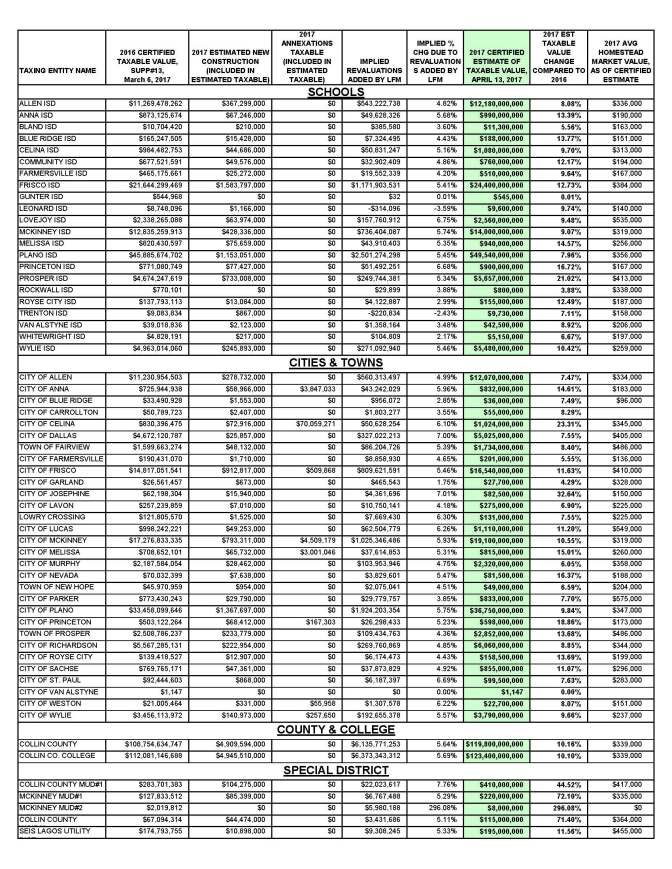
That basically leaves us with the Revaluations to scrutinized. I made an attempt to separate that critical number from an official document released yesterday by the Collin County Appraisal District that can be found at http://www.collincad.org/downloads/viewcategory/55-estimated-taxable-values.

Can the O&M Tax Rate be dropped by that Revaluation Percentage, which is 5.93% for McKinney and 5.11% for the County as a whole? Not exactly. There are two things not covered in the T-n-T calculation. One is inflation. Personnel costs and just about everything costs more due to inflation. So, there is a reasonable expectation that a portion of the increased tax valuations should cover property service cost increases due to inflation. Inflation means I am buying the same things for a higher price.

So, what should that inflation factor be? The official number is about 2.00%. My expectation is that local government inflation is more due to a fairly large amount of commodity costs, such as fuel, electricity, road materials and more. Let’s use 2.50%, just for illustration purposes.

That would leave about 3.43% in the O&M Component of the Tax Rate for McKinney. Should we expect that level of tax reduction?

Well, maybe, but there is one more thing, and it is not tiny. There are new things needed and approved all the time. Cameras and better police vests are examples. Not cheap. The list is long, and many if not most are new services and service level increases requested by the citizens and taxpayers themselves.

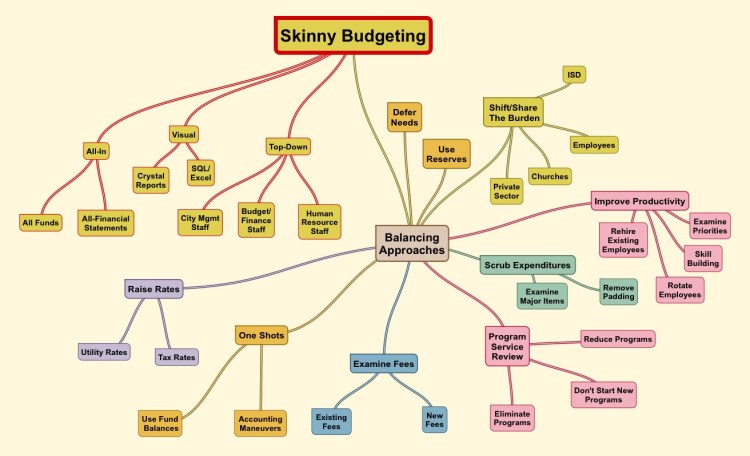
So we should just suck it up and expect all of the 3.43% to be absorbed by local governments? Not at all. In fact, we are isolating just this one component of budget balancing to better understand it. Below the CCAD table, you can find my diagram of all of the other ways local governments have to balance a budget BEFORE they get to raising the taxes or utility rates.

I started calling this approach Skinny Budgeting way before President Trump started using the term. And virtually every avenue for budget balancing has been part of my sermonettes since the early 1970s. The elements of this approach are exhaustive as you drill down within each selection. When I prioritize these approaches, the very last one is to defer necessary expenditures like infrastructure maintenance. The next to the last one is to raise taxes. The very first one is performance improvement, which should be an everyday exercise and not one saved to balance a budget in case of a crunch.

More on Skinny Budget in a later blog. My point for bringing it up as part of this blog is to keep from getting slammed from John & Jill Obvious that tax revenues aren’t the only balancing solution that should be examined.

Also, and this is very important, these CCAD values are preliminary, before they go through the appeal process – a primary obligation of the property owners. LFM

2017EstimateTaxableValues


IMG_1701 (002)

McKinney Police & Fire Unions Have No Business Being Involved in Political Influence Peddling

Introduction.

There is nobody in Texas more supportive of police and fire than I am. For over 44 years I have been involved in lifting them up, praising them across the state and letting them know how important they are to us. My wife and I never miss an opportunity to thank them for protecting us. Our biggest joy is when we offer to buy lunch for a table full of first responders at a restaurant. Our prayers frequently include a specific mention for public safety workers to be protected from harm.

But I have also been the budget director or financial planner to many cities and a couple of counties in Texas. I appreciate all local government workers. My wish is for us to be able to do everything we can to support everyone. While I think of those risking their lives, the municipal family is much broader to me. There is nobody I respect more than the water department workers who are called out at 2 am in the freezing rain to dig a hole to climb down in so they can fix a busted water line in order to service to be restored before I wake up.

Violation of Council-Manager Form of Government.

For the City Council (or candidate) to reach out for direct support and sponsorship by the Police and Fire Unions (or any city government employee group) is just flat wrong. In essence, it is saying my boss is the Chief, and his/her boss is the City Manager and his/her boss is the City Council and their bosses are the Citizens. So, to hell with the legal structure the Citizens adopted in the Charter. Let’s gang up and try to influence the last two echelons of the City’s intentionally selected form of proper governance.

It’s the most basic form political manipulation in McKinney. The common phrase is “count to four.” That means if you can get four votes, you can do or get just about anything you want in McKinney. That is why developers and real estate people are such prominent financial contributors in local races. But the most dastardly maneuvers by that particular group pale in comparison to an employee group trying to pick their boss’s boss two or three levels up.

McKinney Citizens Are Being Duped.

Here is where the Fire & Police Unions laugh all the way to the voting booth. Citizens are under the impression that there is a massive amount of support for a candidate. However, do this math:

  • How many people are in these two departments?
  • How many of the employees of these two departments belong to the Union?
  • How many of those employees actually live in McKinney and are eligible to vote?
  • How many of those voting are doing their own thinking or just following the Union leadership?

Wouldn’t it be funny if having the Police & Fire Union blatant support isn’t really generating that much political favor if the rank and file, not to mention the other city employees, quietly vote the opposite? I don’t know the exact numbers, but I’m guessing there are a small handful of actual employees making it appear has if the entire forces are championing a candidate. Politically brilliant, I suppose, but a charade.

Conclusion.

Citizens, be suspicious of this aspect of McKinney’s Underground Government. It’s real, and the only way it is ever going to change is by new blood. 1-2-3-4.

I will continue to be a cheerleader for all employees in local government. But I will always see a red flag when an employee Union is deliberately trying to manipulate an election! LFM.

Is McKinney Sandbagging Revenue Estimates?

McKinney is asking for citizen input for the upcoming budget at tonight’s meeting. Since most citizen comments are limited to only three minutes, I am opting to blog my observations on sales tax revenue assumptions.

I monitor sales tax revenues for every city, county, transit authority and special district in Texas every month. That would be over 1,600 local governments. Due to the beating levied on the oil patch regions in Texas, the total collections have been relative flat for about 18 months. But the total $8 billion annual local government base has been stable and is now growing again.

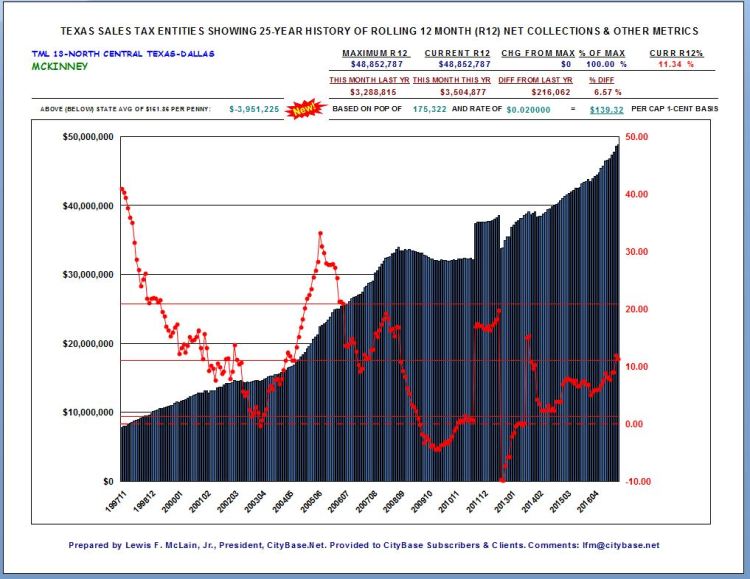
However, while many regions have suffered, that is not the case for others such as in North Texas. The collections have been robust in the DFW area. Let’s look at McKinney in particular. On a Rolling 12-month (R12) basis, there has been constant growth at an impressive rate since the Great Recession. As of April 2017, the City has collected $48,852,787 in the last 12 months, the highest ever. Just about every month is another record breaker.

The annualized growth rate is 11.34%! The R12% is the most telling and sensitive indicator of growth. It will announce slowing, peaking, bottoming and recovering points way before you can grasp the changes in dollars. The R12% is an incredibly robust metric for McKinney. Double-digit growth is difficult to sustain. But half that amount isn’t.

April 2017’s check was $216,062 higher than April 2016 or 6.57% more.

By the way, you can see the anomalies such as the positive $5 million + Audit Adjustment McKinney received back in 2011. The R12 spiked for exactly 12 months and then returned to its strong growth trend.

But let’s shift our attention to the Sales Tax Per Capita calculation. On a statewide level, Texas local governments are receiving $161.86 per capita on a 1-cent basis. McKinney is collecting $139.32 on that same basis. That can be translated into $3,951,225 below average or twice that amount since McKinney collects the full 2-cents allowed for local governments. But we knew that even before the City spent money to have a “leakage” study done in recent years.

McKinneySalesTaxChart

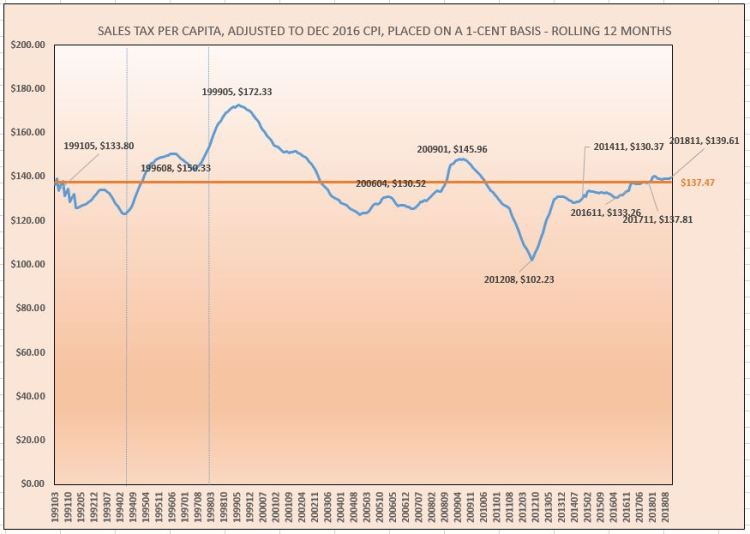
But let’s put $139.32 per capita into perspective. I prepared the chart below a few months ago and have not updated it. However, the value remains. It is instructive to look at McKinney’s Sales Tax Per Capita when you can see several years of history and adjust the calculations for inflation (CPI).

You can see the fluctuations that come from a mix of population growth and economic peaks and valleys.  You can see clearly where McKinney has been in recent years. This metric was $133.26 at the end of the fiscal year 2016. I had projected that it would rise to at least $137.81 at the end of the current fiscal year and then up to $139.61 at the end of FY 2018, the budget year for which input is being requested. I was intentionally slightly conservative. I used an inflation rate of 1.75% when it is likely to be above 2.00%.

This estimate translates into the following, again, on a 1-cent basis:

  • FY 2016 $23,594,961 Actual without any audit adjustments.
  • FY 2017 $24,917,139 or 5.60% higher than FY 2016.
  • FY 2018 $26,367,347 or 5.81% higher than FY 2017.

So, there’s my input.

PerCapita

In looking at the agenda packet for tonight, I find a presentation that indicates a sales tax growth rate of 2.06%! It does not say whether the growth rate is going to be applied to the 2017 Budget, the 2017 Revised Budget or any other base. That’s important. It appears to be scientific in that it is the composite of the Fed Median GDP Projection; the 10-Year Dallas Fed PCE; the 10-Year Rolling Average; and the Low 5-Year Average.

Hold on a second. I’m not sure any those are logical linkages. Here is what I do know. I have prepared some very sophisticated sales tax modeling algorithms in my career. And no matter the degree of complexity or academic statistical excellence I worked into the model, my last step had to include dividing the numerator by the denominator (residential population and employment) to come up with a Sales Tax Per Capita value.

Questions Abound

On the surface, the concept of making conservative estimates sounds noble and smart. But here is the problem. Actually, there are several problems. If you are too conservative (lowering revenue estimates and raising expenditure assumptions), then what is there to manage?

One can brag about how the spending came in under budget. Big deal. Not to hard to do with enough padding.

One might even brag about how money has been “found” mid-year to come in and save the day for new need, especially a political need. In my career, I have seen how eventually nobody needs to fight for resources during the budget. Just know that the real budget “tightening” will come when the budget is revised mid-year in face of the true income and spending levels. Except “tightening” can turn into new-found money (oh how I hate that phrase).

The net result of being overly conservative, other than the kudos for rescue funding mid-year, is that reserves get boosted. But then that argument gets abused. If you have 60 days of operating reserves, wouldn’t 90 be better? Well, if big is better, then why not build reserves up to 180 days. Where do you stop?

Next, comes the most insincere and most abused argument of them all: “the bond rating agencies want big reserves or else they will drop the bond rating.”

Rage sets in on me. I’ve watched the McKinney finance staff shut down a legitimate question asked by a councilmember by simply invoking the “Bond Rating Agency Threat.” Grounds for dismissal in my book. Especially the Deputy City Manager who directs the financial staff. He knows the game, and recent abuses have been on his watch.

But here’s the deal. The bond rating agencies place a high degree of emphasis on fiscal management, including controls and planning. They will even hang with you if you are in trouble. They mainly want to know a couple of things: 1) do you know you are in trouble; and 2) do you know how to get out of trouble?

Want to know how the bond rating agencies will react to something? Go ask them! They are approachable. Plus you pay them a big fee to be rated.

Here’s something else I know. McKinney is flush with reserves after years of overly conservative budgeting. I won’t be handing out a badge of honor for big reserves when there are legitimate needs for spending – or to cut the tax rate.

And I know this. Overly conservative sales tax budgeting boosts the need for property tax revenues. It works like this. A penny on the tax rate produces about $1,700,000. A one percent change in the sales tax revenue equals about $260,000. Low ball the sales tax revenue by 4% and you need the property tax rate equivalent of $1,400,000 or a TRE of about 6/10 of a penny. ($260,000 x 4) / $1,700,000.

So, do this at the McKinney meeting tonight: ask for the Budget vs Actual for Sales Tax Revenues for the past five years. Ask what the revised FY 2017 sales tax revenue estimate is expected to be now that nearly half the year has gone by. LFM

BTW, if you want to see the first chart for every entity in Texas, you can download my charts I prepare monthly. It’s a big PDF file.

You can view “StatewideCharts201704.pdf” at: https://files.acrobat.com/a/preview/8bd7f399-4e3a-48e0-a717-50b9b92e7125