McKinney Underground Government Suffers a Setback, and a New Future Opens

The voters have slammed the business-as-usual, McKinney Underground Government in a big way by making sure the Mayor Pro-Tem doesn’t get to stay at the table. He’s out. I should say he has been outed. Also, three “winkers” and “I can’t vote against my friends” Council members are termed out even though old developer friends rushed to get some things approved just before the election. Good riddance!

Even though there are three runoffs, those with the most votes should be successful. The remaining three Pogue-worshippers will be in a minority. Oopsy!

McKinney made a turn yesterday – a major shift that will bring needed change to the way business is conducted in local government here.

It is clear, crystal clear, that having the McKinney Fire and Police Unions support does not bring assurances you will win office. In fact, I sense that it backfired and will continue to be a negative instead of a positive. A smart candidate in the future will flee from that kind of support, which will make the elections two years from now for the three incumbents that much more interesting. If I were a member of the Fire & Police Unions, I’d seek new leadership and new rules about political pandering.

But there is hope. They have two years of experience under their belt and could make a difference if political intrigue can be replaced with sound decision making. One of the three was overheard telling the other two that I was going to be “taken down” after one of my blogs. Let me say this: I stand ready to heap genuine praise for any and all of the seven doing their job and only their job without favoritism or malice. Try me.

As a companion statement, I will not hesitate to blast any of the new four if they become part of the McKinney Underground. My support of them ends the moment they abandon their independence for their friends. My loyalty is cemented by what they do and only by that yardstick. My training and my orientation are to match words with action.

But this is just the beginning. McKinney voters need to keep up the momentum. After the three runoff leaders get seated, it will be time to push for major changes in the City Charter – the People’s Word. We the citizens need to make sure it becomes a violation of our Charter for political candidates to use the City’s logo for political purposes as is already prohibited in some cities.

If possible, we need to make it illegal to use any city employee group for political influence. As I said recently, it is flat wrong to have city employees pushing to pick their boss three levels up. It stinks, and the voters apparently found the pungent smell too much to reward and unworthy of their vote. Please, people, think deeply about how that has been allowed to happen in McKinney. The only people who have told me there is no Underground are members of the dang Underground!

The future City Council needs to move immediately to get rid of the City Attorney. He is part of the Underground, controlling way too much and being much more involved in City business than just offering legal advice. What are the sound reasons for rotating the City’s independent auditor after several years? It applies to the City Attorney, too. The “he has so much historical knowledge” argument is bogus. If that is so, then we have allowed McKinney to get shackled to a job protection scheme that is simply not a good business practice.

The City Council needs to confront and take action on any aspect of the way McKinney violates the Council-Manager form of government. If it’s one of them (and there have been many), call out the infraction. If it is a staff member undermining the City Manager (and there have been many), then resist the practices of the past. If it is the old establishment of developers and realtors or anybody new on the scene, call out the foul.

McKinney is so desensitized to bad practices that many good people have no clue they are in violation of sound governance because they are just doing what they have seen everybody else do. I think that ended yesterday.

In fact, make it known inside and outside the walls of McKinney that this city assures a level playing field to everyone in both tangible and intangible ways. Ask people outside of McKinney what our political reputation is. Imagine what that answer could be with fair dealings.

I think we are in for two years of new professionalism that will change McKinney forever, with an acceleration two years from now. Professionalism breeds more professionalism. That’s the missing message to bring the quintessence of said professionalism to McKinney in the way of the best businesses. McKinney must get out of the desperation mode. If we could reach build-out in, say ten years, just exactly why would we want to be in that kind of rush?

Then, citizens, we must work on the McKinney ISD, where the sheep-board is anesthetized to the point of servitude to the Superintendent: the opposite end of the governance spectrum. The McKinney City Council can set the example. LFM

Collin County Tax Base is Robust … And Will Put Pressure on Officials to Lower Tax Rates

We are blessed in Collin County. The momentum (momo) is enormous, and there are no signs of slowing down. In fact, it is just the opposite. Our momo is gaining momo!

The market value of my property went up 16.90%. Wow! My investment is paying off. My assessed value is lower due to my Homestead and Over 65 Exemption. Still, that’s quite a rise.

The pressure will be on for local government officials to lower the tax rate in most cases. But just how much? It depends. Each government will have to compute an apples-to-apples comparison in accordance with the State’s Truth-In-Tax laws before tax rates are considered beyond July 25, when the Certified Tax Roll is finalized. A key metric is the Effective Rate. The calculation can get complicated, but it basically boils down to this: what is the tax rate that equals last year’s Operations & Maintenance Tax Revenues + this year’s Debt Service obligations?

Oh, by the way, last year’s O&M Tax Rate can be adjusted to compensate for services needed to cover new growth in our community plus anything we annexed. That’s fair. You don’t add $billions in new subdivisions without needing more staff to patrol and serve same.

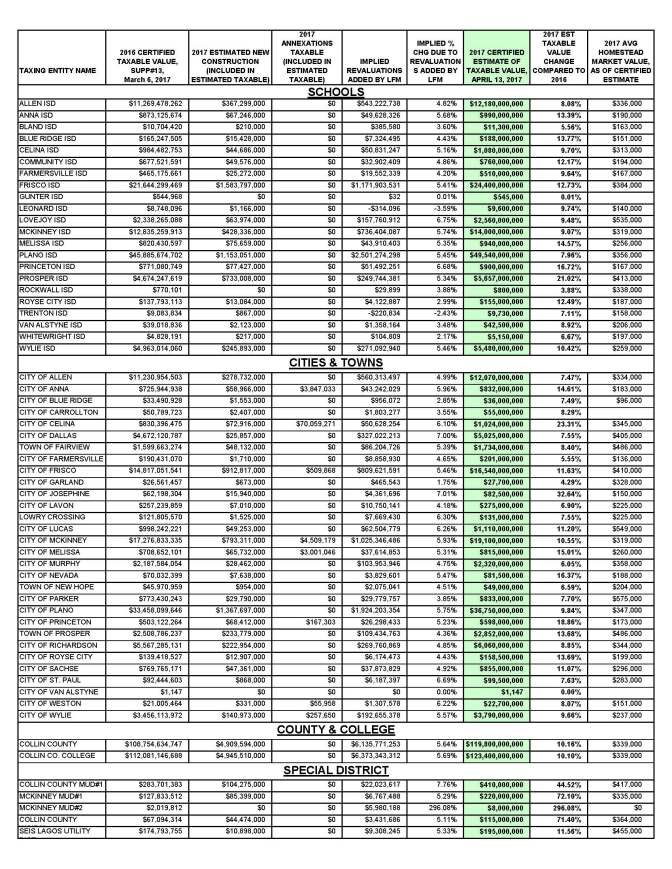
That basically leaves us with the Revaluations to scrutinized. I made an attempt to separate that critical number from an official document released yesterday by the Collin County Appraisal District that can be found at http://www.collincad.org/downloads/viewcategory/55-estimated-taxable-values.

Can the O&M Tax Rate be dropped by that Revaluation Percentage, which is 5.93% for McKinney and 5.11% for the County as a whole? Not exactly. There are two things not covered in the T-n-T calculation. One is inflation. Personnel costs and just about everything costs more due to inflation. So, there is a reasonable expectation that a portion of the increased tax valuations should cover property service cost increases due to inflation. Inflation means I am buying the same things for a higher price.

So, what should that inflation factor be? The official number is about 2.00%. My expectation is that local government inflation is more due to a fairly large amount of commodity costs, such as fuel, electricity, road materials and more. Let’s use 2.50%, just for illustration purposes.

That would leave about 3.43% in the O&M Component of the Tax Rate for McKinney. Should we expect that level of tax reduction?

Well, maybe, but there is one more thing, and it is not tiny. There are new things needed and approved all the time. Cameras and better police vests are examples. Not cheap. The list is long, and many if not most are new services and service level increases requested by the citizens and taxpayers themselves.

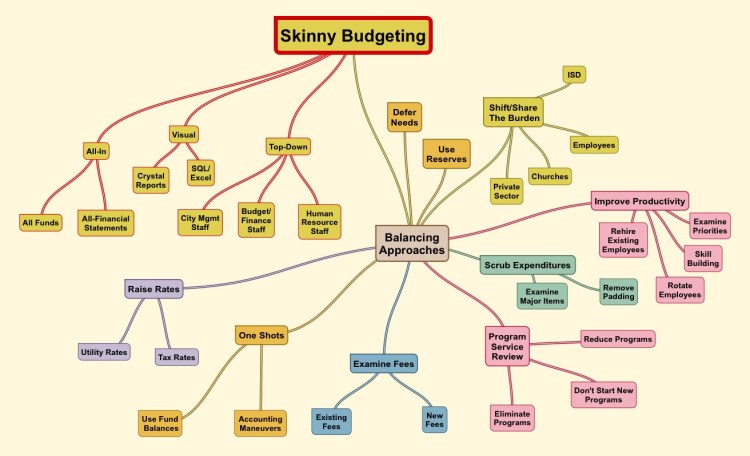
So we should just suck it up and expect all of the 3.43% to be absorbed by local governments? Not at all. In fact, we are isolating just this one component of budget balancing to better understand it. Below the CCAD table, you can find my diagram of all of the other ways local governments have to balance a budget BEFORE they get to raising the taxes or utility rates.

I started calling this approach Skinny Budgeting way before President Trump started using the term. And virtually every avenue for budget balancing has been part of my sermonettes since the early 1970s. The elements of this approach are exhaustive as you drill down within each selection. When I prioritize these approaches, the very last one is to defer necessary expenditures like infrastructure maintenance. The next to the last one is to raise taxes. The very first one is performance improvement, which should be an everyday exercise and not one saved to balance a budget in case of a crunch.

More on Skinny Budget in a later blog. My point for bringing it up as part of this blog is to keep from getting slammed from John & Jill Obvious that tax revenues aren’t the only balancing solution that should be examined.

Also, and this is very important, these CCAD values are preliminary, before they go through the appeal process – a primary obligation of the property owners. LFM

2017EstimateTaxableValues


IMG_1701 (002)

McKinney Police & Fire Unions Have No Business Being Involved in Political Influence Peddling

Introduction.

There is nobody in Texas more supportive of police and fire than I am. For over 44 years I have been involved in lifting them up, praising them across the state and letting them know how important they are to us. My wife and I never miss an opportunity to thank them for protecting us. Our biggest joy is when we offer to buy lunch for a table full of first responders at a restaurant. Our prayers frequently include a specific mention for public safety workers to be protected from harm.

But I have also been the budget director or financial planner to many cities and a couple of counties in Texas. I appreciate all local government workers. My wish is for us to be able to do everything we can to support everyone. While I think of those risking their lives, the municipal family is much broader to me. There is nobody I respect more than the water department workers who are called out at 2 am in the freezing rain to dig a hole to climb down in so they can fix a busted water line in order to service to be restored before I wake up.

Violation of Council-Manager Form of Government.

For the City Council (or candidate) to reach out for direct support and sponsorship by the Police and Fire Unions (or any city government employee group) is just flat wrong. In essence, it is saying my boss is the Chief, and his/her boss is the City Manager and his/her boss is the City Council and their bosses are the Citizens. So, to hell with the legal structure the Citizens adopted in the Charter. Let’s gang up and try to influence the last two echelons of the City’s intentionally selected form of proper governance.

It’s the most basic form political manipulation in McKinney. The common phrase is “count to four.” That means if you can get four votes, you can do or get just about anything you want in McKinney. That is why developers and real estate people are such prominent financial contributors in local races. But the most dastardly maneuvers by that particular group pale in comparison to an employee group trying to pick their boss’s boss two or three levels up.

McKinney Citizens Are Being Duped.

Here is where the Fire & Police Unions laugh all the way to the voting booth. Citizens are under the impression that there is a massive amount of support for a candidate. However, do this math:

  • How many people are in these two departments?
  • How many of the employees of these two departments belong to the Union?
  • How many of those employees actually live in McKinney and are eligible to vote?
  • How many of those voting are doing their own thinking or just following the Union leadership?

Wouldn’t it be funny if having the Police & Fire Union blatant support isn’t really generating that much political favor if the rank and file, not to mention the other city employees, quietly vote the opposite? I don’t know the exact numbers, but I’m guessing there are a small handful of actual employees making it appear has if the entire forces are championing a candidate. Politically brilliant, I suppose, but a charade.

Conclusion.

Citizens, be suspicious of this aspect of McKinney’s Underground Government. It’s real, and the only way it is ever going to change is by new blood. 1-2-3-4.

I will continue to be a cheerleader for all employees in local government. But I will always see a red flag when an employee Union is deliberately trying to manipulate an election! LFM.

Thank you for taking care of us!

When I’m at a big luncheon or similar situation, I find myself watching the faces and demeanor of the servers. I can’t remember when I started doing this, but it was a long time ago. Perhaps it was after reading William F. Buckley’s An Attitude of Gratitude. It is more likely that it’s part of my DNA since my parents had that nature. I find myself having a need to thank the servers in a genuine tone and then seeking them out afterward to thank them again. What I don’t know is whether I do this for the server or for me. It could easily be me doing the serving. My blue-collar upbringing, then college, and then my wife have shaped my every step. Mentors have opened doors, and a few pushed me through those passageways.

A colleague of mine, Ron Holifield, has been placing a big emphasis on Servant Leadership. My first introduction to that particular topic came years ago from another good friend and colleague, Dan Johnson. In a leadership course, he talked about Robert Greenleaf who coined the term. Greenleaf got his idea after reading a book by Hermann Hesse who authored a book about a journey.

The story was about a group of people on a long pilgrimage to seek a great master. The storyteller is laboring with his baggage on the journey when a small man comes to his aid, picking up some of his bags and carrying the load. At some point near the end of the journey the helper disappears, which irritates the pilgrim. Soon after they all reach the top of the mountain. When they meet the master, the man is surprised to learn that it was the master himself who appeared and carried his burden.

These kinds of stories fascinate me. And motivate me. I’ve got many. About 3 out of 4 times my wife Linda goes grocery shopping, half of her time is spent shopping. The other half is spent seeking out a person who needs help. One of her best friendships today started at Wal-Mart years ago with a simple comment turned into an hour-long conversation. And that was just the beginning.

I don’t know if they still do this, but under Ron Whitehead’s leadership at Addison, the councilmembers and CMO staff used to host a cookout for all city staff. A simple gesture with a profound impact.

So, today comes another story. It started my day with an early lift, like a devotional to ground me and to infuse me with gratitude. I’ll let it speak for itself.

theeagle.com

Texas A&M students serve custodial staff at luncheon to show appreciation
STEVE KUHLMANN steve.kuhlmann@theeagle.com

For nearly 20 years, Roslyn Adams has served the students, faculty and staff of Texas A&M University as a member of the custodial team, but Monday — even if for just a few hours — she and her peers got to take a break and enjoy each other’s company in the Bethancourt Ballroom of the Memorial Student Center.

More than 500 members of the university’s custodial staff, employed by custodial, grounds and maintenance service provider SSC, were honored during the annual Custodian Banquet, which featured a catered lunch, raffle, music and a photo booth.

Adams said the student-organized event is a meaningful gesture from those she and her co-workers serve on a daily basis.

“It just shows that somebody around here appreciates us for what we do,” Adams said. “These students don’t have to do this, but they went out of their way to do it, so it really means a lot.”

Freshman Madeleine Williams, a member of the Student Government Association’s Custodian Banquet committee, said helping to plan the event has been special to her as she has been able to interact with custodians throughout the year.

After nearly seven months of preparation and fundraising, Williams said, it was rewarding to see the custodians enjoying the event.

“It really is just a small way to give back to them for serving us every day,” Williams said. “It’s cool to have this opportunity to make them feel special for a day.”

In addition to helping serve the food, busing the tables and visiting with the staff, the students were also in charge of cleaning up the space once the event was over.

Brandon Placker, who has worked at the university for roughly seven years, said while many of the people he comes into contact with on a daily basis are kind, the nature of their work remains largely thankless. Placker said he is appreciative of the students’ efforts to show their gratitude.

“To know that people actually care, it means a lot,” Placker said.

Sincere Johnson, who has been on the job just over 10 months, said she particularly appreciated the free, on-the-clock lunch.

“They saved us money today [since] we didn’t have to go buy lunch, and it was nice to see all the other people I’ve worked with before,” Johnson said.

Ted Dawson, regional manager for SSC, said with more than 23,000 square feet of facilities, it is a rarity for all of the employees to get together.

“It’s great because a lot of these people have known each other for years but may not work together anymore,” Dawson said. “For them to do this for all 550 of our employees is absolutely amazing. It really shows how much the university cares and thinks about the custodian staff.”

Is McKinney Sandbagging Revenue Estimates?

McKinney is asking for citizen input for the upcoming budget at tonight’s meeting. Since most citizen comments are limited to only three minutes, I am opting to blog my observations on sales tax revenue assumptions.

I monitor sales tax revenues for every city, county, transit authority and special district in Texas every month. That would be over 1,600 local governments. Due to the beating levied on the oil patch regions in Texas, the total collections have been relative flat for about 18 months. But the total $8 billion annual local government base has been stable and is now growing again.

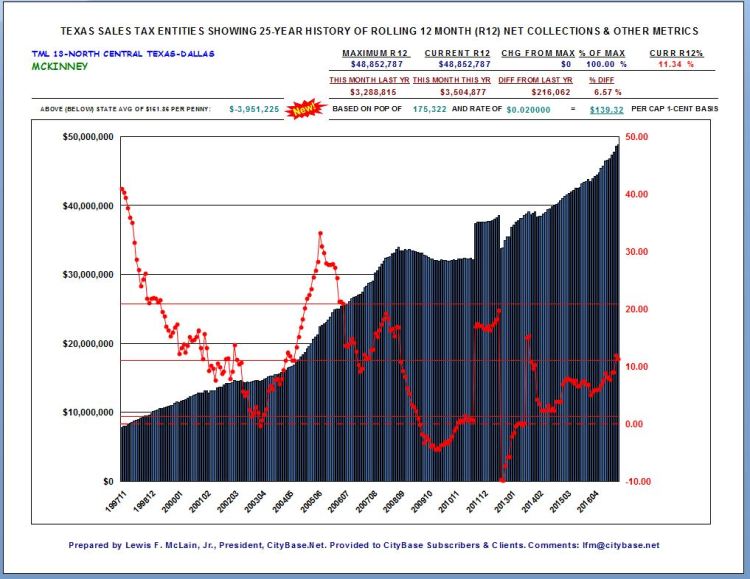
However, while many regions have suffered, that is not the case for others such as in North Texas. The collections have been robust in the DFW area. Let’s look at McKinney in particular. On a Rolling 12-month (R12) basis, there has been constant growth at an impressive rate since the Great Recession. As of April 2017, the City has collected $48,852,787 in the last 12 months, the highest ever. Just about every month is another record breaker.

The annualized growth rate is 11.34%! The R12% is the most telling and sensitive indicator of growth. It will announce slowing, peaking, bottoming and recovering points way before you can grasp the changes in dollars. The R12% is an incredibly robust metric for McKinney. Double-digit growth is difficult to sustain. But half that amount isn’t.

April 2017’s check was $216,062 higher than April 2016 or 6.57% more.

By the way, you can see the anomalies such as the positive $5 million + Audit Adjustment McKinney received back in 2011. The R12 spiked for exactly 12 months and then returned to its strong growth trend.

But let’s shift our attention to the Sales Tax Per Capita calculation. On a statewide level, Texas local governments are receiving $161.86 per capita on a 1-cent basis. McKinney is collecting $139.32 on that same basis. That can be translated into $3,951,225 below average or twice that amount since McKinney collects the full 2-cents allowed for local governments. But we knew that even before the City spent money to have a “leakage” study done in recent years.

McKinneySalesTaxChart

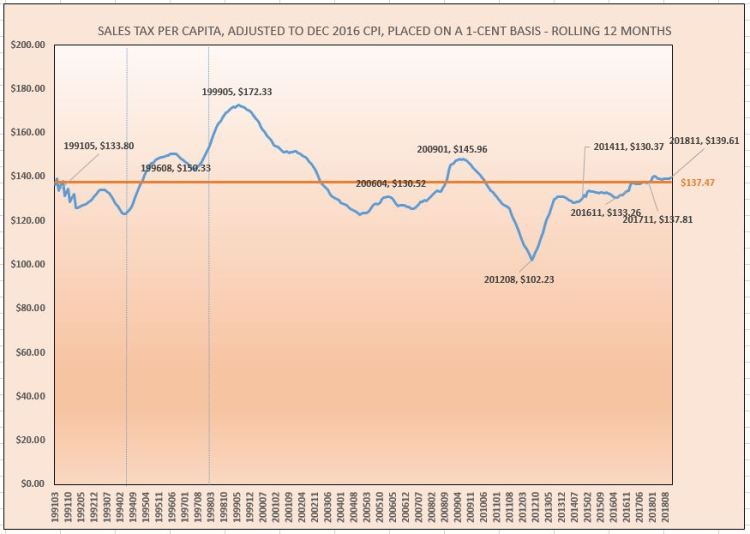
But let’s put $139.32 per capita into perspective. I prepared the chart below a few months ago and have not updated it. However, the value remains. It is instructive to look at McKinney’s Sales Tax Per Capita when you can see several years of history and adjust the calculations for inflation (CPI).

You can see the fluctuations that come from a mix of population growth and economic peaks and valleys.  You can see clearly where McKinney has been in recent years. This metric was $133.26 at the end of the fiscal year 2016. I had projected that it would rise to at least $137.81 at the end of the current fiscal year and then up to $139.61 at the end of FY 2018, the budget year for which input is being requested. I was intentionally slightly conservative. I used an inflation rate of 1.75% when it is likely to be above 2.00%.

This estimate translates into the following, again, on a 1-cent basis:

  • FY 2016 $23,594,961 Actual without any audit adjustments.
  • FY 2017 $24,917,139 or 5.60% higher than FY 2016.
  • FY 2018 $26,367,347 or 5.81% higher than FY 2017.

So, there’s my input.

PerCapita

In looking at the agenda packet for tonight, I find a presentation that indicates a sales tax growth rate of 2.06%! It does not say whether the growth rate is going to be applied to the 2017 Budget, the 2017 Revised Budget or any other base. That’s important. It appears to be scientific in that it is the composite of the Fed Median GDP Projection; the 10-Year Dallas Fed PCE; the 10-Year Rolling Average; and the Low 5-Year Average.

Hold on a second. I’m not sure any those are logical linkages. Here is what I do know. I have prepared some very sophisticated sales tax modeling algorithms in my career. And no matter the degree of complexity or academic statistical excellence I worked into the model, my last step had to include dividing the numerator by the denominator (residential population and employment) to come up with a Sales Tax Per Capita value.

Questions Abound

On the surface, the concept of making conservative estimates sounds noble and smart. But here is the problem. Actually, there are several problems. If you are too conservative (lowering revenue estimates and raising expenditure assumptions), then what is there to manage?

One can brag about how the spending came in under budget. Big deal. Not to hard to do with enough padding.

One might even brag about how money has been “found” mid-year to come in and save the day for new need, especially a political need. In my career, I have seen how eventually nobody needs to fight for resources during the budget. Just know that the real budget “tightening” will come when the budget is revised mid-year in face of the true income and spending levels. Except “tightening” can turn into new-found money (oh how I hate that phrase).

The net result of being overly conservative, other than the kudos for rescue funding mid-year, is that reserves get boosted. But then that argument gets abused. If you have 60 days of operating reserves, wouldn’t 90 be better? Well, if big is better, then why not build reserves up to 180 days. Where do you stop?

Next, comes the most insincere and most abused argument of them all: “the bond rating agencies want big reserves or else they will drop the bond rating.”

Rage sets in on me. I’ve watched the McKinney finance staff shut down a legitimate question asked by a councilmember by simply invoking the “Bond Rating Agency Threat.” Grounds for dismissal in my book. Especially the Deputy City Manager who directs the financial staff. He knows the game, and recent abuses have been on his watch.

But here’s the deal. The bond rating agencies place a high degree of emphasis on fiscal management, including controls and planning. They will even hang with you if you are in trouble. They mainly want to know a couple of things: 1) do you know you are in trouble; and 2) do you know how to get out of trouble?

Want to know how the bond rating agencies will react to something? Go ask them! They are approachable. Plus you pay them a big fee to be rated.

Here’s something else I know. McKinney is flush with reserves after years of overly conservative budgeting. I won’t be handing out a badge of honor for big reserves when there are legitimate needs for spending – or to cut the tax rate.

And I know this. Overly conservative sales tax budgeting boosts the need for property tax revenues. It works like this. A penny on the tax rate produces about $1,700,000. A one percent change in the sales tax revenue equals about $260,000. Low ball the sales tax revenue by 4% and you need the property tax rate equivalent of $1,400,000 or a TRE of about 6/10 of a penny. ($260,000 x 4) / $1,700,000.

So, do this at the McKinney meeting tonight: ask for the Budget vs Actual for Sales Tax Revenues for the past five years. Ask what the revised FY 2017 sales tax revenue estimate is expected to be now that nearly half the year has gone by. LFM

BTW, if you want to see the first chart for every entity in Texas, you can download my charts I prepare monthly. It’s a big PDF file.

You can view “StatewideCharts201704.pdf” at: https://files.acrobat.com/a/preview/8bd7f399-4e3a-48e0-a717-50b9b92e7125

Distractions

The reason I went dark from November 11, 2016, until now is that I have been distracted.

Not all distractions are attached to bad reasons. But they are distractions just the same.

Maybe it started with the presidential elections. The person I voted for won the election. I was surprised and ecstatic. I predicted if he won that he would be a train wreck. If so, let ‘er rip! I’m tired of talk, talk, talk. Dumb Republicans had eight years to groom a candidate but let an Independent steal their party. They got what they deserved.

But after I suffered for eight years and never complained publicly, I’ll not spend a second listening to the whiners who want to protest at sufficiently loud levels as if the more noise will rewind history. Rally all you want. I can’t hear you!

I equally despise Republicans and Democrats. And most of all, the Tea Party. But I do have one good thing to say about the TP (and only one), which I will save for a future blog.

For a long time, I have cherished silence. That need is growing. I opted to send my sister-in-law in my place on a family cruise at the last minute in early March. I spent a week in silence, just working. I watched zero on TV, and still have not turned on my office TV. I deactivated my FaceBook account and still have not reactivated. Same thing for LinkedIn. And Twitter. I do get plenty of news alerts that I read since news is one of my primary businesses. Silence is golden to me.

I am distracted by McKinney politics. Well, until I checked out a few months ago. McKinney is run by an underground that key people in the know will not deny. They also won’t do anything about it. In fact, they have winked for so many years that newbies know no difference and aren’t about to mess up the favoritism playpen. That might change with this upcoming election. Hope so. But it’s going to take some major changes on the Council and inside City Hall.

It bothers me that AG Ken Paxton is abusing the legal system to save his hide. I’m sitting in the middle of Collin County, his Mother Ship, and his nature of doing business up here is legendary. He is bad, but his worshippers won’t admit it.

It got distracted by Bruce Springsteen standing up in a foreign country and telling the world he came to them as an embarrassed American. I was okay with his rants and others before the presidential election, but I was ready to puke when he (and others in the entertainment industry) wouldn’t give it up after the election. After listening to him every single day for decades and giving my family instructions to bury me in one of my Springsteen shirts, he is dead to me. He does not exist. But, honestly, I am grieving. You would have to know what his music and performances meant to me to understand.

Perhaps distractions are affecting me differently since I am turning 70 this year. I don’t feel THAT old. My mind says I am much, much younger. Or so it seems. But my preferences are to stay in my cockpit of two computers and ten monitors to work, think, analyze. And maybe even start writing again.

I’ve sworn off going to conferences. The last one I attended included me falling off the back of the stage just before I spoke. The one before that I forgot my conference clothes and came back from Houston before it even started. The one before that I had to return just before the conference started due to my mother’s impending death. I think the message is clear: stay in your cockpit, Lewis!

I have had some health distractions. Nothing serious, yet, but true distractions.

When I said that not all distractions have been bad, I was particularly thinking about a project I am working on with a client under new city management leadership. It is a multi-year contract to provide an entire series of budgeting, long-range planning, utility rate studies and more. I am considering it to be my final exam regarding just about everything I have done in my 44-year career. I am having a blast.

I started part of this approach years ago, but now I have a real application. I am calling it McLain’s All-In, Top-Down, Visual Skinny Budgeting or Skinny Budgeting (I was using the term before Trump picked it up). If I could work “No Stone Left Unturned” into the title, I would do it. More on that subject over the next few months. It is a dream project for an analyst like me.

Related, I have closed my Confidential Sales Tax Reporting & Analysis work to only current clients until 2018 so I can focus on just them as well as my new project. I have a great client base of 15 cities plus DART that includes 13 cities.

In my career, I have done hundreds of workshops, presentations, and analyses for no compensation. Willingly. To serve the entire municipal family is an honor. I am changing that slightly. I won’t be doing any presentations in the future. Too many rude people in the audience checking their phones for messages or talking.

The exception will be a workshop I am going to do in a few months to promote Skinny Budgeting. I won’t be seeking new clients for anything other than fee-based training. I just want to see the approach used in governance and fiscal policy decisions.

On the other hand, I love one-on-one conversation. I am happy to meet with anyone willing to come to McKinney to chat over a cup of coffee. I also will usually respond quickly to an emailed question on just about anything within my knowledge base, which is narrowing. I treasure my pen pals.

My blog will provide a considerable amount of my thoughts and analyses for those who sign up through http://www.citybaseblog.net. I feel called to write, but the time competes with everything else I do.

Otherwise, I plan to take care of my CityBase subscribers, my Confidential Sales Tax Clients and my one Skinny Budgeting client.

I’m not sure about where I might head blogging about McKinney politics. If the governance and culture do not change, McKinney politics will be dead to me. Not worth it. Life is too short. But I am hopeful that some will leave and go crawl in a hole somewhere. And that some staff who are part of the underground will be run off. We’ll see. LFM

How Much Do I Love Thee, Council – Manager Form of Government? Let Me Count the Ways

Well, let me allow the City Manager of Paris, TX tell us. I can think of three things that can be done to make McKinney the best, most successful, most cohesive and stable City it can and should be. It is to honor and enforce the Council-Manager form of government. Number two and three follow but are a distance from two and three. I’ve been writing about all three. But I want to offer another emphasis of many I will be making about No. One! This letter ran in the Paris newspaper in 2014, but it was a replay of the City Manager’s letter of 2012. It just doesn’t get any clearer than this. LFM


It’s the city manager’s job to run the city, Godwin reminded council in 2012

Posted on Apr 22, 2014
eParisExtra.com
by Charles Richards

(Editor’s Note: As the 2014 City of Paris election approaches for city council positions of districts 1, 2, 3 and 6, it seems timely to present a transcript of city manager John Godwin’s comments during a 90-minute workshop with the Paris City Council in June 2012, shortly after he came on board. Godwin told council members it’s their role to set policy and give direction, and leave the rest to him.)

 John Godwin: Thank you. I appreciate your time. I don’t want to insult anybody’s intelligence, anybody’s level of experience, but I kind of wanted to talk about some basic things.

 Hopefully, I will get some feedback from you and have two-way communication. It’s important that the manager and the council both agree on what his job is, or else it causes you frustration and it causes me to be unemployed, and I don’t want either of those things to happen. (laughter).

City manager is kind of an odd job for whatever reason. August, hopefully, will mark 26 years for me in local government, and I have still a majority of my family members that don’t know quite what a city manager is.

 It is, for whatever reason, kind of an unknown position. People understand that a superintendent in the school district is the CEO of the school district and the school board is there to give policy and direction and those types of things, and adopt a budget.

 It works exactly the same way in cities, but for some reason superintendents are well known and city managers are usually anonymous. I tell people I’m a city manager, and they go, “Oh, you’re like the mayor,” and I say, “No, it’s not at all like the mayor.” And they say, “Well, what do you do?” I say, “Well, I run the city,” and they say, “I thought the mayor does that,” and I said, “No, the mayor DOESN’T do that.” (Laughter)

 I know you guys know this, but there are some new folks on here, too, and even some of you who have been here a while have been here only a year or two years. A lot of things that you’re used to — because it’s been that way for a whole month or for a whole year or for a whole two years on the council — isn’t necessarily the way it always is in other cities, whether that’s good or bad.

 For example, I’ve never run across a city that has a fulltime judge as an employee. That’s nothing against the judge, and that doesn’t mean it’s good or bad, and I’m not suggesting you change it. But if you assume from your governing experience that every city does that – every city doesn’t do that. Every city doesn’t have a fulltime attorney even in house,  or an assistant attorney like you do.

 Here, you approve everything by resolution, almost. And Kent (city attorney Kent McIlyar) prepares the resolution. I’ve seen bunches of those already just in the two meetings I’ve been to. That’s kind of unusual. It’s not completely undone, but that’s kind of unusual. I say all that just to say if there’s things that seem unusual or odd, or you wonder why it’s done that way, it may or may not be for a good reason. It may be just that’s the way it’s always been done.

 As a council, you always have the right to change those kinds of things – the policy things, the processes, your own processes, your own procedures. If you want to do resolutions, do resolutions. If you don’t want to do a resolution for everything, if you want to do a minute order to save time, to save Kent time, anyway, then you can do that, too. I’m not suggesting anything; it’s just something that you can do.

 It’s very important that the council set policy, you set guidelines. An example of that is, and hopefully the council knows this and agreed to it at some point in time, but I got a complaint last week or the week before last, about one of the parks not being mowed. It didn’t look good. And people don’t like to go out there because it doesn’t get mowed.

 Well, the response from the staff was, “Oh, we only mow it every other week because it’s on the ‘B’ list.” Well, I don’t know, if there’s going to be an ‘A’ list and a ‘B’ list, that’s something that the council really ought to say “Yeah, there’s gonna be an A list and a B list because we don’t have enough money or enough energy or enough whatever it is to keep all the parks pristine.”

 Now, if that’s not your policy, I need to know that. I just meant that as an example of staff should not be doing that. That’s a policy thing and staff is not supposed to make policy.

 Another example is the health department. It’s my understanding that staff kind of initiated making changes with the health department. Well, the relationship with the health department is the purview of the council, not of the staff.

 Now, once you tell us, “We want you to do so and so” with the health department or with the parks, or whatever it is, then it’s time for you to back off and let us do that.

The city manager is the CEO, the COO of the organization. Every employee works for the city manager. No employees work for the council except for the city manager – and the city attorney, only those two.

 And, just to be clear on that, and I don’t want to beat it to death, or insult anybody – the last thing I want to do as a brand new guy is to do any of that, but it’s not a matter of the typical chain of command where you’re up here, and then it’s me, and then it’s everybody else. It’s two separate chains of command. It’s you and me, and then over here is a whole ‘nother chain of command. It’s me and everybody else.

 So it’s not that they all work directly for me and indirectly for you. By law, nobody works for you except for me and the city attorney. Whereby I reserve the right if I’ve got a problem department or a concern in a department – and I’ve already done this – to go around with one of my supervisors, with his knowledge hopefully, usually, and talk to subordinates.

 You don’t have the right to do that. You don’t have the authority to do that. And that’s a violation of the Charter for you to give instructions or to interfere in the operations of the city. And that’s typical of almost every city that has a home rule charter. That’s nothing unusual or odd.

 Sometimes, in my job, people talk about how, “Well, it must be really hard to have seven bosses.” And my response to that is always, “I don’t have seven bosses. I only have one. It’s the city council. I don’t have seven individual bosses.”

 If one council member says, “Hey, John, go jump off the roof,” my response is going to be, “Put it on the agenda and get three more votes” — because only one of you can’t tell me something to do. The reason for that is not because I’m hard-headed and don’t want to be cooperative, it’s because if one of you tells me to jump off the roof and I do it, the other six are going to say, “Well, you’re an idiot. You can’t do that.”

 Also, it needs to happen in a meeting. It needs to be in a posted meeting, and it needs to be on the agenda: “Instruct the city manager to jump off the roof.” So, there’s a process. It’s a process for a reason and it’s got nothing to do with me or my preferences.

 Now, little things come along. For the sake of efficiency, I hate bureaucracy, I hate mindless rules, I hate structure that has no point to it, and as you get to know me hopefully a lot better over the next few years – I’m hoping, that’s certainly my goal – you’ll realize I’m about as anti-bureaucrat as there is. I hate that stuff. I hate that mindless, “do things” for no reasons at all.

 But there are reasons for that kind of structure, and it’s important that we both understand that and that we both follow that. But for little things, you know, that’s a different deal. Certainly it’s perfectly OK and it’s even encouraged from time to time that you ask for information from staff. If you want to know, “Gene Anderson, how much money did we spent on pencils last year?” ask him. That’s an information request.

 If you want to know how many tickets we wrote last year, ask the police chief and he’ll tell you.

 Now, I’ll instruct those staff members, when you give information to the council members, copy me on the email, or just let me know that you talked to them, so I know what’s going on, in case there’s an issue or because they tell you something wrong.

 Because ultimately I’m responsible for their behavior, and their performance, and if they don’t perform then I need to know that so I can fix it. If they’re not responsive to your request, I need to know that so I can fix it. So information requests, you’re not forbidden from talking to them, you’re not forbidden from interacting with them. They’re not going to shy away from you. If they do, let me know. They’re not supposed to.

 But they’re not supposed to take their instructions from you either, except for Kent and myself. And even Kent and myself, we’re only required – and that’s a poor choice, we’re only allowed to take instructions from you — when you meet as a group, and only when you vote.

 So to get me to jump off a roof, you’re going to have to put it on an agenda, post it 72 hours in advance of a meeting, and at least four of you are going to have to vote to make me jump off a roof. And then I may or may not do it, and then you can have an executive session about personnel about whether you want to keep around a guy who’s going to be insubordinate about roof jumping.

 Remember, as council members, people will go too far one way or another as council members. You’re still a citizen, you still have a right to have an opinion, you still have a right to say “Hey, I didn’t deserve that ticket,” or “Hey, I want to fight city hall,” or you have an opinion on this issue. You always want to try to think about what’s best for the community as a group, not just one individual.

And you’ll have people – some of your probably already have, I imagine — some people will want you to fix their single problem, and that can get you into trouble because you’re there to represent your entire district first, or however you want to put that, that’s up to you, and then also the entire community, not just one person or a friend or a neighbor.

 But you don’t give up your right to speak. I’ve had council members over the years ask me like, “Well, I can’t talk during a public hearing because, you know, I’m not a citizen anymore.” Well, yeah, you are. You pay taxes, you vote, you get to talk during a public hearing unless the mayor shuts you down for some reason because you’re misbehaving. He’s the moderator of the meeting and he controls decorum and all that kind of stuff.

 If you want information from a staff member, sometimes it can be quicker to just ask me and I’ll get it for you. Or ask Janice (city clerk Janice Ellis) and she can get it for you. But sometimes it’s quicker to just go straight to them, and that’s absolutely OK, and again even encouraged, I think.

 I say some of this because I tend to be a hands-on manager, and it’s not because of ego or because I like to be the boss. For 15 years, I didn’t want to be a city manager, and after working for a couple of bosses I couldn’t stand I thought, OK, I’ll be the boss.

My management style is I really try to be in charge. I was hired to be the CEO and I intend to be the CEO. I do need you to give me policy direction. I do need you to tell me, “Hey, you know what? We never decided there should be an ‘A’ park and a ‘B’ park,” and if that’s the case, I need to get that fixed, because somebody decided that on their own. That’s not the staff’s responsibility, so it works both ways.

 There are certain things you guys are supposed to do. If you guys are not interested in changing the relationship between the city and the health department, then it doesn’t need to change. That’s a policy thing absolutely, and the council should be doing that, not one or random staff members. I don’t know the whole story on that, but something strikes me as a little odd there just from what I’ve seen and heard just in the few weeks I’ve been here.

One of the times that you interact immediately with the staff is on council meetings, obviously, and agendas. To be blunt, there’s been some presentations in the council meetings that I’ve been to that I thought were not as thorough as they should have been.

 One of my short-term goals is to improve the information you get — not a whole lot more, but I think there should be a little more detail. Some of the information you got (for Monday’s city council meeting) I had staff members add detail before it got to you.

 An example of that was last night I had Shawn (city engineer Shawn Napier) to talk about grandfathering on the head shops, because I didn’t want anyone in the audience or on the council to go home thinking “OK, once we’ve passed that ordinance, they’re going to shut all those things down,” because they might be there 40 more years. It just means that they’re a legal, non-conforming use. We hope they’re not there that long, but that’s a possibility.

 If you want to make a change in how agenda items are presented and the documents are given – those green sheets (in the packet that each councilman receives on Fridays before each meeting), that’s something that was invented in Paris; it’s not something that came from state law or anybody else. Some city manager once upon a time just created that form. I’ve used similar forms and I think they’re fine, but if that doesn’t meet your needs, you know, let us know.

If you want more data, or a little less data – especially for the new folks, you know, maybe you want to do this for more than two meetings and see how much you need, because at some point it becomes, “I can’t read all this stuff so don’t give me so much.” Because you don’t want inundated to where it just becomes a beating every time you get a packet.

As an example of things I’ll do differently unless y’all tell me differently tonight, is public hearings. Public hearings are open and people can speak for or against an issue, and then the staff explains it.

 Well, that’s OK if you already know what the issue is about. I prefer to have the staff present what the issue is ahead of time, because what can happen is people in the audience, they see it for the first time, they don’t know what it’s about, and they get up and say I’m against this because of so-and-so. And then they sit down and staff gets up there and explain it, and they say well, I’m not against it after all. You don’t ever want to do that to your citizens, you don’t ever want to have those kinds of misunderstandings.

 So I think it’s important to have staff make a presentation and show this is what it’s about, you know, in advance, before you have a public hearing. I say that just as an example of some of the things I’d like to do a little bit differently.

One of the things I want to get some feedback from you is communication between yourselves and me. I’m used to doing two things. I don’t know how “e-maily” you guys are or, but for instance, this is something that’s happened two or three times in the last week or so. I’ll get an e-mail from a staff member that says the western half of the city is on fire and there’s a flood and six tornadoes just hit.

 What I’ll do, I’ll forward that e-mail to you. Because you need to know. Somebody’s liable to call you up and say hey, what do you know about that fire, or how come I don’t have water on my street. Because people call their council members, and I don’t want you to be in a position of having to say, “Well, I don’t know. Nobody’s told me a thing.”

 Now, for me, the best way to do that is just to send you a group e-mail. I sent you one or two in the last couple of weeks, and I don’t know if you got them or not because I don’t know how often y’all look at those kinds of things. I got one today where there was a water line blew out. I started to send it to you, and I thought well, I’d talk to you tonight and see if that works.

If there’s other ways of getting hold of you, let me know about it, but I really want you to be able to get these kind of newsy things. Something happened, there was a bad fire, or there was a bad wreck, or a water line out. That’s one of the biggest things, if a water line. We had one the other day and they fixed it and it blew out again. They fixed it and it blew out again. We had people without water for a day or two at a time. And I want you to know that, because you may get that call and you need to be in the know.

We don’t ever want to surprise you. If you guys are getting surprised, we’re not doing our job, so let me know, if I surprise you or any of my staff people surprise you. Let me know so I can try to fix that. Because that’s something we don’t want to do.

You need to have information. I can’t always get it to you right away, but with e-mail it’s pretty easy to just send a mass e-mail to all seven of you and hopefully you’ll get it. If you don’t do e-mail, if you don’t check your e-mail but once a week or something like that, let me know and we can fax you or call you. There are different ways to do that, but I want you to get that kind of information.

 The other kind of communications I’m used to doing, and I don’t want to do something that you don’t need or want, but just give you regular reports on what I’ve been up to and things that are happening in the city. I’ve done that on at least a monthly basis, and I’ve done that as often as every Friday. I don’t know if that’s the kind of the thing that would be valuable to you. And you don’t know because I’ve never sent you one. But again, I like you to know what’s going on.

Now, I don’t want you to think you’re in charge. Because I am (laughter).

But I do want you to know what’s going on, and I want you to know what I’ve been up to and who I’ve been meeting with and where I’ve been going. So I assume y’all would like that kind of thing. Is there a good frequency for me to send you that sort of thing, and finally what is the best way to send that? By e-mail, too, or when I next see you? If you have any thoughts about that, let me know.

Another thing, too, along the lines of communication is communication with the community. I don’t know how many of you look at the web site, for example – if you use the web site. I would really like to have your feedback on the web site. If you haven’t looked at it, look at it and see if you’re happy with it or not happy with it, or if there are things that you think ought to be on there that are not on there.

I don’t know if Paris has ever had a newsletter. Lot of cities have newsletters that you send to your citizens; you can stick it in the water bill. That’s a really good way to communicate with your citizens. Once upon a time, when I was young and lazy, I hated doing newsletters, but I’ve been doing them for so many years now, it’s a good tool. Again, if you don’t do it well, you’re better off not doing at all, but it’s something worth investigating. It’s a good opportunity to get information out to the people.

So many times, lack of information causes problems, for the city, for you as council members, for me as the city manager, for the staff that works for me, and you can avoid a lot of that by communicating. We’re a public entity; everything we do is the public’s business.

 Some things you keep in executive session for limited periods of time, but everything we do is public. They’re paying the bills and the public has a right to know what’s going on and often needs to know what’s going on. So I would encourage us to look at opportunities for those kinds of things. It’s just a good habit to get into, because it keeps you from getting accidentally too bureaucratic and too “Well, it’s none of their business; they’re outsiders.” Well, no, they’re not. They’re the stockholders in our organization.

To give you kind of an idea how I approach city management — especially for the new ones that I didn’t interview with back in February or March — I do try to make a lot of decisions, I do not try to belabor and beat things to death. For example, we had a dead tree in a yard, and people were arguing that we (the city) can’t cut down that dead tree. Well, yes we can, just go ahead and cut it down.

I hate bureaucracy, I hate over-thinking and beating stuff to death. Now, sometimes that means I make mistakes. I told people in my last couple of jobs, if you never make mistakes, you’re not doing your job. I don’t want just sit-on-your-hands bureaucracy. A code lien came up that’s been on your agenda – you go and mow somebody’s yard, you cut down their dead tree, or you fix up the place, and you send them a bill and they don’t pay it.

Well, human nature, you want to get your money back, they owe the city that bill, and it’s not fair that the city had to pay that and not get their money back. Well, sometimes those liens get bigger and bigger and bigger, and it gets in the way of things. And sometimes it does make common sense to say, “You know what if you’ll pay 10 cents on the dollar, we’ll get rid of the lien so you can start mowing this every week instead of us going on forever.”

Historically, I’ve just made those decisions like that on my own. But this has already gone to the council level and I wouldn’t presume to do anything like that now because it’s on your agenda and you need to make some policy decisions on that. But that’s an example of things I’ll often do, and you might not even hear about it, but if it makes the city work better, act better, feel better, make our citizens happy, then I’m just going to do it and I’m going to try to empower employees to do that as well.

Now, I’ve had two different things just today, “Well, we can’t do that. We’re not supposed to do that.” I haven’t gotten mad at anybody yet, but it’s inevitable that I will because I hate that kind of answer. So I’m just telling you all that to let you know what you’re getting into with me. Because sometimes you’ll be getting mad at me, but hopefully most of the time you’ll say, “Yeah, cut that tree down and fix that thing, and do whatever.” The problem with making decisions is sometimes you’ll make the wrong decision, but I’m a real outside the box kind of a guy, and I hate rules and too much structure and so forth and so on.

 I’ve got a lot of things I’m looking at, I’ve got a semi-action plan till the end of this fiscal year. That’s what – three and a half months? I’ve got a list of 50 things I want to get done by September 30.

 I don’t believe in just sticking with the status quo. I don’t think I was just hired to do the status quo. That may mean some reorganization. That may mean some staff changes. Don’t be surprised at anything I might do because I’m all crazy when it comes to that sort of thing. I’m real excellence-driven. I want Paris to be an excellent city.

By that I mean the organization itself. Now, if we can have an excellent organization, that makes the city as a living place and as a working place a whole lot better, too. My goal every time I work someplace is to make it the best city in Texas.

Not to be insulting, but it’s almost a shame how many people I meet almost make apologies to me about Paris. Like, “Oh, you’re still here,” and “Why would you come to Paris?” I just cringe at that, because people in Paris need to go “This is a great place, a wonderful place to work!” And that’s what I’m going to try to help you do.

Now, obviously I can’t do that by myself. I remember reading something about I was going to be brought in here to be a community leader. With all due respect, that’s not my job. My job is to lead the 325 people that work here. Y’all are the community leaders, and my job is to support you and to help you achieve your goals and visions, which we’re going to get to eventually, I promise. But that’s such a huge mindset that I wanted to throw that out there.

I’m working for Paris and I’m all onboard for Paris. I want it to be a great place, and I think that’s absolutely doable. It’s not an easy thing to do to be a great place, but it’s absolutely doable. And like I say, I’ve already got my 50 things – you can’t see them – but I’ve got my list. Some of them are small things like cutting down a dead tree, and some of them are bigger things like reorganizing departments. Trying to improve communications. Those kinds of things.

My vision is that big vision of making Paris a great place, and helping you achieve your visions.
 

Why Search for Restaurant Ruse When You’ve Seen This?

McKinney is full of mysteries. And they just keep piling on. How could the City Council possibly be entertaining spending money looking for a place to put the infamous Restaurant Row when they have a place right in front of their faces? Even Councilman Day spoke to it in a public meeting. He said there are only two viable places: 1) Downtown McKinney and 2) Gateway.

Gateway is where the City has already invested untold $millions. How many $millions? A citizen compiled a list totaling over $70 million, and I’ve yet to hear anybody say her numbers are wrong.

Ask any City official who ought to know. If they don’t know, why haven’t they asked? If they do know and won’t say, why would they take that position? If they do know and tell you, then why would they invest so much in one property and then pretend they aren’t sure if it is a good spot for Restaurant Ruse after making such an investment? Have they decided it is a money pit and don’t want to keep throwing good money after bad?

Here is why I point out the need to question the rationale for pushing a Restaurant Row, especially if it is to compete with an already presumably good property.

Please download and look at the Gateway Project plan that was being prepared by Lincoln Properties. Placed adjacent to the Emerson Campus, the Collin College Center, the Gateway Hotel and Conference Center are the following:

Office Site: 5.50 acres.
Office Site: 4.95 acres.
Office Site: 6.30 acres.
Office Site: 6.83 acres with 4 story building.
Office Site: 4.94 acres Class A, 10 stories with parking garage.
Restaurant Pads: 3.32 acres for two restaurants.
Restaurant Pads: 4.31 acres for three restaurants, making a total of five – IN A ROW!
Office Site: 7.44 acres with two Class A buildings, one 6 stories and one 8 stories.
Park Site: 2.03 acres.

There is a mystery as to why Lincoln Properties got this far to prepare a brochure with a plan and expected availability of Spring 2017 (the brochure is dated in September 2015) and then pulled out. I understand a key person at Lincoln Property passed away about this time. But I also heard that the numbers just didn’t work out for them to be able to develop a profitable project.

And why would that be the case? No market demand? If so, then how could that be with 74,401 people within 3 miles and 180,898 people within 5 miles? How could that be with daytime employment being 25,650 within 3 miles and 63,495 within 5 miles? How could that be with Average Household Income of $96,991 within 3 miles and $102,973 within 6 miles? How could that be with 103,000 vehicles per day coming down US 75 and 30,000 vehicles per day coming down Eldorado Parkway?

Nevermind that you can’t see this property when driving north on US 75. Nevermind that if you exit Eldorado Parkway when you when you do get a glimpse of the property, you can’t turn onto the property. But tall buildings will help with the identity some day, and it is not the worse location in the region with sites near clover leafs.

Or is it? Has anybody fessed up to this being the worst location in McKinney after sinking so much money in the property?

More mysteries. So many mysteries. Why won’t anybody come forth and tell the citizens? We can handle the truth. We just can’t handle mysteries and the reasons behind the mysteries.

But let’s go back to the brochure you’ve downloaded.

Why aren’t we starting with this plan and moving forward? If we are going to spend money (more money), what would it cost to rule out this site first before we looked elsewhere? That would make more sense.

Better yet, why wouldn’t we spend a little pocket change in relation to the money already spent to have a valid market study done – or for existing marketing studies to be updated? Why isn’t the MEDC on fire to turn this into a big winner given they own all or most of the property?

Or does this fall into the category of “Perfect But Not Now.” Ouch! My guess is that some of the biggest deals in the region have come about because of patience Plano and Frisco officials and developers have had in the past that is a foreign concept in McKinney. What is McKinney willing to sacrifice to have something on a major corner other than grass when the truly big deal is a few years away. We only have so many prime corners in McKinney.

The single biggest economic development tool cities had for years before incentive agreements, EDCs and  CDCs were allowed (worse laws ever created!) was the proper investment in the roadway and utility infrastructure that opened the paths to private investment. Oh wait, that’s not very sexy and is without the ribbon cutting and photo ops. That’s way too basic. Even though that is possibly the biggest way to be investing today to be ready when it’s McKinney’s time at some point in the future. There’s nothing McKinney can do in a grand way to compete with Plano, Allen and Frisco by wearing the change dispenser belt.

Yet, the Highway 5 Corridor, the Airport (the single item no adjacent city has) can be a game-changer. Lots of open land to the north, but the traffic counts are on the southern central side now.

In the meantime, houses can be built, and yes they are – everywhere. Even though no incentives are needed, McKinney has granted some developers with the use of MUDs with little concern about how that is going to play out in the future.

The famous management consultant, Peter Drucker wrote a book in 1954 and then wrote dozens of books that followed a central theme: “Build On Your Strengths!” Don’t waste resources on trying to fix all of your weaknesses.

If Gateway is not one of the handful of our strengths, then McKinney needs to fess up and declare it so, place it in mothballs and wait for a better day. If it is one of the major strengths, then build on it.

And instead of sprinkling money here and there, think about consolidating the resources to be placed into transportation, infrastructure corridors and things that will matter in the future. Think investment. And patience.

Council, MEDC, if you have a clue as to where we are going and how we are going to get there, please declare it so and shine the light so no mysteries exist. LFM


A Code of Ethics & Conduct McKinney Citizens Should Push To See Happen Now!

I made an Open Records Request for a document that sets forth a Code of Ethics & Conduct for the McKinney City Council and all Boards & Committees. I received a very legalistic document that appears to apply to everyone except the City Council. I recall there was an attempt to create something meaningful with some teeth in the last couple of years. It started out with a councilmember taking a stab at one. I haven’t watched the video lately from back then, but it seemed like most on the Council saw no need for one. I believe it was left with the Mayor and then Mayor Pro-Tem to follow up with, which I think was code for “wooden stake and mallet time.”  I haven’t heard this subject mentioned since then unless I just missed it.

I would like to suggest one that would be solid and with the mandate from the McKinney Citizens by amending the Charter emphasize the importance and the high expectations. There are many of these from other cities on the Web, which eliminates the necessity of starting from scratch. This one was written to make it sound and feel personal as if genuinely embraced by each Councilmember. There was even a pledge form required to make it an annual and ongoing covenant between the Council and the Citizens. I excluded that part. I also added a few of my own words and phrases as you might expect me to if you follow my blogs.

Since we have the possibility of almost a brand new Council by the 2017 elections, I suggest our current City Council move immediately to make this happen. It is a no-brainer. It could be passed now and left for Citizen endorsement and enforcement at the 2017 ballot box. I cannot imagine an argument for not taking this important step. LFM


THE CITY OF McKinney
CODE OF ETHICS AND CONDUCT
ADOPTED __________

 The people of the City of McKinney, at an election held on _________________, approved an amendment to the City Charter of the City of McKinney which states: “The City of McKinney shall adopt a Code of Ethics and Conduct for elected officials and members of appointed boards, commissions, and committees to assure public confidence in the integrity of local government elected and appointed officials.” Consistent with the vote of the people, the following Code of Ethics and Conduct is hereby adopted by the City of McKinney to ensure effective and fair operation of the local government of the City of McKinney.

I.        PREAMBLE

It is the intent of this code to achieve fair, ethical, and accountable local government for the City of McKinney. The people of McKinney expect public officials, both elected and appointed, to comply with both the letter and the spirit of the laws of the State of Texas, the United States of America, and the Charter, Municipal Code, and established policies of the City of McKinney affecting the operations of local government. In addition, public officials are expected to comply with the provisions of this Code of Ethics and Conduct established pursuant to the expressed will of the people. All persons covered by this code will aspire to meet the highest ethical standards in the conduct of their responsibility as an elected or appointed official of the City of McKinney.

This code addresses various aspects related to the governance of the City of McKinney and supplements, but does not supplant other laws and rules that prescribe the legal responsibilities of City officials. These include, but are not limited to, the Federal and State Constitutions, various provisions of the Texas Local Government Code and Other State Laws, and the City of McKinney Charter and Municipal Code. Elected and appointed officials are expected to be familiar with these laws to ensure that they exercise their public responsibilities in a proper fashion.

While it is not possible to anticipate and provide a rule of conduct and ethics for all situations that public officials may face, this Code of Ethics and Conduct is designed to provide a framework to guide public officials in their daily duties.

II.  SCOPE

The provisions of this Code of Ethics and Conduct shall apply to the Mayor and members of the City Council, and to all members of the Boards, Commissions, and Committees appointed by the Mayor and City Council, including any ad hoc committees. Further, the provisions of this Code of Ethics and Conduct shall only apply to these officials and members acting in their official capacities and in the discharge of their duties.

III. CORE VALUES

Attitudes, words, and actions should demonstrate, support, and reflect the following qualities and characteristics for the well-being of our community. The five core values and expressions that reflect these core values are as follows:

INTEGRITY/ HONESTY

  • I am honest with my fellow elected officials, the public and others.
  • I do not promise what I believe to be unrealistic.
  • I am prepared to make unpopular decisions when my sense of the public’s best interests requires it.
  • I credit others’ contributions to moving our community’s interests forward.
  • I do not knowingly use false or inaccurate information to support my position or views.
  • I safeguard the ability to make independent, objective, fair and impartial judgments by scrupulously avoiding financial and social relationships and transactions that may compromise, or give the appearance of compromising, objectivity, independence, and honesty.

RESPONSIBILITY/PROTECTING THE PUBLIC’S INTERESTS

  •  I do not accept gifts, services or other special considerations because of my public position.
  • I excuse myself from participating in decisions when my or my immediate family’s financial interests may be affected by my agency’s actions.
  • I do not give special treatment or consideration to any individual or group beyond that available to any other individual.
  • I refrain from disclosing confidential information concerning litigation, personnel, property, or other affairs of the City, without proper legal authority, nor use such information to advance my financial or other personal interests.

FAIRNESS/ACCOUNTABILITY

  •  I promote meaningful public involvement in the agency’s decision-making processes.
  • I treat all persons, claims and transactions in a fair and equitable manner; I make decisions based on the merits of the issue.
  • If I receive substantive information that is relevant to a matter under consideration from sources outside the public decision-making process, I publicly share it with my fellow governing board members and staff.
  • I work to contribute to a strong organization that exemplifies transparency and open communication.
  • I will not meet privately with any kind of special interests seeking favor from the City unless those meetings are held in City facilities in offices and conference rooms designated by the City.
  • I will not meet directly or indirectly with any form of Walking Quorum to discuss or solicit the direction of decisions being formed by other members of the City Council or any Board or Commission.
  • I will encourage as much discussion as possible to be conducted by special interests in the public forums that allow all parties, including the public to better understand the need, purpose, rationale and technical information surrounding a potential City action.

RESPECT FOR FELLOW ELECTED OR APPOINTED OFFICIALS, STAFF, AND THE PUBLIC

  •  I treat my fellow officials, staff and the public with patience, courtesy and civility, even when we disagree on what is best for the community.
  • I work towards consensus building and gain value from diverse opinions.
  • I understand and support and pledge to adhere by the Council-Manager form of government as required by City Charter. I respect the distinction between the role of office holder and staff;
  • I involve staff in meetings with individuals, those with business before the agency, officials from other agencies and legislators to ensure proper staff support and to keep staff informed.
  • I conduct myself in a courteous and respectful manner at all times during the performance of my official City duties.
  • I encourage full participation of all persons and groups; I am aware and observe important celebrations and events which reflect the values of our diverse population.

PROPER AND EFFICIENT USE OF PUBLIC RESOURCES

  •  I do not use public resources, such as agency staff time, equipment, supplies or facilities, for private gain or personal purposes. This includes taking up valuable staff time for special questions that I can send in writing and ask that they be answered during designated Council briefing opportunities.
  • I make decisions after prudent consideration of their financial impact, taking into account the long-term financial needs of the agency, especially its financial stability.
  • I demonstrate concern for the proper use of agency assets (such as personnel, time, property, equipment, funds) and follow established procedures.
  • I am a prudent steward of public resources and actively consider the impact of my decisions on the financial and social stability of the City and its residents.

IV. IMPLEMENTATION AND ENFORCEMENT

City of McKinney elected and appointed officials of the various boards, commissions and committees have the primary responsibility to assure that ethical standards are understood and met, and that the public can continue to have full confidence in the integrity of government. This Code of Ethics and Conduct will be most effective when the elected and appointed officials are thoroughly familiar with it and embrace its provisions.

Upon adoption of this Code, all current elected or appointed officials shall be given a copy of the Code and asked to affirm in writing that they have received the code, understand its provisions, and pledge to conduct themselves by the code. All new members of the City Council, upon election or reelection, and members of Boards, Commissions, and Committees appointed by the City Council, upon appointment or reappointment, shall be given a copy of the Code and are required to affirm in writing they have received the code and understand its provisions, and pledge to conduct themselves by the code.

Additionally, all members of the City Council, boards, commissions, and committees, as part of their annual orientation and training, shall be provided additional training clarifying the provisions and application of this code. The City Attorney, or his/her designee, shall serve as a resource person to those persons covered by the code to assist them in determination of appropriate actions consistent with the code.

A periodic review of the code shall be conducted to ensure that the Code is an effective and vital document.

This Code of Ethics and Conduct is intended to be a reflection of the community’s values as articulated by the Mayor and City Council as they represent the will of the people of the City of McKinney.

Captain Obvious To The Country of Oblivious: The Math Won’t Compute Forever!

I am approaching my ten-year anniversary of writing about a subject that causes me to feel like Captain Obvious speaking to the Country of Oblivious. Some of us are numbers people, some picture people and others word people. I like all three and try to use every tool to communicate. There are five charts below. Let me see if I can summarize them succinctly.

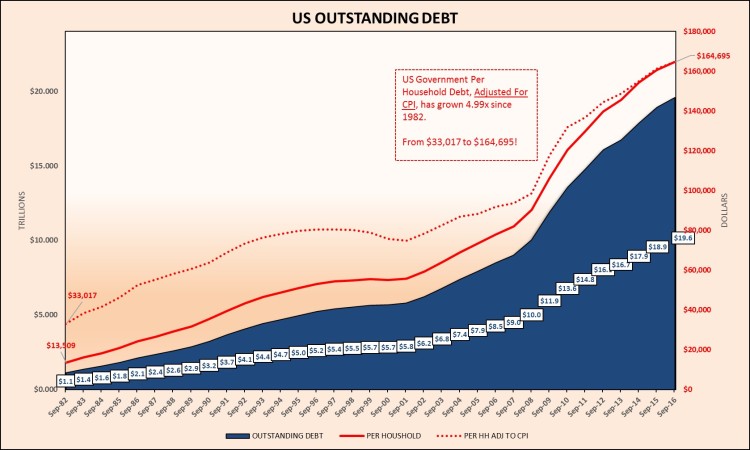
Chart I shows the US outstanding debt from the early 1980s through September 30, 2016. Think Presidents Reagan through Obama. We now owe $19,573,444,713,936.79 in debts. To place $19.6 trillion into a proper perspective,  I have shown this mountain of debt on a per household basis and then adjusted for inflation. The load has risen from $33,017 to $164,695 per household for 4.99x over the relatively short chart period.

This does not include the present value of Social Security and Medicare, which have estimates of over $100 trillion according to the Dallas Federal Reserve. This does not include your personal debt, nor any state, county, city, ISD or special district debt, including the present value of retirement benefits.

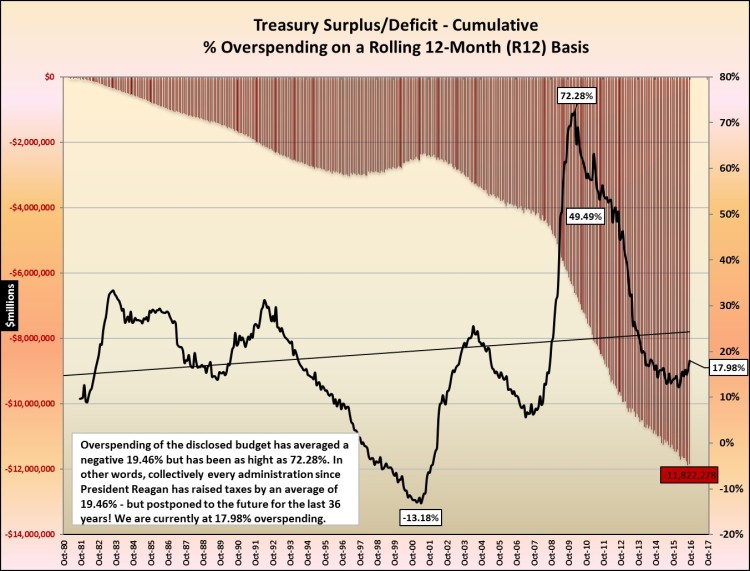
Chart II looks like a portion of Texas. It’s the cumulative amount of debt attributable to operating deficits. Here is a recap (in $millions).

               The Total Deficit as of 9/30/1980              $     907,707.
               Deficit Spending Since                                  $11,822,278.
               Debt Sub-total                                                $12,729,985.
               Debt Outstanding at 9/30/2016                 $19,873,445.
               Difference (Off Books???)                            $  7,143,460.

Yes, the debt has soared. By every President and every sitting Congressional Member no matter the party in control since 1980. Chart II also shows the percentage of overspending on the disclosed operating budget. Right now we are at about 17.98% and have averaged about 20% over the chart period. One way this metric could be interpreted is to say that revenues would need to be raised or expenditures cut (or a combination thereof) by 20% to just breakeven on the disclosed budget and probably about another 10-15% to cover the Off-Books spending. That might stop debt from growing but not pay off a penny of the $19 trillion. Raise your hand if you believe either will happen.

I’m pretty sure my 8th grade granddaughter is working story problems more difficult than this one to figure out where things are heading.

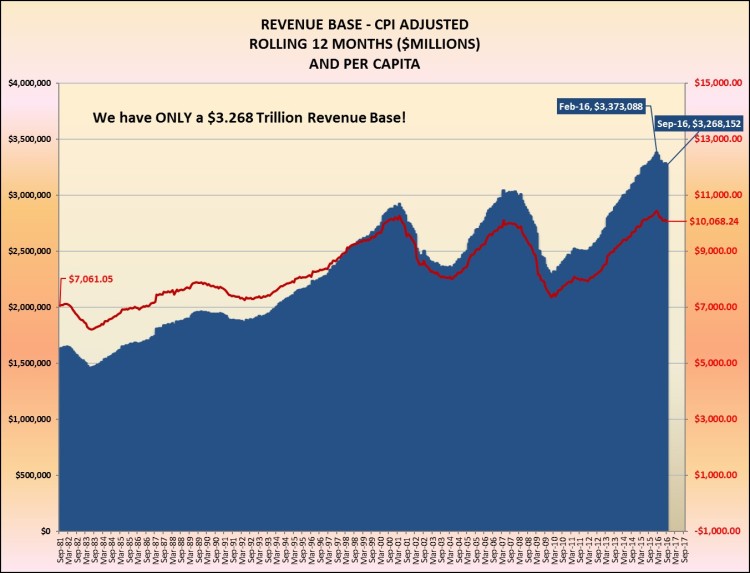
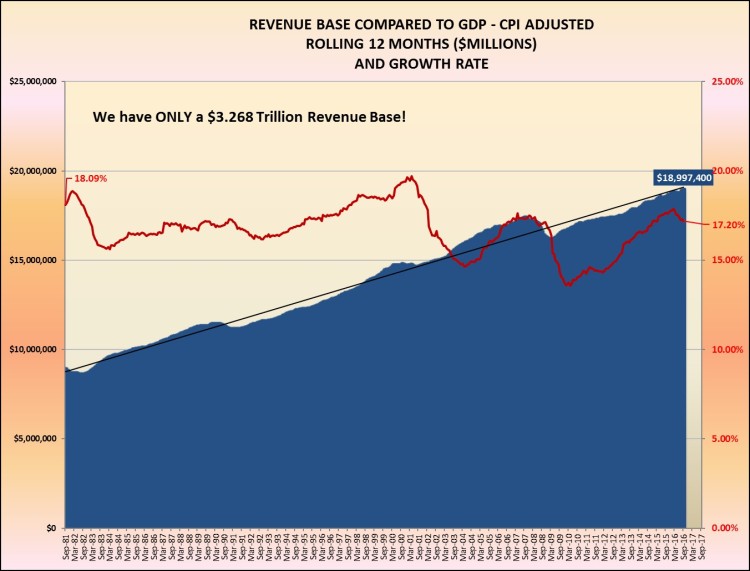
 Charts III and IV give us an idea about how we are pushing the limits on what we can expect to be milked from the overall potential revenue base. All you have to know is that every dollar of our annual Gross National Product totals about $19 trillion. And the US government revenue base is $3.3 trillion. Logic would say that if the federal government is taking in 17.20% of the GNP, that’s big no matter how you measure it. Again, layer the state, county, ISDs and other special districts and … you just have to appreciate reasonable limits.

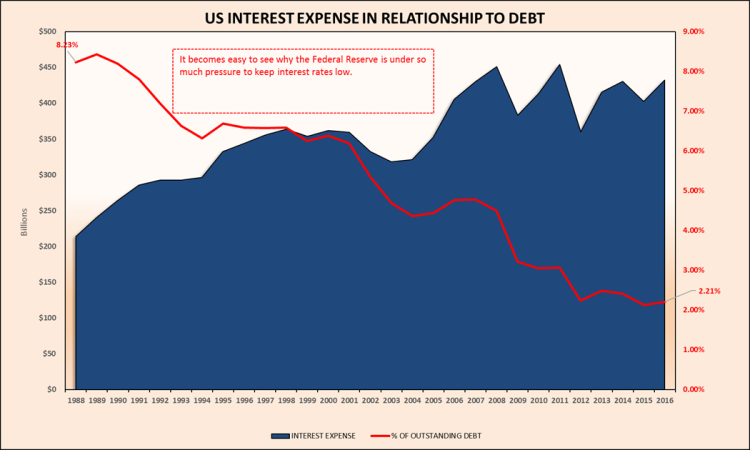
 Chart V is just one of the fabricated and dangerous aspects to the reason we haven’t collapsed since I started predicting so ten years ago. The inflation and interest rates can be manipulated by the Federal Reserve. It has now been so long that many of the newer families and employees don’t realize what has happened. To control rising Social Security costs and to lower the amount the US government pays on interest toward this staggering amount of debt, Chart V shines the light on the gimmick.

Interest rates on US Debt have been lowered from 8.23% in 1988 to 2.21% in 2016. The eye can figure out quite quickly the impact if we were dealing with true interest rates, rates that took real inflation and real risk into consideration. With an expenditure base of about $3.856 trillion, the interest expense of $0.433 trillion is about 11.22%. What would the 2016 disclosed budget operating deficit of about $0.588 trillion have looked like if interest costs were in the 5% range? Close to double. See the motivation our leaders have to manipulate the numbers?

There is another big issue here. Retired people hoping to make it on their 401k and Social Security benefits are getting shafted. The tendency at that age and stage is to be conservative and safe. And for the last several years that kind of thinking will earn retirees very close to zero. I never thought I would  hear serious discussions and see real actions to drive interest rates below zero. But here we are.

To be fair, many Social Security recipients and almost all Medicare beneficiaries are receiving much more out of the system than they ever put into the system – another faulty math problem that has led to the big deficits and debt.

 Conclusion.

The perfect storm is coming as it relates to the sustainability of gimmicks and outright massive spending to keep things afloat. One of the ways the Federal Government has taken advantage of low rates is to move to shorter term instruments. The problem with that is like having a 6-month mortgage instead of 15+ years. You and the lender come face to face frequently, always with the possibility that the lender doesn’t want to reinvest.

The lenders of the $19 trillion are first the government itself. The Social Security funds temporally on hand, for instance, have been used by the Federal Government to pay for operations. Those funds held by foreign countries are not a small part of the lender base. Yes, we are viewed as a safe haven, but that’s mostly because other countries are worse.

 And isn’t that a sound footing to be on? Especially as we want it all, we want it now, and we want somebody else to pay for everything. Good luck, Country of Obvious. That arithmetic is eventually going to catch up with us! LFM

 Chart I.

charti 

Chart II.

 chartii

Chart III.

chartiiiChart IV.

chartiv

Chart V.

chartv