Dear City Council: Please Move McKinney Money Board Meetings to the Council Chambers & Video Tape Them

Sent August 20, 2015
Updated March 8, 2016

Dear City Council Members:

I think you made a terrific move Tuesday night (August 18) by changing the McKinney Economic Development Corporation and McKinney Community Development Corporation (MEDC/MCDC) by-laws to place more oversight and control under the City Manager. You are heading in the right direction, and I am very appreciative of this action.

There are some other moves that I request the council to consider in view of your stated commitment to open government and transparency.

The first is to require all MEDC and MCDC meetings to be held in council chambers. The creation and design of the council chambers to convey openness is not by accident. It would convey a willingness for citizens to better understand and question where $20 million is spent each and every year. Even for people not attending the MEDC/MCDC meetings, a trip to pay their utility bill would allow them to see the business of McKinney being conducted and easily step in to listen to the content. It is no secret that being in a separate building, a bank/business building, is less inviting than being inside the seat of government owned by the citizens of McKinney. Please consider moving the MEDC/MCDC meetings to council chambers as soon as possible. Surely you appreciate the distinction of being in city hall versus a bank building several miles away. Or is the location away from city hall by design?

Related, I would ask that have the MEDC/MCDC meetings held in council chambers to be video and audio recorded. The cost should be minimal since the camera and recording system is in place. And anybody giving away $20 million annually can surely afford the incremental cost. This would allow everybody, including the council members themselves, to review a recording of a meeting they could not attend. I place the recording of the MEDC/MCDC meetings on the same level of importance as moving those meetings to the council chambers. Put bluntly, the standards of recording and proper minutes set for the City Council and P&Z Commission are not applied to these two Money Boards.

Again, related, all council meetings, MEDC meetings and MCDC meetings (as well as P&Z and others) are required by the Open Meetings Act to publicly announce a final action, decision, or vote on a matter deliberated in a closed meeting. I’m not an attorney but part of the TML workshop on this subject covers the requirement to explain how councils and boards arrived at a decision – irrespective of a topic in open session or closed session.

An Example: Servergy – The Company Connected to Ken Paxton Investigation

But let’s talk about practical steps that coincide with your pledges to open government and transparency.

I often find it very difficult to understand how the council and boards arrive at their decisions. The original Servergy contract might have been properly done in a closed session when the project was being considered. However, once decided, what was the rationale for the award? That should be a public explanation. Further, are the progress reports on approved projects done in public session or closed session? What would be the justification for a closed session unless you were considering a lawsuit? When Servergy applied for a second $50,000 extension, the decision was made in executive session. Why? When the votes were taken, there is no record of the rationale. In fact, there is no record of any discussion that I can find.

When the council is presented a zoning case by the staff with a staff recommendation, a motion to go with the staff recommendation may not need any additional discussion. The capable staff has provided the background and reasoning. However, if there is no discussion, a motion is made and the vote is 5-2 or 2-5 (for instance), there is an implied obligation (forget the legal obligation) to explain to the public how the body deliberated (a critical missing element) and arrived at the decision. To do otherwise would suggest the body read each others’ minds or met secretly (including a walking quorum) to be in a position to properly vote.

You, Council, Need to Set the Standard

Therefore, I would request that the council do a good job and set the standard for all boards to document their decisions and votes. A good deliberation (facts, findings, conclusions) recorded with votes is the quintessence of open government.

I would like to point out one other sign of a lack of transparency. There is an agenda item on the special meeting called for next Monday night (August 24) when you are to consider appointments to boards and commissions. But as I understand it, the names can come in as late as Monday at noon. And the meeting does not provide for comments on the candidates. Nor is there sufficient time anyway. Why would you claim transparency and then have it so nobody even sees the candidates nor can they make comments before the decision has been made? That’s flat weird!

It is my request that you publicly make available all of the names being considered by the time of the meeting, take any other suggestions for candidates at the meeting the council may suggest, and then close the opportunity for any names to be suggested. THEN do not make a decision until your next meeting so the public can see the list and make comments to you. How could you possibly argue with taking this public disclosure step before appointing even these two boards controlling $20 million per year?

My last request is that you require all candidates for boards and commissions, as well as the sitting boards and commissions, file Financial Disclosure Reports. Surely I don’t have to explain the reason for my request.

Thank you for considering these items.

Lewis F. McLain, Jr.

BTW, It’s March 8, 2016, and I cannot find where you have considered my request to live out your campaign pledges. MEDC/MCDC will be the topic of several of my blogs since I don’t see sufficient scrutiny of $20 million per year you apply to other parts of the budget.

The GoToPerson

They are rare. I’m talking about the genuine GoToPerson. I’ve met a few in my career. NCTCOG has one I was fortunate enough to meet and have in my department when I was Director of Administration in 2001-2002. Donna Steward is retiring April 1 as Procurement & Facilities Coordinator. Her title should be Director of Whatever You Need. Donna is the quintessential GoToPerson.

While NCTCOG is celebrating their 50th anniversary this year, Donna has been there most of those years.

Due to the dynamic nature of NCTCOG’s services, they have expanded and reconfigured themselves many times. Probably about 50x would be my guess. Donna has been in on them all. When Donna gets called into yet another remodeling need, I don’t think she she says “I’m on it!” But she is. And everybody knows it.

How wonderful to hear and see the action attached to those three wonderful words: I’m on it!

I’m the kind of person who will worry about something unless I’m convinced somebody else is worrying about it for me. People like Donna takes on a task and gets it done. It’s easy to forget how most employees and volunteers are not that way. Some may have spurts of energy and enthusiasm. Some may anticipate and be in motion before they are called. To earn the Donna Steward GoToPerson Award, the one she deserves to have named after her, you’d have to be the GoToPerson for decades.

Oh wait! I’ll bet you have a GoToPerson in your current or past work (or volunteer) life. What makes them tick? They are the true servants by will. By examples they are leaders, standard setters. They posses that intelligence to know how to add value. They act in a capacity where their title doesn’t matter. And, yes, they know they are doing the work of more than one person.

So, have you told your Donna Steward’s you know their value and that the workplace would be quite different without them?

Lewis

Beyond Contentment

We’ve been on many cruises and are grateful for every one of them. I’m always impressed with the well trained staff and how they deal with the guests. I enjoy watching people work. Most staffers on a ship seem content even though I know they go 8-9 months without seeing their families. I’m sure the Internet has helped.

But there is something I’ve noticed on this ship that is making the staff stand out like no other. I thought it was just just an individual or two and just a coincidence. Yet I keep seeing it too many times in too many places for it to be accidental.

These staffers are happy. I can always tell when my wife is content. Linda hums. It is a soothing, pleasant sound. Her sister does the same thing, so I am pretty sure it has to do with their mother. Contentment is a blessing.

But these staffers are singing. And a few are dancing. One guy is greeting the guests with hand spray before you walk into the buffet eating area. When we get off the elevator and round the corner into the room, it is easy to catch him singing and dancing a little step or two before he spots us. He sings a little “washy, washy” tune as he sprays.

In the huge formal dining room we can sit in different places and hear waitstaff singing to the music softly coming from the sound system. They are singing to each other. When you watch from across the room several can be seen doing a little dance to the music.

I do sense a little romance in the air. Or maybe I’m adding that part through my lens, for I am a romantic at heart.

I can only conclude that the morale must be sky high. And it is obvious to me that management must be doing something correct on the ship. Contentment is one thing. These workers are beyond being satisfied. They are bubbling over with an extra injection of motivation that is refreshing. More than just obligatory niceness. More than a common courtesy to coworkers.

I’ve got to find out before we leave the ship on Saturday. Do they have pep rallies for the employees? Does management push past the servitude relationship, because many of the workers are from third-world countries?

Does management go beyond the normal to make the staff feel appreciated, even loved? Is this amped up spirit coming directly from the captain? Is he so seasoned having mastered the technical aspects of sailing a ship that he wants to go past navigation and truly elevate the passengers’ experience by extending his enthusiasm through the lowest level staff member?

I was a wedding photographer while going to college. Once I had the technique down, my main enjoyment was keeping the bride and her mother calm. Is this similar here on the ship where the real enjoyment and pure joy comes from relationship building? Watching people grow in their skills while at the same time just plain being happy?

I think so.

Lewis

BTW. I’m still working on a more formal blog format and Website. Also, please forward this blog to anybody you think might be interested. As promised, my topics will be broad and largely what is on my mind that very day. All I need is an email address sent to LFM@citybase.net.

Dear City Council: About Your Request for Input Regarding Our Next City Manager

Dear City Council: About Your Request for Input Regarding Our Next City Manager

By Lewis F. McLain, Jr

Community survey for City Manager search

Mayor Brian Loughmiller and City Council invite citizens to provide input on the search criteria for the City Manager position via an online survey. Earlier this month, the city held a public input meeting aimed at giving city leaders insight into what residents hope to find in a permanent City Manager. The survey is an additional opportunity to provide feedback, and will remain open until March 28.

Dear City Council:

This may be coming as bad news for you, but the best City Manager Candidates are going to be interviewing YOU. Not the other way around. A magazine that hardly knows anything about McKinney may say we are Number One, but that’s not the way the city management profession may see the City Council. You haven’t done very well for about two decades, although your current Interim City Manager is a model. However, he doesn’t count. You needed him more than he needed you, and everybody has known that he could check out whenever he wanted to since he was already retired when he came in to save your butts.

I think you need to be asking for public input on how the council is going to persuade the best candidates to apply. Oh, you will get plenty of candidates who would take the job even if you promised them every day was going to be a living hell. The compensation is good, and the ability to relocate to the DFW area is a magnet. Plus they may be wanting to get out of their own Dodge City for a variety of reasons. Getting people to apply is not the issue. Getting them on board is not the issue. Keeping them long enough for their efforts to come to fruition and to be successful in every way is THE ISSUE.

Potential Interview Questions for the Council to Answer

If I were a candidate, here are my interview questions for you.

• Is McKinney a Council-Manager form of government?

• Do you know what that means?

• Are you going to allow the City Manager to operate as our City Charter outlines?

• Do you have an Underground Government here in McKinney? By that I mean several things.

     o Does the staff leak information to select council members, developers or community leaders?

     o Does the council allow vendors, developers and community leaders to have private meetings with council members with the intention of being persuaded of positions that will result in favorable council decisions without public discussion or knowledge that the Council has been lobbied?

    o Is the answer a quick Yes followed by “I do it for the education benefit and to be prepared for meetings?”

o And, if so, do you allow the proponent to tell you in those private meetings which other council members they may have talked to and whether they are in favor of the proposition or not?


o Have developers, realtors and builders outside McKinney found it difficult to get projects approved here in McKinney compared to Insiders?


o Have any of these Insiders ever tried to hi-jack a project that was in process by an Outsider?


o Do City Manager, Staff and Board/Commission recommendations consistently get overruled by the Council even when trying to follow Council policy?


o Does the City Council influence the Money Boards (MEDC/MCDC) to play favorites and direct money to pet projects or things the Council itself would be challenged on if spent out of the General Fund and competed with other needs in the City’s budget process?


o Do the Money Board recipients tend to become campaign contributors for Council Members or Candidates?


o Have your Money Boards ever been heavily weighted by board members employed by or closely associated with large amounts of funds given to any company?


o Are there any Council Members, Money Board Members or Staff Members that have been employed by firms (before, during or after) working for the City or that were beneficiaries of Money Board funds?


o Is there a Good Ole Boy Network that is slanted toward longtime friends that are constantly rotated around various boards and commissions?


o Are things that should be known publicly deliberated routed through the City Attorney in order to claim attorney-client privilege and keep out of the public’s view?


o Is there evidence of Walking Quorums, in all the many forms we all know can exist?


o Is there evidence of Jump-In-Front real estate deals where knowledge of City plans leak from Money Boards, Council or the P&Z Commission such that real estate professionals and developers quickly acquire the property in order to make a profit by selling property to the City at higher prices?


o Are discussions in Executive Sessions (whether Council or the Money Boards) ever leaked to persons who should not be privy to those discussions?


o Has the council or any member every gotten involved in a staff issue that resulted in an FBI inquiry?

• Is there anybody on the City staff who cannot be terminated by the new City Manager if he or she concludes that person does not fit within the organization the City Manager wants to build?

• Is there enough transparency and honesty among the Council Members to answer these questions among yourselves as well as to the public?

I have about a dozen more questions and a few hypothetical case studies I may be sending you, all of which may be topics of my future blogs. However, I will wait to see if any of you will provide my blog readers an honest response to these questions. There is a good chance I may have a City Manager Candidate reading this blog and anxious to know whether or not to apply. In fact, many of these questions came indirectly from City Managers in discussions I’ve had with them over the years.

Thanks!

Lewis

Dear City Council: What About Those Legal Fees

Dear City Council:

Yesterday I included you on my blog mail out even though only one of you accepted my invitation to receive my blog a couple of weeks ago. A large number of my blogs will be letters to you.

I am interested in knowing if you found that particular blog of value to you? The reason I ask is that I have already heard from some of my readers wondering why the legal fees to the City Attorney’s firm are so large and are growing so rapidly? Legal advice and representation is understandably expensive, but $7.4 million from FY 2010 through FY 2015 does raise some eyebrows.

It seems that I do recall that the level of money paid for legal services came into question a few years back and it appeared, to me, that there was some momentum growing to question those costs. Questioning included asking if taxpayer money would be saved if many of those services were brought in-house? Or if there were other qualified firms that might find ways to save the City some money after the current firm searched for savings and presented them to you? I do acknowledge that law firms perhaps don’t quite fit the same criteria as other professional firms, but I do know that a fresh look and new set of eyes is the rationale often used to look for staff replacement as well as outside consultants. Not because there is anything wrong necessarily – it’s just good business practices to question everything.

In fact, one of the toughest questions that reveals the level of tolerance someone has is to ask them if you fired everyone under your control today and allowed them to reapply for their jobs, would you hire them back? If your answer is anything but Yes, even if you pause for a minute, real transparency is in how you would answer that question and what you would do about a No or a Doubtful or Reluctant Yes.

You would expect a city manager to be doing that on his or her own, without being pressured by the council. But this is one of the costs that falls in your lap.

I listened to the three of you newly elected officials in front of a Tea Party audience when campaigning – talking tough on how you would be a superior councilmember. Look down my recap of the McKinney Check Register. You as a council don’t control all of those expenditures in reality. On the other hand, you directly control some of the biggest ones. I’ve got about two dozen on that list I am going to be asking you to examine in future blogs. The first is now related to these legal fees. You can fund a ton of pothole fixes and meaningful programs with just a small fraction of savings in legal fees.

I challenge all of you, especially the three puppeting the words of those who elected you to walk the walk and not just talk the talk.

Thank You!

Lewis

See http://www.citybase.net/downloads/mckinneycheckregisters.xlsx

Understanding Data & That Misleading Word, Transparency

I will be talking a lot about Transparency in my blogs, a word that is overused and even misused and abused in government. Yes, there are efforts made by governments and businesses to be transparent. Even the Texas State Comptroller awards programs are designed to promote transparency. Many of those efforts produce translucency more than transparency. I will try to explain and give examples in this blog and in many more to come. However, I must tell you something. I was handed a gift just a few days ago. While the current and past state comptrollers have promoted transparency in local government for many years, a new program has been launched called “Transparency Stars: Recognizing Local Transparency Achievements.

The Texas Comptroller of Public Accounts is proud to announce the upcoming Transparency Stars program, recognizing local governments for going above and beyond in their transparency efforts. Our office will recognize government entities that accomplish the following:

• open their books not only in their traditional finances, but also in the areas of contracts and procurement, economic development, public pensions and debt obligations.

• provide clear and meaningful financial information not only by posting financial documents, but also through summaries, visualizations, downloadable data and other relevant information.

The emphasis on the last few words is mine. I would have to look, but I am pretty sure my writings and presentations on aspects of this subject started 20-25 years ago. Local governments are good at generating data. Operating data. But only in recent years have there been tools and efforts to turn operating data into management data. Some will recall that in addition to 1) summaries and 2) visualizations, I have emphasized 3) exceptions, 4) comparisons, 5) rankings, 6) drilldowns, 7) trends and 8) written explanations.
And even with data presentation improvements, the real test is to determine if the critical message is delivered and understood such as when the Mayor of Dallas pierces through the data and staff babble to declare, and I paraphrase, “the condition of our roadway system STINKS!”

An Example of Transparency Efforts: The Check Register

Many cities now publish an online listing of all of their checks. On July 19, 2015 I went online at the City of McKinney’s Web site and found they had a listing of checks back to 2011. Each year was in a separate file, with 2011 in a PDF format and the other years in Excel. Then I found that over $8 million were written to the bank card company handling the purchasing card program for the City. Of more concern than that to me were a number of vendor payments that were redacted. I expressed my concerns in an email letter to the Interim City Manager and Finance Director attached on that date.

To their credit, they now have an Interactive Financial Reporting Tool that came online in August 2015. As of a couple of weeks ago, they had the old version I was using and have now taken it down. Please note the new check registers and even the payroll register found at https://www.mckinneytexas.org/index.aspx?NID=213. The capability to see more information is truly impressive. They have broken down the PCard spending! They have also UN-redacted many (but not all) of the vendor purchases I had questioned. My compliments to the City of McKinney staff efforts to improve Transparency.

But Does This Effort Accomplish Transparency & Understandability?
The City is providing a check register that almost quadrupled the disclosure of details with over 215,000 pieces of data. I have worn out this quip, but I will continue to use it: as much as I love numbers, I cannot necessarily spot an anomaly by scanning pages of data by eye, even though the City’s sort feature makes it easier to do some ranking. One of the Comptroller’s criteria (downloadable) is of great benefit on the McKinney site. However, it is lacking in looking for the most critical areas of spending that will surface only when summarizing data, then sorting.

For operating data to become management data, somebody has to transform listings into summaries. Even then there must be an appreciation for the Pareto Principle (the 80/20 rule), which simply means I first want to examine the fewest number of (people, problems, items, etc.) that make up the largest impact (dollars, overtime, moral problems, etc). You would still want to see information portrayed for comparison purposes, such as over a number of years, to spot trends.

Excel Pivot Tables to the Rescue

To explain what I am describing, I have a link  to an Excel spreadsheet that takes the good McKinney work and addresses the Comptroller’s new program to make it better. The first tab is the DOWNLOAD of the 215,193 expenditure records from 2010 through January 2016. The second tab, PIVOT BY PAYEE, is where you can see a drilldown that includes 1) the description the City provides and 2) the Fund it was charged to. All elements are sorted from the largest to the small dollars.

Please appreciate this point, whether you are a financial analyst or a city councilmember: The pivot tables have organized (summarized) 215,193 spending elements totaling $998,454,719 into a meaningful presentation that allows you, the reader, to scan the entire $1 billion picture quickly and then to drill down into details at your desired level of information. Folks, that’s powerful. That’s a giant step toward Transparency.

What Do We Do Now?

That’s simple. Read with curiosity. Ask questions. If you are a McKinney resident, this is your money. If you are a councilmember or community leader, learn about where the money goes. There’s a huge amount of discussion in closed meetings that you can’t be privy to, but when the money goes out the door – it’s your business. I can only think of one acceptable condition when the amount and purpose of money going out the door should not be disclosed – the garnishment of wages and payments related to child support. There may be more excuses for redactions but not in my book.

I do have several questions for my city council and staff after preparing this analysis and blog. Actually, I have an Open Records Request for some of the items and should be hearing back soon. Here is my challenge to you if you are a city official: why would you wait for somebody like me to surprise you with a question or perhaps even a finding that you should have already asked and known? The reason I say this is because the dreadful fact is that city officials don’t read their own information. Raise your hand if you have actually read your CAFR in depth. Heck, most cities have been producing a check register for years. As a council, are you looking at that information? The City of McKinney is averaging $104,000 on audit fees. Are you getting more than a drive-by explanation of what’s in it? More coming in a few weeks.

The reality is that the once unavailability of tools for digesting millions of records, slicing and dicing are now available to just about everyone. If you have Excel, you can download years of check registers and create pivot tables in a matter of minutes – no exaggeration.
The Excel spreadsheet is quite large, too big to attach. Therefore, you will need to download from www.citybase.net/downloads/mckinneycheckregisters.xlsm to see the details as well as the construction of the pivot tables. However, I have attached a PDF of the spreadsheet at the vendor/payee level. Vilfredo_Pareto

Oh, and regarding Professor Pareto , you will soon learn the importance of his rule when you continue to be faced with terabytes of data, a meeting agenda that just doesn’t seem to end, or which house repair you are going to tackle first? In this age of information overload, it is the only path to control and sanity. All you have to look at in the spreadsheet is the first 448 items (11.3%) of the vendors/payees that account for 96.4% of the near $1 billion of spending. LFM

Surely You Aren’t for Growing Government, Are You?

If you are receiving this blog twice, it is because you are on one of my lists + you signed up for my blog. I won’t be sending my blogs to you much longer unless you email me to say you want to be on it. I’m also sending from a different address. I know that many of my CityBase subscribers route my news articles into a separate folder and then don’t have time to read them until days or weeks later. If you did not get my original invitation, it is attached to this email.

Introduction

It took me three times to hear it from different people before I fully realized The question, “Let me ask you this, Lewis, are you FOR growing government?” was a baited question. By the third time, I realized it was rehearsed and work shopped, like “Lewis, if you were indicted for being a Christian, would there be enough evidence to convict you?”

The second one caused me to think when I heard it several decades ago. The first one worries me. Both can be intimidating but for different reasons. Actually, my favorite is the question released by the encyclopedia salesman visiting poor rural folk that basically conveyed, “you don’t want your children growing up as dumb as you are, do you?”

Let me get one point on the table. I’m not a Democrat. I’m not a Republican. And I’m not Tea Party. They are all liars, and none of them care about me or my future or my family’s future. They are all self-serving and exist to make themselves look good and their opponents look bad. So there.

This blog is mostly about the question in the subject line.

I’m for the old fashion truth. Facts. Looking for the heart behind the words. Wanting to adhere to the Athenian Oath about leaving this place better than I found it. I’m pretty simple. I don’t like labels that color me inside or outside somebody’s circle. I struggle to be a good listener, and I don’t enjoy being around those who don’t listen. I like civil conversation. Take a few minutes to view this TedTalk clip. After 68 years, 44 in local government, I am still a student. A curious student with a desire to match what I am learning and the words I am hearing with that I am seeing with my own eyes – and verify or confirm independently.

Let’s Dig In

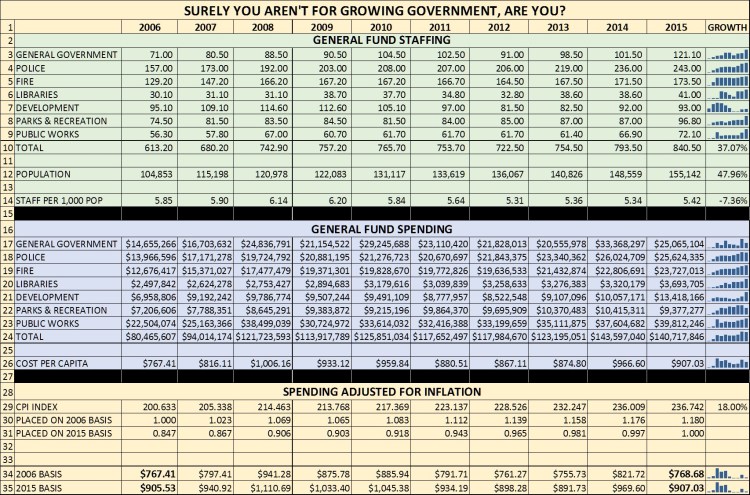
Let’s suppose someone says, “Did you know that the City of McKinney, Texas is an empire building, tax and spend city that has mushroomed, atomic bomb style, from General Fund employees numbering 613 to 841 and with a budget leaping from $80,465,607 to $140,717,846 (that’s one-hundred and forty million, seven hundred and seventeen thousand+ dollars in just ten short years? Hell, Lewis, you live there. Are you for them GROWING THE GOVERNMENT and sucking up those tax dollars like a vacuum cleaner plugged into a 220v outlet? Are you one of those unpatriotic liberals, huh, huh?”

After I peeled all of the labels off of me, I would have this reply. Your numbers are correct yet incomplete. Your conclusion is bad and terribly misleading. I will prove that to you if you are willing to listen. But first – if you will listen and let me speak without interrupting or anticipating your next statement. Then I will allow you to speak without me talking. Is that fair?

First, how do you think all of the services McKinney provides came about? Did the bureaucrats just sit around trying to think of ways to make their staffs larger? Did the council signal to the staff that big is better, so let’s get really great and see if we can grow bigger than Plano?

Have you ever watched their public meetings – they are videoed and archived? What you will witness is a parade of citizens that start out their three minutes with “we need your help,” “please fix this or that” or some statement that is motivated by an unmet need. However, way before that meeting, the staff has fielded several hundred calls or the council several dozen calls from a variety of constituencies pointing out a need. Some are a few representatives from a youth sports league or the biggest HOA in the state explaining a need or perhaps warning of some dire consequences to the public if a health issue isn’t remedied.

Staffs and councils don’t dream up these problems and need for program expansions. Citizens do.

Before I get into some numbers, I’ll stop and let you respond to what I have said.

The Numbers

What if I told you that the City of McKinney was spending less today than 10 years ago? Yes, I said I agreed with your statement of fact that spending went from $80.4 to $140.7 million in ten years. But you left out two extremely important sets of numbers when you tried to make a statement that sounded conclusive and all-revealing with those absolute numbers.

You forgot to mention that the population grew from 104,853 to 155,142 during that exact same time period. Would you have expected McKinney to serve 50,289 more people without there being a cost increase?

The reality is that the City staff in the GF has actually decreased from 5.85 staff per 1,000 population to 5.42 in 10 years (line 14). Do you think your statement might have been accurate but misleading now?

In fact, the cost per capita based on the population growth went from $767.41 to $907.03 over the period in question. That is certainly an increase, but there would still be a missing piece to the more accurate story.

Do you think the costs of labor, material, fuel and other supplies are the same in 2015 as they were in 2006? In reality, the CPI is 18% higher than 10 years ago. Arithmetically, that is only 1.8% per year, which is very low. There have many ten-year blocks of time in the past when the CPI jump may have been 25-35% or more.

Nevertheless, if you care anything about meaningful and accurate comparisons, it is critical that the per capita numbers be adjusted for inflation. There are two ways to adjust the numbers, both with exactly the same accuracy, but with different perspectives. From college and even high school classes you will recall that indexed data can be placed on either a 2006 basis or a 2015 basis.

If you placed the per capita data on a 2015 basis, the $907.03 current value would raise the 2006 equivalent of $767.41 to $905.53. Yes, that is correct, on a 2015 basis, the CPI-adjusted cost per capital has risen from $905.53 to $907.03. A buck-fifty!

If the growth in spending for the last 10 years was restated in 2006 dollars, the change would be minuscule. Does that not amaze you? Do you see how outlandish and misleading you can make the data sound. Yes, it takes a little knowledge of proper indexing which any high school student can do. And a willingness to be fair and accurate before you make assertions.

You might ask if this method of data presentation is so much more superior and accurate then why doesn’t McKinney show the data in this proper context? My answer is that I have no clue. I have been teaching and preaching this fundamentally better presentation all across the state for years. The City of Pearland presents their data this way. Heck, the much smaller Fate, Texas does the same. To expand on this answer would require me to delve into my issues with the overused word, Transparency, which I will save for a future blog.

Other Considerations

What if the CPI-adjusted spending per capita had grown to $1,000? Quite frankly, that was the range I was expecting. There would be an answer to that. First, the real CPI is much greater than the official numbers I have used. Just look at your own personal CPI. Is it only 1.8% per year. Plus there are increased costs of trying to be more effective in municipal service delivery. For instance, more expensive technology to protect a police officer or to help them catch criminals is generally an ongoing ramp up in cost. In every area of local government, there is a desire to be more effective. To respond faster, to repair infrastructure more timely to hold off more expensive replacement and much more.

There are also new or expanded programs. Everybody knows that the most significant way to keep costs down is to never start a program. Yet that is when we cycle back to the source of the demand to expand or even create new programs? The citizens. Park lands or medians looking shabby? Mow once every 5 days instead of every 10 in certain parts of the city. If you plant color beds in the medians, you have to keep up the maintenance. Open a branch library is not just another building but rather more of everything. And new facilities whether libraries, recreation centers or fire stations generally means huge incremental increases in operating costs.

So, how did McKinney add so much and keep the comparative numbers almost flat? That requires more digging, but a mandate almost every local government department lives under is to continually become more efficient. That doesn’t always mean doing more with less but rather doing more with the same. Or doing much more without an increase of resources at the same magnitude.

Conclusion

Apparently, the way to get elected in conservative Collin County and especially McKinney is (before you know the facts), just proclaim that growing government is just as bad as treason and that you are going to just say no with your fingers in your ears no matter reality. Or else. The “else” is that even after you get elected you are going to get texted during a meeting to remind you who brought you to the party, your pledge and the price you are going to pay if you get out of line. Here’s the deal, however, it can work right now in McKinney. Decent quality growth is on steroids, especially residential. Ultra-Conservative Bating is on fire and politically effective. The City of McKinney is doing very well financially. Actually, too well. More saved for blog in the near future.

If you think this blog is going to be an apologist mouthpiece for local government, you are dead wrong. I’ve got plenty I want to share. Stay tuned. LFM

MckinneyPerCap

BTW, if you read to this point and appreciate good analysis work and would like to have a copy of this Excel template, just let me know. I would be happy to email it to you. LFM