Approved As To Form But Not Legality

I’ve been baffled over the years. Why do city attorneys sometimes sign ordinances and contracts “Approved as to form and legality” and others leave off the last two words? My sensitivity increased about 25 years ago when a city manager told me he didn’t ask the question but rather told the city attorney he wanted to include “and legality” on the signature block. The city attorney complied. Reluctantly.

Why would a city pay so much money for an attorney to draw up a legal document or to review a legal document and then not declare it as “legal” if the document is being declared to be in “form,” which one might assume to be in good legal form? Can a legal document be in legal form and not be legal? I suppose it could. If nobody is claiming it is legal.

A signal would be a challenge by someone suing the city for having an illegal document approved by the city council. I can just hear a city attorney saying to the council: “look, I never said it was legal. I just said it passed the legal-pretty test.”

But a red flag in my mind would be when the city attorney has reviewed a legal document where the author placed in the signature block “Approved as to form and legality” and then the city attorney or someone later changed the legal document to take off the last two words? Would that not make you wonder why an attorney would deliberately remove those important words?

That’s exactly what has happened at McKinney. The typical signature block in McKinney only includes the words “Approved as to form.” So at the next council meeting, there is an ordinance amending a previous ordinance involving two MUDs in McKinney’s ETJ. The MUDs want the ability to issue up to $262,800,000 in bonds when they already have the ability to issue $120,000,000 from the City before asking for more. They also want to automatically add more MUDs without having to bother the Council again.

Lastly, they want to have the cap adjusted 3% annually without further approval. That means the lid will be $353,181,225 in ten years before the development is built out. And this does include the refunding of the original bonds. With interest rates of 3.3% to 4.0% for the MMUD’s 2016 Bonds, you can be assured this will churn out a ton of business to the bond issuance community. What the heck, 29.1% of the $13.8 million issued is all going to soft costs rather than hard assets. MUDs are all about helping the developer and all of the supporting players engineering and debt issuance players.

I have already blogged about this particular MUD. Since then I  have driven through the MMUD. The first thing that caught my eye as you approach Trinity Falls is the huge elevated storage tank that has the same McKinney logo. There is no conspicuous sign that says the development is in a MUD, so it looks and feels very much like you are in McKinney. BTW, that water tank is not McKinney’s! In fact, I called a realtor who has been doing business in McKinney for many years. She said TF is in the City of McKinney. I said that it wasn’t. It’s in the ETJ and has a $1.05 tax rate. And there is virtually no legal limit on how high the tax rate could be raised. She knows me quite well but was certain that I was wrong since the MLS listing has the properties in the McKinney postal code designation.

While the houses appear to be cheaper in this MUD, the fact is the price is similar and could be more than the same house in McKinney. They are just paying part of the cost in their mortgage and part in a tax rate. It should be entertaining when they go back and re-read the documents they signed when they bought the house. But good luck if they want to complain to the City.

I am guessing if you walked down the street and knocked on the couple of hundred doors of occupied residences, you would find out most people think they are in McKinney. I dare the Council to send a staffer to take a survey! If they were to watch the last McKinney City Council meeting when this amendment was tabled, they would see that Councilmembers are on record as confirming it is not in the City and that from their viewpoint it is not likely to ever be in the City. The historical tug-of-war between MUDs and cities is that the MUDs want to be taken over when their debt is high and their tax rate is high. Just the opposite for cities.

But our City Council is pretty good about not asking too many questions when it comes to helping out a developer and is likely to rubber stamp this approval next week.

Also, this blog is about amending an agreement involving huge amounts of dollars with the appearance that the City Attorney does not want his signature on it if he has to vouch that it is legal. Don’t count on the Good Ole Boy Network, of which the City Attorney is a full-fledged member, to do anything about it. I’m surprised it is not on the Consent Agenda. However, there is no public hearing. It will be a drive-by item.

Besides, it’s in legal form. LFM

Who Is Monitoring McKinney Municipal Utility Districts?

McKinney Municipal Utility District No. 1 (MMUD1) is the legal subdivision of the state located in the City of McKinney’s ETJ but not in the city limits as of now. I am going to refer to it as MMUD(s) because documents refer to MUD1 and MUD2, but MUD1 is the Master District. The City has control of a number of construction requirements and is party to an agreement that allows the City to even contract with the MMUD for the City to provide certain services. MMUD was created in the 80th legislature in 2007 by Rep. Jodie Laubenberg as HB 3979.

This MMUD is also the entity involving the Trinity Falls Development. From everything I hear, the Developer is experienced with these kinds of financing vehicles. This blog is not about the developer per se. It is about MUDs in general and the MMUD as an example in particular. MUDs are about helping the developer get a project financed. MUDs are in abundance in the Houston area. Missouri City, as an example, has 25 MUDs in their city limits. MUDs are not so popular North Texas. And for a reason. Take a poll of the Houston area cities with MUDs and ask if they could undo the MUDs today if they could?

MUDs help with leapMMUD-frogging development. Leap-frogging is not a positive term. In many cases it means allowing islands to be created. Everybody knows that the best growth management is in contiguous concentric circles, but that never happens like the textbook pictures. There are always people wanting to get away from the city where land is cheaper. And almost always the growth fills in between until the outlanders become just like the city, too.
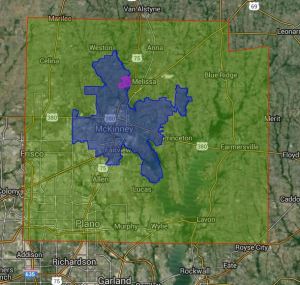
In the map below from the Municipal Advisory Council (MAC), it shows Collin County in green, McKinney ISD in blue and MMUD in pink. MMUD is 880.42 acres in size. In other disclosures, the Trinity Falls property is shown to be 1,700 acres. Therefore, one must assume that MMUD could expand. I have heard that there will be a MUD3 and MUD4 at some point in time.

The purpose of the MMUD is to sell bonds to pay for the infrastructure (and substantial other costs) put in place by the Developer. By infrastructure, it is meant to be roadways as well as water and wastewater lines. How much in bonds are anticipated? That becomes a very interesting question. We turn to their bond disclosure documents to understand. MMUD shows the authorized debt to be as follows:

$133,050,000  Roadways.
$145,000,000 Water & Sewer System.
$  10,240,000 Fire Protection Related.
$288,290,000 Total Bonds Authorized.

You are probably asking if this could be correct? It’s going to take $288,290,000 to provide infrastructure for 880 acres of mostly residential development?

Again, we look to official documents to understand. As it turns out, they show only 680 acres of development, and it is all residential. The remainder is for parkland, an elementary school or is undevelopable.

Unless you’ve beat me to it, then $288,290,000 divided by 680 acres is $423,956 per acre. Based on an average of what they have disclosed so far, the average lots per acre is 2.935. That would mean the bond authorization placed on a per lot basis is $144,443 per lot!

Before we go further, it is important to realize that bond authorization does not mean they will sell that much in bonds to repay the developer. However, the significance is still there, and I guarantee you $144,443 is probably not a number shown to the McKinney City Council or that staff bothered to calculate or that the council bothered to ask.

So What If The Lot Cost Is Very High?

You can say that if the buyer wants to purchase a house that has $144,443 in it before any vertical construction begins, then that is their business. But that is why we must dig deeper. If it goes into the value of the house, then you know the full cost. However, homeowners in the MMUD must be on their toes to realize the cost of the house they pay to the builder is only part of their costs.

In addition, they have to pay a MMUD tax that covers the $144,443 per lot:

House Price Paid by Mortgage.
+Infrastructure Paid by MMUD I&S Tax Levy Paid.
= The Full Cost of the House & Property.

The MMUD tax is the issue that can become troublesome. Take a poll today of the MMUD occupants and ask if they understand the MMUD taxes?

How Much Is The MMUD Tax?

There are two parts to the answer. The first is how high could the MMUD Tax be. The McKinney ISD has a maximum rate that is very high. It is a total of $1.67 per $100 value. That is broken down into Maintenance & Operations (M&O) of $1.17 and $0.50 for Interest & Sinking (I&S or Debt Service). Both components are at the maximum the state allows.

The City of McKinney’s tax rate, although not charged to the MMUD property owners, is $0.5830 with $0.4100 being for M&O and $0.173 for I&S. It is nowhere near the maximum allowed by state law.

The MMUD is quite different. The M&O maximum tax rate is $1.20. However, there is no limit on the I&S portion of the tax rate. Therefore, there is no legal limit on the tax rate.

However, the question first at hand is what is the current MMUD tax rate? The answer is $1.05 per $100 broken down into $0.505 for M&O and $0.545 for I&S.

Therefore, if you live in the City of McKinney, the total tax rate is $0.5830. If you live in the MMUD, the tax rate is $1.050.

Okay, So What?

Your next thought might be the same as mine, and that is won’t the house price and taxable value of the house reflect a lower amount since part of the home is financed out of the mortgage and part out of the MMUD tax?

Let’s check. One MMUD home on Sabine is valued at $397,392. The land value is $80,000 for the lot, and the improvement value is $317,392.

The lot is 7,500 square feet or $10.67 per sf. The improvements, based on 3,612 sf would be $87.87 per sf. for a total of $110.02 per sf when the total value is stated on the main area of 3,612 sf.

What do you think? Discounted or not?

Of course, these are Collin County Appraisal District values and not the actual purchase price. The purchase price could have been lower. Or higher.

It must be mentioned that these are the market values as shown by CCAD before any exemptions are taken into consideration.

What We Do Know.

The total tax bill on the example property, before exemptions, would be $3.03696 per $100 when adding in the MISD ($1.67); Collin County ($0.235); College District ($0.08196) to the MMUD’s rate of $1.05.

These are the current year’s rates. The tax rolls will not be certified until July 25, 2016 for the tax bills mailed October 1, 2016 and due January 31, 2017. So sometime between July 25 and October 1, the MMUD will be setting their tax rate for the bill to be mailed by October 1. It could be the same or lower. There is virtually no ceiling on the topside.

When the tax bill is received (again, before exemptions) of $12,068.64 ($397,342 x $3.03696 / $100), the homeowner will realize what they have bought into by being in the MMUD.

Were they told of the MMUD tax potential at the closing of the purchase? Oh, yes, they signed a document along with dozens more when they were just hours away from getting the key. The tax bill may have been incorporated into the mortgage, so the homeowner will have a wake up call to examine their escrow every year when insurance and taxes possibly change. A fully informed potential buyer would be educated when they drove into a subdivision of MMUD. I drove around this morning and didn’t see a sign.

Lewis, Why Do You Care If The MMUD Homeowner Gets Riled?

I don’t. My concerned being raised is about the City of McKinney. Maybe even the County/CCCD. If you read through the documents, you can find quite a bit of language that says, read our lips, the City and the County are not responsible for the debt and payments of MMUD. But you would be quite naïve if you think there are no repercussions.

First, I don’t like it that the MMUD has the name “McKinney” in it. If there was ever a MMUD default, the headline would not be favorable for the City. Also, the history of MUDs all over the state is for the homeowners to get restless or irritated with a dose of buyers’ remorse once they realize their tax bill would be lower by $1,846.68 annually ($1.05-0.5853 x $397,392 / $100) if they lived in the McKinney city limits. Take a poll of the highest tax rates in Texas and you will find mostly MUDs at the top of the list.

If the MMUD homeowners believe they got duped paying a competitive price for their house plus a tax rate that included part of their house (meaning they paid twice for part), then embarrassment turns into rage. Especially if they can’t sell their house to escape the burden. Before long they may start wanting to run for City Council to force the absorption of the MMUD by the City AND to absorb the outstanding debt at the time. It HAS happened across the state. If they see that the City is part of the agreement and had plans to incorporate the MMUD, then why not now?

What About The Debt?

Now we are getting to the guts of the matter. The tiny little MMUD has been authorized to issue, $288,290,000 in bonds supported only by the property owners of MMUD. They have issued only $13,800,000 to date in two issues. However, they are ramping up in that $8,070,000 was dated September 1, 2015 with a secondary issue of $5,730,000 dated February 1, 2016. The race is to sell debt as fast as possible to reimburse the developer when there is value on the ground to carry the debt service.

For a perspective, the entire outstanding debt for all of Collin County is $379,084,150! For all of the City of McKinney, the outstanding tax related debt is $307,790,000!

Do you see my concern?

Can the City of McKinney control the issuance of more debt until they have confirmations there is not going to be a negative impact on the City, legal, public relations or other? The answer is yes and no.

By contract, the City has placed a cap of $120,000,000 of debt issuance on MMUD unless they approve to raise the level.

So, Lewis, why don’t you shut up and wait until a problem crops up? First, I’m not geared that way. My entire career has been about worrying over things that could blow up. But the real reason is that I was waiting for the audited financial statements for the MMUD for their fiscal year ending March 31, 2016.

Then something happened on the way to the wait station.

The McKinney City Council shows a workshop agenda for tomorrow night and a Council meeting agenda item on Tuesday night to amend the 2012 agreement. McKinney does a horrible job of providing background before a meeting as I complained about in my last blog. First, they claim the amendment resolution preamble is in the best interest to the City. Quite noble, but they don’t explain the benefit. In fact, there is no staff paper, no real back story, no staff recommendation.

What the amendment does say, to me, is that MMUD is being given permission to raise the debt issuance limit to $262,800,000!

Why in the world if there is already a $120,000,000 cap with only $13,800,000 issued would MMUD need to lift the cap right now?

And nobody seems concerned that all debt issuance and taxes entity have a bearing on each other. A $million of debt uses everybody’s debt capacity. A penny tax increase is a penny of taxing capacity the resident can afford.

Conclusion & Recommendation.

I am concerned how we allowed a MUD to get created in McKinney in the first place. Yet bigger, since we are only about 50% built-out and tens of thousands of acres left to be developed, how are we going to say no to the next Houston-style method of incentivizing a developer? In fact, why are we incentivizing residential development at all? In addition to allowing the MUD financing vehicle, the City is granting a sales tax split to MMUD!

I am requesting of the City Council that this agreement amendment be postponed until the middle of July when the audited financial statements should be finished as well as the certified tax roll be delivered.

More importantly, I suggest the City Council require a five-year plan be provided to the City Council when additional bonds are issued and made a requirement for City approval to go forward with future bonds. The financial plans should show the lot and construction pipeline as MMUD already discloses now to bond holders in their official bond issuance statement. The plan should also show the tax value assumptions, the debt issuance/debt service assumptions as well as the tax rate component forecast for the next five years. It is with 100% certainty that MMUD has this information.

In fact, the bond rating agencies would be insisting to see this information. Except there is one problem: these bonds are not rated nor or they guaranteed by a bond insurer. And there is a reason for their absence. Only very sophisticated buyers would be interested in these bonds. And there is a premium they earn for the risk. Take a poll of the interest rates on these and other MUD bonds compared to typical tax supported bonds.

At this point, I am not suggesting that toothpaste can be put back into the tube. However, the MMUD board meetings should be held in McKinney and the City needs to be involved in monitoring. The MMUD now shows bookkeepers, financial advisors, bond attorneys and auditors all being from Houston. They are very smart people with absolute perfect knowledge of how MUDs work. I have to wonder if the City of McKinney asked their own financial advisors and bond attorneys the pros and cons of allowing a MUD to be created in the ETJ? Who did the due diligence on this proposition from the beginning and since the inception?

Ironically, they show Chandler Merritt, Public Works Director of the City of McKinney, as a finance-connected official according to the Municipal Advisory Council. Go figure!

Lastly, it should be noted that 29.1% of the $13,800,000 in bond currently outstanding went toward soft costs (legal fees, financial fees, capitalized interest and other non-construction costs). There is an entire cottage/mansion industry in Houston related to MUDs. We really need to think long and hard about the potential for MUDs to proliferate in North Texas.

Nobody thinks through how these animals end, but there are many stories of ugly exits as they take on a life of their own and want to be absorbed when it is in the best interest of the MUD. But my overriding concern is that a council known for making decisions without full public disclosure really needs to monitor the MMUD and any MUD in the ETJ. LFM


The Ultimate Transparency Model: The Teaching Government

The Problem: A Sampling.

I’m going to make the assumption you really do believe in transparency. It is clear to me that everybody talks about transparency as if they embrace it. I also know that the word and concept are often cheap lip-service. Let’s go forward with the assumption you believe government should endorse AND push for true transparency.

Can we also agree that much of the material placed on government Web sites in the name of transparency are well-meaning attempts but with a fatal flaw? They are informative but, they also require much time to read and often a level of expertise few possess. As much as I love and read CAFRs, I must confess they have become so complex I wonder if the dedicated layperson could actually make sense of them? I’m guessing the number of people who even try, outside the finance department, could be counted on one hand with some fingers left over. That’s a shame.

Lastly, as I read local government Web sites and materials, there is an overhwelming effort to encourage citizens to join in, to participate, to learn about their government. Related, I’ve heard stories about how hard it is to recruit volunteers to apply for board and committee positions. And then to get them to attend meetings faithfully, not to mention do their homework. The sound of briefing packets being opened as the meeting starts is often a joke even though there is nothing funny about it. Actually, the rustling sound of the packets does not exist any longer since most of the information is on a desktop or tablet.

The Solution: Implement a Teaching Government.

Let’s face it. Many local government meetings are sterile and boring. It is mechanical by design following an agenda while adhering to Robert’s Rules of Order. The meetings are usually constrained by time. Out of necessity, the leader must move it along. But I’ve seen that rush abused. I once heard about a mayor who was setting a record with 30-minute meetings, or at least that was his target. In the audience are often reporters with limited experience and a deadline that is well before the meetings end. What a farce meetings can be.

Out attitudes about meetings are all wrong. These are critical forums for learning. We are missing the teaching moments. We want people to attend, or at least we say we do, and then we want them to determine on their own the meat of a topic and how decisions are made. Mechanical boards and a blank-faced audiences are the antithesis of learning environments. We can’t beg for an educated citizenry and then not assist in the instructional process.

So, what is a Teaching Government? First, it is one that is clear in its intentions and  deliberate in its actions. There must be a declaration that the forum and format are going to change into a learning environment. I assume you might ease into it, but we become more accountable when we make a public statement that a change is in order to meet an unfilled need. There are many characteristics one might express: dialogue with decorum; public teaching moments; citizen development; transparency and disclosure; academic articulation with a classroom demeanor.

Let’s Talk About Examples.

The public forums (council chambers and boardrooms in most cases) need to be video and audio taped. Good quality is a must. If there is a flip chart with bullet points, the audience whether sitting in the chambers or watching on the Internet, need to be able to see.

Start with the agenda. Every agenda item other than a few housekeeping items should have an explanation. Many cities do this already. The documentation of decision processes are limited to just one page, maybe two, but they contain the basic elements of a term paper: What is the issue? What are we being asked to do/approve? What is the background? What is being asked to be decided? What are the options explored and the pros and cons to each? What is the recommendation and why? Who is involved? What is the timeline? What are the costs or savings?

All of that information on just one page or two? Absolutely! What are the basic questions one would expect the council or a citizen to have? Then include it in the briefing memo. Most staffers working under a good manager have developed the skill of out of necessity. A professional organization knows you don’t bring a problem to your superior unless you have thought a bout a solution.

Big ticket items would require more attachments as most cities have currently. Those include the developer request and justification; the staff evaluation and recommendation; and other pertinent documentation like location maps and public notices. But since council meetings are often slices of a continuing story, context much be provided. How many platted lots or building permits are in the pipeline? What are our cumulative budget amendments so far for this year? How much money have we given this non-profit over the last five years and how many people do they serve?

Something Still Missing?

Yes. The Narrator. Hear me out before you judge me on this one, please.

How can you add assurance that everybody on the board, as well as every person in the audience or anybody watching the video, just understood the issue and the decision? An honest board member will often say after a vote, “what did we just decide?”  Whoa! You just participated in a discussion or Q&A, voted and didn’t fully understand what happened? The honest answer is yes. Questions weren’t fully answered. There were cross-conversations between board members. And then all of a sudden someone calls for the vote. It happens all the time.

So, if a board member is confused, what must the audience make of it? A true teaching spirit in an intentional environment would appreciate how the best of us struggle to discern complex issues. Or masked issues. Or consent agenda items that have no documentation attached to them!

It sounds strange, but what if the Mayor or Board President prefaced the agenda item with a brief comment about the purpose of the agenda item? And then after the vote, he or she recapped the merits discussed and the basis for the decision? The higher the elevated position, the greater the requirement to possess or acquire basic teaching skills.

The only reason that might sound strange is that nobody conducts that narration routinely.

If you were in a true classroom, it would be typical to introduce a topic, explain the subject matter and then recap the key points before moving to the next item. In a courtroom, a huge amount of effort is invested to make sure the jury understands the story and specific facts, along with the decision expected of them. In a novel or a play, the writer must make sure the plot is understood by the reader or audience. All of these examples involve a deliberate effort to explain the story. And to answer the questions naturally arising from the curious mind. There is a reason to have prologues, preambles, prefaces and introductions. The same goes for the postscript and epilogue.

In news media parlance, is it about answering the Who, What, When, Where, Why and How questions before you are done with an item. You would never go into the office of a tough and skilled executive without knowing the questions you are going to be asked and being prepared to answer them.

More On The Narrator.

I can think of several people who could play the role of the Narrator. The Mayor/Board President? Yes. The City Manager/School Superintendent/Executive Director? Yes. But what about the Public Information Officer?

It seems to me that a large number of local governments, by far the majority, have slim to shallow news reporting if they have any at all. Experienced or not, many reporters have multiple assignments and simply can’t be in two places at the same time. If the PIOs are supposed to be in charge of press releases and media content, then why aren’t they writing news briefs about the council items and decisions? Their skill-set should be such that they could stand up at the end of a council meeting and run through the highlights of the meetings for the audience to grasp. They could also write a synopsis of the meeting as a press release to go out electronically to citizens. How refreshing it would be to have some professional feedback at the end of the council meeting.

What About a Commentator?

This part gets sticky. If the Narrator could and would speak to both sides of an issue, a Commentator may not be necessary. But we learn from someone telling all sides to a story. A local government official may not be able to do that for a variety of obvious reasons. This is where the blogging community could help. I’m not talking about overtly or even covertly biased people with a chip on their shoulder repeating Tea-Party mantras. I imagine that most communities have historians of some sort. The collection of all the meeting agendas and associated materials, as well as news accounts and community letter writers compile a history of the community in all cases. Every meeting is another chapter.

The problem is that the history is often incomplete, biased, shallow or all three. I’m convinced there could be an independent historical board established to write the most accurate history of the city as it unfolds. I know, I know. Even if we could advance to this point, the probability for a breakdown is high. It would have to have integrity yet the ability to be as honest and truthful as possible. This kind of panel would need to be independently funded and possibilty a program within the local junior college or other higher education institution. It would be hard to do a good job in a real-time fashion, but it also couldn’t be with too much of a time delay. Weeks, not months and certainly not years.

Conclusion.

We all could give ten valid reasons why The Teaching Government idea wouldn’t work for every reason it might work. And all ten would be personality issues. But before we throw up our hands, let’s go back to the introduction where the problems were stated. Do we desire to address those problems? If so, how could a resolution be designed and successfully implemented? If we place so much emphasis on education and the tools to achieve an intelligent community, why not this approach or something similar?

Are we willing to look back to see decades of the same forum and format as we have today and be satisified that this is the best we can do? Is this the same picture we are going to see in the next decade or two with only a few technical achievements to show for our efforts? Why do we use the phrase political science with no desire to approach the stated problems with no skills? Can we get motivated to advance our skill-sets to draw from several effective story-telling examples to elevate the citizen and draw them to be involved in our local democracy?

Why would we cast the net for board and committee volunteers and then be surprised at the qualifications fo the applicants? Why wouldn’t a threshold requirement be the number of meetings they have attended in the past year and what they learned from those forums?

My first council meeting in 1973 looked as identical and as ugly as the ones I see in 2016. The common thread is the regiment and sterility of Robert’s Rules of Order. A good student can glean some community and governmental knowledge if they work hard at it. But most forums are without a learning environment attitude and ingredients. Moreover, if the players want to participate in a charade where you see voting and a few good questions sprinkled amongst stoic elected officials who don’t know, don’t care and are there mostly to protect their special interests, then all we have to do is keep having meetings erroneously labeled as transparency.

I would like to see a Teaching Government forum with intentional instructors. LFM


We Can Learn From Comparative Data

[Note: this blog has been updated to correct an error in the table and also to expand the table to be more informative with the breakdowns between cities, counties and school districts. The overall message is generally the same, but a few specific comments have been updated. LFM]


It will be best if you read yesterday’s blog before delving into today’s information.

Introduction.

Sometimes it can be dangerous to start comparing one local government to another. Part of the reason is that no single piece of data can tell a complete story. The other part is a fairly compelling argument that you must understand a lot about all of the cities in the comparison. There always will be outliers. At the same time, you will tend to see norms forming as certain ratios begin to cluster. And it is the ratios that are absolutely necessary to see. Ratios are the equalizers, or as close as we can make the data reveal a story.

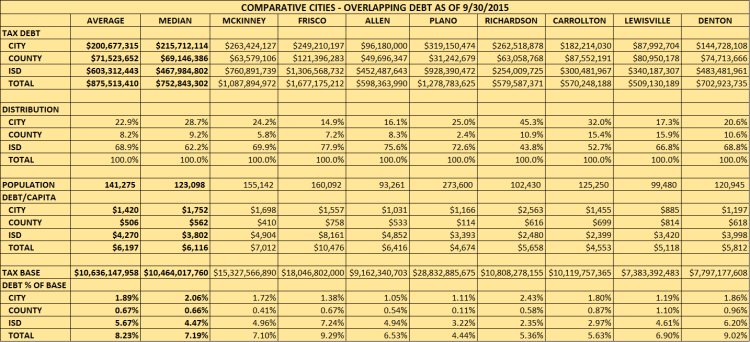
First, you must select relatively meaningful entities to compare. Two common criteria are size and proximity. Below I have compared eight cities using those guidelines. Four are very close in size regarding population. Plano is included due to proximity to McKinney. I might have omitted Lewisville and even Denton except they are close in size, and Denton is a county seat city. Taken together, they perhaps form a nice U-shaped, contiguous configuration that starts and ends with McKinney and Denton in alignment with Hwy 380 to complete the horseshoe.

Comparison3

Building on yesterday’s blog, we have now enhanced our knowledge base considerably. I intentionally wanted you to focus on just the underlying approach and to be hungry to see how McKinney compares with a meaningful sample as presented today.

The absolute dollars are interesting but the least helpful in comparisons until you view the data on some common basis such as the percentage distribution. The average/median is 22.9/28.7% for the cities, 8.2/9.2% for county related and 68.9/62.2% for school districts. To no surprise after learning about the domination of ISDs yesterday, McKinney is well above the average and median. But let’s look deeper.

On a Per Capita basis, McKinney is quite high at $7,102 second only to Frisco with $10,476. Plano is the outlier on the lower end of the spectrum.

On the other key metric, Debt as a % of Taxable Values, McKinney is the third highest, with Frisco and Denton quite a bit higher.

So, What Are Our Takeaways?

There’s actually quite a few.

  • We have confirmed that the school districts dominate in debt in just about every comparison.
  • We have shown where McKinney is significanly higher than most of the cities we might use for comparison purposes in an effort to establish a “norm.”
  • As a burden on city taxpayers, McKinney’s load due to ISDs (McKinney ISD, Frisco ISD predominately), is noteworthy.
  • It is possible that we have spotted a cost differential with Frisco ISD’s policy of more but smaller high schools versus Allen ISD’s single high school. Not sure, more digging required to explain any outlier. What we also don’t know is the school building unused capacity for any of the school districts.
  • We may have also spotted a high % of the tax base for debt in Denton due to the combination of so much non-taxable property with two large universities as well as county facilities. Again, validation requires some digging.

The Bigger Hidden Story.

Even well-managed city cannot control the other local governmental entities. Also, in many cases, counties, cities and school districts don’t talk to each other any more than they have to. In fact, many overlapping entities stay at odds with each other. Even though they serve the same taxpayers.

This friction becomes obvious to people like bond rating agencies having to evaluate each entity in light of one taxpayer and the vast number of bond holders. If the bond rating agencies and the citizens could huddle in one spot and deal with this one question, what do you think the outcome would be?

The Question: what could be done regarding debt and tax rates that would be the best for the citizens and the bondholders regarding affordability, ability to pay and willngness to pay?

The Possible Answer: Develop a policy that sets some parameters so that we can see the picture as a whole. For debt, the amount cannot exceed a total of $________ per capita with no more than $____ going to the county, $______ going to the city and $______ going to the school district(s).

Can you see how that is not so hard to do when you put comparative data in front of intelligent people willing to serve the people? Financial policies can be formulated, adopted and then revisited annually to affirm a gyroscope is in place to assure responsibleness. Can you imagine a set of policies everybody can articulate?

Conclusion.

Okay, okay, climb back over your pew and sit down. Even the bond rating agencies don’t like caps that could threaten the ability to repay the bond holders and to disrupt the operations of the local governments. I’m just trying to convey that more and more attention is being given to data-driven decisions. There is a maximum limit out there somewhere. Some say there is room to go. Others say were are there right now. Yet others say we have passed the limit. Can you put a number on it? I can. And you can, too.

Here is what we know. We (public officials and citizens) either self-police or else we risk somebody imposing a lid on us. In fact, did you know there is a traveling senate committee going around the state armed with data they are misusing to basically be prepared to stifle local governments’ ability to decide? We have prominent state officials elected on the promise they would try to eliminate property taxes? They had much rather “clean up” local government than to face their own egregious mishandling funds at the state level.

But heed the warning. Even today another story came out about Garland ISD missing the cost of a $20 million natatorium the voters approved by $10 million!

We are violating the principle of taking care of the basics and, if possible, do a few frilly things. In fact, the optional things that allow an elected official’s name on a building plaque are coming ahead of the crumbling streets and school buildings in many cases. More on that topic coming up. LFM


Understanding Overlapping Numbers – Like Debt & Tax Rates

Introduction.

I have always encouraged MPA students to work hard on being able to visualize the magnitude of numbers they hear. Basic things. A single acre of land. A square mile. A football field. A water storage tank size in gallons and the cost per gallon to build. The cost of a lane-mile of roadway. Hip pocket numbers I would say. You will forever be in discussions about the size and cost of things. Be prepared to do a logic test.

At the same time, don’t shy away from putting big numbers in context. It is early and quite often you start hearing millions and billions. If you hear that the city uses 10 billion gallons a year, don’t immediately think waste. It might be. But for McKinney with a population of 155,142, that breaks down to 176.59 gallons per capita per day (gpcd). And since that includes commercial and industrial water use in the average, the residential portion would be less. But the point is that 10 billion is a large number easily misinterpreted unless placed in a proper perspective.

The perspective becomes more important when talking about dollars. There is an interesting principle involved here that I must pause to explain. If you want to place emphasis on a metric, you multiply it as high as possible. “We’re going to be using over 100 billion gallons of water over the next 10 years!” If you want to minimize the emphasis, you divide to the lowest possible level. I just did that with my gpcd calculation.

The principle can be applied to deliberately distort facts. Or to genuinely understand a perspective. I just want you to know that I know the game. At the same time, I want you to appreciate that I am trying to help. If you are interested in local government, you deal with a lot of numbers and some very large numbers. With the massive amount of growth in Texas (a million new people every 7-10 years just in the Metroplex), one must gird up to appreciate the task of grasping large numbers. The minute you hear, “we get 36,000 calls per year,” whip out your calculator and see how many that is per dispatcher per day or hour just to equip yourself with a perspective.

Let’s Play With Debt.

I am the first to be cautious about debt. And if there is a viewpoint I take, it is that of the bond rating agencies representing the concern of the bond purchasers. Why? Because in my entire career, rating agencies are the first (and for years the only) outsiders that care about the consequences of today’s actions on the future. They appreciate a good financial condition today, but can you repay your bonds for the next 20 years? They also know the importance of one governmental entity on the others. That starts at the state level. But the more granular local level rises to take center stage fairly quickly. From the taxpayers’ standpoint, the checkbook doesn’t care. What is the total tax bill? So, too, it is the bond rating agencies’ concerns about the overlapping impact of things like debt and tax payments that we focus on today.

OverlappingDebt

In the table above, you can see about 11 lines down that the City of McKinney has $263,424,127 in debt supported by property taxes. That is a significant amount of money by any yardstick. However, the story that often goes unnoticed is that there is an additional $824,470,845 in overlapping debt from Collin County, Collin County College District and the School Districts inside McKinney.

Clearly the County and CCCD are not overly burdensome. However, the ISDs make up $760,891,739 of the debt carried by the taxpayers inside the City of McKinney. In total, it all adds up to $1,087,894,972. Now you can get a sense of the magnitude of debt and the sources? By the way, these numbers come from required financial disclosures to the public – wonderfully informative data often ignored by local government leaders and citizens.

In an effort to place over $1 billion in debt into perspective, I have shown the number as:

  • $7,012.25 per capita.
  • $20,966.64 per household.
  • 7.10% of the taxable values in the City of McKinney.

The next obvious question is How does McKinney compare with Plano, Frisco, Allen and other area cities? I’m going to give you that answer in a future blog, but that is not the point here. In one sense it doesn’t matter. The objective is to understand our own and how local governments impact each other. And when we can carry no more?

Another perspective is to appreciate the direction we are headed with debt. These numbers do not include the approximate $110 million recently approved for the City and the $220 million for McKinney ISD. After those bonds are issued, along with other authorized bonds but unissued bonds, there will be some bonds that will have been paid off. Therefore, these metrics change often but generally trend upward.

In any case, whether viewed as total absolute dollars or on a per unit basis (capita, household or tax base), it’s a lot of money. Every elected official and appointed money board member needs to have these hip-pocket numbers in their head or in the cell phone notes.

What About Overlapping Tax Rates?

Again, when viewed in total, the numbers are quite high. The City of McKinney has not raised the tax rate in years; in fact, they have been lowered slightly. However, the bill that the taxpayer gets is based on the total of all taxing entities, and that number is about $2.48 per $100 of value broken down as follows:

  • City of McKinney $0.583
  • Average  ISD $1.590
  • County/CCD $0.307

Conclusion.

It’s hard not to be the Master of the Obvious, but clearly almost 70% of the debt carried within the City of McKinney boundaries is related to school districts. ISDs also account for about 64% of the tax rate.

MISD is supposed to be lowering their rate by 2-cents next year, and the FISD is talking about raising theirs considerably. FISD can by law go up to $1.67.

This blog is one of many planned to take a spoonful of local government finance items at a time. I encourage you to study the selected numbers and the associated perspectives and stories.

The City of McKinney voters took a menu of bond propositions and said yes to most but no to $millions of others. McKinney ISD gave the voters an all or none proposition that included $50 million for a football stadium to add to almost $12 million authorized in past years and yet to be issued.

It is imperative that citizens and all taxpayers look at the entirety of the burden placed by county, city and ISDs collectively. It’s all coming out of the same pocketbook.

There is also a finite amount of debt and taxes that can be placed on the public without there being some repercussions. We aren’t there yet from the bond rating agencies’ standpoint else we would be seeing some downgrades. But we must understand that the rating agencies look at both 1) ability to pay and 2) willingness to pay.

Collin County is a very wealthy sub-region in a wealthy region in a relatively wealthy state. Citizens keep allowing bonds to pass and tax rates to increase. Therefore, we keep passing the ability and willingness tests. For now.

However, we aren’t paying sufficient attention to big-ticket liabilities coming down the road. I have blogged about many of these and will continue to do so.

When the McKinney City Council sat passively and listened to the pitch for the MISD bond program by their superintendent, I was thinking, my goodness, the City just winked at $62 million of future roadway needs that would have been the exact some impact on Joe Sixpack (me). But that concern would only come up if people really thought about the sustainability of the community for the long-term future.

Also, near Houston, the Katy ISD 12,000 seat football stadium was reported just four days ago to have increased from $57.6 million to $62.0 million. The increase was for add-ons and unforeseen infrastructure requirements.

MISD has yet to go our for, receive and award a bid. It’s a long time before the kickoff whistle blows. LFM


City of McKinney Makes Quantum Leap in True Transparency

In mid-March, Mayor Brian Loughmiller urged the City Council to have the McKinney Economic Development Corporation (MEDC) and the McKinney Community Development Corporation (MCDC) meet in the Council Chambers instead of their small conference room in a bank building where they now office. All of the councilmembers agreed. Or at least nobody disagreed. And it happened!

What a difference it makes. A small conference room with only translucent windows inside a suite of offices inside a bank office building miles from City Hall was not very inviting. The Council Chambers inside City Hall are accessible as soon as you walk in the door. It’s inviting with the openness and clear glass walls making it quite a different experience. The meetings are also videotaped. You can go and watch live, sit at home and watch live or you can go back to see the recording after the meeting if you cannot attend.

I wish McKinney had a better City Hall that incorporated all of the city departments and made a more complete statement about the seat of government, its openness to citizens and anyone desiring to go to one place the public owns to see with their own eyes where the business of government is conducted. The current City Hall is, in fact, an old bank building. You can’t approach it or even see it until you are in front of it. There is no curb appeal, so to speak. For a city our size, it is a little bit of an embarrassment. However, I’ll save structure for a future blog. It isn’t the house but rather the home that this blog is focused.

What’s Different?

Reading through minutes of a meeting is a cold and clinical process. In fact, most minutes are just sterile, skeletal representations that a meeting event occurred, that certain topics were discussed and that votes were recorded. A video recording of the meeting allows one to see which board members have done their homework. There is a joke in city government about the sound of council packets that were delivered days before being opened just as a meeting starts. I watched the most recent MCDC meeting. I was so impressed with the constructive and deep level of questioning as groups made their pitch for money to support their projects. Board members asked about O&M costs beyond the initial funding. They asked about repair and replacement reserves. They asked questions about their financial statements – including their balance sheets! And the observer got to hear the answers. One can see, on record, whether the proposer had done their homework. Now that is a giant step toward transparency. You don’t get that from reading

I watched the most recent MCDC meeting. I was so impressed with the constructive and deep level of questioning as groups made their pitch for money to support their projects. Board members asked about O&M costs beyond the initial funding. They asked about repair and replacement reserves. They asked questions about their financial statements – including their balance sheets! And the observer got to hear the answers. One can see, on record, whether the proposer had done their homework. Now that is a giant step toward transparency. You don’t get that level of understanding from reading minutes, because it’s not in a typical set of minutes.

You also get to hear the tone of voice and see the facial expressions. That’s important. I once emailed the City Council about a meeting the night before where the words coming out of their mouths didn’t match the expressions on their faces. Those are important signals to understand the basis for a vote or even an effort to cloak an approval or a denial of a request in political babbletalk. Once a developer who generally got his way on any request started getting some hard questions from a couple of councilmembers. It was almost funny for the developer’s cronies on the council to sit up straight, pull up to the microphone and tried to rescue the vote they thought was another slam dunk.

You can also see the potential of future leaders headed toward council elections. There is an unwritten rule, it seems, that you need to pay your dues on some boards and committees before you are qualified for being on the City Council. I don’t fully embrace that concept, but it makes sense to show the commitment and to gain the experience. I’m always amazed at council candidates with a burning desire to serve a city who then disappear after an election until the next one come up timed with their burning desire to serve.

Experience is good as long as one is not co-opted into the McKinney culture where certain people are just rotated over the years and become desensitized to the duties of independence and ethical judgment. As I have written about before, I sincerely believe that some actions have been taken by board members who, in their mind, have acted no differently than those before them and those beside them. A question I don’t think is ever asked of a council candidate or a board applicant is this: how many meetings have you attended or videos of meetings have you watched or minutes of meetings have you read from the most recent 12 months? If the answer is none, that is not consistent with burning desire nor a signal the candidate will do their homework.

The Educational Value.

I have taught MPA graduate courses at SMU and UNT in past years. And, as I have mentioned before, I am still a student in what I consider the most wonderful laboratory in the world – local government. Earlier this week, there was a strategic planning workshop for the MEDC Board. I am about a quarter way through the 6-hour video. It is rich with instruction about economic development issues. It is facilitated by an expert, but the Board participation and dialogue are invaluable if one is interested in learning about core municipal issues. Surprisingly and pleasingly, the Board is brutally honest about the strengths and weaknesses of McKinney. There isn’t a better classroom. There isn’t a better laboratory. You can be in the physician’s gallery overlooking real open-heart surgery while in the comfort of your home. Thank you, City of McKinney City Council!

In fact, if you considered every council meeting, MEDC/MCDC meeting and P&Z meeting to be one graduate course class night, one could be equipped in one year to be the most knowledgeable elected official or candidate for City Council who ever walked the earth. Even for a citizen not interested in being on the council or a board or committee, this is great Civics 101 on steroids. An added benefit is the professional input from staff and consultants. One of the saddest observations I’ve made in my lifetime is how the vast majority of citizens cannot articulate the most basic issues and processes of the municipal world that is wholly devoted to making their lives the safest and highest quality possible.

Conclusion.

The City has made a heavy investment in information and materials on their Web site. Our Web site. There are years of financial documents and hours of meeting videos. Some people enjoy book clubs, gardening clubs other study groups for many reasons. One is to simply enjoy that treasured reward that comes from learning something new; to be able to converse about topics not previously explored. If you were to examine the rewards, they would include being able to understand the vernacular of newly discovered areas. They include concepts and philosophical foundations for community life. But they also include or could include real basics. Interesting basics. Just exactly how are water and sewer lines tested for leaks? What are the unintended consequences of a landscape ordinance passed last year? What is happening at today’s council and committee meetings that are shaping our future – or better or worse? LFM


Heaping Praise & Sending Insults Simultaneously

Please consider my last blog about the McKinney City Council’s consideration of a private firm taking over our biggest ballpark.

I have never seen a city council go out of their way to thank the staff for what they do. In fact, it is sometimes entertaining to watch each council member compete to be the first to praise the staff. It gets gushy. And it is a pleasure to watch the gratitude and appreciation. It is genuine.

Yet this video clip referenced in the blog is an illustration of how the City Council insults the staff in the very meeting projectile praise is offered. This is a council that has pretty much ignored the Council-Manager form of government for a very long time. Some Council members meet privately with developers in the name of just wanting to be better informed about issues coming before the Council. The only problem is that you often see both the P&Z and staff being overridden without much explanation. The very forum where the public could learn details about an issue, including pros and cons, gets cheated out of a teaching moment.

The first tip off that something is not right in the meeting I have highlighted is that a private company is making a pitch, and the pitch is introduced by a councilmember, Chuck Branch. One of the reasons to have a staff is to vet these kinds of pitches. And everybody knows the danger of indicating a favoritism of a company wanting to do business with the City. Unfortunately, the first worry is criticism from competitors.

In fact, if the staff determines there is merit to a new service or product, the first thing the proposer hears from staff is that the City will have to develop a Request for Proposal (RFP) or Request for Qualifications (RFQ) to see who else might be able to serve the City. Also, there is an obligation for the City to evaluate the best and lowest price for the said service or product.

In this case, you can see on the video where the Parks & Recreation Director is called on to comment on the presentation in the live meeting. It makes you wonder, did Councilman Branch even talk to the PARD director before the meeting? In the agenda packet you find a copy of the Letter of Intent as well as the presentation. In most cases, like with P&Z, you usually find a staff report and probably a recommendation. Not here. It’s all a one-sided pitch.

Except there is usually an obligation to give consideration to a P&Z item. There is no obligation to take up at least 20-25 staff/council hours in one meeting to hear a pitch. Does Mr. Branch have any idea how many pitches compete for staff and purchasing attention every single year? I’m assuming he has no vested interest in this particular company and is only wanting to bring something to the table that he thinks might help the City. However, has he ever been to a TML conference where there are literally hundreds of exhibitors who would love to have 20-25 staff/council hours to make a pitch for something?

There is absolute disregard for the Council-Manager form of government here. Why is the member of a governing and policy board out hustling for something new for the City to do? And is there no sense of bad timing obvious here when the City just completed a comprehensive parks plan? Is there no respect for staff input? Can you imagine the workload on the council and staff Councilman Branch just initiated?

This is where the meeting went sideways. There was serious discussion about – get this – developing an RFP/RFQ to consider a consultant to evaluate the proposal. Holy Cow! This is where the mayor or mayor pro-tem should have shown some leadership and stopped the whole thing in its tracks. It never should have gotten this far in the first place, but by the time a huge investment was made in listening to the pitch, the PARD director and the audience, a council appreciative of the staff should have driven a wooden stake into the heart of this deal. And, on the side in private, somebody on the council should have told the freshman councilmember what a dumb thing he had just done. I would have considered it an imposition on me as a councilmember.

But then that is where the culture of McKinney Governance is to do just that. Way too much involvement in daily operations and details. This should have been handled with nothing more than a paragraph in a City Manager’s weekly memo to the council, at best. One paragraph. We’ve been approached. We looked at it. It doesn’t fit and here is why. We recommend saying no in a polite letter unless you want to pursue it. And by the way, this is one of six items we have been approached on this week (300 in the last year!) as explained in the next five paragraphs. Actually, I’m not sure it qualifies as to be in a weekly report.

Has Mr. Branch even asked how many vendors currently serve the City? And for every one of them there are several more companies that want to have the City of McKinney as a client. And most importantly, for every vendor selected, there were probably six that were told they didn’t get it. For every one of those six, there is a probability that a protest was registered even in a mild form. Can I see all of the proposals? Why didn’t you give me more weighting in this evaluation criteria? My bid was lower than the awardee. Why did you give it to them? I want to challenge you on your definition of “best bid.”

As I have already said, this is insane. I also cautioned the Council months ago that a good City Manager candidate was going to be interviewing them as hard as they were going to be interviewing the candidate. The basic questions were 1) do you as a council understand the Council-Manager form of government and 2) do you respect and adhere to it?  Not in McKinneyLand!

It is clear that Mr. Branch has no clue. It is equally clear that nobody else on the Council does either. Especially to have let this unsolicited pitch get this far and then promoted by a councilmember. God help us if this doesn’t change and we continue the city manager revolving door episodes of the past. Red flag! Red flag! LFM


Sometimes The Process Starts With NO!

Listen up, MPA students and future council candidates! The City of McKinney has just given you a wonderful case study. First, you need to invest a little time to watch this presentation to the City Council and how the meeting played out. Here’s my take:

A group wants to take the City’s best and biggest sports park, Gabe Nesbitt, and investment money to upgrade the fields so they can be used for tournament leagues and bring more out of town teams to play on our fields. They also want to control and collect all of the money, including concessions. They also want the City to continue paying for much of the maintenance costs.

Oops! That becomes unclear right the very beginning. What the company is saying in their presentation doesn’t exactly jive with the materials they already had in the Council packets. They do the typical, “let me blind you with dreams of massive economic benefits” and show a very large $30 million tag. Except the Council isn’t so blind. In fact, they almost compete to ask good professional questions. The company’s answers aren’t so good. They have a good ole’ boy speaker who doesn’t impress the City Council.

But the Council is playing nice. You can tell by their tone that they are trying to be fair and hear the full pitch. Then they ask the Rhoda Savage, the Parks & Rec Director to comment. She is polished and makes some very good points. Her credility is sky high with the Council. You can sense her skepticism, but she is all professional.

Then an original McKinney good ole’ boy speaks. He is not polished, but he is powerful. He calls out 50 years of memories with the good ole’ boys on the Council. While being polite, he delivers a sledge hammer plea. He’s repeats more than once that he is not smart enough to figure this out, but you know very well he is smart as a whip.

But then comes the polished and well thought out speech from Lonea, head of one of the McKinney baseball leagues. She raises questions that nobody in the room would have thought to consider. Bang, bang, bang. You could sense that the Council probably has seen her stern professional demeanor, but they know there is a fire that they surely want to contain.

At this point you know this pitch is not going to fly. But then the bureaucratic (from the Council, not staff) agony overcomes the meeting, like a thick cloud of goo. Oh my goodness, here comes the process. We’re going to study it to death. A park master plan has just be done. It is so new that it hasn’t been presented to the council. Undo? Redo? How to scope another study? Who should do it and who should pay for it? Can’t be staff. Too busy. It will have to have tons of community input, from the same people who were just asked for input on the park master plan.

Stop. Stop. Stop. Every councilmember either doesn’t want this or shouldn’t want it in light of the lousy presentation from the business and the multiple questions raised by the baseball league representatives. Nobody even asks if this is such a good deal, and the business is going to make sufficient money to make a profit or perhaps just break even after they put $millions into it and set fees to cover their costs, then McKinney only has literally tens of thousands of undeveloped acres, so why not do their own thing?

This is insane. The Council is going to allow this to go several steps through the process just so they can say they went through a process in order to say no. NO is the correct answer RIGHT NOW. Why waste staff time? Why get the baseball family in an uproar? The Council knows the little leaguers can fill the council chambers 10x over – and will.

Or they could write a polite letter:

Dear Company:

Thank you for your interest in McKinney. We believe that all of our current resources going mostly to the advantage of recreational baseball is the will of the Council reflecting the will of the people. We believe there is plenty of land in McKinney for you to create a tournament league complex in McKinney, invest your money and set your own fees. By the way, you happened to mention in your answers to some questions that there was some legal action being taken in some adjacent communities where tournament leagues were not being given the same status as recreational teams. We would have to tell you that making that statement was not a very smart thing to do. We wish you well in your future endeavors.

Respectfully,

McKinney City Council


Improper Teacher-Student Relationships Are Happening Right Now

As many of you know, one of my businesses is an electronic news clipping service. I read newspapers from the viewpoint of a mayor or city manager – interested in anything that affects local governments in Texas. I poll and read from 168 newspapers in Texas and about 56 other news sources at the national level. It is simply fascinating to see stories as they pop up all over the state that become “heads up” material. Part of this bubbling up of similar stories is that reporters read other newspapers. An event in the Rio Grande Valley will result in a reporter asking a city in North Texas how they deal with this or that.

But some of the similarities have to do with a wave of events in our state that are, in fact, truly societal. I pick up hints by also reading from the national level. Sometimes I am baffled. How is it that black mold was like swarming locusts just a few years ago and now there isn’t a story to be found? Did it pop up overnight and is now cured? I doubt it. It is my guess that a 1,000-year-old problem got the spotlight placed on it, and much has been cured. But has it disappeared? Doubt it.

One of the trends I’ve mentioned a lot over the past few years has never gone away and is, in fact, growing at alarming rates. I don’t keep counts, but I’m guessing there are 4-5 reported on just about any given week. I actually don’t send most of those stories even though I often mention how many I’ve found on a particular day. I had just made that point a few days ago when a more comprehensive story came out four days ago in the Austin American Statesman. Please take time to read below.

But don’t stop there. Ask your school boards and administrations to explain how they are dealing with this issue? There should be some policies, and here’s why. It is happening in your ISD. Another consideration has to do with a police statistic. Every police department knows that for every reported incidence, there are usually multiple incidences of the same type that are not being reported – in this case by the student.

Yet the critical issue is prevention. What is being done to prevent these incidences from happening? Everybody would probably agree that 100% prevention is not realistic. The key is to make sure that there is an proactive preventative program in place. Is there regular emphases placed on improper teacher-student relationships through teacher meetings? If there is a known flirtatious student being noticed, is there a confrontation and counseling? If you follow these stories, you realize that many do involve female teachers as well as men. Are all teachers and employees asked perhaps a couple of times a year, in private, if there have been any incidences or temptations and how the teacher handled it? Is there a policy that an unreported incident, no matter how small, is grounds for termination?

Again, an improper teacher-student relationship is happening in your ISD right now as you read this blog. As I am prone to do, this is another example where I would urge everyone to work it backwards. Imagine a major scandal sufficient to rock the ISD and cost hundreds of hours and thousands of dollars dealing with an improper relationship. Now go back to how it started. What could be done at that moment to head it off? Who knew something didn’t look or seem right and had been suspicious all along? LFM


Improper teacher-student cases on track to break Texas record

By Julie Chang – American-Statesman Staff
Posted: 5:27 p.m. Tuesday, May 10, 2016
Highlights
Social media and text messaging continue to be main drivers of the increase in such cases, official says.
Between Sept. 1 and March 31, 114 cases were opened, up from 85 during the same period last year.
Texas Education Agency wants more access to investigative documents.
————————————————–
The number of Texas teachers accused of developing romantic relationships with students this year is on course to outstrip last year’s record total, even as quashing such misconduct remains a priority for lawmakers and education officials.
Between Sept. 1 and March 31, the Texas Education Agency opened investigations into 114 teachers who were accused of acting improperly with students — up from 85 teachers during the same period last year — with behavior ranging from sending personal text messages to having sex with multiple students.
Last fiscal year, the education agency opened 188 such cases, the seventh consecutive year of growth.
Related
Report of improper teacher-student relationship at Ann Richards School
Surge in improper student-teacher relationships prompts state inquiry
Texas sees rising number of improper teacher-student relationships
Social media has continued to fuel this year’s rise, said Doug Phillips, director of investigations at the Texas Education Agency, who will testify Wednesday before the Texas House Public Education Committee about improper teacher-student relationships. The state Senate held a similar hearing in December.
Phillips’ wish list from lawmakers for the 2017 legislative session will include tightening school district requirements on reporting teacher misconduct; requiring school districts to develop policies to rein in unsupervised contact between teachers and students; and forcing school districts to hand over teacher evaluations, which are typically protected by privacy laws.
“We are here to protect the kids. School districts are here to protect the kids,” Phillips said. “We all have the same interest. We have to deal with this issue of giving teachers this direct unsupervised contact.”
Four local cases
Of the 118 investigations the Texas Education Agency has launched since the fiscal year began in September, at least four were in Central Texas school districts:
• Westlake High School math teacher Haeli Noelle Wey was arrested in December after police said she had sex with a 17-year-old student and kissed and touched another 17-year-old student.
• Vandegrift High School communication applications teacher and coach Je’ron Curtis resigned in December after the school district said he was in a relationship with a student in another school district.
• Math teachers Austin Locklear from Crockett High School and Keith Marquez from McCallum High School resigned this year after the Austin school district launched separate investigations into allegations of improper teacher-student relationships, according to documents the district sent to the Texas Education Agency.
The Austin school district reported that Marquez’s actions weren’t criminal, but documents the Texas Education Agency provided to the American-Statesman didn’t describe the types of text messages that he allegedly sent to a student. The documents also didn’t detail the accusations against Locklear.
Although an improper teacher-student relationship is narrowly defined in the penal code as involving sexual contact or online solicitation of a minor, the education agency can sanction teachers or revoke teaching certificates based on misconduct that falls short of a crime, including exchanging flirtatious text messages with a student.
Superintendents are required to report misconduct to the state within seven days if it has led to the termination or resignation of a teacher.
Policing e-messages
Phillips said most of the improper teacher-student relationships his office investigates stem from social media or text messaging — types of communication that provide opportunities to push professional and personal boundaries with students while creating a record of exchanges that can be used later as evidence.
Experts suggest that some school districts fail to adequately train teachers on communications boundaries because they assume teachers know what they shouldn’t do.
Some districts also tend to perceive frequent and candid training on improper relationships as admitting to a problem, said Phillip S. Rogers, head of the National Association of State Directors of Teacher Education and Certification. The association has co-developed a model code of ethics for educators, including in the proper use of technology.
“One of the things we find with superintendents when we start talking about the model code, they’re a little standoffish. Why? Because people are going to think that ‘we have a problem,’” Rogers said.
Phillips said more training will help, but he also suggests that school districts require teachers to copy parents on any electronic messages sent to students or to use a district email or messaging system to communicate with students.
“If it takes legislation to compel districts to implement policies about use of electronic media and any communication, in my opinion it should be that you don’t communicate with a student one-on-one. It has to be transparent,” he said.
More investigative power
For years, Phillips’ investigators have faced resistance from some school officials who withheld teacher documents because they feared lawsuits or wanted to protect district reputations.
Lawmakers ­granted the TEA subpoena ­power Sept. 1 after the ­agency complained that some school districts were redacting names of key witnesses and sometimes entire pages of a teacher’s personnel records.
Phillips said the subpoena power has helped the state get information and close cases quicker, but there are still some loopholes available to districts.
One weakness is that the law requires only superintendents to report a termination or resignation due to teacher misconduct, if they know about it. Phillips said the language should be tightened so all school district officials have a responsibility to report teacher misconduct.
Another loophole, he said, is that school districts can hide information about educator misconduct in teacher evaluations, which are protected by privacy laws and aren’t obtainable through subpoenas. Phillips said he will ask legislators for such authority.
“We have to get away from worrying about the teachers. We have victims who are kids,” Phillips said.
The Texas Association of Professional Educators said it supports making teacher information available as long as the accused educator has the right to review the information that is provided to investigators.
What we’ve reported
The American-Statesman first reported in May 2015 that some Texas school districts, worried about lawsuits and their reputations, were refusing to give information to state officials about teachers accused of improper relationships with students. That lack of information made it more difficult for state education officials to sanction teachers who had left school districts for alleged misconduct. Later that year, the Legislature granted subpoena power to Texas Education Agency investigators.

More Proof That McKinney ISD Lacks Transparency

Even if you are not inclined to dig into financial documents, please take a quick look at some key pages of the following documents:

McKinney ISD Financial Report for FY 2015. (93 pages).

Plano ISD Comprehensive Annual Financial Report (CAFR) for FY 2015. (163 pages).

Frisco ISD Comprehensive Annual Financial Report (CAFR) for FY 2015. (146 pages).

Allen ISD Comprehensive Annual Financial Report (CAFR) for FY 2015. (196 pages).

To make this easy, first look at the cover page to give you a clue to the differences in professionalism. MISD doesn’t really have one. In fact, they do not produce a comprehensive audited report. To have a CAFR, you are required to have much more managerial and analytical information to help the layperson understand the contents. MUCH MORE.

Now go toward the back of the reports. The last three will have an entire section of statistical data: several schedules showing ten years of comparative data. I am a finance person and I simply can’t see the story in the numbers without comparative data. I spent a considerable amount of time for my last two blogs just to get some select data compared for the last five years. The CAFRs contain ten years of very helpful information.

In all fairness, many of these districts have moved from the basic required audited financial reports to CAFRs only in recent years. Perhaps we will see a MISD CAFR someday. But based on the efforts I’ve seen in recent months to be transparent, I’m guessing they are in no hurry.

Here’s the interesting part, you don’t tell the bondholders that you are sorry you don’t have comparative data and that you promise that you will be more forthcoming and helpful in the future. No! You produce much comparative data and ratios for at least the most recent five years. If you issue bonds regularly, which they do, then you already have a ton of the ten-year historical data. The work to produce a CAFR is lessened.

But, there is a part that takes a little work the first time. It is the MD&A, which stands for Management Discussion & Analysis. A little work and a willingness to interpret complex financial documents.

In fact, MISD just refunded bonds. The Official Statement is dated a month ago. This document is filled with legal language. Skip those parts for now and just look at the tables. It is rich with good information.

MISD may have a Sheep-Board and even an abundance of Sheep-Citizens. What you won’t ever find is a Sheep-Bondholder and the cast of players watching out for the bondholder, such as the bond rating agencies. As a side note, you would be amazed at the additional information in a modern O/S compared to the 1970s and earlier. They were very thin on analytical information. But after being asked repeatedly for certain information, the Finance Advisors realized they need to assemble the information that was going to be requested time and again. Also regulatory agencies have beefed up requirements all in the name of protecting the bondholder.

However, the bondholder just wants to make sure they get their interest paid and their principal back.

As a taxpayer, I want to see more comparative numbers without having to mine the data from multiple sources. There are plenty of examples of how the more truly transparent ISDs provide their information. Or just look at what the City of McKinney has been doing for years! Can MISD spell C-O-O-K-B-O-O-K? LFM