Understanding Overlapping Numbers – Like Debt & Tax Rates

Introduction.

I have always encouraged MPA students to work hard on being able to visualize the magnitude of numbers they hear. Basic things. A single acre of land. A square mile. A football field. A water storage tank size in gallons and the cost per gallon to build. The cost of a lane-mile of roadway. Hip pocket numbers I would say. You will forever be in discussions about the size and cost of things. Be prepared to do a logic test.

At the same time, don’t shy away from putting big numbers in context. It is early and quite often you start hearing millions and billions. If you hear that the city uses 10 billion gallons a year, don’t immediately think waste. It might be. But for McKinney with a population of 155,142, that breaks down to 176.59 gallons per capita per day (gpcd). And since that includes commercial and industrial water use in the average, the residential portion would be less. But the point is that 10 billion is a large number easily misinterpreted unless placed in a proper perspective.

The perspective becomes more important when talking about dollars. There is an interesting principle involved here that I must pause to explain. If you want to place emphasis on a metric, you multiply it as high as possible. “We’re going to be using over 100 billion gallons of water over the next 10 years!” If you want to minimize the emphasis, you divide to the lowest possible level. I just did that with my gpcd calculation.

The principle can be applied to deliberately distort facts. Or to genuinely understand a perspective. I just want you to know that I know the game. At the same time, I want you to appreciate that I am trying to help. If you are interested in local government, you deal with a lot of numbers and some very large numbers. With the massive amount of growth in Texas (a million new people every 7-10 years just in the Metroplex), one must gird up to appreciate the task of grasping large numbers. The minute you hear, “we get 36,000 calls per year,” whip out your calculator and see how many that is per dispatcher per day or hour just to equip yourself with a perspective.

Let’s Play With Debt.

I am the first to be cautious about debt. And if there is a viewpoint I take, it is that of the bond rating agencies representing the concern of the bond purchasers. Why? Because in my entire career, rating agencies are the first (and for years the only) outsiders that care about the consequences of today’s actions on the future. They appreciate a good financial condition today, but can you repay your bonds for the next 20 years? They also know the importance of one governmental entity on the others. That starts at the state level. But the more granular local level rises to take center stage fairly quickly. From the taxpayers’ standpoint, the checkbook doesn’t care. What is the total tax bill? So, too, it is the bond rating agencies’ concerns about the overlapping impact of things like debt and tax payments that we focus on today.

OverlappingDebt

In the table above, you can see about 11 lines down that the City of McKinney has $263,424,127 in debt supported by property taxes. That is a significant amount of money by any yardstick. However, the story that often goes unnoticed is that there is an additional $824,470,845 in overlapping debt from Collin County, Collin County College District and the School Districts inside McKinney.

Clearly the County and CCCD are not overly burdensome. However, the ISDs make up $760,891,739 of the debt carried by the taxpayers inside the City of McKinney. In total, it all adds up to $1,087,894,972. Now you can get a sense of the magnitude of debt and the sources? By the way, these numbers come from required financial disclosures to the public – wonderfully informative data often ignored by local government leaders and citizens.

In an effort to place over $1 billion in debt into perspective, I have shown the number as:

  • $7,012.25 per capita.
  • $20,966.64 per household.
  • 7.10% of the taxable values in the City of McKinney.

The next obvious question is How does McKinney compare with Plano, Frisco, Allen and other area cities? I’m going to give you that answer in a future blog, but that is not the point here. In one sense it doesn’t matter. The objective is to understand our own and how local governments impact each other. And when we can carry no more?

Another perspective is to appreciate the direction we are headed with debt. These numbers do not include the approximate $110 million recently approved for the City and the $220 million for McKinney ISD. After those bonds are issued, along with other authorized bonds but unissued bonds, there will be some bonds that will have been paid off. Therefore, these metrics change often but generally trend upward.

In any case, whether viewed as total absolute dollars or on a per unit basis (capita, household or tax base), it’s a lot of money. Every elected official and appointed money board member needs to have these hip-pocket numbers in their head or in the cell phone notes.

What About Overlapping Tax Rates?

Again, when viewed in total, the numbers are quite high. The City of McKinney has not raised the tax rate in years; in fact, they have been lowered slightly. However, the bill that the taxpayer gets is based on the total of all taxing entities, and that number is about $2.48 per $100 of value broken down as follows:

  • City of McKinney $0.583
  • Average  ISD $1.590
  • County/CCD $0.307

Conclusion.

It’s hard not to be the Master of the Obvious, but clearly almost 70% of the debt carried within the City of McKinney boundaries is related to school districts. ISDs also account for about 64% of the tax rate.

MISD is supposed to be lowering their rate by 2-cents next year, and the FISD is talking about raising theirs considerably. FISD can by law go up to $1.67.

This blog is one of many planned to take a spoonful of local government finance items at a time. I encourage you to study the selected numbers and the associated perspectives and stories.

The City of McKinney voters took a menu of bond propositions and said yes to most but no to $millions of others. McKinney ISD gave the voters an all or none proposition that included $50 million for a football stadium to add to almost $12 million authorized in past years and yet to be issued.

It is imperative that citizens and all taxpayers look at the entirety of the burden placed by county, city and ISDs collectively. It’s all coming out of the same pocketbook.

There is also a finite amount of debt and taxes that can be placed on the public without there being some repercussions. We aren’t there yet from the bond rating agencies’ standpoint else we would be seeing some downgrades. But we must understand that the rating agencies look at both 1) ability to pay and 2) willingness to pay.

Collin County is a very wealthy sub-region in a wealthy region in a relatively wealthy state. Citizens keep allowing bonds to pass and tax rates to increase. Therefore, we keep passing the ability and willingness tests. For now.

However, we aren’t paying sufficient attention to big-ticket liabilities coming down the road. I have blogged about many of these and will continue to do so.

When the McKinney City Council sat passively and listened to the pitch for the MISD bond program by their superintendent, I was thinking, my goodness, the City just winked at $62 million of future roadway needs that would have been the exact some impact on Joe Sixpack (me). But that concern would only come up if people really thought about the sustainability of the community for the long-term future.

Also, near Houston, the Katy ISD 12,000 seat football stadium was reported just four days ago to have increased from $57.6 million to $62.0 million. The increase was for add-ons and unforeseen infrastructure requirements.

MISD has yet to go our for, receive and award a bid. It’s a long time before the kickoff whistle blows. LFM


Sometimes The Process Starts With NO!

Listen up, MPA students and future council candidates! The City of McKinney has just given you a wonderful case study. First, you need to invest a little time to watch this presentation to the City Council and how the meeting played out. Here’s my take:

A group wants to take the City’s best and biggest sports park, Gabe Nesbitt, and investment money to upgrade the fields so they can be used for tournament leagues and bring more out of town teams to play on our fields. They also want to control and collect all of the money, including concessions. They also want the City to continue paying for much of the maintenance costs.

Oops! That becomes unclear right the very beginning. What the company is saying in their presentation doesn’t exactly jive with the materials they already had in the Council packets. They do the typical, “let me blind you with dreams of massive economic benefits” and show a very large $30 million tag. Except the Council isn’t so blind. In fact, they almost compete to ask good professional questions. The company’s answers aren’t so good. They have a good ole’ boy speaker who doesn’t impress the City Council.

But the Council is playing nice. You can tell by their tone that they are trying to be fair and hear the full pitch. Then they ask the Rhoda Savage, the Parks & Rec Director to comment. She is polished and makes some very good points. Her credility is sky high with the Council. You can sense her skepticism, but she is all professional.

Then an original McKinney good ole’ boy speaks. He is not polished, but he is powerful. He calls out 50 years of memories with the good ole’ boys on the Council. While being polite, he delivers a sledge hammer plea. He’s repeats more than once that he is not smart enough to figure this out, but you know very well he is smart as a whip.

But then comes the polished and well thought out speech from Lonea, head of one of the McKinney baseball leagues. She raises questions that nobody in the room would have thought to consider. Bang, bang, bang. You could sense that the Council probably has seen her stern professional demeanor, but they know there is a fire that they surely want to contain.

At this point you know this pitch is not going to fly. But then the bureaucratic (from the Council, not staff) agony overcomes the meeting, like a thick cloud of goo. Oh my goodness, here comes the process. We’re going to study it to death. A park master plan has just be done. It is so new that it hasn’t been presented to the council. Undo? Redo? How to scope another study? Who should do it and who should pay for it? Can’t be staff. Too busy. It will have to have tons of community input, from the same people who were just asked for input on the park master plan.

Stop. Stop. Stop. Every councilmember either doesn’t want this or shouldn’t want it in light of the lousy presentation from the business and the multiple questions raised by the baseball league representatives. Nobody even asks if this is such a good deal, and the business is going to make sufficient money to make a profit or perhaps just break even after they put $millions into it and set fees to cover their costs, then McKinney only has literally tens of thousands of undeveloped acres, so why not do their own thing?

This is insane. The Council is going to allow this to go several steps through the process just so they can say they went through a process in order to say no. NO is the correct answer RIGHT NOW. Why waste staff time? Why get the baseball family in an uproar? The Council knows the little leaguers can fill the council chambers 10x over – and will.

Or they could write a polite letter:

Dear Company:

Thank you for your interest in McKinney. We believe that all of our current resources going mostly to the advantage of recreational baseball is the will of the Council reflecting the will of the people. We believe there is plenty of land in McKinney for you to create a tournament league complex in McKinney, invest your money and set your own fees. By the way, you happened to mention in your answers to some questions that there was some legal action being taken in some adjacent communities where tournament leagues were not being given the same status as recreational teams. We would have to tell you that making that statement was not a very smart thing to do. We wish you well in your future endeavors.

Respectfully,

McKinney City Council


Texas Local Government Sales Taxes Are Flat

One always has to remember that you can drown in a pond that only averages being 6-inches deep. I’ll get back to you on that one.

For the most part, local governments (cities, counties, transit authorities and special districts) take advantage of the maximum sales tax rate of 2-cents. That amounts to just over $8 billion each year. The state collects their 6.25%, so it is easy to see how significant this revenue source is in Texas. They also collect on auto and boat sales while the locals get none of that slice. Sales taxes are one of the major ways we keep from having an income tax in Texas. It is usually either the number one or number two largest revenue sources for the cities’ General Fund, often trading places with Property Taxes. Sales taxes are the Property Tax Rate Equivalent of about $0.35-$0.45.

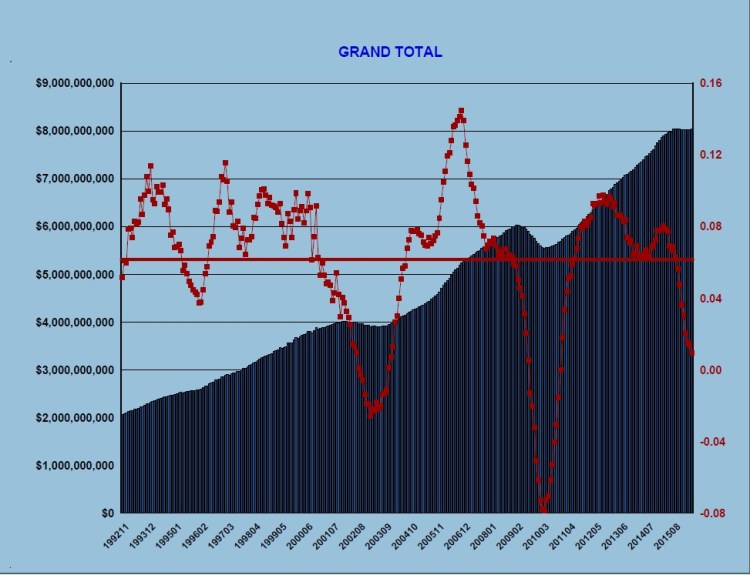
When you look at sales tax data that is seasonal, while also being tied to the economic cycles (two different factors), it is hard to make sense of it unless you view the data on a Rolling 12-Month basis (R12). That way you are always looking at a year’s worth of data. As you can see in the chart below, the trend has always been to the upside except temporarily during recessions. Texas is not immune from hurting badly when the consumers (70% of the economy) decide to slow down their spending, willingly or unwillingly. There is also a significant amount of business-to-business (B2B) sales and use taxes that make up this important revenue base.

Interestingly, you can use this data to identify the exact month that it was clear to the chart reader that we were entering into the Dot Com recession as well as the Great Recession. We can also see the exact month we had a confirmed bottom. The depth and length of the recessions and the rate of the recoveries are also critical to understand. Part of the understanding of recessions is simple: they happen! Economic cycles are treated as an injury that demands all kinds of rescue efforts and major surgery. Hence the Federal Reserve as well as the Political Machinery jump into action and sometimes do dumb things to prevent a natural economic cycle from playing out as it should.

As a whole, the local governments in Texas have collected $8,040,691,221 in sales taxes for the 12 months ending May 2016. However, the amount collected for the 12 months ending May 2015 totals $7,966,819,038! That’s almost perfectly flat. In fact, we are in our 15th month (it really went flat in March 2015) of almost zero growth.

Even more revealing than the absolute dollars is the R12% growth rate, the red lines. This is a more sensitive indicator and announces a slowing and changing of a trend quicker than can be seen just looking at the blue dollar bars. There are several stories in the red lines. Since 1992, the average has been 6.14%. That is a very robust number that takes into consideration 1) population and business growth; 2) inflation; and 3) a “wealth/debt” factor. We are a relatively wealthy state, but we have also been as foolish as the rest of the nation with consumers spending more than we have via HELOC loans, credit cards and any other kind of money we could borrow.

As a rule, as the historical data proves it, any time the R12% growth rate has even approached 9-10%, a recoil soon follows. The recoils can be ugly and as deep as the preceding rises were steep. This makes sense in that the third factor listed above cannot be sustained for a long period of time without bursting. If the consumer lived with their means, there would not be as many booms and busts. Also, full-employment has the unwanted and unsustainable pay increase pressures that breakdown at some point.

So, where are we? The most recent R12% peak was at 8.02% in March 2015. If you are studying the chart below carefully, you should be asking about the previous recent spike that declined to the average and then rose again before the current roller-coaster dip started. The answer is that we were recovering from the Great Recession just fine, peaked and then were pulling back when something happened. Gasoline prices plunged giving the consumer a few extra bucks to spend. Wal-Mart keeps metrics and can actually tell when tax laws change or some event gives or takes away $20 per week of people’s spending money.

But in Texas, cheap oil and gasoline is a double-edged sword. Hence, the downward pressure of the economy overwhelmed the state. An extra $20 per week for the majority can’t offset $30,000 to $100,000 jobs being lost by the thousands. The interconnectedness of our state started showing up in a big way 15 months ago.

The R12% growth rate peaked and has declined in 14 of the 15 past months. That statistic dropped to a brutal low of +0.93% in May 2016. It is possible that it could stay near-flat for months, but there would be every reason to believe we could go negative in the R12 and the R12% as early as next month.Yes, it is possible the sales tax levels could rise again. But I’ll let you make the call.

Today there were several stories in the news about some of the major bellwether retail companies suffering big declines. The job market has been softening for several months at both the national and state level. Fitch came out today with a report that housing prices in the North Texas were 15-20% too high. My goodness, we have learned absolutely zero from the causes of the Great Recession!

So if this is statewide information, how are individual regions, sub-regions and cities doing? Well, that’s why the 6-inch drowning comment was made in the introduction. While the state as a whole is grinding to a stop, some cities are getting killed. Mostly in the oil patches and where local economies heavily support the oil & gas industries.

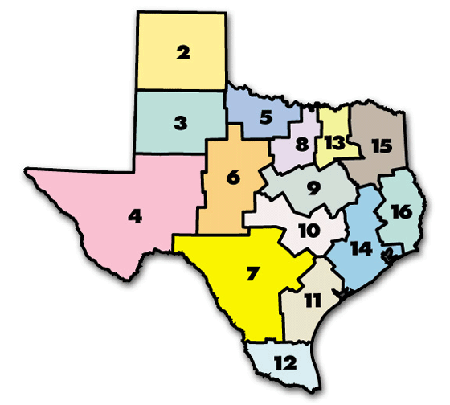
See the TML Regional Map following the chart. Most of the regions have been falling steeply for months and have been negative for at least a few months. As of May 2016, these are the following R12% results:

TML Region 02: -2.10%. (Amarillo area)
TML Region 03: +0.65%. (Lubbock area)
TML Region 04:-5.90%. (Midland-Odessa area)
TML Region 05: -1.58%. (Wichita Falls area)
TML Region 06: +3.88%. (Abilene area)
TML Region 07: +0.40%. (San Antonio area)
TML Region 08: +12.28%. (Fort Worth area)
TML Region 09: +4.53%. (Waco area)
TML Region 10: +7.24%. (Austin area)
TML Region 11: -2.97%. (Corpus Christi area)
TML Region 12: +4.62%. (Rio Grande Valley area)
TML Region 13: +17.96%. (Dallas area)
TML Region 14: +18.29%. (Houston area)
TML Region 15: +8.13%. (Tyler-Longview area)
TML Region 16: -1.39%. (Beaumont area)

Yes, North Texas and a few other regions of the state don’t know what everybody is talking about regarding slow growth. There have been some huge corporate moves in motion that don’t stop until  done. And remember that these TML Regions are quite large. Region 14 is doing well, but Houst0n itself is down -2.71%.

Here is what I do every month, and I invite you to dive in and see for yourself. First, look at the state as a whole. Then look at the 15 Regions. Appreciate the economic diversity across the state. Then look at any of the 1,600+ individual entities.

You can train your eyes fairly quickly to just look at the shapes and directions. Then with the roll of the wheel on your mouse, you can spend just a few seconds on each chart to size up the magnitude and direction of sales taxes. A dozen people looking at 50 charts are highly likely to arrive at the same conclusion regarding the overall direction and health of this key metric.

Appreciate the fact that sales taxes are just about as early of a warning system as we could have. The sales tax checks we received last Friday are for the actual business activity through March 31, 2016. Imagine that. Buy an iPhone on March 31, and the sales tax is in the local government’s bank account about 40 days later. That is dang near real time.

The collection of charts can be found at this link. It is a large file that may take a few minutes to download. I can download on my iphone and iPad, but it is best downloaded to your laptop or desktop. For those of us who like real data in addition to charts, a recap of the last 25 months can be found at this location.

Let me know if you have any questions. LFM

ScreenHunter_03 May. 12 16.40

TMLREGIONSmap

You can go to http://www.tml.org/regions to see the exact counties in each Region.

More Proof That McKinney ISD Lacks Transparency

Even if you are not inclined to dig into financial documents, please take a quick look at some key pages of the following documents:

McKinney ISD Financial Report for FY 2015. (93 pages).

Plano ISD Comprehensive Annual Financial Report (CAFR) for FY 2015. (163 pages).

Frisco ISD Comprehensive Annual Financial Report (CAFR) for FY 2015. (146 pages).

Allen ISD Comprehensive Annual Financial Report (CAFR) for FY 2015. (196 pages).

To make this easy, first look at the cover page to give you a clue to the differences in professionalism. MISD doesn’t really have one. In fact, they do not produce a comprehensive audited report. To have a CAFR, you are required to have much more managerial and analytical information to help the layperson understand the contents. MUCH MORE.

Now go toward the back of the reports. The last three will have an entire section of statistical data: several schedules showing ten years of comparative data. I am a finance person and I simply can’t see the story in the numbers without comparative data. I spent a considerable amount of time for my last two blogs just to get some select data compared for the last five years. The CAFRs contain ten years of very helpful information.

In all fairness, many of these districts have moved from the basic required audited financial reports to CAFRs only in recent years. Perhaps we will see a MISD CAFR someday. But based on the efforts I’ve seen in recent months to be transparent, I’m guessing they are in no hurry.

Here’s the interesting part, you don’t tell the bondholders that you are sorry you don’t have comparative data and that you promise that you will be more forthcoming and helpful in the future. No! You produce much comparative data and ratios for at least the most recent five years. If you issue bonds regularly, which they do, then you already have a ton of the ten-year historical data. The work to produce a CAFR is lessened.

But, there is a part that takes a little work the first time. It is the MD&A, which stands for Management Discussion & Analysis. A little work and a willingness to interpret complex financial documents.

In fact, MISD just refunded bonds. The Official Statement is dated a month ago. This document is filled with legal language. Skip those parts for now and just look at the tables. It is rich with good information.

MISD may have a Sheep-Board and even an abundance of Sheep-Citizens. What you won’t ever find is a Sheep-Bondholder and the cast of players watching out for the bondholder, such as the bond rating agencies. As a side note, you would be amazed at the additional information in a modern O/S compared to the 1970s and earlier. They were very thin on analytical information. But after being asked repeatedly for certain information, the Finance Advisors realized they need to assemble the information that was going to be requested time and again. Also regulatory agencies have beefed up requirements all in the name of protecting the bondholder.

However, the bondholder just wants to make sure they get their interest paid and their principal back.

As a taxpayer, I want to see more comparative numbers without having to mine the data from multiple sources. There are plenty of examples of how the more truly transparent ISDs provide their information. Or just look at what the City of McKinney has been doing for years! Can MISD spell C-O-O-K-B-O-O-K? LFM


McKinney ISD Physical Assets Are Depreciating $44,109 Every Single Day

Introduction.

The problem I have with the overuse of the word “transparency” is that it really only means “we put it on the Web, but it is your job to dig through 1,000s of pages and millions of numbers to make sense of it.”

For instance, MISD puts the last several years of budgets and audited financial statements on the Web site. However, I’ll bet there aren’t collectively 10 people in the district (citizens, board members or non-financial staff) who read the audited financial statements and footnotes. That’s why real transparency would include the finance people highlighting certain key numbers and ratios at board meetings. I touched on just a few metrics in my last blog.

It is enlightening to realize that New York City defaulted on some of their bonds in 1975. It is important not only due to that single event, but something more profound happened. The governmental accounting industry ended up getting a big part of the blame. It was from that event that accounting standards got strengthened and several regulatory bodies and accounting authorities got established. That always happens with any segment of our society does not do their own policing.

To this day four decades later, the rules continue to get written. The underlying message has been “our profession is about disclosure and it won’t be us to blame if something runs amok.” The evolution has been fascinating. Many big ticket items have forced the accounting and auditing profession to take a hard look at themselves. Three of the largest have been pensions, post-employment benefits and infrastructure accounting. There have also been three stages of evolution and solution:

  • Don’t recognize an expense at all.
  • Recognize the expense but put it in a footnote.
  • Move the expense to the income statement and deal with it on the balance sheet.

I believe it was in about 1987 that I started writing about how if certain expenses were recognized on the financial statements, many cities would find themselves in a deep deficit.

Tragically, the fatal flaw in all of these efforts to improve disclosure is that you can’t force people to read. You could force knowledgeable people to interpret and explain to the layperson – meaning the councils and boards. That flat ain’t happening anywhere.

What About Infrastructure?

If you dig into the MISD financial statements, you can find some very interesting numbers. First, there were $612,513,419 in Buildings & Improvements and Furniture & Equipment. Those are assets that depreciate. This does not count $40,071,014 in Land that is not a depreciable item. The fact that $612.5 million depreciate means they can also turn into liabilities at some point in time. Also, keep in mind that $612.5 million is the number for the original costs at the time built.

We can get an idea of how fast MISD thinks they will depreciate. Buildings are recorded as depreciating over 40 years;  Building Improvements over 20 years; Vehicles over 10 years; Office Equipment over 7 years; and Computer Equipment over 5 years. That sounds fairly reasonable.

The one flaw MISD and every other governmental entity makes is that they think of depreciation as if that happens uniformly each year in a straight-line fashion. In reality, most assets depreciate in a geometric or exponential fashion. That means it is easy to get lulled into a period in the early life of an asset when the signs of deterioration are not too visible, pushing the inevitable confrontation off for a number of years. However, when signs of age and deterioration do begin to show, governments have to move swiftly to keep up.

However, it can hardly be a surprise that an expense is coming. That is when we can’t afford to skip basic maintenance that will soon turn into repair. And repair that will quickly turn into rehabilitation. And at some point there will be a total replacement likely. Done properly, replacement might be well past 40 years.

On the maintenance to replacement continuum, there is a graduation from the operating budget to the capital budget to the debt-funded options. The extremes of the continuum are easy to figure out. It’s the middle pieces that are judgment calls. However, a well-managed system has people who know the expected life of signage, roofs, HVAC systems, carpet and every other component of a building.

Okay, So What’s Your Beef?

I’ve already discussed the trickery that I think is involved in the current bond program for a stadium with a ton of basic maintenance and equipment in it so every school could show benefitting at least a little from bond money. I’m just wondering why more operating money hasn’t been spent in recent years to deal with the smaller items to keep the debt levels lower for MISD. My last blog raises the question about why is MISD sitting on $25 million more in reserves than they need?

In Note 4D found on page 30 of the FY 2015 audited finance statements,  MISD shows that there was $16,099,959 recorded as depreciation last year. The numbers are broken down nicely by 10 different categories. I am quite certain those numbers are supported by an asset inventory that goes down to the individual water fountains in the halls and desks in the classroom.

My beef is this: if they know things are wearing out to the tune of $44,109 every day, why is MISD letting needs being deferred to roll up to a level that requires $170 million in debt to take care of basics? I know a chunk of the non-stadium money is for some building expansions, but you don’t sell bonds for things like defibrillators. Well, apparently MISD does.

The budgets provided online are the least informative set of budgetary documents I’ve seen in my career. I don’t see any meaningful financial policies that include replacement strategies and funding. No fund balance policies that I can find. Is the Sheep-Board asking for this kind of information? If not, why not? If they are getting this kind of management and policy making information, why isn’t it on the Web site? Even the documents on the MISD Web site are listed in a random order. If you were going to have links for the last 10 years of audited financial statements, wouldn’t you think they would be listed in chronological order?

I just don’t undestand why the stable of credentialed officials at MISD don’t get it. MISD may be governed by a Sheep-Board, but I’m sensing the Sheep-Citizens are getting a little restless. We want more information to understand how MISD business is run. LFM


McKinney ISD Is Hoarding Money Big Time

Introduction.

There is an old style kind of thinking in local government that can be overdone. It is good to have reserve funds. To have balances too low is not good management. However, to consider good management to be how big an entity can build their fund balances is where the flaw comes in. Huge balances and unmet needs are where the clashes come into play. I have rarely seen any local government that has all of their needs met due to some degree of strained resources. I would even go so far as to say that there is a healthy tension when funds are tight enough to cause an organization to set priorities and to be pressured to reallocate resources as a manner of normal business.

How Do You Determine Appropriate Fund Balance Levels?

There is a way to approach this question logically. There are many factors to consider. You look at your revenue and expenditure flows throughout the year. A worst case scenario is if your revenues are heavily weighted toward the end of the fiscal year and your expenditures weighted in the early part of the year. If revenue potential to not materialize is high, you need more reserves. If you are located in the coastal regions where hurricanes are a certainty at some level of frequency, then you need to be prepared with larger reserves. If you are in a hyper-growth situation, the demand for services precedes the tax monies coming in.

If the opposite of these items are true, then an entity could have less reserves and everything be just fine for regular annual operations.

There is also the argument of pleasing the bond holders and bond rating agencies. This argument is often misused or even abused. There are many factors taken into consideration when local governments receive a bond rating. Reserve levels are big concerns, but only one. The local economy, management controls and governing body policies are also very important. There is also a consideration as to how all of an entity’s metrics stack up with not only neighboring entities but also across the country based on size and rating grades.

However, a red flag should go up when you hear locals wanting to shut down a conversation or question by using the rating agency club. Club as in wooden bat, not a fraternity. Twice in the past I have heard the same phrase used by different councils in Texas: “we are so tired of bowing to the altar of the AAA bond rating when we have needs going unmet.”

Let’s Take a Stab at It

Is MISD experiencing rampant growth? I was shocked to learn that the student level for MISD is virtually the same as it was five years ago. That is as far back as I had time to look, but I will be adding an additional five years to my database when I  have time. From FY 2011 through the current FY 2016, the student load has been 24,422; 24,733; 24,382; 24,565; 24,715; and 24,915. That is relatively low and stable growth of about 0.40% on an average annual growth rate basis.

BTW, most of the ISDs will publish in their budget and or audited financial statements the total capacity and level of usage by every school in their district. I find it strange that MISD fails to disclose these critical metrics that anybody can understand. We know that the absorption rate in total is about a low of 99 students per year. What is that level by grade and school? What is the capacity and utilization rate by grade and school? Does the Sheep-Board ask these questions? And if they do and know, why wouldn’t they share that great information with us?

During this same time period, the expenditures per student have gone up 2.22% annually. When inflation is taken into consideration, this means to me that spending levels have been flat. We need a new stadium, they say, but not a dime more is being spent on academics on a per student, CPI adjusted basis? Something is wrong with that logic.

At the same time, the revenue base has gone up 3.00%. Due the shifting of state funds to local support with the controversial TRE election and adjustment, property taxes have actually gone up an average of 7.06% annually.

What About Reserve Levels?

This is where resources have shifted, and our attention is needed. The average growth rate of the Fund Balance has grown by 10.84% annually!

So, what is the level that is really needed? One of the ways almost every governmental entity shows this is by the number of days of operating expenditures in the Fund Balance. Some use a percentage, but all you have to do is multiply by 365 to get the statistic that is a little more relatble. For instance, if you knew that the FY 2011 budget projected a fund balance of $45,163,432, all you would know is that the number sure sounds big. However, if you knew that was about 25% of a year’s worth of spending, you get a better perspective. Multiply by 365 to get 90 days worth and now most of us could grasp the degree of reasonableness. Most policies would state a number like 60-90 days, meaning 16-25%.

So, 90 days was good enough for the FY 2011 budget, but how did that year end up regarding fund balances? The answer is 118.7 days. MISD typically budgets conservatively. Then the excesses that could go into the classroom go into Fund Balance. And it is all labeled as good management. If teachers have to go into their own pockets for classroom supplies they think is necessary, and fund balances get bloated, what’s wrong with this picture?

What  happened after FY 2011? Glad you asked. Hold on. The Fund Balances have mushroomed. MISD went from 118.7 days (FY 2011) to 135.46 days (FY 2012); 113.38 days (FY 2013 the year of the drawdown before the TRE); 120.53 days (FY 2014); 140.64 days (FY 2015) and is headed toward 134.96 days for FY 2016.

What is the dollar value of Fund Balance projected to be in FY 2016 at 134.96 days of operations? The answer is $74,924,235.

What would that Fund Balance be at the end of FY 2016 if it was at 90 days? The answer is $49,964,294 or $24,959,941 less than projected.

What could it be used for? For operations, but there would need to be controls. You wouldn’t spend $25 million on pay raises, because then you would need another $25+ million for each subsequent year. But there are easily $25 million in the bond program that are actually discretionary items like defibilltors that could have reduced the bond programs.

Could taxes be reduced? Sure could. The fact is that MISD did not need the full 17-cent tax rate in the TRE from two years ago. They were heavy by at least 3-4 cents. Maybe more. Let’s do some math. If MISD gave back to the taxpayers. $25 million over the next five years, how much would the tax rate go down? The answer is 4-cents, almost exactly. The 2016 preliminary tax base is $12.52 billion dollars. MISD is going to generate $17,019,482 more in FY 2017 than in FY 2016 at their $1.67 per $100 tax rate.

More Findings & Conclusion.

MISD is hoarding money. It’s nice to have a cushion, but MISD cannot justify one as large as they have. It could be reduced with little repercussions. They have been intellectually dishonest again, which continues to be confirmed when you dig into their numbers and listen to their yak-yak. Their Sheep-Board should know every piece of information mentioned in this blog. They are either complicit by not asking the questions or already knowing the answers and not establishing policy to cover needs.

The perception that the City of McKinney is growing in leaps and bounds does not translate to MISD since apparently much of the growth has been in the Frisco ISD.

Another trouble spot is that even though MISD has an 8.86% growth in the FY 2017 tax base in the making, 6.98% is coming from revaluations and only 2.14% from new construction. Those same numbers for the City of McKinney’s 10.34% growth are 6.97% revaluations and 3.51% new growth. Neither are very impressive on the new growth part. Revaluation means the same taxpayers paying more unless the tax rate is decreased.

The Certified Tax Roll for FY 2017 will not be finalized until July 25, 2016, so these numbers will change slightly. However, it appears the Appraisal District has adjusted the preliminary numbers to account for some losses through the appeals process.

The numbers I have not seen from MISD is the operating costs of the new stadium. It is a basic tenet in capital projects management that all CIP projects should reveal the operating costs the citizens are buying into. They already confirmed the tax rate equivalent of the “free” stadium to be 4-cents after I pushed for them to disclose it. What is the operating impact going to be? LFM


How Many People Can Fit On A Bus at McKinney ISD?

McKinney ISD approached the McKinney Zoning Board of Adjustment this week to request a reduction in the required parking spaces. Whoa! That was the single biggest argument for needing a huge multi-million dollar stadium. How did they come up with that rationale?

I was asleep at the wheel and didn’t notice this item on the ZBA agenda until I passed the bulletin board while in city hall yesterday. I assume it passed, but I could not confirm.

Later I read the agenda item and the explanation provided by MISD to the ZBA. I’m not a very smart person, but I do have to rely on my 7th grade math. Also, I am haunted by physics, the time and space stuff.

First the requirement for 3,000 spaces comes from a 12,000 stadium capacity adjusted for at 1:4 parking space requirement. That would mean in gross terms that a stadium filled with 12,000 people all driving in cars would have to have 4 people per vehicle. My logic tells me that there will be many cars with 4 people, but it sure won’t be the average.

But that’s gross. Mathematical gross, not ugly gross. That comes later.

MISD points out that the 42 bus parking spots are not taken into account. I agree. About taking buses into consideration.

Yet here is where it gets ugly gross. MISD wants to subtract 3,402 seats that will be filled by people coming on buses. In my mind, 42 buses seems like a lot, but I’ll take them at their word.

Now here comes the interesting arithmetic. MISD is assuming that each of the 42 buses will have 81 people on it!

Wow! That seems like a lot even if the seats were filled by elementary kids. But football players, band members and equipment as well as cheerleaders and drill team with all of their accoutrements?

How many people can fit into a phone booth? The number for a college fraternity initiation and for the normal use are way different.

Did the ZBA ask any questions or do any kind of logic test on this pitch? I don’t know yet. I wasn’t there, and that is all my fault. Mea culpa again. I hope the ZBA minutes will reflect the Q&A.

Here is what I would like to know. In this particular case, I don’t care squat about any other school districts. We’ve got real life data right here in McKinney.

  • What is the average number of people per parking space at the McKinney high school games right now?
  • What is a real close estimate of the number of people on MISD school buses when we go out of town to a football game? Do we take 21 buses at 81 people per bus? What is the most we have ever packed on to buses and what is the largest number of buses we have ever taken to a football game?
  • BTW, why is this being brought up six days before the election?
  • If the ZBA let this one get by without heavily questioning the data, what else do they approve without scrutiny?
  • Did the MISD Sheep-Board get briefed on this item, the timing and, if so, what comments did they have? Did any of them attend the ZBA meeting?
  • Did the McKinney City Council have any level of curiosity at all and ask any questions? Did any of them attend the ZBA meeting?
  • Also, where is any kind of staff recommendation like is usually found in Council and P&Z agenda packets? LFM


Will The Real Population Numbers Please Stand Up!

Dear Santa:

All I want for Christmas is a good clean set of official population estimates by year. From one official source. I know. I said by year, but it’s not that easy. Population numbers “by year” come in at least four flavors. As of April for Census purposes. As of July for intra-census years. By fiscal year that usually begins in October. And let’s not forgot the good old calendar year! Oh my. I just don’t care. Just make all of the “years” be consistent, please.

Is there a way, Santa, for it to be against the law for any agency to put out population estimates except for the one designated and blessed by you, and only you, to be the official estimator? Also, is there any way that you could require that central agency to let the city officials see the estimates first. Or better yet, have the city submit their estimates and the basis for their estimates to the official high order of population estimators that report only to you? If there is a difference, one party or the other has to agree to one number. If you have to be called in to be the sole arbiter, then so be it.

If the numbers that become the official estimate are averages, please do me a favor. Don’t footnote that it was averaged or that the median was used. I don’t want to know. The official number must be the official number. Yes, it must take into consideration that there is a vacancy rate assumed. Until satellite imagery tools are available to compute an exact vacancy rate, then make one up. But don’t footnote what it is. If it’s from your anointed pop estimating laboratory, then keep it secret. I don’t want to know. It won’t matter, because there can be only one number.

One last favor, Santa, would you please check over my compilation of all Texas cities since 1990 that can be found at this safe and secure Adobe site? I worked very hard to combine all of these files.

I have some other questions, but I don’t want to distract you until you have time:

  • Why was Uncertain, TX uncertain about the name they wanted to give themselves? That one is really bugging me.
  • Also, once a city has a name, is there any way you could make it illegal for another city to put North, East, South or West in front of it and them claim it as their own? That’s just not right and makes it so confusing. Make everybody be original.
  • I believe in the punishment fitting the crime, Santa, so would you permit a public flogging of the person who allowed a city to have the same name as another city in another part of the state? That’s just wrong! Putting the county name in parenthesis is not a fix. I want my pound of flesh on that goof.
  • Does the Town of DISH regret they changed their name for free TV service? Is that like a tattoo that you just have to live with for the rest of your life? Did they think that one through and realize it had to be all caps? Do they yell DISH when someone asked them where they are from?
  • Why did Tool, TX let that happen? Was that a positive term at some time in the past or was there a Mr. Tool who decided to gather all of the little Tools and start a town? I’ll bet it never gets misspelled like Balmorhea.
  • Could Cut and Shoot not decide, so they used used both suggestions? I’ll have to look that one up in the Texas Almanac. Perhaps there was a tentative name until they had their first council meeting that didn’t go so well.

It looks like things are going fairly well in Texas, Santa. There were 26,956,958 of us as of July 2014. Adding about 400,000 to 450,000 a year is pretty impressive! I estimated the numbers for 2015 and 2016 using the most recent five-year average. I could get 2015 from another source, but then I would have to worry about reconciling numbers, and I’m flat worn out from putting together what I have now sent you.

Oh, I forgot to mention something else, Santa. I know you are expecting us to provide services to an additional near-half-mil people every year at no additional cost. Sorry Santa, that ain’t gonna happen. However, most are coming with jobs and equity from their California homes, so we will be okay. Just in case you belong to that Tea Party, Santa, I couldn’t resist.

I am about to release this compilation of population numbers to my blog and CityBase readers, Santa. I’ll let you know when I get a landslide of mail telling me the numbers I am showing for them are wrong. Some will use colorful Texas adjectives about how wrong they are.  That’s why I put the source on the bottom of my report. I hope they don’t go probing around the Web to learn there are only about a dozen “official” state and federal agency population numbers available. Most are not sufficiently generous to include much history. The more history, the greater the potential for arguments. We don’t talk to each other here in Texas, Santa. It’s not in our DNA. We’re flexible. We are also optimistic. Our population would be 100 million by now if it weren’t for those dang Census folks.

There are also several agencies that provide future estimates, way past 2050. The problem with some of those official sources, even those used to forecast water demand, is that they apparently don’t have logic checks built into them. Some state agencies estimate cities to have a certain population by 2050. The only problem is that a few of those cities were at those population levels 10 years ago. Others are projected to be way larger than they are now even though they are nearing build-out and are landlocked. Guess we will see some 100 story housing units in Texas someday.

Anything you can do to help is greatly appreciated, Santa.

Your Faithful Analyst,

Lewis

Is Your Capital Project Management Headed Toward a Forensic Audit?

Capital Project Management

Do it right on the front end or suffer the forensic audit process on the back end
by Lewis F. McLain, Jr, Executive Director, GFOAT
Written July 2000; Tweaked April 2016

“EVERYTHING IS THE RESPONSIBILITY OF EACH ONE OF YOU UNLESS I SPECIFICALLY SAY IT IS NOT!”

It has been almost a quarter of a century since I heard those scathing words as David Leininger, Fiscal Services Director, had his finance director, internal auditor, purchasing agent and budget director (yours truly) sitting side-by-side on a long sofa in his office like school boys waiting to be called into the principal’s office to take our licks.

A $30 million sewer treatment plant project was in trouble. It was over schedule and over budget, but that was not the worse part. Change orders had been approved by a utilities director. Some had not been approved at all. Paperwork was not centralized. In fact, it was a mess. As the partial story was being told to us, we found ourselves pointing to someone else on the sofa or in the general direction of the engineering department downstairs or the utilities department across the street. Before we could get the flimsy words of excuse out of our mouths, we were blasted with the caustic words that are still scorched on my backside.

Since the project was 75% grant funded, an audit by the feds was about to occur and every one of the fiscal players in this large city of 100,000+ assumed someone else was in charge of the project and communicating the details to upper management and the council. I think that is when I first learned that “assume” means “making an ass out of you and me” when applied to big-ticket matters like capital projects.

Every file cabinet in the utilities department was confiscated and placed in an empty room in fiscal administration about the size of a double garage. Any other files or correspondence between a dozen players (EPA, the contractor, the city, etc.) held by anyone in the city was ordered to be brought to the room. A secretary then spent several weeks building a file system with information labeled, classified and put in chronological order. It then took several more weeks of review before our boss, David Leininger, figured out the story to the best of his ability, realizing there were a number of holes that still existed in the information. Some were never sufficiently answered.

Just about every problem that could be imagined had become part of the story of sloppiness in controls and absence of communication. Every player in every responsible department, in addition to the fiscal departments, failed to do their job. Even the most basic things were not covered. Copies of legal documents, signatures, briefings and authorizations were incomplete. All of the questions that had never been asked became obvious as they were being asked in the context of the aftermath of a train wreck that left a pile of administrative and fiscal rubble.

And the Beat Goes On

 What is even more amazing as I think back over this nightmare experience of 25 years ago is that I can read about at least a half-dozen similar stories making the headlines in today’s papers as I write this article. And it has been that way all these years. I addressed a city council the other night after they had heard a forensic audit report on a golf course project, one that paralleled my sewer story of long ago. It occurred to me that I actually know of very few cities that would lift up their capital project management control and fiscal reporting systems for peer scrutiny without some trepidation. Those cities with good capital project management systems, I said, are probably those cities that have experienced one or more project blunders of the magnitude this forensic auditor had just unveiled.

When did “Forensic” replace “Fraud?”

I’ve asked two forensic auditors just exactly when did the word “forensic” start being used as an adjective to describe an audit or auditor. Neither was certain. One jokingly said, “It means we audit dead bodies.” I turned to the dictionary, which broadened and deepened my understanding of the word, “forensic.” Merriam-Webster says this adjective comes from the Latin forensis or public – where we get our word forum. Forensic is not a new word. It dates back to 1659 and means: belonging to, used in, or suitable to courts of judicature or to public discussion and debate. It relates to or deals with the application of scientific knowledge to legal problems <forensic medicine> <forensic science> <forensic pathologist> <forensic experts>. And now we add <forensic audit>.

So it does not mean fraud necessarily but is the piecing together and story-telling of just exactly what happened. It is somewhere between a mystery novel and the product of bond attorneys when you sell bonds: what they call a “transcript of proceedings” that has every legal and procedural document and detail from the authorization to sell the bonds to the signatures on all of the final disclosures and the delivery of the money into the proper accounts.

The product of an in-depth forensic audit is the documentation of the story of how budgeting and capital project management goes wrong. Even if there is no malfeasance found, it is the report card on the basics of the very business that public finance officials are called to participate in if not lead! It may support the probability of recovering money from someone who owes the city some of the money lost, wasted, or stolen.

The remainder of this article will be a review of the role finance officials should play in capital project management. It will cover some of the procedures and reports that should be the products of the finance officials. The term finance officials includes in some form, depending on the city size and organizational structure: the finance director, the capital project accountant or budget analyst, the purchasing agent and the internal auditor. There are several public works type players, of course, as well as the legal department that should be part of the Capital Project Management Team reporting to city management.

General Ledger and Project Management Accounting Incongruities

One of the first things a finance official learns is that capital project budgeting and accounting do not fit into the same accounting system and cycle as you might otherwise desire to mold it. Some things are similar. Both capital project funds and operating funds can include moneys from other sources such as grants or impact fees that supplement the primary source of revenues.

However, the primary source of funds for capital projects is usually long-term debt or bond funds. Bond funds are often authorized by the voters. There is usually a need to account for the “bonding authorization” from the receipt of the proceeds to the complete spending on the intended purpose. Impact Fees have to be accounted for by type (water, sewer, roadway) and even by geographic area in some cases. Capital projects do not fit well into the annualized segmentation of spending as the operating funds do.

Most capital projects span a period of two or more years. Many capital projects are phased for contract award and scheduling purposes. Almost all capital projects have major cost components, all of which need to have some level of budget and accounting control by component: Right-of-way acquisition, engineering and design, utility relocation, site preparation, construction and other key components that will be enumerated later.

So there needs to be separate funds established and the account coding structure that allows you to separate water projects from road projects. The projects themselves need to have the ability to provide a breakdown in the major project cost components. In addition, the projects may need to capture city labor and material costs as well as direct payments made to contractors and others.

Reports

There should be several reports:

Capital Budget Reports: The capital budgeting process itself should be compiled with sufficient detail to provide each member of the Capital Project Management Team, as well as city management office and city council, the ability to ask questions. The capital improvement budget should have an individual form for each project. The budget form should include as a minimum:

  • The title of the project and account number assignments.
  •  The name of project manager or city department and the name of key players such as architects, engineers and contractors.
  •  A description of the project and a small locator map to orient the reader as to the part of town the facility is to be built or the starting and ending point of roads or utility lines.
  •  A cost breakdown by key component:
    •  Administration/Debt Issuance.
    •  Land acquisition (including ROW, legal costs of condemnation and outright land purchases).
    •  Architectural/Engineering Fees.
    •  Utility relocation.
    •  Site Preparation and drainage improvements.
    •  Construction costs.
    •  Lighting.
    •  Landscaping/Irrigation.
    •  Equipment, furnishings, signage.
    •  Other.
  •  The source of funds.
    •  Current funds.
    •  Bond funds.
    •  Impact Fees.
    •  Grants.
    •  Other.
  •  The sources and uses of funds broken down by year for the next several years, usually at least five years.
  •  The general status of the project, including chronological and authorization information.
  •  Contract award dates.
  •  Expected completion dates.
  •  Reason and expected remedies for any delays or complications.
  •  Affirmation of any future bond issue needs.
  •  Affirmation that project is progressing as planned if that is the case.
  •  The capital improvement budget details should be summarized in front of the compiled document:
    • By project types (i.e. water, roadways).
    • By funding sources (i.e. bonds, grants).
    • By fiscal year.

Capital Project Accounting Reports. It is equally imperative that the city provide good monthly accounting reports to show the sources of funds and the spending of money:

  • At the project cost component level.
  • This detailed information should be summarized at the project level as well as the fund level.
  • There should also be a good comparative horizontal time and status segregation of information on the capital accounting reports.
  • The original bond authorization by the voters, if applicable.
  • The original budget approved by the council appropriating the funds to individual capital project funds.
  • The official revised budget that has been approved by the city council.
  • The projected budget that is going to be needed to finish the project, subject to council approval.
  • The expenditures for the monthly period.
  • The life-to-date expenditures.
  • The remaining budget authorization (the difference between the council approved revised budget and the life-to-date expenditures).
  • The remaining funds needed to be authorized to finish the project (the difference between the projected final budget and the council approved revised budget).
  • A reference column to notes and comments that can be located at the back of the accounting report.

So, What Are We To Do With The Reports?

The answer is to use them as the centerpieces of timely project review meetings and improved communication. The lack of good and timely capital project management reports is a universal weakness in cities across Texas. The larger shortcoming, however, is in something even more basic: communication. There is often minimal dialogue between the finance department and public works or parks department. The legal department is brought in only when there is a problem. The planning department is often not a player at all except in big-picture capital planning. Moreover, the busyness of the city management office hampers systematic reviews. Rather the involvement is in the form of injections into the capital project management process that are event driven, such as a roadway project that has suddenly become a hot topic with the council.

Wait a minute! We must pause to really look at this aspect of capital project management. The city has millions of dollars tied up in dozens or hundreds of projects. Each project has multiple steps, most with a medium to high degree of technical or political complexity. The duration of a project can be from months to years. In addition, the Capital Project Management Team is perhaps only an ad hoc gathering at best and a phantom committee at its worst. The financial players are off worrying over monitoring a few thousand dollars of travel accounts and office supplies while millions of dollars in capital projects are left unchecked. What’s wrong with this picture?

The answer is that everything is wrong, and it shows up in the forensic audit. In the golf course example mentioned earlier, the project manager was the city manager! The public works director wasn’t involved and neither was the parks director or a golf course manager. The finance director paid whatever the city manager sent him to pay without question. Nobody asked questions and nobody knew where the project stood financially. One of the saddest pieces of evidence I have ever seen was the handwritten notes of a city manager trying to figure out the basic arithmetic of determining how many dollars had been spent and how many were still available for change orders.

Statesmanship skills are not very helpful once a forensic auditor has held up the mirror to the fundamental process of control and reporting. As one of our senators said in another matter, “If you can put a pretty face on this deal, then you ought to be a mortician instead of a politician!”

Systematic and Timely Review of Project Status.

The finance official should be highly involved in capital project management. The involvement should extend well beyond just selling the bonds to fund projects and writing the checks to pay for the projects. Finance people can blend their natural levels of healthy skepticism with much of the same talents of logic acquired from their training and, most importantly, their innate drive to maintain the integrity of numbers to be good team players on the Capital Project Management Team. They can even lead the team in some cases!

The following is a list of suggestions and comments that can help the Capital Project Management Team be more effective:

  • The city manager needs to deputize the Capital Project Management Team with the responsibility to be accountable to each other and to be given the weight of team responsibility. In other words, “Everything is the responsibility of each one of you unless I specifically say it is not!” There is certainly a practical limit or differentiation between public works and the finance departments, but the point is to let everybody know that you are authorized and expected to ask questions of each other and to report to the city manager those items in need of his or her attention.
  • Capital project review meetings need to be held regularly. These should at least be quarterly in terms of a big-picture overview, monthly for specific project progress reports, and perhaps even weekly in the case of projects in trouble or when indications are that they are about to be in trouble.
  • Each project needs to be assigned to someone in the organization, and that person need to be in on meetings involving their projects.
  • Don’t be afraid to invite the city attorney into the process. Weigh the cost of problem preventive as opposed to the time and effort to rectify a project in trouble.
  • There needs to be an agenda for these meetings to include either a project-by-project review or a categorization:
  • Those in the planning stage.
    • Under design.
    • Right-of-way/Land acquisitions.
    • Utility relocation.
  • Those under construction.
  • Those in final stages of completion.
  • Those completed and ready for finalization.
  • Those projects in the planning stage need to be reviewed for completeness and accuracy in terms of timing and financial analysis. It is all too common for there to be a complete ball field built with the bleachers left out. Or a parking lot to be built without lights. Or landscaping and irrigation to be left out. The bad part is when cities have ignored or underestimated the cost of meeting their own landscaping ordinances. Ouch! The finance officer should be a part of reviewing bids and, in some cases, comparing to other cities’ recent experience. Why would you be surprised if library bids were 25% over expectations (or bond election authorization) if the bids you received are in line with two comparable libraries in the region that have been built or awarded in the last six months?
  • Projects in the design stage can provide the red flags of budget problems that will be fully revealed within a few months. If the city’s plans were to build a sewer line along a route that required hundreds of trees to be cut down, and now you realize that’s not going to happen due to environmental protests and city tree ordinance violations, what is going to happen to the project? Another longer route or a much more expensive process of tunneling under trees is likely to raise the ultimate budget significantly. You don’t need to wait for the design to be finished or surely not have to wait for the bids to come in to know that the original capital budget for a project is woefully deficient. You may not be solely responsible for asking every question, but you can contribute to the team appointed to ask those kinds of questions.
  • Many projects are put on hold while land acquisition and right-of-way issues are involved. Without trying to always be throwing cold water on capital project management, someone needs to be asking about the progress of those decisions that virtually stop a project dead in its tracks until resolved. It is not unusual for bond money to be provided for a construction project that doesn’t occur for up to three or more years after original expectations. This is often due to some fundamental initial step, such as right-of-way acquisition being impossible to accomplish within the original unrealistic time frame. Remember, a forensic audit is taking a problematic result and working the problem backwards. A golf course opening isn’t going to happen until there is grass, so when you miss the intended grass maturation season, it’s not too hard to figure out that some of the big operating costs are going to begin, but the projected revenue for the delayed period is zilch.
  • The construction phase is when the big bucks start going out the door and many of the problems start to surface. Bad designs or missed points or a lack of firm decisions or bad contractors translate into delays, change orders, confrontations, finger pointing and lawsuits. Our “low-bid” environment exacerbates the problem. I was once told that ship builders intentionally bid projects below their costs, knowing that the profit will be in the numerous change orders when the owners finally start thinking through amenities and structural changes that never got addressed in the planning stages. Everyone who has ever built a house from the blueprint stage to the move-in date without experiencing a hitch of some kind, often very costly, could meet in a phone booth! Why would we think that a multi-million dollar, multiyear project could be built from start to finish without an enormous amount of oversight and end up within schedule and within budget?
  • The completion stage is not usually easy and requires that everyone on the Capital Project Management Team double their efforts to reach closure without letting something fall through the cracks. Checklists are helpful here. Before you release retainage money that has been withheld, do you have all of the as-built plans? Are all of the performance bonds in place (actually a first step that should have been accomplished long ago)? Do you have operating manuals for building equipment? Has a complete punch-list been rectified? Has all of the clean-up work been accomplished? Is all signage in place? Has the City formally taken action by the council to accept the project?

Documentation and Authorizations

The forensic audit highlights what happens when there is inadequate documentation. A big part of the documentation is in the previously mentioned budget and accounting reports or items related to the preparation of the reports. But there should be a very clear paper trail among the public works, city secretary, city attorney and finance departments that includes:

  • The bond authorization documents, including the literature that was used to promote the bond election that contains any listing of the specific projects that are being promised or suggested to be build and their associated costs.
  • Bid documents that include a great deal of specificity about how the bid estimate was compiled, such as the square yards of concrete, number of light standards, acres of landscaping, area of irrigation coverage, number of manholes, length and size of pipe and depth of pipe to be buried – and all of the unit costs.
  • All contracts fully executed, many of which will include detail budget accounting information, such as an aggregation of the bid quantities just mentioned. Also, the contracts will include the number of allotted days, rain day allowances, penalties for contractor delays and other important information to turn to when something goes wrong.
  • Change orders, with all of the supporting information to explain the purpose.
  • Correspondence between architects, engineers, contractors and the city that include references to contract interpretation, notifications of problems or events that are occurring that are signals of a conflict carrying a potential negative fiscal impact. Each member of the Capital Project Management Team should be duty-bound to keep each other advised and to communicate clearly and timely to the city management office well before little problems turn into big project overruns.
  • It is very important to have proper signatures and council action taken on all matters of bid awards, contract change order authorizations and budget amendments. Further, there should be a trail of briefing memos and/or council minutes that reflect the council’s knowledge and understanding of events as well as directives for staff actions.

Closing Thoughts.

Almost every capital project that turns into a “train wreck” can be shown to be an avoidable situation. The forensic audits are teaching lessons on how simple it sounds when the breakdowns are often tied to issues that should never happen. Here are a few thoughts.

  • You must have public works, finance (budget, accounting, purchasing), risk management, legal and other personnel associated with capital projects in the city who are willing to communicate with one another. They don’t have to be the best of friends, but there should be some healthy respect for what the others can contribute and what they all need individually and collectively to keep themselves and the city out of trouble. It is my estimation that communication does not exist in many cases, leading to symptoms and results that are not much different than those found in a dysfunctional family. If there is a potential team player that, in fact, shows an unwillingness to communicate, cooperate and participate, then I suggest there may need to be some staff changes in the city.
  • There needs to be sufficient staffing. In addition to being a team player, there should be a great emphasis placed on sufficient staffing. Why would we initiate a $10 million or $50 million capital improvement plan and not think there is going to be some added management and accounting requirements and costs involved? This issue particularly grieves me when a forensic audit eliminates malfeasance as a factor and then points to a seemingly noble excuse: a desire to save the city money by having the work done by a fatigued staff that is already too thin to manage all but the normal day-to-day fiscal operations, not to mention a sizable capital program! Why would a city manager be acting in the role of a project manager for a golf course that ended up with almost a $3 million overrun or 50% greater than the original estimates?
  • There needs to be good project accounting software in place to assist with controls and reports. Capital project management and reporting cannot simply be integrated into many of the general ledger systems. A great deal can be done with some creative account numbering if there is the flexibility to custom design the reports produced from the accounting system. If that is not the case, the city may be well served to look at modules within their own software vendor packages that are geared toward the characteristics of capital project management.

Conclusion.

Capital project management involves controlling and accounting for huge amounts of public moneys. There should be several key players on the Capital Project Management Team, including the financial officers. In most cases, there should be a dedicated capital project accountant or budget analyst who is freed from operating budget details to focus on the capital project side of the house. That person needs to be in constant communication with public works personnel and others in the city handling some aspect of capital project management. There should be regular reports and meetings with early warning signs of project problems that reach the city management office and the city council in a timely manner.

The finance department can not only be a team player but may actually be able to provide some needed leadership, depending on the size of the city and the organization and communication skill level of other participants on the Capital Project Management Team. It is very clear that the finance officials cannot stick their heads in the sand by saying that capital project management is the responsibility of someone else in the organization. If that were the case, I would advise you to get written authorization freeing you from the fiduciary duties that are the underpinnings of basic financial management and control. I can’t imagine you getting that authorization nor can I imagine you wanting to work for an organization granting you that exemption. It certainly becomes the centerpiece of analysis when the forensic audit is conducted. The better advice is to be properly staffed and to insist that you be involved – perhaps even to take the lead in good capital project management.

Here is a test. The City Manager calls in key department heads, including finance, public works, parks and every department involved in a capital project of almost any size. The City Manager has only these questions:

  • What is the status for all of the projects we know we are having troubles with
  • What are the projects heading for trouble you haven’t told me about yet?
  • What are the projects headed for trouble even you don’t know about right now but should? LFM


Generations Wanting Choices

Choices.

Most of us don’t like take it or leave it situations. It was recognized a few decades ago that people at that time and those in the future wanted more options. We had already advanced in a big way from the days when Henry Ford said you can have any color car you want – as long as it’s black. Sears & Roebuck kept it simple. They offered most items with three options: good, better and best. But that wasn’t sufficient for a more modern generation. The word “menu” got transferred from restaurants to just about everything we buy. Choices, choices, choices! Eventually, the multiplicity of choices got back to the restaurant. That is why people stare at a menu about as long as they take to eat when the food arrives. And then, like my wife Linda does, she wants item 62 but with the sauce from item 21 and the pasta from item 88. But bring the sauce on the side and leave off the onions!

This internal urge to have options in local government got pushed hard in the 1970s. It was called Zero Base Budgeting (ZBB). I won’t use this time to give a full technical explanation of ZBB, and even thought about not mentioning the buzz word at this point. ZBB got crushed by its own weight since it was first tried as a manual process producing reams of paper. Many cities say they want it, but they really don’t. Some cities say they have it, and they really don’t. Others say they don’t want anything to do with ZBB, but they actually have remnants in their current budget process and probably don’t realize it. In fact, I would say there are pieces of ZBB in just about every local government’s process in both form and substance.

Forget What I Just Said.

Like in the movie, Men in Black, the flash from the gizmo that erases what you just saw or heard has just blinded you. You aren’t biased one way or another about that budgeting concept that was boiled down to three seductive letters. You don’t know anything about it. About what, you say? Good, a clean slate.

Let’s Evolve.

What you do want is to be relieved of the frustration of a dilemma. “Take it or leave it” brings out your fangs and claws. Your organization has advanced to the point of having a budget broken down into funds and departments. That was just to fulfill a Charter requirement. You want more choices. If you could visualize the budget presentation you want, it would likely take some coaching to be able to articulate the tool and process you want. Let me help with some instruction and vernacular.

You would want the departments to be broken down into functions or divisions that reflect the way things are organized. If you walked into the police station, the physical layout would be obvious in most cases. In fact, look at the signage in the building. You would see Administration, Records, Dispatch, Patrol, Investigations, Training, Crime Prevention, Property Room, Jail and more. This is easier to do with a very large organization. What are the resources needed for each one of those divisions?

There are some things that go across all of those divisions. You learn from asking questions that there is a Tuition Reimbursement Program embedded in most of those divisions. But you then realize when aggregated the dollar amount is quite large. So you would really like to be able to see some spending broken down by … gee how can we describe it? Programs! Program that allow you to make separate decisions without them being bundled inside multiple divisions. Hey, you just nailed it. Decision Units. Using this example, some cities have moved Tuition Reimbursement Programs into the HR Department or to a Non-Departmental account so that the dollars can be controlled and the policies administered evenly – and the results followed up consistently by an “independent party.”

Therefore, a Decision Unit can be a division within a department or a program within a division or … it can be anything meaningfully grouped so that it can be studied and decided upon separately.

Okay, Now What?

If a budget could be broken down such that you have nicely identifiable Decision Units, what else would you need? This is where it can be complicated. If you could understand each Decision Unit in the context of Sears & Roebuck’s, “Good, Better and Best”, that information would be of tremendous help to policy makers. If fact, a true examination would include levels in the other direction: “Adequate, Not Good, Not Needed.”

Oh my. Lewis, you just stopped preaching and have gone to meddling. Yes, and I have intentionally multiplied the complexity by introducing Levels of Service. However, it is a fact that every single Decision Unit could be stratified into levels:

Best.
Better.
Good.
Adequate.
Not Good.
Not Needed.

The operative words are “could be stratified.” These could be called Decision Packages.

Pause.

Let’s do a reality check. If the General Fund had 30 Departments and each Department averaged 3 Divisions and each Division had 4 Decision Units and each Decision Unit had 6 Decision Packages, I may have just created a monster. And I have. Unless done smartly and with a maximum use of automation. But there is more. Let me get to the end.

The Managerial Questions.

The brilliance and reward for breaking down a budget into Decision Packages is to then apply the essence of managerial analysis. The roots are in Peter Drucker’s 1954 book, Principles of Management. The questions all get to Drucker’s fundamental question asked in every one of his subsequent books: “What is our business, and what should it be?”

For each Decision Package, visualize being able to grasp this information:

What is the purpose of us performing this service?
What are the benefits to be gained from funding this service?
What are the consequences of us not funding this service at this level?
What are some alternative ways we can provide this service?
Who else is providing some form of service?
How many people are being served for these dollars?
What are the key, measurable metrics to understand effectiveness?
What are some key, measurable metrics and ratios to understand efficiency?
What are the direct fees and revenues generated from this service, if any?

How Is A Final Decision Reached?

This is another brilliant feature of budgeting that can work in a collaborative fashion. In its purest form, the police department would rank each Decision Package with the involvement of all division commanders. Then the police executive staff would provide their ranking to the police chief.

The police department and every other department head could take the same input and provide their collective ranking to present to the City Manager. Yes, every department can learn what the other departments do, understand their priorities and appreciate the entirety of city services. What a novel idea! After tweaking, the City Manager would then present the budget to the City Council for their ranking.

But wait, appreciate this. It is very likely that the City as a whole would have hundreds of Decision Packages. They key is to focus on perhaps the 50 DPs that barely didn’t get funded and the 50 DPs that barely got funded. There can be drastic deep reaches at any point. By that I mean that the City Manager or Council could elect to remove a DP that every level of management thought was mandatory or indisputable essential. But that is not likely to happen often. There are ways in the ranking process to prevent a police helicopter from being ranked number 1 over patrol or jail operations.

The essence of policy making and the meshing of policies and management decisions is by close examination of those items that hug the funding line. The discussion of the trade offs of moving something that wasn’t initially funded to replace a DP that was initially funded is the centerpiece of budget balancing.

The council could also see very clearly the recommendations (and consequences) for cuts if they were prone to cut the tax rate. And the same goes for moving the tax rate up to fund what might be considered a high priority by the Council.

Enough?

Okay, this is ZBB in its purest form. It can work and it does work. It is, however, WORK. It is a participative budgeting process. It is open-heart surgery. It could be applied across the entire city in one budget season, but that might be overkill for staff and the Council. It could be done selectively with several departments examined one year and another set the following year.

Here’s the deal. It IS being done at some level by every good management team irrespective of the forms and instructions. ZBB is simply first slicing an organization such that the deliberate and profound management questions can be asked and answered in a meaningful way. It is an analytical tool. But it would all be academic if not used as a communication tool. And communication leads to understanding and, hopefully, better decisions. LFM.