A collaboration between Lewis McLain & AI (more from the three visits Linda & I had to the Louvre with high school students from Trinity Christian Academy).
Antonio Canova and the Awakening of the Soul
Introduction
Among the marble treasures of the Louvre Museum stands one of the most moving sculptures of all time — Psyche Revived by Cupid’s Kiss, carved by the Italian master Antonio Canova between 1787 and 1793. It depicts the mythological moment when the god Cupid (Eros) revives his beloved Psyche with a kiss, restoring her from deathlike sleep to life and love.
At once tender, idealized, and technically perfect, this masterpiece captures not only the beauty of myth but also the intellectual spirit of the Neoclassical age. For any student observer, it represents the perfect synthesis of form, feeling, and philosophy — a lesson in how art can make marble breathe.
1. The Artist and His Era
Antonio Canova (1757–1822) was born in Possagno, Italy, into a family of stonemasons. Trained in Venice and working in Rome, he became the undisputed master of the Neoclassical style, the artistic movement that sought to revive the order, harmony, and moral clarity of ancient Greece and Rome.
Canova’s art emerged during the Age of Enlightenment, a time when reason, science, and rediscovered antiquity guided intellectual life. Artists looked to classical sculpture for purity of line and noble simplicity. Against the emotional extravagance of the Baroque, Canova’s figures embodied balance, restraint, and serenity.
His goal, he once said, was to give marble the “appearance of living flesh” — and through meticulous polishing and proportion, he succeeded. His works, such as Perseus with the Head of Medusa and The Three Graces, stand as paragons of refinement and calm emotional depth.
2. The Myth of Cupid and Psyche
The story comes from Apuleius’s The Golden Ass (2nd century A.D.), one of the most enduring love myths of classical antiquity.
Psyche, a mortal woman of exceptional beauty, arouses the jealousy of Venus (Aphrodite), who orders her son Cupid to make Psyche fall in love with a monster.
Instead, Cupid himself falls in love with Psyche, visiting her each night unseen. When Psyche disobeys his order never to look at him, he vanishes.
After many trials set by Venus, Psyche opens a box meant to contain beauty but instead releases a deadly sleep upon herself.
Cupid finds her lifeless body, lifts her in his arms, and awakens her with a kiss.
In the end, the gods grant Psyche immortality so she may be eternally united with Cupid.
The myth is a timeless allegory of the soul’s (psyche) awakening to divine love and eternal life — a theme that resonated deeply with both ancient philosophy and Christian symbolism.
3. Commission and Creation
Canova received the commission around 1787 from Colonel John Campbell, a British nobleman visiting Rome. The sculptor completed the work by 1793, using Carrara marble, prized for its pure white translucence.
He later produced a second version (1796), now in the Hermitage Museum, but the first — the Louvre version — remains the most celebrated. It was acquired by Joachim Murat, Napoleon’s brother-in-law, and entered the Louvre’s collection in 1824.
Canova personally oversaw every stage of its creation, using fine abrasives and oil to achieve an extraordinary surface polish. This allowed light to glide across the marble as if over living skin, enhancing the illusion of breath and movement.
4. Composition and Form
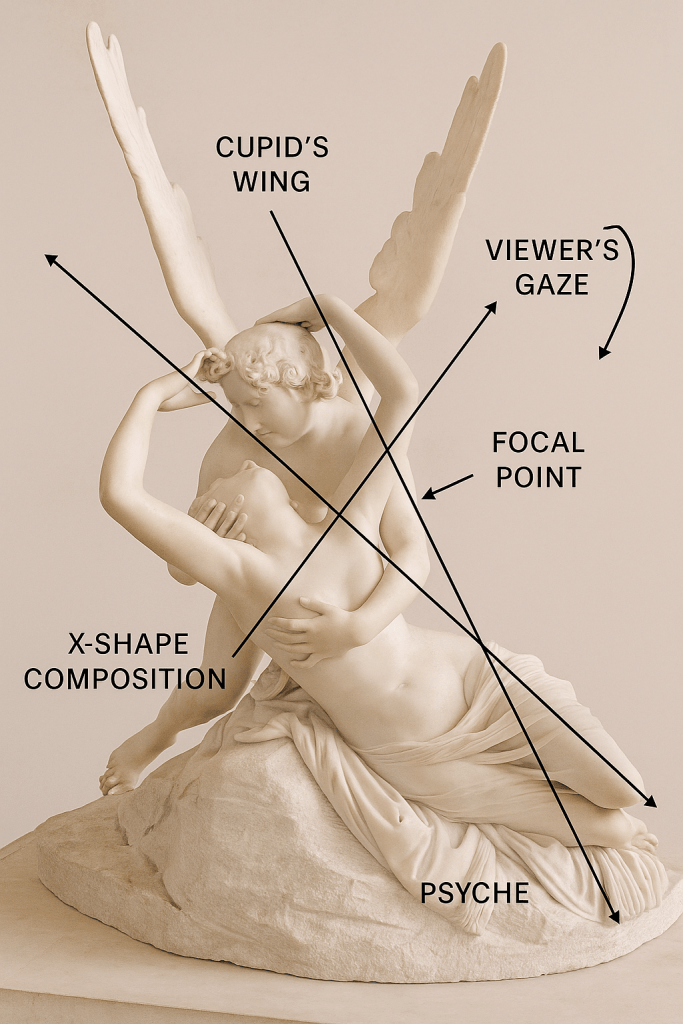
The sculpture captures the precise instant of awakening: Cupid bends over Psyche, supporting her head with one hand while their lips draw near. Psyche’s arms reach upward to encircle him, creating a perfect X-shaped composition — a dynamic cross of limbs and wings that binds the figures together.
Key features to observe:
Cupid’s wings rise upward like an angelic halo, framing the scene and drawing the eye toward the couple’s faces.
Psyche’s body arches in a graceful curve, suggesting both fragility and renewal.
Their hands and faces form the emotional focal point — the intersection of life, love, and divine energy.
The base of the sculpture, rough and unpolished, contrasts with the smooth flesh above, symbolizing the transition from earthly death to heavenly awakening.
In the educational diagram below, the X-shape composition and the diagonal lines of sight show how Canova directs the viewer’s gaze from Cupid’s wings to Psyche’s face and then downward through the drapery — a continuous flow of motion through stillness.
5. Symbolism and Interpretation
Canova’s sculpture is far more than an illustration of a myth — it is a philosophical meditation on love and the soul.
The moment of Psyche’s awakening becomes a symbol of spiritual rebirth. The butterfly, often associated with Psyche in classical art, represents transformation — the soul leaving its cocoon of mortality. Cupid, as divine love, breathes eternal life into that soul.
The composition’s diagonal tension embodies both physical energy and emotional ascent: the human yearning for the divine, the eternal dance between matter and spirit.
In Neoclassical thought, beauty was a moral force — the visible expression of virtue and truth. Thus, Canova’s restrained tenderness contrasts with the passionate turmoil of Baroque art. Love here is not sensual conquest but spiritual restoration.
6. Reception and Legacy
When first exhibited in Rome, Psyche Revived by Cupid’s Kiss was immediately recognized as a masterpiece. Critics called it “the triumph of grace over passion.” Visitors were captivated by its lifelike delicacy and emotional power conveyed without exaggeration.
It became a defining work of Neoclassicism, illustrating how calm form could evoke profound feeling. The sculpture influenced generations of artists — including Bertel Thorvaldsen, Jean-Baptiste Carpeaux, and later Romantic painters who explored the harmony of body and spirit.
Even into the 19th century, it remained a reference point for art academies, where students studied its anatomy, symmetry, and emotion as an ideal of beauty.
7. Observing the Sculpture in the Louvre
The sculpture is displayed in the Denon Wing, Room 403, near Michelangelo’s Dying Slave and Rebellious Slave. The museum’s lighting enhances the subtle contrast between shadow and shine that Canova intended.
For a student observer:
Move around the sculpture; every angle reveals a new emotional dialogue.
Notice how light travels across the marble — the figures almost seem to breathe.
Observe how Cupid’s downward gaze meets Psyche’s upward movement, forming an eternal loop of love and revival.
Pay attention to the texture contrast between the finely polished skin and the rough rock — symbolizing transformation from mortality to divinity.
This active observation turns the experience from passive viewing into an encounter with Canova’s philosophy of life and art.
8. Enduring Meaning for Students
For modern students, Psyche Revived by Cupid’s Kiss offers three timeless lessons:
Technical mastery serves emotional truth. Canova’s polish and proportion allow the emotion to flow through form rather than overwhelm it.
Balance creates beauty. The sculpture’s X-shaped harmony shows how composition guides feeling.
Love awakens the soul. Beyond its mythic story, it reminds us that true beauty unites body and spirit, art and life.
In this sense, Canova’s work is not just about marble or myth — it is about humanity’s eternal desire for renewal, compassion, and transcendence.
Conclusion
In Psyche Revived by Cupid’s Kiss, Antonio Canova transformed stone into spirit. He captured the silent instant where death yields to love, and stillness becomes motion. His art bridges mythology and philosophy, sensuality and serenity, mortal and divine.
For all who stand before it — whether in wonder, study, or reverence — the message remains the same: Love revives, beauty endures, and art can awaken the sleeping soul.
“The beauty of the body is the beauty of the soul made visible.” — Antonio Canova
Suggested by Dan Johnson, Written by Lewis McLain & AI
Based on the book by Paul Woodruff (Oxford University Press, 2001; Revised Edition 2022)
Author Introduction: Paul B. Woodruff (1943–2023)
Paul Woodruff was a philosopher, classicist, educator, soldier, and moral thinker whose half-century career at the University of Texas at Austin left an enduring legacy of both wisdom and warmth. Born in New Jersey in 1943, he graduated from Princeton University in Classics in 1965, earned a B.A. in Literae Humaniores at Oxford University as a Marshall Scholar, and then served as a U.S. Army captain in Vietnam (1969–1971). After the war, he returned to Princeton for his Ph.D. in Philosophy under Gregory Vlastos, one of the century’s greatest interpreters of Socrates.
When Woodruff joined the faculty of UT Austin in 1973, he brought with him not only academic brilliance but a passion for conversation. As Chair of Philosophy, Director of the Plan II Honors Program, and later Dean of Undergraduate Studies, he embodied his own teaching: that truth begins with humility. In the Joynes Reading Room, he designed and personally crafted the oval seminar table—ensuring that no student would ever sit at the “head.”
His books—including Reverence: Renewing a Forgotten Virtue (2001), First Democracy (2005), The Necessity of Theater (2008), and The Ajax Dilemma (2011)—blend classical insight with moral urgency. In Reverence, he observed a spiritual crisis spreading through modern institutions: the loss of humility and awe. His motivation was not religious nostalgia but civic concern—he feared that a culture which forgets reverence will also forget restraint, gratitude, and love.
Woodruff passed away in 2023, but his life’s work still asks us a timeless question: What do we revere—and what happens to us when we stop?
Chapter-by-Chapter Overview
1. Introducing Reverence
Woodruff opens with a question as ancient as philosophy itself: how do humans live well together? His answer is that societies depend upon a virtue older than law—reverence. It is, he writes, “the well-developed capacity to have the feelings of awe, respect, and shame when these are the right feelings to have.” Reverence keeps us aware of limits: of mortality, of mystery, of the dignity of others. It is the opposite of hubris, the blindness that afflicts both tyrants and mobs.
He insists that reverence is not superstition, nor mere etiquette. It is a cultivated sensitivity to what deserves honor. The truly reverent person feels shame not because others condemn him, but because he recognizes the distance between what is and what ought to be. Reverence protects moral imagination—it reminds us that even our best intentions are small before the vastness of truth.
2. Without Reverence
The second chapter is a mirror held up to modern life. What happens, Woodruff asks, when reverence fades? The result is not freedom but fragmentation. He describes families that eat together without speaking, governments driven by ego, and public speech that mocks rather than listens. When nothing is held sacred, everything becomes disposable.
He uses the metaphor of “hollow ritual”: ceremonies repeated without meaning—graduations, inaugurations, marriages, even prayers—lose their power to shape character. Without reverence, power becomes arrogance and criticism becomes contempt. A civilization that laughs at reverence may enjoy temporary freedom but ultimately loses coherence; its citizens forget how to live with limits or gratitude.
3. Music and a Funeral
Woodruff then paints a scene nearly everyone understands: a funeral. Amid grief, music plays, silence falls, people stand together. No words can explain death, yet ritual gives shape to feeling. In that space of mourning, reverence is reborn. It is not belief that holds mourners together, but shared awe before mystery.
The funeral becomes a parable for all human art. Just as a requiem gathers pain into harmony, so art itself gives reverence form. Reverence, he concludes, is not an idea but a rhythm of the soul—it is learned through gestures, tones, pauses, and attention. In an irreverent age, art may be our last surviving temple.
4. Bare Reverence
This chapter asks: what remains if you strip reverence of religion, nation, or tradition? Woodruff identifies three universal threads. First, reverence requires humility—a recognition of limits. Second, it requires awe—the awareness of something greater. Third, it requires discernment—the ability to distinguish what truly deserves respect from what merely demands it.
He compares reverence to courage: both are habits of the heart rather than doctrines of the mind. Bare reverence can unite believers and skeptics, ancient and modern, because it answers a need rooted in our shared humanity. But he cautions against its counterfeits: fear mistaken for reverence, or idolatry disguised as devotion. True reverence always enlarges; false reverence enslaves.
5. Ancient Greece — The Way of Being Human
Turning to his scholarly home, Woodruff explores how the Greeks made reverence the cornerstone of moral life. In Homer, hubris brings ruin; in Sophocles, the gods teach humility through tragedy. Greek drama, public ritual, and law were all infused with reverence for the unseen order that sustains the city.
He explains how Greek theater itself was an act of civic reverence—performed at religious festivals to remind citizens of their fragility and interdependence. From this, Woodruff extracts a political warning for the present: democracy cannot survive without reverence. When leaders forget limits and citizens scorn the sacred, the state decays from within. The Athenian tragedies, far from relics, are mirrors of modern pride.
6. Ancient China — The Way of Power
Moving east, Woodruff finds in Confucianism a practical school of reverence. Confucius taught that virtue begins in li—ritual propriety. Ritual is not empty ceremony but the training of feeling. Bowing to elders, observing moments of silence, following forms of greeting—all shape humility. Reverence, for Confucius, is embodied before it is understood.
Woodruff contrasts this with the modern West’s suspicion of formality. We think authenticity means spontaneity, yet unrestrained spontaneity often produces disrespect. The Confucian model teaches that form can cultivate freedom: discipline precedes grace. In rediscovering reverent habits—ceremony, gratitude, patience—we recover moral rhythm in an age of improvisation.
7. Reverence Without a Creed
Woodruff now addresses the modern secular conscience. Can reverence survive in a disenchanted world? His answer is yes. Reverence is possible wherever people honor truth or beauty without claiming to own them. The scientist who feels awe before the laws of nature, the judge who bows to justice, or the artist who respects the mystery of creation—all live reverently.
He acknowledges that secularism often drains language of sacred meaning, leaving irony where reverence once stood. Yet he insists that reverence does not require faith; it requires attention. The posture of the astronomer gazing into the night sky or the nurse watching over a dying patient can be as reverent as the monk at prayer.
8. Reverence Across Religions
Here Woodruff becomes anthropologist and theologian. He finds reverence at the heart of all major faiths: in Christian worship, Buddhist mindfulness, Muslim submission, Jewish remembrance, and Confucian order. Across these differences, a common pattern emerges—ritual, humility, silence, and gratitude.
But he also exposes the danger: religion without reverence becomes idolatry of power. When faith is used to dominate rather than to serve, it betrays itself. The cure, he says, is empathy—the capacity to “feel what is sacred to another.” That practice of reverent curiosity could, in his view, do more for peace than any treaty.
9. Relativism
In one of his most philosophically subtle chapters, Woodruff tackles relativism. If reverence takes many forms, does that mean anything can be revered? He answers no. Reverence requires moral judgment. To revere cruelty, wealth, or ideology is to pervert the virtue. Reverence must always be joined to truth and justice.
He calls this “critical reverence”—respect without surrender. It keeps us from both arrogance and moral paralysis. Reverence does not freeze values; it tests them. Thus, Woodruff offers reverence as a moral compass for pluralism: we can honor different paths without denying that some lead nowhere.
10. The Reverent Leader
Leadership, he writes, is the public face of reverence. The leader’s task is not to command worship but to model restraint. In ancient societies, kings performed sacrifices not to feed gods but to remind themselves of dependence. The wise leader still performs symbolic acts of humility—listening, apologizing, serving.
Woodruff contrasts this with the “pageantry of ego” that fills modern politics and business. Ceremony, when genuine, steadies authority by binding it to shared values. Reverence, not charisma, gives leaders legitimacy. The reverent leader measures success not by control but by the flourishing of those they serve.
11. The Silent Teacher
Few sections reveal Woodruff’s heart more than this one. As a lifelong educator, he believed that the classroom is a temple of truth. Reverent teaching begins in silence—the pause that honors the student and the subject. The teacher, like Socrates, must be humble before wisdom itself.
He contrasts two styles of education: one that seeks victory, the other that seeks understanding. The first breeds arrogance; the second breeds reverence. A reverent teacher listens, models curiosity, and treats every question as sacred. For Woodruff, education is the moral rehearsal of democracy—an arena where reverence for truth and for one another coexist.
12. Home
Reverence, Woodruff reminds us, must be domestic as well as civic. The home is the first moral school, and its rituals—shared meals, greetings, bedtime prayers—are the small liturgies of love. They teach gratitude and patience, grounding children in respect for one another and for life itself.
Drawing on The Odyssey, he contrasts Odysseus’s restless striving with Telemachus’s steadiness and Penelope’s faithfulness. Reverence, he suggests, keeps home sacred even in absence or struggle. When families abandon ritual for convenience, they lose the grammar of love. But even a simple grace before dinner can restore proportion and gratitude.
13. Sacred Things(Added in the Revised Edition)
In the revised edition, Woodruff asks: what counts as sacred in a secular age? For some it is God; for others, justice, the planet, or human rights. Sacred things are those beyond price—objects or values that must not be exploited or mocked. Reverence protects them, not through coercion but through care.
He distinguishes reverence from idolatry. To idolize is to possess; to revere is to approach gently. When societies lose reverence for the sacred—whether for nature, life, or truth—they begin to desecrate. Reverence thus becomes an ecological and moral safeguard, reminding us that the world itself is worthy of awe.
14. Compassion(Added in the Revised Edition)
Compassion, Woodruff writes, is reverence in motion—the outward expression of inner humility. Compassion honors suffering as something sacred. Yet he warns that compassion without reverence can become self-righteous, the vanity of those who feel virtuous for caring. Reverence disciplines compassion by keeping it humble and alert to dignity rather than pity.
He illustrates this through failures of compassion: bureaucratic cruelty, ideological purity, and the cold efficiency of systems that forget people. Reverence corrects these by re-humanizing vision. To treat each person as sacred is to unite compassion with justice.
15. Epilogue — Renewing Reverence
The closing chapter is not theoretical but practical. Reverence cannot be commanded; it must be cultivated through daily acts—silence before speech, gratitude before demand, reflection before judgment. These habits, he says, are like seeds that restore moral soil.
Woodruff’s final claim—“Reverence can save lives”—is both literal and prophetic. In war, reverence prevents atrocity; in politics, it tempers pride; in family life, it heals cruelty. The measure of a culture is not its wealth or innovation but its capacity for reverence. Without it, progress itself becomes dangerous.
Appendix: Reflection & Discussion Guide
This appendix offers core questions and reflection prompts for readers, classes, and study groups.
1. Introducing Reverence
Core Questions:
How is reverence different from politeness or worship?
Why does humility form its foundation? Reflection:
Recall a moment when awe or shame guided you toward respect. What did it teach you?
2. Without Reverence
Core Questions:
What happens to a community when reverence disappears? Reflection:
Identify one modern sphere—politics, education, family—where reverence has eroded. What replaced it?
3. Music and a Funeral
Core Questions:
Why does art succeed where argument fails in teaching reverence? Reflection:
When has music or ceremony helped you face loss or meaning beyond words?
4. Bare Reverence
Core Questions:
What elements make reverence universal? Reflection:
What idols—wealth, ideology, pride—most threaten true reverence today?
5. Ancient Greece
Core Questions:
What lessons about leadership and humility do Greek tragedies offer? Reflection:
Where do modern leaders exhibit hubris similar to classical heroes?
6. Ancient China
Core Questions:
How does ritual shape moral character? Reflection:
Which small daily gestures could become rituals of gratitude in your life?
7. Reverence Without a Creed
Core Questions:
Can a secular person be genuinely reverent? Reflection:
What do you personally revere—truth, beauty, conscience, or faith?
8. Reverence Across Religions
Core Questions:
How can reverence create bridges between faiths? Reflection:
Have you ever honored another tradition’s sacred space? What did it teach you?
9. Relativism
Core Questions:
How does reverence differ from moral relativism? Reflection:
How do you discern what is worthy of reverence and what is not?
10. The Reverent Leader
Core Questions:
What distinguishes reverent leadership from authoritarian command? Reflection:
Identify a leader—historical or personal—who modeled reverence. What habits define them?
11. The Silent Teacher
Core Questions:
What does silence teach that speech cannot? Reflection:
How could reverence change the way we teach, mentor, or learn?
12. Home
Core Questions:
What makes home a sacred space? Reflection:
Which family traditions or rituals nurture gratitude and respect in your home?
13. Sacred Things
Core Questions:
How should a pluralistic society treat what different people hold sacred? Reflection:
How can we defend others’ sacred values without surrendering our own?
14. Compassion
Core Questions:
Why does Woodruff say compassion is reverence in action? Reflection:
How might reverent compassion transform public discourse or leadership?
15. Epilogue: Renewing Reverence
Core Questions:
How can reverence be practiced rather than merely admired? Reflection:
What one habit—silence, gratitude, listening, humility—could you begin today to renew reverence in your life?
Why Reverence Still Matters in 2025
In an age defined by speed, outrage, and self-promotion, Paul Woodruff’s call for reverence feels prophetic. He warned that societies crumble when they lose awe for what transcends them. In 2025—when technology races ahead, discourse grows coarse, and power outpaces restraint—reverence remains not a luxury but a necessity.
Reverence is the quiet art of perspective. It begins with humility: the awareness that we are small and that truth, justice, and beauty are larger than our ambitions. Progress without humility becomes peril; freedom without restraint becomes chaos. Reverence restores proportion—it reminds leaders that authority is stewardship, teachers that learning is sacred, and citizens that freedom must bow to responsibility.
Woodruff’s insight was not nostalgic but urgent. Reverence, he wrote, “can save lives.” It anchors moral balance in a time of excess. It softens rhetoric, steadies conscience, and revives community. To live reverently in 2025 is therefore an act of resistance against arrogance and noise. It means pausing before judgment, listening before speaking, and honoring what deserves honor—whether God, truth, or the dignity of others.
Paul Woodruff’s passing in 2023 closed a life spent teaching that the highest form of wisdom is humility. His legacy endures in every classroom, household, and public square where people remember that greatness lies not in control but in what we revere. If we can again stand in awe before truth and kindness, reverence will not be forgotten—it will live anew.



 Let's Talk About It, Lewis!
You must be logged in to post a comment.