Trump, Einstein, and Socrates Walk Into a Blog

A collaboration between Lewis McLain & AI

A Three-Act Comedy Starring Einstein, Socrates, and Trump
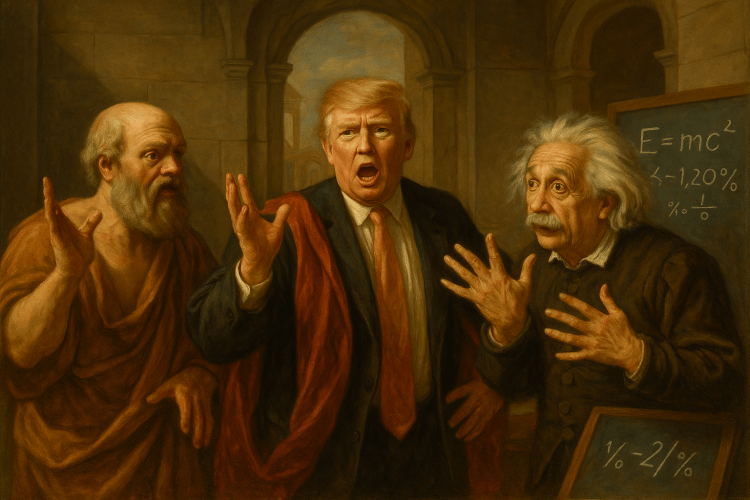


ACT I — THE RETURN OF EINSTEIN

[The Oval Office. TRUMP is leafing through a stack of “Big Beautiful Bill” drafts printed on thick gold-edged paper. EINSTEIN stands before a chalkboard that looks like it’s survived a hurricane.]

EINSTEIN:
Mr. Trump, I have returned because I heard you said your rally crowd “dropped 1,200% in the rain.”

TRUMP:
It did. Huge drop. People couldn’t believe how much it dropped. Even the raindrops dropped harder — beautiful drops, by the way.

EINSTEIN:
A drop cannot exceed 100%!
A 1,200% drop would require the crowd to run backward through time, perhaps into ancient Greece.

TRUMP:
Exactly. They left so fast they created a vacuum. Very scientific. You should be proud.

EINSTEIN: (clutching his hair)
I am not proud! I am horrified!

TRUMP:
People tell me all the time, “Sir, your crowds defy physics.”
And I say, “Yes they do. Tremendously.”

EINSTEIN:
Physics is not meant to be defied!

TRUMP:
Sure it is. Everything is meant to be improved.
Even your hair could use some product.

EINSTEIN:
(looks up at ceiling)
Please. Strike me now.

TRUMP:
Don’t quit. You’re doing great.


ACT II — ENTER SOCRATES

[Sudden breeze. A faint smell of olives. SOCRATES steps into the room wearing a toga and sandals, carrying a scroll titled “My New Blog on the Truth of Truth.”]

SOCRATES:
Greetings! I sensed an argument.
Excellent!
Tell me, what is a percentage?

TRUMP: (points)
This guy again? He followed me into my blog draft earlier.

EINSTEIN:
Socrates, please — we are trying to keep the math grounded in reality.

SOCRATES:
Reality?
What is reality?
Is rain real?
Is a crowd real?
Are numbers real, or merely the shadows of higher truths?

TRUMP:
Here we go.
He turns everything into a TED Talk with sandals.

SOCRATES: (leaning in toward Trump)
Tell me, O Orangest One —
When you say a crowd “dropped 1,200%,” do you mean the crowd fell, or your idea of the crowd fell?

TRUMP:
I mean the crowd dropped bigly.
The biggest drop since the invention of drops.

EINSTEIN:
(whispering to Socrates)
Help me. He is destroying the concept of numbers.

SOCRATES:
I cannot help you.
I only ask questions until everyone cries.


THE BLOG REVELATION

SOCRATES: (sees Trump’s laptop open to a WordPress page)
Behold… a scroll of thought for the masses.
A modern blog!

TRUMP:
Yeah, that’s mine. Don’t touch it.

SOCRATES:
I too had blogs.
Many blogs.
Some written, some spoken, some scratched in the sand, some left as riddles in the agora.

TRUMP:
You didn’t have blogs.

SOCRATES:
Of course I did.
Plato plagiarized all of them.

EINSTEIN:
(whispering to Trump)
He actually believes this.

TRUMP:
Well, tell him to get out of my blog. This is my blog.

SOCRATES:
Every argument is my blog.
Every debate is my domain.
I invented the comments section!

EINSTEIN:
Socrates, please. You must leave.
This is already chaos.

TRUMP: (pointing to the door)
Go back to Ancient Greece and blog there.
Take Plato with you.

SOCRATES: (offended)
Plato is a content aggregator, not a thinker!

TRUMP:
Yeah, that sounds right.
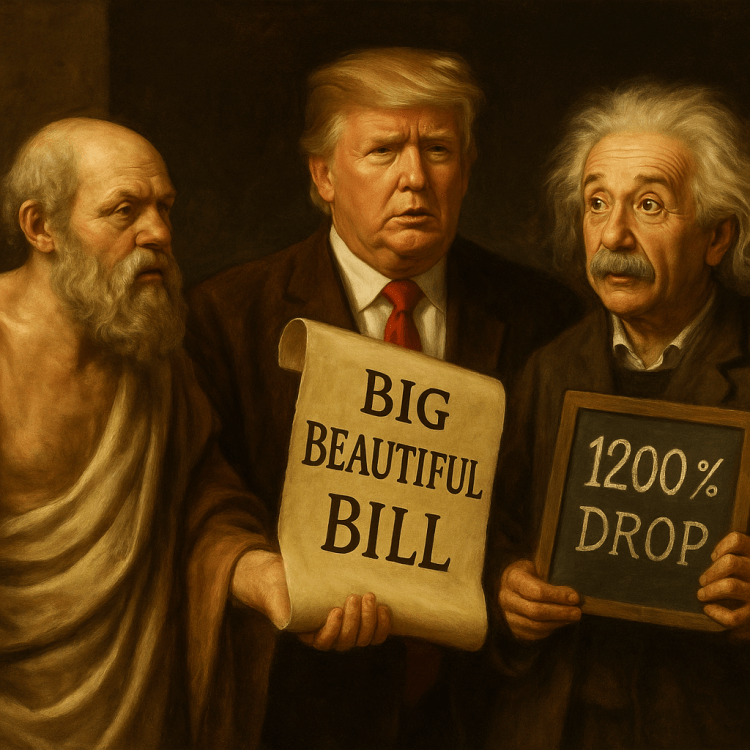


ACT III — THE FINAL MELTDOWN

SOCRATES:
Before I go, answer me this:
If a crowd drops 1,200%, does the crowd exist at all?

TRUMP:
It exists beautifully.
Negatively, even.

EINSTEIN:
Negative crowds do not exist.

TRUMP:
You said it yourself — your sanity dropped 300%.
So clearly things can drop more than 100%.

EINSTEIN:
I was speaking metaphorically!

TRUMP:
Doesn’t matter. I accept your concession.

SOCRATES:
Gentlemen… the argument has now transcended numbers.
It has become…
dumb.

EINSTEIN:
Agreed.

TRUMP:
Agreed. Very dumb.
But also amazing.
People love it.

SOCRATES:
Then I shall take my leave.
There is another blog — in the realm of ideas —
where someone is wrong on the internet.

[He exits dramatically. His cape billows like a curtain that refuses to obey gravity.]


EPILOGUE

EINSTEIN:
I preferred it when he drank hemlock.

TRUMP:
Same.
I liked him better when he said he had two blogs and stayed in them.

EINSTEIN:
So we are agreed?

TRUMP:
Totally.
This is my blog.

EINSTEIN:
Then I shall go.

TRUMP:
Good.
Because my last crowd dropped 2,000%

EINSTEIN: (screams) NOOOO!

[Blackout.]

Socrates Teaches Auditing

A collaboration between Lewis McLain & AI

A Philosophical Comedy in Three Parts

(Socrates Explains Auditing to a Very Slow Student)


Dramatis Personae

  • Socrates – Philosopher, irritated and unpaid.
  • Apprentice – An eager but dim student, fluent in curiosity, not accounting.
  • CFO – A tired but triumphant modern executive.
  • Audit Partner – High priest of Reasonable Assurance.
  • Junior Auditor – Silent observer, always writing.

Part I – Why “Unqualified” Means “Clean”

Apprentice: Master, I am baffled. Why do auditors call their best opinion unqualified? When my mother says I am unqualified, it is not a compliment.

Socrates: (Groaning) Because, my dear imbecile, the gods of accounting delight in contradiction. When they say unqualified, they mean without reservations. When they say clean, they mean no visible dirt. When they say material, they mean big enough to embarrass someone important.

Apprentice: So, “unqualified” means “good,” even though it sounds “bad”?

Socrates: Precisely. It is the linguistic gymnastics of a profession allergic to plain speech. An unqualified opinion is a clean one—no disclaimers, no confessions, no footnotes whispering “don’t sue us.”

Apprentice: But why not call it a perfect opinion?

Socrates: Because auditors fear perfection. Perfection implies responsibility, and responsibility implies liability. Instead, they seek the safer realm of reasonable assurance—a phrase that means, “We’re fairly sure everything’s fine, unless it isn’t.”

Apprentice: What about this word materiality they keep using?

Socrates: Ah, yes—their sacred idol. Materiality is the holy threshold between sin and salvation. A missing coin? Immaterial. A missing treasury? Material. And if the city burns down? “Subsequent event—disclosed in Note 17.”

Apprentice: And who decides what’s material?

Socrates: A mythical being known as the reasonable user of financial statements—a creature never seen in nature, but often invoked in court.


Part II – Socrates’ Audit Field Notes

(From the philosopher’s unwilling internship.)

Day 1 – Arrival
They descend upon the city like well-dressed locusts carrying laptops. They introduce themselves politely, then demand ledgers, receipts, and things long lost to history. “We’ll only be here a few weeks,” they say. Three moons later, they’re still in the break room, testing petty cash.

Day 7 – Sampling
They claim to find the truth by studying ten transactions out of ten thousand. “Representative sample,” they say. “Reasonable assurance,” they add. I call it faith healing with spreadsheets.

Day 15 – Materiality
The auditors debate whether a missing goat is material. After long deliberation, they conclude that one goat is immaterial—unless the herd only had one.

Day 29 – Planning the Plan
They plan the audit, then plan the planning, then plan a meeting to discuss whether the plan aligns with the planned planning. I admire their devotion to process, if not progress.

Day 45 – Walkthrough
An auditor asks me to “walk him through” our cash disbursement cycle. We literally walk—to the market, buy a chicken, and pay the vendor. “Control deficiency,” he mutters. I agree.

Day 73 – The Opinion Letter
After months of work and the sacrifice of several interns, the final parchment emerges:

“In our opinion, the financial statements present fairly, in all material respects…”

Translated from Auditorian: “We didn’t find anything catastrophic, though we looked very hard and are still suspicious.”

Closing Reflection:
Auditors are philosophers of doubt. They pursue truth with calculators and disclaimers, living in eternal tension between assurance and fear of subpoena.


Part III – The Post-Audit Symposium

CFO: Finally! A clean opinion! We are vindicated.

Audit Partner: Indeed. Unqualified—no exceptions, no reservations, no surprises.

Socrates: And yet, you call it “fairly presented.” Why not “true”?

Audit Partner: Because “true” is for prophets. We offer “fair,” which is safer and billable.

Socrates: You sell comfort, not certainty.

Audit Partner: Exactly! Certainty is reckless. Comfort pays the rent.

CFO: Still, this took four months!

Audit Partner: Timeliness is immaterial. Until it surpasses a GASB requirement.

Socrates: (Sighs) So your audit is both eternal and late. How fitting. Tell me, why not simply trust the books?

Audit Partner: Because trust, unverified, is heresy.

Socrates: Then you are theologians of skepticism.

Audit Partner: (Nods) We call it professional skepticism.

Socrates: A fine term for universal suspicion.

Audit Partner: We are trained to doubt until evidence says otherwise—and even then, we document our doubt in triplicate.

CFO: Still, “unqualified” sounds insulting.

Socrates: Indeed! The irony is that the highest praise of your craft sounds like an insult. You should call it Immaculately Unqualified.

Audit Partner: We tried that once. Legal said no.

(The Junior Auditor silently logs 0.25 hours for “client philosophical engagement.”)

Socrates: And this materiality—how is it decided?

Audit Partner: We gather in secret, summon spreadsheets, and chant percentages until consensus appears.

Socrates: A ritual of quantitative mysticism! Tell me, what if you find something truly awful?

Audit Partner: Then the opinion is qualified, the CFO is nervous, and the audit partner retires early.

Socrates: (Raising his cup) To auditors—guardians of truth by approximation! May your samples be random, your conclusions conservative, and your coffee deductible!

All: Hear, hear!


Epilogue – The Ancient Spoof

(Socrates unrolls an ancient scroll.)

“The typical accountant is a man, past middle age, spare, wrinkled, intelligent, cold, passive, non-committal, with eyes like a codfish; polite in contact but at the same time unresponsive, calm and damnably composed as a concrete post or a plaster-of-Paris cast; a petrification with a heart of feldspar and without charm of the friendly germ, minus bowels, passion or a sense of humor. Happily, they never reproduce, and all of them finally go to Hell.
Elbert Hubbard, early 1900s (often quoted mid-century for auditors and proudly found in the preface of some auditing reference material)

Socrates: A cruel jest—but one senses it was written by a man recently audited.


Final Hymn: “Reasonable Assurance”

(To the solemn tempo of an office coffee maker)

Verse 1
Oh, auditors come in the fall’s rain,
With checklists, ticks, and doubt’s domain.
They question all, from cash to soul,
Then bill us hourly for control.

Chorus
Reasonable assurance, softly we pray,
Nothing material shall ruin our day.
Clean though unqualified, cautious yet bright,
Blessed be GAAP, and good-night, good-night.

Verse 2
They test the goats, they test the grain,
They find no fraud—just minor pain.
They sign their names, they bow, they leave,
And send an invoice we can’t believe.

Final Chorus
Reasonable assurance, hold fast, hold true,
For certainty’s dangerous and lawsuits accrue.
Clean though unqualified, may wisdom delight,
For even Socrates closes the books at night.