It’s hard to read the news today without sensing that something fundamental is at risk. Nuclear tensions flicker back into relevance. Artificial intelligence accelerates faster than governance can follow. Climate systems strain, pandemics linger in collective memory, and truth itself feels fractured by speed, scale, and noise.
The language has grown heavier: existential risk, civilizational collapse, end of the world as we know it. These aren’t fringe ideas anymore; they’ve moved into mainstream conversation. And on the surface, the concern doesn’t seem irrational. The tools we’ve built are powerful, interconnected, and increasingly autonomous. A mistake at scale no longer stays local.
It feels different this time.
But that feeling deserves examination.
A necessary pause
Before concluding that the present moment is uniquely fragile, it’s worth asking a quieter, steadier question:
How many times have recent generations believed they were living at the edge of catastrophe—and survived anyway?
The answer is not “once or twice.” It’s repeatedly.
Living under the shadow of instant annihilation
From 1945 through the end of the Cold War, nuclear war was not a background concern—it was a daily assumption. Children practiced duck-and-cover drills in classrooms. Missile flight times were measured in minutes. Early-warning systems were crude, leaders were fallible, and several near-launch incidents were stopped only because a single human being hesitated.
This was not a slow, abstract threat. Civilization could have ended on a Tuesday afternoon due to misinterpretation or panic.
It didn’t.
World wars that truly looked final
Before existential risk was a phrase, it was a lived reality. World War I shattered empires and faith in progress. World War II erased cities, normalized mass civilian death, and introduced industrial genocide. Nuclear weapons were not theoretical—they were used.
In the early 1940s, it was entirely reasonable to believe that modern civilization had run past its own limits.
Instead, nations rebuilt. Institutions re-formed. Norms—damaged but not destroyed—re-emerged.
Economic collapse that shook belief itself
The Great Depression wasn’t just a downturn; it was a crisis of legitimacy. One-quarter of the workforce unemployed. Banks failing. Democratic capitalism itself under suspicion. Radical alternatives didn’t just sound plausible—they sounded inevitable.
Later came oil shocks, stagflation, and repeated predictions that the economic model could not continue.
It did—messily, imperfectly, but decisively.
Environmental fears that once felt irreversible
In the 1960s and 1970s, many believed overpopulation would cause mass starvation, pollution would make cities unlivable, and atmospheric damage was permanent. Some fears were exaggerated. Others were real—and addressed through regulation, innovation, and adaptation.
Not solved. Managed well enough to keep going.
So what’s actually different now?
The difference is not danger itself. Danger has always been present.
What is different is how risks now overlap, compound, and accelerate. Technology compresses decision-making time. Systems are more interconnected. Failures propagate faster. Threats are less discrete and more ambient.
That makes the present feel uniquely unstable—even if, historically, it may not be uniquely lethal.
The pattern history keeps revealing
Looking backward, one truth emerges with surprising consistency:
Catastrophe requires near-perfect failure. Survival requires only partial success.
Civilizations rarely endure because they are wise in advance. They endure because:
restraint interrupts escalation,
coordination emerges under pressure,
and adaptation happens before collapse becomes inevitable.
History’s most underrated force isn’t genius. It’s imperfect competence sustained long enough.
A quieter, earned conclusion
None of this denies today’s risks. It simply resists panic masquerading as insight.
Every generation feels its moment is unprecedented—and in form, it usually is. But in structure, it rarely is. The future always looks more fragile when you’re standing inside it.
That doesn’t guarantee safety. It does suggest resilience.
Not because humans are calm. Not because institutions are flawless. But because again and again, we adjust, restrain, and muddle through before the worst becomes unavoidable.
That isn’t denial. It’s historical memory.
And memory, used well, is one of humanity’s most reliable survival tools.
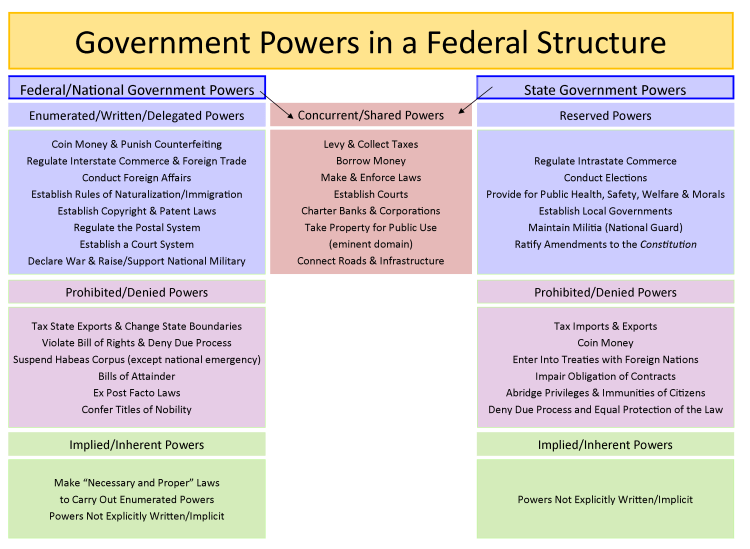
Any serious discussion of Texas local government must begin with a foundational constitutional fact:
In the United States, there are only two levels of sovereign government: the federal government and the states.
That is the full list.
Counties, cities, school districts, special districts, authorities, councils, boards, and commissions are not sovereign. They possess no inherent authority. They exist only because a state legislature has chosen to delegate specific powers to them, and those powers may be expanded, limited, preempted, reorganized, or withdrawn entirely.
Texas local government is therefore not a story of decentralization. It is a story of delegated administration, followed—inevitably—by state-directed coordination when delegation produced excessive fragmentation.
The State of Texas as Sovereign and System Designer
The State of Texas is sovereign within its constitutional sphere. That sovereignty includes the authority to:
Create local governments
Define and limit their powers
Redraw or freeze their boundaries
Preempt their ordinances
Reorganize or abolish them
Local governments are not junior partners in sovereignty. They are instruments through which the state governs a vast and diverse territory.
From the beginning, Texas made a defining structural choice: rather than consolidate government as complexity increased, it would delegate narrowly, preserve local identity, and retain sovereignty at the state level. That choice explains the layered system that followed.
Counties: The First Subdivision of State Power
Counties were Texas’s original subdivision of state authority, adopted after independence and statehood from Anglo-American legal traditions.
They were designed for a frontier world:
Sparse population
Horseback travel
Local courts
Recordkeeping
Elections
Law enforcement
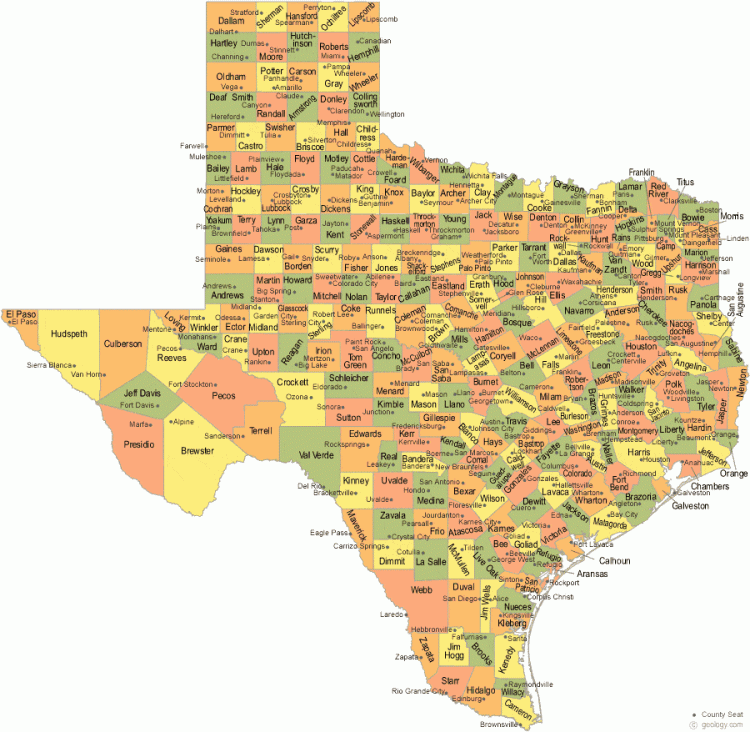
During the 19th century, Texas rapidly carved itself into counties so residents could reach a county seat in roughly a day’s travel. By the early 20th century, the county map had largely frozen at 254 counties, a number that remains unchanged today.
Counties are constitutional entities, but they are governed strictly by Dillon’s Rule. They have no inherent powers, no residual authority, and little flexibility to adapt structurally. Once the county map was locked in place, counties became increasingly mismatched to Texas’s urbanizing reality—too small in some areas, too weak in others, and too rigid everywhere.
Rather than consolidate counties, Texas chose to work around them.
Dillon’s Rule: The Legal Engine of Delegation
The doctrine that made this system possible is Dillon’s Rule, named after John Forrest Dillon (1831–1914), Chief Justice of the Iowa Supreme Court and later a professor at Columbia Law School. His 1872 treatise, Commentaries on the Law of Municipal Corporations, emerged during a period of explosive city growth and widespread municipal corruption.
Dillon rejected the notion that local governments possessed inherent authority. He articulated a rule designed to preserve state supremacy:
A local government may exercise only (1) powers expressly granted by the legislature, (2) powers necessarily implied from those grants, and (3) powers essential to its declared purpose—not merely convenient, but indispensable. Any reasonable doubt is resolved against the local government.
Texas did not merely adopt Dillon’s Rule; it embedded it structurally. Counties, special districts, ISDs, and authorities operate squarely under Dillon’s Rule. Even cities escape it only partially through home-rule charters, and only to the extent the Legislature allows.
Dillon’s Rule explains why Texas governance favors many narrow entities over few powerful ones.
Cities: Delegated Urban Management, Not Local Sovereignty
As towns grew denser, counties proved incapable of providing urban services. The state responded by authorizing cities to manage:
Police and fire protection
Streets and utilities
Zoning and land use
Local infrastructure
Cities are therefore delegated urban managers, not sovereign governments.
Texas later adopted home-rule charters to give larger cities greater flexibility, but home rule is widely misunderstood. It does not reverse Dillon’s Rule. It merely allows cities to act unless prohibited—while preserving the Legislature’s power to preempt, override, or limit local authority at any time.
Recent state preemption is not a breakdown of the system. It is the system operating as designed.
Independent School Districts: Function Over Geography
Education exposed the limits of place-based governance earlier than any other function.
Counties were too uneven. Cities were too political. Education required stability, long planning horizons, and uniform oversight.
Texas responded by removing education from both counties and cities and creating Independent School Districts.
ISDs are:
Single-purpose governments
Granted independent taxing authority
Authorized to issue bonds
Subject to state curriculum and accountability mandates
ISDs do not answer to cities or counties. They answer directly to the state. This was one of Texas’s earliest and clearest moves toward functional specialization over territorial governance.
Special Districts: Precision Instead of Consolidation
As Texas industrialized and urbanized in the 20th century, the Legislature faced increasingly specific problems:
Flood control
Water supply
Drainage
Fire protection
Hospitals
Ports and navigation
Rather than expand general-purpose governments, Texas created special districts—single-mission entities with narrow authority and dedicated funding streams.
Special districts are not accidental inefficiencies. They reflect a deliberate state preference:
Solve problems with precision, not with consolidation.
The result was effectiveness and speed, at the cost of growing fragmentation.
MUDs and Authorities: Growth and Risk as State Policy
Municipal Utility Districts and authorities are often mistaken for private or quasi-private entities. Legally, they are governments.
MUDs:
Are created under state law
Levy taxes
Issue bonds
Are governed by elected boards
Provide essential infrastructure
They allow the state to:
Enable development before cities arrive
Finance infrastructure without municipal debt
Shift costs to future residents
Avoid restructuring counties
Similarly, transit authorities, toll authorities, housing authorities, and local government corporations exist to isolate risk, bypass constitutional debt limits, and accelerate projects. These are not loopholes. They are state-designed instruments.
The Consequence: Functional Fragmentation
By the mid-20th century, Texas governance had become highly functional—and deeply fragmented:
Fixed counties
Expanding cities
Independent ISDs
Thousands of special districts
Authorities operating alongside cities
Infrastructure crossing every boundary
The system worked locally, but failed regionally.
No entity could plan coherently across jurisdictions. Funding decisions conflicted. Infrastructure systems overlapped. Federal requirements could not be met cleanly. At this point, Texas made another defining choice.
It did not consolidate governments. It pulled planning and coordination back upward, closer to the state.
Councils of Governments: State-Authorized Coordination
Beginning in the 1960s, Texas authorized Councils of Governments (COGs) to address fragmentation.
Today:
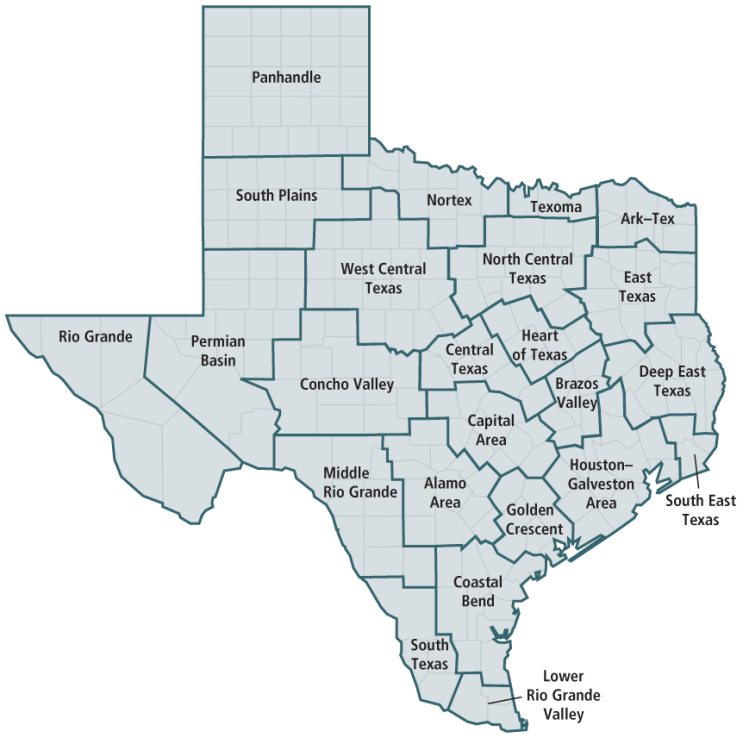
24 COGs cover the entire state
Each spans multiple counties
Membership includes cities, counties, ISDs, and districts
COGs:
Have no taxing authority
Have no regulatory power
Have no police power
They exist to coordinate, not to govern—to reconnect what delegation had scattered. Their weakness is intentional. They sit conceptually just beneath the state, not beneath local governments.
MPOs: Transportation Planning Pulled Upward
Transportation forced an even clearer pull-back.
Texas has 25 Metropolitan Planning Organizations, designated by the state to comply with federal law. MPOs plan, prioritize, and allocate federal transportation funding. They do not build roads, levy taxes, or override governments.
MPOs act as planning membranes between federal mandates and Texas’s fragmented local structure.
Water: Where Texas Explicitly Rejected Fragmentation
Water planning most clearly demonstrates the limits of local delegation.
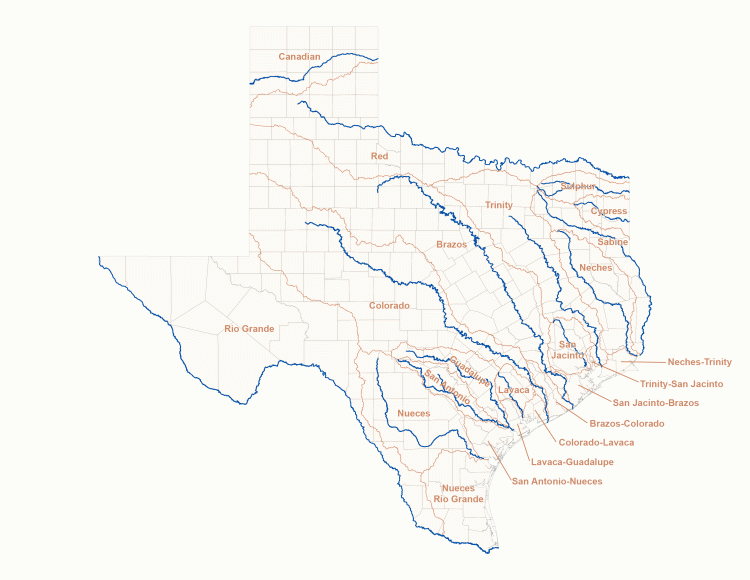
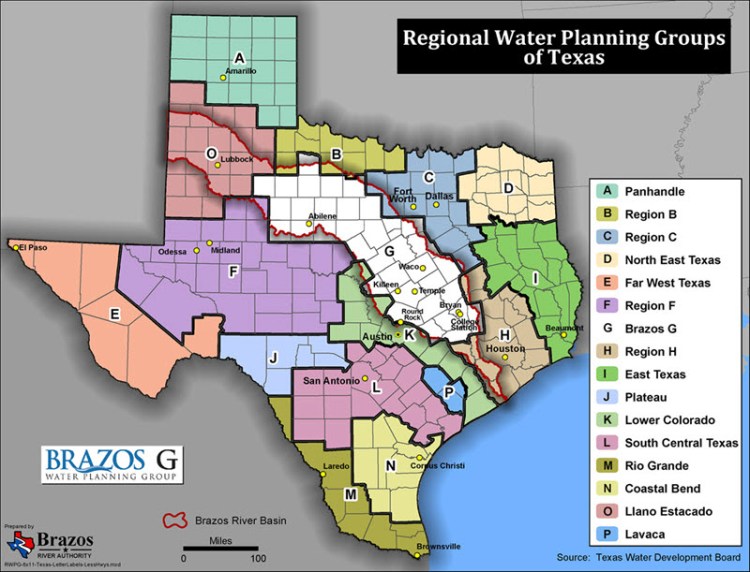
Texas spans 15 major river basins, with annual rainfall ranging from under 10 inches in the west to over 50 inches in the east. Water ignores counties, cities, ISDs, and districts entirely.
Texas responded by creating:
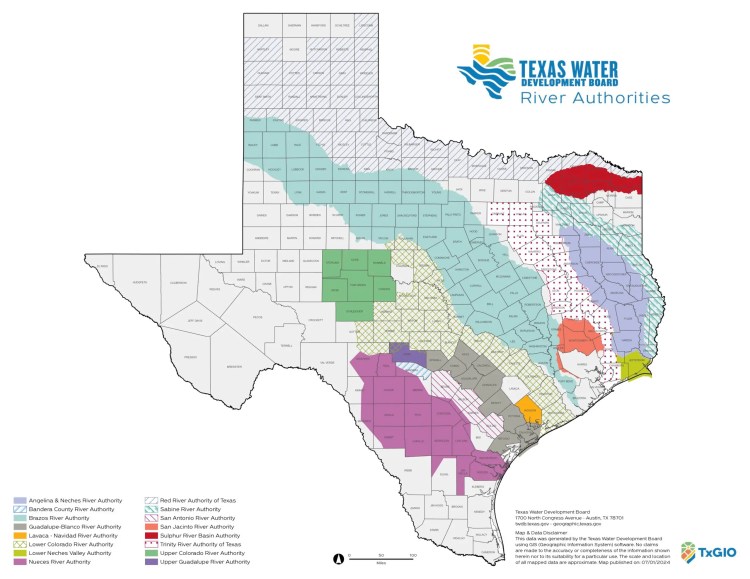
Approximately 23 river authorities, organized by watershed
16 Regional Water Planning Areas, overseen by the Texas Water Development Board
A unified State Water Plan, adopted by the Legislature
Regional Water Planning Groups govern planning, not operations. Funding eligibility flows from compliance. This is state-directed regional planning with local execution.
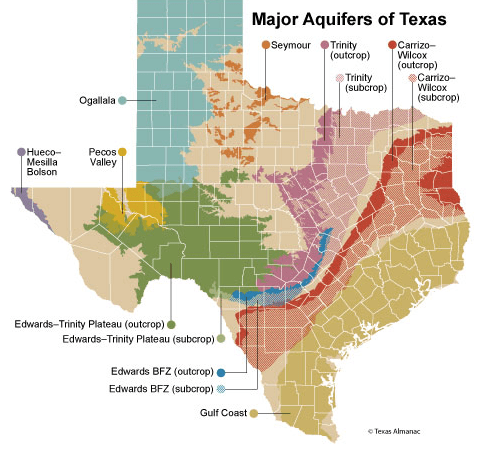
Texas also created 95+ Groundwater Conservation Districts, organized by aquifer rather than politics—another instance of function overriding geography.
Public Health and Other Quiet Pull-Backs
Public health produced the same result. Disease ignores jurisdictional lines. Texas authorized county, city-county, and multi-county health districts to exercise delegated state police powers regionally.
The same pattern appears elsewhere:
Emergency management regions
Workforce development boards
Judicial administrative regions
20 Education Service Centers
Air-quality nonattainment regions
Each represents the same logic:
Delegation fragments
Fragmentation impairs system performance
The state restores coordination without transferring sovereignty
Final Synthesis
Texas local government did not evolve haphazardly. It followed a consistent philosophy:
Preserve sovereignty at the state level
Delegate functions narrowly
Avoid consolidation
Specialize relentlessly
Pull planning back upward when fragmentation becomes unmanageable
What appears complex or chaotic is actually layered intent.
Services are delegated downward. Planning is pulled back upward. Sovereignty never moves.
That tension—between delegation and coordination—is not a flaw in Texas government. It is its defining structural feature.
Skills, Motivation, and the Capabilities Behind Accurate Mapping
Introduction: The Human Attempt to Shrink the World Into Understanding
A map seems simple at first glance: a flat surface covered with lines, shapes, labels, and colors. Yet the act of creating an accurate map is one of the most difficult intellectual tasks humans have ever attempted. Mapping demands a rare combination of observation, mathematics, engineering, imagination, artistry, philosophy, and courage. It requires a person to look at a world too large to see all at once and to represent it faithfully on something small enough to hold in the hand. Every map, whether carved on a clay tablet or drawn by satellite algorithms, is a claim about what is real and what matters.
This paper explores the mapmaker’s mind across four eras—ancient, exploratory, philosophical, and modern technological—and then strengthens that understanding through case studies and technical appendices. Throughout the narrative, one idea remains constant: accuracy is not merely a technical achievement; it is a human triumph grounded in the mapmaker’s inner capabilities.
I. Ancient Mapmakers: Building Accuracy from Memory, Observation, and Survival
For thousands of years, before the invention of compasses, sextants, or even numerals as we know them, mapmakers relied on the most fundamental tools available to any human being: their memory, their senses, and their endurance.
A Babylonian cartographer might spend long days walking field boundaries and tying lengths of rope to stakes to re-establish property lines after floods. An Egyptian “rope stretcher” could look at the shadow of a pillar, note the angle, and derive a surprisingly accurate sense of latitude and season. Polynesian navigators sensed the shape of islands from the swell of the ocean, the direction of prevailing winds, the pattern of clouds, or the flight paths of birds—even when land was hundreds of miles away. All of this happened without written language in many places, and without anything like formal mathematics.
The motivations were simple but powerful. Survival required knowing where water, game, shelter, and danger lay. Governance required knowing how much farmland belonged to whom, where the temples held jurisdiction, and how to tax agricultural output. Trade required predictable knowledge of paths, distances, and safe passages. Human curiosity played its own role as well; people have always wanted to know the shape of their world.
Accuracy in ancient mapping was limited by natural constraints. Long distances could not be measured with confidence. Longitude remained elusive for nearly all of human history. Oral traditions, though rich, introduced distortions. Political agendas often shaped borders. And yet ancient maps show remarkable competence: logical river systems, consistent directions, recognizable landforms, and surprisingly stable proportionality. Accuracy was relative to the tools available, but the intent—the desire to record reality—was the same as today.
II. Explorers and Enlightenment Surveyors: Lewis & Clark and the Birth of Scientific Mapping
The early nineteenth century introduced a new kind of cartographer: the trained surveyor who combined field observation with scientific measurement. Lewis and Clark exemplify this transition.
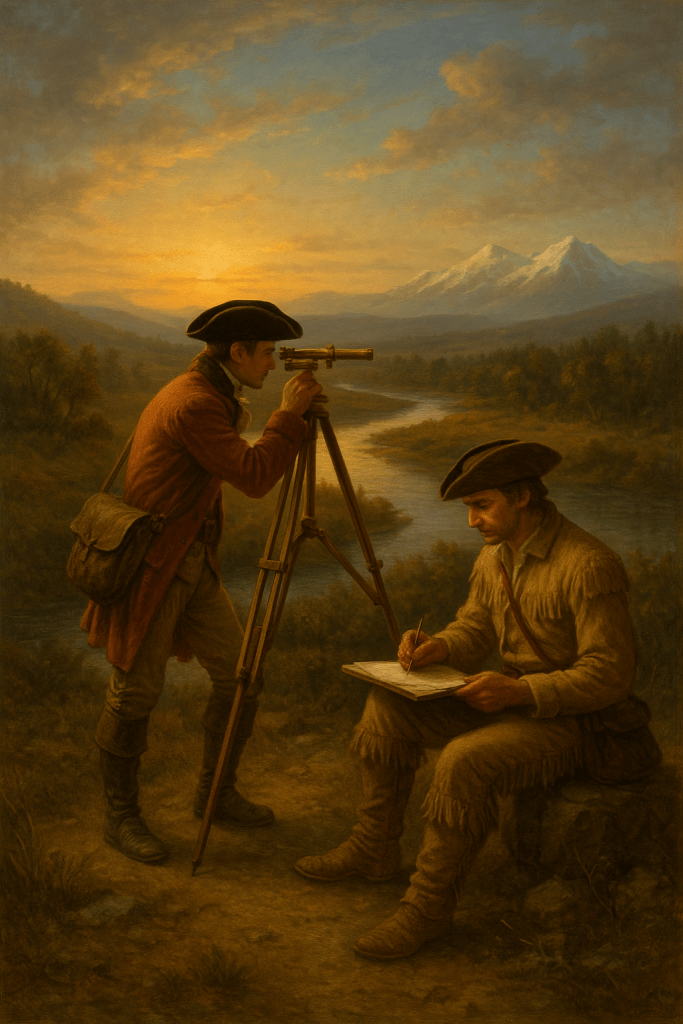
Armed with sextants, compasses, chronometers, astronomical tables, and notebooks filled with surveying instructions, they attempted to impose geometric precision on a landscape no European-American had ever mapped. They measured solar angles to determine latitude, recorded compass bearings at virtually every bend of the Missouri River, estimated distances by managing travel speeds, and triangulated mountain peaks whenever weather permitted. Their notebooks reveal how meticulously they checked, recalculated, and corrected their own readings.
Their motivation blended national ambition, Enlightenment science, personal curiosity, and a desire for legacy. President Jefferson viewed the expedition as a grand experiment in empirical observation and hoped to gather geographic, botanical, zoological, and ethnographic knowledge all at once. Lewis and Clark themselves were deeply committed to documenting not only what they saw but how they measured it.
Despite their tools, they faced severe limitations. Cloud cover often prevented celestial readings. Magnetic variation made some compass bearings unreliable. River distances were difficult to estimate accurately when paddling against currents. Longitudes were usually approximations, sometimes guessed, because no portable timekeeping device of the period could maintain accuracy under field conditions. Yet the map produced from their expedition defined the American West for decades, confirmed mountain ranges, captured river systems, located tribal lands, and fundamentally reshaped the geographic understanding of a continent.
Their accomplishment demonstrates that accuracy is a function not only of tools but of discipline, repetition, cross-checking, and the mental fortitude to tolerate error until it can be corrected.
III. The Philosophical Mapmaker: Understanding That a Map Is a Model, Not the World
One of the most difficult but essential truths in cartography is that a map can never be fully accurate in every dimension. A map is a model, not the thing itself. Understanding this transforms how we judge accuracy.
No map can include everything. The mapmaker must decide what to include and what to omit, what to emphasize and what to generalize. This selective process shapes meaning as much as measurement does. A map that focuses on roads sacrifices terrain; a map that shows landforms hides political boundaries; a nautical chart prioritizes depth, hazards, and tides while ignoring nearly everything inland.
Even more fundamentally, the Earth is round and a map is flat. Flattening a sphere introduces distortions in shape, area, distance, or direction. No projection solves all problems at once. The Mercator projection preserves direction for navigation but distorts the sizes of continents dramatically. Equal-area projections preserve proportional land area but contort shapes. Conic projections work beautifully for mid-latitude regions like the United States but fail near the equator and poles.
Scale introduces another layer of philosophical choice. A map of a neighborhood can show driveways, footpaths, and fire hydrants; a map of a nation must erase tens of thousands of such details. At global scale, even major rivers become thin suggestions rather than features.
Finally, maps inevitably carry bias. National borders are often political statements as much as geographic descriptions. Cultural assumptions guide what is considered important. The purpose of a map—a subway map, a floodplain map, a highway atlas—governs its priorities. Every map quietly expresses a worldview.
Thus, “accurate” does not mean “perfectly true.” It means “fit for the purpose.” A map is correct to the extent that it serves the need it was created for.
IV. The Modern Cartographer: Satellites, GIS, and the Era of Precision
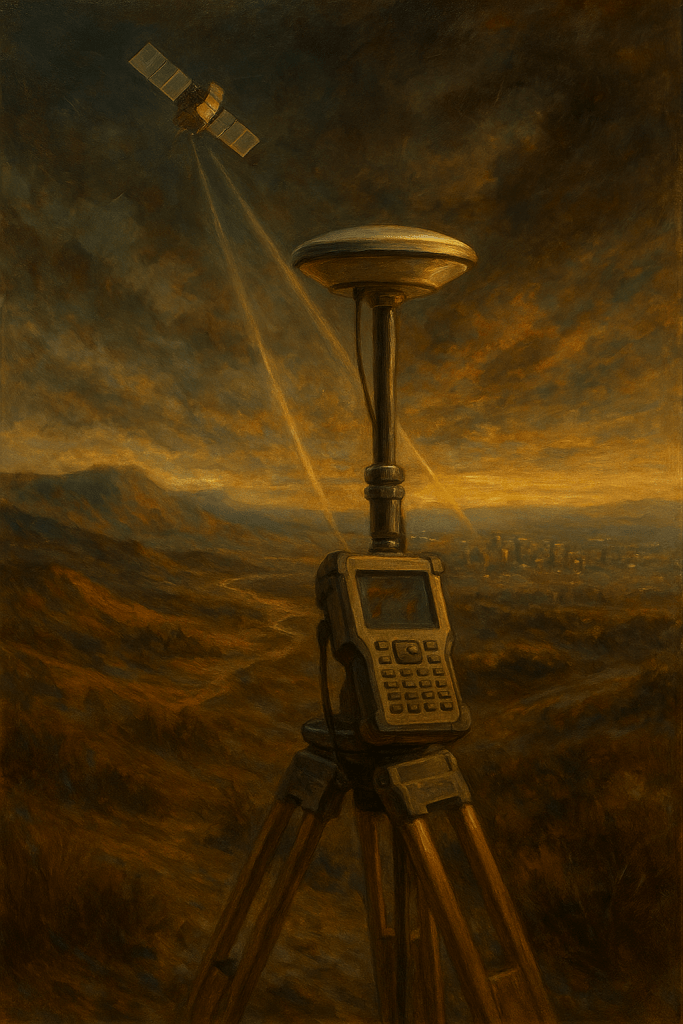
The modern mapmaker operates in a world overflowing with spatial information. GPS satellites circle the earth, constantly broadcasting timing signals that allow any handheld receiver to determine position within a few meters—and survey-grade receivers to reach centimeter-level accuracy. High-resolution satellite imagery captures coastlines, forests, highways, and rooftops with astonishing clarity. LiDAR sensors measure elevation by firing millions of laser pulses per second, creating three-dimensional models of terrain. GIS (Geographic Information Systems) software organizes, analyzes, and visualizes enormous spatial datasets.
The work of the modern cartographer is less about drawing lines and more about managing data. A GIS analyst must understand spatial statistics, database schemas, metadata verification, remote sensing interpretation, coordinate transformations, and the difference between nominal, ordinal, interval, and ratio data. The skill set is analytical, computational, and scientific.
The motivations have expanded as well. Modern mapping supports transportation engineering, zoning, emergency response, flood mitigation, environmental policy, epidemiology, commercial logistics, climate science, and international security. Governments, companies, and researchers all rely on constantly updated maps to make daily decisions.
Yet the abundance of data introduces new complications. Errors no longer stem primarily from lack of information but from inconsistency among datasets, outdated imagery, automated misclassification, incorrect coordinate transformation, or the false sense of precision that digital numbers can give. Even in a world of satellites, the mapmaker must remain vigilant and skeptical. Accuracy must still be earned, not assumed.
V. Case Studies: How Real Maps Achieve Real Accuracy
The theory of mapmaking becomes clearer when examined through specific examples. Four case studies reveal how different contexts produce different solutions to the same universal problem.
Case Study 1: The USGS Topographic Map
The United States Geological Survey began producing standardized topographic maps in the late nineteenth century, combining triangulation, plane-table surveying, and field verification. Later editions incorporated aerial photography and eventually satellite data. These maps formed the spatial backbone of national development. Engineers relied on them to place highways, dams, airports, pipelines, and railroads. Hikers and outdoor enthusiasts still use them today.
Their accuracy was remarkable for their time: often within a few meters horizontally and within a meter vertically. They became the nation’s common spatial language, demonstrating how consistent methodology and repeated verification create reliability across vast geographic space.
Case Study 2: Nautical Charts and the Challenge of the Ocean
No mapping discipline demands more caution than nautical charting. Mariners depend on accurate depths, hazard markings, and tidal information. Early sailors used weighted ropes and visual triangulation to estimate depth. Today’s hydrographers use multibeam sonar, satellite altimetry, LiDAR bathymetry, and tide-corrected measurements to produce charts that can reveal underwater features with astonishing detail.
Yet the ocean floor is dynamic. Storms move sandbars. Currents reshape channels. Dredging alters harbor depths. For this reason, nautical charts are never fully “finished.” They require constant updating. The challenge is not simply measuring depth once, but sustaining accuracy in a world that changes.
Case Study 3: The London Underground Map and the Meaning of “Accuracy”
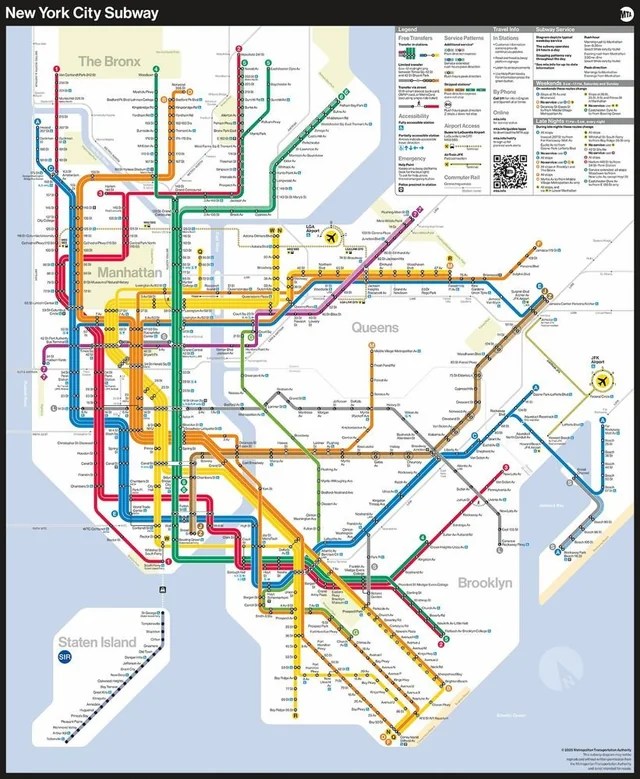
The London Tube Map, introduced by Harry Beck in 1933, revolutionized the concept of cartographic truth. Beck realized that subway riders did not need geographic precision. They needed simplicity, clarity, and relational accuracy—knowing how stations connected, not how far apart they were in miles.
By replacing geographic realism with abstract geometry, he created a map that was technically inaccurate but functionally brilliant. Nearly all subway maps worldwide now follow the same principle. This case study illustrates that the “right” map is the map that serves the user’s need, not the map that most faithfully represents ground truth.
Case Study 4: Google Maps and the Algorithmic Cartographer
Google Maps represents an entirely new form of mapping. Unlike paper maps, it is not a static depiction of geography. It is a constantly shifting model created from satellite images, aerial photos, street-level observations, user reports, and complex routing algorithms. It recalculates itself continuously, adjusting for traffic, construction, business changes, and political variations in border representation.
Its power is extraordinary, but its limitations remind us that automation cannot eliminate human judgment. The platform reflects commercial incentives, political boundaries, and the imperfections of crowdsourced information. Accuracy is high but uneven, and like the ocean charts, the system must be updated constantly to remain trustworthy.
VI. A Unified Theory of Mapmaking
Across all eras and technologies, the mapmaker’s challenge remains the same. The world is too large and too complex to be perceived directly, so the mapmaker must choose which aspects of reality to capture. Those choices—shaped by purpose, tools, knowledge, and bias—determine whether the resulting map will be useful or misleading. Measurement introduces error; projection introduces distortion; interpretation introduces judgment. Accuracy is always relative to context, intention, and method.
The mapmaker succeeds not by eliminating error altogether, but by understanding its sources, managing its influence, and balancing the competing truths that every map must negotiate.
VII. Technical Appendices
Appendix A: Coordinate Systems and Projections
Modern mapping rests on systems that allow the entire Earth to be described mathematically. Latitude and longitude divide the globe into degrees, providing a universal reference easy to conceptualize but difficult to measure perfectly at large scales. The Universal Transverse Mercator (UTM) system divides the Earth into narrow vertical zones, each of which minimizes distortion for engineering purposes. The North American Datum (NAD83) and the World Geodetic System (WGS84) provide precise mathematical models of the Earth’s shape, enabling GPS receivers to calculate location with remarkable accuracy.
Map projections translate the curved surface of the Earth to a flat plane. Each projection sacrifices something: the Mercator preserves direction but exaggerates the size of high-latitude regions; equal-area projections maintain proportional land area at the cost of distorting continents; the Robinson projection compromises carefully to create a visually balanced world. The choice of projection reflects the map’s purpose more than the mapmaker’s preference.
Appendix B: Surveying Instruments Through Time
The tools of mapping have evolved dramatically. Ancient civilizations used gnomons to measure shadows, ropes to mark distances, and rudimentary cross-staffs to gauge angles. Renaissance innovations introduced compasses, astrolabes, sextants, and the plane table, bringing scientific precision to exploration. By the eighteenth century, the theodolite allowed surveyors to measure angles with unprecedented accuracy.
Modern surveyors rely on total stations, which combine angle measurement with laser-based distance calculation; GNSS receivers capable of centimeter-level precision; LiDAR instruments that generate three-dimensional point clouds of terrain; and drones that capture aerial photographs suitable for photogrammetric reconstruction. Although the instruments have changed, the underlying goal has remained constant: to measure the Earth in a way that minimizes error and maximizes reliability.
Appendix C: Sources of Error and How Mapmakers Correct Them
Cartographic errors emerge from several sources. Positional error occurs when instrument readings or GPS signals are distorted by environmental conditions, equipment limitations, or signal reflections from buildings or terrain. Projection error arises because any flat map must distort some combination of shape, area, direction, or distance. Human interpretation error appears during the classification of aerial images or the delineation of ambiguous features. Temporal error affects maps that have not been updated to reflect natural or man-made changes.
Mapmakers mitigate these errors by using redundant measurements, cross-checking data from multiple sources, incorporating ground-truth verification, applying statistical corrections, and selecting projections tailored to the region being mapped. Accuracy is achieved not through perfection but through a disciplined process of detecting, bounding, and correcting inevitable imperfections.
Conclusion: The Eternal Mind Behind the Map
From a Babylonian surveyor tying knots in a rope, to a Polynesian navigator reading waves in the dark, to Lewis and Clark marking compass bearings along unknown rivers, to a modern GIS analyst adjusting satellite layers on a computer screen, the mapmaker’s mind has never changed in its essential character. The world is too vast, varied, and dynamic to be seen directly, so we create representations—models that reveal structure, meaning, and relationship.
A map is not merely a depiction of space. It is a human judgment about what matters. Every accurate map represents a triumph of curiosity over ignorance, order over chaos, and understanding over confusion. The tools are part of the story, but the deeper story is the capability of the person wielding them: the patience to measure carefully, the discipline to verify and correct, the imagination to translate complexity into clarity, and the humility to know that no map is final, complete, or perfect.
Mapmaking is the oldest form of reasoning about the world, and perhaps the most enduring. To draw a map is to make the world legible. To understand a map is to understand the choices of the person who created it. And to appreciate accuracy is to recognize that behind every line lies a mind trying to grasp the infinite.
A Three-Act Comedy Starring Einstein, Socrates, and Trump
ACT I — THE RETURN OF EINSTEIN
[The Oval Office. TRUMP is leafing through a stack of “Big Beautiful Bill” drafts printed on thick gold-edged paper. EINSTEIN stands before a chalkboard that looks like it’s survived a hurricane.]
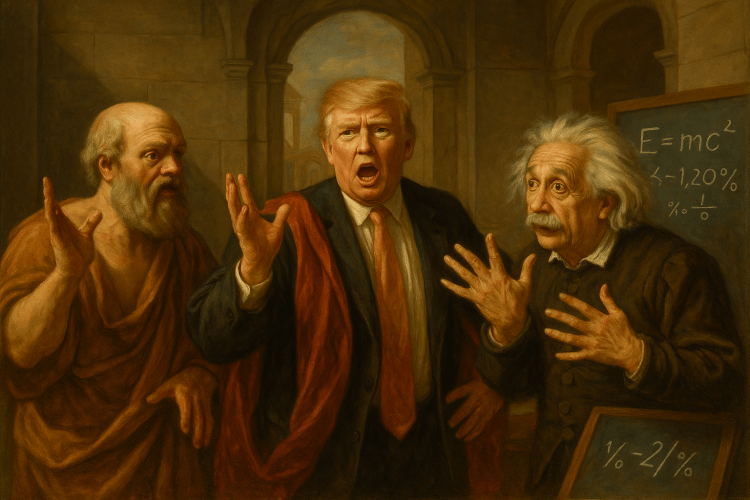
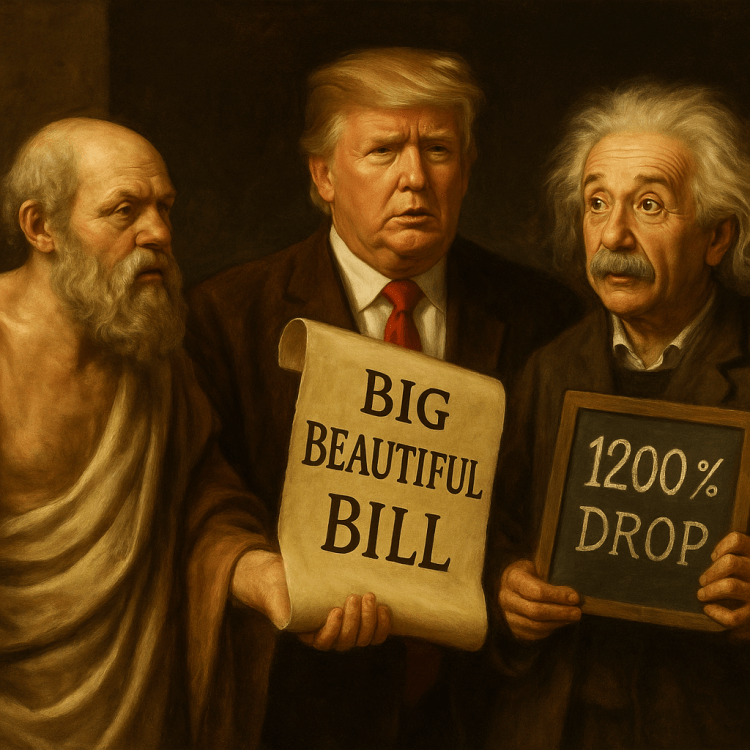
EINSTEIN: Mr. Trump, I have returned because I heard you said your rally crowd “dropped 1,200% in the rain.”
TRUMP: It did. Huge drop. People couldn’t believe how much it dropped. Even the raindrops dropped harder — beautiful drops, by the way.
EINSTEIN: A drop cannot exceed 100%! A 1,200% drop would require the crowd to run backward through time, perhaps into ancient Greece.
TRUMP: Exactly. They left so fast they created a vacuum. Very scientific. You should be proud.
EINSTEIN: (clutching his hair) I am not proud! I am horrified!
TRUMP: People tell me all the time, “Sir, your crowds defy physics.” And I say, “Yes they do. Tremendously.”
EINSTEIN: Physics is not meant to be defied!
TRUMP: Sure it is. Everything is meant to be improved. Even your hair could use some product.
EINSTEIN: (looks up at ceiling) Please. Strike me now.
TRUMP: Don’t quit. You’re doing great.
ACT II — ENTER SOCRATES
[Sudden breeze. A faint smell of olives. SOCRATES steps into the room wearing a toga and sandals, carrying a scroll titled “My New Blog on the Truth of Truth.”]
SOCRATES: Greetings! I sensed an argument. Excellent! Tell me, what is a percentage?
TRUMP: (points) This guy again? He followed me into my blog draft earlier.
EINSTEIN: Socrates, please — we are trying to keep the math grounded in reality.
SOCRATES: Reality? What is reality? Is rain real? Is a crowd real? Are numbers real, or merely the shadows of higher truths?
TRUMP: Here we go. He turns everything into a TED Talk with sandals.
SOCRATES: (leaning in toward Trump) Tell me, O Orangest One — When you say a crowd “dropped 1,200%,” do you mean the crowd fell, or your idea of the crowd fell?
TRUMP: I mean the crowd dropped bigly. The biggest drop since the invention of drops.
EINSTEIN: (whispering to Socrates) Help me. He is destroying the concept of numbers.
SOCRATES: I cannot help you. I only ask questions until everyone cries.
THE BLOG REVELATION
SOCRATES: (sees Trump’s laptop open to a WordPress page) Behold… a scroll of thought for the masses. A modern blog!
TRUMP: Yeah, that’s mine. Don’t touch it.
SOCRATES: I too had blogs. Many blogs. Some written, some spoken, some scratched in the sand, some left as riddles in the agora.
TRUMP: You didn’t have blogs.
SOCRATES: Of course I did. Plato plagiarized all of them.
EINSTEIN: (whispering to Trump) He actually believes this.
TRUMP: Well, tell him to get out of my blog. This is my blog.
SOCRATES: Every argument is my blog. Every debate is my domain. I invented the comments section!
EINSTEIN: Socrates, please. You must leave. This is already chaos.
TRUMP: (pointing to the door) Go back to Ancient Greece and blog there. Take Plato with you.
SOCRATES: (offended) Plato is a content aggregator, not a thinker!
TRUMP: Yeah, that sounds right.
ACT III — THE FINAL MELTDOWN
SOCRATES: Before I go, answer me this: If a crowd drops 1,200%, does the crowd exist at all?
TRUMP: It exists beautifully. Negatively, even.
EINSTEIN: Negative crowds do not exist.
TRUMP: You said it yourself — your sanity dropped 300%. So clearly things can drop more than 100%.
EINSTEIN: I was speaking metaphorically!
TRUMP: Doesn’t matter. I accept your concession.
SOCRATES: Gentlemen… the argument has now transcended numbers. It has become… dumb.
EINSTEIN: Agreed.
TRUMP: Agreed. Very dumb. But also amazing. People love it.
SOCRATES: Then I shall take my leave. There is another blog — in the realm of ideas — where someone is wrong on the internet.
[He exits dramatically. His cape billows like a curtain that refuses to obey gravity.]
EPILOGUE
EINSTEIN: I preferred it when he drank hemlock.
TRUMP: Same. I liked him better when he said he had two blogs and stayed in them.
EINSTEIN: So we are agreed?
TRUMP: Totally. This is my blog.
EINSTEIN: Then I shall go.
TRUMP: Good. Because my last crowd dropped 2,000%—
A collaboration between Lewis McLain & AI (more from the three visits Linda & I had to the Louvre with high school students from Trinity Christian Academy).
Antonio Canova and the Awakening of the Soul
Introduction
Among the marble treasures of the Louvre Museum stands one of the most moving sculptures of all time — Psyche Revived by Cupid’s Kiss, carved by the Italian master Antonio Canova between 1787 and 1793. It depicts the mythological moment when the god Cupid (Eros) revives his beloved Psyche with a kiss, restoring her from deathlike sleep to life and love.
At once tender, idealized, and technically perfect, this masterpiece captures not only the beauty of myth but also the intellectual spirit of the Neoclassical age. For any student observer, it represents the perfect synthesis of form, feeling, and philosophy — a lesson in how art can make marble breathe.
1. The Artist and His Era
Antonio Canova (1757–1822) was born in Possagno, Italy, into a family of stonemasons. Trained in Venice and working in Rome, he became the undisputed master of the Neoclassical style, the artistic movement that sought to revive the order, harmony, and moral clarity of ancient Greece and Rome.
Canova’s art emerged during the Age of Enlightenment, a time when reason, science, and rediscovered antiquity guided intellectual life. Artists looked to classical sculpture for purity of line and noble simplicity. Against the emotional extravagance of the Baroque, Canova’s figures embodied balance, restraint, and serenity.
His goal, he once said, was to give marble the “appearance of living flesh” — and through meticulous polishing and proportion, he succeeded. His works, such as Perseus with the Head of Medusa and The Three Graces, stand as paragons of refinement and calm emotional depth.
2. The Myth of Cupid and Psyche
The story comes from Apuleius’s The Golden Ass (2nd century A.D.), one of the most enduring love myths of classical antiquity.
Psyche, a mortal woman of exceptional beauty, arouses the jealousy of Venus (Aphrodite), who orders her son Cupid to make Psyche fall in love with a monster.
Instead, Cupid himself falls in love with Psyche, visiting her each night unseen. When Psyche disobeys his order never to look at him, he vanishes.
After many trials set by Venus, Psyche opens a box meant to contain beauty but instead releases a deadly sleep upon herself.
Cupid finds her lifeless body, lifts her in his arms, and awakens her with a kiss.
In the end, the gods grant Psyche immortality so she may be eternally united with Cupid.
The myth is a timeless allegory of the soul’s (psyche) awakening to divine love and eternal life — a theme that resonated deeply with both ancient philosophy and Christian symbolism.
3. Commission and Creation
Canova received the commission around 1787 from Colonel John Campbell, a British nobleman visiting Rome. The sculptor completed the work by 1793, using Carrara marble, prized for its pure white translucence.
He later produced a second version (1796), now in the Hermitage Museum, but the first — the Louvre version — remains the most celebrated. It was acquired by Joachim Murat, Napoleon’s brother-in-law, and entered the Louvre’s collection in 1824.
Canova personally oversaw every stage of its creation, using fine abrasives and oil to achieve an extraordinary surface polish. This allowed light to glide across the marble as if over living skin, enhancing the illusion of breath and movement.
4. Composition and Form
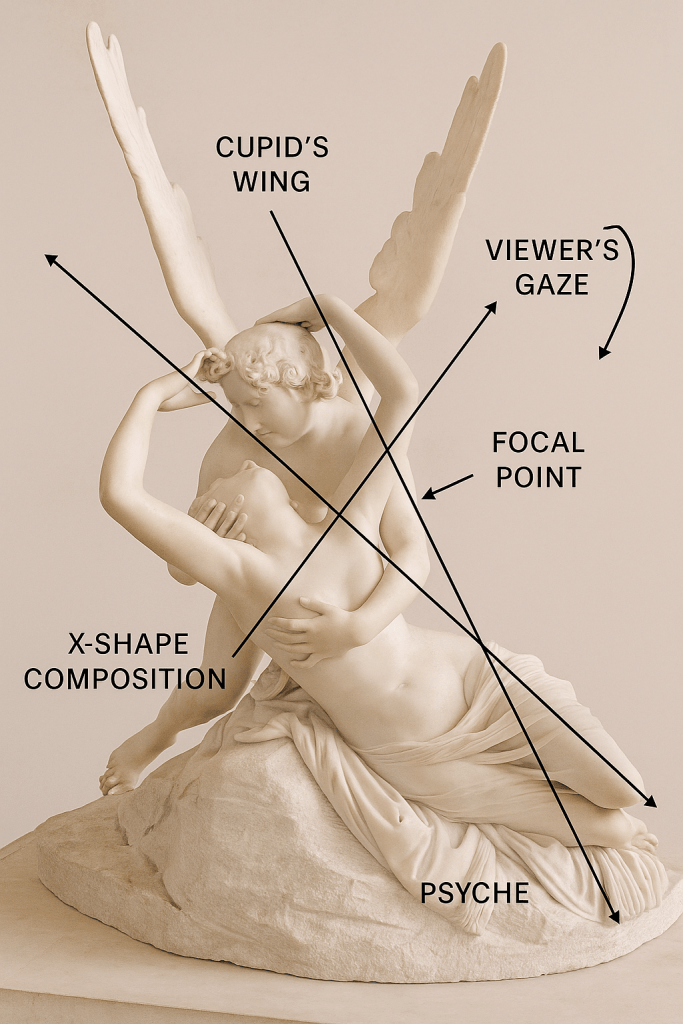
The sculpture captures the precise instant of awakening: Cupid bends over Psyche, supporting her head with one hand while their lips draw near. Psyche’s arms reach upward to encircle him, creating a perfect X-shaped composition — a dynamic cross of limbs and wings that binds the figures together.
Key features to observe:
Cupid’s wings rise upward like an angelic halo, framing the scene and drawing the eye toward the couple’s faces.
Psyche’s body arches in a graceful curve, suggesting both fragility and renewal.
Their hands and faces form the emotional focal point — the intersection of life, love, and divine energy.
The base of the sculpture, rough and unpolished, contrasts with the smooth flesh above, symbolizing the transition from earthly death to heavenly awakening.
In the educational diagram below, the X-shape composition and the diagonal lines of sight show how Canova directs the viewer’s gaze from Cupid’s wings to Psyche’s face and then downward through the drapery — a continuous flow of motion through stillness.
5. Symbolism and Interpretation
Canova’s sculpture is far more than an illustration of a myth — it is a philosophical meditation on love and the soul.
The moment of Psyche’s awakening becomes a symbol of spiritual rebirth. The butterfly, often associated with Psyche in classical art, represents transformation — the soul leaving its cocoon of mortality. Cupid, as divine love, breathes eternal life into that soul.
The composition’s diagonal tension embodies both physical energy and emotional ascent: the human yearning for the divine, the eternal dance between matter and spirit.
In Neoclassical thought, beauty was a moral force — the visible expression of virtue and truth. Thus, Canova’s restrained tenderness contrasts with the passionate turmoil of Baroque art. Love here is not sensual conquest but spiritual restoration.
6. Reception and Legacy
When first exhibited in Rome, Psyche Revived by Cupid’s Kiss was immediately recognized as a masterpiece. Critics called it “the triumph of grace over passion.” Visitors were captivated by its lifelike delicacy and emotional power conveyed without exaggeration.
It became a defining work of Neoclassicism, illustrating how calm form could evoke profound feeling. The sculpture influenced generations of artists — including Bertel Thorvaldsen, Jean-Baptiste Carpeaux, and later Romantic painters who explored the harmony of body and spirit.
Even into the 19th century, it remained a reference point for art academies, where students studied its anatomy, symmetry, and emotion as an ideal of beauty.
7. Observing the Sculpture in the Louvre
The sculpture is displayed in the Denon Wing, Room 403, near Michelangelo’s Dying Slave and Rebellious Slave. The museum’s lighting enhances the subtle contrast between shadow and shine that Canova intended.
For a student observer:
Move around the sculpture; every angle reveals a new emotional dialogue.
Notice how light travels across the marble — the figures almost seem to breathe.
Observe how Cupid’s downward gaze meets Psyche’s upward movement, forming an eternal loop of love and revival.
Pay attention to the texture contrast between the finely polished skin and the rough rock — symbolizing transformation from mortality to divinity.
This active observation turns the experience from passive viewing into an encounter with Canova’s philosophy of life and art.
8. Enduring Meaning for Students
For modern students, Psyche Revived by Cupid’s Kiss offers three timeless lessons:
Technical mastery serves emotional truth. Canova’s polish and proportion allow the emotion to flow through form rather than overwhelm it.
Balance creates beauty. The sculpture’s X-shaped harmony shows how composition guides feeling.
Love awakens the soul. Beyond its mythic story, it reminds us that true beauty unites body and spirit, art and life.
In this sense, Canova’s work is not just about marble or myth — it is about humanity’s eternal desire for renewal, compassion, and transcendence.
Conclusion
In Psyche Revived by Cupid’s Kiss, Antonio Canova transformed stone into spirit. He captured the silent instant where death yields to love, and stillness becomes motion. His art bridges mythology and philosophy, sensuality and serenity, mortal and divine.
For all who stand before it — whether in wonder, study, or reverence — the message remains the same: Love revives, beauty endures, and art can awaken the sleeping soul.
“The beauty of the body is the beauty of the soul made visible.” — Antonio Canova
(Socrates Explains Auditing to a Very Slow Student)
Dramatis Personae
Socrates – Philosopher, irritated and unpaid.
Apprentice – An eager but dim student, fluent in curiosity, not accounting.
CFO – A tired but triumphant modern executive.
Audit Partner – High priest of Reasonable Assurance.
Junior Auditor – Silent observer, always writing.
Part I – Why “Unqualified” Means “Clean”
Apprentice: Master, I am baffled. Why do auditors call their best opinion unqualified? When my mother says I am unqualified, it is not a compliment.
Socrates: (Groaning) Because, my dear imbecile, the gods of accounting delight in contradiction. When they say unqualified, they mean without reservations. When they say clean, they mean no visible dirt. When they say material, they mean big enough to embarrass someone important.
Apprentice: So, “unqualified” means “good,” even though it sounds “bad”?
Socrates: Precisely. It is the linguistic gymnastics of a profession allergic to plain speech. An unqualified opinion is a clean one—no disclaimers, no confessions, no footnotes whispering “don’t sue us.”
Apprentice: But why not call it a perfect opinion?
Socrates: Because auditors fear perfection. Perfection implies responsibility, and responsibility implies liability. Instead, they seek the safer realm of reasonable assurance—a phrase that means, “We’re fairly sure everything’s fine, unless it isn’t.”
Apprentice: What about this word materiality they keep using?
Socrates: Ah, yes—their sacred idol. Materiality is the holy threshold between sin and salvation. A missing coin? Immaterial. A missing treasury? Material. And if the city burns down? “Subsequent event—disclosed in Note 17.”
Apprentice: And who decides what’s material?
Socrates: A mythical being known as the reasonable user of financial statements—a creature never seen in nature, but often invoked in court.
Part II – Socrates’ Audit Field Notes
(From the philosopher’s unwilling internship.)
Day 1 – Arrival They descend upon the city like well-dressed locusts carrying laptops. They introduce themselves politely, then demand ledgers, receipts, and things long lost to history. “We’ll only be here a few weeks,” they say. Three moons later, they’re still in the break room, testing petty cash.
Day 7 – Sampling They claim to find the truth by studying ten transactions out of ten thousand. “Representative sample,” they say. “Reasonable assurance,” they add. I call it faith healing with spreadsheets.
Day 15 – Materiality The auditors debate whether a missing goat is material. After long deliberation, they conclude that one goat is immaterial—unless the herd only had one.
Day 29 – Planning the Plan They plan the audit, then plan the planning, then plan a meeting to discuss whether the plan aligns with the planned planning. I admire their devotion to process, if not progress.
Day 45 – Walkthrough An auditor asks me to “walk him through” our cash disbursement cycle. We literally walk—to the market, buy a chicken, and pay the vendor. “Control deficiency,” he mutters. I agree.
Day 73 – The Opinion Letter After months of work and the sacrifice of several interns, the final parchment emerges:
“In our opinion, the financial statements present fairly, in all material respects…”
Translated from Auditorian: “We didn’t find anything catastrophic, though we looked very hard and are still suspicious.”
Closing Reflection: Auditors are philosophers of doubt. They pursue truth with calculators and disclaimers, living in eternal tension between assurance and fear of subpoena.
Part III – The Post-Audit Symposium
CFO: Finally! A clean opinion! We are vindicated.
Audit Partner: Indeed. Unqualified—no exceptions, no reservations, no surprises.
Socrates: And yet, you call it “fairly presented.” Why not “true”?
Audit Partner: Because “true” is for prophets. We offer “fair,” which is safer and billable.
Socrates: You sell comfort, not certainty.
Audit Partner: Exactly! Certainty is reckless. Comfort pays the rent.
CFO: Still, this took four months!
Audit Partner: Timeliness is immaterial. Until it surpasses a GASB requirement.
Socrates: (Sighs) So your audit is both eternal and late. How fitting. Tell me, why not simply trust the books?
Audit Partner: Because trust, unverified, is heresy.
Socrates: Then you are theologians of skepticism.
Audit Partner: (Nods) We call it professional skepticism.
Socrates: A fine term for universal suspicion.
Audit Partner: We are trained to doubt until evidence says otherwise—and even then, we document our doubt in triplicate.
CFO: Still, “unqualified” sounds insulting.
Socrates: Indeed! The irony is that the highest praise of your craft sounds like an insult. You should call it Immaculately Unqualified.
Audit Partner: We tried that once. Legal said no.
(The Junior Auditor silently logs 0.25 hours for “client philosophical engagement.”)
Socrates: And this materiality—how is it decided?
Audit Partner: We gather in secret, summon spreadsheets, and chant percentages until consensus appears.
Socrates: A ritual of quantitative mysticism! Tell me, what if you find something truly awful?
Audit Partner: Then the opinion is qualified, the CFO is nervous, and the audit partner retires early.
Socrates: (Raising his cup) To auditors—guardians of truth by approximation! May your samples be random, your conclusions conservative, and your coffee deductible!
All: Hear, hear!
Epilogue – The Ancient Spoof
(Socrates unrolls an ancient scroll.)
“The typical accountant is a man, past middle age, spare, wrinkled, intelligent, cold, passive, non-committal, with eyes like a codfish; polite in contact but at the same time unresponsive, calm and damnably composed as a concrete post or a plaster-of-Paris cast; a petrification with a heart of feldspar and without charm of the friendly germ, minus bowels, passion or a sense of humor. Happily, they never reproduce, and all of them finally go to Hell.” — Elbert Hubbard, early 1900s (often quoted mid-century for auditors and proudly found in the preface of some auditing reference material)
Socrates: A cruel jest—but one senses it was written by a man recently audited.
Final Hymn: “Reasonable Assurance”
(To the solemn tempo of an office coffee maker)
Verse 1 Oh, auditors come in the fall’s rain, With checklists, ticks, and doubt’s domain. They question all, from cash to soul, Then bill us hourly for control.
Chorus Reasonable assurance, softly we pray, Nothing material shall ruin our day. Clean though unqualified, cautious yet bright, Blessed be GAAP, and good-night, good-night.
Verse 2 They test the goats, they test the grain, They find no fraud—just minor pain. They sign their names, they bow, they leave, And send an invoice we can’t believe.
Final Chorus Reasonable assurance, hold fast, hold true, For certainty’s dangerous and lawsuits accrue. Clean though unqualified, may wisdom delight, For even Socrates closes the books at night.







 Let's Talk About It, Lewis!
You must be logged in to post a comment.