What Question Are We Actually Answering?

A collaboration between Lewis McLain & AI

Why Good Analysis Begins Long Before Data — and Why Asking Better Questions Is a Skill That Must Be Practiced


I. The Invisible Starting Line

Every serious analysis begins with a question.
Almost every serious failure begins with the wrong one.

This is uncomfortable because it means that many errors are not technical. They are not caused by bad data, weak models, insufficient funding, or lack of expertise. They occur before any of that—at the moment a question is framed, accepted, and allowed to go unchallenged.

Questions are often inherited rather than chosen. They arrive embedded in headlines, legislation, grant applications, consulting scopes, software templates, or political urgency. By the time anyone pauses to ask whether the question itself is sound, the machinery is already moving.

Once that happens, better data does not fix the problem.
It accelerates it.

Precision is not clarity. A precisely answered wrong question produces results that feel authoritative while being fundamentally misleading. This is why analysis so often fails quietly and confidently.


II. The Four Types of Questions (And Why Only One Sustains Analysis)

Not all questions do the same kind of work. Most confusion in public debate and institutional decision-making comes from treating very different questions as if they were interchangeable.

1. Descriptive Questions

What is happening?

These establish facts, counts, and trends. They are necessary, but inert. Description alone does not explain change, causation, or constraint. Mistaking description for understanding is one of the most common analytical errors.

2. Attributional Questions

Who is responsible?

These arrive early and loudly. They satisfy emotional and political needs, but they tend to collapse complex systems into villains and heroes. Attribution feels like insight, but it usually precedes understanding.

3. Prescriptive Questions

What should we do?

These feel decisive and productive. They are also dangerous when asked prematurely. Prescriptions lock systems into action paths that may be impossible to reverse, even if the diagnosis was wrong.

4. Analytical Questions

What changed, relative to what, over what time horizon, and under which constraints?

These are the least intuitive and least rewarded questions, yet they are the only ones that scale. They slow the conversation down, resist moral shortcuts, and force structure onto complexity.

Most debates skip directly from description to prescription. Analysis happens, if at all, in the margins.


III. Time Horizons: The Quiet Distorter

Every question implies a time frame, whether stated or not. When it goes unstated, it is almost always too short.

Systems behave differently over one year than over five, and differently again over a generation. Short horizons hide maturation effects, suppress lagged consequences, and reward surface solutions. Long horizons expose tradeoffs, reveal inevitabilities, and demand humility.

When someone asks, “Why is this happening now?” without clarifying whether “now” means this quarter, this decade, or this lifecycle stage, the answer will be confident and wrong.

A reliable analytical rule is simple:
If the time horizon is unstated, it is probably distorting the conclusion.


IV. Baselines: The Question Nobody Wants to Ask

“Compared to what?” is the most expensive sentence in analysis.

Baselines are almost always chosen quietly and defended rarely. Yet they determine whether something appears as growth or stagnation, crisis or normal variation, success or failure.

Common baseline errors include:

  • Comparing growing systems to static ones
  • Comparing interventions to “doing nothing,” which never exists
  • Comparing today to yesterday instead of to trend or lifecycle stage

Without a baseline, change has no meaning. Without an agreed-upon baseline, debate becomes endless recalibration rather than understanding.

The refusal—or failure—to ask baseline questions is not a technical oversight. It is often a psychological one. Baselines make certain narratives harder to maintain.


V. The Substitution Problem

Systems do not eliminate pressure. They redirect it.

Every policy, reform, or intervention substitutes one cost, risk, or burden for another. The analytical failure is not unintended consequences; it is unacknowledged substitution.

When analysis celebrates a solution without tracing where pressure moved, it is incomplete by definition. The question “What problem did we solve?” must be followed immediately by “Where did the pressure go?”

Ignoring substitution allows success to be declared in one domain while strain accumulates invisibly in another.


VI. Metrics Are Mirrors, Not Truth

Metrics are indispensable—and dangerous.

They capture what is easy to measure, not necessarily what matters most. They reward visibility, not durability. They improve responsiveness but often degrade resilience.

Measurement should provoke questions, not end them. When metrics become substitutes for judgment, they stop illuminating reality and begin reflecting institutional incentives back at themselves.

What improves on paper may be decaying in practice. The analyst’s task is not to reject metrics, but to interrogate them relentlessly.


VII. The Discipline of the Second Question

Most people ask one good question. Then they stop.

The first question usually reveals curiosity. The second reveals discipline.

  • First question: What happened?
  • Second question: Relative to what expectation?
  • Third question: Why now and not earlier?
  • Fourth question: At whose expense did this improve?
  • Fifth question: What constraint was binding?

Most analytical errors occur between questions one and two. The pause required to ask the second question feels unproductive, even obstructive. In reality, it is where understanding begins.


VIII. Asking Good Questions Is a Skill — and It Must Be Practiced

The ability to ask good questions is not innate. It is trained.

It requires resisting the urge to sound smart quickly. It requires tolerating ambiguity longer than is comfortable. It requires being willing to appear slow, cautious, or even naïve in environments that reward speed and certainty.

Like any discipline, it improves through repetition:

  • Reviewing past analyses and identifying where the wrong question was asked
  • Practicing reframing problems in multiple ways before selecting one
  • Studying failures not for answers, but for misframed questions
  • Learning to sit with incomplete understanding without rushing to closure

Good questioners are not passive. They are rigorous. They know that the hardest work happens before the first chart, model, or recommendation.


IX. What Your Questions Reveal About You

Questions are diagnostic. They reveal far more about the questioner than about the subject being questioned.

They reveal:

  • Whether someone is seeking understanding or validation
  • Whether they tolerate uncertainty or rush to control
  • Whether they think in systems or in narratives
  • Whether they are curious about limits or allergic to them

A person who habitually asks attributional questions before analytical ones is revealing impatience with complexity. A person who never asks baseline or time-horizon questions is revealing comfort with surface explanations.

In this sense, questions are a form of moral autobiography. Over time, they expose whether a person is oriented toward truth, persuasion, blame, or reassurance.


X. Analysis as Responsibility

Analysis is not neutral. It shapes how resources are allocated, how authority is exercised, and how force—legal, financial, or moral—is applied.

Bad questions do not merely mislead; they coerce. They narrow the range of permissible answers and foreclose alternatives before they are considered.

The responsibility of the analyst is not certainty. It is honesty about limits, tradeoffs, and unknowns. Asking better questions is not intellectual vanity; it is an ethical act.


Conclusion

The most dangerous answers are not the wrong ones.
They are the ones that emerge from unexamined questions.

Before asking what the data says, before debating solutions, before declaring success or failure, the analyst owes one discipline above all others:

Stop.
Name the question.
Interrogate it.
And be willing to change it.

That pause—unrewarded, uncomfortable, and often invisible—is where real thinking begins.

Plan v Pivot: Texas Municipal Leadership in the World of “Re-”

Suggested by Dan Johnson, written mostly by AI, guided and edited by Lewis McLain

Introduction

In Texas, city and county leaders live in the tension between plans that guide and pivots that save. Long-range blueprints for infrastructure, budgets, and land use are essential. Yet when storms overwhelm, revenues collapse, or the legislature rewrites the rules, leaders must step into the re- world: redoing assumptions, rewriting priorities, reallocating resources, reassessing risks, and reestablishing trust with citizens. Leadership is not static. It is a continual act of resilience, built on both discipline and improvisation. There is a rhythm, not quite a dance, but an orchestra conductor directing an Attacca, a performance instruction that means to go straight on without pause to the next movement.


The Discipline of Planning

Texas cities exemplify disciplined planning:

  • Capital Improvement Programs (CIPs). Road expansions, water treatment plants, and fire stations are mapped years in advance.
  • Water Supply Projects. Regional providers like the North Texas Municipal Water District (NTMWD) develop 50-year strategies for reservoirs, pipelines, and treatment capacity.
  • Comprehensive Plans. Land use, housing, and growth corridors are charted to keep pace with booming populations.

Planning sets expectations, aligns departments, and reassures taxpayers. Without it, chaos replaces coordination. But even the most detailed plan must later be reassessed when conditions shift.


Planning or Pivoting?

The Guadalupe River Flood: Forced to Re-Act

On July 4, 2024, relentless rains along the Guadalupe River brought flash floods that tore through Comal and Guadalupe Counties.

  • Plans Overwhelmed. Drainage systems designed for “100-year storms” were outmatched. Evacuation maps had to be rewritten in real time.
  • Immediate Pivot. Cities reallocated crews from parks to barricading roads, redirected budget reserves to emergency shelters, and reorganized communication channels for disaster alerts.
  • Aftermath. Communities began to rebuild, reestablish housing security, and rejuvenate battered neighborhoods with state and federal aid. Drainage master plans were redone with updated floodplain models, a stark reminder that plans are only drafts in the face of Texas weather.

This was not failure of planning but proof that leaders must be able to redo and rewrite without hesitation.


Normal Maintenance

Planned Programs Interrupted by Necessary Pivots

Pivoting to State Legislative Changes

Just as floods force emergency pivots, state politics forces cities into the re- cycle.

  1. Revenue Caps (2019). When Senate Bill 2 capped property tax growth at 3.5% without voter approval, cities like Austin, Plano, and may others had to recalculate their forecasts, reallocate funds from amenities to core services, and reassess debt capacity.
  2. Annexation Restrictions (2017 & 2019). Cities such as San Antonio saw decades-long growth plans undone. Annexation strategies were rewritten, and economic development priorities restructured to adapt to shrinking boundaries.
  3. Sales Tax Rebate Reforms (SB 878, 2023). Cities like Round Rock and Coppell, which had relied on rebate agreements with corporations, had to pivot to reforecast, redefine budgets, and reestablish trust with residents when revenues suddenly tightened.

In each case, local leaders could not cling to outdated forecasts. They had to redo priorities, rewrite budgets, and reframe commitments while keeping faith with their communities.


Fundamental Programs

Interrupted by Unplanned Events

The Backbone of Data Management & Operations Flow Attacked

The Total Focus for Days, Weeks, or even Months

The Source and Power of “Re-”

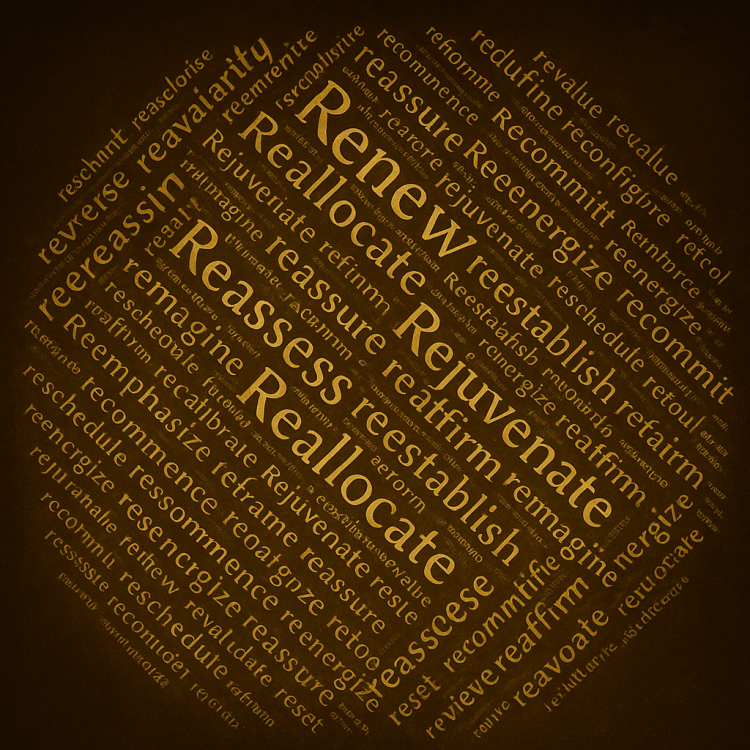
I think back to when I taught budgeting in the SMU MPA programs, my introduction to the subject included an emphasis on “The Re Words.” The prefix re- comes from Latin, where it carried the simple meaning of “back” or “again.” Over centuries, carried into English through Old French, it grew into one of the most versatile and powerful tools in our language. To add re- to a verb is rarely neutral; it signals renewal, restoration, or fresh possibility. Rebuild, reconnect, reform, restore, redeem, resurrect—each carries the weight of beginning again, of not being bound by failure or finality. Even in ordinary civic leadership, words like reassess, reallocate, reimagine, and rejuvenate offer not just management strategies but visions of resilience. The “re-” family of words tends toward the uplifting: they invite us to believe that what is broken can be mended, what is lost can be recovered, and what seems finished can yet be begun anew. In that sense, “re-” is not merely a prefix but a promise—one that leaders must embody when guiding people and communities through change.


The Language of Pivoting

The Leadership Imperative: Living in the Re- Cycle

Texas municipal leadership is now defined by agility within the re- cycle:

  • Reassess: Constantly test whether assumptions still hold.
  • Reallocate: Shift funds and staff quickly to where they are most needed.
  • Rewrite: Adjust ordinances, plans, or budgets without waiting for the next five-year update.
  • Reestablish: Rebuild legitimacy and public confidence after disruption.
  • Rejuvenate: Use moments of crisis to breathe new energy into tired systems, outdated practices, or strained organizations.

These concepts do not abandon planning. It is treating plans as living documents, always subject to revision and renewal.


Conclusion: The Art of Resilience

In Texas municipal government, planning without pivoting is arrogance, and pivoting without planning is chaos. The art lies in combining the two through a constant rhythm of re- words: to redo when plans prove wrong, rewrite when policies are outdated, reallocate when funds are strained, reassess when risks emerge, reestablish when trust falters, and rejuvenate when systems tire.

Leadership is not about choosing plan or pivot once and for all. It is about repeatedly returning—to purpose, to mission, to the people—no matter how many times circumstances force change. It requires the supreme idea of agility. Some responses can’t wait hours or days. They must be well-oiled actions as if you knew an event was coming.

The July 4 flood showed that nature will undo assumptions. The Legislature’s actions showed that politics will redraw boundaries. But resilient leaders—those willing to live in the re- cycle—ensure that their cities not only survive, but renew themselves time and again. Interestingly, and sometimes strangely, the outcome will not be just a fix but rather an improvement.


The Re-Creed of Leadership

We plan with care,
yet we are ready to redo, knowing even the best blueprints must yield to reality.

We decide with courage,
yet we humbly reassess, for wisdom is found not in stubbornness but in learning anew.

We allocate with prudence,
yet we swiftly reallocate, remembering that resources serve people, not plans alone.

We write for the future,
yet we are willing to rewrite, because vision is alive and must grow with the times.

We stand for stability,
yet we daily reestablish trust, for legitimacy is not won once, but earned again and again.

We serve in the present,
yet we strive to rejuvenate tomorrow, so that what we build outlasts us and lifts generations to come.

For true leadership is not one act,
but the continual rhythm of resilience, renewal, and return.

Servant Leadership: From Hermann Hesse to Robert Greenleaf and Beyond

Inspired by Dan Johnson, Written by AI, Guided and Edited by Lewis McLain

I. Hermann Hesse: Life and Vision

Hermann Hesse (1877–1962) was one of the twentieth century’s most influential literary figures, a seeker whose novels became guideposts for millions navigating the crises of modernity. Born in Calw, in the Black Forest of Germany, Hesse was the son of Christian missionaries. His childhood was steeped in pietism and biblical devotion, but also in conflict—he struggled against the rigidity of his family’s expectations and endured mental health crises that shaped his outlook. When I read many of his books, there were two recurring personal notes in his diaries: he had bad eyesight and complained about how much his eyes hurt. He also traded letters with friends that include small water paintings sent and received. Those pictures seemed to be pleasing to Hesse. If you start seeing pictures (with the help of AI), my motivation comes from Mr. Hesse. LFM


Herman Hesse

For Hesse, writing was both therapy and spiritual exploration. His early novels reflected the tensions of his life: the desire for freedom against the weight of tradition, the search for authenticity in a rapidly industrializing world.

  • In Demian (1919), Hesse explored inner duality, freedom, and the necessity of self-discovery beyond societal norms.
  • In Siddhartha (1922), he imagined a man’s journey to enlightenment in ancient India, fusing Western existential doubt with Eastern philosophy.
  • In Steppenwolf (1927), he dramatized the loneliness of the modern intellectual and the quest for transcendence amid despair.
  • In The Glass Bead Game (1943), his Nobel Prize–winning masterpiece, he conjured a future order devoted to the synthesis of knowledge, beauty, and spirituality.

Amid these great novels stands a shorter but profoundly symbolic tale: The Journey to the East (1932). Though brief, it contains one of Hesse’s most enduring insights—leadership is not power, but service.


II. The Journey to the East: The Servant and the Master

The novella tells the story of a secret brotherhood called the League, a timeless spiritual fellowship that undertakes a pilgrimage “to the East.” The East is never fully defined—it is both place and symbol, representing wisdom, transcendence, and the fulfillment of human longing.

The narrator, H.H., joins the League’s pilgrimage. Along the way he describes a mysterious assortment of travelers: historical figures, literary characters, and seekers from all walks of life. The journey unites them in pursuit of a higher goal.


Leo

Yet the true heart of the story is a man named Leo. Leo appears to be nothing more than a cheerful servant. He tends to the pilgrims, carries their bags, prepares their meals, and sings songs that lift their spirits. He is ordinary, unnoticed—yet indispensable.

Then one day Leo disappears. Without him, the pilgrims falter. Discord and division creep in, and the League dissolves. H.H. falls into despair, convinced the journey has failed.

Years later, in a twist of revelation, H.H. learns the truth: Leo was not simply a servant. He was in fact a leader of the League, the embodiment of the very wisdom the pilgrims were seeking. The pilgrimage fell apart because the group failed to recognize that true leadership had been in their midst all along.

Hesse’s parable is at once mystical and practical: it insists that authentic leadership flows not from domination but from humble service. In the inversion of roles—servant as master, master as servant—Hesse revealed a paradox at the heart of human community.


Greenleaf

III. Robert Greenleaf and the Birth of Servant Leadership

Decades later, in the United States, Robert K. Greenleaf (1904–1990), an executive at AT&T, was searching for a new way to understand leadership. He had witnessed firsthand how corporate hierarchies often crushed initiative, fostered fear, and alienated workers. After 40 years in management, he turned to teaching and writing, determined to challenge the prevailing model of top-down authority.

In the 1950s, Greenleaf read The Journey to the East, and Leo’s example struck him like lightning. Here was the vision he had been seeking: the leader is great not because of command but because of service. Out of this insight, he developed the philosophy he called servant leadership.

In his seminal 1970 essay, The Servant as Leader, Greenleaf wrote:

“The servant-leader is servant first… It begins with the natural feeling that one wants to serve, to serve first. Then conscious choice brings one to aspire to lead. The difference manifests itself in the care taken to make sure that other people’s highest priority needs are being served.”

Greenleaf’s framework reshaped modern leadership thinking. He identified qualities that distinguish servant leaders:

  • Listening and Empathy – Understanding others deeply before acting.
  • Awareness and Foresight – Seeing beyond immediate demands to future consequences.
  • Healing and Stewardship – Caring for individuals and institutions as trust, not possessions.
  • Commitment to Growth – Helping others become wiser, healthier, and freer.
  • Building Community – Nurturing belonging, not simply extracting productivity.

Unlike traditional leadership, which seeks power to direct, servant leadership seeks responsibility to care. Greenleaf insisted that the true test of leadership was not organizational success but human flourishing: “Do those served grow as persons?”


IV. Servant Leadership in Today’s World

Although Greenleaf’s vision emerged from corporate disillusionment, servant leadership has spread far beyond the boardroom. Its influence can be traced across diverse spheres today:

1. Faith-Based Institutions

  • Many Christian organizations and seminaries explicitly teach servant leadership, grounding it in the life of Jesus.
  • Pope Francis has often invoked its spirit, urging leaders to be “shepherds who smell of the sheep.”
  • Evangelical colleges and Catholic universities alike offer leadership courses built around Greenleaf’s principles.

2. Education

  • Universities such as Gonzaga, Indiana Wesleyan, and Regent have made servant leadership central to their leadership programs.
  • In secular contexts, “inclusive leadership” and “transformational leadership” often echo servant leadership’s core values of empathy and empowerment.

3. Healthcare and Caring Professions

  • Hospitals and nursing schools apply servant leadership to patient-centered care.
  • Nursing theory highlights Greenleaf’s ideas of empathy and stewardship as essential to healing.
  • Systems like Cleveland Clinic and Mayo Clinic promote leadership cultures rooted in service.

4. Nonprofits and Social Enterprises

  • Global NGOs like Habitat for Humanity and World Vision emphasize leadership through service to the vulnerable.
  • Social entrepreneurs adopt servant leadership as a model for organizations aimed at social good.

5. Business

  • Southwest Airlines and TDIndustries are classic case studies of servant leadership cultures in practice.
  • The rise of “conscious capitalism” and stakeholder-driven business models reflects a growing embrace of servant-leadership values.

6. Military and Public Service

  • Though hierarchical, parts of the U.S. military stress servant leadership: officers as stewards of their soldiers’ welfare.
  • Police and fire departments in some communities incorporate the philosophy for community trust.

7. Global Reach

  • In Africa, servant leadership resonates with Ubuntu (“I am because we are”), highlighting shared humanity.
  • In Asia, it has influenced leadership practices in Singapore and the Philippines, where communal values are strong.
  • In Scandinavia, egalitarian management structures mirror Greenleaf’s call for humility and shared responsibility.

In today’s world of political polarization, corporate scandals, and institutional mistrust, servant leadership remains both countercultural and urgently relevant. Where command-and-control leadership often falters, servant leadership builds trust, resilience, and long-term sustainability.


V. Conclusion: The Servant as the True Leader

Hermann Hesse, writing in a fractured Europe, offered a parable of a servant who was secretly a master. Robert Greenleaf, confronting the failures of mid-century corporate America, found in that story the spark for a radical rethinking of leadership.

Together, they remind us that the deepest authority is not rooted in command but in service. Leadership is not the pursuit of followers but the care of souls. Institutions endure not because of power structures but because of communities sustained by humility, empathy, and stewardship.

In an age that often celebrates strength as dominance, Hesse and Greenleaf point to another way: that the one who carries the bags may in fact be the one who carries the truth.