Psyche Revived by Cupid’s Kiss

A collaboration between Lewis McLain & AI (more from the three visits Linda & I had to the Louvre with high school students from Trinity Christian Academy).

Antonio Canova and the Awakening of the Soul


Introduction

Among the marble treasures of the Louvre Museum stands one of the most moving sculptures of all time — Psyche Revived by Cupid’s Kiss, carved by the Italian master Antonio Canova between 1787 and 1793. It depicts the mythological moment when the god Cupid (Eros) revives his beloved Psyche with a kiss, restoring her from deathlike sleep to life and love.

At once tender, idealized, and technically perfect, this masterpiece captures not only the beauty of myth but also the intellectual spirit of the Neoclassical age. For any student observer, it represents the perfect synthesis of form, feeling, and philosophy — a lesson in how art can make marble breathe.


1. The Artist and His Era

Antonio Canova (1757–1822) was born in Possagno, Italy, into a family of stonemasons. Trained in Venice and working in Rome, he became the undisputed master of the Neoclassical style, the artistic movement that sought to revive the order, harmony, and moral clarity of ancient Greece and Rome.

Canova’s art emerged during the Age of Enlightenment, a time when reason, science, and rediscovered antiquity guided intellectual life. Artists looked to classical sculpture for purity of line and noble simplicity. Against the emotional extravagance of the Baroque, Canova’s figures embodied balance, restraint, and serenity.

His goal, he once said, was to give marble the “appearance of living flesh” — and through meticulous polishing and proportion, he succeeded. His works, such as Perseus with the Head of Medusa and The Three Graces, stand as paragons of refinement and calm emotional depth.


2. The Myth of Cupid and Psyche

The story comes from Apuleius’s The Golden Ass (2nd century A.D.), one of the most enduring love myths of classical antiquity.

  • Psyche, a mortal woman of exceptional beauty, arouses the jealousy of Venus (Aphrodite), who orders her son Cupid to make Psyche fall in love with a monster.
  • Instead, Cupid himself falls in love with Psyche, visiting her each night unseen. When Psyche disobeys his order never to look at him, he vanishes.
  • After many trials set by Venus, Psyche opens a box meant to contain beauty but instead releases a deadly sleep upon herself.
  • Cupid finds her lifeless body, lifts her in his arms, and awakens her with a kiss.
  • In the end, the gods grant Psyche immortality so she may be eternally united with Cupid.

The myth is a timeless allegory of the soul’s (psyche) awakening to divine love and eternal life — a theme that resonated deeply with both ancient philosophy and Christian symbolism.


3. Commission and Creation

Canova received the commission around 1787 from Colonel John Campbell, a British nobleman visiting Rome. The sculptor completed the work by 1793, using Carrara marble, prized for its pure white translucence.

He later produced a second version (1796), now in the Hermitage Museum, but the first — the Louvre version — remains the most celebrated. It was acquired by Joachim Murat, Napoleon’s brother-in-law, and entered the Louvre’s collection in 1824.

Canova personally oversaw every stage of its creation, using fine abrasives and oil to achieve an extraordinary surface polish. This allowed light to glide across the marble as if over living skin, enhancing the illusion of breath and movement.


4. Composition and Form

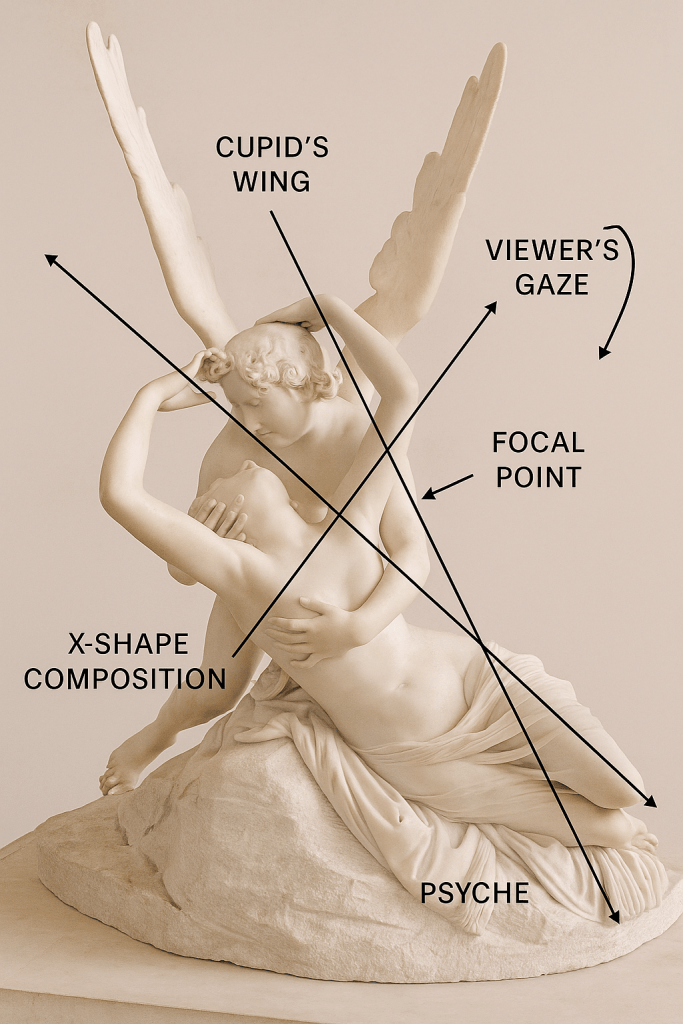
The sculpture captures the precise instant of awakening: Cupid bends over Psyche, supporting her head with one hand while their lips draw near. Psyche’s arms reach upward to encircle him, creating a perfect X-shaped composition — a dynamic cross of limbs and wings that binds the figures together.

Key features to observe:

  • Cupid’s wings rise upward like an angelic halo, framing the scene and drawing the eye toward the couple’s faces.
  • Psyche’s body arches in a graceful curve, suggesting both fragility and renewal.
  • Their hands and faces form the emotional focal point — the intersection of life, love, and divine energy.
  • The base of the sculpture, rough and unpolished, contrasts with the smooth flesh above, symbolizing the transition from earthly death to heavenly awakening.

In the educational diagram below, the X-shape composition and the diagonal lines of sight show how Canova directs the viewer’s gaze from Cupid’s wings to Psyche’s face and then downward through the drapery — a continuous flow of motion through stillness.


5. Symbolism and Interpretation

Canova’s sculpture is far more than an illustration of a myth — it is a philosophical meditation on love and the soul.

The moment of Psyche’s awakening becomes a symbol of spiritual rebirth. The butterfly, often associated with Psyche in classical art, represents transformation — the soul leaving its cocoon of mortality. Cupid, as divine love, breathes eternal life into that soul.

The composition’s diagonal tension embodies both physical energy and emotional ascent: the human yearning for the divine, the eternal dance between matter and spirit.

In Neoclassical thought, beauty was a moral force — the visible expression of virtue and truth. Thus, Canova’s restrained tenderness contrasts with the passionate turmoil of Baroque art. Love here is not sensual conquest but spiritual restoration.


6. Reception and Legacy

When first exhibited in Rome, Psyche Revived by Cupid’s Kiss was immediately recognized as a masterpiece. Critics called it “the triumph of grace over passion.” Visitors were captivated by its lifelike delicacy and emotional power conveyed without exaggeration.

It became a defining work of Neoclassicism, illustrating how calm form could evoke profound feeling. The sculpture influenced generations of artists — including Bertel Thorvaldsen, Jean-Baptiste Carpeaux, and later Romantic painters who explored the harmony of body and spirit.

Even into the 19th century, it remained a reference point for art academies, where students studied its anatomy, symmetry, and emotion as an ideal of beauty.


7. Observing the Sculpture in the Louvre

The sculpture is displayed in the Denon Wing, Room 403, near Michelangelo’s Dying Slave and Rebellious Slave. The museum’s lighting enhances the subtle contrast between shadow and shine that Canova intended.

For a student observer:

  • Move around the sculpture; every angle reveals a new emotional dialogue.
  • Notice how light travels across the marble — the figures almost seem to breathe.
  • Observe how Cupid’s downward gaze meets Psyche’s upward movement, forming an eternal loop of love and revival.
  • Pay attention to the texture contrast between the finely polished skin and the rough rock — symbolizing transformation from mortality to divinity.

This active observation turns the experience from passive viewing into an encounter with Canova’s philosophy of life and art.


8. Enduring Meaning for Students

For modern students, Psyche Revived by Cupid’s Kiss offers three timeless lessons:

  1. Technical mastery serves emotional truth. Canova’s polish and proportion allow the emotion to flow through form rather than overwhelm it.
  2. Balance creates beauty. The sculpture’s X-shaped harmony shows how composition guides feeling.
  3. Love awakens the soul. Beyond its mythic story, it reminds us that true beauty unites body and spirit, art and life.

In this sense, Canova’s work is not just about marble or myth — it is about humanity’s eternal desire for renewal, compassion, and transcendence.


Conclusion

In Psyche Revived by Cupid’s Kiss, Antonio Canova transformed stone into spirit. He captured the silent instant where death yields to love, and stillness becomes motion. His art bridges mythology and philosophy, sensuality and serenity, mortal and divine.

For all who stand before it — whether in wonder, study, or reverence — the message remains the same: Love revives, beauty endures, and art can awaken the sleeping soul.

“The beauty of the body is the beauty of the soul made visible.”
Antonio Canova

Socrates Teaches Auditing

A collaboration between Lewis McLain & AI

A Philosophical Comedy in Three Parts

(Socrates Explains Auditing to a Very Slow Student)


Dramatis Personae

  • Socrates – Philosopher, irritated and unpaid.
  • Apprentice – An eager but dim student, fluent in curiosity, not accounting.
  • CFO – A tired but triumphant modern executive.
  • Audit Partner – High priest of Reasonable Assurance.
  • Junior Auditor – Silent observer, always writing.

Part I – Why “Unqualified” Means “Clean”

Apprentice: Master, I am baffled. Why do auditors call their best opinion unqualified? When my mother says I am unqualified, it is not a compliment.

Socrates: (Groaning) Because, my dear imbecile, the gods of accounting delight in contradiction. When they say unqualified, they mean without reservations. When they say clean, they mean no visible dirt. When they say material, they mean big enough to embarrass someone important.

Apprentice: So, “unqualified” means “good,” even though it sounds “bad”?

Socrates: Precisely. It is the linguistic gymnastics of a profession allergic to plain speech. An unqualified opinion is a clean one—no disclaimers, no confessions, no footnotes whispering “don’t sue us.”

Apprentice: But why not call it a perfect opinion?

Socrates: Because auditors fear perfection. Perfection implies responsibility, and responsibility implies liability. Instead, they seek the safer realm of reasonable assurance—a phrase that means, “We’re fairly sure everything’s fine, unless it isn’t.”

Apprentice: What about this word materiality they keep using?

Socrates: Ah, yes—their sacred idol. Materiality is the holy threshold between sin and salvation. A missing coin? Immaterial. A missing treasury? Material. And if the city burns down? “Subsequent event—disclosed in Note 17.”

Apprentice: And who decides what’s material?

Socrates: A mythical being known as the reasonable user of financial statements—a creature never seen in nature, but often invoked in court.


Part II – Socrates’ Audit Field Notes

(From the philosopher’s unwilling internship.)

Day 1 – Arrival
They descend upon the city like well-dressed locusts carrying laptops. They introduce themselves politely, then demand ledgers, receipts, and things long lost to history. “We’ll only be here a few weeks,” they say. Three moons later, they’re still in the break room, testing petty cash.

Day 7 – Sampling
They claim to find the truth by studying ten transactions out of ten thousand. “Representative sample,” they say. “Reasonable assurance,” they add. I call it faith healing with spreadsheets.

Day 15 – Materiality
The auditors debate whether a missing goat is material. After long deliberation, they conclude that one goat is immaterial—unless the herd only had one.

Day 29 – Planning the Plan
They plan the audit, then plan the planning, then plan a meeting to discuss whether the plan aligns with the planned planning. I admire their devotion to process, if not progress.

Day 45 – Walkthrough
An auditor asks me to “walk him through” our cash disbursement cycle. We literally walk—to the market, buy a chicken, and pay the vendor. “Control deficiency,” he mutters. I agree.

Day 73 – The Opinion Letter
After months of work and the sacrifice of several interns, the final parchment emerges:

“In our opinion, the financial statements present fairly, in all material respects…”

Translated from Auditorian: “We didn’t find anything catastrophic, though we looked very hard and are still suspicious.”

Closing Reflection:
Auditors are philosophers of doubt. They pursue truth with calculators and disclaimers, living in eternal tension between assurance and fear of subpoena.


Part III – The Post-Audit Symposium

CFO: Finally! A clean opinion! We are vindicated.

Audit Partner: Indeed. Unqualified—no exceptions, no reservations, no surprises.

Socrates: And yet, you call it “fairly presented.” Why not “true”?

Audit Partner: Because “true” is for prophets. We offer “fair,” which is safer and billable.

Socrates: You sell comfort, not certainty.

Audit Partner: Exactly! Certainty is reckless. Comfort pays the rent.

CFO: Still, this took four months!

Audit Partner: Timeliness is immaterial. Until it surpasses a GASB requirement.

Socrates: (Sighs) So your audit is both eternal and late. How fitting. Tell me, why not simply trust the books?

Audit Partner: Because trust, unverified, is heresy.

Socrates: Then you are theologians of skepticism.

Audit Partner: (Nods) We call it professional skepticism.

Socrates: A fine term for universal suspicion.

Audit Partner: We are trained to doubt until evidence says otherwise—and even then, we document our doubt in triplicate.

CFO: Still, “unqualified” sounds insulting.

Socrates: Indeed! The irony is that the highest praise of your craft sounds like an insult. You should call it Immaculately Unqualified.

Audit Partner: We tried that once. Legal said no.

(The Junior Auditor silently logs 0.25 hours for “client philosophical engagement.”)

Socrates: And this materiality—how is it decided?

Audit Partner: We gather in secret, summon spreadsheets, and chant percentages until consensus appears.

Socrates: A ritual of quantitative mysticism! Tell me, what if you find something truly awful?

Audit Partner: Then the opinion is qualified, the CFO is nervous, and the audit partner retires early.

Socrates: (Raising his cup) To auditors—guardians of truth by approximation! May your samples be random, your conclusions conservative, and your coffee deductible!

All: Hear, hear!


Epilogue – The Ancient Spoof

(Socrates unrolls an ancient scroll.)

“The typical accountant is a man, past middle age, spare, wrinkled, intelligent, cold, passive, non-committal, with eyes like a codfish; polite in contact but at the same time unresponsive, calm and damnably composed as a concrete post or a plaster-of-Paris cast; a petrification with a heart of feldspar and without charm of the friendly germ, minus bowels, passion or a sense of humor. Happily, they never reproduce, and all of them finally go to Hell.
Elbert Hubbard, early 1900s (often quoted mid-century for auditors and proudly found in the preface of some auditing reference material)

Socrates: A cruel jest—but one senses it was written by a man recently audited.


Final Hymn: “Reasonable Assurance”

(To the solemn tempo of an office coffee maker)

Verse 1
Oh, auditors come in the fall’s rain,
With checklists, ticks, and doubt’s domain.
They question all, from cash to soul,
Then bill us hourly for control.

Chorus
Reasonable assurance, softly we pray,
Nothing material shall ruin our day.
Clean though unqualified, cautious yet bright,
Blessed be GAAP, and good-night, good-night.

Verse 2
They test the goats, they test the grain,
They find no fraud—just minor pain.
They sign their names, they bow, they leave,
And send an invoice we can’t believe.

Final Chorus
Reasonable assurance, hold fast, hold true,
For certainty’s dangerous and lawsuits accrue.
Clean though unqualified, may wisdom delight,
For even Socrates closes the books at night.

The Mind of an Inventor: The Common Thread of Creation

A collaboration between Lewis McLain & AI


I. Introduction — The Spark That Changes the World

Every great invention begins not in a laboratory but in a restless mind that refuses to accept things as they are. The inventor lives in the thin air between wonder and frustration: the wonder of seeing what might be, and the frustration that it does not yet exist.

To invent is to cross the border between imagination and matter—between “why not?” and “now it works.” Across centuries, the world’s greatest inventors have built in different mediums—stone, steam, circuits, code—yet share the same mental wiring: curiosity that won’t rest, courage that won’t quit, and a faith that imagination can serve humanity.


II. The Inventive Mindset

The inventor’s mind is a paradox. It thrives on both chaos and order, fantasy and formula.

  • Curiosity is its compass—an ache to understand how things work and how they could work better.
  • Observation is its lens—seeing patterns others overlook.
  • Playfulness is its fuel—testing ideas without fear of failure.
  • Persistence is its backbone—enduring the thousand prototypes that don’t succeed.

Failure doesn’t frighten the inventor; indifference does. To stop asking “why” is a far greater tragedy than a circuit that burns or a model that breaks.


III. Ten Inventors, Ten Windows into the Mind of Creation

Leonardo da Vinci — Sketching the Sky Before It Existed

Leonardo filled his notebooks with wings, gears, and impossible dreams. He studied the curve of a bird’s feather as if decoding a sacred language.

“Once you have tasted flight,” he wrote, “you will forever walk the earth with your eyes turned skyward.”
He painted with one hand and designed with the other, proving that art and engineering are not rivals but reflections. His flying machines never left the ground, yet every modern aircraft carries a trace of his ink.


Benjamin Franklin — Harnessing Heaven for Humanity

Franklin saw storms not as terrors but as teachers. He tied a key to a kite and coaxed lightning to reveal its secret kinship with electricity.

“Electric fire,” he marveled, “is of the same kind with that which is in the clouds.”
The lightning rod followed—a humble spike that saved countless roofs. His bifocals, his stove, his civic inventions all arose from empathy: an elder’s eyes, a neighbor’s cold house, a printer’s smoky air. He turned curiosity into charity.


Eli Whitney — The Engineer Who Made Things Fit

Whitney watched field hands comb seeds from cotton and thought, There must be a better way. His wire-toothed drum and brush—the cotton gin—sped production a hundredfold.

“It was a small thing,” he later said, “but small things change empires.”
The gin enriched the South and, tragically, deepened slavery. Seeking redemption through precision, Whitney built the first system of interchangeable parts, proving that uniformity could multiply freedom of production. He changed not just a crop but the logic of industry.


Thomas Edison — The Factory of Light

At Menlo Park, light spilled from the windows while others slept. Inside, hundreds of filaments burned and failed.

“I haven’t failed,” Edison smiled. “I’ve found ten thousand ways that won’t work.”
When carbonized bamboo finally glowed for 1,200 hours, he built an entire electric ecosystem—power plants, wiring, meters, sockets. His true invention was not the bulb but the process of systematic innovation itself.


Nikola Tesla — The Dream That Outran Its Century

Tesla lived amid lightning of his own making. To him, the universe pulsed with invisible currents waiting to be tamed.

“The moment I imagine a device,” he claimed, “I can make it run in my mind.”
His AC induction motor and polyphase system powered cities from Niagara Falls. His dream of wireless energy bankrupted him but electrified the future. In him, imagination was not daydreaming—it was blueprinting.


Marie Curie — The Glow of the Invisible

In a shed that smelled of acid and hope, Curie boiled tons of pitchblende until a speck of radium glowed.

“Nothing in life is to be feared,” she said, “it is only to be understood.”
Her discovery of radioactivity opened new worlds of medicine and physics. During World War I she outfitted trucks with X-rays, saving thousands of soldiers. Science for her was not ambition—it was service illuminated.


The Wright Brothers — Learning the Language of Air

In their Dayton workshop, the Wrights balanced on wings of wood and faith. They built a wind tunnel, measured lift with bicycle parts, and studied every gust as if air itself were a textbook.

“The bird doesn’t just rise,” Wilbur observed, “it balances.”
Their 1903 flight at Kitty Hawk lasted only seconds, yet the world’s horizon shifted forever. They proved that methodical curiosity could conquer gravity itself.


Albert Einstein — Thought as an Instrument

Einstein’s laboratory was his imagination. He pictured himself chasing a beam of light and realized time might bend to keep pace.

“Imagination,” he said, “is more important than knowledge.”
From that image grew relativity, which remade physics. Yet his most practical insight—the photoelectric effect—became the foundation of solar power. Einstein invented with ideas instead of tools, showing that creativity can re-engineer reality.


Steve Jobs — The Art of Simplicity

Jobs demanded elegance as fiercely as others demanded speed. He fused hardware and software into harmony.

“It just works,” he’d say, though it took a thousand revisions to reach that ease.
The Mac, the iPod, the iPhone—each was less a gadget than a philosophy: that design is love made visible. Jobs reinvented the personal device by stripping it down until only meaning remained.


Tim Berners-Lee — The Architect of the Digital Commons

In a corridor at CERN, Berners-Lee envisioned scientists everywhere linking their work with one simple syntax.

“I just wanted a way for people to share what they knew.”
He built HTTP, HTML, and the first web server—then released them freely. No patents, no gatekeepers. His generosity made the World Wide Web the shared library of humankind.


Together they form a single conversation across centuries. Leonardo sketched the dream of flight; the Wrights gave it wings. Franklin tamed electricity; Tesla made it sing; Edison wired it into homes. Curie revealed invisible forces; Einstein explained them. Jobs and Berners-Lee re-channeled that same human spark into light made of code. Each voice answers the one before it, echoing: The world can be improved, and I will try.


IV. The Invisible Thread — Purpose and Pattern

Behind every experiment lies a conviction: that the universe is intelligible and worth improving.
Their shared geometry is imagination → iteration → illumination.
They teach that invention is not chaos but a form of hope—faith that our designs, however imperfect, can serve life itself. The true legacy of invention is not a patent portfolio; it is a pattern of thinking that turns wonder into welfare.


V. Conclusion — Love, Made Useful

The mind of an inventor is not born whole. It is forged in curiosity, hammered by failure, and tempered by empathy. These ten lives remind us that progress is a moral act, rooted in patience and compassion.

To think like an inventor is to love the world enough to fix it—to build not merely for profit or prestige but for people yet unborn. Invention, at its purest, is love that learned to use its hands.


Appendix — Biographical Notes and Key Inventions

Leonardo da Vinci — Italian polymath; foresaw helicopters, tanks, and canal locks through meticulous study of anatomy and motion.
Key: flight sketches, helical air screw, gear systems.

Benjamin Franklin — Printer, scientist, diplomat; proved lightning’s electrical nature; invented lightning rod, bifocals, Franklin stove.
Key: electrical experiments, civic innovations.

Eli Whitney — American engineer; built the cotton gin and standardized interchangeable parts for firearms, shaping mass production.
Key: cotton gin, precision tooling.

Thomas Edison — Inventor-entrepreneur; created the practical light system, phonograph, and motion picture camera; pioneered industrial R&D.
Key: incandescent lamp, phonograph, Kinetoscope.

Nikola Tesla — Serbian-American engineer; developed AC motors, polyphase power, radio principles, and the Tesla coil.
Key: alternating-current system, wireless power concepts.

Marie Curie — Physicist-chemist; discovered radium and polonium; founded radiology; first double Nobel laureate.
Key: radioactivity research, mobile X-rays.

Orville & Wilbur Wright — American aviation pioneers; invented three-axis control, conducted first powered flight.
Key: controlled flight, wind-tunnel data.

Albert Einstein — Theoretical physicist; formulated relativity, explained photoelectric effect, father of modern physics.
Key: relativity, photoelectric effect.

Steve Jobs — Apple co-founder; integrated technology and design into consumer art; drove personal computing and mobile revolutions.
Key: Macintosh, iPod/iTunes, iPhone, iPad.

Tim Berners-Lee — British computer scientist; created the World Wide Web’s foundational architecture and kept it open.
Key: URL, HTTP, HTML, first web server/browser.


🎨 Painting Concept: “The Council of Inventors”

Setting:
A softly lit Renaissance-style hall that feels timeless — stone arches overhead, candlelight mingling with the faint glow of electricity. At the center, a great oak table curves like an infinity symbol, symbolizing endless human curiosity. Around it, the ten inventors gather in dialogue — not chronological, but thematic, their inventions subtly illuminating the room.


Foreground Figures

  • Leonardo da Vinci stands near the left, sketchbook open, gesturing midair with a quill as though explaining the curvature of wings. His gaze meets the Wright Brothers, who are bent over a small model glider resting on the table.
  • Benjamin Franklin leans in nearby, one hand on a metal key, the other holding a faintly glowing lightning rod that arcs softly — the light blending into the candle glow.
  • Across from him, Edison adjusts a glowing bulb, its light reflecting in Franklin’s spectacles. Behind him, Nikola Tesla gazes upward, a tiny arc of blue current jumping between his fingertips, illuminating the diagram behind them.

Middle Figures

  • Eli Whitney sits near the table’s midpoint, hands on precision tools and calipers, his musket parts laid out like a puzzle. The Wright Brothers’ propeller model rests beside his gear molds, symbolizing the bridge between ground and air.
  • Marie Curie stands slightly apart, her face serene but determined, holding a small vial that emits a gentle ethereal light — a faint halo of pale blue radiance, illuminating her lab notes.
  • Albert Einstein leans over her shoulder, pipe in hand, scribbling light equations on a parchment that glow faintly, as if chalked by photons.

Background Figures

  • Steve Jobs is seated farther right, dressed in his signature black turtleneck — timeless among them — explaining the first iPhone to Tim Berners-Lee, who nods thoughtfully while holding a glowing string of code shaped like a thread of light. Between them, a subtle digital aura rises — a lattice of glowing lines suggesting the web connecting every mind in the room.

Antifa, Funding Issues, and the Psychology of Crowd Violence

A collaboration between Lewis McLain & AI

Introduction

The word “Antifa” has become one of the most polarizing terms in American politics. For some, it calls to mind images of masked demonstrators confronting police or smashing windows. For others, it represents grassroots resistance to racism and authoritarianism – or the perception of them. Making sense of Antifa requires more than soundbites. We must sift historical facts from rumors, distinguish lawful dissent from criminal acts, and weigh psychology alongside law. Above all, as Christian conservatives, we must seek truth, reject hysteria, and offer a constructive path forward that upholds both justice and peace.


What Fascism Is — and Why Comparisons Matter

To understand Antifa’s self-description, we must first clarify what fascism means. A standard dictionary definition describes fascism as “a political philosophy, movement, or regime that exalts nation and often race above the individual, with a centralized autocratic government headed by a dictatorial leader, severe economic and social regimentation, and forcible suppression of opposition.”

Historically, fascism referred to the regimes of Benito Mussolini in Italy and Adolf Hitler in Germany, both of which combined dictatorship, militarism, racism, and brutal suppression of dissent. It is essential to emphasize that America today is not Nazi Germany. However divided our politics, we continue to function under constitutional law, contested elections, and protected civil liberties. Modern Antifa rhetoric often invokes “fascism” as if it were at the doorstep, but this comparison is disproportionate. Real fascism was a genocidal system, not the messy disagreements of a pluralistic democracy.


What Fascists and Nazis Actually Did in the 1930s

When modern groups invoke the language of “fascism,” we must remember what it actually meant in the 1930s. The brutality was not rhetorical, not symbolic — it was physical, bloody, and state-organized.

Nazi Germany

  • Opening of Dachau (1933): Within weeks of seizing power, the Nazis established Dachau, the first concentration camp. Communists, Social Democrats, and union leaders were dragged off the streets, beaten with rifle butts, lashed until skin tore, and thrown into barracks with little food. Many prisoners were executed or worked to death. Torture was routine: prisoners hung by their wrists until shoulders dislocated, starved until skeletal, or shot during “escape attempts” staged by guards.
  • The Night of the Long Knives (June 30–July 2, 1934): Hitler unleashed the SS against his rivals, especially leaders of the SA stormtroopers. Men were dragged from their beds in the night, pistol-whipped, and shot at close range. Some were stabbed repeatedly with bayonets before being dumped in shallow graves. Estimates of the dead range from 85 to over 400. Blood soaked the floor of Gestapo headquarters in Berlin. Hitler had ordered it personally, and it showed the German people that dissent could be answered with murder.
  • Kristallnacht (November 9–10, 1938): This pogrom was a nationwide orgy of violence against Jews. Synagogues burned with Torah scrolls thrown into the flames. Jewish shopkeepers were clubbed unconscious in front of their shattered storefronts; children were beaten with fists and boots in the streets. At least 100 were killed outright in the chaos. Thousands more were rounded up, battered with rifle butts, and shipped to camps like Dachau and Buchenwald, where many perished from beatings, exposure, or starvation. Broken glass glittered across Germany — not just from windows but from the teeth of victims smashed against the pavement.
  • Sterilizations and Killings of the Disabled (1933–1939): Under the “Law for the Prevention of Hereditarily Diseased Offspring,” over 300,000 Germans were forcibly sterilized. The operations were often botched, leaving women torn and bleeding or men maimed and in chronic pain. By 1939, the Nazis escalated into the T4 “euthanasia” program, luring parents to hand over disabled children “for care.” Instead, they were strapped to gurneys and given lethal injections, or starved until they died in agony. Witnesses reported piles of tiny corpses waiting for cremation. Adults with disabilities were herded into sealed rooms and gassed with carbon monoxide — the test runs for the death camps to come.

Fascist Italy

  • Blackshirt Violence: Mussolini’s paramilitary “squadristi” terrorized opponents throughout the 1920s and into the 1930s. Their signature humiliation was forcing enemies to drink castor oil mixed with gasoline — inducing vomiting, diarrhea, internal bleeding, and sometimes death. Opponents were stripped, beaten with truncheons until bones cracked, and left crippled in ditches.
  • Assassination of Giacomo Matteotti (1924, still emblematic in the 1930s): Matteotti, a socialist MP, was kidnapped, stabbed multiple times with daggers, and left in a shallow grave for daring to denounce fascist violence. His murder warned every Italian that opposition could be met with knives and silence.
  • Colonial Atrocities in Ethiopia (1935–1936): Fascist Italy’s invasion brought barbarity to Africa. Italian planes dropped mustard gas on soldiers and civilians alike. Victims stumbled blind and blistered, skin sloughing off, lungs burning until they drowned in their own blood. Priests were shot for preaching resistance. Entire villages were machine-gunned. Ethiopian resistance fighters were captured, beaten, and hanged in public squares as warnings. Tens of thousands died under chemical clouds and fascist bullets.

Why This Matters

By the end of the 1930s, before the Second World War fully erupted, fascism had already left a trail of maiming, sterilization, torture, and outright mass murder. This was not merely heated rhetoric or “culture war.” It was broken bodies, charred synagogues, and children starved to death in hospitals.

That history underscores why comparisons today must be careful. However divided our politics, America in the 2020s is not Germany or Italy in the 1930s. When Christians and conservatives hear the word “fascism” hurled about, we must remember what it really meant: not simply political disagreement, but a system of organized, state-directed brutality that bathed whole nations in blood.


Historical Roots of Antifa

The term Antifa traces to interwar Germany. In 1932, the Communist Party launched Antifaschistische Aktion, with its now-famous twin-flag emblem. Around the same time, the Social Democratic coalition known as the Iron Front popularized the Three Arrows symbol, designed to overpaint swastikas in public spaces. Both movements were born in a desperate climate: the Weimar Republic was collapsing, and Nazi power was rising fast.

Modern activists adopt these symbols to claim continuity with that resistance. Yet the comparison is strained. Antifa of the 1930s fought fascism seizing state power; today’s Antifa is a marginal protest current within a functioning democracy. The symbolism is potent, but the contexts are not equivalent.


What Antifa Is Today

Contemporary Antifa in the United States is not a centralized organization but a loose network of activists and affinity groups. There is no national leadership, no membership rolls, and no dues. Small collectives in various cities operate independently, sometimes sharing tactics but rarely coordinating beyond local networks.

Antifa is also reactive, not proactive. Its activity spikes in moments of confrontation. Sometimes this means mobilizing far-right (real or perceived) groups that attempt rallies or demonstrations. However, just as often in recent years, Antifa has directed its energy toward law enforcement agencies as they carry out their duties. Immigration and Customs Enforcement (ICE) facilities have been frequent targets, with protesters hurling objects at officers or vandalizing property under the banner of opposing “fascism.” Unfortunately, the “resistance” has escalated to shootings at ICE officials. Police departments in cities like Portland have faced recurring clashes, as Antifa-affiliated demonstrators portray officers as instruments of authoritarian repression. In these settings, the men and women attacked were not extremists but sworn officers enforcing democratically enacted laws.

Some Antifa activists focus on research and exposure of extremist networks; others on mutual aid or community defense. A smaller subset embraces direct confrontation, which can escalate into vandalism, assaults, or clashes with police. For conservatives, the key is not to overstate Antifa’s size or permanence—it is not an underground army. But it is equally important not to understate its disruptions or the fact that many of its battles are now with the very agencies tasked with keeping civic order.


Mob Mentality and Crowd Psychology

Crowd psychology explains why protests sometimes spiral out of control.

When individuals mask their faces and merge into a bloc, they experience deindividuation, lowering inhibitions and accountability. Emotions spread quickly through crowds; emotional contagion turns fear into panic and anger into rage. Groups often become more extreme than their average member, a phenomenon called group polarization.

This is not unique to Antifa. The same dynamics are visible in right-wing rallies, sports riots, or even church history when mobs gathered in anger. But in Antifa’s case, these dynamics reinforce a confrontational image: groups that see themselves as defensive often look aggressive once mob psychology takes hold. The line between legal protests and illegal brutality is razor thin.


Rumors of Funding and Paid Agitators

One of the most persistent claims is that Antifa is secretly bankrolled by billionaires, most often George Soros. Fact-checkers consistently find no evidence of Soros—or his Open Society Foundations (OSF)—directly funding Antifa groups or paying masked demonstrators. No checks to “Antifa” exist in the public record.

But critics rightly frame the suspicion differently: “It is not Soros directly, but his nonprofits.” This is the logical pathway if such funding were to exist—through NGOs and nonprofit grant networks. OSF is among the largest in the world, distributing billions to civil-society organizations that support democracy, minority rights, bail funds, and advocacy. These grants are transparent and traceable. But once money flows into NGOs, subgrants, or affiliated nonprofits, it becomes more difficult to track how funds are used locally.

This is why congressional inquiries and watchdog groups sometimes investigate: to test whether nonprofit dollars intended for civil-rights work might be diverted to militant activity. So far, documentation shows adjacency, not intent—support for nonprofits that operate in the same ecosystem as protest movements, but no proof of deliberate financing of Antifa violence.

The rumor persists because it is plausible in theory and because real-world practices—like bail funds, mutual aid networks, and protest logistics—often do receive nonprofit money. But proximity is not proof. Without intent and direction, suspicion remains speculation, even though evidence may be forthcoming as investigations continue. The most accurate statement today is this: Soros’s foundations fund civil-society organizations, not masked street fighters directly. Again, investigators continue to test whether NGO pathways could ever blur that line.


Documented Cases of Gear Distribution

While grand funding conspiracies remain unproven, there are documented cases of organized gear distribution.

In Los Angeles, June 2025, television cameras filmed a pickup truck unloading boxes of “Bionic Shield” face shields to protesters. Federal prosecutors indicted Alejandro Orellana, alleging he conspired to aid and abet civil disorder by distributing equipment after an unlawful assembly was declared. Defense lawyers countered that the gear was protective, not offensive. Local news footage confirmed masked individuals handing out riot shields and gas masks, while national outlets like Newsweek and New York Post reported the same incident.

These events prove that gear drops do occur and sometimes lead to charges under civil disorder laws. But they remain localized and small-scale. They do not prove a vast, centrally funded operation. They illustrate how local actors can escalate protest dynamics, sometimes blurring lawful protection with unlawful facilitation of unrest.


What the Law Says

American law distinguishes between lawful support and criminal incitement.

The Anti-Riot Act (18 U.S.C. §2101) makes it a crime to use interstate travel or facilities with intent to incite or promote a riot. The Civil Disorder statute (18 U.S.C. §231) penalizes acts that interfere with law enforcement during unrest. Conspiracy and aiding-and-abetting charges apply when someone provides gear or funding with intent to support violence.

The dividing line is intent. Providing food, water, or legal aid is lawful. Providing protective gear is gray, depending on timing and purpose. Paying people to commit violence is clearly illegal. Prosecutors must prove intent, not mere association. That distinction is central to a Christian-conservative view of justice: fairness requires evidence, not guilt by rumor.


Where This Leads

The trajectory of Antifa is not toward permanent institutions but diffusion. Its brand may fade, while its tactics—counter-mobilizations, black bloc, research collectives—are absorbed into broader activist culture. Violent flare-ups will recur when extremist groups mobilize, because Antifa is reactive. Rumors of billionaire funding will persist because they are politically useful and superficially plausible. But the enduring challenge is mob mentality, which can transform protests—left or right—into destructive crowds.


A Christian-Conservative Response

For Christians and conservatives, a balanced response requires moral clarity and careful restraint.

We must insist on truth over rumor. Repeating unproven funding myths undermines credibility. We must support and uphold the rule of law: prosecuting crimes firmly, but not criminalizing dissent. We must care for communities harmed by violence, providing aid and pastoral care. We must strengthen civic institutions, so extremism finds less fertile ground. And we must model discernment and peace. The Apostle Paul told us to “test everything; hold fast what is good” (1 Thess. 5:21). In a culture awash with rumor, that admonition is urgently needed.


Conclusion

Antifa is not a monolithic army but a loose collection of activists and tactics. Its roots lie in the desperate resistance to 1930s fascism, but America today is not Nazi Germany. Rumors of billionaire funding circulate widely, and while NGOs are the logical pathway for covert financing, the evidence so far suggests proximity, rather than proof. Proof could be forthcoming as investigations continue. Documented cases—such as the Los Angeles gear drop—demonstrate a real escalation but remain local and situational.

The Christian-conservative response must be balanced: uphold law with fairness, refuse exaggeration, care for the wounded, and protect civil society. We should not minimize the harm Antifa can cause, nor should we inflate it into a phantom army. Instead, we must respond with truth, order, compassion, and faith in Christ, who remains the Prince of Peace.

History vs. Heritage Are Two Different Things

This essay did not begin in isolation. It is the product of a long friendship and professional journey with my colleague and friend of 45 years, Dan Johnson. Dan is a retired city manager whose career I followed closely from start to finish. Though he often insists that I have been something of a mentor to him, being nearly eight years his senior, I have long considered him one of my most outstanding mentors.

Dan is unusually gifted: bright, articulate, persuasive, and approachable. He earned his undergraduate degree at a liberal arts school (Austin College) before completing a Master of Public Administration (UNT). Those experiences shaped his mind into a rare blend of philosophy and pragmatism. He thinks differently than most—able to reflect deeply on ideas while also commanding numbers, budgets, and analytics with clarity.


Dan & Lewis

This essay reflects the influence of his way of thinking. It was born from our conversations, his insights, and the questions he raises about how we remember the past. While I take responsibility for shaping and editing the writing, the heart of this piece owes so much to him. Dan is more than a co-writer in spirit—he is the spark that brought these ideas to life.

What follows, then, is not just an intellectual exploration. It is also a tribute to the kind of mentoring friendship that spans decades. Together we wrestled with how societies record events (history) and how they preserve meaning (heritage). Out of that dialogue came this essay, which I now offer with both gratitude and humility.


History: Chronos and the Record of Events

History lives in chronos, the measured unfolding of time. It examines cause and effect, documents and data, victories and failures. This approach often feels detached or clinical. A history textbook might describe the Great Depression in terms of unemployment rates and legislative acts, but not the emotions of the families who lived through it.

Yet this precision is valuable. By stripping away bias, history protects against myth and distortion. In the secular world, this means confronting injustices such as slavery, colonial exploitation, or political corruption. In the biblical world, this meant preserving accurate accounts of Israel’s rebellion as well as its faithfulness. As Ecclesiastes reminds us, “For everything there is a season, and a time for every matter under heaven” (Ecclesiastes 3:1). History shows us those seasons with clarity.


Heritage: Kairos and the Power of Memory

Heritage lives in kairos—the meaningful, sacred moments (the aha moment of the prodigal son) that transcend mere sequence. It is less about what happened and more about what still matters. Heritage is the story told at a family table, the song sung on a national holiday, the heirloom preserved with reverence.

For secular society, heritage might mean fireworks on Independence Day, memorial ceremonies at Ground Zero, or festivals that preserve immigrant traditions. These moments are powerful because they stir emotion—pride, grief, gratitude, belonging.

Scripture also emphasizes heritage. God commanded Israel to remember His works not only with words but with rituals and symbols. Joshua set up twelve stones by the Jordan so that when future generations asked, “What do those stones mean to you?” the story of God’s deliverance would be told (Joshua 4:6–7). In the church, Communion is heritage as well as history—“Do this in remembrance of me” (1 Corinthians 11:24).


Individual and Collective Memory

History often surveys nations and systems; heritage lives closer to home. For a historian, immigration may be a set of numbers. For a family, it is a recipe, a language, a story of survival. Both are true, but they speak differently.

Psalm 78 reminds us, “We will tell the next generation the praiseworthy deeds of the Lord.” Secular society echoes this impulse when it says, “Never forget” after national tragedy. Whether sacred or secular, heritage moves us beyond knowledge to identity.


Risks on Both Sides

Neither history nor heritage is sufficient on its own.

  • History without heritage risks being lifeless. Facts alone rarely inspire sacrifice or unity. A society that only analyzes but never remembers can grow cynical or rootless.
  • Heritage without history risks distortion. Pride and nostalgia can drift into myth, or worse, propaganda. Jesus warned against traditions that obscure truth (Matthew 15:6). In secular life, we see this when heritage clings to symbols without acknowledging the injustices tied to them.

Both truth and meaning are needed.


Chronos and Kairos Together

The ancient categories of time help explain this balance. Chronos is measured, sequential time—where history operates. Kairos is meaningful, appointed time—where heritage thrives. Secular societies and faith communities alike need both.

  • Chronos ensures we know what happened.
  • Kairos ensures we feel why it matters.

Germany’s reckoning with the Holocaust illustrates this balance. History preserved the sterile record—dates, numbers, documents. Heritage shaped memorials, ceremonies, and vows of “Never Again.” Without one, memory would be incomplete.


Bridging for Today

The healthiest societies, whether secular or religious, integrate both.

  • Education should combine historical facts with heritage storytelling, so students not only learn but also connect.
  • Memorials should preserve accurate history while also stirring reverence. A wall engraved with names is history; the silence of those who stand before it is heritage.
  • Families and churches should preserve both genealogies (history) and testimonies (heritage), ensuring truth and meaning pass together from generation to generation.

Reverence as the Key to Balance

Reverence is the posture that unites history and heritage. It is more than respect; it is a deep humility before the weight of memory. Reverence does not strip away facts, but it refuses to treat them as dry data. It does not idolize tradition, but it cherishes it with gratitude.

Reverence is what makes a classroom moment of silence powerful. It is what causes a museum visitor to lower their voice instinctively. It is what compels families to handle an heirloom carefully or churches to guard their sacraments with solemnity. Reverence bridges the gap between head and heart.

Without reverence, history becomes cold, reduced to statistics on a page. Without reverence, heritage becomes sentimentality or even manipulation. But when reverence surrounds both, truth gains depth, and memory gains integrity. Reverence allows us to honor both the accuracy of history and the meaning of heritage without confusing the two.


Case Study: Jericho as History and Heritage

Few places capture the interplay of history and heritage as vividly as Jericho.

History (Chronos)
Archaeologically, Jericho is one of the oldest inhabited cities in the world. Excavations at Tell es-Sultan reveal settlement layers stretching back 10,000 years, including stone fortifications and one of the earliest known towers. Modern historians can date, map, and measure its ancient walls and subsequent occupations by empires ranging from Canaanite to Roman to Islamic. This is history in its most ordered form—facts, chronology, and evidence preserved across millennia.

Heritage (Kairos)
For Jews and Christians, however, Jericho is more than stratigraphy. It is the city where God gave Israel victory, where walls fell not by human strength but by obedience and faith. That story is heritage—retold in sermons, children’s lessons, pilgrimages, and songs. In the New Testament, Jericho also becomes the setting where Zacchaeus climbed the sycamore tree to see Jesus, a moment that has been remembered not just as fact but as a symbol of personal transformation. Heritage makes Jericho alive with meaning long after the stones themselves have crumbled.

Reverence
Reverence ties these together. Visitors lower their voices at Tell es-Sultan, not just because of history, but because of what the site represents. Pilgrims stand in awe before the sycamore tree or ride the cable car up to the Mount of Temptation. Reverence prevents history from being reduced to ruins, and it prevents heritage from slipping into sentimentality. It anchors both truth and memory in humility before something greater.

Governance and Culture Over Time
Jericho also illustrates how governance and culture can change while heritage persists. Over its long history, Jericho has been ruled by Canaanite kings, Israelite tribes, Persians, Greeks, Romans, Byzantines, Muslim caliphates, Crusaders, Ottomans, the British, Jordanians, and now the Palestinian Authority. Its culture shifted accordingly—from Canaanite religion to Israelite worship, Byzantine Christianity, Islamic traditions, and today’s Palestinian Arab identity. Yet through all these changes, Jericho remained a living settlement, famed for its oasis agriculture and symbolic meaning. Its continuity as one of the world’s oldest inhabited cities shows how history records change while heritage preserves significance.

Jericho Today
Modern Jericho is a Palestinian city of about 20,000 people in the West Bank. It is both an archaeological site of global importance—now UNESCO-listed—and a living community with markets, schools, and festivals. It stands as a meeting point of history’s chronos and heritage’s kairos, where the past is carefully studied and yet continually re-experienced.


Conclusion

“History vs. Heritage are two different things.” History is truth-seeking, analytical, rooted in chronos. Heritage is meaning-making, emotional, rooted in kairos. History without heritage becomes detached; heritage without history becomes distorted. Together, they give us memory that is accurate and alive.

For the Christian, this balance echoes God’s call to remember His mighty acts with both truth and love. For the secular world, it reflects the need to learn from facts while also cherishing identity. In both, the lesson is the same: we must carry forward the past with clarity of mind and depth of heart.

Gerrymandering in America: Race, Party, and the Battle Over Fair Maps

Research by AI; Guided by Questions from Lewis McLain


I. Origins & Etymology

Gerrymandering derives from early 19th-century Massachusetts: In 1812, Governor Elbridge Gerry approved a partisan redistricting plan so oddly shaped it resembled a salamander. A Boston Gazette cartoon coined the term “Gerry‑mander,” merging his name with the creature’s form.

At its core, gerrymandering refers to drawing district lines to benefit particular political interests—resulting in bizarre, contorted districts. While most people associate it with partisan trickery, the truth is more layered: racial bias and partisan bias often function in tandem.

  • Racial gerrymandering dilutes or overconcentrates minority voters, violating the Voting Rights Act of 1965 or the Equal Protection Clause of the 14th Amendment.
  • Partisan gerrymandering distorts maps to entrench the ruling party, regardless of overall vote share.

Though the two tactics are frequently inseparable in practice, the United States Supreme Court treats them differently:

Partisan gerrymandering is considered a nonjusticiable political question, outside the reach of federal courts, as established in Rucho v. Common Cause (2019).

Racial gerrymandering is subject to strict judicial scrutiny.


II. Why & How Gerrymandering Happens

Redistricting, conducted every ten years after each census, is meant to reflect population changes. However, when controlled by legislators, it often becomes a tool for cementing political advantage through two tactics:

  • Cracking divides opposing-group voters—often minorities or supporters of another party—across several districts so they cannot form a majority.
  • Packing concentrates those voters into a few districts where they win overwhelmingly, wasting their votes elsewhere.

These techniques are the foundational tools of both racial and partisan gerrymandering.

While all states redraw district lines, gerrymandering intensity varies—some use independent commissions (e.g., Arizona) to constrain manipulation, while others are deeply partisan.


III. Do All 50 States Gerrymander?

Technically, every state adjusts its electoral maps, but not all do so with partisan intent. Some, like Arizona, employ independent commissions to limit political influence.

Recent trends point to a redistricting “arms race”: Texas enacted a mid-decade map boosting Republican advantage, triggering lawsuits over minority vote dilution. Meanwhile, California, New York, and Utah (the latter with a court-ordered redraw) exemplify ongoing tensions.


IV. Supreme Court & Landmark Cases

Foundational Jurisprudence

  • Baker v. Carr (1962): Established that redistricting is justiciable under the Fourteenth Amendment’s Equal Protection Clause.
  • Wesberry v. Sanders (1964) & Reynolds v. Sims (1964): Reinforced “one person, one vote.”

Racial Gerrymandering Cases

  • Shaw v. Reno (1993): Race-based districts trigger strict scrutiny under Equal Protection.
  • Shaw v. Hunt (1996): Reinforced that race-dominated design must be narrowly tailored.
  • Miller v. Johnson (1995): Reaffirmed the unconstitutional nature of race-dominant districting.

Voting Rights Act Protections

  • Allen v. Milligan (2023): Required Alabama to add a second Black-majority district under Section 2 of the VRA.
  • Louisiana v. Callais (2025 Term): Now challenging whether creating race-conscious districts—even to prevent minority dilution—is constitutional. Oral arguments are scheduled for October 2025.

Partisan Gerrymandering Jurisprudence

  • Rucho v. Common Cause (2019): Declared partisan gerrymandering a nonjusticiable political question, preventing federal courts from intervening.

State-Level Reform & Independent Commissions

  • Arizona State Legislature v. Arizona Independent Redistricting Commission (2015): Upheld the right of voters to empower independent commissions for map-drawing under the Elections Clause.

V. Supreme Court Rejections of Partisan Gerrymandering Claims

The Supreme Court has consistently declined to address partisan gerrymandering claims:

  • Rucho v. Common Cause (2019): Held such cases are outside federal jurisdiction.
  • Lamone v. Benisek (2019): Declined to intervene in a Maryland case, affirming Rucho.
  • Gill v. Whitford (2018): Dismissed due to lack of standing, without addressing the merits.
  • Benisek v. Lamone: Another Maryland case rejected on procedural grounds.
  • Gaffney v. Cummings (1973): Upheld a Connecticut map, issuing that minor political imbalances don’t violate Equal Protection.

VI. If Courts Treated Partisan Bias Like Racial Bias

In current jurisprudence, racial gerrymandering is justiciable—courts routinely strike down districts when race is used as the predominant factor without sufficient justification. But in Rucho v. Common Cause, the Supreme Court held that federal courts cannot hear claims of partisan gerrymandering, declaring them political questions beyond their reach.

But what if that changed? If courts treated partisan bias the same way they treat racial bias—with strict scrutiny and intervention—many current maps would likely be invalidated. This shift in doctrine could dramatically rebalance political power in Congress.

Several prominent analyses help estimate the scale of potential change:

  • The Brennan Center (2024) found that current maps cost Democrats approximately 16 seats due to partisan gerrymandering.
  • A Center for American Progress (2012–2016) report found that up to 59 House seats were skewed in favor of Republicans through unfair redistricting.
  • A FiveThirtyEight simulation concluded that if all 50 states gerrymandered to their fullest extent, Republicans would gain roughly 30–35 extra seats.

In sum, correcting partisan bias through judicial oversight would likely flip between 16 and 59 seats from Republicans to Democrats, altering or even reversing the current House majority.


VII. State-by-State Breakdown: Where the Seats Would Shift

To understand how partisan gerrymandering distorts representation, it helps to look at specific states. Below are groupings based on how maps are drawn, their partisan bias, and expected seat shifts if redrawn under neutral or court-approved standards.

🟢 Independent Commissions (Low/Neutral Bias)

These states use nonpartisan or bipartisan commissions, reducing opportunities for political manipulation:

  • California: No bias; citizen-led process
  • Colorado: Competitive and balanced districts
  • Michigan: Commission adopted after 2018 reform
  • Arizona: Minor Democratic lean, but publicly accountable process

🟡 Moderate or Mixed Bias

States with recent court-drawn maps or commissions with imperfect balance:

  • Pennsylvania: Court intervention restored balance
  • Virginia: Map drawn after commission impasse
  • New Jersey: Tie-breaker rules favor incumbents; moderate Democratic lean

🔴 Extreme Republican Gerrymanders

These states are the largest contributors to Republican overrepresentation:

  • Texas: +6 to +9 seats due to cracking Latino and urban communities
  • Florida: +5 to +6 seats after DeSantis overturned a fairer court-approved map
  • Ohio, North Carolina, Wisconsin: Legislatures engineered consistent GOP advantages despite roughly even statewide vote shares
  • Georgia, Louisiana, Tennessee: Minority dilution and urban fracturing yield additional GOP gains

🔵 Extreme Democratic Gerrymanders

Though fewer, some Democratic-controlled states also engage in biased line-drawing:

  • Illinois and Maryland each net 1–2 seats by concentrating rural GOP voters or diluting their influence

This breakdown illustrates how partisan bias—especially in large, fast-growing, or swing states—can significantly shift congressional outcomes.


VIII. Independent Commissions vs. Legislative Control

When comparing states that use independent commissions to those that rely on legislature-controlled maps, a clear pattern emerges:

  • Independent commissions result in fairer, more proportional representation, with greater competitiveness and fewer legal challenges.
  • Legislature-led states, especially those with single-party dominance, tend to produce maps with significant bias, often preserving or expanding partisan advantage regardless of voter shifts.

This contrast reinforces the conclusion that reform through commissions, transparency, and public engagement is the most viable path to redistricting fairness.


IX. Summary of Projected Seat Shifts

These projections combine data from simulations, court filings, and voting behavior models. The following states are the most affected by partisan bias:

  • Texas: 6–9 seats to Democrats
  • Florida: 5–6 seats
  • Ohio: 3–4 seats
  • North Carolina: 2–3 seats
  • Wisconsin: 2 seats
  • Georgia: 1–2 seats
  • Louisiana: 1 seat (restoring a Black-majority district)
  • Tennessee: 1 seat
  • Illinois and Maryland: 2–3 seats might flip to Republicans under a neutral standard

Nationwide impact: Correcting partisan bias through judicial scrutiny could flip between 16 and 59 seats. Such a shift would not only affect House control but also committee leadership, federal legislation, and the national policy agenda.ould shift—enough to reverse the House majority and shape national policy for a decade.


X. Conclusion: One Standard, Two Outcomes

America currently applies two legal standards to what is often one strategy:

  • When race is the explicit factor in redistricting, courts scrutinize and often strike down maps.
  • When race is used as a proxy for party advantage, courts defer to the political process.

The result is a system where millions of voters—especially those in diverse, urban, or competitive regions—are systematically underrepresented, while entrenched state governments shield themselves from competition.

If courts treated partisan gerrymandering with the same seriousness as racial gerrymandering, it would transform American representation and restore fairness to the democratic process.

Begging the Question

✅ 1. Clarify the Core Question

Should the distribution of seats in the U.S. House of Representatives roughly reflect the ratio of votes cast for each party in presidential elections (or other statewide totals)?

This involves a deeper question:

  • Should representational fairness be tied to aggregate voter preference, or to district-level dynamics?

🧩 2. Define Evaluation Criteria

To weigh the pros and cons fairly, establish the principles or goals you care about. For example:

CriterionExplanation
Democratic FairnessDoes the system reflect the will of the people as expressed in their votes?
Constitutional IntegrityDoes the idea respect the U.S. system of government and its legal framework?
Representation QualityDoes it allow local communities to elect candidates who reflect their specific interests?
Feasibility & StabilityIs it workable, and does it produce stable, trusted outcomes?
Manipulation ResistanceDoes it reduce incentives or tools for gerrymandering?

⚖️ 3. Weigh Pros and Cons Under Each Criterion

CriterionPro-Alignment ArgumentAnti-Alignment Argument
Democratic FairnessVote-seat alignment ensures majority rule and legitimacySplit-ticket voting and turnout variation mean alignment may misrepresent intent
Constitutional IntegrityCould guide mapmakers without requiring reformThe Constitution guarantees single-member districts, not proportionality
Representation QualityPrevents distortions where 45% of voters get 20% of seatsHouse members serve local areas, not national party shares
Feasibility & StabilityEasy to measure; can inform fair redistricting practicesMay encourage radical reforms or undermine federalism if applied rigidly
Manipulation ResistancePresidential vote benchmarks expose gerrymanderingCould mask subtler forms of bias not captured in statewide totals

🧠 4. Synthesize: Which Principles Matter Most?

Ask:

  • Is vote-seat proportionality a core democratic value?
  • Or is local, district-based representation more important, even if it causes some mismatch?

If your priority is majoritarian fairness and anti-manipulation, you may favor alignment.
If your priority is constitutional tradition, localism, or district-level nuance, you may favor flexibility.


🧭 5. Conclusion: Nuanced Recommendation

You could logically conclude:

Presidential vote ratios should not rigidly dictate House representation, but they should serve as a diagnostic benchmark. When vote-share and seat-share diverge significantly, it often signals manipulation—not natural variation. Therefore, they should be used to identify potential gerrymanders, but not as a constitutional requirement.


Another Major Question: The Independence of Commissions?

Independent redistricting commissions are designed to reduce partisan influence—but they’re not immune to bias or manipulation. Here are the key ways that even these commissions can be bent to political advantage:


⚠️ 1. Commission Composition Can Be Politically Engineered

  • Who selects the commissioners? Often, political leaders (e.g., legislative leaders or governors) nominate or approve members.
  • This can lead to:
    • “Bipartisan collusion”: Democrats and Republicans may agree to protect incumbents rather than ensure fairness.
    • Hidden partisanship: Individuals labeled as “independent” may still have partisan loyalties or donor histories.

Example:
In New Jersey, the bipartisan commission includes a tie-breaking member chosen by both parties—often leading to deals that entrench both sides’ incumbents rather than create competitive maps.


⚠️ 2. Data and Criteria Can Be Manipulated

  • Commissioners choose how to interpret criteria like “compactness,” “communities of interest,” or “competitiveness.”
  • If partisan operatives influence data models, mapping software, or community testimony, the final map can reflect subtle bias.

Example:
In Arizona, although the commission is independent, critics argued that some early cycles were swayed by Republican-linked consultants who shaped how communities of interest were defined.


⚠️ 3. Deadlock or Commission Failure Can Default to Partisan Actors

  • Some commissions require supermajority or bipartisan approval. If they deadlock, the decision reverts to courts or legislatures, which reintroduces partisanship.

Example:
In Virginia, a bipartisan commission deadlocked in 2021. The state supreme court appointed two special masters, both tied to past partisan mapmakers, prompting concerns over impartiality.


⚠️ 4. Public Input Can Be Staged or Stacked

  • Open hearings are meant to encourage civic participation, but parties can mobilize supporters to dominate public comments, creating the illusion of grassroots consensus.

Example:
In Michigan, activists warned that coordinated testimony from party-aligned groups overwhelmed independent perspectives, subtly shaping the map outcomes.


⚠️ 5. Reform Language Can Be Vague

  • Some “independent commissions” are only advisory, with their proposals subject to legislative override.
  • Even binding commissions may be poorly defined, allowing backdoor political influence through legal loopholes.

✅ Summary: Commissions Reduce Risk—Not Eliminate It

WeaknessDescription
Composition biasSelection process favors party insiders
Data manipulationCriteria interpreted to favor outcomes
Deadlocks & defaultsProcess can revert to legislature/courts
Staged public inputManufactured testimony shapes perceptions
Weak enforcement“Independent” may lack legal authority

Conclusion:
Independent commissions are generally more fair than legislature-controlled redistricting—but they are not foolproof. Ensuring true independence requires transparency, oversight, citizen engagement, and strict conflict-of-interest rules.

Texas State vs Local Government Powers: A Struggle for Control in the Lone Star State

Introduction: The Central Tension

There are two major forms of government. There is the Federal Government, and State Government. Everything else is a subdivision of the state. This post was written with the help of AI while guided and edited by Lewis McLain.

In Texas, the tension between state power and local self-governance has deep roots and wide-reaching implications. From its early independence days through Reconstruction and into the 21st century, Texas has oscillated between fierce localism and assertive state control. Today, that struggle plays out in the form of state-imposed limits on local autonomy—through legislation, finance, judicial decisions, and bureaucratic mechanisms. Understanding this dynamic requires a detailed look at the history, structure, legal frameworks, fiscal policies, and political motivations that shape the relationship between the State of Texas and its local governments.


I. The Historical Backdrop: From Colonies to Constitution

1. Mexican Rule and Texian Rebellion

As early as 1832–1833, Texian settlers resisted central control from the Mexican government. Their political conventions were declared illegal by Mexican authorities, which insisted that petitions flow through the ayuntamientos (local councils). This early conflict introduced the lasting theme: local populations versus centralized power.

2. The Constitution of 1876

After Reconstruction, the 1876 Texas Constitution sought to sharply limit centralized authority. It fragmented the executive branch, constrained legislative power, and emphasized local control. Yet paradoxically, it also embedded structural dependence: counties and special districts have only the powers the state explicitly grants them, while only cities of 5,000+ population can adopt home-rule charters. Even home-rule cities are bound by laws of general application.

This setup hardwired state supremacy over counties and most special-purpose governments while allowing limited autonomy for larger municipalities.


II. The Architecture of Local Governance in Texas

1. Sheer Volume and Fragmentation

Texas has the most counties of any U.S. state—254 in total. In addition:

  • Over 1,200 municipalities, divided into general-law and home-rule cities
  • More than 1,100 independent school districts (ISDs)
  • Over 3,250 special-purpose districts (utility, water, MUDs, etc.)
  • An estimated 5,300 distinct local governments across the state

This staggering fragmentation leads to overlapping authority, duplication of services, and vastly differing levels of governance capacity.

2. Counties and Their Limits

Counties are administrative arms of the state: they manage jails, elections, public health, and roads—but cannot enact zoning laws or ordinances. Their governance is handled by a commissioners court, not a traditional executive council. They hold no inherent regulatory powers and rely entirely on statutory authorization for fees, facilities, or services.

3. Regional Councils of Governments (COGs)

In 1965, the Texas Legislature passed the Regional Planning Act, creating voluntary Councils of Governments (COGs). Today, there are 24 COGs serving as regional coordinating bodies. Two of the most significant are:

North Central Texas Council of Governments (NCTCOG)

  • Formed in 1966, NCTCOG is the largest, covering 16 counties, 169 cities, 19 school districts, and 24 special districts over 12,800 square miles.
  • Based in Arlington, NCTCOG facilitates transportation planning, environmental coordination, GIS mapping, emergency preparedness, and more—but has no taxing or regulatory power.
  • In 2025, NCTCOG allocated $3.5 million to rescue the Amtrak Heartland Flyer—stepping in where the Legislature had declined support.

Houston–Galveston Area Council (H-GAC)

  • Established in September 1966, H-GAC serves 13 counties over roughly 12,500 square miles, with a population exceeding 6 million.
  • Headquartered in Houston, H-GAC enables local governments to coordinate on transportation, air quality, economic and workforce development, emergency preparedness, and environmental planning.
  • It also functions as the Metropolitan Planning Organization (MPO) for eight core counties, overseeing federally funded transportation projects and regional emissions planning.
  • Its Board of Directors, composed of local elected officials, sets the organization’s policy direction through a General Assembly structure.

Both NCTCOG and H-GAC demonstrate the potential for regional cooperation—but also underscore the limits of voluntary, underfunded bodies without enforcement authority.


III. State Preemption: The Legal and Legislative Mechanics

1. Home-Rule vs Dillon’s Rule

While Texas allows home-rule cities greater self-governance, state law—and state courts—have held that state legislation overrides local ordinances unless local authority is explicitly protected. Courts traditionally require “unmistakable clarity” in legislative intent to uphold preemption, but recent laws have blurred those lines.

Texas operates under both a home-rule framework and the legal philosophy of Dillon’s Rule, which holds that local governments have only those powers: (1) expressly granted by the state, (2) necessarily or fairly implied from those express powers, or (3) essential to the purposes of the government. If there’s any doubt, the presumption is that the power does not exist.

Named after Iowa Supreme Court Justice John F. Dillon (1868), this rule is a bedrock principle in Texas constitutional law—especially for counties and general-law cities. Even home-rule cities, which have broad authority under Article XI of the Texas Constitution, are subordinate to state law in areas of general application.

Thus, while home-rule cities may regulate broadly in the absence of conflicting state laws, any new state law—such as HB 2127—can override them unless clearly unconstitutional. Counties, meanwhile, are strictly creatures of statute and can act only when authorized by state law.

2. The Death Star Bill – HB 2127 (2023)

HB 2127, known as the Texas Regulatory Consistency Act, severely restricts local governments from regulating labor, agriculture, natural resources, property, or finance unless state law expressly permits it.

  • It invalidated numerous local ordinances (e.g., paid sick leave, wage theft protections, tenant protections).
  • Lawsuits argue it violates the Texas Constitution’s home-rule provisions; though a lower court struck it down, it remains in effect pending appeal.

IV. Fiscal Shackles: How the State Controls Local Budgets

1. Revenue Caps & Rollback Elections

The Truth-in-Taxation framework restricts local tax hikes:

  • 3.5% above the previous year’s revenue is allowed without voter approval; 1% under proposed legislation.
  • Local governments face procedural burdens to raise revenue effectively.

2. Central Appraisal Districts (CADs) & Appraisal Caps

  • Property values are set uniformly by CADs—state-regulated but locally governed, limiting flexibility.
  • A 10% homestead appraisal cap restricts rapid valuation increases, compressing revenue potential.

3. Tax Abatement Loopholes and Reforms

  • Housing Finance Corporations (HFCs) and Public Facility Corporations (PFCs) had exploited loopholes to extend tax breaks across jurisdictions.
  • HB 21 (2025) closed the loophole, restricting housing finance agency activity to their constituents.

4. Robin Hood Plan – School Finance Recapture

  • Property-rich districts must transfer surplus tax revenue to the state for redistribution—more than $1.8 billion annually.

5. Chapter 313 Tax Agreements

  • Firms receive tax breaks in exchange for jobs; these abatements have cost local schools $10.8 billion (2006–2020).

6. Sales Tax Rebate Abuses and Reform

  • In recent years, some cities created sales tax rebate agreements allowing businesses to collect sales tax on transactions across the state, then receive a large percentage back—sometimes for decades.
  • These deals have allowed small cities to capture tax revenue from remote or online sales with no real economic connection to the transaction location.
  • While cities like Round Rock, which built costly infrastructure for Dell, argue for retaining those revenues, abuse by other jurisdictions led to public backlash.
  • In response, the state passed Senate Bill 878 (2025) to reform these incentives by:
    • Capping rebate agreements at 25 years
    • Requiring public hearings before approval
    • Mandating online transparency and reporting
    • Including performance metrics and clawback provisions

These reforms signal a new phase in the state’s effort to prevent local deals that distort statewide equity in tax policy.


V. State Actions Triggered by Local Abuses

  • The Tenaha asset forfeiture scandal involved law enforcement seizing money and property from drivers without charges—used locally without oversight—prompting state restrictions on civil forfeiture.
  • The Houston ISD takeover followed governance failures, prompting state intervention amid accusations of ethics violations.
  • Floodplain development and disasters exposed gaps in county zoning authority—fueling arguments for stronger centralized land-use regulation.

VI. Motivation: Why the State Seeks to Control Localities

  • Partisan Dynamics – Urban centers often pursue progressive policies that contrast sharply with conservative state leadership.
  • Business Interests & Uniformity – Corporations and developers favor consistent regulations across jurisdictions.
  • Legislative Efficiency – Texas’s biennial sessions incentivize centralized governance in place of a patchwork of local rule.
  • Corrective Oversight – High-profile local abuses have increased public tolerance for state intervention and financial limits.

Conclusion: Democracy in the Balance

Texas’s governance framework blends one of the most fragmented local government landscapes in the nation with robust state oversight and restriction. From NCTCOG and H-GAC to counties, school districts, and beyond, local governments face legal curbs and financial constraints even as citizen demands increase. At times, these constraints are reactions to real abuses—but often, they undermine local democracy, responsiveness, and innovation.

In a state that prides itself on independence, the real question becomes: Whose independence counts? The state’s? Or the people’s, acting through their cities, counties, and school boards?