Consider Your Ways — A Call to the People of God
A collaboration between Lewis McLain & AI; Influenced by Jody Gerber
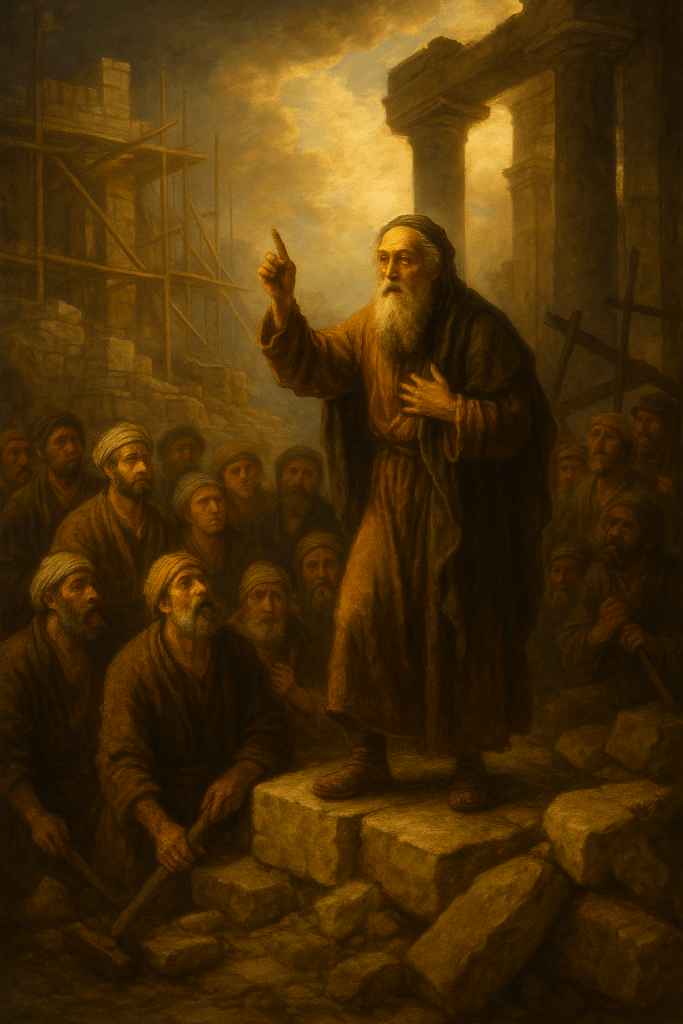
📖 Introduction: Haggai and His Prophetic Moment
The book of Haggai stands like a trumpet blast in the closing decades of the Old Testament. Composed around 520 B.C., during the reign of Darius I of Persia, it records only four short prophecies—yet each is direct, dated, and divinely charged.
Eighteen years earlier, the first exiles had returned from Babylon under Zerubbabel and Joshua the high priest. They laid the foundation of the temple with zeal (Ezra 3:8–10), but after facing opposition and discouragement, the work stopped. For nearly two decades the temple lay in ruins while the people built fine homes and pursued personal prosperity. Into this complacency came Haggai’s piercing message:
“Now this is what the Lord Almighty says: Give careful thought to your ways.” — Haggai 1:5 (NIV) [Bible Gateway]
The Hebrew phrase śîm lēb literally means “set your heart upon.” God’s call was not simply to think but to turn the heart inward, to evaluate one’s path and reorder one’s priorities.
Haggai’s book unfolds in four precisely dated oracles:
- A Call to Rebuild the Temple (1:1-15)
- Encouragement for the Builders (2:1-9)
- A Warning About Defilement (2:10-19)
- A Promise of Blessing and Future Hope (2:20-23)
Through them, God declares that true worship is not architectural but relational—not measured in stone and cedar but in obedience and holiness. The dwelling He desires is not a structure of marble but a people of faith.
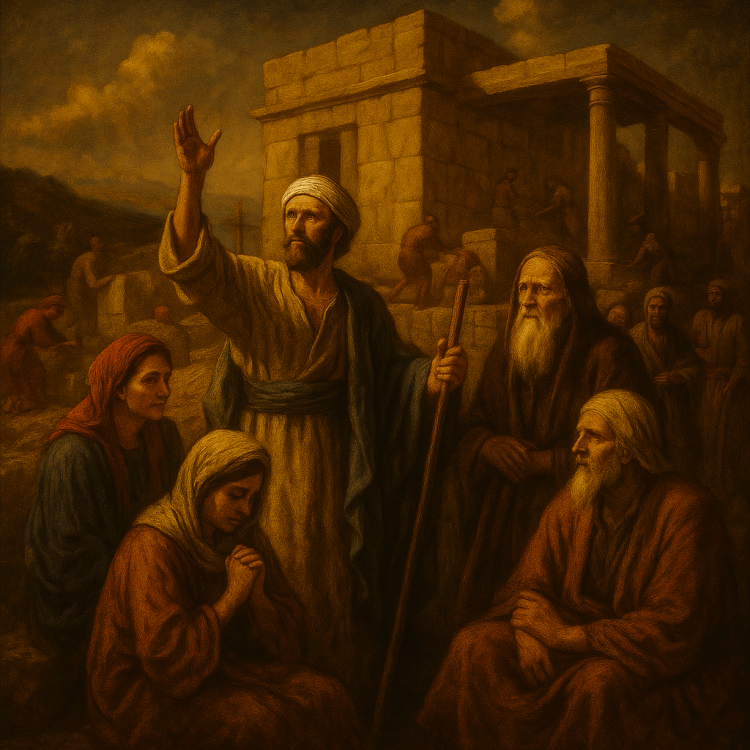
I. “Consider Your Ways” — The Prophetic Core
“This is what the Lord Almighty says: Give careful thought to your ways.” — Haggai 1:7 (NIV) [Bible Gateway]
“You have planted much, but harvested little. You eat, but never have enough… You earn wages, only to put them in a purse with holes in it.” (Haggai 1:6) [Bible Gateway]
The frustration of fruitless labor was God’s mercy in disguise. He withheld blessing not to punish but to awaken. “You expected much, but see, it turned out to be little… Because of my house, which remains a ruin, while each of you is busy with your own house.” (Haggai 1:9) [Bible Gateway]
When the people obeyed, “the Lord stirred up the spirit of Zerubbabel and of all the people, and they came and began to work.” (1:14) [Bible Gateway]
Reflection became repentance; repentance brought renewal.
II. Echoes Through Scripture — The Divine Rhythm of Reflection
1️⃣ In the Wilderness — Deuteronomy 8:2
“Remember how the Lord your God led you all the way in the wilderness these forty years, to humble and test you in order to know what was in your heart.” [Bible Gateway]
Testing is revelation. God already knows our hearts; the wilderness exposes them to us.
2️⃣ In the Psalms — Psalm 119:59-60
“I have considered my ways and have turned my steps to your statutes. I will hasten and not delay to obey your commands.” [Bible Gateway]
Reflection must lead to movement. Contemplation without obedience is sentiment, not sanctification.
3️⃣ In Exile’s Aftermath — Lamentations 3:40
“Let us examine our ways and test them, and let us return to the Lord.” [Bible Gateway]
Here is national repentance: collective soul-searching that restores covenant life.
4️⃣ In the Wisdom Tradition — Proverbs 4:26
“Give careful thought to the paths for your feet and be steadfast in all your ways.” [Bible Gateway]
Wisdom is not speed but steadiness—foresight rooted in reverence.
5️⃣ In Jesus’ Parables — Luke 15:17
“When he came to his senses…” [Bible Gateway]
The prodigal’s awakening is Haggai’s sermon in story form: conviction that leads home.
6️⃣ In Christ’s Letters — Revelation 2:5
“Consider how far you have fallen! Repent and do the things you did at first.” [Bible Gateway]
From Moses to John, the call repeats: remember, repent, return.

III. The Church Is Not a Building
The temple in Haggai’s day pointed forward to something far greater—the living temple of the redeemed.
The True Meaning of “Church”
“And I tell you that you are Peter, and on this rock I will build my church, and the gates of Hades will not overcome it.” — Matthew 16:18 (NIV) [Bible Gateway]
The Greek ekklesia means “assembly” or “called-out ones.” It never refers to a building. As one commentary notes, “In the New Testament the church is always a people, never a place.” [Tabletalk Magazine]
A Living Temple of People
“You also, like living stones, are being built into a spiritual house to be a holy priesthood…” — 1 Peter 2:5 (NIV) [Bible Gateway]
Believers themselves are the stones, fitted together by grace, animated by the Spirit.
Members of God’s Household
“Consequently, you are no longer foreigners and strangers, but fellow citizens with God’s people and also members of his household…” — Ephesians 2:19-22 (NIV) [Bible Gateway]
Paul’s architecture is alive: Christ the cornerstone, the apostles and prophets the foundation, and believers the rising walls. Together they form a dwelling where God lives by His Spirit.
The Indwelling Presence
“Don’t you know that you yourselves are God’s temple and that God’s Spirit dwells in your midst?” — 1 Corinthians 3:16 (NIV) [Bible Gateway]
Not the bricks, not the steeple, but the living community of faith.
Helpful commentary puts it plainly:
“In summary, the church is not a building or a denomination. According to the Bible, the church is the body of Christ—all those who have placed their faith in Jesus Christ for salvation.” [GotQuestions.org]
And:
“We often hear that the church isn’t a building; it’s people. Church isn’t where you meet. It’s who meets.” [logos.com]
These reflections guard us from confusing the place of worship with the people who worship.
IV. The Cycle of Spiritual Renewal
| Stage | Scriptural Example | Meaning and Application |
|---|---|---|
| Reflection | “Give careful thought to your ways.” — Haggai 1:5 (NIV) [Bible Gateway] | Self-examination exposes the distance between God’s priorities and ours. It is the spiritual inventory that precedes revival. |
| Repentance | “Let us examine our ways and return to the Lord.” — Lamentations 3:40 (NIV) [Bible Gateway] | Reflection without repentance leaves us unchanged. Repentance re-aligns our hearts and restores communion with God. |
| Renewal | “The Lord stirred up the spirit of the people.” — Haggai 1:14 (NIV) [Bible Gateway] | When hearts respond, the Spirit reignites vision and energy. Obedience becomes joy; service becomes worship. |
This rhythm—Reflection → Repentance → Renewal—is the heartbeat of every true awakening.

V. Applying “Consider Your Ways”
Personal Life
We, too, may live in paneled houses while God’s work lies unfinished. Our modern “paneled houses” might be careers, comforts, or reputations—good things that crowd out the best. If we are restless though busy, fruitless though tireless, the Spirit whispers Haggai’s question again: Consider your ways. [Bible Gateway]
“But seek first his kingdom and his righteousness, and all these things will be given to you as well.” — Matthew 6:33 (NIV) [Bible Gateway]
Church Life
When we treat the church as a building rather than a body, we invert the gospel’s order. Programs replace prayer, facilities replace fellowship, and success is measured in square feet instead of souls. The early church had no cathedrals but changed the world because it carried Christ within. [Bible Gateway]
“These men who have caused trouble all over the world have now come here.” — Acts 17:6 (NIV) [Bible Gateway]
Let our sanctuaries serve our mission—not define it. The church is living architecture, built of souls, cemented by love.
National Life
“You expected much, but see, it turned out to be little.” — Haggai 1:9 (NIV) [Bible Gateway]
A nation that values prosperity above piety soon finds its harvest thin. When morality erodes, so does stability. “Righteousness exalts a nation, but sin condemns any people.” — Proverbs 14:34 (NIV) [Bible Gateway]
VI. Building with the Right Materials
“If anyone builds on this foundation using gold, silver, costly stones, wood, hay or straw, their work will be shown for what it is.” — 1 Corinthians 3:12-13 (NIV) [Bible Gateway]
Not every project is praiseworthy. Gold and silver represent truth and love—enduring virtues refined by fire. Wood and straw symbolize efforts done for applause or ease. The true measure of our work is not visibility but viability before God. [logos.com]
Every life is a construction site. Each day lays another stone on the foundation of Christ. To build well is to live with eternity in view.
VII. The Temple That Lives
When Haggai called Israel to rebuild, his goal was not architecture but adoration. God desired a people whose hearts were His dwelling. Today that dwelling is the church—the living temple of those redeemed by Christ.
The church is not a cathedral but a community; not a monument but a movement; not a place of brick but a people of breath.
🌿 Poetic Meditation
We are the stones that breathe and sing,
The temple not of brick but being;
Each life a wall, each heart a flame,
Together bearing Jesus’ name.
Not vaulted roof nor gilded spire,
But humble hearts that God inspires;
Consider, soul, the path you tread—
Build living homes where Christ is Head.
🙏 Prayer
Lord God, search our hearts and stir our spirits.
Help us to consider our ways.
Forgive us when we have treated church as a building rather than as Your body.
Teach us to live as Your people—united in Christ, filled with Your Spirit, building one another up in love.
Make us living stones in Your spiritual house, shining as Your temple in the world.
In Jesus’ name, Amen.
 Let's Talk About It, Lewis!
You must be logged in to post a comment.