Nathan and the Courage to Speak Truth to Power

A collaboration between Lewis McLain & AI


Few moments in ancient literature capture the moral courage required to speak truth to power as vividly as the encounter between the prophet Nathan and King David. The scene is brief, almost understated, yet it exposes a problem as old as authority itself: what happens when power no longer hears the truth.

David, at this point in the biblical story, is not a fragile leader. He is Israel’s greatest king—military hero, national symbol, and political success. His reign is stable. His enemies are subdued. His legitimacy is unquestioned. That success, however, has begun to insulate him from accountability.¹

The Bible does not soften what happens next, and it is worth telling plainly.

What David Did

One evening, David notices a woman bathing from the roof of his palace. He learns she is married to one of his own soldiers, a man currently fighting on the front lines. David summons her anyway. As king, his request carries force whether spoken gently or not. She becomes pregnant.²

David now faces exposure. Instead of confessing, he attempts to manage the situation. He recalls the husband from battle, hoping circumstances will hide the truth. When that fails, David escalates. He sends the man back to war carrying a sealed message to the commanding general—an order placing him where the fighting is fiercest and support will be withdrawn.³

The man is killed.

The machinery of power functions smoothly. No inquiry follows. David marries the widow. From the outside, the matter disappears. Politically, the problem is solved. Morally, it has only been buried.

This is the danger Scripture names without hesitation: power does not merely enable wrongdoing; it can normalize it.

Why Nathan Matters

Nathan enters the story not as a revolutionary or rival, but as a prophet—someone whose authority comes from obedience to God rather than proximity to the throne. He is not part of David’s chain of command. He does not benefit from David’s favor. That independence is everything.⁴

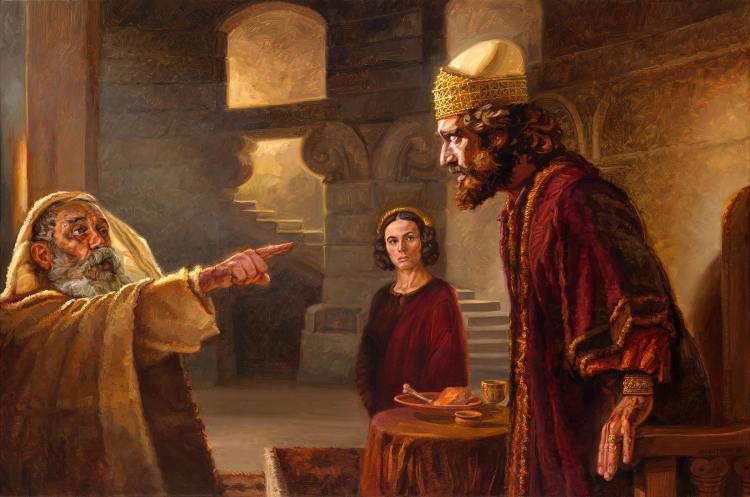
Nathan does not accuse David directly. Instead, he tells a story.

He describes two men in a town. One is rich, with vast flocks. The other is poor, possessing only a single lamb—so cherished it eats at his table and sleeps in his arms. When a guest arrives, the rich man does not draw from his abundance. He takes the poor man’s lamb instead.⁵

David is outraged. As king, he pronounces judgment swiftly and confidently. The man deserves punishment. Restitution. Consequences.

Then Nathan speaks the words that collapse the distance between story and reality:

**“You are the man.”**⁶

In an instant, David realizes he has judged himself. Nathan names the facts plainly: David used his power to take what was not his, destroyed a loyal man to conceal it, and assumed his position placed him beyond accountability.

This is not a trap meant to humiliate. It is truth delivered with precision. Nathan allows David’s own moral instincts—still intact beneath layers of authority—to render the verdict.

Speaking Truth to Power Is Dangerous

Nathan’s courage should not be underestimated. Kings do not respond kindly to exposure. Many prophets were imprisoned or killed for far less. Nathan risks his position, his safety, and possibly his life. He cannot know how David will react. Faithfulness here is not measured by outcome but by obedience.⁷

Speaking truth to power is rarely loud. It is rarely celebrated. It requires proximity without dependence, clarity without cruelty, and courage without illusion. Nathan does not shout from outside the palace gates. He walks directly into the seat of power and speaks.

David’s response is remarkable precisely because it is not guaranteed:

*“I have sinned against the Lord.”*⁸

Repentance does not erase consequences. Nathan makes that clear. Forgiveness and accountability coexist. The Bible refuses to confuse mercy with immunity.⁹

Why This Story Still Matters

This encounter reveals something essential about power: authority tends to surround itself with affirmation and silence. Over time, wrongdoing becomes justified, then invisible. Institutions close ranks. Loyalty replaces truth. Image replaces integrity.

Nathan represents the indispensable outsider—the one who loves truth more than access and justice more than comfort. He does not seek to destroy David. He seeks to save him from becoming a king who can no longer hear.

Scripture does not present leaders as villains by default. It presents them as dangerous precisely because they are human. Power magnifies both virtue and vice. Without truth, it corrodes.¹⁰

The Broken Hallelujah

This is where Leonard Cohen’s Hallelujah belongs—not as ornament, but as interpretation.

The song opens with David’s musical gift, his calling, his nearness to God:

“Now I’ve heard there was a secret chord
That David played, and it pleased the Lord…”

But Cohen does not linger there. He moves quickly to the roof, the bath, the fall:

“You saw her bathing on the roof
Her beauty and the moonlight overthrew you.”

Cohen refuses to romanticize David any more than Nathan does. He understands that David’s story is not primarily about victory, but about collapse and confession. And he understands something many listeners miss: praise spoken after exposure cannot sound the same as praise spoken before it.

That is why the refrain matters:

“It’s a broken hallelujah.”

A cheap hallelujah is easy—praise without truth, worship without repentance, confidence without cost. It thrives where power is affirmed but never confronted.¹¹

A broken hallelujah is what remains when illusion is stripped away. It is praise that has passed through judgment. It is faith no longer dependent on image, position, or success. It is what David offers in Psalm 51, after Nathan leaves and the consequences remain.¹²

Nathan does not end David’s worship. He saves it from becoming hollow.

For Our Time

Nathan’s story is not ancient trivia. It is a permanent challenge.

Every generation builds systems that reward silence and discourage dissent—governments, corporations, churches, universities, families. Power still resists accountability. Truth still carries a cost. And praise without honesty still rings empty.

Speaking truth to power does not guarantee reform. It guarantees integrity.

Nathan spoke. David listened. And centuries later, a songwriter captured what that moment sounds like from the inside—not triumphant, not resolved, but honest.

Not every hallelujah is joyful.
Some are whispered.
Some are broken.
And those may be the ones worth hearing most.


Scripture References & Notes

  1. David’s power and success: 2 Samuel 5–10
  2. Bathsheba episode begins: 2 Samuel 11:1–5
  3. Uriah’s death order: 2 Samuel 11:14–17
  4. Nathan as prophet to David: 2 Samuel 7; 2 Samuel 12
  5. Nathan’s parable: 2 Samuel 12:1–4
  6. “You are the man”: 2 Samuel 12:7
  7. Prophetic risk: cf. 1 Kings 18; Jeremiah 20:1–2
  8. David’s confession: 2 Samuel 12:13
  9. Consequences despite forgiveness: 2 Samuel 12:10–14
  10. Power and accountability theme: Proverbs 29:2; Psalm 82
  11. Empty worship critique: Isaiah 1:11–17; Amos 5:21–24
  12. David’s broken praise: Psalm 51:16–17

Hallelujah

Song by Leonard Cohen ‧ 1984

Now I’ve heard there was a secret chord
That David played, and it pleased the Lord
But you don’t really care for music, do you?
It goes like this, the fourth, the fifth
The minor falls, the major lifts
The baffled king composing Hallelujah

Hallelujah, Hallelujah

Your faith was strong but you needed proof
You saw her bathing on the roof
Her beauty and the moonlight overthrew you
She tied you to a kitchen chair
She broke your throne, and she cut your hair
And from your lips she drew the Hallelujah

Hallelujah, Hallelujah

You say I took the name in vain
I don’t even know the name
But if I did, well, really, what’s it to you?
There’s a blaze of light in every word
It doesn’t matter which you heard
The holy or the broken Hallelujah

Hallelujah, Hallelujah

I did my best, it wasn’t much
I couldn’t feel, so I tried to touch
I’ve told the truth, I didn’t come to fool you
And even though it all went wrong
I’ll stand before the Lord of Song
With nothing on my tongue but Hallelujah

Hallelujah, Hallelujah

Hallelujah, Hallelujah

Hallelujah, Hallelujah

Hallelujah, Hallelujah

Source: Musixmatch

Songwriters: Leonard Cohen / Theresa Christina Calonge De Sa Mattos

When Faith is Slipping

A collaboration between Lewis McLain & AI
A long answer to a short question from Tuesday Morning Men’s Bible Study

“Granddad… my faith is slipping.”

“Granddad, can I tell you something and you won’t think less of me?
I feel like my faith in God is slipping away. I’ve prayed—truly prayed—for our family to heal, for hearts to soften, for conversations about the Lord to open again. These aren’t selfish prayers. They’re for relationships to be mended, for love to return, for estrangements to disappear.

But nothing changes.
Some hearts grow colder.
And any mention of God shuts everything down.

Why doesn’t God answer these good prayers?
Why is He silent when the need is so great?
I don’t want to lose my faith, Granddad…
but I don’t know how much more silence or tension I can take.”


**THE GRANDFATHER’S ANSWER:

A Loving Reassurance About the Awakening—The Kairos Moment God Has Appointed**

Come here, child. Sit beside me.
I want to tell you something about God’s timing, something Scripture calls kairos—the appointed moment, the perfectly chosen hour when God reaches the heart in a way no human effort ever could.

Before any other story, let’s start with the one Jesus Himself told.


THE PRODIGAL SON: THE PATTERN OF ALL AWAKENINGS

(Luke 15:11–24)

A young man demands his inheritance, leaves home, and wastes everything in reckless living (vv. 12–13). When famine comes, he takes the lowest job imaginable—feeding pigs—and even longs to eat their food (vv. 14–16).

Then comes the sentence that describes every true spiritual awakening:

“But when he came to himself…” (Luke 15:17)

That is the kairos moment.

What exactly happened in that moment?

  1. Reality shattered illusion.
    He saw his condition honestly for the first time.
  2. Memory returned.
    He remembered his father’s goodness.
  3. Identity stirred.
    He realized, “This is not who I am.”
  4. Hope flickered.
    “My father’s servants have bread enough…”
  5. The will turned.
    “I will arise and go to my father.” (v. 18)

Notice something important:

  • No one persuaded him.
  • No sermon reached him.
  • No family member argued with him.
  • No timeline pressured him.

His awakening came when the Father’s timing made his heart ready.

The father in the story doesn’t chase him into the far country.
He waits. He watches. He trusts the process of grace.

And “while he was still a long way off,” the father sees him and runs (v. 20).

Why this matters for your prayers:

You’re praying for the very thing Jesus describes here.
But the awakening of a heart—any heart—comes as God’s gift, in God’s hour, through God’s patient love.

The Prodigal Son shows us:
God can change a life in a single moment.
But He decides when that moment arrives.

This is the foundation.
Now let me walk you through the other stories that prove this pattern again and again.


1. Jacob at Peniel — The Wrestling That Revealed His True Self

(Genesis 32:22–32)

Jacob spent years relying on himself. But his heart did not change—
not through blessings,
not through hardship,
not through distance.

Only when God wrestled him in the night and touched his hip (v. 25) did Jacob awaken.

This was his kairos:

When his strength failed, his faith was born.

He limped away, but walked new
with a new name, a new identity, and a new dependence on God.


2. Nebuchadnezzar — One Glance That Restored His Sanity

(Daniel 4:28–37)

After years of pride, exile, and madness, his turning point wasn’t long or gradual. It happened in one second:

“I lifted my eyes to heaven, and my sanity was restored.” (Dan. 4:34)

The moment he looked up was the moment God broke through.

Kairos is when God uses a single upward glance to undo years of blindness.


3. Jonah — The Awakening in the Deep

(Jonah 2)

Jonah ran from God’s call until he reached the bottom of the sea. Only there, trapped in the fish, did Scripture say:

“When my life was fainting away, I remembered the LORD.” (Jonah 2:7)

That remembering?
That was kairos.

When every escape ended, God opened his eyes.


4. David — Truth Striking in One Sentence

(2 Samuel 12; Psalm 51)

Nathan’s story awakened what months of hidden sin could not.
When Nathan said, “You are the man” (2 Sam. 12:7), David’s heart broke open.

He went from blindness to confession instantly:

“I have sinned against the LORD.” (v. 13)

Psalm 51 pours out the repentance birthed in that moment.

Kairos often comes through truth spoken at the one moment God knows the heart can receive it.


5. Peter — The Rooster’s Cry and Jesus’ Look

(Luke 22:54–62)

After Peter’s third denial, Scripture says:

“The Lord turned and looked at Peter.” (v. 61)

That look shattered Peter’s fear and self-deception.

He went out and wept bitterly—
not because he was condemned,
but because he was awakened.

Kairos can be a look, a memory, a sound—something only God can time.


6. Saul — A Heart Reversed on the Damascus Road

(Acts 9:1–19)

Saul was not softening.
He was escalating.

But Jesus met him at the crossroads and asked:

“Why are you persecuting Me?” (v. 4)

That question was a divine appointment—the moment Saul’s life reversed direction forever.

Kairos is when Jesus interrupts a story we thought was going one way and writes a new one.


7. What All These Stories Teach About Kairos Moments

Across all Scripture, kairos moments share the same attributes:

1. They are God-timed.

We cannot rush them. (Ecclesiastes 3:11)

2. They are God-initiated.

Awakenings are born of revelation, not persuasion. (John 6:44)

3. They break through illusion and restore reality.

“Coming to himself” means the heart finally sees truth. (Luke 15:17)

4. They lead to movement toward God.

Every awakening ends with a step homeward.

Your prayers are not being ignored.
They are being gathered into the moment God is preparing.


8. Why This Matters for Your Family

You are praying for softened hearts, restored relationships, spiritual awakening.
Those are kairos prayers, not chronos prayers.

Chronos is slow.
Kairos is sudden.

Chronos waits.
Kairos transforms.

You can’t see it yet, but God is preparing:

  • circumstances
  • conversations
  • memories
  • encounters
  • turning points

just like the father of the prodigal knew that hunger, hardship, and reflection would eventually lead his son home.

The father didn’t lose hope.
He didn’t chase the son into the far country.
He trusted that God’s timing would bring his child to the awakening moment.

You must do the same.


**9. Take Courage, Sweetheart:

The God Who Awakened Prodigals Will Awaken Hearts Again**

The Prodigal Son’s turning point didn’t look like a miracle.
It looked like ordinary hunger.

David’s looked like a story.
Peter’s looked like a rooster.
Saul’s looked like a question.
Nebuchadnezzar’s looked like a glance.
Jonah’s looked like despair.
Jacob’s looked like a limp.

Kairos moments rarely look divine at first.
But they are.

And when God moves, hearts—no matter how hard—can turn in a single breath.

Don’t lose faith, child.
The silence is not God’s absence.
It is God’s preparation.

And when your family’s kairos moment comes,
you will say what the father in Jesus’ story said:

“This my child was dead, and is alive again;
was lost, and is found.”
(Luke 15:24)

Until then, hold on.
Your prayers are planting seeds that God will awaken in His perfect time.

Come to Me as a Child: The Invitation from Christ and Its Meaning Today

A collaboration between Lewis McLain & AI


Introduction: The Most Disarming Invitation

Of all the invitations Jesus ever gave, none is more tender or more revealing than His call to “Let the little children come to Me.” In a world that prized power, rank, and age, Jesus placed a child in the midst of grown men and declared that the way into His Kingdom was not through merit, intellect, or strength—but through simplicity of heart. The Gospels record this lesson several times (Matthew 18:1-5; 19:13-15; Mark 10:13-16; Luke 18:15-17), which tells us how central it is to the heart of the Christian life.


The Scene: Greatness Redefined

In Matthew 18, the disciples were debating who would be greatest in heaven. Their conversation revealed an adult obsession with comparison and hierarchy. Jesus interrupted their ambitions by calling over a small child—someone overlooked, unranked, and powerless.

“Unless you change and become like little children, you will never enter the kingdom of heaven.” (Matthew 18:3)

In one sentence, Jesus inverted the value system of His listeners. Greatness, He said, begins with humility. To “become like children” is to admit dependence and trust rather than display status. The Kingdom of God is not climbed into; it is received with open hands.

Reflection Questions

  1. What ambitions or comparisons most distract you from a childlike faith?
  2. How do humility and dependence challenge our culture’s idea of success?
  3. In what ways might “becoming smaller” actually enlarge your soul?

The Heart of the Matter: Childlike, Not Childish

Jesus did not praise immaturity, ignorance, or naivety. He praised childlikeness—qualities of heart that adults tend to lose: trust, wonder, forgiveness, curiosity, and the ability to be taught. A child depends without shame, asks without hesitation, and forgives without keeping score. These traits mirror the faith that connects us to God.

When He said, “Anyone who will not receive the kingdom of God like a little child will never enter it” (Mark 10:15), Jesus was describing an approach, not an age. The requirement is not to remain small but to remain soft—humble enough to receive grace instead of earning it.

Reflection Questions

  1. Which childlike quality—trust, wonder, forgiveness, curiosity—do you find hardest to retain?
  2. How can you cultivate teachability before God this week?
  3. What would your worship look like if you came with that childlike heart?

The Blessing: His Hands on the Children

In both Mark 10 and Matthew 19, people brought children to Jesus, and the disciples tried to push them away. Perhaps they thought He had more important work to do. But Jesus became indignant—a rare word for His righteous anger. He insisted, “Do not hinder them.” He gathered the children into His arms, laid His hands on them, and blessed them.

That gesture still defines the heart of Christian ministry. To hinder a child—by neglect, cynicism, or hardness—is to obstruct the very image of faith God desires. Every time the Church welcomes the least, protects the vulnerable, or teaches with gentleness, it reenacts that moment of blessing.

Reflection Questions

  1. Who in your life might be “hindered” from coming to Jesus by neglect or discouragement?
  2. How can your words or presence become an open invitation instead?
  3. What practical steps could your church take to bless children and the childlike?

The Application: What It Means Today

1. Trust Over Control

Modern life prizes control—plans, schedules, data, mastery. Yet the Gospel calls us to trust. A child steps forward because the parent’s voice is enough. To follow Jesus is to release the illusion of control and to rest in His character.

2. Wonder Over Cynicism

Children see beauty where adults see routine. Faith flourishes when we regain our sense of wonder—when sunrise, Scripture, and song awaken gratitude instead of fatigue. Cynicism may sound sophisticated, but it cannot worship.

3. Relationship Over Performance

Children do not earn their place at the table; they belong by birth and love. In the same way, believers are accepted not by performance but by adoption into God’s family. Our worth is not negotiated—it is bestowed.

4. Presence Over Hurry

A child notices the moment; an adult is often elsewhere. Jesus invited children to come to Him—a call to be present. Prayer and worship are not tasks but encounters. To come as a child is to arrive unhurried, eager, and attentive.

Reflection Questions

  1. Where in your life are you trying to control what only God can direct?
  2. When was the last time you paused to experience pure wonder before God?
  3. How can you practice “presence over hurry” in your daily prayer or worship?

The Challenge: Becoming Small in a Big World

It is striking that Jesus did not tell the children to become like the disciples, but the disciples to become like the children. In every generation, the Church is tempted to mirror worldly hierarchies—titles, influence, eloquence, size. But the Kingdom belongs to those who kneel, not to those who climb. To be childlike is not to be weak but to be free from pretense. It is the posture that allows grace to enter.

Reflection Questions

  1. Where might pride or performance still keep you from kneeling?
  2. How does God invite you to rest in grace rather than achievement?
  3. What would your leadership, parenting, or ministry look like if shaped by childlike humility?

I love you, Ben, and will always be by your side.

Conclusion: The Open Arms of Christ

When Jesus said, “Let the little children come to Me,” He was not limiting His invitation to a specific age. He was revealing the doorway of heaven. The arms that once cradled children on a Galilean hillside would soon stretch open on a cross to welcome all of God’s children home.

To come as a child is to come with empty hands, honest eyes, and an open heart. In that humility, we find not only the entrance to the Kingdom—but the embrace of the King Himself.


A Prayer of Childlike Faith

Lord Jesus,
Teach me to come to You not with pride but with peace,
not with credentials but with curiosity.
Make my heart soft again—able to wonder, to trust, to forgive.
Strip away the layers of cynicism that I have called wisdom,
and restore to me the joy of simple belief.
As a child finds rest in a father’s arms,
let me find rest in Yours.
Amen.

Genuine Goodness: The Quiet Strength of a Christian Life

A collaboration between Lewis McLain & AI

“Let your light so shine before men, that they may see your good works and glorify your Father in heaven.” — Matthew 5:16

There are people whose very presence calms a room. They do not demand attention, yet they seem to fill every space they enter with warmth. Their strength is not loud; their influence is not forced. They lead not through speeches or titles, but through the steady rhythm of goodness that flows from a heart aligned with God.


One such man is Harvey Oaxaca — a teacher, coach, administrator, mentor, and friend whose life continues to remind us that genuine goodness still has a face.


Roots of Character

Long before Harvey led Sunday school at First Baptist Church of McKinney, he was a young man in cleats, running plays on the fields of McMurry University in Abilene, Texas. There he earned his degree in education and became a record-setting running back and team captain.

After graduation, Harvey poured that same discipline into a lifetime of service in education. He spent more than four decades as a teacher, coach, and administrator, including twenty-three years in the McKinney Independent School District. He taught in classrooms, guided student-athletes, and eventually helped lead schools with the same calm faith and fairness that have always defined him.

Harvey wasn’t just fast — he was faithful. Teammates recall how he helped others up before celebrating his own touchdown. By graduation he had earned a place among McMurry’s top rushers and, years later, induction into the McMurry Athletic Hall of Honor.

But his greatest victories weren’t measured in yards gained — they were measured in character formed. The discipline of the athlete became the discipline of the servant; the humility of the player who lifted others became the humility of the man who now lifts spirits.

“Do you not know that in a race all the runners run, but only one receives the prize? Run in such a way as to get the prize.” — 1 Corinthians 9:24

Harvey’s race never ended at the goal line — it became a lifelong run toward goodness, guided by faith.


Faith That Speaks Softly

At First Baptist McKinney, Harvey leads his Sunday school class with that same steady resolve. He doesn’t dominate the room; he shepherds it. His teaching and demeanor are more conversation than lecture — he listens, nods, and draws wisdom even from the quietest voice in the circle.

“Who is wise and understanding among you? Let them show it by their good life, by deeds done in the humility that comes from wisdom.” — James 3:13

There is no pretense in Harvey’s faith. It’s as real as the man himself — genuine, unguarded, and shaped by decades of walking with the Lord.


Goodness in Action

When Harvey extends his hand, it’s never just a handshake — it’s a blessing. I’ll never forget watching him greet my three grandchildren as each graduated from high school over the recent years. One by one, he congratulated them with a personal acknowledgment, offering encouragement as if they were his own.

That’s Harvey: goodness not as ceremony but as instinct — quiet, consistent, sincere.

His close friend and co-leader of the class, Dr. Bobby Waite, put it best:

“Harvey’s only fault is he can’t say no to a request or a need. It breaks his heart if he’s double-booked. One way or another, he makes things happen to be there to serve.”

That truth showed itself again recently when Harvey returned to class after a hospital stay for a hip issue. As he stood before his friends, tears filled his eyes. Overcome with gratitude for every prayer and note of concern, he said he could not imagine a world without his church and his class. In that moment — unguarded, grateful, and full of grace — his true goodness was once again on display for all to see. One does not have to guess where his heart is.


Loved by All

To know Harvey is to be drawn to him. His life has touched countless others — students, church members, colleagues, and neighbors.

As one friend said, “You can’t be around Harvey and not believe in goodness again.”

In a world that rewards charisma, Harvey’s quiet strength stands apart. He reminds us that greatness is not about being seen — it’s about being genuine.


The Spirit of Goodness

“But the fruit of the Spirit is love, joy, peace, patience, kindness, goodness, faithfulness, gentleness, and self-control.” — Galatians 5:22-23

Harvey lives those words as naturally as breathing — steady as his steps once were on the football field, steady as his walk now is with God.

His life testifies that Christian goodness is not dramatic or loud; it’s faithful, consistent, and full of quiet joy.


A Legacy of Grace

When people speak of Harvey, they don’t recall titles or positions; they recall presence — his smile, his kindness, his reliability. He’s the kind of man whose example lingers long after he’s left the room.

“Well done, good and faithful servant… Enter into the joy of your master.” — Matthew 25:21

That’s the prize Harvey has always been running toward — not fame, not applause, but faithfulness.


What More Can We Say About True Goodness

True goodness is one of the simplest virtues to describe and the hardest to live. It doesn’t draw attention to itself, and that’s what makes it powerful. In a culture that confuses being nice with being good, Harvey reminds us that goodness is not mere politeness — it is holiness expressed in kindness. One looks at Harvey’s face and sees Christ looking back.

Goodness is love with feet on the ground.
It’s compassion that costs something.
It’s humility that refuses to quit.

The truly good person doesn’t act good to be admired; he acts good because his heart has been changed. Goodness is what happens when a man allows God’s Spirit to shape his motives, reactions, and tone. It’s not performance — it’s transformation.

“Surely goodness and mercy shall follow me all the days of my life.” — Psalm 23:6

Goodness follows those who walk with God — it’s the fragrance left behind by faith.


A Benediction of Goodness

Goodness walks softly, without sound,
Its footsteps holy, sure, and bound
To hearts that serve and hands that mend,
To lives that love until the end.

It does not shout, it does not shine,
It whispers of a grace divine.
It bends to lift, it waits, it prays,
It lives the truth it dares to praise.

No crowd applauds, no trumpet rings,
Yet Heaven knows such quiet things.
The smile that steadies, the prayer unheard,
The faithful deed, the gentle word.

And when life’s race is nearly run,
And shadows fade before the Son,
The voice of God will softly say —
“Well done, good heart, you showed the way.”


In Harvey Oaxaca, we glimpse what true goodness looks like — not distant, not impossible, but alive, humble, and quietly shining in McKinney, Texas, every Sunday morning.

Concentric Circles of Concern

A collaboration between Lewis McLain & AI

Revisiting an influential book for me, fitting into the primary theme of my recent posts. LFM


Introduction: The Man Behind the Circles

William Oscar Thompson Jr. (1918–1980) lived a life that testified to the power of relationship. He was not a man of grand celebrity or global fame; rather, he was a pastor and evangelist whose impact spread quietly through students, parishioners, and colleagues who absorbed his conviction that the Christian life must be lived relationally, not institutionally.
After two decades of faithful pastoral work, Thompson became a professor of evangelism at Southwestern Baptist Theological Seminary in Fort Worth, Texas. It was there, during his own physical suffering and eventual battle with cancer, that he refined the model that would outlive him — a model that connected spiritual authenticity with human connection.

Thompson’s health declined even as his insight deepened. He realized that the gospel was never meant to travel primarily by microphone or mass event, but through people whose lives touched one another’s every day — in kitchens, workplaces, front porches, and hospital rooms. After his death in 1980, his wife, Carolyn Thompson Ritzmann, edited his unfinished manuscript, and evangelism teacher Claude V. King (best known for Experiencing God) later helped expand and republish it. The revised edition, Concentric Circles of Concern: Seven Stages for Making Disciples, was released in 1999 by Broadman & Holman, nearly two decades after the original 1981 publication.

The phrase “concentric circles” is not just a metaphor in Thompson’s hands; it is a theology of life. His belief was that the Christian’s influence for Christ begins not in distant mission fields but within the very relationships already entrusted to them. Evangelism, he argued, must ripple outward from the integrity of the inner life — from the soul that has been made right with God — until it touches every layer of community, from family to stranger. His framework provides a vision of discipleship that is both deeply personal and expansively missional, a reminder that faith spreads through people who love well.


The Concentric Circles and Their Living Logic

At the heart of the book lies a simple, unforgettable diagram: seven circles, each one nested inside the next, radiating outward from a center. The image, though deceptively modest, reshapes how one thinks about spiritual responsibility.

1. Self

The innermost circle, labeled Self, represents one’s own soul — the center of all relational and spiritual life. For Thompson, self-examination and humility before God are not indulgent acts but sacred ones. A Christian must first cultivate honesty with themselves and communion with their Creator. Spiritual neglect at this level produces hypocrisy; spiritual health here produces authenticity that naturally flows outward. He reminds his readers that “the most important word in the English language, apart from proper nouns, is relationship.” That relationship begins vertically — between oneself and God — and then extends horizontally into every human connection. Evangelism without integrity is noise; discipleship without inner renewal is hollow ritual.

2. Family

The second circle embraces one’s immediate family. It is easy, Thompson observed, to romanticize missions across oceans while ignoring ministry across the dinner table. The home is the first proving ground of grace. Faith that cannot be lived out among those who know us best will rarely stand in the wider world. A Christian who learns to forgive within marriage, to listen to their children, or to extend patience to aging parents is already practicing evangelism of the highest order. Family is the first “field” of discipleship, where love is tested daily and faith becomes tangible.

3. Relatives

The third circle includes extended family — the kin network that may stretch across states, generations, and emotional boundaries. These relationships are often complicated by history, misunderstanding, or absence. Thompson urges believers not to abandon these connections but to redeem them. The gospel’s reconciling power, he writes, often begins when a believer takes the initiative to heal an old wound or rekindle a neglected bond. A letter of apology, a phone call of encouragement, or an unexpected act of service within the extended family can become the spark of redemption.

4. Friends

Friends form the fourth circle — those we choose to walk beside in life. Unlike family, friendship is elective; it is built on mutual trust and shared affection. Thompson views friendship as one of the most powerful conduits of witness. Friends already see us unfiltered; they know our habits, hopes, and contradictions. When they witness genuine spiritual transformation in our character, they often feel it before they hear it. To live faithfully among friends is to let the gospel speak through laughter, loyalty, and long conversation.

5. Neighbors and Associates

Next come Neighbors and Associates — the people who share our routines but not necessarily our intimacy: colleagues, classmates, teammates, or the barista who knows our order by heart. Thompson believed these daily intersections were fertile soil for spiritual conversation, if approached with humility and care. Instead of seeing such relationships as mundane, he taught his students to see them as providential appointments. Every encounter, no matter how ordinary, carries the potential of divine significance.

6. Acquaintances

The sixth circle widens to include those we know only loosely — the casual relationships of community life. Here, evangelism takes the form of kindness and presence more than speech. Thompson often told his students that “you may be the only gospel someone ever reads,” meaning that one’s demeanor and compassion can preach where words cannot. Consistency — being gracious over time — often speaks louder than any tract or slogan.

7. Person X

Finally comes Person X — the unknown stranger, the person with no prior connection. Most evangelistic training begins here, teaching believers how to witness to strangers. Thompson deliberately places it last. He argues that the credibility built in inner circles prepares believers to approach outer ones with sincerity rather than anxiety. When a life already radiates peace and love, even a stranger senses authenticity. Evangelism to “Person X,” then, is not a special performance; it is the natural overflow of a life already aligned with God.

Thompson captured the urgency of this relational approach when he wrote, “Most of our lives are crucified between two thieves, yesterday and tomorrow. We never live today. But the time to live is now.” The concentric circles remind us that the mission field is not someday or somewhere else — it is here, in the people who already populate our lives.


The Seven Stages of Making Disciples

Thompson’s circles describe who we are called to influence; his seven stages explain how. The stages form a dynamic rhythm — not a rigid checklist but a living cycle of growth that repeats again and again.

Stage 1: Get Right

Spiritual influence begins with moral clarity. To “get right” is to confront sin, mend broken relationships, and align one’s will with God’s. Thompson likens unreconciled relationships to blockages in a pipe: until they are cleared, the Spirit’s flow is obstructed. Getting right means making amends, confessing pride, forgiving debts, and letting the Holy Spirit cleanse the inner life. This stage humbles the believer before they presume to guide another.

Stage 2: Survey

Once reconciled, the believer must “survey” their relational field — a prayerful mapping of the people God has already placed within reach. Thompson encouraged writing names in each circle, not as a project list but as a sacred responsibility list. The act of seeing these names laid out visually reawakens compassion. We begin to see that our lives are already mission fields bursting with divine opportunity.

Stage 3: Pray

Prayer, for Thompson, is the lifeblood of evangelism. He calls it “a guided missile — it always hits its target.” Prayer aligns the heart with God’s timing and opens doors that human persuasion cannot. The believer prays not only for conversion but for understanding, patience, and divine orchestration — that conversations will arise naturally, that the Spirit will prepare both speaker and listener. Without prayer, evangelism degenerates into salesmanship; with prayer, it becomes partnership with God.

Stage 4: Build Bridges

Bridge-building is the practical art of connection. It may involve hospitality, listening, volunteering, or sharing a meal. Thompson viewed every bridge as an act of incarnation — stepping into another’s world as Christ stepped into ours. Bridges require humility, empathy, and time. They often begin with small acts: remembering a name, showing up at a funeral, sending a card. Over time, these gestures form trust strong enough to carry the weight of truth.

Stage 5: Show Love

The fifth stage deepens bridge-building into tangible service. “Love that is not demonstrated is not credible,” Thompson warns. To show love means to meet needs: to feed the hungry, comfort the grieving, or simply listen without agenda. Genuine love expects nothing in return. When people experience that kind of care, they become open not merely to a message but to a Messenger. Thompson’s famous illustration of a student returning a stolen motorcycle mirror captures this stage perfectly: confession and restitution became a living sermon that words alone could not match.

Stage 6: Make Disciples

Having earned trust and demonstrated love, the believer can now share the gospel sincerely. But Thompson insists this is not the finish line — it is the midpoint. True discipleship involves walking with new believers as they learn to obey Christ, discover Scripture, and find community. Evangelism divorced from discipleship, he warned, produces orphans; discipleship joined with love produces heirs. Making disciples means nurturing growth until the new believer can, in turn, disciple others.

Stage 7: Begin Again

The cycle ends where it began — and then continues. The new disciple becomes a new center of concentric influence, applying the same seven stages to their own relationships. Thus, the gospel spreads organically, not by mass production but by multiplication — one circle at a time. Thompson’s model mirrors nature itself: seeds producing fruit that carries new seeds. Discipleship is the divine geometry of multiplication through love.


Theology and Heartbeat of the Model

At its core, Concentric Circles of Concern is a theology of incarnation. It declares that God’s mission moves through human relationships — not in spite of them. Christ entered history relationally, dwelling among us; His followers must do the same. The model ties spiritual maturity to relational responsibility. To be “right with God” without being reconciled to others is an illusion.

Thompson’s vision also bridges two great biblical commands: the Great Commission (“Go and make disciples”) and the Great Commandment (“Love your neighbor as yourself”). The circles remind believers that these are not separate mandates but two halves of the same calling. Evangelism divorced from love becomes manipulation; love without truth becomes sentimentality. The mature Christian practices both — speaking truth through relationships of genuine care.

Prayer anchors this balance. Thompson’s metaphor of prayer as a “guided missile” conveys both power and precision: prayer can reach where presence cannot. It can travel across distance, culture, and even hostility. When believers pray for those within each circle, their hearts become attuned to God’s compassion, and they see people not as projects but as souls.


Strengths, Challenges, and Contemporary Relevance

The enduring strength of Thompson’s model lies in its simplicity. It does not require technology, programs, or budgets — only attentiveness, humility, and perseverance. Yet its simplicity hides profound depth. The circles create a lifelong map for Christian influence, reminding believers that evangelism is less about campaigns and more about consistency.

In today’s world of fractured relationships and digital disconnection, Concentric Circles of Concern feels prophetic. Our social networks may have expanded, but our intimacy has shrunk. Thompson’s framework invites believers to slow down, notice, and invest. Modern adaptation can include digital circles — online friends, social followers, professional networks — but the principle remains unchanged: spiritual credibility flows through relationship.

Still, Thompson’s model demands balance. One must not become so inwardly focused that the outer circle, Person X, is forgotten. Nor should believers treat relationships as strategies for conversion. The goal is love, not leverage. When love is real, evangelism follows naturally. As Thompson might say, evangelism is not a project to complete but a person to become.


Memorable Quotations

“The most important word in the English language, apart from proper nouns, is relationship.”
“Intercessory prayer is like a guided missile — it always hits its target.”
“Most of our lives are crucified between two thieves, yesterday and tomorrow. We never live today.”
“Love that is not demonstrated is not credible.”
“You cannot lead someone closer to the Lord than you are yourself.”

These words capture his conviction that relational faith is both the method and the message of the gospel.


Reflective Poem — Ripples of Concern

I stand within the quiet center,
A soul restored, the heart made whole;
From this still place the circles widen,
Grace flows outward, soul to soul.

My home becomes the first frontier,
Where love must bloom before it’s taught;
And every quarrel, every silence,
Is soil where mercy must be sought.

Through friendship’s bridge and neighbor’s need,
Through acts of care that speak, not plead,
The gospel walks on human feet,
Love’s language stronger than a creed.

Beyond the known, to stranger’s face,
The ripples travel, still by grace;
Till every heart, in widening span,
Feels heaven’s pulse through human hands.

And when another life takes flame,
A new set of circles starts again;
From self to world, from love to light,
The pattern echoes Christ’s design.


Concentric Circles of Concern remains one of the clearest blueprints ever written for living out the Great Commission through the Great Commandment. Thompson’s wisdom continues to challenge believers to think relationally, act prayerfully, love tangibly, and live authentically — one circle at a time

Here Am I, Lord: The Call and Commission in Today’s World

A collaboration between Lewis McLain & AI


I. Introduction: The Prophet Who Heard the Voice

Among the great figures of the Old Testament, Isaiah stands tall as one of the most profound and poetic prophets ever called by God. Living and writing in the eighth century before Christ, during the reigns of Uzziah, Jotham, Ahaz, and Hezekiah—four kings of Judah—Isaiah witnessed both the spiritual decline of his nation and the political upheavals that threatened its very survival. His name, Yeshayahu, means “The Lord is salvation,” and indeed, his entire message weaves together judgment and redemption, despair and hope, sin and grace.

Isaiah’s writings form one of the most theologically rich books in all of Scripture—sixty-six chapters that stretch from visions of God’s holiness to prophecies of the coming Messiah. Scholars have called Isaiah “the fifth gospel” because it so vividly anticipates the life, suffering, and triumph of Christ centuries before His birth. Unlike many prophets who simply declared oracles of doom, Isaiah combined poetic beauty, moral clarity, and divine vision. He saw beyond the immediate history of Israel to the sweeping purposes of God for all nations.

What sets Isaiah apart is not only the grandeur of his language but the intimacy of his calling. His ministry begins not with action but with awe—with a vision that breaks and remakes him. In the year that King Uzziah died, Isaiah saw “the Lord, high and lifted up, and His train filled the temple.” He hears angelic voices crying, “Holy, holy, holy is the Lord of hosts; the whole earth is full of His glory.” Overwhelmed by divine holiness, Isaiah cries out, “Woe is me, for I am a man of unclean lips, and I dwell among a people of unclean lips.” Then, in a moment of grace, a seraph touches his lips with a live coal from the altar, saying, “Your guilt is taken away, and your sin atoned for.” Only then does Isaiah hear the divine question: “Whom shall I send, and who will go for us?” His response—simple, immediate, and wholehearted—has echoed through millennia: “Here am I; send me.”

II. The Original Moment: From Vision to Vocation

Isaiah’s encounter in the temple is one of the most profound calling narratives in Scripture because it reveals the entire arc of spiritual transformation—conviction, cleansing, and commission. Before Isaiah can speak for God, he must be purified by God. The coal that touches his lips symbolizes both pain and purification; it burns away unworthiness and ignites a new fire of purpose. Isaiah learns that divine service is not earned by merit but granted through mercy.

This moment defines prophetic ministry for all who follow. Isaiah does not volunteer because he feels capable; he volunteers because he has been forgiven. His “send me” is not a boast of strength but a surrender of will. It shows that readiness in God’s kingdom comes not from talent or position but from humility and obedience. The prophet’s call reminds every believer that God does not ask for perfection, only availability. He does not seek the qualified; He qualifies the willing.

III. The Voice That Still Calls: Modern Applications of “Send Me”

Though centuries separate us from Isaiah’s temple vision, the same question still echoes: “Whom shall I send?” The call of God is not a relic of ancient prophecy—it is a living summons to every generation. In every time and place, men and women hear this question in the quiet chambers of conscience and the crowded corridors of daily life. The divine call may not come through visions of angels, but it comes through needs that cry out to be met, through injustices that demand courage, through moments of compassion that ask for response.

A. The Personal Call: Faith in the Ordinary
In a world that prizes self-assertion, Isaiah’s answer is radical: availability over ability. “Here am I” means being present before God—before the noise of ambition or distraction drowns out His voice. For the modern believer, this call begins in small, faithful acts: showing kindness when it’s inconvenient, forgiving when it’s undeserved, speaking truth when it’s unpopular. It may mean teaching a Sunday school class, visiting the sick, mentoring a child, or simply standing up for integrity in one’s profession.
The modern application of Isaiah’s “send me” is less about geography and more about posture. You may never cross an ocean, but you can cross the street. You may not go into a pulpit, but you can live the Gospel at your desk, in your classroom, or around your dinner table. In every generation, God asks not “Who is talented?” but “Who is willing?”


B. The Public Call: Faith in the Civic and Professional Realm
Isaiah was not just a preacher in the temple; he was an adviser to kings and a voice in national affairs. His message reached palaces and public squares alike. Likewise, today’s disciples are called to bring righteousness into their professions—to be prophetic voices in civic life. Whether one serves in government, finance, education, or healthcare, the “send me” spirit calls for moral clarity amid compromise.
In municipal councils, corporate meetings, or courtrooms, there is still a need for those who say, “Here am I” not to their own advancement but to the cause of truth and justice. The Isaiah spirit is the courage to stand for what is right even when it costs reputation or comfort—to call nations back to integrity, to defend the vulnerable, to remind leaders that power must serve people. In every public servant who leads with humility, in every teacher who shapes conscience, in every judge who loves mercy, the voice of Isaiah lives on.

C. The Global Call: Faith Beyond Borders
Isaiah’s vision of God’s glory filling the whole earth anticipates the Great Commission of Christ. “Send me” is a global phrase—it transcends race, nation, and time. In our interconnected world, the mission field is both next door and around the globe. It includes the refugee, the orphan, the imprisoned, the forgotten. To say “send me” today is to accept the responsibility of love in a wounded world.
It might mean serving on a mission trip, supporting a humanitarian cause, or developing technology that uplifts rather than exploits. It can mean using one’s influence, wealth, or voice for those who have none. The modern missionary is not only the preacher or doctor abroad, but also the scientist working for sustainable solutions, the artist telling redemptive stories, and the citizen advocating for peace and dignity.


IV. The Obstacles to Saying “Send Me”

Many never reach Isaiah’s moment of surrender because they stop at his first confession: “Woe is me.” Fear, inadequacy, and distraction paralyze potential prophets. The world today offers endless reasons to delay obedience—busyness, cynicism, self-doubt, or the illusion that someone else will go. The modern heart is often over-informed but under-committed.

Yet the secret of Isaiah’s response lies in trust. He did not know where he would be sent, what he would face, or whether he would succeed. God revealed only the call, not the destination. And still he said yes. The modern disciple must learn this same holy courage—the faith to say “yes” before knowing the cost. Real obedience precedes full understanding.

We also face cultural barriers. The age of irony mocks conviction; the age of comfort avoids sacrifice. But God still calls amid the noise. Every generation must rediscover the sacred simplicity of Isaiah’s answer: to stand up when called, to speak when it’s easier to stay silent, to go when it’s safer to stay home.


V. The Transformation of the Willing Heart

The power of Isaiah’s response lies in transformation. He entered the temple burdened by guilt and left commissioned by grace. The same God who cleansed his lips also shaped his life. Service becomes the fruit of forgiveness. Every believer who says “send me” enters this same pattern: encounter, cleansing, and calling.

Modern discipleship is not a part-time endeavor but a lifelong response. When we offer ourselves to God’s purposes, He transforms both us and the world around us. A single “send me” can ripple through generations. One teacher who sees their classroom as a mission field, one civic leader who governs with justice, one artist who creates with reverence—each becomes a vessel through which God’s light reaches others.

In this way, Isaiah’s call is not a moment but a movement. It is the continual surrender of the heart that says, “Use me, Lord, wherever You will.”

VI. Conclusion: The Call Continues

Isaiah’s cry, “Here am I, Lord; send me,” remains one of the purest expressions of faith in all of Scripture. It is both an answer and a challenge. Across the centuries, prophets, apostles, and saints have echoed it in their own tongues—Moses before Pharaoh, Mary before the angel, Peter beside the sea, Paul on the Damascus road. And still the question comes: “Whom shall I send?”

Every believer must decide whether to remain a spectator in the temple or to become a servant in the field. The call may come through Scripture, through conscience, or through the cry of human need. The answer must come from the heart: “Here am I.” In those three words lies the essence of Christian discipleship—the surrender of self to the will of God.

In a fractured world that hungers for hope, the echo of Isaiah’s voice is needed more than ever. The Lord still seeks those who will go—into classrooms, hospitals, city halls, neighborhoods, and nations—to live out His message of redemption. To every willing soul, He still asks the ancient question. And to every heart brave enough to respond, He still gives divine purpose.

“Here am I, Lord; send me.” May it not be only Isaiah’s prayer—but ours.


Reflective Prayer: “Here Am I, Lord”

O Lord, high and lifted up,
whose glory fills the earth and whose mercy touches even the most unworthy lips,
we come before You with humbled hearts.

We have heard Your question echo through the ages —
“Whom shall I send, and who will go for us?”
And though the world grows noisy with fear and distraction,
still Your voice breaks through.

Touch our lips as You touched Isaiah’s,
burn away our pride, our hesitation, our excuses.
Cleanse what is unclean,
renew what is weary,
and make our hearts burn again with holy purpose.

When the needs of the world seem too vast, remind us:
You do not ask us to save the world, only to serve in it.
You do not need our strength, only our surrender.
You do not require our perfection, only our presence.

So here we stand, O Lord —
in our cities, our classrooms, our homes, our workplaces.
Here we are, with our small voices and open hands.
Send us where love is lacking.
Send us where truth is silenced.
Send us where hope has grown dim.

And when we go, go with us —
that every act may carry the mark of Your grace,
and every word may bear the weight of Your holiness.

We pray this not in our own name,
but in the name of Jesus Christ,
the One who was sent and who sends us still.

Amen.


Searching for God’s Plan Is Part of God’s Plan

🕯️ A collaboration between Lewis McLain & AI


🕯️ Searching for God’s Plan Is Part of God’s Plan

A meditation on divine purpose, patience, and the gentle guidance of the Holy Spirit


Introduction — The God Who Is Three in One

When we speak of God’s plan, we must first understand who God is.
All of Scripture — and every whisper of divine purpose — flows from the mystery of the Holy Trinity, the eternal truth that God is One in essence and Three in person: God the Father, God the Son, and God the Holy Spirit.

From the first pages of the Bible, God reveals Himself not as solitary but as relational. In Genesis 1:26, the Creator declares, “Let Us make mankind in Our image, in Our likeness.” This “Us” is not the language of royalty but of communion — a glimpse into the fellowship that has always existed within the Godhead.

God the Father is the Creator and Sustainer of all things, the One who spoke light into being and still speaks purpose into creation. He is the source from which all love, justice, and wisdom flow.

God the Son, Jesus Christ, is the Word made flesh — “the image of the invisible God” (Colossians 1:15). Fully divine and fully human, He entered time so that eternity could enter us. Through His life, death, and resurrection, He revealed the Father’s heart and opened the way for humanity to live in communion with God once more.

God the Holy Spirit is the living presence of God with us — the Comforter Jesus promised in John 14:26, the One who guides, convicts, empowers, and renews. The Spirit does not simply move around us but dwells within us, breathing life where there was none and transforming belief into becoming.

Together, the Father, the Son, and the Holy Spirit are one God — distinct in person, united in essence, perfect in love. The Father wills, the Son reveals, the Spirit indwells. This divine harmony is not a concept to be solved but a communion to be entered — the eternal dance of love that invites us to join.

To seek God’s plan, then, is to be drawn into the life of the Holy Trinity itself — to hear the Father’s call, to follow the Son’s example, and to walk in the Spirit’s guidance. Every act of faith, every search for purpose, begins and ends within that holy fellowship of love.


🌅 I. The Longing to Know

Every soul, at some quiet moment, comes to the edge of its own mystery and whispers,
Why am I here?
What am I meant to do?
How will I know when I’ve found it?

These are not small questions, nor are they unspiritual ones. They are the pulse of eternity within human clay — the proof that we were made by a purposeful God who designed us to long for Him. As the writer of Ecclesiastes says, “He has set eternity in the human heart.” (Ecclesiastes 3:11). That longing, that inward ache for meaning, is not a flaw in the system — it is the invitation itself.

Before we ever lift our eyes toward heaven, the Holy Spirit has already stirred the waters of our hearts. It is He who awakens the desire to seek, to question, to yearn for direction. We imagine that we begin the search, but in truth, we are responding to One who has already begun calling our name. “Before I formed you in the womb, I knew you,” says the Lord (Jeremiah 1:5). The search is not the beginning of God’s plan — it is the awakening to it.

We live in a world that tells us to chase identity through productivity — to define purpose by what we do. Yet the Spirit teaches us to begin with who we are: beloved, chosen, formed for good works prepared in advance (Ephesians 2:10). When we start from belovedness, direction becomes less about achievement and more about alignment. The question shifts from “What is my plan for my life?” to “What is God’s life doing through me?”

There are times the longing feels like a burden — like a hunger that won’t be filled. But that hunger is holy. It is the echo of Eden within us, the part of the soul that still remembers walking with God in the cool of the day. Every time we ask “Why am I here?” we are really asking, “Lord, where are You?” And the Spirit answers softly in the dark: “Closer than you think.”

The longing to know is not a sign that we are lost; it is proof that we are loved. God hides His purposes not to frustrate us but to form us. Like a sunrise that slowly brightens the horizon, His plan is not a flash of lightning but a gentle unveiling. And as we watch for the light, we come to see — the search itself is sacred. The seeking heart is already standing within the circle of His will.


🌾 II. The Restless Heart

“As the deer pants for streams of water, so my soul pants for You, my God.”Psalm 42 : 1
“It is God who works in you to will and to act in order to fulfill His good purpose.”Philippians 2 : 13

There is a restlessness that runs through the human spirit — a holy discomfort that keeps us from settling for less than what God intended. We call it anxiety, ambition, or uncertainty, but beneath those names lies a deeper truth: the soul was not designed for stagnation. The Spirit keeps us moving because life in Christ is a pilgrimage, not permanence.

The restlessness of the heart is a divine stirring. It is what moved Abraham to leave Ur without a map, Moses to wander through desert silence, and Paul to cross seas with only the Spirit’s whisper, “Go.” None of them saw the full plan, but each trusted that the One who called would lead.

When the Holy Spirit “woos” the soul, He does not always comfort first; sometimes He unsettles. He loosens our grip on comfort so that we might reach for calling. The Spirit’s invitation is often disguised as discomfort — not to harm us, but to stretch us toward holiness.

We often mistake that tension as something to escape. But restlessness can be sacred ground if we let it drive us to prayer instead of panic. The heart that refuses to grow numb, that dares to ask “Is there more?” is already being moved by the Breath of God.

If you feel restless today, take courage. The ache itself is evidence that the Spirit is alive within you — awakening desire, stirring purpose, leading you toward something truer than you can yet name.


🌊 III. The Hidden Path

“Your word is a lamp for my feet, a light on my path.”Psalm 119 : 105
“Trust in the Lord with all your heart and lean not on your own understanding; in all your ways submit to Him, and He will make your paths straight.”Proverbs 3 : 5–6

We wish God would hand us the map. Instead, He gives us a lamp.

Faith does not come with a blueprint; it comes with a Person. The Holy Spirit does not reveal the entire road — He reveals the next step. That is why the lamp is at our feet, not miles ahead. If God showed us everything at once, we would no longer need faith; we would manage life by sight.

The hidden path is the training ground of trust. We take one obedient step, and the next is revealed. Guidance in Scripture always comes to those who are already moving: Abraham stepping out, Peter stepping onto the water, Paul stepping toward Macedonia. Divine direction is discovered in motion.

Discernment grows in stillness and obedience. God speaks through His Word, through the peace that follows prayer, through the wise voices He plants around us. The Holy Spirit confirms through alignment — when Scripture, conscience, and peace all point in the same direction.

We are not asked to see far, only to walk faithfully where the light falls. The Spirit’s guidance often turns like a lighthouse beam — rhythmic, partial, but consistent. The light always returns.


IV. The Stillness of Trust

“Be still, and know that I am God.”Psalm 46 : 10
“Though it linger, wait for it; it will certainly come and will not delay.”Habakkuk 2 : 3

The hardest obedience is not movement — it is stillness.
We can act, plan, or work; but to be still and trust feels like doing nothing. Yet Scripture reveals that stillness is not inactivity; it is surrender.

Stillness says, “God, You do not need my panic to accomplish Your promise.”
It is a holy resting of the soul, a decision to stop wrestling for control.

When Elijah fled to the cave, God was not in the wind, earthquake, or fire, but in the gentle whisper (1 Kings 19:12). Jesus, too, embodied that peace — sleeping through a storm that terrified seasoned fishermen. Both moments show the same truth: the presence of chaos does not mean the absence of God.

In a world that rewards busyness and noise, stillness is an act of rebellion. It is spiritual warfare against hurry, fear, and self-sufficiency. To be still is to declare that God’s timing is trustworthy, His sovereignty complete.

Waiting is not wasted time. It is the slow shaping of faith into maturity. What we think is delay is often design. And while we wait, the Holy Spirit breathes courage into our quiet — a courage that does not demand proof, only Presence.


🌤 V. The Mystery of Hindsight

“You do not realize now what I am doing, but later you will understand.”John 13 : 7
“And we know that in all things God works for the good of those who love Him.”Romans 8 : 28

God’s handwriting is easiest to read backwards.

Joseph understood his suffering only after the famine was over. Ruth saw redemption only after returning from Moab. Peter grasped the grace of denial only after resurrection morning. Each could have cried in the middle, “What possible good could come of this?” — yet each found that God had been writing something beautiful in invisible ink.

The Spirit is the Interpreter of the Past. He helps us re-read our pain through the lens of providence. What once looked like abandonment becomes preparation. What once felt like punishment becomes protection.

When hindsight meets humility, gratitude is born. We begin to thank God not only for what He gave but for what He withheld. The fog clears, and we realize that every step, even the missteps, were guided by mercy.

In time, revelation becomes remembrance — and remembrance becomes worship.


🕯️ VI. Living Inside the Plan

“He has shown you, O mortal, what is good. And what does the Lord require of you? To act justly and to love mercy and to walk humbly with your God.”Micah 6 : 8
“You will seek Me and find Me when you seek Me with all your heart.”Jeremiah 29 : 13

To live inside God’s plan is not to solve a puzzle; it is to live in relationship.
We seek His will not as detectives chasing clues but as children trusting a Father.

The will of God is not a distant treasure buried under mystery; it is the life of Christ formed in us through faith. Every decision, every act of love, every moment of humility becomes the shaping of divine purpose.

When we walk in love, we are already in the center of His will. When we forgive, serve, give, and trust — we are fulfilling His design more than we realize.

Faith is not a destination but a direction. The Spirit leads not by shouting orders but by indwelling presence. To live “in the plan” is to live with the Planner — daily, presently, obediently.

We spend so much time asking, “Am I in God’s will?”
Perhaps heaven’s better question is, “Am I walking with God?”

The seeker who walks with God is never off the map.


🕊️ VII. The Seeker’s Prayer

Lord of the journey,
You who shape the tides and light the stars,
teach me to trust the mystery of Your plan.
When I cannot see the shoreline,
let me rest in the rhythm of Your waves.

When my heart cries, “Why am I here?”
whisper back, “You are Mine.”
When I ask, “What should I do?”
remind me to keep the lamp trimmed,
to walk one faithful step at a time.

Holy Spirit, gentle Companion,
thank You for stirring my questions
and for meeting me inside them.
Let Your whisper rise above the wind,
Your peace outshine my fear.

I do not ask for the full map —
only the courage to follow the next light.
For even my searching belongs to You.
Every longing, every delay, every unanswered prayer
is already written in Your design.

Keep me seeking.
Keep me trusting.
And when the dawn finally breaks,
may I find that the path I wandered
was the one You planned all along.

Amen.


🌅 VIII. Epilogue — The Morning of Understanding

The first light slips across the sea. The storm has passed. Whether one stands on a balcony or kneels beside a bed, there comes a moment when striving ceases and trust begins.

The questions that once pressed hard against the heart grow quiet.
We do not have every answer—only peace. The waiting, the wondering, the wandering — all reveal themselves as the Spirit’s slow choreography toward surrender.

Below us, life continues — tides rise and fall, plans shift and change. Yet above all, God remains steady. His plan, mysterious and merciful, unfolds with perfect rhythm.

In that awareness the soul finds rest.
The search, it turns out, was never about discovering a destination but discovering Him.

The Spirit still whispers over the waters:
Be still and know that I am God.

And the heart that listens understands at last —
to search for God’s plan was always to walk within it.
The light was never lost;
it was leading all along.

Reverence: Renewing a Forgotten Virtue

Suggested by Dan Johnson, Written by Lewis McLain & AI

Based on the book by Paul Woodruff (Oxford University Press, 2001; Revised Edition 2022)


Author Introduction: Paul B. Woodruff (1943–2023)

Paul Woodruff was a philosopher, classicist, educator, soldier, and moral thinker whose half-century career at the University of Texas at Austin left an enduring legacy of both wisdom and warmth.
Born in New Jersey in 1943, he graduated from Princeton University in Classics in 1965, earned a B.A. in Literae Humaniores at Oxford University as a Marshall Scholar, and then served as a U.S. Army captain in Vietnam (1969–1971). After the war, he returned to Princeton for his Ph.D. in Philosophy under Gregory Vlastos, one of the century’s greatest interpreters of Socrates.

When Woodruff joined the faculty of UT Austin in 1973, he brought with him not only academic brilliance but a passion for conversation. As Chair of Philosophy, Director of the Plan II Honors Program, and later Dean of Undergraduate Studies, he embodied his own teaching: that truth begins with humility. In the Joynes Reading Room, he designed and personally crafted the oval seminar table—ensuring that no student would ever sit at the “head.”

His books—including Reverence: Renewing a Forgotten Virtue (2001), First Democracy (2005), The Necessity of Theater (2008), and The Ajax Dilemma (2011)—blend classical insight with moral urgency. In Reverence, he observed a spiritual crisis spreading through modern institutions: the loss of humility and awe. His motivation was not religious nostalgia but civic concern—he feared that a culture which forgets reverence will also forget restraint, gratitude, and love.

Woodruff passed away in 2023, but his life’s work still asks us a timeless question: What do we revere—and what happens to us when we stop?


Chapter-by-Chapter Overview


1. Introducing Reverence

Woodruff opens with a question as ancient as philosophy itself: how do humans live well together? His answer is that societies depend upon a virtue older than law—reverence. It is, he writes, “the well-developed capacity to have the feelings of awe, respect, and shame when these are the right feelings to have.” Reverence keeps us aware of limits: of mortality, of mystery, of the dignity of others. It is the opposite of hubris, the blindness that afflicts both tyrants and mobs.

He insists that reverence is not superstition, nor mere etiquette. It is a cultivated sensitivity to what deserves honor. The truly reverent person feels shame not because others condemn him, but because he recognizes the distance between what is and what ought to be. Reverence protects moral imagination—it reminds us that even our best intentions are small before the vastness of truth.


2. Without Reverence

The second chapter is a mirror held up to modern life. What happens, Woodruff asks, when reverence fades? The result is not freedom but fragmentation. He describes families that eat together without speaking, governments driven by ego, and public speech that mocks rather than listens. When nothing is held sacred, everything becomes disposable.

He uses the metaphor of “hollow ritual”: ceremonies repeated without meaning—graduations, inaugurations, marriages, even prayers—lose their power to shape character. Without reverence, power becomes arrogance and criticism becomes contempt. A civilization that laughs at reverence may enjoy temporary freedom but ultimately loses coherence; its citizens forget how to live with limits or gratitude.


3. Music and a Funeral

Woodruff then paints a scene nearly everyone understands: a funeral. Amid grief, music plays, silence falls, people stand together. No words can explain death, yet ritual gives shape to feeling. In that space of mourning, reverence is reborn. It is not belief that holds mourners together, but shared awe before mystery.

The funeral becomes a parable for all human art. Just as a requiem gathers pain into harmony, so art itself gives reverence form. Reverence, he concludes, is not an idea but a rhythm of the soul—it is learned through gestures, tones, pauses, and attention. In an irreverent age, art may be our last surviving temple.


4. Bare Reverence

This chapter asks: what remains if you strip reverence of religion, nation, or tradition? Woodruff identifies three universal threads. First, reverence requires humility—a recognition of limits. Second, it requires awe—the awareness of something greater. Third, it requires discernment—the ability to distinguish what truly deserves respect from what merely demands it.

He compares reverence to courage: both are habits of the heart rather than doctrines of the mind. Bare reverence can unite believers and skeptics, ancient and modern, because it answers a need rooted in our shared humanity. But he cautions against its counterfeits: fear mistaken for reverence, or idolatry disguised as devotion. True reverence always enlarges; false reverence enslaves.


5. Ancient Greece — The Way of Being Human

Turning to his scholarly home, Woodruff explores how the Greeks made reverence the cornerstone of moral life. In Homer, hubris brings ruin; in Sophocles, the gods teach humility through tragedy. Greek drama, public ritual, and law were all infused with reverence for the unseen order that sustains the city.

He explains how Greek theater itself was an act of civic reverence—performed at religious festivals to remind citizens of their fragility and interdependence. From this, Woodruff extracts a political warning for the present: democracy cannot survive without reverence. When leaders forget limits and citizens scorn the sacred, the state decays from within. The Athenian tragedies, far from relics, are mirrors of modern pride.


6. Ancient China — The Way of Power

Moving east, Woodruff finds in Confucianism a practical school of reverence. Confucius taught that virtue begins in li—ritual propriety. Ritual is not empty ceremony but the training of feeling. Bowing to elders, observing moments of silence, following forms of greeting—all shape humility. Reverence, for Confucius, is embodied before it is understood.

Woodruff contrasts this with the modern West’s suspicion of formality. We think authenticity means spontaneity, yet unrestrained spontaneity often produces disrespect. The Confucian model teaches that form can cultivate freedom: discipline precedes grace. In rediscovering reverent habits—ceremony, gratitude, patience—we recover moral rhythm in an age of improvisation.


7. Reverence Without a Creed

Woodruff now addresses the modern secular conscience. Can reverence survive in a disenchanted world? His answer is yes. Reverence is possible wherever people honor truth or beauty without claiming to own them. The scientist who feels awe before the laws of nature, the judge who bows to justice, or the artist who respects the mystery of creation—all live reverently.

He acknowledges that secularism often drains language of sacred meaning, leaving irony where reverence once stood. Yet he insists that reverence does not require faith; it requires attention. The posture of the astronomer gazing into the night sky or the nurse watching over a dying patient can be as reverent as the monk at prayer.


8. Reverence Across Religions

Here Woodruff becomes anthropologist and theologian. He finds reverence at the heart of all major faiths: in Christian worship, Buddhist mindfulness, Muslim submission, Jewish remembrance, and Confucian order. Across these differences, a common pattern emerges—ritual, humility, silence, and gratitude.

But he also exposes the danger: religion without reverence becomes idolatry of power. When faith is used to dominate rather than to serve, it betrays itself. The cure, he says, is empathy—the capacity to “feel what is sacred to another.” That practice of reverent curiosity could, in his view, do more for peace than any treaty.


9. Relativism

In one of his most philosophically subtle chapters, Woodruff tackles relativism. If reverence takes many forms, does that mean anything can be revered? He answers no. Reverence requires moral judgment. To revere cruelty, wealth, or ideology is to pervert the virtue. Reverence must always be joined to truth and justice.

He calls this “critical reverence”—respect without surrender. It keeps us from both arrogance and moral paralysis. Reverence does not freeze values; it tests them. Thus, Woodruff offers reverence as a moral compass for pluralism: we can honor different paths without denying that some lead nowhere.


10. The Reverent Leader

Leadership, he writes, is the public face of reverence. The leader’s task is not to command worship but to model restraint. In ancient societies, kings performed sacrifices not to feed gods but to remind themselves of dependence. The wise leader still performs symbolic acts of humility—listening, apologizing, serving.

Woodruff contrasts this with the “pageantry of ego” that fills modern politics and business. Ceremony, when genuine, steadies authority by binding it to shared values. Reverence, not charisma, gives leaders legitimacy. The reverent leader measures success not by control but by the flourishing of those they serve.


11. The Silent Teacher

Few sections reveal Woodruff’s heart more than this one. As a lifelong educator, he believed that the classroom is a temple of truth. Reverent teaching begins in silence—the pause that honors the student and the subject. The teacher, like Socrates, must be humble before wisdom itself.

He contrasts two styles of education: one that seeks victory, the other that seeks understanding. The first breeds arrogance; the second breeds reverence. A reverent teacher listens, models curiosity, and treats every question as sacred. For Woodruff, education is the moral rehearsal of democracy—an arena where reverence for truth and for one another coexist.


12. Home

Reverence, Woodruff reminds us, must be domestic as well as civic. The home is the first moral school, and its rituals—shared meals, greetings, bedtime prayers—are the small liturgies of love. They teach gratitude and patience, grounding children in respect for one another and for life itself.

Drawing on The Odyssey, he contrasts Odysseus’s restless striving with Telemachus’s steadiness and Penelope’s faithfulness. Reverence, he suggests, keeps home sacred even in absence or struggle. When families abandon ritual for convenience, they lose the grammar of love. But even a simple grace before dinner can restore proportion and gratitude.


13. Sacred Things (Added in the Revised Edition)

In the revised edition, Woodruff asks: what counts as sacred in a secular age? For some it is God; for others, justice, the planet, or human rights. Sacred things are those beyond price—objects or values that must not be exploited or mocked. Reverence protects them, not through coercion but through care.

He distinguishes reverence from idolatry. To idolize is to possess; to revere is to approach gently. When societies lose reverence for the sacred—whether for nature, life, or truth—they begin to desecrate. Reverence thus becomes an ecological and moral safeguard, reminding us that the world itself is worthy of awe.


14. Compassion (Added in the Revised Edition)

Compassion, Woodruff writes, is reverence in motion—the outward expression of inner humility. Compassion honors suffering as something sacred. Yet he warns that compassion without reverence can become self-righteous, the vanity of those who feel virtuous for caring. Reverence disciplines compassion by keeping it humble and alert to dignity rather than pity.

He illustrates this through failures of compassion: bureaucratic cruelty, ideological purity, and the cold efficiency of systems that forget people. Reverence corrects these by re-humanizing vision. To treat each person as sacred is to unite compassion with justice.


15. Epilogue — Renewing Reverence

The closing chapter is not theoretical but practical. Reverence cannot be commanded; it must be cultivated through daily acts—silence before speech, gratitude before demand, reflection before judgment. These habits, he says, are like seeds that restore moral soil.

Woodruff’s final claim—“Reverence can save lives”—is both literal and prophetic. In war, reverence prevents atrocity; in politics, it tempers pride; in family life, it heals cruelty. The measure of a culture is not its wealth or innovation but its capacity for reverence. Without it, progress itself becomes dangerous.


Appendix: Reflection & Discussion Guide

This appendix offers core questions and reflection prompts for readers, classes, and study groups.


1. Introducing Reverence

Core Questions:

  • How is reverence different from politeness or worship?
  • Why does humility form its foundation?
    Reflection:
  • Recall a moment when awe or shame guided you toward respect. What did it teach you?

2. Without Reverence

Core Questions:

  • What happens to a community when reverence disappears?
    Reflection:
  • Identify one modern sphere—politics, education, family—where reverence has eroded. What replaced it?

3. Music and a Funeral

Core Questions:

  • Why does art succeed where argument fails in teaching reverence?
    Reflection:
  • When has music or ceremony helped you face loss or meaning beyond words?

4. Bare Reverence

Core Questions:

  • What elements make reverence universal?
    Reflection:
  • What idols—wealth, ideology, pride—most threaten true reverence today?

5. Ancient Greece

Core Questions:

  • What lessons about leadership and humility do Greek tragedies offer?
    Reflection:
  • Where do modern leaders exhibit hubris similar to classical heroes?

6. Ancient China

Core Questions:

  • How does ritual shape moral character?
    Reflection:
  • Which small daily gestures could become rituals of gratitude in your life?

7. Reverence Without a Creed

Core Questions:

  • Can a secular person be genuinely reverent?
    Reflection:
  • What do you personally revere—truth, beauty, conscience, or faith?

8. Reverence Across Religions

Core Questions:

  • How can reverence create bridges between faiths?
    Reflection:
  • Have you ever honored another tradition’s sacred space? What did it teach you?

9. Relativism

Core Questions:

  • How does reverence differ from moral relativism?
    Reflection:
  • How do you discern what is worthy of reverence and what is not?

10. The Reverent Leader

Core Questions:

  • What distinguishes reverent leadership from authoritarian command?
    Reflection:
  • Identify a leader—historical or personal—who modeled reverence. What habits define them?

11. The Silent Teacher

Core Questions:

  • What does silence teach that speech cannot?
    Reflection:
  • How could reverence change the way we teach, mentor, or learn?

12. Home

Core Questions:

  • What makes home a sacred space?
    Reflection:
  • Which family traditions or rituals nurture gratitude and respect in your home?

13. Sacred Things

Core Questions:

  • How should a pluralistic society treat what different people hold sacred?
    Reflection:
  • How can we defend others’ sacred values without surrendering our own?

14. Compassion

Core Questions:

  • Why does Woodruff say compassion is reverence in action?
    Reflection:
  • How might reverent compassion transform public discourse or leadership?

15. Epilogue: Renewing Reverence

Core Questions:

  • How can reverence be practiced rather than merely admired?
    Reflection:
  • What one habit—silence, gratitude, listening, humility—could you begin today to renew reverence in your life?

Why Reverence Still Matters in 2025

In an age defined by speed, outrage, and self-promotion, Paul Woodruff’s call for reverence feels prophetic. He warned that societies crumble when they lose awe for what transcends them. In 2025—when technology races ahead, discourse grows coarse, and power outpaces restraint—reverence remains not a luxury but a necessity.

Reverence is the quiet art of perspective. It begins with humility: the awareness that we are small and that truth, justice, and beauty are larger than our ambitions. Progress without humility becomes peril; freedom without restraint becomes chaos. Reverence restores proportion—it reminds leaders that authority is stewardship, teachers that learning is sacred, and citizens that freedom must bow to responsibility.

Woodruff’s insight was not nostalgic but urgent. Reverence, he wrote, “can save lives.” It anchors moral balance in a time of excess. It softens rhetoric, steadies conscience, and revives community. To live reverently in 2025 is therefore an act of resistance against arrogance and noise. It means pausing before judgment, listening before speaking, and honoring what deserves honor—whether God, truth, or the dignity of others.

Paul Woodruff’s passing in 2023 closed a life spent teaching that the highest form of wisdom is humility. His legacy endures in every classroom, household, and public square where people remember that greatness lies not in control but in what we revere. If we can again stand in awe before truth and kindness, reverence will not be forgotten—it will live anew.

Exploring the Bible: History, Structure, Literature, Theology, Application, and Influence

A collaboration between Lewis McLain & AI


Introduction

Few books (if any) have shaped human history as profoundly as the Bible. Revered as sacred Scripture by Jews and Christians, and respected by other traditions, the Bible is at once an ancient library, a theological manifesto, a work of literature, and a source of personal devotion. For Christians in particular, it is not merely a record of human religious thought but the inspired Word of God — “God-breathed,” as the Apostle Paul put it (2 Timothy 3:16). Inspiration means that, while written by human authors in particular times and places, the Bible ultimately conveys the message and truth of God Himself.

Because of this conviction, believers affirm the Bible’s infallibility: that in all matters of faith and practice it speaks without error, reliably guiding humanity to God’s will and salvation. The trustworthiness of the Scriptures is supported not only by theological conviction but also by historical evidence. The remarkable preservation of manuscripts, such as the Dead Sea Scrolls (1), shows the consistency of the biblical text over centuries. Thousands of New Testament manuscripts, some dating to within a century of the originals, provide far more textual support than any other ancient work. Archeological discoveries — from the ruins of Jericho to the records of Babylonian kings — often corroborate biblical accounts. Prophecies fulfilled in history, such as Isaiah’s foretelling of the suffering servant or Micah’s prediction of Bethlehem as Messiah’s birthplace, lend further weight to the claim of divine inspiration.

Yet Christians also recognize that not every mystery of the Bible can be resolved by reason or evidence alone. Faith is required. The most faithful of believers often acknowledge that some questions belong to what they call the “Why Line” — matters that will only be fully understood when we reach Heaven. This humble acceptance of mystery underscores the conviction that the Bible is trustworthy even where human understanding reaches its limits.


Historical Foundations and Canon

The Bible is best understood as a collection of sacred writings rather than a single book. Composed over some 1,500 years, it brings together voices as varied as shepherds and kings, prophets and priests, apostles and tentmakers. The Hebrew Bible, or Tanakh, is traditionally divided into three major sections: the Torah, the Prophets, and the Writings. Christians inherit this structure but order the books differently and add the New Testament, which consists of Gospels, Acts, Epistles, and Revelation.

The Torah provided the foundation for Jewish faith and practice, while the Prophets carried forward Israel’s story and interpreted it through the lens of God’s covenant demands. The Writings offered poetry, wisdom, and reflections for worship and daily living. Christians then recognized the Gospels as testimonies to the life, death, and resurrection of Jesus; Acts as the bridge between Jesus and the early church; the Epistles as letters of instruction; and Revelation as a vision of ultimate hope.

The recognition of these writings as authoritative was gradual, with Jewish communities closing their canon in the first centuries AD, and the Christian church largely confirming the New Testament canon by the fourth century. The very process of canonization (2) reveals how the community of faith shaped the Bible even as the Bible shaped the community. For believers, this process was guided not merely by human decision but by God’s providence, ensuring that the inspired Word was faithfully preserved for future generations.


The Hebrew Bible / Old Testament

The Torah, sometimes called the Pentateuch, includes Genesis, Exodus, Leviticus, Numbers, and Deuteronomy. These five books lay the theological foundation for everything that follows. Genesis introduces creation, humanity’s fall, and the beginnings of God’s covenant with Abraham. Exodus recounts Israel’s dramatic liberation from slavery and the giving of the Law at Sinai. Leviticus focuses on holiness, ritual, and the priestly system, while Numbers portrays Israel’s wilderness wanderings. Deuteronomy concludes the Torah by rehearsing the covenant and calling the nation to faithfulness before entering the promised land.

The Torah reveals God’s character as Creator, Redeemer, and Lawgiver, and its preservation through centuries testifies to its central role in Jewish and Christian faith. While skeptics debate details of chronology or authorship, believers affirm that God ensured the Torah’s message remained intact, even if some questions about its composition remain for the “Why Line.”

The Prophets are traditionally divided into the Former and the Latter Prophets. The Former Prophets — Joshua, Judges, Samuel, and Kings — recount Israel’s history from the conquest of Canaan to the Babylonian exile. These books are not merely chronicles of events; they interpret history through the lens of covenant obedience and disobedience.

The Latter Prophets include the “Major Prophets” — Isaiah, Jeremiah, and Ezekiel — as well as the “Minor Prophets,” the twelve shorter books from Hosea to Malachi. Isaiah brings a grand vision of judgment and restoration, Jeremiah warns of destruction yet promises a New Covenant, and Ezekiel combines vivid symbolic acts with hope for renewal.

This “New Covenant,” first announced in Jeremiah 31:31–34, promised that God would write His law not on tablets of stone but on the hearts of His people. Unlike the old covenant, which Israel repeatedly broke, the New Covenant would be marked by forgiveness of sins, an intimate knowledge of God, and a transformed inner life. Jesus later defined its essence when He declared that all the Law and the Prophets rest on two commandments: to love God with all one’s heart, soul, and mind, and to love one’s neighbor as oneself (Matthew 22:37–40). In this way, the New Covenant is both fulfillment and simplification — distilling the law’s deepest intent into love for God and love for others, made possible through the transforming power of the Holy Spirit.

The Writings form a diverse collection that includes poetry, wisdom, and historical reflection. Psalms gathers prayers and songs that span the full range of human emotion, from despair to jubilation. Proverbs offers compact sayings of wisdom for daily living, while Ecclesiastes reflects on the meaning of life in the face of mortality. Job wrestles with suffering and divine justice — a book that especially challenges human understanding, where many Christians confess that only eternity will fully reveal God’s purposes.

Other writings, like Ruth and Esther, tell stories of ordinary faithfulness and courage in extraordinary times. Lamentations mourns the destruction of Jerusalem, while Daniel combines narratives of exile with visions of God’s sovereignty. Chronicles and Ezra-Nehemiah retell Israel’s story with an eye toward restoration after exile. Together, the Writings remind readers that faith involves trust in God’s wisdom even when the reasons behind life’s trials are hidden.


The Judeo-Christian Heritage

The close relationship between the Old and New Testaments explains why many speak of the “Judeo-Christian” tradition. Christianity is deeply rooted in the faith of Israel. The moral law of the Torah, the prayers of the Psalms, and the prophetic hope of redemption all form the groundwork upon which Christianity is built.

Jesus himself was a Jew who affirmed the authority of the Hebrew Scriptures and declared that He came not to abolish the Law or the Prophets but to fulfill them (Matthew 5:17). The early church drew its Scriptures, liturgy, and moral vision from Judaism, even as it proclaimed the New Covenant established in Christ — the fulfillment of Jeremiah’s promise of a covenant written on the heart, sealed in the blood of Jesus, and offering forgiveness and transformation to all who believe.

When Christians use the term “Judeo-Christian,” they affirm continuity — that the God of Abraham, Isaac, and Jacob is the same God revealed in Jesus Christ. The phrase also highlights shared ethical commitments, such as the sanctity of life, justice, compassion for the poor, and the dignity of work, which have shaped Western civilization.

This heritage also explains why many Christians express solidarity with the Jewish people and support for Israel. While Christianity and Judaism diverge in their understanding of Jesus as Messiah, Christians nevertheless honor Israel’s role as God’s covenant people and see in them the roots of their own faith. For some, this connection is not only historical but also prophetic, tied to God’s ongoing purposes for Israel. Thus, the Judeo-Christian tradition is more than a cultural phrase — it represents a living bond between two faiths that share Scripture, history, and hope.


The New Testament

The Gospels — Matthew, Mark, Luke, and John — stand at the heart of the New Testament. Each one offers a distinctive portrait of Jesus. Matthew emphasizes Jesus as the fulfillment of Old Testament prophecy, Mark presents a fast-paced account of His ministry, Luke highlights compassion for the marginalized, and John portrays Jesus as the eternal Word made flesh.

While critics sometimes note variations among the Gospel accounts, Christians see these differences as complementary perspectives rather than contradictions — much like multiple witnesses to the same event. The sheer number of manuscript copies, their closeness to the originals, and their consistency across centuries provide strong evidence of accuracy. Yet, faith still plays a role: Christians acknowledge that understanding how divine sovereignty and human authorship blend is part of the mystery left for the “Why Line.”

The Acts of the Apostles continues the story, tracing the Spirit-empowered spread of the church from Jerusalem to Rome. Its historical details align with known geography, customs, and Roman administration, lending confidence in its reliability. At the same time, it reminds believers that the work of the Spirit often exceeds human explanation.

The Epistles provide pastoral and theological guidance, shaping doctrine and practice. Their survival across centuries and wide circulation among early Christian communities speak to their authenticity. Still, Christians accept that some teachings, like the relationship between divine sovereignty and human choice, will only be fully understood in eternity.


Revelation: The Consummation of God’s Story

The New Testament concludes with the Book of Revelation, a work unlike any other in the biblical canon. Written by the Apostle John while in exile on the island of Patmos, Revelation is both a pastoral letter to persecuted churches and a sweeping vision of cosmic conflict and ultimate victory. Its opening chapters contain messages to seven churches in Asia Minor, urging faithfulness amid suffering and compromise. These letters ground the book’s apocalyptic visions in real communities, reminding readers that Revelation is not mere speculation about the future but a call to perseverance in the present.

Revelation is filled with vivid imagery: beasts rising from the sea, trumpets sounding, bowls of wrath poured out, and a radiant city descending from heaven. These symbols draw heavily on Old Testament prophecy — echoes of Daniel, Ezekiel, Isaiah, and Zechariah run throughout the text. Rather than providing a literal timetable of end-time events, Revelation uses this imagery to unveil spiritual realities. The word “apocalypse” itself means “unveiling.” What John unveils is the deeper truth that behind political powers, wars, and persecutions lies a spiritual battle between the Lamb who was slain and the forces of evil.

Central to Revelation is the vision of Christ as the triumphant Lamb. Though slain, He is victorious, and by His blood people from every tribe and nation are redeemed. This paradox — victory through sacrifice — is the heart of Christian hope. The book shows that worldly empires may rage, false prophets may deceive, and persecution may intensify, but Christ reigns sovereign. The throne room vision in chapters 4 and 5 pulls back the curtain on history to reveal that God, not Rome or any earthly power, sits at the center of the universe.

Revelation also portrays the judgment of evil. Babylon, the symbol of corrupt power and idolatry, is cast down. The dragon, representing Satan, is defeated. Death and Hades are thrown into the lake of fire. These images remind believers that evil, though real and destructive, is not eternal. God’s justice will prevail, even if its timing is hidden from human sight. For many Christians, the exact details of how and when these events occur belong to the “Why Line” — mysteries entrusted to God until eternity clarifies them.

The climax of Revelation is its vision of new creation. In the final chapters, John sees a new heaven and a new earth, where the holy city, the New Jerusalem, descends like a bride adorned for her husband. Here God dwells with humanity, wiping away every tear, and abolishing death, mourning, and pain. The imagery returns readers to the garden of Genesis, now transformed into a city where the river of life flows and the tree of life bears fruit for the healing of nations. The Bible’s story, which began with creation and was marred by sin, concludes with re-creation and eternal communion with God.

For Christians, Revelation offers both warning and comfort. It warns against complacency, idolatry, and compromise with worldly powers, while comforting believers with the assurance that Christ is victorious and that suffering will give way to glory. While debates about millennial timelines, rapture theories, and symbolic details have divided interpreters, the central message remains clear: God is sovereign, Christ has triumphed, and the faithful are called to endure with hope.

Revelation continues to speak powerfully to the modern church. In a world marked by war, corruption, persecution, and uncertainty, its message of hope remains as relevant as ever. Believers under oppressive regimes find courage in its assurance that earthly empires do not have the last word. Christians navigating cultural pressure are reminded, like the seven churches of Asia, to hold fast to truth and resist compromise. Even in prosperous societies, Revelation warns against complacency and lukewarm faith. Most of all, it reassures every generation that history is not spiraling out of control but moving toward God’s promised renewal. For the church today, Revelation calls for perseverance, purity, and trust in Christ’s ultimate victory — a hope that sustains the faithful until the day when the “Why Line” is finally crossed and God’s purposes are made fully known.


Literary Diversity

Across these divisions, the Bible reveals itself as a rich tapestry of literary forms. Historical narratives, poetry, laws, parables, letters, and visions each serve unique purposes. The diversity of style strengthens rather than weakens the Bible’s credibility, demonstrating that its inspiration spans genres and cultures while still carrying a unified message.


Theological Core

Through all its varied voices, the Bible tells a single story: creation, fall, covenant, Christ, church, and consummation. At points this story confronts human understanding with mysteries — how God’s sovereignty works with human freedom, why suffering persists, or how eternity will unfold. Christians hold that such questions belong to faith, trusting that the God who inspired Scripture will one day supply answers.


Practical Application

Because of its varied content and structure, the Bible speaks to every dimension of human life. The Torah calls for obedience, the Prophets demand justice, the Writings shape worship and wisdom, the Gospels reveal Christ, the Epistles guide the church, and Revelation instills hope. Believers live with confidence in the reliability of God’s Word, while also acknowledging that some matters remain beyond comprehension — entrusted to God until the “Why Line” is crossed in eternity.


Cultural Influence

The Bible’s influence extends beyond the boundaries of faith communities. Its stories and phrases have seeped into common speech — “the powers that be,” “the writing on the wall,” “by the skin of your teeth.” Its themes have inspired the greatest achievements of Western art and music, from Michelangelo’s Creation of Adam to Handel’s Messiah. Its moral vision has informed legal systems, human rights movements, and social reforms.

At times, its words have been misused to defend injustice, but they have also served as rallying cries for freedom and equality, from the abolition of slavery to the civil rights movement. The Bible’s cultural legacy demonstrates its unique power to speak to the human condition across time and space.


Conclusion

To explore the Bible is to encounter both unity and diversity. Its structure — Torah, Prophets, Writings, Gospels, Acts, Epistles, and Revelation — provides the framework for God’s grand story. Within this structure lie literary beauty, theological depth, practical wisdom, and cultural influence.

For Christians, the Bible is more than history or literature; it is the inspired, infallible Word of God. It is accurate in its transmission, reliable in its message, and enduring in its truth. At the same time, it calls for faith — faith that accepts both what is clear and what remains a mystery for the “Why Line” in Heaven.

The Bible is a historical witness, a literary masterpiece, a theological anchor, an ethical guide, and a cultural fountainhead. Above all, it is the living Word of God that continues to speak, comfort, challenge, and transform.


Notes:

(1) The Dead Sea Scrolls were discovered between 1946 and 1956 in a series of caves near Qumran, on the northwest shore of the Dead Sea in modern-day Israel.

  • The first discovery came in late 1946 or early 1947, when Bedouin shepherds stumbled upon clay jars containing scrolls.
  • Over the next decade, archaeologists and local tribesmen uncovered 11 caves with thousands of fragments.
  • In total, the scrolls represent about 900 different manuscripts, including portions of nearly every book of the Hebrew Bible (except Esther), as well as sectarian writings from the Jewish community that lived there.

These texts are dated from about 250 BC to AD 70, making them the oldest surviving biblical manuscripts, and they confirm the remarkable consistency of Scripture over centuries of transmission.

(2) The Process of Canonization: Canon comes from the Greek word kanōn, meaning “rule” or “measuring rod.” In the context of Scripture, it refers to the official list of books recognized as inspired and authoritative for faith and practice.

1. Old Testament / Hebrew Bible

  • Torah (Pentateuch): The first five books were accepted earliest. By the time of Ezra (5th century BC), the Law of Moses was already authoritative.
  • Prophets: Historical books (Joshua–Kings) and prophetic writings were recognized as Scripture by around the 2nd century BC.
  • Writings: Books like Psalms, Proverbs, and Chronicles were accepted later. By the end of the 1st century AD (around the time of the Jewish Council at Jamnia, c. AD 90), the Hebrew Bible was essentially fixed.
  • Criteria: Books were accepted if they had recognized prophetic or divine authority, were consistent with the Torah, and were widely used in worship.

2. New Testament

  • Early Use: By the end of the 1st century, Paul’s letters and the four Gospels were already circulating among churches. Early Christians read them alongside the Hebrew Scriptures.
  • Apostolic Authority: Writings had to be connected to the apostles or their close companions (e.g., Luke with Paul, Mark with Peter).
  • Orthodoxy: The teaching had to align with the “rule of faith” — the core message of Jesus’s life, death, and resurrection.
  • Widespread Use: Books accepted and read across many churches carried more weight than local or sectarian texts.
  • Recognition, not Selection: Early councils did not “create” the canon but confirmed what was already being used and recognized as inspired.

3. Key Milestones

  • By AD 170, the Muratorian Fragment lists most New Testament books.
  • By the 4th century, church councils (Hippo in 393 and Carthage in 397) confirmed the 27 books of the New Testament we know today.
  • The canon was recognized by both usage and consensus — seen not as human invention, but as God’s providence guiding the church.

📖 Summary:
The canonization process was organic and Spirit-led, unfolding over centuries. The Bible wasn’t “invented” at a council but recognized as Scripture because the people of God had already experienced these writings as the inspired Word.

Acts 23

A collaboration between Lewis McLain & AI

In recent chapters, a recurring theme emerges as Paul preaches before being beaten, jailed, and run out of town, preventing further harm. However, the tension grows as the crowds now want him killed. We know something terrible is going to happen, but when, where, and how is still not known.

Section 1: Paul Before the Sanhedrin (vv. 1–11)


Summary

Paul, standing before the Sanhedrin (the Jewish ruling council composed of elders, priests, and scribes, functioning as the highest court in religious and civil matters), begins by declaring his clear conscience before God. The high priest Ananias orders him struck on the mouth, prompting Paul to call him a “whitewashed wall.”¹ Realizing afterward that he had spoken harshly against the high priest, Paul cites the law forbidding him from reviling a ruler of the people.³

Cleverly, Paul then shifts the focus by declaring his belief in the *hope of the resurrection of the dead.*² This phrase immediately divides the council. Some were Pharisees (a group devoted to strict observance of the Law of Moses, the oral traditions, and belief in resurrection, angels, and spirits), while others were Sadducees (a priestly, aristocratic group that rejected resurrection, angels, and spirits, accepting only the written Torah). This difference causes violent dissension, forcing the Roman commander to intervene and remove Paul by force. That night, the Lord appears to Paul, assuring him that just as he testified in Jerusalem, so he must also testify in Rome.


Text (NIV)

  1. Paul looked straight at the Sanhedrin and said, “My brothers, I have fulfilled my duty to God in all good conscience to this day.”
  2. At this the high priest Ananias ordered those standing near Paul to strike him on the mouth.
  3. Then Paul said to him, “God will strike you, you whitewashed wall!¹ You sit there to judge me according to the law, yet you yourself violate the law by commanding that I be struck!”
  4. Those who were standing near Paul said, “How dare you insult God’s high priest!”
  5. Paul replied, “Brothers, I did not realize that he was the high priest; for it is written: ‘Do not speak evil about the ruler of your people.’³”
  6. Then Paul, knowing that some of them were Sadducees and the others Pharisees, called out in the Sanhedrin, “My brothers, I am a Pharisee, descended from Pharisees. I stand on trial because of the hope of the resurrection of the dead.²”
  7. When he said this, a dispute broke out between the Pharisees and the Sadducees, and the assembly was divided.
  8. (The Sadducees say that there is no resurrection, and that there are neither angels nor spirits, but the Pharisees believe all these things.)
  9. There was a great uproar, and some of the teachers of the law who were Pharisees stood up and argued vigorously. “We find nothing wrong with this man,” they said. “What if a spirit or an angel has spoken to him?”
  10. The dispute became so violent that the commander was afraid Paul would be torn to pieces by them. He ordered the troops to go down and take him away from them by force and bring him into the barracks.
  11. The following night the Lord stood near Paul and said, “Take courage! As you have testified about me in Jerusalem, so you must also testify in Rome.”

¹ The phrase “whitewashed wall” draws from Ezekiel 13:10–15, where false prophets covered weak walls with plaster to hide their flaws, and from Jesus’ rebuke in Matthew 23:27 calling the Pharisees “whitewashed tombs.” Whitewashing made a wall or tomb look clean outwardly, but it could not change the corruption or weakness beneath. Paul applied this imagery to Ananias, exposing his hypocrisy as a judge of the law who violated the law.

² Paul uses the phrase “hope of the resurrection of the dead” not because he lacked certainty (he had seen the risen Christ and even witnessed resurrection miracles) but because “hope” in biblical usage means confident expectation rooted in God’s promise. It also strategically appealed to the Pharisees, who shared this doctrine, creating division with the Sadducees. The phrase reflects both the already of Christ’s resurrection and the not-yet of the final resurrection still to come (see 1 Corinthians 15:20–23).

³ Paul’s statement comes from Exodus 22:28: “Do not blaspheme God or curse the ruler of your people.” The Torah commanded respect for leaders as an extension of respect for God’s authority. Even David refused to curse or harm Saul, calling him “the Lord’s anointed” (1 Samuel 24:6). Paul quickly acknowledged that Scripture restrained his words, even when the high priest acted unjustly.


Reflection Questions

  1. How does Paul’s appeal to resurrection strategically divide his opponents?
  2. What can we learn from Paul’s correction after insulting the high priest?
  3. How does the Lord’s reassurance to Paul at night shape his courage for the trials ahead?


Section 2: The Plot to Kill Paul (vv. 12–22)

Summary

A group of Jews form a conspiracy, vowing neither to eat nor drink until they kill Paul. More than forty men join this plot, seeking the support of the chief priests and elders. But Paul’s nephew overhears the plan and reports it to Paul, who sends him to the Roman commander (Claudius Lysias). The commander hears him privately and warns the boy to tell no one that he has revealed this conspiracy.


Text (NIV)

  1. The next morning some Jews formed a conspiracy and bound themselves with an oath not to eat or drink until they had killed Paul.
  2. More than forty men were involved in this plot.
  3. They went to the chief priests and the elders and said, “We have taken a solemn oath not to eat anything until we have killed Paul.
  4. Now then, you and the Sanhedrin petition the commander to bring him before you on the pretext of wanting more accurate information about his case. We are ready to kill him before he gets here.”
  5. But when the son of Paul’s sister heard of this plot, he went into the barracks and told Paul.
  6. Then Paul called one of the centurions and said, “Take this young man to the commander; he has something to tell him.”
  7. So he took him to the commander. The centurion said, “Paul the prisoner sent for me and asked me to bring this young man to you because he has something to tell you.”
  8. The commander took the young man by the hand, drew him aside and asked, “What is it you want to tell me?”
  9. He said: “Some Jews have agreed to ask you to bring Paul before the Sanhedrin tomorrow on the pretext of wanting more accurate information about him.
  10. Don’t give in to them, because more than forty of them are waiting in ambush for him. They have taken an oath not to eat or drink until they have killed him. They are ready now, waiting for your consent to their request.”
  11. The commander dismissed the young man with this warning: “Don’t tell anyone that you have reported this to me.”

Reflection Questions

  1. What does this plot reveal about the depth of opposition to Paul?
  2. How does God’s providence work through Paul’s nephew?
  3. What lessons can believers take from the commander’s discretion with Paul’s nephew?


Section 3: Paul Sent to Governor Felix (vv. 23–35)


Summary

The commander arranges for Paul’s safe transfer to Caesarea under heavy guard, recognizing the seriousness of the plot against him. He writes a formal letter to Governor Felix, explaining Paul’s situation: that Paul is accused over religious disputes, not crimes deserving death or imprisonment. Paul is escorted with two hundred soldiers, seventy horsemen, and two hundred spearmen to Antipatris, then to Caesarea. There, Felix agrees to hear Paul’s case once his accusers arrive, and Paul is held in Herod’s palace.


Text (NIV)

  1. Then he called two of his centurions and ordered them, “Get ready a detachment of two hundred soldiers, seventy horsemen and two hundred spearmen to go to Caesarea at nine tonight.
  2. Provide horses for Paul so that he may be taken safely to Governor Felix.”
  3. He wrote a letter as follows:
  4. Claudius Lysias, To His Excellency, Governor Felix: Greetings.
  5. This man was seized by the Jews and they were about to kill him, but I came with my troops and rescued him, for I had learned that he is a Roman citizen.
  6. I wanted to know why they were accusing him, so I brought him to their Sanhedrin.
  7. I found that the accusation had to do with questions about their law, but there was no charge against him that deserved death or imprisonment.
  8. When I was informed of a plot to be carried out against the man, I sent him to you at once. I also ordered his accusers to present to you their case against him.
  9. So the soldiers, carrying out their orders, took Paul with them during the night and brought him as far as Antipatris.
  10. The next day they let the cavalry go on with him, while they returned to the barracks.
  11. When the cavalry arrived in Caesarea, they delivered the letter to the governor and handed Paul over to him.
  12. The governor read the letter and asked what province he was from. Learning that he was from Cilicia, he said,
  13. “I will hear your case when your accusers get here.” Then he ordered that Paul be kept under guard in Herod’s palace.


Reflection Questions

  1. What does the military escort say about the seriousness of Paul’s situation?
  2. How does Claudius Lysias’s letter reveal Roman attitudes toward religious disputes?
  3. Why is it important that Paul ends up in Caesarea before Felix?

Expanded Poetic Conversation

Paul:
“The council rages, yet I stand,
My hope in God, not built on sand.
Through chains and threats, I will proclaim,
The risen Lord, His holy name.”

High Priest Ananias:
“Strike him down, this man of lies!
He mocks the law, he dares defy.
Yet law I bend for power’s gain,
A robe of white hides inward stain.”

Pharisees:
“Perhaps a spirit spoke his word,
Perhaps an angel he has heard.
The dead shall rise, the prophets say,
On such a hope we stake our way.”

Sadducees:
“No angel comes, no dead shall wake,
The Law is ours alone to take.
His words are smoke, his hope a snare,
No life awaits beyond the grave’s cold air.”

Paul’s Nephew:
“My heart beat fast, my voice was low,
A deadly plot I came to show.
O God who guards the weak and small,
Through me You chose to save Your Paul.”

Commander Claudius Lysias:
“A Roman citizen, I must defend,
From mob and oath that seek his end.
By night we ride, with torch and steel,
To guard this man of fervent zeal.”

Governor Felix:
“A letter comes, I read with care,
This Paul shall answer judgment here.
I’ll wait until accusers speak,
And weigh the strength of law they seek.”

The Lord (to Paul):
“Take courage, son, the night is mine,
In Rome your voice shall yet still shine.
Though plots may rise and chains may bind,
My sovereign hand directs mankind.”