Epiphany

A collaboration between Lewis McLain & AI


It began with the sound of rain.

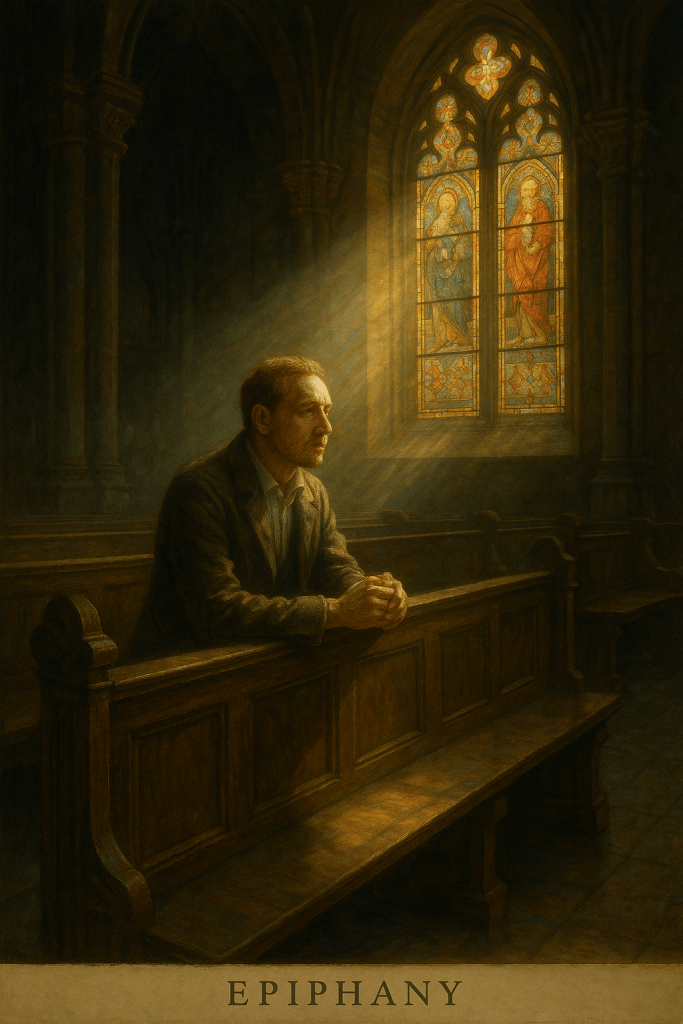
Not the violent kind that rattles windows and demands attention, but the kind that seems to think—pausing, resuming, whispering to itself. The rain had followed him down the street and into the old stone church, where it softened into echoes and silence.

He had not planned to stay. The church was only a shortcut between the office and the parking lot, a dry passage through a wet afternoon. But something slowed him. He found himself in the back pew, coat still damp, listening to the hush settle around him as the last of the lights were switched off one row at a time.

The nave held the faint scent of incense and old stone—memory suspended in air. In the stillness, he could feel his own breathing again, and beneath it the steady, stubborn rhythm of his heart, like a clock that had kept time through disappointment without ever being consulted.


The week had been heavy in ways that never show up on calendars or balance sheets. A conversation delayed too long. A letter unopened on the kitchen table. A friendship fractured not by malice but by neglect. He had lived lately by screens and schedules, moving efficiently while drifting inwardly, performing life rather than inhabiting it.

When the rain began earlier that afternoon, it felt as though the world had decided to mourn first.

He looked toward the altar. It was plain—no ornament, no spectacle. A linen cloth folded with care. Above it, a wooden cross, worn smooth by time and eyes. The figure upon it was neither triumphant nor dramatic. It looked tired. Human.

In that weariness, he recognized something familiar.


Lightning flared suddenly through the stained glass, flooding the nave with color for a heartbeat—reds and blues and golds briefly made whole. In that instant, he noticed a woman kneeling several pews ahead of him.

She hadn’t been there before. Or perhaps she had, and he had not been ready to see her.

She wasn’t praying with folded hands but with palms open, resting lightly on her knees, as though offering something invisible. When the light faded and the thunder rolled, she did not move.

The storm continued its rhythm, and the building seemed to breathe with it: thunder, pause, rain, silence.

A word surfaced in his mind—epiphany. A word he remembered from long ago, defined as a sudden revelation, a moment when something hidden becomes visible. A manifestation. An appearing.

For the first time in years, he wondered whether such moments still happened—not in Scripture or spectacle, but quietly, woven into ordinary time.


He closed his eyes.

The air smelled of damp stone and candle wax. Images rose without invitation: his father’s laughter, the sterile light of a hospital room, the way a lake turned silver just before sunset. A stranger’s voice from years ago, saying, You look like someone still searching.

His life felt layered, translucent, as though meaning had always been present but partially obscured. One layer lifted, then another—not by effort, but by grace.

When he opened his eyes, the woman was gone.

Only her umbrella leaned against the front pew.

He stood and walked forward, intending to return it if she was still nearby. As he approached, something inside him loosened—a knot he hadn’t known how to name. The familiar tension between doing and being, between guilt and mercy, softened.

The umbrella was patterned with constellations. When he lifted it, droplets slid across the fabric like falling stars.


Outside, the storm had broken.

The air was sharp with ozone and freshness. Streetlights shimmered on wet pavement. Cars hissed past, ordinary and miraculous at once. Across the street, a diner sign flickered OPEN—half the letters burned out, yet unmistakable.

He laughed quietly. Even broken, it told the truth.

Inside, the waitress poured him coffee without asking. The woman from the church sat near the window, stirring her tea. She glanced up, smiled faintly, and nodded.

No words passed between them. None were required.

He sipped the coffee. The city hummed like an organ warming up. Outside, clouds thinned, and the first ribbon of sunrise touched the street. It caught the rim of his cup, the chrome of the jukebox, and the tear he hadn’t noticed had fallen.

Everything aligned—not as an explanation, but as a recognition.

The rain. The church. The cross. The lightning. The diner’s broken sign.

Not revelation in thunder. Not truth carved in stone.

Just the world, quietly saying: I am here.


When he left the diner, he didn’t take the umbrella.

He wanted to feel the light on his face.

The city resumed its noise—engines, voices, footsteps. Nothing had changed, and yet everything had. He carried no answers, no resolutions, no plans—only a stillness, warm and steady, glowing just behind his ribs.

He was no longer alone in the silence.

As he turned the corner, he thought again of the woman and the umbrella left behind.

Why hadn’t he given it back?
The question rose naturally, as it might in the reader’s own mind.

Perhaps because she hadn’t truly forgotten it.
Perhaps because some gifts aren’t meant to be returned.

The umbrella had done its work—a small constellation pointing toward a larger one, a reminder that revelation often leaves something behind.

Something you don’t need to keep
in order to remember.


Epilogue

Epiphany is a word that means “to appear.”

But perhaps its truer meaning is this:
to notice.

For the divine has always been appearing. The shepherds came to see the Baby.
It is we who, at last, learn to look.

What Every Student Should Know: The Real Purpose of English Literature Education

A collaboration between Lewis McLain & AI (1 of 4 in a series)

I was not a good student until long after college. My high school education was mediocre at best — partly because of the school, but mostly because of me. I didn’t know how to study. I didn’t seek help. I had no real intellectual mentors. I was lazy in a quiet, unintentional way and never understood the bigger purpose or long-term path of a good education. I knew how to get through classes, most of the time, but not how to learn from them.

It took years before I realized what I had missed and why those required English literature courses mattered far more than I ever understood at the time. What educators were really trying to give me — and every student — was not just exposure to books, but the foundation for thinking, communicating, understanding, and living well.

This essay explains what those courses are actually designed to teach, why they matter, and why they still matter in a world now shaped by artificial intelligence.


1. The Ability to Understand Complex Texts

A central purpose of literature education is to build the skill of reading difficult material — the kind students will face throughout their adult lives. High school graduates, and especially college graduates, must be able to read:

  • Long, nuanced arguments
  • Old or formal language
  • Symbolic or poetic writing
  • Dense reports, court opinions, contracts, and historical documents

Literature is the training ground for that ability.

Shakespeare teaches students how to decode older forms of English. Faulkner tests their patience and perseverance. Austen reveals the layers beneath social formality. Toni Morrison stretches their emotional and cultural imagination.

As students wrestle with these texts, they develop a quiet but essential confidence:
“I can understand things that are difficult.”
That confidence becomes a life skill.


2. Understanding How Literature Works

Educators also want students to understand the machinery behind writing — the basic tools every author uses to create meaning.

Students learn:

  • Metaphor (the green light in The Great Gatsby)
  • Symbolism (the conch shell in Lord of the Flies)
  • Point of view (Scout’s innocent narration in To Kill a Mockingbird)
  • Irony (Orwell’s weapon of choice in Animal Farm)
  • Imagery and diction (Frost’s careful simplicity)

The goal is not to create literary critics. The goal is to give students the ability to recognize how language shapes thought. A person who understands how a story works is better equipped to understand political messaging, advertising, public relations, or even everyday persuasion.

This is why literature is not a luxury — it’s training in how not to be fooled.


3. Cultural Literacy: Joining the Human Conversation

There are certain books, ideas, and stories that form a shared cultural foundation. Literature courses introduce students to the stories that have shaped society, not because they are old, but because they remain true.

Students learn why:

  • Sophocles still speaks to our conflicts between conscience and law.
  • Shakespeare still reveals jealousy, ambition, love, and betrayal.
  • Dickens still exposes economic injustice and compassion.
  • Orwell still warns us about surveillance, language manipulation, and authoritarianism.
  • Austen still exposes pride, social pressure, and misunderstanding.

A culturally literate student becomes a culturally capable adult — someone able to participate in discussions about society, politics, ethics, and history.


4. Critical Thinking: The Lifelong Skill

Perhaps the most valuable outcome of English literature education is critical thinking.

In reading, students must ask:

  • What is the author really saying?
  • Why did they choose this perspective, this language, this structure?
  • What assumptions lie underneath the text?
  • What does this reveal about the world or human nature?

A student who can interpret a complex novel can interpret a tax policy, a city budget, a political speech, or a scientific claim.
A student who can evaluate a character’s flawed reasoning can evaluate flawed reasoning in real life.

Literature is not merely about stories. It is about sharpening the mind’s ability to see clearly.


5. Communication and Writing Mastery

Every literature course is also a writing course, whether students realize it or not. The act of writing about literature teaches students to:

  • Argue from evidence
  • Organize thoughts coherently
  • Write with clarity and purpose
  • Support ideas logically
  • Use language with precision

These skills matter in every field: law, finance, medicine, management, politics, engineering, ministry, and public service.

A student who can explain the theme of Macbeth can write a clear email, a persuasive memo, a professional proposal, or a thoughtful report. Writing is not an English-specific skill — it is a leadership skill.


6. Empathy, Imagination, and Emotional Intelligence

Developing the mind is not enough. Literature develops the heart.

When students read:

  • Elie Wiesel’s Night they encounter the raw trauma of the Holocaust.
  • Chimamanda Adichie’s Purple Hibiscus they glimpse life in postcolonial Nigeria.
  • Steinbeck’s Of Mice and Men they feel loneliness and dignity in the lives of the marginalized.
  • The Odyssey teaches themes of homecoming, loyalty, and courage.

Literature gives students the ability to imagine lives that are not their own.
It cultivates empathy — the ability to understand and care about other people’s experiences.

This is not sentimental. It is essential for citizenship, leadership, community, and family.


7. Why Literature Still Matters in the Age of AI

In a world where artificial intelligence can summarize, rewrite, and generate text in seconds, some people ask whether traditional literature education still matters.

It matters more than ever.

AI can produce words, but it cannot replace judgment.

Only a well-educated human being can tell whether a paragraph is wise, ethical, manipulative, or true.

AI can generate information, but it cannot generate insight.

Insight is born only from a well-trained mind — one capable of making connections, recognizing patterns, understanding motives, and evaluating consequences.

AI can mimic style, but it cannot understand meaning.

Understanding meaning requires the human experiences literature cultivates: empathy, cultural awareness, emotional maturity, and moral imagination.

AI can assist thinking, but it cannot replace thinkers.

A person who has never read deeply cannot judge whether an AI’s output is sound.
A person who has read deeply can use AI the way a carpenter uses a tool — with skill, caution, and purpose.

This is why literature education is not obsolete in the age of AI. It is the antidote to shallow thinking in a time of overwhelming information.


Conclusion: The Mind, The Heart, and The Citizen

When educators require English literature classes, they are not trying to burden students with book reports. They are trying to form capable human beings.

They want students to leave school with:

  • The ability to read hard things
  • The capacity to think deeply
  • A sense of cultural inheritance
  • The skill to write clearly
  • The imagination to empathize
  • The judgment to navigate an AI-driven future

I learned these truths later in life, long after I realized how much I had coasted through school. But I now understand that English literature — at its best — does not simply teach books. It teaches people how to live, how to think, how to understand others, and how to contribute meaningfully to society.

It is one of the few subjects that strengthens both the mind and the soul. It is why I think, research and blog.

Fund 999


A collaboration between Lewis McLain & AI

Expanded Municipal Conference Edition
(A municipal one-act for finance directors, auditors, city managers, and anyone who fears the phrase “per GASB …”)

Dramatis Personae

  • Socrates — “Temporary Fiscal Clarity Consultant.”
  • Clerk — keeper of keys, minutes, and mysteries.
  • Finance Director — calm, caffeinated, bindered.
  • Auditor — cheerful, bespectacled, powered by sampling.
  • Councilmember — earnest, reform-minded, occasionally literal.
  • Budget Analyst — Excel whisperer, existential worrier.
  • Grants Coordinator — compliance hobbyist, binder color-coder.
  • IT Person — speaks API, fears “Final_FINAL_v27.xlsx.”
  • Bond Counsel (Cameo) — invokes covenants, vanishes.
  • City Manager — thunder on loafers.
  • Stranger — walk-on comic angel of clarity.
  • Chorus — two staffers labeled “Chart of Accounts,” who sing footnotes and disclaimers.

Scene 1 — Records Room, 8:01 a.m.

(A pull-chain bulb. Filing cabinets labeled “Special Revenue (Ancient)” and “Projects We Definitely Finished.” A banker’s box glows faintly.)

Clerk: (whispering) I found it behind the 1998 copier lease and an unsigned MOU.
Socrates: (peering in) Ah! A relic with a number: Fund 999. The last digit thrice—the mystics will be unbearable.
Clerk: We numbered it so we’d remember it. We forgot it because we numbered it.
Socrates: Thus the first law of bureaucracy: name a thing, and it hides behind the label.

(Enter Finance Director with coffee.)

Finance Director: We don’t use Fund 999. It’s legacy. Dormant. Harmless.
Socrates: Dead or sleeping?
Finance Director: With funds there is “active,” “should’ve been closed,” and “awaiting discovery by auditors.”
Chorus: (soft hum) GASB fifty-four… five flavors… evermore…
Socrates: Five flavors? I hope they pair with coffee.
Finance Director: They pair with pain.

(Lights shift.)


Scene 2 — The Conference Room of Unfinished Business

(Whiteboard reads: “CLOSE-OUT PLAN — DRAFT OF THE DRAFT.” A plate of cookies labeled “For Council Only.”)

Budget Analyst: We think it began as a Special Revenue Fund.
Socrates: “Special” in the sense of purpose or in the sense of “we didn’t know where else to put it”?
Budget Analyst: (shrugs) Column G says purpose. Column H says “¯\(ツ)/¯”.
Grants Coordinator: I found a 2004 email: “Use Fund 999 for ‘Economic Vibrancy Initiatives.’”
Socrates: A phrase so broad that even philosophy can’t hug it.

Finance Director: (opens binder) Under GASB 54, fund balance has five flavors: Nonspendable, Restricted, Committed, Assigned, Unassigned.
Socrates: Like Greek virtues, but with footnotes and acronyms. Which flavor is 999?
Finance Director: (grim) It says Assigned.
Socrates: Assigned by whom?
Finance Director: People who no longer work here and possibly never existed.

Councilmember: If it’s assigned, can we un-assign it and buy sidewalks?
Socrates: Can a promise made at midnight guide a parade at noon?

(Enter Auditor, jolly and terrifying.)

Auditor: I sensed ambiguity. I came as soon as it balanced.

(They gather around a laptop that immediately requests updates.)


Scene 3 — Field Audit, with Flashlight

(A worktable of binders, highlighters, and a flashlight for dramatic effect.)

Auditor: Three classic reasons a fund like this persists:

  1. Revenue vanished, meetings continued.
  2. It became a parking lot for “temporary” due-to/due-from balances during the Bronze Age.
  3. Someone feared commingling like they fear cilantro—

(Door SLAMS. Enter City Manager, thunder on loafers.)

City Manager: (booming) WHO SPOKE THE C-WORD?
(Everyone freezes. Coffee trembles.)
City Manager: The C-word is worse than profanity! It shall never enter your mind nor cross your lips. Should you contemplate inter-fund cross-pollination, your tenure shall be concluded by end of day—by end of lunch if I’ve had decaf! We separate by purpose, by law, by covenant, by destiny! Are we clear?
All: Crystal!
City Manager: Carry on. (Exits like a thunderclap. The doorknob impelled the wall and won’t close until maintenance can come.)

Socrates: Behold, a policy sermon in one act.
Auditor: We shall say “cash cross-contamination.”
Grants Coordinator: I prefer “inter-fund salsa.”
Finance Director: Let’s say none of that in the minutes.

Auditor: As I was saying: trace origin, verify restrictions, clear “temporary” balances old enough to vote, and—if unconstrained—close or repurpose per policy.
Socrates: A funeral with paperwork.
Budget Analyst: And an obituary in Column J.

Chorus: (singing softly) Schedule of Expenditures of Federal Awards… SEFA, SEFA, hallelujah…


Scene 4 — The Council Work Session That Lasts Forever

(Slide: “Agenda Item 7: Fund 999 — Close-Out Options.” The clock reads 5 p.m. It will continue to read 5 p.m.)

Councilmember: Why do we have so many funds?
Socrates: Because the human heart loves categories. Also, reports paginate badly.
Finance Director: Funds aren’t piles of cash; they’re accounting entities. The question: does 999 still serve a public purpose with the correct basis of accounting, or is it an honorary title we forgot to retire?
Councilmember: And the risk?
Finance Director: Confusion, misreporting, and the slow death of transparency by a thousand “Other Financing Sources.”
Socrates: When is a Special Revenue Fund truly special?
Finance Director: When a revenue is legally restricted or formally committed. “We like it this way” is not a restriction.
Socrates: Capital Projects Fund?
Finance Director: For major construction tracked over years.
Socrates: Internal Service?
Finance Director: Shared services—fleet, IT, insurance—half science, half therapy.
Socrates: Enterprise?
Finance Director: Water, sewer, airport—where depreciation is theoretical until cash runs out.
Councilmember: So Fund 999 may be none of these.
Socrates: Or all in spirit and none in substance—Schrödinger’s Fund- you know, the quantum mechanics thingy.
Auditor: And remember: no cross-conta—
All: SHH!
Auditor: (solemn) The thing we do not name.

(Suddenly, the door opens. A man in jeans and a checked shirt leans in, microphone in hand.)

Stranger: You might be a redneck if the only thing you know about debits and credits applies to your bar tab!

(He tips his hat and leaves before anyone can speak. A beat of stunned silence.)

Budget Analyst: Was that Jeff Foxworthy?
Councilmember: Sure looked like him.
Finance Director: Who invited him to this workshop?
Clerk: Dunno, but he nailed our internal controls problem.
Socrates: A wandering comic sage—he spoke truth in accruals.
Auditor: And violated no procurement policy.
(They shrug and return to the slide.)


Scene 5 — The Archive Yields a Scroll

(The IT Person hustles in with a USB drive labeled “Do_Not_Delete.”)

IT Person: I found the creation memo in a retired share. Also twelve copies named “Final.”
Budget Analyst: (reading) “Fund 999 established to collect developer contributions for ‘Vibrancy Improvements’: benches, trees, and public art—until expended.”
Grants Coordinator: That smells like Restricted—by agreement, maybe even by location.
Finance Director: If contribution agreements limit geography and purpose, the money can’t fund sidewalks three miles away or festival confetti.
Socrates: The fund’s soul is not empty; merely mislabeled.

Auditor: Proposed remedy:

  • Inventory balances; tie dollars to source agreements and zones.
  • Finish intended projects or amend agreements in public.
  • Anything orphaned goes to the closest lawful purpose via resolution, with a bright-line audit trail.

Councilmember: And if any dollars touched bonds?
(Enter Bond Counsel like a thundercloud.)
Bond Counsel: Then behold private use and spend-down rules. One does not mix—
All: SHH!
Bond Counsel: —one does not cohabit bond proceeds with things best left separate. (Vanishes.)
Socrates: A god descended, spoke in acronyms, and departed.


Scene 6 — The Ritual of Reclassification

(Whiteboard now reads: “Close-Out Steps (No New Mysteries).”)

Finance Director:

  1. Document the origin — revenue source, legal constraints, geographic limits.
  2. Reconcile balances — clear “temporary” due-tos/froms and identify encumbrances older than our interns.
  3. Reclassify fund balance — from “Assigned” to Restricted where supported; from myth to Committed via Council action; true orphans to Unassigned in General Fund—but only if truly free.
  4. Council resolution — honor original intent, specify projects, authorize closure or continuation in a proper fund.
  5. ERP updates — lock Fund 999; migrate remaining activity with a clean audit trail and a change log longer than the Iliad.
  6. Public report — plain-English: “Where it came from, where it’s going, why it’s right.”

Auditor: And when you close it, do not create a brand-new “Miscellaneous Special” for leftovers. That’s like cleaning your desk by buying a bigger drawer.
Budget Analyst: (guilty) Drawer 4 is full.

Socrates: Adopt a Fund Rationalization Policy:

  • Sunset clauses (“close within 24 months of project completion”).
  • Criteria for when a special revenue fund is warranted vs. a department in General.
  • An annual Fund Cemetery Review: who can be merged, closed, or resurrected only with cause.

Finance Director: (scribbling) I’ll title it “The No New Mysteries Act.”
Grants Coordinator: With an appendix: “Words We Don’t Say.”
All: (in unison) The C-word.


Scene 7 — The Public Hearing

(A citizen with a stroller; a teenager in a marching band shirt; a retiree holding a sapling.)

Councilmember: Tonight we confess: sometimes we created complex things for simple purposes, then forgot the purpose. We bind ourselves to clarity.
Citizen: Does this mean the benches and trees are finally coming?
Finance Director: (smiles) In the right places, for the right reasons, with the right dollars.
Socrates: If a city can discover the meaning of “assigned,” it can surely plant a tree.

Chorus: (like a lullaby)
Nonspendable for what cannot be spent,
Restricted by law and covenant;
Committed by council’s earnest vote,
Assigned by those who mind the float;
Unassigned to cushion rain…
and never hide your funds again.


Scene 8 — Epilogue in the Records Room

(The box labeled “Fund 999” now bears a red tag: “CLOSED—SEE RES. 2025-117.”)

Clerk: Will there be others like it?
Socrates: Anything built by people is half cathedral, half maze.
Finance Director: But now we keep a map—and a list of words we do not speak.
Auditor: See you next year. Fewer legends, more sidewalks.
(They nod. The bulb clicks off.)


Closing Hymn (Tempo: Workshop After 5 p.m.)

Verse 1
We opened every ledger, we traced the oldest thread,
Found dollars softly sleeping in the archives of the dead.
We numbered them with reverence, we labeled them with care,
Then closed them with a policy and sunlight everywhere.

Chorus
Oh sing the five fund flavors, in balance true and kind:
Restricted, Committed, Assigned, Unassigned!
And when the auditors arrive, we greet them with a grin—
For legends fade to footnotes when the policies begin.

Verse 2
We honored covenants sacred, we planted trees at last,
We cleared the “temporary” items from the echoes of the past.
If ever funds grow labyrinths on shelves we cannot see,
We’ll ask the simplest question first: “What is the purpose, be?”

Chorus (repeat)


Quick Reference

  • GASB 54 Fund Balance: Nonspendable / Restricted / Committed / Assigned / Unassigned
  • Special Revenue Fund: Use only for legally or formally constrained revenues.
  • Capital Projects Fund: Track major construction across years.
  • Internal Service Fund: Shared services; mind rate setting and net position.
  • Enterprise Fund: Business-type; depreciation is real (and so is cash).
  • Close-Out Steps: Origin → Reconcile → Reclassify → Council Action → ERP Migration → Public Summary.
  • Policy Fixes: Sunset clauses; annual fund rationalization; bright-line handling of orphans; glossary of “Words We Do Not Say.”

Staging & Use Notes

Run time ≈ 15–18 minutes. Cast 8–10. Props: banker’s box, scary binder, whiteboard, pull-chain bulb, one cookie labeled “For Council Only.”
Handout: Close-Out Checklist + Five Flavors explainer.


Socrates Teaches Auditing

A collaboration between Lewis McLain & AI

A Philosophical Comedy in Three Parts

(Socrates Explains Auditing to a Very Slow Student)


Dramatis Personae

  • Socrates – Philosopher, irritated and unpaid.
  • Apprentice – An eager but dim student, fluent in curiosity, not accounting.
  • CFO – A tired but triumphant modern executive.
  • Audit Partner – High priest of Reasonable Assurance.
  • Junior Auditor – Silent observer, always writing.

Part I – Why “Unqualified” Means “Clean”

Apprentice: Master, I am baffled. Why do auditors call their best opinion unqualified? When my mother says I am unqualified, it is not a compliment.

Socrates: (Groaning) Because, my dear imbecile, the gods of accounting delight in contradiction. When they say unqualified, they mean without reservations. When they say clean, they mean no visible dirt. When they say material, they mean big enough to embarrass someone important.

Apprentice: So, “unqualified” means “good,” even though it sounds “bad”?

Socrates: Precisely. It is the linguistic gymnastics of a profession allergic to plain speech. An unqualified opinion is a clean one—no disclaimers, no confessions, no footnotes whispering “don’t sue us.”

Apprentice: But why not call it a perfect opinion?

Socrates: Because auditors fear perfection. Perfection implies responsibility, and responsibility implies liability. Instead, they seek the safer realm of reasonable assurance—a phrase that means, “We’re fairly sure everything’s fine, unless it isn’t.”

Apprentice: What about this word materiality they keep using?

Socrates: Ah, yes—their sacred idol. Materiality is the holy threshold between sin and salvation. A missing coin? Immaterial. A missing treasury? Material. And if the city burns down? “Subsequent event—disclosed in Note 17.”

Apprentice: And who decides what’s material?

Socrates: A mythical being known as the reasonable user of financial statements—a creature never seen in nature, but often invoked in court.


Part II – Socrates’ Audit Field Notes

(From the philosopher’s unwilling internship.)

Day 1 – Arrival
They descend upon the city like well-dressed locusts carrying laptops. They introduce themselves politely, then demand ledgers, receipts, and things long lost to history. “We’ll only be here a few weeks,” they say. Three moons later, they’re still in the break room, testing petty cash.

Day 7 – Sampling
They claim to find the truth by studying ten transactions out of ten thousand. “Representative sample,” they say. “Reasonable assurance,” they add. I call it faith healing with spreadsheets.

Day 15 – Materiality
The auditors debate whether a missing goat is material. After long deliberation, they conclude that one goat is immaterial—unless the herd only had one.

Day 29 – Planning the Plan
They plan the audit, then plan the planning, then plan a meeting to discuss whether the plan aligns with the planned planning. I admire their devotion to process, if not progress.

Day 45 – Walkthrough
An auditor asks me to “walk him through” our cash disbursement cycle. We literally walk—to the market, buy a chicken, and pay the vendor. “Control deficiency,” he mutters. I agree.

Day 73 – The Opinion Letter
After months of work and the sacrifice of several interns, the final parchment emerges:

“In our opinion, the financial statements present fairly, in all material respects…”

Translated from Auditorian: “We didn’t find anything catastrophic, though we looked very hard and are still suspicious.”

Closing Reflection:
Auditors are philosophers of doubt. They pursue truth with calculators and disclaimers, living in eternal tension between assurance and fear of subpoena.


Part III – The Post-Audit Symposium

CFO: Finally! A clean opinion! We are vindicated.

Audit Partner: Indeed. Unqualified—no exceptions, no reservations, no surprises.

Socrates: And yet, you call it “fairly presented.” Why not “true”?

Audit Partner: Because “true” is for prophets. We offer “fair,” which is safer and billable.

Socrates: You sell comfort, not certainty.

Audit Partner: Exactly! Certainty is reckless. Comfort pays the rent.

CFO: Still, this took four months!

Audit Partner: Timeliness is immaterial. Until it surpasses a GASB requirement.

Socrates: (Sighs) So your audit is both eternal and late. How fitting. Tell me, why not simply trust the books?

Audit Partner: Because trust, unverified, is heresy.

Socrates: Then you are theologians of skepticism.

Audit Partner: (Nods) We call it professional skepticism.

Socrates: A fine term for universal suspicion.

Audit Partner: We are trained to doubt until evidence says otherwise—and even then, we document our doubt in triplicate.

CFO: Still, “unqualified” sounds insulting.

Socrates: Indeed! The irony is that the highest praise of your craft sounds like an insult. You should call it Immaculately Unqualified.

Audit Partner: We tried that once. Legal said no.

(The Junior Auditor silently logs 0.25 hours for “client philosophical engagement.”)

Socrates: And this materiality—how is it decided?

Audit Partner: We gather in secret, summon spreadsheets, and chant percentages until consensus appears.

Socrates: A ritual of quantitative mysticism! Tell me, what if you find something truly awful?

Audit Partner: Then the opinion is qualified, the CFO is nervous, and the audit partner retires early.

Socrates: (Raising his cup) To auditors—guardians of truth by approximation! May your samples be random, your conclusions conservative, and your coffee deductible!

All: Hear, hear!


Epilogue – The Ancient Spoof

(Socrates unrolls an ancient scroll.)

“The typical accountant is a man, past middle age, spare, wrinkled, intelligent, cold, passive, non-committal, with eyes like a codfish; polite in contact but at the same time unresponsive, calm and damnably composed as a concrete post or a plaster-of-Paris cast; a petrification with a heart of feldspar and without charm of the friendly germ, minus bowels, passion or a sense of humor. Happily, they never reproduce, and all of them finally go to Hell.
Elbert Hubbard, early 1900s (often quoted mid-century for auditors and proudly found in the preface of some auditing reference material)

Socrates: A cruel jest—but one senses it was written by a man recently audited.


Final Hymn: “Reasonable Assurance”

(To the solemn tempo of an office coffee maker)

Verse 1
Oh, auditors come in the fall’s rain,
With checklists, ticks, and doubt’s domain.
They question all, from cash to soul,
Then bill us hourly for control.

Chorus
Reasonable assurance, softly we pray,
Nothing material shall ruin our day.
Clean though unqualified, cautious yet bright,
Blessed be GAAP, and good-night, good-night.

Verse 2
They test the goats, they test the grain,
They find no fraud—just minor pain.
They sign their names, they bow, they leave,
And send an invoice we can’t believe.

Final Chorus
Reasonable assurance, hold fast, hold true,
For certainty’s dangerous and lawsuits accrue.
Clean though unqualified, may wisdom delight,
For even Socrates closes the books at night.

I’m Back!

I see that my last post was in 2019. So, why start posting again? There are several reasons.

  1. I’ve actually been writing quite a bit – just not posting since most of my writings have been about personal matters.
  2. I now write in collaboration with AI, mostly ChatGPT. By the time I have had AI add, rewrite, and let me be the content guide and editor, is it Lewis or AI? Like I said, it is a collaboration in the truest since of the word.
  3. I’m heavily influenced by a Bible Study I am in as well as the ages and stages of life. Our oldest granddaughter, Lindsey, has now graduated from college, is teaching 4-year-old autistic children and living in her own apartment in downtown McKinney. Lily is a junior architectural student at Texas Tech. Anderson just left last Friday for Texas Tech as a freshman. He is planning to study business and computers. Kenneth & DeAnne are downsizing their home and plan to live in the historic district in Downtown McKinney. Linda & I are both 78, in so-so health, and are celebrating our 57th anniversary today. God is good, and all is well. Just happy to be alive!
  4. After years of being politically neutral as much as possible, with conservative leanings, I am full bore conservative/anti-woke and a Trump supporter now. My disdain for liberalism is greater than my support of conservativism.
  5. I still write about governmental finance topics even though my preferred subject stream is wherever my mind and heart are at any given moment. I still work close to 40 hours a week with my expertise being narrowed to Sales Tax Analyses as well as Multi-Year Financial Planning (MYFP). I love every minute of my consulting and will probably continue as long as I can use the keyboard.

    What this means is that if you are not interested in the type of topics I mostly write about these days, then I think there is a way you can unsubscribe on your own.

    If you think I have anything interesting to say, please forward to any of your friends, colleagues and family.

    Thank you!
    Lewis