Turning Down the Lights, Saving the Migratory Birds
A curiosity exploration by Lewis Mclain & AI
Introduction: Why Lights and Glass Matter
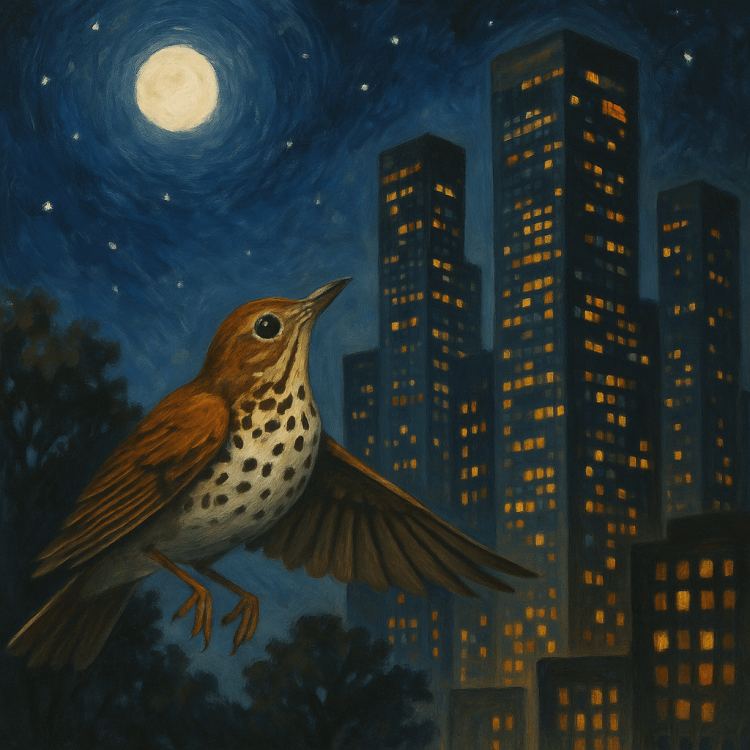
Every year, more than a billion birds migrate across North America, traversing thousands of miles between their breeding and wintering grounds. These journeys are guided by instinct, celestial navigation, magnetic fields—and increasingly disrupted by one major human factor: artificial light at night. The bright glow of modern cities lures birds off course, disorients them, and often leads to fatal collisions with glass buildings.
Cities that turn off or dim nonessential lights during peak migration seasons can prevent hundreds of thousands of bird deaths. Implementing such changes requires more than flipping a switch—it involves understanding bird behavior, adjusting building policies, managing light pollution, and building public awareness.
This guide educates and equips local governments, building owners, designers, students, and the public to understand and address this avoidable ecological crisis.
Part 1: The Science of Migration
Birds migrate to survive. They follow ancient routes each spring (March through June) and fall (August through November), driven by food availability, breeding cycles, and temperature shifts. Most species migrate at night to avoid predators, conserve energy, and navigate by the stars.
However, artificial light confuses their internal compass. Most birds take off within 30 to 60 minutes after sunset. Peak flights typically occur 2 to 4 hours after dusk, with birds flying at elevations of 500 to 2,000 feet. This makes them especially vulnerable to tall, illuminated buildings.
Part 2: How Light and Glass Kill
Birds cannot recognize glass as a barrier. To them, it either reflects what’s behind them or appears invisible. Transparent corners, reflective windows, and brightly lit interiors create the illusion of open sky or shelter.
Birds are drawn toward city lights—particularly during cloudy or moonlit nights. The brighter the building, the more likely it is to attract and disorient migratory species. Fatal collisions spike during migration peaks. One study in Chicago found that turning off lights on a set of downtown buildings reduced bird deaths by over 80% (Ecological Applications, 2009).
Part 3: When and Where Collisions Are Worst
Spring migration (March 15–June 15) and fall migration (August 15–November 15) are the most critical periods. Birds such as the wood thrush, blackpoll warbler, and golden-winged warbler are among the most vulnerable.
Cities on major flyways—like Chicago (Mississippi Flyway), Dallas (Central Flyway), and New York (Atlantic Flyway)—see the highest levels of mortality. On some nights, radar confirms that over 400 million birds are airborne across the U.S. (BirdCast).
Part 4: Current Ordinance Models
Cities have approached the issue in multiple ways:
- Voluntary programs such as “Lights Out” (Chicago, Dallas, Houston)
- Mandated bird-safe glazing ordinances (New York City, Toronto)
- Green building guidelines that include bird protection standards (San Francisco)
Strong laws target buildings 4 stories or taller or those with 40%+ glass on lower façades. Effective programs reduce exterior lighting from 8:00 PM to 2:00 AM and require bird-safe glass in new construction.
Part 5: Sample Model Ordinance Components
- Migration Periods: March 15 to June 15 and August 15 to November 15
- Covered Buildings: Structures 4+ stories tall or with ≥40% glass within first 60 vertical feet
- Lighting Rule: Extinguish/dim nonessential exterior/interior lighting from 8:00 PM to 2:00 AM
- Glass Rule: Bird-safe glazing (e.g., fritted, patterned, UV reflective) on new construction or major renovation
- Reporting: Building managers must report if 3 or more birds die on their site in one night
- Enforcement: Educational warnings escalate to fines and permit reviews
- Public Engagement: Outreach campaigns, city-sponsored monitoring, BirdCast alerts
- Incentives: Tax abatements, public awards, fast-track permits for compliant projects
Part 6: The Politics and Pushback
Some developers object to the cost of glass retrofits or the aesthetic limitations of fritting. Business associations worry about dimming signage or nighttime visibility.
In several U.S. states, especially those with strong anti-regulatory politics, local ordinances have been challenged or preempted. Nonetheless, cities have found success when they:
- Start with voluntary programs
- Apply rules to new construction only
- Offer phase-in periods for retrofits
- Provide clear visuals and alternative compliance paths

Part 7: A Scripted City Council Debate
[Scene: City Council Chambers – Exampleville – Evening Meeting on the Proposed Bird-Safe Lighting Ordinance. The public gallery is nearly full. A large screen behind the dais displays a title slide: “BIRD-SAFE LIGHTING: Proposed Ordinance for Migratory Protection.” The atmosphere is a mix of civic seriousness and simmering tension.]
Councilmember Rodriguez (Environment Committee Chair): “Colleagues, we have before us Ordinance 25-102: requiring certain buildings to dim or extinguish nonessential lighting between 8 PM and 2 AM during migratory seasons, and to incorporate bird-safe glazing in new construction. I want to start by saying: this is not a symbolic ordinance. This is about life and death—measurable, preventable, local deaths of creatures flying thousands of miles. This is stewardship.”
Councilmember Garrett (At-Large): “I appreciate the heart behind this, but I’m also hearing from property owners—especially downtown—that this proposal could cost them significantly. They’ve raised questions about how lighting reductions might affect nighttime safety, tourism visibility, and brand presence. What’s our strategy for mitigating unintended consequences?”
Councilmember Nguyen (District 3): “Let’s clarify: we are not banning lights. We’re asking that buildings dim or turn off nonessential lighting—accent lights, internal lobby glows, façade spotlights—during specific high-risk windows. That’s 8 PM to 2 AM, only from March to June and August to November. Buildings can still meet all safety and egress codes.”
Councilmember Vega (Deputy Mayor Pro Tem): “We also have to acknowledge public health and ecological science. This is backed by Cornell, the National Audubon Society, and hundreds of radar studies. We have collision data from our own downtown—over 1,000 carcasses collected last fall alone by volunteers from Local Audubon. Those are just the ones we found.”
City Planner (staff): “We’ve modeled the cost of retrofitting a mid-rise glass building with fritted or patterned glazing on the first 60 feet. It averages $3.50 to $5 per square foot. For new construction, the cost difference is often under 1%. For lighting, motion sensors and timers are inexpensive and often reduce utility costs.”
Public Comment – Ms. Lily Tran, 5th Grade Science Teacher: “My students are tracking migration using BirdCast and eBird. We identified over 50 species flying above this city just last week. They’re excited—until they hear about the dead birds outside City Hall and the convention center. They asked me, ‘Do the people in charge know? Do they care?’ Please show them we do.”
Public Comment – Mr. Elias Price, Developer Association: “I want to be clear: we support conservation in principle. But requiring bird-safe glass adds costs. Some of our clients are nonprofits and small businesses. They can’t absorb another code layer. Where are the incentives? Why not encourage first, regulate later?”
Public Comment – Ms. Carol Brenner, Private Citizen: “I don’t know when the city decided birds were more important than people. We’re already under pressure from zoning changes, water restrictions, emissions rules—and now you want to tell me what time I can turn my lights on? This is government overreach, plain and simple. I moved here for freedom, not to be micromanaged by a committee that’s never run a small business.”
Councilmember Rodriguez (responding): “Ms. Brenner, I understand the frustration. But let’s be clear—this ordinance doesn’t affect residential homes or mom-and-pop shops. It’s targeted to large commercial buildings with known collision risk. And it’s not just about birds. This reduces energy waste, saves on nighttime utilities, and lowers skyglow that affects human sleep patterns too.”
City Attorney: “The ordinance includes a variance process for hardship exemptions and allows for phased compliance. We also structured the enforcement to start with education and warnings—not immediate fines.”
Councilmember Nguyen: “We’ve done the listening. We’ve held four public forums. We’ve amended the original language to exclude single-story buildings, exempt signage, and clarify compliance options. We’ve built a reasonable, science-based, phased-in policy. And we’re still the second city in the region to even attempt this.”
Councilmember Garrett: “Can we include a provision that city-owned buildings must comply first? Lead by example?”
Councilmember Rodriguez: “Absolutely. That’s in Amendment B. Our libraries, fire stations, and City Hall will retrofit by next spring.”
Mayor: “Seeing no further comments, we move to vote. Ordinance 25-102, as amended, with variances, educational-first enforcement, and municipal leadership provisions. All in favor?”
[Six hands rise. One abstains. Motion carries. Applause from half the gallery.]
Part 8: Tools for Public Education
- BirdCast provides live migration forecasts by region
- Feather Friendly and Acopian BirdSavers offer DIY collision prevention materials
- eBird allows citizen scientists to track local bird data
- Students and volunteers can log bird deaths and document mitigation success
Part 9: Moral, Legal, and Ethical Dimensions
Migratory birds cross borders without passports. They are a shared public trust. The Public Trust Doctrine holds governments accountable for protecting wildlife held “in common” by society.
From an ethical standpoint, these deaths are unnecessary. Preventing them costs little and benefits ecosystems, climate goals, and public awareness. From a spiritual or stewardship lens, protecting creation reflects moral responsibility.
Conclusion: A Call to Action
The birds are flying tonight. Somewhere above the skyline, thrushes and warblers are navigating by instinct and starlight. Whether they live or die depends, in part, on what your city chooses to do.
LFM Note: I was curious about how the discussions go on this topic. I was formerly neutral at best. However, my financial background dampens my enthusiasm for supporting retrofitting. I’m not the one having to make decisions on protecting the birds, but my research has created an awareness of the passion some people have to protect migratory birds. Moreso, my empathy goes to the City Manager and City Council considering the issue with strong positions on both sides. LFM
 Let's Talk About It, Lewis!
You must be logged in to post a comment.