Psyche Revived by Cupid’s Kiss

A collaboration between Lewis McLain & AI (more from the three visits Linda & I had to the Louvre with high school students from Trinity Christian Academy).

Antonio Canova and the Awakening of the Soul


Introduction

Among the marble treasures of the Louvre Museum stands one of the most moving sculptures of all time — Psyche Revived by Cupid’s Kiss, carved by the Italian master Antonio Canova between 1787 and 1793. It depicts the mythological moment when the god Cupid (Eros) revives his beloved Psyche with a kiss, restoring her from deathlike sleep to life and love.

At once tender, idealized, and technically perfect, this masterpiece captures not only the beauty of myth but also the intellectual spirit of the Neoclassical age. For any student observer, it represents the perfect synthesis of form, feeling, and philosophy — a lesson in how art can make marble breathe.


1. The Artist and His Era

Antonio Canova (1757–1822) was born in Possagno, Italy, into a family of stonemasons. Trained in Venice and working in Rome, he became the undisputed master of the Neoclassical style, the artistic movement that sought to revive the order, harmony, and moral clarity of ancient Greece and Rome.

Canova’s art emerged during the Age of Enlightenment, a time when reason, science, and rediscovered antiquity guided intellectual life. Artists looked to classical sculpture for purity of line and noble simplicity. Against the emotional extravagance of the Baroque, Canova’s figures embodied balance, restraint, and serenity.

His goal, he once said, was to give marble the “appearance of living flesh” — and through meticulous polishing and proportion, he succeeded. His works, such as Perseus with the Head of Medusa and The Three Graces, stand as paragons of refinement and calm emotional depth.


2. The Myth of Cupid and Psyche

The story comes from Apuleius’s The Golden Ass (2nd century A.D.), one of the most enduring love myths of classical antiquity.

  • Psyche, a mortal woman of exceptional beauty, arouses the jealousy of Venus (Aphrodite), who orders her son Cupid to make Psyche fall in love with a monster.
  • Instead, Cupid himself falls in love with Psyche, visiting her each night unseen. When Psyche disobeys his order never to look at him, he vanishes.
  • After many trials set by Venus, Psyche opens a box meant to contain beauty but instead releases a deadly sleep upon herself.
  • Cupid finds her lifeless body, lifts her in his arms, and awakens her with a kiss.
  • In the end, the gods grant Psyche immortality so she may be eternally united with Cupid.

The myth is a timeless allegory of the soul’s (psyche) awakening to divine love and eternal life — a theme that resonated deeply with both ancient philosophy and Christian symbolism.


3. Commission and Creation

Canova received the commission around 1787 from Colonel John Campbell, a British nobleman visiting Rome. The sculptor completed the work by 1793, using Carrara marble, prized for its pure white translucence.

He later produced a second version (1796), now in the Hermitage Museum, but the first — the Louvre version — remains the most celebrated. It was acquired by Joachim Murat, Napoleon’s brother-in-law, and entered the Louvre’s collection in 1824.

Canova personally oversaw every stage of its creation, using fine abrasives and oil to achieve an extraordinary surface polish. This allowed light to glide across the marble as if over living skin, enhancing the illusion of breath and movement.


4. Composition and Form

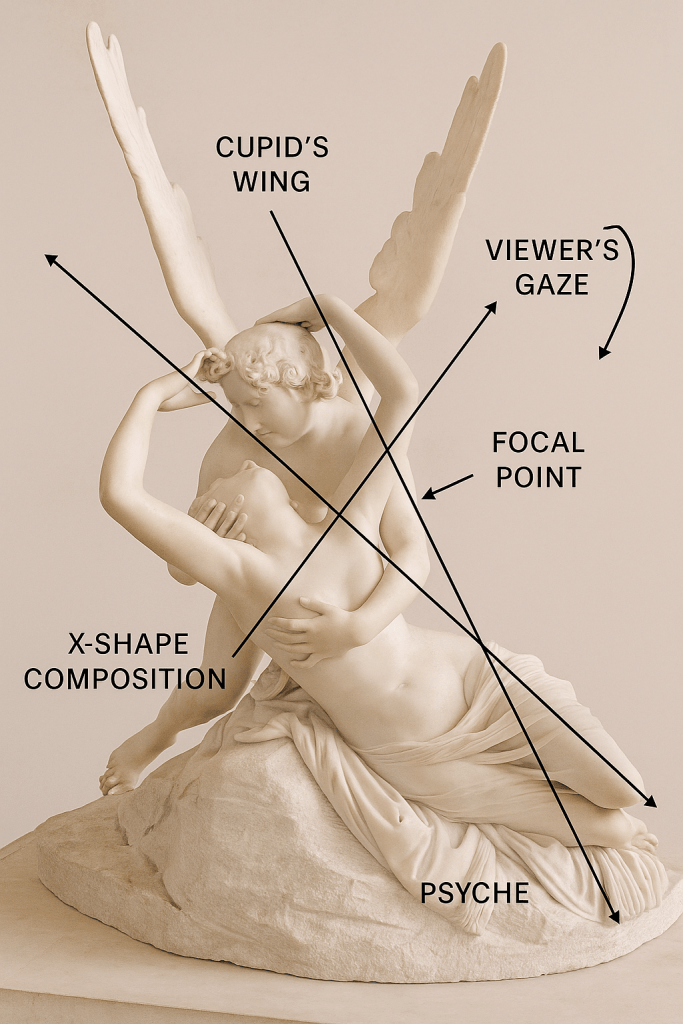
The sculpture captures the precise instant of awakening: Cupid bends over Psyche, supporting her head with one hand while their lips draw near. Psyche’s arms reach upward to encircle him, creating a perfect X-shaped composition — a dynamic cross of limbs and wings that binds the figures together.

Key features to observe:

  • Cupid’s wings rise upward like an angelic halo, framing the scene and drawing the eye toward the couple’s faces.
  • Psyche’s body arches in a graceful curve, suggesting both fragility and renewal.
  • Their hands and faces form the emotional focal point — the intersection of life, love, and divine energy.
  • The base of the sculpture, rough and unpolished, contrasts with the smooth flesh above, symbolizing the transition from earthly death to heavenly awakening.

In the educational diagram below, the X-shape composition and the diagonal lines of sight show how Canova directs the viewer’s gaze from Cupid’s wings to Psyche’s face and then downward through the drapery — a continuous flow of motion through stillness.


5. Symbolism and Interpretation

Canova’s sculpture is far more than an illustration of a myth — it is a philosophical meditation on love and the soul.

The moment of Psyche’s awakening becomes a symbol of spiritual rebirth. The butterfly, often associated with Psyche in classical art, represents transformation — the soul leaving its cocoon of mortality. Cupid, as divine love, breathes eternal life into that soul.

The composition’s diagonal tension embodies both physical energy and emotional ascent: the human yearning for the divine, the eternal dance between matter and spirit.

In Neoclassical thought, beauty was a moral force — the visible expression of virtue and truth. Thus, Canova’s restrained tenderness contrasts with the passionate turmoil of Baroque art. Love here is not sensual conquest but spiritual restoration.


6. Reception and Legacy

When first exhibited in Rome, Psyche Revived by Cupid’s Kiss was immediately recognized as a masterpiece. Critics called it “the triumph of grace over passion.” Visitors were captivated by its lifelike delicacy and emotional power conveyed without exaggeration.

It became a defining work of Neoclassicism, illustrating how calm form could evoke profound feeling. The sculpture influenced generations of artists — including Bertel Thorvaldsen, Jean-Baptiste Carpeaux, and later Romantic painters who explored the harmony of body and spirit.

Even into the 19th century, it remained a reference point for art academies, where students studied its anatomy, symmetry, and emotion as an ideal of beauty.


7. Observing the Sculpture in the Louvre

The sculpture is displayed in the Denon Wing, Room 403, near Michelangelo’s Dying Slave and Rebellious Slave. The museum’s lighting enhances the subtle contrast between shadow and shine that Canova intended.

For a student observer:

  • Move around the sculpture; every angle reveals a new emotional dialogue.
  • Notice how light travels across the marble — the figures almost seem to breathe.
  • Observe how Cupid’s downward gaze meets Psyche’s upward movement, forming an eternal loop of love and revival.
  • Pay attention to the texture contrast between the finely polished skin and the rough rock — symbolizing transformation from mortality to divinity.

This active observation turns the experience from passive viewing into an encounter with Canova’s philosophy of life and art.


8. Enduring Meaning for Students

For modern students, Psyche Revived by Cupid’s Kiss offers three timeless lessons:

  1. Technical mastery serves emotional truth. Canova’s polish and proportion allow the emotion to flow through form rather than overwhelm it.
  2. Balance creates beauty. The sculpture’s X-shaped harmony shows how composition guides feeling.
  3. Love awakens the soul. Beyond its mythic story, it reminds us that true beauty unites body and spirit, art and life.

In this sense, Canova’s work is not just about marble or myth — it is about humanity’s eternal desire for renewal, compassion, and transcendence.


Conclusion

In Psyche Revived by Cupid’s Kiss, Antonio Canova transformed stone into spirit. He captured the silent instant where death yields to love, and stillness becomes motion. His art bridges mythology and philosophy, sensuality and serenity, mortal and divine.

For all who stand before it — whether in wonder, study, or reverence — the message remains the same: Love revives, beauty endures, and art can awaken the sleeping soul.

“The beauty of the body is the beauty of the soul made visible.”
Antonio Canova

The Mind of an Inventor: The Common Thread of Creation

A collaboration between Lewis McLain & AI


I. Introduction — The Spark That Changes the World

Every great invention begins not in a laboratory but in a restless mind that refuses to accept things as they are. The inventor lives in the thin air between wonder and frustration: the wonder of seeing what might be, and the frustration that it does not yet exist.

To invent is to cross the border between imagination and matter—between “why not?” and “now it works.” Across centuries, the world’s greatest inventors have built in different mediums—stone, steam, circuits, code—yet share the same mental wiring: curiosity that won’t rest, courage that won’t quit, and a faith that imagination can serve humanity.


II. The Inventive Mindset

The inventor’s mind is a paradox. It thrives on both chaos and order, fantasy and formula.

  • Curiosity is its compass—an ache to understand how things work and how they could work better.
  • Observation is its lens—seeing patterns others overlook.
  • Playfulness is its fuel—testing ideas without fear of failure.
  • Persistence is its backbone—enduring the thousand prototypes that don’t succeed.

Failure doesn’t frighten the inventor; indifference does. To stop asking “why” is a far greater tragedy than a circuit that burns or a model that breaks.


III. Ten Inventors, Ten Windows into the Mind of Creation

Leonardo da Vinci — Sketching the Sky Before It Existed

Leonardo filled his notebooks with wings, gears, and impossible dreams. He studied the curve of a bird’s feather as if decoding a sacred language.

“Once you have tasted flight,” he wrote, “you will forever walk the earth with your eyes turned skyward.”
He painted with one hand and designed with the other, proving that art and engineering are not rivals but reflections. His flying machines never left the ground, yet every modern aircraft carries a trace of his ink.


Benjamin Franklin — Harnessing Heaven for Humanity

Franklin saw storms not as terrors but as teachers. He tied a key to a kite and coaxed lightning to reveal its secret kinship with electricity.

“Electric fire,” he marveled, “is of the same kind with that which is in the clouds.”
The lightning rod followed—a humble spike that saved countless roofs. His bifocals, his stove, his civic inventions all arose from empathy: an elder’s eyes, a neighbor’s cold house, a printer’s smoky air. He turned curiosity into charity.


Eli Whitney — The Engineer Who Made Things Fit

Whitney watched field hands comb seeds from cotton and thought, There must be a better way. His wire-toothed drum and brush—the cotton gin—sped production a hundredfold.

“It was a small thing,” he later said, “but small things change empires.”
The gin enriched the South and, tragically, deepened slavery. Seeking redemption through precision, Whitney built the first system of interchangeable parts, proving that uniformity could multiply freedom of production. He changed not just a crop but the logic of industry.


Thomas Edison — The Factory of Light

At Menlo Park, light spilled from the windows while others slept. Inside, hundreds of filaments burned and failed.

“I haven’t failed,” Edison smiled. “I’ve found ten thousand ways that won’t work.”
When carbonized bamboo finally glowed for 1,200 hours, he built an entire electric ecosystem—power plants, wiring, meters, sockets. His true invention was not the bulb but the process of systematic innovation itself.


Nikola Tesla — The Dream That Outran Its Century

Tesla lived amid lightning of his own making. To him, the universe pulsed with invisible currents waiting to be tamed.

“The moment I imagine a device,” he claimed, “I can make it run in my mind.”
His AC induction motor and polyphase system powered cities from Niagara Falls. His dream of wireless energy bankrupted him but electrified the future. In him, imagination was not daydreaming—it was blueprinting.


Marie Curie — The Glow of the Invisible

In a shed that smelled of acid and hope, Curie boiled tons of pitchblende until a speck of radium glowed.

“Nothing in life is to be feared,” she said, “it is only to be understood.”
Her discovery of radioactivity opened new worlds of medicine and physics. During World War I she outfitted trucks with X-rays, saving thousands of soldiers. Science for her was not ambition—it was service illuminated.


The Wright Brothers — Learning the Language of Air

In their Dayton workshop, the Wrights balanced on wings of wood and faith. They built a wind tunnel, measured lift with bicycle parts, and studied every gust as if air itself were a textbook.

“The bird doesn’t just rise,” Wilbur observed, “it balances.”
Their 1903 flight at Kitty Hawk lasted only seconds, yet the world’s horizon shifted forever. They proved that methodical curiosity could conquer gravity itself.


Albert Einstein — Thought as an Instrument

Einstein’s laboratory was his imagination. He pictured himself chasing a beam of light and realized time might bend to keep pace.

“Imagination,” he said, “is more important than knowledge.”
From that image grew relativity, which remade physics. Yet his most practical insight—the photoelectric effect—became the foundation of solar power. Einstein invented with ideas instead of tools, showing that creativity can re-engineer reality.


Steve Jobs — The Art of Simplicity

Jobs demanded elegance as fiercely as others demanded speed. He fused hardware and software into harmony.

“It just works,” he’d say, though it took a thousand revisions to reach that ease.
The Mac, the iPod, the iPhone—each was less a gadget than a philosophy: that design is love made visible. Jobs reinvented the personal device by stripping it down until only meaning remained.


Tim Berners-Lee — The Architect of the Digital Commons

In a corridor at CERN, Berners-Lee envisioned scientists everywhere linking their work with one simple syntax.

“I just wanted a way for people to share what they knew.”
He built HTTP, HTML, and the first web server—then released them freely. No patents, no gatekeepers. His generosity made the World Wide Web the shared library of humankind.


Together they form a single conversation across centuries. Leonardo sketched the dream of flight; the Wrights gave it wings. Franklin tamed electricity; Tesla made it sing; Edison wired it into homes. Curie revealed invisible forces; Einstein explained them. Jobs and Berners-Lee re-channeled that same human spark into light made of code. Each voice answers the one before it, echoing: The world can be improved, and I will try.


IV. The Invisible Thread — Purpose and Pattern

Behind every experiment lies a conviction: that the universe is intelligible and worth improving.
Their shared geometry is imagination → iteration → illumination.
They teach that invention is not chaos but a form of hope—faith that our designs, however imperfect, can serve life itself. The true legacy of invention is not a patent portfolio; it is a pattern of thinking that turns wonder into welfare.


V. Conclusion — Love, Made Useful

The mind of an inventor is not born whole. It is forged in curiosity, hammered by failure, and tempered by empathy. These ten lives remind us that progress is a moral act, rooted in patience and compassion.

To think like an inventor is to love the world enough to fix it—to build not merely for profit or prestige but for people yet unborn. Invention, at its purest, is love that learned to use its hands.


Appendix — Biographical Notes and Key Inventions

Leonardo da Vinci — Italian polymath; foresaw helicopters, tanks, and canal locks through meticulous study of anatomy and motion.
Key: flight sketches, helical air screw, gear systems.

Benjamin Franklin — Printer, scientist, diplomat; proved lightning’s electrical nature; invented lightning rod, bifocals, Franklin stove.
Key: electrical experiments, civic innovations.

Eli Whitney — American engineer; built the cotton gin and standardized interchangeable parts for firearms, shaping mass production.
Key: cotton gin, precision tooling.

Thomas Edison — Inventor-entrepreneur; created the practical light system, phonograph, and motion picture camera; pioneered industrial R&D.
Key: incandescent lamp, phonograph, Kinetoscope.

Nikola Tesla — Serbian-American engineer; developed AC motors, polyphase power, radio principles, and the Tesla coil.
Key: alternating-current system, wireless power concepts.

Marie Curie — Physicist-chemist; discovered radium and polonium; founded radiology; first double Nobel laureate.
Key: radioactivity research, mobile X-rays.

Orville & Wilbur Wright — American aviation pioneers; invented three-axis control, conducted first powered flight.
Key: controlled flight, wind-tunnel data.

Albert Einstein — Theoretical physicist; formulated relativity, explained photoelectric effect, father of modern physics.
Key: relativity, photoelectric effect.

Steve Jobs — Apple co-founder; integrated technology and design into consumer art; drove personal computing and mobile revolutions.
Key: Macintosh, iPod/iTunes, iPhone, iPad.

Tim Berners-Lee — British computer scientist; created the World Wide Web’s foundational architecture and kept it open.
Key: URL, HTTP, HTML, first web server/browser.


🎨 Painting Concept: “The Council of Inventors”

Setting:
A softly lit Renaissance-style hall that feels timeless — stone arches overhead, candlelight mingling with the faint glow of electricity. At the center, a great oak table curves like an infinity symbol, symbolizing endless human curiosity. Around it, the ten inventors gather in dialogue — not chronological, but thematic, their inventions subtly illuminating the room.


Foreground Figures

  • Leonardo da Vinci stands near the left, sketchbook open, gesturing midair with a quill as though explaining the curvature of wings. His gaze meets the Wright Brothers, who are bent over a small model glider resting on the table.
  • Benjamin Franklin leans in nearby, one hand on a metal key, the other holding a faintly glowing lightning rod that arcs softly — the light blending into the candle glow.
  • Across from him, Edison adjusts a glowing bulb, its light reflecting in Franklin’s spectacles. Behind him, Nikola Tesla gazes upward, a tiny arc of blue current jumping between his fingertips, illuminating the diagram behind them.

Middle Figures

  • Eli Whitney sits near the table’s midpoint, hands on precision tools and calipers, his musket parts laid out like a puzzle. The Wright Brothers’ propeller model rests beside his gear molds, symbolizing the bridge between ground and air.
  • Marie Curie stands slightly apart, her face serene but determined, holding a small vial that emits a gentle ethereal light — a faint halo of pale blue radiance, illuminating her lab notes.
  • Albert Einstein leans over her shoulder, pipe in hand, scribbling light equations on a parchment that glow faintly, as if chalked by photons.

Background Figures

  • Steve Jobs is seated farther right, dressed in his signature black turtleneck — timeless among them — explaining the first iPhone to Tim Berners-Lee, who nods thoughtfully while holding a glowing string of code shaped like a thread of light. Between them, a subtle digital aura rises — a lattice of glowing lines suggesting the web connecting every mind in the room.