How to Learn About Local Government In McKinney

There are three levels of local government I suggest my neighbors watch closely: Collin County, the City of McKinney and McKinney ISD. Being a student of local government is like being in a giant laboratory. Some people think that the only way you might be an effective player in governance is to run for office. I disagree.

Officeholders usually find themselves decision makers yet highly constrained. They have to operate under rules that, quite frankly, limit what they can do or say. And while they are at the table in meetings and at the dais, they actually find themselves having too much to read and study to be fully prepared if they also have to hold down full-time jobs.

Also, in my opinion, they lose some independence. Before long they end up having to go along to get along. If they want something done and need support, then they need three more votes (two in county government). It is said that politics is all about compromise. But the deep levels of compromise can be ugly and are often not what they expected — or wanted.

The real power is in the people. Well, it should be. But here is what happens. The majority of the citizens don’t care or don’t have time as long as their garbage gets picked up and emergency responses are relatively fast. If water comes out of the faucets and and sewerage is taken away, then the focus is on taking kids to sports activities, keeping the yard and house maintained and on advancing in a career. I understand.

And even the power of the citizen or business is compromised if you want something that directly benefits the person. I’ve been told by some prominent business people in McKinney that I am right on target, that I was their hero or some other words of encouragement. That is nice but when I ask them to help, they back away. Why? Because they do business or have favors to ask of an elected official. They have even told me that have to go along to get along.

Wait! They are knowledgeable about things that go on in McKinney, things they say irk them and are unethical or immoral at best and questionable about the legality in many cases, but can’t or won’t say anything because they rub shoulders with people at the Chamber or the county club and don’t won’t to get their friends upset at them? Ugh! You’re killing me!

So, the masses don’t know and don’t care and the knowledgeable are disgusted but may need a favor at some point in the future. Gee, that is a horrible community situation. But that is the way it is.

There is actually another group, and it is this particular group I am writing to today. There are those interested in the way government works, but they find it way too complicated. Politics are complex but finances are even more difficult to grasp. So, if you don’t want a single thing from local government other than good, honest decisions that serve all people today and, more importantly, our children and grandchildren in the future, then today’s blog is for you.

How Do You Learn?

It does take some time to learn, but most local governments have done a good job of putting information on their Web sites in the name of Transparency. There are documents, meeting videos and minutes available for your education. I believe there is the equivalent of a master’s degree just waiting for you to grasp.

However, in one sense, it can be like drinking from a fireplug. Most elected bodies do, in fact, get an orientation just before or after they are elected. However, these are usually just a few hours or maybe a two-day retreat. And then the remainder is on-the-job-training. And OJT will eventually get you there if you are on the governance boards long enough to get the benefit of hours of meetings.

First, just explore every single piece of information available on the Web sites of local governments. The amount of published information has grown immensely over the years – and for a reason – presumably for you to read! Here are just a few:

Budgets.
Comprehensive Annual Financial Reports (CAFRs).
Official Statements for Bond Issues.
Continuing Disclosure Filings Related to Bond Issues.
Video Recordings of Council Workshops and Council Meetings.
Video Recordings of MEDC/MCDC Meetings (not yet but coming).
Video Recordings of Planning & Zoning Meetings.
Agendas and Agenda Packets.
Minutes of Meetings.
The City Charter & Ordinances.
Pertinent State Laws (on another site).

How Does One Start?

In one of my MPA classes I taught at UNT years ago, I handed out a three-inch set of printouts of data to analyze. The class freaked out. I then told them to just study one page. Understand it completely. Hand calculate a few of the ratios. Then I said, all of the pages are the same. Different months, but the same data. Different classifications, but the same data.

That is not always the case, but my point applied here is to first glance through the entire budget, for instance. It is organized in a certain way for a reason. If in PDF format, as most are these days, there are bookmarks that help to navigate. Then read the transmittal letters and explanations in the front end. Read them twice. Maybe three times. Next year’s budget is likely to be in the exact same format with different numbers. And the key stories conveyed in the transmittal sections will usually tell you what is changed.

Let’s Stop Here.

In the spirit of taking a good spoonful and digesting before the next bite, let’s see if any McKinney or Collin County citizen (heck, anybody!) will take an interest in today’s blog and be willing to become a student again. After 42 years in the municipal business, I am still a student. I will always be. Yes, it is THAT interesting!

I hope my blogs, in their entirety but particularly those directly talking about local government, are being viewed as educational tools.

The Reward.

If I have to explain the rewards of being better educated or to make someone a better thinker, then I’m at a loss as to how to convey that motivation. A smarter citizenry can help a governing body. My goodness, just read the City’s weekly newsletter. They are begging the citizens to get more knowledgeable. It is a double-edged sword. You are likely to be way more supportive and understanding of most decisions that are being made.

You can also be there as a reminder that the body is veering from their stated goals. Or when something simply smells bad. Why did something that seems significant get placed on the consent agenda? Was it discussed before in a workshop and I just missed it? When some council members went against a staff recommendation, did they place on the record their explanation of their decision?

This is all about making government more open and honest. There is only one group of people who could possible be against such a goal. Let’s look at the group most of us want to be in. I was a Rotarian for only a short time years ago, but I am motivated to write these blogs today for similar reasons Rotarians subscribe to their Four-Way Test:

1) Is it the truth?

2) Is it fair to all concerned?

3) Will it build goodwill and better friendships?

4) Will it be beneficial to all concerned?

Some might argue that I am failing on the third one. But I think the first and second are my primary concerns now and the other two will work out over time. LFM

McKinney: What Have We Gotten For Our Quarter-Billion Dollars?

The City of McKinney is not having such a good week in the economic development department. First Lincoln Properties pulls out of the celebrated Gateway Project. This is particularly disappointing since the hotel component didn’t happen without lawsuits and  $millions spent before this more recent phase moved into the forefront. So in early 2014 we think something is finally going to happen on the remainder of the Gateway property. And by early 2016 it is stalled again as the developers walk away.

Now comes Barclays Bank. In September 2014, we hear that 500 jobs are coming with a $4 million investment on the City’s part. And now in April 2016, Barclays is leaving before fulfilling their mission. The City says none of the $4 million was spent because Barclays had not met their threshold for jobs. Not to Barclays, maybe, but not a penny paid to the property developer?

Are we just that unfortunate here in McKinney? Yes, things happen. And there is much not within our control. I suppose.

However, this opens a door. I’ve walked through it before when I have questioned how the money is being spent for both the McKinney Economic Development Corporation (MEDC) as well as the McKinney Community Development Corporation (MCDC). The City Council did give a nod to a gigantic step when they indicated it would be a good thing to move the MEDC/MCDC Board meetings to the Council Chambers and video record those meetings. I greatly appreciate that move when it happens.

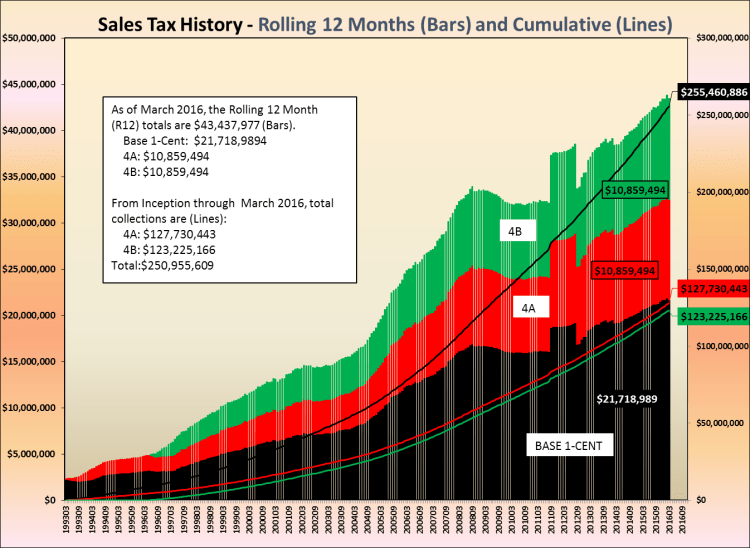
I have harped on this subject before, but I think it is imperative that the citizens of McKinney really get the full picture of where the MEDC/MCDC (4A & 4B) money has been used over the years. Between the two Money Boards, $250,955,609 of sales tax money has been collected for MEDC and MCDC operations and projects. For all the scrutiny the Council and public would give on the General Fund budget, is the same attention being paid to the Money Boards?

In just the past 12 months, $21,718,989 has been collected for the two funds. You may recall that I urged the MISD to show us the cost of the football stadium in terms of the Tax Rate Equivalent (TRE). So what is the TRE on the sales taxes going into the Money Boards? That’s very easy to determine. The taxable value is currently $15,200,173,814. If the City did not have sales taxes at all, and the same amount of money was spent in the City budget, it would take a property TRE of 28.58 cents to generate that much in funds.

Since the General Fund gets 1-penny while the other 1 penny is split evenly between the MEDC and MCDC, then we can see that these two Money Boards are getting the TRE of 14.29 cents.  That’s a lot of money!

So, what are we getting for that money? Let’s just focus on the MEDC right now or about 7.145 cents and $123 million since it started being a revenue source in 1996. What is the return on our investment?

Just how closely would you personally monitor every dollar if it was your $123 million? That’s the deal. It is our money. We elected the City Council, and they have appointed a City Manager and Boards to watch over it like it was their own checkbook.

In fact, when you go over the 75/SRT flyover and look down at Gateway, if you can see it, just exactly how much of OUR tax money has gone into that project? And after you head west on SRT and glance over at the Craig Ranch property you can partially see, how much money has been given to that developer? And what have we received in return?

In addition to cash, how much has been given by the City putting in infrastructure the benefited Craig Ranch? Or how many dollars have been waived that would have been paid in other parts of the City by developers for roadway and utility impact fees?

There is an exact amount. I have sent an Open Records Request asking for documents that will let me compile that number for my readers. It think it is going to be a shocking number. Later, I will hope to answer another question I am curious to learn more about. How many people were on the MEDC Board (and City Council) that were working for Craig Ranch, directly or indirectly, when decisions were made to give money to that project as well as to the Gateway Project?

How is it that this information isn’t more readily available on the City’s Web site in the holy name of Transparency? Maybe we can all learn soon. LFM

BTW, if you like to study charts, and I hope a few of you do, you will notice that the Rolling 12 Month totals spiked for a period started in September 2011 due to favorable audit adjustments that benefited the City to the tune of $5,345,794. State law protects the specifics from being revealed, but it is an anomaly that skews the data. Otherwise, you can actually see the exact months the City has headed into a recessionary period and recovered. Many cities are peaking in their sales tax collections at the current time.

MCKSalesTax


Somebody is Stealing From You as You Read This

Written in 1998.
Updated in 2002.
Updated in 2008.
Tweaked in 2016.

Introduction.

The newspapers are full of reports daily. An appraisal district employee is indicted for stealing. A city manager is put on administrative leave while an audit is conducted to determine if his city credit card has been used for personal items over the past few years. A computer analyst is charged with fraud indictment after he allegedly hacked into the District Clerk’s wireless system and “intentionally caused damage without authorization to a protected computer.” A veterinarian, claiming he was fired after complaining about conditions at the city animal pound, wins a $1.2 million jury whistle-blower award.

 A former probation officer accused of stealing on the job was placed on probation by a jury, after pleading guilty to felony theft by a public servant. Another paper reports that an audit says the city may have overpaid the law firm hired to collect delinquent property taxes. In another city, a favorable court decision that could cost the city more than $500,000 for more than 200 firefighters continues to smolder as the city looks at appealing the ruling. Another paper reports that an ex-municipal court worker faces charges of tampering with public records – police say he tried to sell fake insurance cards to people with citations. In another city, a former building inspections office employee is charged with stealing more than $20,000 of permit fees. In yet another city, headlines announce that a police sergeant is on leave after a narcotics audit reveals $1,000 is discovered missing.

 This little sampling should be quite disturbing to finance officials and city managers for a number of reasons. The first reason is that these are stories from Texas alone. The second reason is that these are stories that have been in the papers in the last 10 days alone! The third reason is that there are probably just as many or even more stories similar to this that have not made the paper in the last ten days. Some of you have reported them to me. Many are handled quietly like is done in the private sector.

 There is a fourth reason. Our finance profession knows this reason but doesn’t want to talk about it. Elected officials don’t want to hear about it or don’t care. It is this: stealing is going to rise over the next few years.

 Why? Let’s return to another sampling of the headlines. Actually, I will put the headlines into a succinct composite. Tax bases are slowing or decreasing. Sales tax receipts are plunging. Positions are being eliminated. Pay raises are being canceled or will be minuscule. In some cases, pay may be cut. Employees are going to be asked to pay more of their insurance premiums. Some cities are having some of these budget balancing adjustments placed on them and some are having all of these and even more. It’s not a pretty picture.

 But, of course, you are saying this recession is everywhere and is temporary in the great scheme of things. It is even expected and the natural cleansing of the inefficient squeezed down by economic forces. Well, true to an extent. Except things are different now that we have factors induced by national security issues as well as national corruption on an unbelievable and unprecedented scale.

 But there is more. A large number of our government workforce has never been through a major cutback. A large number of our city managers and finance officials have never been through this experience – at least not since they have been in the top level positions they now fill. And all of us are just now coming into the realization that we knew would arrive at our doorstep some day: the drill of confronting the results of the Big Lie. The Big Lie is that we can do everything for everybody and, of course, it won’t cost a thing.

 How does this become a burden to be carried by finance officers and city managers? And perhaps the connection to stealing hasn’t become clear yet. Let me see if I can make my point. My article entitled “Why Good People Steal” written over four years ago dealt the centrality of dishonesty. It has to do with the rationalization of the mind. We must always be vigilant but really step up our sensitivity when circumstances become ripe for employees to believe in their own minds that they aren’t stealing but only borrowing or getting what is due to them. It is worth replaying the 1998 article and then to add some comments related to 2002 and the next few years that we may be in an economic slump around most of the state.

 Why Good People Steal

 “Right now — right this very minute — someone is stealing something from the city.” This was the answer to a new finance director’s question about what she should be concerned about in her new role. “And even after realizing this, you cannot become paranoid” was the second part of the answer. She gulped on cue and had that “Bambi in the headlights” look. The answer came from observations over the years and from stories directly shared by finance officials. The focus of this article is not on the method of theft or internal controls, but rather the underlying causes or excuses offered when a theft is discovered. Names of people and organizations are omitted. A couple of examples are even made up for illustration purposes.

 The goal is to help you become more effective as a city official by becoming more sensitive to the circumstances that can often lead to a good person making a decision to steal. The emphasis is on “good” people, not the common criminal. This is because rarely will you deal with the latter. It is almost always the former. In particular, a common yet surprising characterization of a person who has been caught stealing is that they were trusted, often long-tenured, and were the last people that would have been suspected of wrongdoing.

 The scary part of this topic is not only are good people involved, but much of stealing is petty. That is, the rationalization to steal does not need much effort if the stakes are small. This logic compounds itself if the person initially feels justified due to acceptable standards subtly set in the organization. When an offense is no worse than what someone else does and not any more significant than was done last week or last month, then the stage is set for the rationalizing mind to grant permission for a misdeed. In fact, it is possible that the organization has tacitly given an okay to an act — at least to the person rationalizing in his or her own mind.

 Here are some starters:

 _ A finance director cannot figure out why 40% of the Scotch tape usage occurs during the months of November and December. Can you help them out here?

 _ One city keeps open boxes of coffee packets in the break room but cannot figure out how coffee consumption averages 18 cups per day per employee. Got a clue?

 _ An employee makes personal copies at work, which is no worse than the waste of making 100 copies (only $2- $5 worth!) for the weekly office football pool.

 _ Employees tend to cash checks at the city collections department after 2:00 p.m. on Fridays because they know their checks will not be deposited until the following Monday.

 _ It is general knowledge in some city offices that the department directors instruct their secretaries to make airline reservations for a seat that costs $50-$100 more, but the directors get personal frequent flyer miles for traveling on the costlier airline.

 How much worse is each successive example compared to the one before? Are these examples of stealing? Is it an effective use of your time to worry about these little things? Are these bad people? Have you given tacit approval of these acts, knowingly or unknowingly? Do you wish that you had not started reading this article? Are you gulping yet?

 I got a call from a finance director asking for help one day. One of his best employees had been caught at a grocery store stealing less than $5.00 worth of products. The city’s policy was automatic termination. The finance director was disappointed because this was such a bright young person with so much promise. The request was to help the young man find some work elsewhere.

 The terminated employee came to visit me. He was remorseful beyond description. He had a wife and child and came from a good family. He had shamed them all. He was especially distraught because he simply had no explanation for why he took the petty store products. He had more than enough money in his pocket to pay for the goods. It was a “mental lapse,” he explained.

 A city had a loyal employee, a department head over revenue collections, steal over $25,000 during a two-year period. The reason given related to a son going through a divorce needing his help. In another city, a city manager got in hot water for accepting a $25,000 “consulting fee” from a developer on a land deal, a clear impropriety. The reason given was that he had a twin brother who had become addicted to prescription medicine and was in financial straits. He did nothing to help himself, only his brother. See how this works?

 A chief accountant, now in jail, was proud to show off his new car. But then his new boat and other things popped up that seemed out of reach for his one-salary. The finance director became suspicious and began digging into what eventually would be revealed as small daily cash thefts that had accumulated to more than $100,000. There was no formal explanation given, but the only conclusion was that his spouse had expectations of a grander lifestyle than is normally afforded a municipal employee.

 Another finance director considered a rising star was on her way to her fourth city and a major promotion in stature and a mid-$50’s salary ($100k+ in 2016). Upon vacating her third city, it was revealed that she owed the city several hundred dollars that stemmed from past due water bills for several months. How did that happen? She had instructed the staff to exempt herself, the city manager and the mayor from cut-offs for non-payment, unbeknownst to the latter two, but enough to convince her employees that this was a sanctioned directive.

The finance director acted surprised that her husband had not “taken care of the debt like he was supposed to.” She had just been given her final check with accrued vacation and paid sick leave and another check from her new city for moving expenses — all totaling several thousands of dollars. However, she could only pay half the past due bills — and then that check bounced! After being indicted, she plea bargained just before going to trial and got probation. This one is still a mystery.

 One of the highest paid school superintendents in the state has pled guilty to the misappropriation of funds, including purchasing $16,000 of personal furniture for her home with school funds. In another less publicized case, a utility billing manager making over $50,000 was terminated after adjusting her own water bill that amounted to only $30- $50 per month.

 What were these people thinking? How could they have possibly rationalized that what they did was okay? How did they think they could get away with it? And in every case, these were considered, bright, trusted and respected people by most of their peers and supervisors. How is anyone supposed to be able to spot these misdeeds or at least suspect that something is amiss before they surface in such obvious ways?

 Several municipal officials made a direct or indirect contribution to this article through their stories. There are also some insights that have been forged from their reflections and made a part of this article. They do not desire the focus to be on the person who disappointed them or on the city involved. They do share some advice, along with the author, for the benefit of those city managers and finance officials who not only might become embarrassed by a theft, but who might get their own necks chopped off when a theft occurs.

 Be vigilant.

 If you do not heed the yellow and red flags of this article, then you may be foolish only up to the moment a discovery is made. Vigilance is the smart substitute for paranoia. Trust your instincts when something does not look right or sound right. Be alert, watchful. Visualize in your mind the ways that money, tools, materials or other city property could be walking off.

Ask questions and walk around with regularity. Listen to cautions made by auditors. Mind the little things. If the organization realizes that little things matter to you, then it follows that larger offenses have commensurate consequences. The most honest person I ever met in government used to keep a can in the copy room labeled, “Personal Copies – $0.10.” He regularly asked with a friendly but serious tone of voice if people were making personal copies on COUNTY equipment and, if so, to kindly make a deposit.

Another finance director tells of her city manager who annually gave the city a check for several hundred dollars marked “for the little things I forgot.”

Open Door Policy.

A city manager was dismayed at what was acceptable by lower echelons of the organization as “authorized” improprieties once it became known that a finance director had instructed or approved a misdeed. The ever so simple solution was to publish a letter annually that, in essence, forbade even the slightest irregularity and personally granted every employee an open door invitation to speak about violations of city policy — real or perceived — with anonymity. E-mail now makes that message even easier to convey.

 Changes in Personal Lives – Part I. This advice is offered in the most compassionate manner possible. It can be understood only when you have been faced with a genuinely good employee in crisis who then wishes they could undo a foolish misdeed. You could be doing both the city and the employee a favor if internal controls are stepped up when a person handling money or goods has a crisis going on in their lives. The mind’s ability to rationalize is stretched to its illogical worse state when a spouse has lost their job or has been hospitalized, creating a financial hardship. The burden to make ends meet becomes substantial.

 Again, if this advice seems callous, then visualize working the problem backwards. This good person has stolen money, and it is up to you to correct the problem and to possibly destroy their career and lives. IT HAPPENS!

 Changes in Personal Lives – Part II. There have been several other stories told with dread over the years that have an especially ugly twist. When you look at the statistics of people in our society with addictions and other personal habits that require sizeable sums of money to sustain, the rationalizations are less honorable yet perhaps even stronger than the ones previously mentioned.

 One finance director caught an employee stealing who confessed to a gambling addiction. This thief provided him insight that she, like most gambling addicts, was absolutely certain she had a knack for winning at the gambling tables in Shreveport and Las Vegas. She had just “borrowed” the money with an intention of paying it back with her winnings — winnings that did not materialize.

 Another finance official tells of an employee with a drug addiction that quickly grew outside the bounds of affordability for the typical professional salary. One finance official was caught stealing sizeable sums of money after an expensive girlfriend on the side became necessary to hide from his wife. A city manager called me years ago to ask if I thought it was strange that his flamboyant and extravagant assistant city manager over finance had a $100,000 – 2% (this was in the 6-10% days) loan with the city’s depository bank. It is often difficult to spot a questionable lifestyle that could point to malfeasance, not to mention the possible legal hindrances involved in a probe. Ironically, it is often found that many people in this category do little to hide the product of their misdeed. Again, be vigilant and trust your instincts when you sense something is amiss.

 Organizational and Personal Clashes.

 Back to the less exciting and glamorous signals of conditions that foster improprieties. The ability to rationalize thefts is magnified in some cases when a person justifies the theft as fair compensation. This can be particularly bad organizationally when the city has gone for long periods of no pay increases granted by the city council. It is equally possible to rationalize a theft when someone has been passed over for a raise or has reached the top of their pay range and is no longer receiving pay increases. The signals may be manifested in poor attitudes or other disgruntled actions.

 This condition can also occur when there is disillusionment with life in general or with a person’s status in life related to their peers. If mid-life crisis enters the equation and a large percentage of the baby-boomers are into that stage of life, then misplaced justification may grow in the future. The characteristics of the baby-boomers in their 40’s and early 50’s include fewer big increases in income levels, overextended personal debt, high tuition demands for kids in college and increasing requirements to take care of aging parents.

 The point being offered is to be sensitive about those who you suspect feel cheated in life or by the organization and who could possibly rationalize that what they are doing is not stealing but righting a perceived wrong.

 Conclusion.

 It is critical to emphasize the second part of the advice given to the new finance director — do not be paranoid. This article is about the real world and the ugly side of being a financial official or city manager over all departments. On the other hand, it does not apply to most of your employees. It is meant to thrust you into that ugly scene when there has been a theft and to work backwards. If you have not had to deal with a theft in your organization, you are either still lacking experience or missing signals in front of you.

 If you can avoid ever having to spend the emotional time and energy working through a theft resolution, then more constructive and rewarding things can be added to your agenda. Most people will vouch that dealing with a theft is all consuming — often for months or years. They also will tell you that it is highly possible that you will get the blame and that you will personally kick yourself for not seeing the obvious or for not trusting your instincts and pursuing your suspicions.

 Also, there is a certain amount of effort involved in the establishment of internal controls. You must be adequately staffed in many cases to have effective internal controls. Ironically, many finance officials refuse to ask for justified positions in order to set an example for all departments being denied their budget requests. These sacrifices are all fine until a theft blows up in your face.

 I cannot recall a single finance official being thanked for their bare bones budget once malfeasance was pasted across the headlines and embarrassed city officials were looking for heads to roll. So, the perspective is important, the degree of alertness is crucial, the staffing and training for effective internal controls is the fundamental charges for the modern finance official. LFM (1998).

 Back To The Future

 I had many favorable comments to that article back in 1998. I repeated it again here in 2002, because I think the subject is timeless. As an avid reader of news from every corner of Texas, I can tell you that the frequency of malfeasance is increasing in relatively petty cases as well as with some quite grand.

 And what can be more grandiose than the stories that have come out and the stories that continue to come out almost weekly about major misdeeds. They are colossal. It is within the government sector that suspicion has be most prevalent all along. We now know that private sector misdeeds dwarf those found in the public sector – even the largest. But we can find no comfort with that piece of knowledge. We have too many of our own popping up on a regular basis to be smug.

 So What Are We Supposed To Do?

 This is a hard question to answer and for the answer to apply to everyone. We almost always have to rely on the judgment of the individual to determine what is best under the circumstances. Nevertheless, I am willing to throw out a few suggestions:

 Mind your business. This pertains to your shop, your people, their assignments, their level of training, their sensitivity. You cannot be everywhere and check every single thing. You must rely on your immediate fiscal staffers to be deputized to adhere to the most basic practices of internal control. You must be sufficiently staffed and for the staff to be sufficiently trained. A private sector colleague, now deceased, once told me that there isn’t enough money in the paychecks for most finance officials to take the risks they take. You would be well-advised to step up internal control standards, not lower to dilute them.

 Work It Backwards.

For motivation to be more vigilant, I suggest you think about how much your next few weeks or months are going to be tied up with a theft if you don’t prevent or discourage theft in all of it many, many forms. Go a step further, however, and assume it is happening. Where is that likely to be? Where do you think it is least likely to be? Call in a few key people and see if you are surprised with how many matches you might find if the question is posed. Involve supervisors dealing directly with money. It would be a healthy exercise just to send the signal through the organization. While you might be surprised with a theft situation, who is sitting next to the person involved in theft who ends up saying “there was something about him …”

Be extra vigilant when you know an employee may be struggling with a personal problem. Send an annual memo that is both a carrot and stick. Include an open invitation but express an expectation that there is a duty involved. You can do this without an Orwellian tone to it. LFM
McKinney Gateway Project Raises Questions Not Asked By News Media

Shallow news media coverage is driving me crazy. And I’m also not very impressed with information one can find on the City of McKinney Web site. The real story. The Gateway Project has had a ton of public money poured into it. It is 90 acres that hugs the northeast quadrant of Hwy 75 and Sam Rayburn Tollway, the site you can’t see until you are almost past it due to the highway flyover. Let’s see what we can learn from the City under their Transparency link.

Gateway Update.

Lincoln Property Company, Inc. has notified the City of McKinney that it cannot proceed under the terms and conditions set forth in the Master Development Agreement entered into with the city. It has withdrawn from the agreement to serve as the master developer for the approximately 57 acres at the Gateway site surrounding the current anchor owners, such as Emerson Process Management.

Located at what many refer to as the “gateway” to McKinney, the Gateway site is one of the most visible development sites in McKinney located at the heavily-traveled interchange of the Sam Rayburn Tollway and U.S. 75. Collin College was the first occupant at Gateway, opening the Higher Education Center in January 2010. Emerson Process Management followed by moving the world headquarters of its Regulator Technologies business to the Gateway site in 2013. The Sheraton Hotel and Conference Center opened at Gateway in February 2015. These anchor properties occupy approximately 33 acres of the 90-acre site. The approximately 57 acres surrounding these anchor owner sites is intended to be a mixed-use development including restaurants and office space.

In concert with the McKinney Economic Development Corporation, which owns the land, the city determined the primary developer. Following an RFP and selection process, a master development agreement was signed with Lincoln Property Company, Inc. on May 14, 2015. According to the terms of the agreement, Lincoln had to acquire the first parcel by executing a purchase agreement by February 16, 2016 in order to continue as the master developer.

“We are disappointed that Lincoln has withdrawn from this important economic development project,” said Mayor Brian Loughmiller. “This is a development site that has been years in the making and we remain committed to bringing a robust master development for this highly visible and important Gateway site to our community. The city, MEDC and the MCDC will be exploring next steps for Gateway very soon.”

So Joe Sixpack, the citizen, relies on the newspaper to answer the most basic of journalistic questions: Why did Lincoln Properties pull out so quickly after they made a proposal to the City and entered into an agreement?

So far the Dallas Morning News has not reported on this story that I can find. The McKinney Courier Gazette ran a story yesterday. The story is 563 words long and is a blend of the mostly lifted City’s release of 314 words plus some filler from the same reporter’s story in 2014. It appears the reporter did ask the WHY question and settled for a quote from the Interim City Manager: any real details as to why Lincoln dropped the project “would be more speculation than anything” at this point.

So, Let’s Speculate.

I have complained to the City on more than one occasion that it bothers that I have to be the one asking questions and not their own staff or the Council itself. I extend my complaint to the news media. You have to be fairly bright to understand intricate issues. But more than that, you have to spend time to learn the players and relationships, understand important history and dig, dig, dig into documents and numbers.

I don’t think most reporters are lazy as much as it is they are stretched too thin. If you are covering multiple cities and ISDs, plus Collin County as a reporter, I can pretty much guess how superficial the reporting is going to be. And then with the average tenure of a reporter on assignment being just a few short years or less, you might as well forget it. Don’t they pass on their research files to the next reporter?

Here are a few questions I suggest somebody ask and answer:

Is there anything wrong with this Gateway location? I would think not except for the visual obstruction I mentioned. As you approach Gateway from any direction, I don’t recall a sign announcing it is ahead and how best to approach it.

Is there a demand for anything that would fit on the property? The 2014 news story mentions the competing developers making a claim that they had several letters of intent from potential users of the site. Of course, a big story missed yesterday when they mentioned the competitor is that Wallace Bajjalli Development Partners failed in Amarillo and other places and was linked to Ponzi schemes. Why would a reporter mentioned WB yesterday and miss the chance to tell local McKinney folks something new – and perhaps pat the city officials on the back for not going down that path?

But Lincoln Properties is a big firm with good credentials. Where was the market demand study they or the City provided to indicate there was a convincing attraction to this Gateway site? Collin College being there itself probably wouldn’t be singularly a draw, and Emerson Electric was already in another location of the City. “Build it and they will come” is a movie script, not harsh reality in most cases where something is going to be writing checks.

What are the rent rates necessary to make the numbers work? I am skeptical of the first thing out of a developer’s mouth being that they need this or that to make the numbers work, but I do understand arithmetic. You aren’t going to buy a piece of land and build something on it without knowing both the numerator and denominator. The numerator is going to be the full cost plus profit and the denominator is going to be square feet or some kind of unitized value. The result is a cost and rent rate per square foot. Is that why Lincoln backed out? Are construction costs rising that much or the demand for the products diminishing?

Speaking of the denominator, this is where all cities have gotten themselves in a trap offering incentives. What was being asked of the City regarding taking on some of the infrastructure costs (roadways, drainage, water, sewer)? And this is where you have to look beyond the site in question. What kinds of incentives are being offered in Frisco, Fairview, Allen and Plano? McKinney would do well just to get the crumbs from some of the robust adjacent cities.

What kinds of incentives were offered (or demanded) and paid to the huge commercial developer just down the tollway at Craig Ranch? In fact, I have a huge related question. If Lincoln is out and Craig Ranch or another developer, local or not, comes in to bid on the completion of the Gateway project, will the City offer them incentives that were not offered to Lincoln Properties?

Whoa, baby! If you think the McKinney Two-Step hasn’t been danced around here before, then you don’t understand the McKinney Underground. Do you think this is the first out of town developer who might have backed out or was otherwise urged out by the local movers and shakers?

Or is this just a quirk? I had heard a few weeks back that a Lincoln executive highly involved in the project had passed away suddenly. In that case, it may just be a situational deal where the project champion can’t be replaced with a person with a similar passion or availability. Or it may be a combination of all these things. Do we even know that McKinney is viewed as a 10-foot pole city, as in don’t touch them with one?

However, what are the lessons learned by the City up to this point?

And just exactly what has the City gotten in return for their investment in both Gateway and Craig Ranch?

Why is Plano and Allen so willing to sit on valuable frontage property until the demand gets right and McKinney is so unwilling to do the same? Why has McKinney had so much pressure to give back commercially zoned property to residential purposes? Why has the current council so loudly proclaimed “property rights” so that it makes it easy for a landowner do whatever they want? What’s next? An alligator farm or a petting zoo for Gateway? How about giant warehouse storage complex? Move over Crepe Myrtle Capital of Texas.

Or do we just wait patiently? McKinney’s time will come. McKinney is only half built-out. But then if we could somehow build out completely in the next 10 years, the question I would have is this: Why in the world would be want to do that? LFM


Is Election Fraud Occurring in Addison?

My Dog In This Hunt.

After I wrote my last Addison blog, I was asked if I had a dog in the hunt? Thank you for asking, for I surely do. I grew up in Farmers Branch and went through high school in Carrollton. Addison and Coppell were part of my hometown. Two of my classmates worked for Addison. I did consulting work for Addison when it was just about to burst into a thriving employment center. Even before Ron Whitehead, the City Manager for 32 years, got there – just as you could see building cranes in all directions. I attended staff retreats in those early years.

I handled the search process when the very professional Randy Moravec came on board as finance director for over two decades. My son graduated from Trinity Christian Academy in Addison, and my wife worked at TCA for over a decade. We spent thousands of dollars in Addison restaurants when we moved to Carrollton just on the edge of Addison for 14 years. Lastly, I was a charter member and treasurer of the Addison Noonday Rotary Club until we moved to McKinney.

So, yes, I have have a dog in the hunt.

Even without that direct connection with Addison, it is hard for me to not get riled when the city management profession is being attacked. Worse, when there is a vicious attack with a companion action to thwart a defense. And then the ultimate insult, a news media that publicizes the attacks while being strangely silent regarding the attempt to respond and expose the political motivation behind the attacks. Especially when the entire political process is being orchestrated to manipulate an election process.

Election Fraud?

What explanation could one use in a case like this? The mayor and council hire an outside forensic auditor with no apparent specific scope of work. The auditor bills $125,000 and produces nothing of substance that anybody can examine. In a simply weird council meeting held on April 22, 2014, it is clear to see on this video that the City Council itself is generally confused and clueless about what is about to happen. There are two firms (Kanter Financial Forensics, LLC and Gradient Solutions Corporation) being hired to do what one councilmember says sounds like the same work. The Mayor demonstrates how he is trying to sound balanced but is manipulating the Council. The more you watch him, the more you have to give him credit for being a master manipulator.

Jump ahead to October 28, 2014 where Larry Kanter and the Mayor are trying to sound professional, but what is suspected becomes reality as this is all about taking a shot at the current and past city managers. If a new media person unaware of the Kanter/Meier saga just came on board in 2015, for instance, they could track this story and, most importantly see how it unfolds in meetings that are held on April 8, 2014; April 22, 2014; June 10, 2014; August 12, 2014; October 28, 2014; November 11, 2014; and then January 13, 2015.

If an alert reporter knew the history or spent the time learning the history, he or she would have fallen out of their seat to learn that the forensic auditor topic popped up again on February 23, 2016. What the hell! This presentation is an assassination attempt on the former city managers. Listen to Kanter’s choice of words and the tone of the delivery. It is a reading of charges before the Guillotine blade drops. Mr. Kanter is not wearing an executioner’s hood, but he should have been so his dress matched his voice.

What’s Missing?

Ron Whitehead is not there. Lea Dunn is not there. But this is where it gets interesting. This disconnect in the timing of Mr. Kanter’s presentation coincides with an election coming up where there might be some candidates who would view the previous city managers more favorably and Mayor Meier’s antics less so. The newspaper reporter in attendance or writing a story from watching the video would have to have a finger in his or her nose to miss this artful but poor theatrical buffoonery.

So 13 months go by without a council update and now this gotcha comes just a few weeks before an election. Give me a break. Are the citizens of Addison so imperceptive that they can’t see what’s happening?

So what is one to do? You do an Open Records Request to try to get details of Mr. Kanter’s findings. Your ORR also includes wanting to see copies of invoices to understand how much new work was performed by Mr. Kanter between the last report and the most recent report. That would help evaluate the validity and severity of Mr. Kanter’s findings. Those are critical pieces of information. I included those items in my own ORR to Addison.

I had heard from Sue Halpern on her blog about how she was trying to get that information and was being blocked. Ms. Halpern is not a local gadfly. She is a former councilmember and is a lawyer. Audit workpaper exceptions where shoved in Ms. Halpern’s face. Attorney-client privileges were being claimed.

I received a letter from Addison on Saturday, March 26, 2016 dated March 22 on my own ORR. They are stalling me. Surprise, surprise!

I asked for a copy of all reports provided to the Town Council by Larry Kantor regarding the publicized forensic audit. The Town wants clarification. Do I want drafts or final reports? What part of “all” is confusing or needs clarification?

I asked for any campaign reports showing any financial contributions by Larry Kanter to any Council Member. The Town wants me to clarify which councilmember term I am requesting? Well, of course, I was talking about the council of 1952!

I asked for the standard Conflict of Interest form provided by Larry Kanter. The Town has informed me they don’t have such a document.

On my other two items, a copy of the agreement with Larry Kanter and copies of invoices, the Town has asked that I clarify if I am asking for any information in those two requests that are attorney-client privileged or anything that would require AG authorization. They didn’t think that dumb question through very well.

You can’t make up this kind of stuff!

Conclusion.

This sure seems to me that the election process is being manipulated in the most egregious sense I can recall ever seeing. I think this is a FBI matter or at least something the state or federal elections or ethics commissions need to investigate. There is something very wrong going on in Addison. And the news media is either cooperating or sound asleep! LFM


The Dilemma for Recipients of Public Funds

Something is bothering you, dear, what is it?

No big deal. Well, yes, I guess it is. I got invited to a fund raiser today for Councilman Smith’s reelection?

Why does that bother you, although you were never invited before this election season?

It’s a dilemma for me. Remember when he was on the Community Development Corporation Board? He was very nice to me when I approached the Board for $20,000 in funds for my non-profit organization. It was Smith who encouraged me to apply when we were at the same table at a Chamber luncheon a month earlier. He was very enthusiastic and actuall rallied the cause on my behalf with the other Board members. The vote was unanimous. I later thanked him for taking the lead, championing my request.

So, what is wrong with that? Your non-profit serves the community well.

There’s a couple of problems that bother my conscious. The first is that if I had a $1,000 to give, I should be contributing to my non-profit. They could use the funds.

What is the second problem?

Well, I feel obligated to make a contribution. In a way, I owe him. There is no obligation for the amount to be $1,000. I could contribute less. But then I would feel ungrateful and probably be viewed by him as unappreciative. It was a large amount of taxpayer money I received.

And weren’t you thinking of approaching the CDC Board again this year for a comparable amount?

Yes, that adds to my dilemma.

I can see why. But he is not on the CDC Board any longer. Doesn’t that let you off the hook?

Not really. The CDC Board members are appointed by the City Council. In fact, Councilman Smith is one of the two Council Liaisons to the CDC Board. He would be there in the meeting if I asked for more money.

Gee. This IS a dilemma you have been put in. It just eases its way into the equation, doesn’t it? Is there no solution?

I see one solution, but it would take an action on the City Council’s part. And that is not likely to happen. Four of the seven council members were formerly on the CDC Board.

Tell me how this dilemma could be solved.

There are several ways, but the most effective way would be for the Council to require a recipient of any city funds to be disallowed from ever contributing money to a council candidate or council member.

My goodness. That would be a profound step of integrity on the City Council’s part. And that would remove the dilemma of dozens or maybe even hundreds of recipients from feeling an obligation to contribute, right?

Almost. Any time money is being doled out, it is impossible for Board or Council members to prevent building a potential political constituency. That is why all boards especially Money Boards are a natural springboard to running for City Council.

But doesn’t that happen all the time, like when the Council responds to youth athletic teams build or improve ball fields?

Yes, to some degree. It is natural to try to help an incumbent garner votes if they have done something for you. That is generally why it is so hard for an outsider to beat an incumbent. Nobody is doing anything wrong, it is just hard not to return a favor or to say thanks when you get public money or projects built from public money.

Wow! This is a big issue. Unfortunately, that’s the way it is. And is probably the reason former council and board members say they went from being highly popular to a nobody the day they left office. But what are you going to do about your invitation to Councilman Smith’s fund raiser.

I’m going. And I will make a contribution. I feel obligated to do so. However, I will be changing my mind on a related issue.

What’s that?

I am not going to be going to the CDC this year for a continuation of the funding for my non-profit.

I fully understand. A clear conscious is not worth it.

Exactly!


Local Elected Officials Should Receive Long Reach-Back Report Cards

Introduction.

An interesting phenomenon exists when a school board or city council member gets elected. There is a good chance that a large percentage of the things on their agenda being dealt with were put in motion by past councils and boards. Similarly, many of the decisions while they are in the capacity of an elected official will not come to fruition for years after they have completed their terms. Nor will the financial impact.

For example, it is possible that a bond election could occur under one city council, the issuance of bonds and groundbreaking occur under a subsequent council and the full cost have to be assumed by yet a third generation of council members. The first two periods of time often come in a celebrative atmosphere. Photo ops and brass plaques. The last period, raising funds to cover the costs, may not be such a happy time.

If I were on the third generation of council members or school board, I would have two questions for my colleagues: 1) why are we acting surprised? And 2) why should we apologize for stepping up to our responsibility to take care of what was put in motion before we came on board?

This is where the “just say no” mindset of the current generation of elected officials across the country and across the state is simply wrong-headed. And this is where the deferral option of balancing local budgets is so popular. Especially when it comes to employee compensation, pension funding and infrastructure maintenance & repair.

A Report Card.

This is why communities should prepare a report card on council and school board decisions. And that includes the sitting council today as well as the councils of years past – often for a decade or two. A budget is not truly balanced unless it is spending sufficient funds to keep up with the expenses occurring right now that might not have checks written until the future.

But let’s face it, that is not happening and is not likely to happen by the governing body itself. Often the race isn’t the election battle to get seated. With the clock ticking, how many things can a current elected body initiate knowing it will be a future council who has to figure out how to pay? Every professional manager knows that the single most effective way to balance a budget is to not start any program or project you can’t afford to fund now and in the future. Perhaps that is why so many things are approved with only a partial year’s costs shown.

A Multi-Year Financial Plan.

An honest MYFP produces some interesting revelations. A one-year budget can be and is often structurally imbalanced even through it appears to be balanced. Police cars with 100,000 miles on them can be pushed out at least one more year, perhaps. However, in a MYFP, you are faced with balancing the subsequent years, too. In the end, you can easily spot the gaps on the horizon. That is why the Tax Rate Equivalent (TRE) I wrote about is so important. You can’t raise taxes in advance – and may not even have to.

However, it is extremely valuable to know that a gap with a TRE of, say 3 to 5 cents can’t be ignored. A MYFP can give you a heads up on the challenge. The logical order of budget balancing steps are:

Improve Productivity.
Trim Expenditures.
Use Reserves.
Reduce Program Service Levels.
Eliminate Programs & Services.
Raise User Fees.
Raise Taxes.

There are a few other ways, but they are generally gimmicks and short-term fixes. Only five of those on the list really make a difference when balancing a budget. Trimming expenditures, like cutting travel expenses by 30%, really does not translate into sufficient moneys to balance a budget. Using reserves is a temporary solution.

If the last four are used, these can create huge negative reactions if discussed in the heat of the budget workshops. They require much discussion and planning steps to execute.

You will notice that the Deferral option is not shown on the balancing list even though it is the Number One annual budget choice, a bad choice. Even a deceitful choice. If you Defer to the following year, the impact starts to show up in a MYFP. You can replace 5 police cars a year, as needed, or 25-30 in a single year if you wait long enough and let your maintenance costs eat you alive.

The Look Back.

It is even possible to do this in reverse. I would not be an elected official for a million bucks, but the first thing I would do if I were is to go back at least five years to determine how the budget was balanced in those years. I would do this using my seven options above plus Deferrals and Non-Recurring Revenues like a big bump in sales taxes due to a positive audit adjustment that created a windfall.

What would I do with this historical information? I would put out a report card on the decisions of the past councils and boards that might be responsible for laying in my lap the obligation to balance the current year plus the past gaps pushed forward.

But there could be a good report card here. If I had been in office for a term or two and was leaving, I would want to do my own report card showing how my colleagues and I had taken care of business. Perhaps even established some reserves to recognize Depreciation.

The Political Report Card.

I believe in McKinney this is much more important report card than the budget since the resources have been rich for a number of years.

I’m interested in where the money went for the MEDC/MCDC $millions since inception. Who were the board members and their relationships to the recipients of those moneys? Who received money and then later became city council candidate contributors? Which council members built their political constituency by playing Santa Claus?

What were the bigger land deals and how were those decisions made? Why are there so many lawsuits involved? What are those about? Why were some council members so involved in some staff issues and terminations that their actions led to the FBI being called in?

There’s no political historian in McKinney. There needs to be one. Actually, there needs to be an independent team preparing report cards without a statute of limitations. LFM


McKinney City Council: Raise the Bar & Lower the Boom on “Mr. McKinney”

From most accounts, Robbie Clark is a nice guy. In a 2007 local newspaper story, Mr. Clark is referred as “Mr. McKinney.” He was the star quarterback of the McKinney High School football team in the 1960s. A search of Mr. Clark’s service on the City of McKinney Boards and other community boards shows he is highly involved. I would say he qualifies as being part of the McKinney Good Ole Boy Network – or the Underground Government, as I call it.

You might recall my Rumors vs Fact blog a few days ago. I had heard rumors from more than one person that Robbie Clark goes a little overboard in representing his bank while he sits on the McKinney Economic Development Corporation. The rumor included pushing for the MEDC to give Mr. Clark’s friend or customer some extra consideration on a piece of property the MEDC was selling. So I did an Open Records Request. After three attempts I finally got the email MEDC Executive Director about which I was hearing. It is dated November 27,2013. I suggest you read carefully.

“I have been aware for over a year that Larry Crosby has put a group of investors together to purchase land in East McKinney. The Group started with the purchase of the Cotton Compress property. I understand they are trying to put property together to make significant investments in new construction projects in East McKinney. If at all possible, I would like to see us give them every consideration that we can for the purchase of the old Emerson Building. I know nothing of the other offers, when they came in, if the purchasers have the capacity to buy or what the intended uses are. I understand that it is difficult to run to board members for approval. I understand your intentions to talk to the Executive Committee, but this seems like an odd way of selling City owned property valued at over $3MM. Why would we not bring all three proposals along with the back up information on each proposal to the board for approval of one. I don’t think you want to take the risk yourself if there is political fall out over the selection process.

I apologize for being new to the process and don’t want to be a trouble maker or second guesser, but I think you can use your board to see that you are negotiating the swamp. I have always thought that reasonable business thinkers, given all the information, will tend to come to the same conclusions except when politics are involved.

Mr. Crosby has gone to considerable expense for a while to assemble property. I understand that he may be interested in buying some property in East McKinney along the railroad track that would significantly clean up a blighted area. I think this is someone we want to work with and will help us. Please let me know if you would like to discuss further. I am in Friday and will be available most of the day.

 Thanks,

Robbie”

The MEDC Executive Director responded that he was trying to keep politics completely out of the process and that all three prospects were “clients” of MEDC.

The Brush Off.

I contacted the Mayor and Interim City Manager (ICM) as was told they would check into this incident. A week or so later I was invited back to talk to the ICM. The response was exactly what a few people told me would happen, as if some of my colleagues had seen the script. Mr. Clark shouldn’t have done that, but he meant well as a representative of the City. His choice was not awarded the contract, so no harm was done. He probably just wasn’t thinking and wasn’t likely to do it again. I assumed somebody at the City had talked to him. In fact, the City Council at that point had already made the move to place the Money Boards (MEDC/MCDC) administrative oversight under the City Manager. I expressed my great disappointment with the response and left fairly quickly. I sensed a circling of the wagons going on.

The McKinney Way.

I sincerely believe Mr. Clark is a good man. I also believe he may have behaved not realizing he was doing something wrong. But then why would someone have that perspective? I feel fairly confident in saying Mr. Clark is a product of what he has seen being done over the years by others. That is exactly the way we humans rationalize and lower the bar on behavior. “Nothing I did or am doing is much worse than others have done before me.”  That is how a culture gets established. Left unchecked, the inevitable laxness settles in. The bar is lowered. McKinney has a ton of examples I will be writing about in the future.

So, What Should Happen?

I believe Mr. Clark should be removed from the MEDC Board by the City Council. They have removed another MEDC Board member at least once to my knowledge not due to a conflict, real or  perceived but for a potential conflict of interest. This is the real thing, concrete,  with Robbie Clark. If Mr. Clark was anything but a hometown football hero, this might have already been done.

Actually, I am calling on Robbie Clark himself to resign. It is the honorable thing to do. I am quite sure that this is not the first time he has used his influence, although it is hopefully the most flagrant. In my ORR emails I received from the City, I found it interesting that he lobbied the MEDC to look favorably toward his good bank client: Servergy. It may have been before he joined the MEDC Board, but there was another time when he recommended his good friend, the ex-CFO of Servergy, to be the Compliance Auditor for the MEDC to monitor contracts. All you have to do is Google “Servergy” to be reminded it is the company Ken Paxton is connected to and part of Mr. Paxton’s current indictment. And if you were to go to the offices of Servergy, you walk past the adjoining neighboring offices of the MEDC/MCDC.

The City Council should raise the standard and live by the highest standards of all. The two Money Boards (MEDC/MCDC) receive $10,000,000 each in sales taxes every single year.

Reversing The Culture.

In just one generation of elected City Council members, The McKinney Way could be reversed. They could do that by living within a high code of ethics, written or unwritten. They could convey a message that conflicts of interest, real or perceived, will not be tolerated. They would make it known to a board violator that they stepped over a line. The standards would be fully understood if the example exuded from every Council member themselves.

If there is one single achievement that would match the best of just about everything I’ve seen from recent City Councils, it would be this: Change the culture. This monumental act would survive them and mold the most honest future possible for the City of McKinney. I have many more examples to write about this week. LFM


MISD: Give Us The Tax Rate Equivalent!

I’ve been told by some MISD officials that I simply don’t understand the difference between an Operating & Maintenance Tax Rate (General Fund) and the Interest & Sinking Tax Rate (Debt Service Fund). After working with government financial information for over 43 years, I think I do. I’ve been told that I am ignorant or just making the decision on my own to disregard the facts. I don’t think I have. I think the MISD is doing just that.

I do know this: the audited financial statements available on the MISD Web site are very helpful, but they are also not easy to discern certain critical pieces of information. And the posted budget? It is simply horrible. High level and without the most critical pieces of data to assess certain trends, ratios and key factors, especially as it relates to debt. So where do you go to find that information?

The Bond Holder.

In general, the MISD Board is dependent on the story and the spin on the story provided by the professional staff. The bond holder is a quite different. If you think Jane & Joe Citizen have a stake in MISD because they pay taxes, what about those holding $485,660,000 in tax supported bonds? There are a few individuals holding these precious bonds, but mostly banks and insurance companies hold these bonds. Smart individuals. They don’t accept “trust me” as an answer. They know the vernacular, the concepts and the downright hard dollar issues. And they ask a lot of questions.

In fact, the there is an entire array of financial disclosures MISD makes to the bond holder. MISD is not only obligated to disclosure a lot of data, but they sign an agreement that they will continually update and disclosure key datasets. The Official Statements and obligatory Continuing Disclosure statements are rich with meaningful data. Especially for the MISD Board and Finance Committee. Since these documents are prepared for bondholders and their “representatives” such as the bond rating agencies, these documents are generally presented in very clear tables and footnotes.

What Can We Learn?

I would be happy to spend several blogs breaking down and analyzing the data that MISD discloses to the bond buying public yet probably not even to its own taxpayers. But let’s just pick a few points to answer the question that is not being addressed in the current discussion regarding the football stadium. Let’s start with the Continuing Disclosure statement filed by Jason Bird, MISD Chief Financial Officer, on December 17, 2015, exactly three months ago. That’s pretty fresh data!

The Taxable Assessed Valuation has increased from $8.787 billion to $11.555 billion from fiscal year 2012 through FY 2016 (the year we are in). That’s a nice improvement and gives the bond holder a nice sense of security with assurances there is the ability to repay them through the I&S Tax Rate of $0.50. The math is easy. The tax base x the tax rate per $100 results in a levy of $192.972 million at the full rate of $1.67 (the one my checkbook cares about), with $0.50 or $57.776 million going to the I&S Fund to be spent only on debt service.

So, is the Debt Service payments for FY 2016 $57.776 million? No, another schedule shows us that number to be $55.838 million. Why the difference? It should be closer, but it is usually because an allowance is made in case some taxes are not collected. Some taxes that are levied are not collected? Yes, but it is a small portion. We can find that MISD collects about 98.7% of the current levy plus past delinquent amounts that adds up to darn near 100%. MISD even collected more than 100% in one year.

We can also learn that Debt Service (DS) obligations drop off significantly unless more debt is issued. In FY 2017 the DS will drop to $48.388 million. Payment levels hold in that general range for three years and then drops to $43.854 million by FY 2020. Then the DS drops off in a rapid fashion.

So, that is how MISD is going to be able to sell more bonds in the $200 million election and not have to raise the tax rate – in fact even drop the I&S rate by 2-cents? That is correct. The MISD has been conservative (that’s a good thing!) in its debt issuance strategies to allow for future debt capacity.

So what’s the beef you have with the football stadium, Lewis?

The Intellectual Dishonesty: Tax Rate Equivalent (TRE)

There is one sure way to understand the magnitude of  local government and school spending. MISD already states much of the budget on a per pupil basis. What is missing is the perspective that gives the MISD Board and, in return, the public the ability to assess the fiscal impact of MISD decisions.

Somebody at MISD has a Debt Service payout schedule associated with the football stadium. In total, between the $50.3+ million to be voted on plus the $12.5 million authorized but unsold from the 2000 authorization, there is close to $63 million of debt likely to be issued. So the question that should be asked and answered is this: what is the Debt Service going to be on $63+/- million in new bonds just for the football stadium?

I am 100% positive that MISD has that debt schedule internally. To not have it would be reckless. In a bond election such as we have in front of us, it is likely they have several DS scenarios that vary to some degree based on the staging of the issues, interest rates and the length of the bond issue – likely to be 25 years. The bond committee and finance committee know the numbers. Again, for them not to have asked or for them not to be presented the numbers without having to ask for it is an oversight.

The Numerator & Denominator.

I am pretty sure I could get extremely close to the Debt Service number on my own. It is likely to be between $5-6 million in the first few years and then drop off, depending on how the payout is structured. That’s the numerator.

The denominator is the tax base. We already know the assessed valuation is currently $11.55 billion and is likely to increase in the near future. Not by double-digit levels as we saw in FY 2016. But for an average over the next few years, let’s use a generous $14 billion.

At $5 million of DS to cover with a $14 billion dollar base, we can get within a range of the tax rate impact equal to about $0.0357 for the football stadium. So, I believe I’m in safe territory saying the fiscal impact, the Tax Rate Equivalent of the football stadium is between 3 and 4 cents – and maybe as high as 5 cents.

There likely would be a stampede at the City of McKinney if the City Council even suggested a fraction of one penny TRE for something. Therefore, the range I am talking about (but MISD isn’t) is a gigantic taxpayer hit being disguised as no impact.

So, does that mean that if the football stadium is not built and the $60+/- million is not issued, that the increment of 3-5 cents could be reduced from the current $0.50 I&S tax rate? Yes, that is exactly what I am saying.

Bad-Faith Bundling.

I received the most interesting response from a knowledgeable MISD person after I sent my blog out on Tuesday. After going back and forth with him about my “errors and ignorance in my blog,” I was not told of anything specifically I said in error. Let me say now that I am always willing to stand ready to be corrected if I have goofed. But after pressing the person and not finding anything specific where I was wrong, I asked about the elephant in the room. He had not said anything about the biggest blast I had made.

He had not mentioned I was wrong about the Ballot Bundling where the MISD is planning to not separate the football stadium but rather to make it all or none bond proposition. If you want the HVAC to keep working, give us a football stadium! But then I was shocked with his response when pressed on this biggest issue of all:

“I realize you don’t like it, but if it is legal, then they (MISD) can use it as a mechanism.”

OMG, that was the opening line of my blog played back to me! How arrogant! How intellectually dishonest could one get? I suspect he was puppeting the very words of the MISD staff pumping up the bond committee in a bond speaking points pep rally.

Bottom Line:

Unbundle the football stadium and tell me it is the Tax Rate Equivalent of 3-5 cents (they know the exact number), and I will vote YES.

Deceive the public, and my grandchildren will not have the HVAC fixed in their schools. I won’t be blackmailed. LFM

Bond Disclosure Materials.


Go to http://www.emma.msrb.org. Type in McKinney TX, and you will get a list of the Official Statements for both the City of McKinney and McKinney ISD. Click on the 2014 bond issue. You can then download the Official Statement as well as the Continuing Disclosure statement. LFM

McKinney ISD is Intellectually Dishonest

Introduction.

“We don’t legally have to do that.” Gee, I hate that response. There are reasons we have laws that make us do something. Usually these reasons include an abuse of power, a lack of transparency or flat out deceitfulness. Oh, and worse of all, when we take choices away from the taxpayer or voter. There are many examples. A daily blog for each one would fill most of my calendar year. But let’s talk about one.

For many years, cities and counties were allowed to choose how the ballot was fashioned for a bond election. Let’s think this through. If I were a city council or staff member and had some controversial items I wanted to see passed, what could I do? The logical and most honest way to be fair with the taxpayers is to separate the choices on the ballot. Almost never are bond ballot items given the same weight. Streets and Drainage are often top priorities. And for a good reason. They are used by everybody daily and create a hardship when they fall into disrepair.

But how about a library? I would give it a high priority, but would you? A new city hall? We might be split more evenly on that one, although I personally would push hard for the important image of the building that houses the seat of government and the public forum. Many would disagree and be perfectly happy in an ugly two story bank building that you can stand in front of and possibly miss. If we went down the list, there would be certain items that we might really bicker over. Something big and expensive used infrequently might be tough to get passed.

So, would a city place 4-8 separate items on the ballot and let the voter choose? Or would the city council lump the controversial items with sure-thing items and put the voters in an All-or-None situation?

Ballot Bundling used to be legally possible for cities to do in Texas. But then laws got changed to force a city to allow the voters to see the choices, make the choices and for the city to live with the outcome. So, Streets & Drainage are separated from Parks & Recreation. And even Parks & Recreation might be split so the voter can decide. A Natatorium would surely be separated.

When you think about it, while now a law, most citizens and city officials they elect would think of it as the insult of the grandest order if they were placed in an All-or-None situation. In other words, abuse came first, then a law, and now it would be considered an egregious act to force a voter into a corner and demand a ransom.

Now Comes McKinney ISD.

MISD is days away from calling a $200+ million bond election. It contains an expensive $50+ million football stadium. The remainder has to do with classrooms and other facilities that, on the surface, sound logical and needed. If anyone has been preaching to take care of aging infrastructure longer than I have, please step forward.

Silly ole me made the assumption the football stadium would be a separate ballot item.

Then a colleague told me that MISD was going to bundle the stadium with the core infrastructure items. I quickly corrected them that it would be illegal for a ballot to be designed that way. I was then told school districts could get away Ballot Bundling. As I am prone to do, I checked with some professionals and got put in my place. ISDs can do this – legally – and MISD plans to do so in just a couple of days.

Intellectual Dishonesty.

I am stunned! While anticipating that the bastions in search of truth, our educational institutions, are going to pop the “it’s legal” over the net, I’m ready for slam it back. This is the egregious abuse of power and deceitfulness and voter extortion that got the cities in trouble years back. How is it that ISDs can get away with this nonsense? Better lobbyist?

Whoa, Baby! Now you have my full attention. But as I get into this deal, I get more alarmed. Most of the people in McKinney ISD had not heard of these plans for a football stadium until June 2015 when a huge sign appeared in a field at a prominent location just off the Sam Rayburn Tollway. It’s prime commercial property to me, but that’s another issue. In McKinney we have two zoning designations: 1) Residential and 2) Commercial About To Be Rezoned to Residential.


There were several news stories at the time, most of them quoting school officials saying the football stadium conversation was just getting started.

So I go to the property rolls and learn that there are three large parcels of land that make up the stadium site. Two were bought in September 2011 and one in 2015. Sounds to me that the conversation started some time ago. Then I find a high-level sketch of the site and a rough cost estimate by an architectural firm working for the ISD. They may be working on other things, but they have been paid $2.3 million with the first payments on August 22, 2014. By the time the sign had been planted in the field, MISD had spent $1.277 million on them. Okay, this is getting a little more irritating to me.

No Tax Rate Increase???

But there is a bigger issue here. I am hearing that the stadium can be built without raising the property taxes. Now this is both heartbreaking and maddening at the same time. I was part of the group who voted for a 13-cent tax rate increase in 2013. The proposition passed but my little circle of friends thought I was crazy. However, I did my own number crunching back then (of course I did!).

Fortunately, I wrote an email to a colleague back at that time explaining my logic. In the email I also indicated that, according to my analysis, the MISD was asking for 3-4 cents more than they needed. I was actually okay with that. In my mind, a huge increase means you better not come back to the taxpayer for quite some time.

I also gave weight to my decision when I watched the video of the school superintendent at that time talking about how the MISD had taken so many steps to cut here and there before having to ask for the voters to fill the gap left by the mean ole state legislators.

Fool me once, shame on you. Fool me twice, shame on me. Dang! We have made a quick recovery. Three years after needing 13-cents, MISD can miraculously build a $50+ football stadium without raising taxes. Somehow I don’t hear the ISD explaining the converse: if we don’t build a new football stadium, we can cut the taxes by …

So what do we have now? Apparently a $50+ million stadium that to my knowledge was presented at the outset as a Cadillac model. Did the MISD board get a chance to see Chevy alternative? And not only do we get sold the Cadillac, but it may be bundled with the HVAC to keep our “keeds” warm or cool or to keep the roof from leaking on their heads. Take it or leave it!

Is The MISD Board on Planet Earth?

I tried to go online to see what I could learn about the MISD Board meetings. I can find agendas, but no minutes although the button says there are minutes. I tried to watch a video of a meeting. I can only find two video and neither of them had the audio working. I tried to look at check registers, and they are in PDF format and listed in an order that must have come from a random number generator.

Does the Board ask questions or rubber stamp everything? Do any of them have any kind of business sense? I would like to know if any of them have even looked at the budget and audited financial statements? Or the check registers?

As an aside, nobody seems to have taught the MISD B0ard and Administration about timing and perception. Allen ISD’s football stadium has nothing to do with this MISD decision. Or does it? The entire world gasped at the cost of the Allen ISD stadium ($60 million for 18,000 seats) as well as the problems they had. The construction company fixed the problem, we read, and the AISD was not out more money.

However, the construction company is McKinney-based and has built almost every school building in McKinney over the years. Their school buildings seem to enjoy a great reputation. MISD has paid them $138,938,096 since FY 2008, the largest cash outflow other than personnel costs and wire transfers for bond payments. And that doesn’t mean they are even going to bid on this proposed stadium nor does it mean MISD would select them. However, add a perception issue to everything else, and you just have to ask yourself what is the MISD Board thinking?

Oh my, I get the sense that the MISD is another entity that labels themselves as transparent. If you are smart enough to dig through their information and ask a lot of questions. And I mean a ton of questions! LFM