Cross-Strait Tensions in the Taiwan Strait

Cross-Strait Tensions in the Taiwan Strait

A collaboration between Lewis McLain & AI

Understanding the Headlines — and the History Behind Them

(As of December 31, 2025)

https://cdn.britannica.com/32/245432-050-C0AC0B3A/Locator-map-Taiwan-Strait.jpg
https://pbs.twimg.com/media/FZaS5UNaQAARbcl.jpg
https://ichef.bbci.co.uk/news/480/cpsprodpb/24F6/production/_132226490_china_taiwan_v05_first_island_chain_2x640-nc.png.webp

The Taiwan Strait—a body of water only about 180 kilometers wide separating Taiwan from China—has become one of the most dangerous fault lines in global politics. As of the final days of 2025, tensions are not merely elevated; they are tightly wound, compressed by military modernization, economic interdependence, and unresolved history.

For many observers, the story appears in fragments: arms packages, military drills, sharp diplomatic language. What follows connects those fragments into a coherent narrative.


Geography and the Strategic Chokepoint

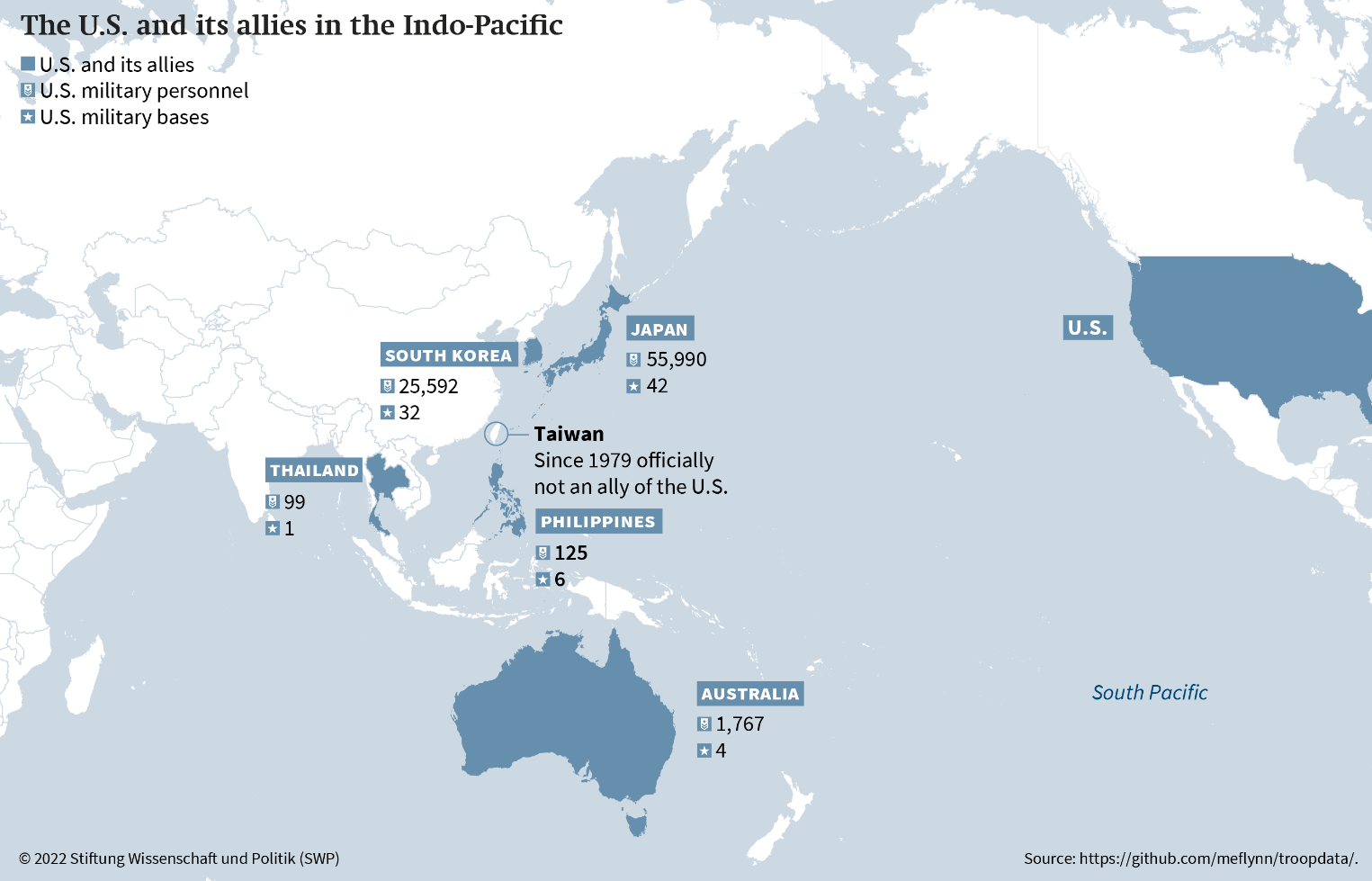
Taiwan’s location places it at the center of the First Island Chain—a strategic arc stretching from northern Japan through Taiwan and into the Philippines. This chain functions as a natural barrier limiting access from the Asian mainland to the open Pacific. Control of Taiwan would fundamentally alter naval power projection in East Asia.

This geography explains why the Taiwan Strait is never “quiet.” It is narrow, crowded, and increasingly contested. The informal median line that once helped reduce risk has largely disappeared as a meaningful restraint.


The Backstory That Never Ended

https://64.media.tumblr.com/6547e6ebe056b21bed8cb13fb6c988cf/tumblr_ntbf5m34Yn1rasnq9o1_1280.jpg
https://upload.wikimedia.org/wikipedia/commons/5/59/Movement_KMTretreat.svg
https://upload.wikimedia.org/wikipedia/commons/8/85/Mao_Proclaiming_New_China.JPG

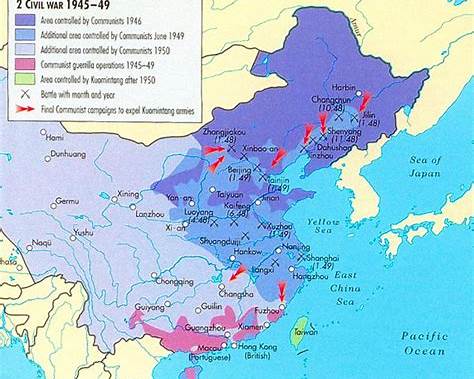
The roots of the current crisis trace back to 1949. After losing the Chinese Civil War, the Kuomintang retreated to Taiwan, while the People’s Republic of China was founded on the mainland.

From Beijing’s perspective, Taiwan is not a foreign country but the last unresolved piece of a civil war. From Taiwan’s perspective, decades of separate political development—culminating in a robust democracy—have produced a distinct identity and lived reality. These competing narratives coexist uneasily, and neither side believes time alone will resolve the dispute.


Why the United States Is Involved — Carefully

https://thenewglobalorder.com/wp-content/uploads/2021/07/https3A2F2Fs3-ap-northeast-1.amazonaws.com2Fpsh-ex-ftnikkei-3937bb42Fimages2F12F42F12F12F16741141-1-eng-GB2F20181120-Taiwan-conflict.png.jpeg
https://upload.wikimedia.org/wikipedia/commons/6/6b/Taiwan_Strait.png

U.S. involvement is governed by the Taiwan Relations Act, which commits Washington to helping Taiwan maintain the capacity to defend itself. Importantly, U.S. policy relies on strategic ambiguity—deliberately avoiding a clear promise or denial of military intervention.

This ambiguity has preserved peace for decades by discouraging both Chinese aggression and unilateral Taiwanese declarations of independence. However, ambiguity works best when power balances change slowly. That condition no longer holds.


The Trigger: U.S. Military Aid in December 2025

https://www.reuters.com/resizer/v2/2RKW6S33PROONHWXO7W7TG7EUQ.jpg?auth=a0523ed0fb5e1875fafd538866db65fb28080b6d95285c6151b5cbd85ee315fd&height=1200&quality=80&smart=true&width=1200
https://defence-blog.com/wp-content/uploads/2025/12/GzaHUC4a4AAIS49.jpg
https://upload.wikimedia.org/wikipedia/commons/5/57/Launcher_of_Chien_hsiang_loitering_munition.jpg

On December 17–18, 2025, the United States approved an approximately $11.1 billion military assistance package for Taiwan. This package was significant not only for its size, but for its strategic intent.

Rather than emphasizing prestige platforms, the aid focused on asymmetric defense systems—HIMARS, advanced artillery, loitering munitions, and anti-armor weapons. These systems are designed to complicate invasion planning, disrupt amphibious landings, and increase uncertainty for any attacker.

The signal was clear: the United States intends to strengthen deterrence by denial—making success less likely, not merely punishment more severe.


China’s Immediate Response: Overt Military Drills

https://news.cgtn.com/news/2022-08-06/Chart-of-the-Day-Why-PLA-s-six-drills-areas-around-Taiwan-matter-1chdv5ynjMc/img/21dc2e4e70794017866fe13e8cdf5e70/21dc2e4e70794017866fe13e8cdf5e70.png
https://www.visualcapitalist.com/wp-content/uploads/2025/12/China_Military_Drills_Around_Taiwan_SITE.webp
https://eng.mod.gov.cn/xb/News_213114/TopStories/_attachment/2022/08/04/4917338_1c697a55663b2455f0c40c.jpg

Within days, China responded with large-scale military exercises under Justice Mission 2025, conducted during the final two days of December. These were not symbolic maneuvers.

The drills included simulated blockades, live-fire missile activity, coordinated naval and air encirclement, and electronic and cyber operations. Crucially, they ignored the historical median line, reinforcing Beijing’s assertion that no boundary exists.

For China, the drills served three audiences at once:

  • Domestic: demonstrating resolve and control
  • Military: testing readiness under realistic conditions
  • International: signaling that U.S. aid will be met with immediate pressure

The speed of response mattered as much as the scale. Where past reactions unfolded over weeks, this response arrived in days—illustrating how compressed the strategic environment has become.


Timeline: How the Escalation Unfolded

https://chinapower.csis.org/?attachment_id=10673
https://2021-2025.state.gov/wp-content/uploads/2023/09/FMS-2023-Graphic.jpg
  • Mid-December 2025 – U.S. approves major asymmetric defense aid to Taiwan
  • Days later – China announces and executes large-scale encirclement exercises
  • End of December – Normalization of high-intensity operations around Taiwan

This is not a crisis spike followed by calm. It is a ratcheting process.


Why This Moment Is Different

Three changes distinguish today’s environment from earlier decades:

  1. Military capability gaps have narrowed — China can now execute complex, multi-domain operations
  2. Economic stakes are global — Taiwan’s semiconductor dominance affects every advanced economy
  3. Reaction time has collapsed — signaling and counter-signaling now occur almost instantly

These factors reduce the margin for error. Whenever magnitude and velocity step up exponentially, watch out!


What Happens Next? Plausible Paths Forward (6–12 Months)

https://csis-website-prod.s3.amazonaws.com/s3fs-public/2024-06/240605_Lin_ChinaQuarantineTaiwan_Fig7_0.png?VersionId=xD7gUdmVW4zZT2yrU.fQLCYscFBHFSDm
https://www.swp-berlin.org/publications/assets/Research_Paper/2022RP11/images/2022RP11_Security_Indo-Pacific_001.png

Scenario 1: Sustained Pressure (Most Likely)
China continues frequent drills, air incursions, and maritime pressure short of war. Taiwan fortifies defenses. The U.S. deepens coordination with allies. Tension remains constant but controlled.

Scenario 2: Crisis Trigger (Moderate Risk)
An accident, miscalculation, or political shock produces a short-term crisis—missile tests, blockade rehearsal, or sharp escalation—followed by emergency diplomacy.

Scenario 3: De-Escalation Window (Least Likely)
Back-channel diplomacy temporarily reduces activity, but core disagreements remain unresolved.


Reading the News With Clearer Eyes

For those following headlines, the danger is assuming each event stands alone. In reality, the Taiwan Strait operates as a continuous feedback loop—every move invites a response, every response reshapes expectations.

The risk lies not in any single arms package or military drill, but in the cumulative narrowing of choices. When history, identity, military power, and global economics converge in a narrow stretch of water, stability depends not on goodwill—but on restraint, clarity, and time. All three are increasingly scarce.

After the Fireworks: What the First Morning of the Year Is For

A collaboration between Lewis McLain & AI

Midnight gets the attention, but morning gets the truth.

The fireworks fade quickly. The music stops. Streets empty. Festive hats are cleared away. By the time the sun rises on the first day of the year, the world has grown quiet again—almost unchanged. The calendar has turned, but the room still looks the same. The problems did not disappear overnight. Neither did the blessings.

That quiet is not a letdown. It is the point.

For thousands of years, humanity has gathered at midnight to mark the turning of time. But it has always been the morning after that determines whether anything truly changes. Midnight is ceremonial. Morning is operational.


Why Midnight Can’t Carry the Weight We Give It

We ask too much of midnight.

We expect clarity, resolve, closure, and renewal to arrive in a single moment. We compress an entire year’s worth of meaning into a countdown and a cheer. When it fails to deliver transformation, we feel either disappointed or embarrassed by our own expectations.

But midnight was never meant to do the work of renewal. It only marks the handoff.

Even in ancient cultures, the celebration was followed by days of ritual reordering—debts repaid, vows honored, fields prepared, households reset. Renewal was not instantaneous; it was deliberate.

The modern world kept the celebration and lost the follow-through.


The First Morning Is Honest in a Way Midnight Is Not

Morning has no soundtrack. No audience. No spectacle.

The first morning of the year confronts us with continuity:

  • The same body
  • The same relationships
  • The same responsibilities
  • The same unfinished work

And that is precisely why it matters.

Real change does not arrive in dramatic gestures. It arrives in quiet decisions made when no one is counting down, applauding, or watching. Morning exposes whether we were serious—or merely hopeful.


What the First Morning Asks of Us

The first morning of the year asks better questions than midnight ever could.

Not What do you promise?
But What will you tend?

Not What will you fix all at once?
But What will you stop ignoring?

Not Who do you want to become?
But Who will you show up as today?

These questions do not demand ambition. They demand honesty.


Why Small Faithfulness Outlasts Grand Resolution

Resolutions fail not because they aim too high, but because they assume momentum will carry them. Morning teaches a different lesson: momentum fades; habits remain.

Civilizations, institutions, and people rarely collapse because of one bad decision. They erode because of deferred maintenance—small things left unattended because they were inconvenient, invisible, or uncomfortable.

The same is true personally. Health declines quietly. Relationships drift slowly. Faith thins gradually. None of it announces itself with fireworks.

Morning is where maintenance happens. It is time to restore, to recommit, to renew, to recount the blessings!


The Courage of Ordinary Beginnings

There is a particular courage in beginning again without drama.

It looks like:

  • Returning a call that should have been made months ago
  • Scheduling an appointment long avoided
  • Reopening a conversation gently rather than triumphantly
  • Continuing a responsibility without announcing it as a “new start”

This is not inspirational courage. It is durable courage.

The kind that survives February.


A Word About Gratitude

The first morning of the year is also where gratitude regains its balance.

Gratitude at midnight often feels forced—too broad, too general. Morning gratitude is specific. It notices:

  • What endured
  • What was preserved
  • What did not break, even when it could have

Gratitude without denial is one of the most stabilizing forces a person—or a society—can cultivate.


Why This Matters Beyond the Personal

What is true for individuals is true for communities.

Cities do not renew themselves at ribbon cuttings. Institutions do not regain trust through slogans. Systems do not become safer because a report was filed or a year closed.

Improvement happens in the quiet work that follows acknowledgment:

  • Maintenance after inspection
  • Correction after recognition
  • Stewardship after celebration

Morning is where accountability lives.


The Gift of the First Morning

The first morning of the year offers a gift that midnight cannot: continuity without illusion.

It does not erase the past.
It does not guarantee the future.
It simply gives us another day—and asks what we will do with it.

That is enough.


Conclusion: Why the Morning Deserves More Honor Than Midnight

We will always gather at midnight. That is human. We need ceremony. We need markers. We need shared moments.

But if we are honest, the future is shaped less by how loudly we celebrated than by how quietly we lived afterward.

The year does not change at midnight.
It changes when morning meets responsibility.

And that is where renewal—real, lasting renewal—has always begun.

Standing at Midnight: The History, Meaning, and Stories of New Year’s Eve

A collaboration between Lewis McLain & AI

Every year, at the stroke of midnight, millions of people pause—some in crowded city squares, some in living rooms, some alone. Fireworks erupt, glasses clink, and clocks roll forward. It feels celebratory, but beneath the noise lies something far older and quieter: a human instinct to stop time long enough to ask where we’ve been and whether it is safe to go on.

New Year’s Eve is not merely a party. It is one of humanity’s oldest rituals, reshaped again and again as civilizations learned to measure time, fear uncertainty, and hope for renewal.


From Chaos to Order: Why the Year Needed an Ending

The earliest New Year observances were not festive. They were protective.

Thousands of years ago, agricultural societies understood that survival depended on cycles they could not control. The Babylonians marked the new year with Akitu, a multi-day rite meant to reaffirm cosmic order, humility before the gods, and continuity of leadership. The “new year” was not a reset—it was a plea.

Ancient Rome refined this idea when Julius Caesar reformed the calendar in 46 BC. By fixing January 1 as the start of the year, Rome anchored time itself to Janus, the god who looked backward and forward at once. Romans exchanged gifts, offered sacrifices, and spoke carefully, believing the first words of the year could shape the months ahead.

From the beginning, New Year’s Eve was about thresholds—dangerous, hopeful moments when one thing ended and another had not yet begun.


Faith, Restraint, and the Moral Turn

As Christianity spread across Europe, exuberant pagan festivals fell under suspicion. The Church redirected the year’s turning toward reflection rather than revelry. For centuries, the end of the year was marked not with fireworks but with prayers, vigils, and confession.

This tradition never fully disappeared. “Watch Night” services—especially prominent in Methodist and African-American churches—framed New Year’s Eve as a sacred accounting: gratitude for survival, repentance for failures, and trust for what lay ahead.

The message was simple but demanding: celebration without reflection is shallow; reflection without hope is unbearable.


Fire, Noise, and Folk Wisdom

Outside formal religion, people preserved older instincts in folk traditions.

In Scotland’s Hogmanay, torchlight processions and fire festivals symbolized purification. In many cultures, loud noises were believed to chase away misfortune—an echo of ancient fears that the boundary between years left communities vulnerable.

What we now call “festive chaos” once served a serious purpose: protecting the future by confronting the unknown.


The Clock Takes Over: Modern New Year’s Eve Is Born

The Industrial Revolution changed everything. Once time became standardized—regulated by clocks, railways, and broadcast signals—midnight itself became the star.

In 1907, a glowing sphere descended in Times Square, creating a ritual that transformed New Year’s Eve into a shared national moment. Later, television turned it global. Fireworks over Sydney now greet the year before much of the world is awake, passing the celebration westward like a torch.

New Year’s Eve became less about survival and more about synchronization—humanity counting together.


Noteworthy Stories That Shaped the Meaning

1. Vows Older Than Resolutions

Modern New Year’s resolutions often feel flimsy, but their roots are ancient. Babylonians made promises to repay debts and return borrowed tools. Romans vowed loyalty and moral improvement. What changed is not the impulse, but our patience.

The failure of resolutions is not proof of their foolishness—it is evidence that self-examination has always been hard.


2. Midnight in Wartime

One of the most poignant New Year stories comes not from a party, but from silence.

During World War I, soldiers wrote letters describing New Year’s Eve in the trenches—cold, dark, uncertain. In some places, guns fell quiet at midnight. Men on opposite sides marked the passing year with prayers rather than gunfire, unsure if they would see another.

The calendar turned, but the war did not end. The moment mattered anyway.


3. The Baby New Year

The image of a diaper-clad infant replacing an old man with a beard emerged in 19th-century America. It is sentimental, but revealing. The symbol suggests not erasure of the past, but inheritance: the old year hands something unfinished to the new.

The baby does not judge the year that was. It simply receives it.


Why We Still Gather

Despite centuries of change, New Year’s Eve retains its core tension:

  • We celebrate because survival deserves joy.
  • We reflect because denial is dangerous.
  • We hope because despair is unsustainable.

Fireworks today are not so different from ancient fires. They declare, in light and sound, that we are still here.


The Deeper Meaning of Midnight

New Year’s Eve is not about pretending the past did not happen. It is about acknowledging that time moved forward anyway.

At midnight, we stand in a narrow space where memory and possibility overlap. We look back—not to relive—but to understand. We look forward—not to predict—but to commit.

That is why the ritual endures.


Conclusion: The Year Ends Whether We Pay Attention or Not

The calendar will turn without our consent. What remains a choice is whether we notice.

Across civilizations, faiths, wars, and technologies, New Year’s Eve has survived because it answers a human need deeper than celebration:

To pause long enough to tell the truth—then step forward anyway.

Fireworks fade. Music ends. Glasses are set down.
But the quiet question lingers into the first morning of the year:

Given what we now know, how shall we live the days we’ve been given next?

That question—asked honestly—is the oldest New Year’s tradition of all.


The Handoff

Midnight is not an ending so much as a transfer.

One year does not disappear when the clock strikes twelve; it places its weight gently—but firmly—into the hands of the next. What we learned does not evaporate. What we failed to do does not reset. What endured does not need to be announced again.

New Year’s Eve marks the moment when time pauses just long enough to look both ways. But the work of living has never belonged to midnight. It belongs to the hours that follow—when the noise fades, when the lights dim, and when responsibility returns without ceremony.

The celebration marks the handoff.
The morning receives it.

And so, having stood at midnight and named what this turning means, it is right to ask what comes next—not with promises shouted into the dark, but with attention offered quietly in the light of a new day.


When the Holidays Press In: Recent Texas Tragedies and a Call to Awareness

A collaboration between Lewis McLain & AI

In the days surrounding Christmas, several Texas communities awoke to grim headlines—family-related killings that unfolded not in public places, but inside homes. These cases remain under investigation. The reasons are not yet known, and in some instances may never be fully understood. Still, the timing of these events—clustered around a season commonly associated with joy and togetherness—has prompted renewed concern about how holidays can intensify pressures already present in many lives.

What the News Reports—Briefly and Factually

In Grand Prairie, police responded late at night to a family-violence call. According to investigators, a man shot his wife inside their home and later died from a self-inflicted gunshot wound. Their adult son was injured but survived after escaping and calling 911. Officers described the scene as a domestic tragedy with no ongoing threat to the public. The investigation continues, and authorities have not released a motive.

In McKinney, officers conducting a welfare check discovered an elderly couple dead in their home, both victims of homicide. While clearing the residence, police encountered the couple’s adult son, armed with a firearm. Officers shot him after he failed to comply with commands. He survived and has been charged in connection with his parents’ deaths. Officials have emphasized that details remain under investigation and have cautioned against speculation.

Elsewhere in Texas during the holiday period, authorities have reported additional family-related killings, including cases involving intimate partners and children present in the home. In some instances, police noted prior disturbance calls; in others, no public history has been released. Across these reports, one common thread stands out: the violence occurred within close relationships, during a time of year when stress is often high and support systems can be strained.

What These Stories Illustrate—Without Explaining Them

None of these cases proves that the holidays cause violence. The news does not say that. Law enforcement has not said that. But the clustering of tragedies during this season illustrates something widely acknowledged by counselors, clergy, and first responders: holidays can amplify pressures that already exist.

The holiday season compresses time and expectations. Financial strain increases. Work and school routines shift or disappear. Families spend more time together—sometimes healing, sometimes reopening old wounds. Grief is sharper for those who have lost loved ones. Loneliness is heavier for those who feel forgotten. For people already struggling with mental illness, addiction, despair, or anger, the margin for coping can narrow quickly.

Violence rarely begins at the moment it erupts. More often, it follows a long buildup of unaddressed pain, shame, fear, or perceived failure. The holidays can act as a mirror—reflecting not only what is celebrated, but also what is missing. When expectations collide with reality, and when isolation replaces connection, the risk of harm rises.

An Urgent Caution—For Families and Communities

These recent Texas stories are not puzzles to be solved from afar. They are warnings to be heeded close to home.

They remind us to:

  • take signs of distress seriously, especially sudden withdrawal, volatility, or hopeless talk;
  • recognize that “togetherness” can be difficult or even dangerous for some families;
  • understand that asking for help is not a weakness but a necessary intervention;
  • remember that stepping away from a heated situation can be an act of love.

The most dangerous assumption during the holidays may be that everyone else is fine.

A Prayer

God of mercy and peace,

We come before You mindful of lives lost and families shattered,
especially in a season meant for light and hope.

Hold close those who grieve tonight—
those whose homes are quiet when they should be full,
and those whose hearts carry questions without answers.

For those living under heavy pressure—
weighed down by fear, anger, loneliness, illness, or despair—
grant clarity before harm, courage to ask for help,
and the presence of someone who will listen.

Give wisdom to families, neighbors, pastors, counselors, and first responders
to notice distress, to intervene with compassion,
and to act before silence turns into tragedy.

Teach us to be gentle with one another,
patient in conflict,
and quick to choose life, restraint, and love.

In this season, may Your peace enter the places
where celebration feels hardest,
and may Your light reach even the darkest rooms.

Amen.

The Infrastructure We Don’t See: Aging Gas Systems, Hidden Risks, and the Case for Annual Accountability

A collaboration between Lewis McLain & AI

It’s not if, but when!

Natural gas infrastructure is the most invisible—and therefore the most misunderstood—critical system in modern cities. Power lines are visible. Water mains announce themselves through pressure and flow. Roads crack and bridges age in plain sight. But gas lines remain buried, silent, and largely forgotten—until something goes wrong.

That invisibility is not benign. It creates a governance gap where responsibility is fragmented, risk is assumed rather than measured, and accountability is episodic instead of continuous. As cities grow denser, older, and more complex, that gap widens.

This essay makes a simple but demanding case: cities should require annual, technical accountability briefings from gas utilities and structured gas-safety evaluations for high-occupancy buildings—public and private—because safety is no longer assured by age, ownership boundaries, or regulatory compliance alone.

The ultimate question is not whether gas systems are regulated. They are.
The question is whether, at the local level, we are actually safer than we were a year ago.


I. The Aging Gas Network: A Technical Reality, Not a Hypothetical

Much of the U.S. gas distribution network was installed decades ago. While significant modernization has occurred, legacy materials—particularly cast iron and bare steel—still exist in pockets, often in the very neighborhoods where density, redevelopment, and consequence are highest.

These systems age in predictable ways:

  • Material degradation such as corrosion, joint failure, and metal fatigue
  • Ground movement from expansive soils, drought cycles, and freeze–thaw conditions
  • Pressure cycling driven by modern load variability
  • Construction interaction, including third-party damage during roadway, utility, and redevelopment projects

Technically speaking, aging is not a binary condition. It is a curve. Systems do not fail all at once; they fail where stress, material fatigue, and external disturbance intersect. Cities that approve redevelopment without understanding where those intersections lie are not managing risk—they are inheriting it.


II. Monitoring Is Better Than Ever—But It Is Not Replacement

Modern gas utilities deploy advanced leak detection technologies that did not exist a generation ago: mobile survey vehicles, high-sensitivity handheld sensors, aerial detection, and in some cases continuous monitoring.

Regulatory standards have improved as well. Leak surveys are more frequent, detection thresholds are lower, and repair timelines are clearer. From a technical standpoint, the industry is better at finding leaks than it was even a few years ago.

But monitoring is inherently reactive. It detects deterioration after it has begun. It does not restore structural integrity. It does not change the age profile of the system. It does not eliminate brittle joints or corrosion-prone materials.

Replacement is the only permanent risk reduction. And replacement is expensive, disruptive, and largely invisible unless cities require it to be discussed openly.


III. Why Annual Gas Utility Accountability Briefings Are Essential

Gas utilities operate under long-range capital replacement programs driven by regulatory approval, rate recovery, and internal prioritization models. Cities operate under land-use approvals, zoning changes, density increases, and redevelopment pressures that can change risk far faster than infrastructure plans adjust.

An annual gas utility accountability briefing is how those two worlds reconnect.

Not a promotional update. Not a general safety overview. But a technical, decision-grade briefing that allows city leadership to understand:

  • What materials remain in the ground
  • Where risk is concentrated
  • How fast legacy systems are being retired
  • Whether replacement is keeping pace with growth
  • Where development decisions may be increasing consequence

Without this, cities are effectively approving new intensity above ground while assuming adequacy below it.


IV. The Forgotten Segment: From the Meter to the Building

Most gas incidents that injure people do not originate in transmission pipelines or deep mains. They occur closest to occupied space—often in the short stretch between the gas meter and the building structure.

Legally, responsibility is clear:

  • The utility owns and maintains the system up to the meter.
  • The property owner owns everything downstream.

Assessment, however, is not.

Post-meter gas piping is frequently:

  • Older steel without modern corrosion protection
  • Stressed by foundation movement
  • Altered during remodels and additions
  • Poorly documented
  • Rarely inspected after initial construction

Utilities generally do not inspect customer-owned piping. Building departments see it only during permitted work. Fire departments respond after leaks are reported. Property owners often do not realize they own it.

This creates a true orphaned asset class: high-consequence infrastructure with no lifecycle oversight.


V. Responsibility Alone Is Not Safety

Cities often take comfort in the legal distinction: “That’s private property.” Legally, that is correct. Practically, it is insufficient.

Gas does not respect ownership boundaries. A failure inside a school, apartment building, restaurant, or nursing home becomes a public emergency immediately.

Risk governance does not require cities to assume liability. It requires them to ensure that someone is actually evaluating risk in places where failure would have severe consequences.


VI. Required Gas-Safety Evaluations for High-Occupancy Properties

This is the missing pillar of modern gas safety.

Just as elevators, fire suppression systems, and boilers undergo periodic inspection, gas piping systems in high-occupancy buildings should be subject to structured evaluation—regardless of whether the building is publicly or privately owned.

Facilities warranting mandatory evaluation include:

  • Schools (public and private)
  • Daycares
  • Nursing homes and assisted-living facilities
  • Hospitals and clinics
  • Large multifamily buildings
  • Assembly venues (churches, theaters, gyms)
  • Restaurants and food-service establishments
  • High-load commercial and industrial users

These are places where evacuation is difficult, ignition sources are common, and consequences are magnified.

A gas-safety evaluation should assess:

  • Condition and material of post-meter piping
  • Corrosion, support, and anchoring
  • Stress at building entry points
  • Evidence of undocumented modifications or abandoned lines
  • Accessibility and labeling of shutoff valves

These evaluations need not be frequent. They need to be periodic, triggered, and credible.


VII. Triggers That Make the System Work

Cities can implement this framework without blanket inspections by tying evaluations to specific events:

  • Change of occupancy or use
  • Major remodels or additions
  • Buildings reaching certain age thresholds when work is permitted
  • Repeated gas odor or leak responses
  • Sale or transfer of high-occupancy properties

This approach focuses effort where risk is most likely to have changed.


VIII. Public vs. Private: One Standard of Care

A gas explosion in a public school is not meaningfully different from one in a private daycare or restaurant. The victims do not care who owned the pipe.

A city that limits safety evaluation requirements to public buildings is acknowledging risk—but only partially. The standard should be risk-based, not ownership-based.


IX. Are We Better or Worse Off Than a Year Ago?

Technically, the answer is nuanced.

We are better off nationally in detection capability and regulatory clarity. Technology has improved. Survey frequency has increased. Reporting is stronger.

But many cities are likely worse off locally in exposure:

  • Buildings are older
  • Density is higher
  • Construction activity is heavier
  • Post-meter piping remains largely unassessed
  • High-occupancy facilities rely on outdated assumptions

So the honest answer is this:

We are better at finding problems—but not necessarily better at eliminating risk where people live, work, and gather.


X. Governance Is the Missing Link

Gas safety is no longer only an engineering problem. It is a governance problem.

Cities already regulate:

  • Land use and density
  • Building permits and occupancy
  • Business licensing
  • Emergency response coordination

Requiring annual gas utility accountability briefings and targeted gas-safety evaluations does not expand government arbitrarily. It closes a blind spot that modern urban conditions have exposed.


Conclusion: Asking the Right Question, Every Year

The most important question cities should ask annually is not:

“Did the utility comply with regulations?”

It is:

“Given our growth, our buildings, and our infrastructure, are we actually safer than we were last year?”

If city leaders cannot answer that clearly—above ground and below—it is not because the answer is unknowable.

It is because no one has required it to be known.


**Appendix A

Model Ordinance: Gas Infrastructure Accountability and High-Occupancy Safety Evaluations**

This model ordinance is designed to improve transparency, situational awareness, and public safety without transferring ownership, operational control, or liability from utilities or property owners to the City.


Section 1. Purpose and Findings

1.1 Purpose

The purpose of this ordinance is to:

  1. Improve transparency regarding the condition, monitoring, and replacement of gas infrastructure;
  2. Ensure that risks associated with aging gas systems are identified and reduced over time;
  3. Require periodic gas safety evaluations for high-occupancy buildings where consequences of failure are greatest;
  4. Strengthen coordination among gas utilities, property owners, and City emergency services; and
  5. Establish consistent, decision-grade information for City leadership.

1.2 Findings

The City Council finds that:

  1. Natural gas infrastructure is largely underground and not visible to the public.
  2. Portions of the gas system—including customer-owned piping—may age without systematic reassessment.
  3. Increased density, redevelopment, and construction activity elevate the consequences of gas failures.
  4. Existing regulatory frameworks do not provide city-specific visibility into system condition or replacement progress.
  5. Periodic reporting and targeted evaluation improve public safety without assuming utility or private ownership responsibilities.

Section 2. Annual Gas Utility Accountability Briefing

2.1 Requirement

Each gas utility operating within the City shall provide an Annual Gas Infrastructure Accountability Briefing to the City Council or its designated committee.

2.2 Scope

The briefing shall address, at a minimum:

  • Pipeline materials and age profile;
  • Replacement progress and future plans;
  • Leak detection, classification, and repair performance;
  • High-consequence areas and impacts of development;
  • Construction coordination and damage prevention;
  • Emergency response readiness and communication protocols.

2.3 Format and Standards

  • Briefings shall include written materials, maps, and data tables.
  • Metrics shall be presented in a year-over-year comparable format.
  • Information shall be technical, factual, and suitable for governance decision-making.

2.4 No Transfer of Liability

Nothing in this section shall be construed to transfer ownership, maintenance responsibility, or operational control of gas facilities to the City.


Section 3. High-Occupancy Gas Safety Evaluations

3.1 Covered Facilities

Gas safety evaluations are required for the following facilities, whether publicly or privately owned:

  • Schools (public and private)
  • Daycare facilities
  • Nursing homes and assisted-living facilities
  • Hospitals and medical clinics
  • Multifamily buildings exceeding [X] dwelling units
  • Assembly occupancies exceeding [X] persons
  • Restaurants and commercial food-service establishments
  • Other facilities designated by the Fire Marshal as high-consequence occupancies

3.2 Scope of Evaluation

Evaluations shall assess:

  • Condition and materials of post-meter gas piping
  • Corrosion potential and structural support
  • Stress at building entry points and foundations
  • Evidence of undocumented modifications or abandoned piping
  • Accessibility, labeling, and operation of shutoff valves

3.3 Qualified Evaluators

Evaluations shall be conducted by:

  • Licensed plumbers,
  • Licensed mechanical contractors, or
  • Professional engineers with gas system experience.

3.4 Triggers

Evaluations shall be required upon:

  • Change of occupancy or use;
  • Major remodels or building additions;
  • Buildings reaching [X] years of age when permits are issued;
  • Repeated gas odor complaints or leak responses;
  • Sale or transfer of covered properties, if adopted by the City.

Section 4. Documentation and Compliance

4.1 Certification

Property owners shall submit documentation certifying completion of required evaluations.

4.2 Corrective Action

Identified hazards shall be corrected within timeframes established by code officials.

4.3 Enforcement

Non-compliance may result in:

  • Withholding of permits or certificates of occupancy;
  • Temporary suspension of approvals;
  • Administrative penalties as authorized by law.

Section 5. Education and Coordination

The City shall:

  • Provide educational materials clarifying ownership and safety responsibilities;
  • Coordinate with gas utilities on public outreach;
  • Integrate findings into emergency response planning and training.


**Appendix B

Annual Gas Utility Accountability Briefing — Preparation Checklist**

This checklist ensures annual briefings are consistent, measurable, and focused on risk reduction rather than general compliance.


I. System Inventory & Condition

☐ Total pipeline miles within city limits (distribution vs. transmission)
☐ Pipeline miles by material type
☐ Pipeline miles by decade installed
☐ Location and extent of remaining legacy materials
☐ Identification of oldest segments still in service


II. Replacement Progress

☐ Miles replaced in the previous year (by material type)
☐ Five-year replacement plan with schedules
☐ Funded vs. unfunded replacement projects
☐ Year-over-year reduction in legacy materials
☐ Explanation of changes from prior plans


III. Leak Detection & Repair Performance

☐ Total leaks detected (normalized per mile)
☐ Leak classification breakdown
☐ Average and maximum repair times by class
☐ Repeat leak locations identified and mapped
☐ Root-cause analysis of recurring issues


IV. Monitoring Technology

☐ Detection technologies currently deployed
☐ Survey frequency achieved vs. required
☐ Use of advanced or emerging detection tools
☐ Known limitations of monitoring methods


V. High-Consequence Areas

☐ Definition and criteria for high-consequence zones
☐ Updated risk maps
☐ Impact of new development on risk profile
☐ Trunk lines serving rapidly densifying areas


VI. Construction & Damage Prevention

☐ Third-party damage incidents
☐ 811 ticket response performance
☐ High-risk project types identified
☐ Coordination procedures with City capital projects


VII. Emergency Response Readiness

☐ Incident response timelines
☐ Coordination with fire, police, and emergency management
☐ Date and scope of last joint exercise or drill
☐ Public communication and notification protocols


VIII. Customer-Owned (Post-Meter) Piping

☐ Incidents involving post-meter piping
☐ Common failure materials or conditions
☐ Customer education and outreach efforts
☐ Voluntary inspection or assistance programs


IX. Forward-Looking Risk Assessment

☐ Top unresolved risks
☐ Areas of greatest concern
☐ Commitments for the next 12 months
☐ Clear answer to:
“Are we safer than last year—and why?”


Closing Note

A briefing that cannot complete this checklist is not incomplete—it is revealing where risk remains unmanaged.

That visibility is the purpose of accountability.

An Update on Drone Uses in Texas Municipalities

A second collaboration between Lewis McLain & AI

From Tactical Tools to a Quiet Redefinition of First Response

A decade ago, a municipal drone program in Texas usually meant a small team, a locked cabinet, and a handful of specially trained officers who were called out when circumstances justified it. The drone was an accessory—useful, sometimes impressive, but peripheral to the ordinary rhythm of public safety.

That is no longer the case.

Across Texas, drones are being absorbed into the daily mechanics of emergency response. In a growing number of cities, they are no longer something an officer brings to a scene. They are something the city sends—often before the first patrol car, engine, or ambulance has cleared an intersection.

This shift is subtle, technical, and easily misunderstood. But it represents one of the most consequential changes in municipal public safety design in a generation.


The quiet shift from tools to systems

The defining change is not better cameras or longer flight times. It is program design.

Early drone programs were built around people: pilots, certifications, and equipment checklists. Today’s programs are built around systems—launch infrastructure, dispatch logic, real-time command centers, and policies that define when a drone may be used and, just as importantly, when it may not.

Cities like Arlington illustrate this evolution clearly. Arlington’s drones are not stored in trunks or deployed opportunistically. They launch from fixed docking stations, controlled through the city’s real-time operations center, and are sent to calls the way any other responder would be. The drone’s role is not to replace officers, but to give them something they rarely had before arrival: certainty.

Is someone actually inside the building? Is the suspect still there? Is the person lying in the roadway injured or already moving? These are small questions, but they shape everything that follows. In many cases, the presence of a drone overhead resolves a situation before physical contact ever occurs.

That pattern—early information reducing risk—is now being repeated, in different forms, across the state.


North Texas as an early laboratory

In North Texas, the progression from experimentation to normalization is especially visible.

Arlington’s program has become a reference point, not because it is flashy, but because it works. Drones are treated as routine assets, subject to policy, supervision, and after-action review. Their value is measured in response times and avoided escalations, not in flight hours.

Nearby, Dallas is navigating a more complex path. Dallas already operates one of the most active municipal drone programs in the state, but scale changes everything. Dense neighborhoods, layered airspace, multiple airports, and heightened civil-liberties scrutiny mean that Dallas cannot simply replicate what smaller cities have done.

Instead, Dallas appears to be doing something more consequential: deliberately embedding “Drone as First Responder” capability into its broader public-safety technology framework. Procurement language and public statements now describe drones verifying caller information while officers respond—a quiet but important acknowledgement that drones are becoming part of the dispatch process itself. If Dallas succeeds, it will establish a model for large, complex cities that have so far watched DFR from a distance.

Smaller cities have moved faster.

Prosper, for example, has embraced automation as a way to overcome limited staffing and long travel distances. Its program emphasizes speed—sub-two-minute arrivals made possible by automated docking stations that handle charging and readiness without human intervention. Prosper’s experience suggests that cities do not have to grow into DFR gradually; some can leap directly to system-level deployment.

Cities like Euless represent another important strand of adoption. Their programs are smaller, more cautious, and intentionally bounded. They launch drones to specific call types, collect experience, and adjust policy as they go. These cities matter because they demonstrate how DFR spreads laterally, city by city, through observation and imitation rather than mandates or statewide directives.


South Texas and the widening geography of DFR

DFR is not a North Texas phenomenon.

In the Rio Grande Valley, Edinburg has publicly embraced dispatch-driven drone response for crashes, crimes in progress, and search-and-rescue missions, including night operations using thermal imaging. In regions where heat, terrain, and distance complicate traditional response, the value of rapid aerial awareness is obvious.

Further west, Laredo has framed drones as part of a broader rapid-response network rather than a narrow policing tool. Discussions there extend beyond observation to include overdose response and medical support, pointing toward a future where drones do more than watch—they enable intervention while ground units close the gap.

Meanwhile, cities like Pearland have quietly done the hardest work of all: making DFR ordinary. Pearland’s early focus on remote operations and program governance is frequently cited by other cities, even when it draws little public attention. Its lesson is simple but powerful: the more boring a drone program becomes, the more likely it is to scale.


What 2026 will likely bring

By 2026, Texas municipalities will no longer debate drones in abstract terms. The conversation will shift to coverage, performance, and restraint.

City leaders will ask how much of their jurisdiction can be reached within two or three minutes, and what it costs to achieve that standard. DFR coverage maps will begin to resemble fire-station service areas, and response-time percentiles will replace anecdotal success stories.

Dispatch ownership will matter more than pilot skill. The most successful programs will be those in which drones are managed as part of the call-taking and response ecosystem, not as specialty assets waiting for permission. Pilots will become supervisors of systems, not just operators of aircraft.

At the same time, privacy will increasingly determine the pace of expansion. Cities that define limits early—what drones will never be used for, how long video is kept, who can access it—will move faster and with less friction. Those that delay these conversations will find themselves stalled, not by technology, but by public distrust.

Federal airspace rules will continue to separate tactical programs from scalable ones. Dense metro areas will demand more sophisticated solutions—automated docks, detect-and-avoid capabilities, and carefully designed flight corridors. The cities that solve these problems will not just have better drones; they will have better systems.

And perhaps most telling of all, drones will gradually fade from public conversation. When residents stop noticing them—when a drone overhead is no more remarkable than a patrol car passing by—the transformation will be complete.


A closing thought

Texas cities are not adopting drones because they are fashionable or futuristic. They are doing so because time matters, uncertainty creates risk, and early information saves lives—sometimes by prompting action, and sometimes by preventing it.

By 2026, the question will not be whether drones belong in municipal public safety. It will be why any city, given the chance to act earlier and safer, would choose not to.


Looking Ahead to 2026: When Drones Become Ordinary

By 2026, the most telling sign of success for municipal drone programs in Texas will not be innovation, expansion, or even capability. It will be normalcy.

The early years of public-safety drones were marked by novelty. A drone launch drew attention, generated headlines, and often triggered anxiety about surveillance or overreach. That phase is already fading. What is emerging in its place is quieter and far more consequential: drones becoming an assumed part of the response environment, much like radios, body cameras, or computer-aided dispatch systems once did.

The conversation will no longer revolve around whether a city has drones. Instead, it will focus on coverage and performance. City leaders will ask how quickly aerial eyes can reach different parts of the city, how often drones arrive before ground units, and what percentage of priority calls benefit from early visual confirmation. Response-time charts and service-area maps will replace anecdotes and demonstrations. In this sense, drones will stop being treated as technology and start being treated as infrastructure.

This shift will also clarify responsibility. The most mature programs will no longer center on individual pilots or specialty units. Ownership will move decisively toward dispatch and real-time operations centers. Drones will be launched because a call meets predefined criteria, not because someone happens to be available or enthusiastic. Pilots will increasingly function as system supervisors, ensuring compliance, safety, and continuity, rather than as hands-on operators for every flight.

At the same time, restraint will become just as important as reach. Cities that succeed will be those that articulate, early and clearly, what drones are not for. By 2026, residents will expect drone programs to come with explicit boundaries: no routine patrols, no generalized surveillance, no silent expansion of mission. Programs that fail to define those limits will find themselves stalled, regardless of how capable the technology may be.

Federal airspace rules and urban complexity will further separate casual programs from durable ones. Large cities will discover that scaling drones is less about buying more aircraft and more about solving coordination problems—airspace, redundancy, automation, and integration with other systems. The cities that work through those constraints will not just fly more often; they will fly predictably and defensibly.

And then, gradually, the attention will drift away.

When a drone arriving overhead is no longer remarkable—when it is simply understood as one of the first tools a city sends to make sense of an uncertain situation—the transition will be complete. The public will not notice drones because they will no longer symbolize change. They will symbolize continuity.

That is the destination Texas municipalities are approaching: not a future where drones dominate public safety, but one where they quietly support it—reducing uncertainty, improving judgment, and often preventing escalation precisely because they arrive early and ask the simplest question first: What is really happening here?

By 2026, the most advanced drone programs in Texas will not feel futuristic at all. They will feel inevitable.

We Can’t Afford to Stay Alive

A collaboration between Lewis McLain & AI

Longevity, Hidden Costs, and the Obligation We Never Could Afford

We have achieved something extraordinary. Modern medicine has extended human life far beyond what any previous generation thought possible. Hearts are restarted. Organs are replaced. Diseases that once killed quickly are managed for decades. Death, increasingly, is postponed.

But longevity has come with a reckoning we continue to avoid: the longer we live under modern medicine, the more expensive—and often the more diminished—life becomes. And the bill for this achievement is not abstract. It is measurable, enormous, and largely invisible.


1. The Cost Curve We Pretend Not to See

Healthcare spending does not rise evenly across a lifetime. It accelerates sharply after age 65 and even more steeply after 75. By the final years of life, annual medical spending commonly reaches $30,000–$40,000 per person, often much higher when hospitalizations, intensive care, dialysis, and skilled nursing are involved.

These dollars rarely purchase recovery. They purchase maintenance—keeping organs functioning as the body steadily declines. Survival is extended, but vitality shrinks. Independence narrows. The space for joy and contribution contracts.

We have learned how to keep bodies alive.
We have not learned how to keep those added years whole.


2. Longevity Without Living

Extended life is usually framed as an unqualified good. Yet for many people, the additional years are marked by:

  • Chronic pain and fatigue
  • Loss of mobility
  • Dependence on institutions
  • Endless appointments and medications
  • A shrinking world defined by medical routines

The paradox is hard to escape: the more medicine we apply, the narrower life often becomes. We stretch time while quietly hollowing out what fills it.


3. The Mind Ages on a Different Clock

Physical decline is only part of the story. The body and the mind do not fail together—and medicine is far better at sustaining one than preserving the other.

Millions spend their final years with significant cognitive decline:

  • Dementia
  • Alzheimer’s disease
  • Loss of memory, recognition, and orientation

In those years, the cruelty is subtle but profound. Lifelong friends are forgotten. Spouses become strangers. Children become caregivers to someone who no longer knows their name.

Medicine can often keep the body alive long after identity, memory, and relationship have begun to fade. These are years of biological survival, not the life most people imagine when they say, “I want to live as long as possible.”


4. What the System Is Actually Buying

Late-life healthcare spending increasingly funds not restoration, but management of decline:

  • Memory-care facilities
  • Hospitalizations for falls, infections, and complications
  • Medications to control agitation and confusion
  • Constant supervision rather than healing

This care is often compassionate and necessary—but it is not curative. We are not extending life as people envision it. We are extending dependency, supervision, and medical captivity.


5. The Hidden Bill: Medicare and the Great Disappearing Cost

The reason this system persists with so little public reckoning is simple: the price is hidden.

Medicare absorbs the overwhelming cost of late-life medicine and spreads it across workers, employers, borrowing, and future taxpayers. At the bedside, care feels earned and affordable because the bill never arrives.

But when economists ask what Medicare actually costs under current law, the answer is staggering.

The present value of Medicare’s future obligations—discounted into today’s dollars and net of dedicated revenues—is commonly estimated between $50 trillion and $85 trillion over a 75-year horizon. Some longer-horizon analyses, including work associated with the Federal Reserve Bank of Dallas, place the figure well above $100 trillion when extended beyond the artificial cutoff of 75 years.

These are not hypothetical programs. They are legal promises already made.


6. Put It Where It Belongs: Per Household

Large numbers dull the mind. Per-household figures sharpen it.

With roughly 130 million U.S. households, the math becomes unavoidable:

  • Medicare unfunded obligations:
    ~$400,000 to ~$650,000 per household, depending on assumptions
  • Current national debt (~$34–35T):
    ~$260,000 per household

Even under conservative estimates, Medicare’s future obligations exceed the national debt on a per-household basis. And unlike the debt, Medicare’s costs cannot be refinanced, inflated away, or postponed indefinitely. They represent real doctors, nurses, facilities, drugs, and care delivered every year.

The national debt is what we argue about.
Medicare is what we quietly promise.


7. The Pre-Retirement Parallel We Ignore

This illusion does not begin at 65.

The Affordable Care Act performs the same cost-concealing function for pre-retirement generations. By subsidizing premiums, suppressing actuarial pricing, and prohibiting underwriting, it hides the rising cost of aging bodies between ages 50 and 64.

Without subsidies, many near-retirees would face insurance premiums rivaling housing costs. The shock would be immediate—and politically intolerable.

Together, the systems form a seamless bridge:

  • ACA conceals costs before retirement
  • Medicare absorbs them after retirement

At no point does the public see the full cost curve.


8. Why This Is More Serious Than “Debt”

The national debt is a stock.
Medicare is a machine.

Debt grows because Congress borrows.
Medicare grows even if Congress does nothing—because people live longer and medicine does more.

It is politically invisible, structurally automatic, and morally shielded from scrutiny by the language of compassion.


9. The Question Beneath the Numbers

“We can’t afford to stay alive” is not a rejection of care or compassion. It is recognition of a mismatch:

  • We can extend biological function
  • But we cannot indefinitely preserve dignity, clarity, and meaning through technology alone

When price signals are fully suppressed, society defaults to the most expensive answer every time: one more treatment, one more year, one more intervention—even when what is being preserved no longer resembles life as the person understood it.


10. Toward a More Honest Compassion

A humane future does not mean less care. It means wiser care.

That means:

  • Earlier and honest conversations about goals of care
  • Treating comfort and peace as successes, not failures
  • Valuing palliative and hospice medicine as achievements, not retreats
  • Acknowledging that identity, memory, and relationship matter as much as pulse and oxygen

Longevity was medicine’s triumph.
Wisdom must be its successor.

Until then, we will continue to spend sums larger than the national debt—quietly, automatically, and without consent—
extending lives that feel increasingly unlike living,
and reassure ourselves it is progress because the machines are still running.

WHAT ABOUT THE FACT THAT RIGHT NOW IT APPEARS THAT THE OBAMA CARE SUBSIDY IS GOING AWAY? IT IS AT OUR DOORSTEP.

https://i.etsystatic.com/33485018/r/il/bb55d2/5279336820/il_fullxfull.5279336820_1uxy.jpg
https://thefinancebuff.com/wordpress/wp-content/uploads/2025/07/aca-net-premium-cliff.jpg
https://cdn.aarp.net/content/dam/aarp/money/managing-debt/2019/04/1140-couple-concerned-on-a-couch.jpg

Addendum: The Subsidy Cliff Is No Longer Theoretical

One more fact now pushes We Can’t Afford to Stay Alive from theory into immediate reality:

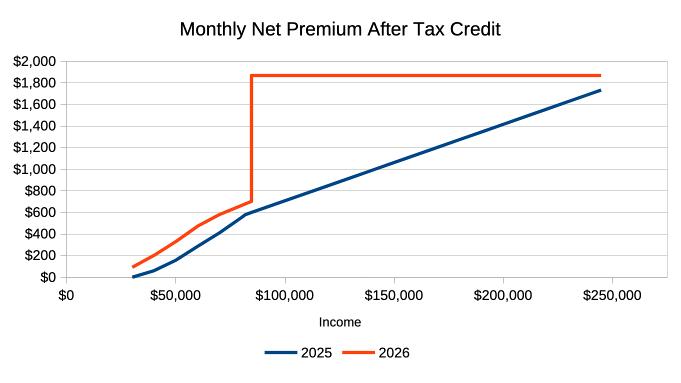
The Affordable Care Act’s enhanced premium subsidies are scheduled to expire unless Congress acts.
This is no longer a distant budget debate. It is at our doorstep.

And when those subsidies disappear, the hidden cost structure we’ve been describing will be exposed overnight—for millions of pre-retirement households.


1. What the Subsidy Was Really Doing

The ACA subsidy did not reduce healthcare costs.
It reassigned who paid them.

For people ages roughly 50–64—the most expensive group outside Medicare—the subsidy:

  • Suppressed actuarial pricing
  • Capped premiums as a share of income
  • Masked the true cost of aging bodies
  • Prevented mass exit from the insurance pool

In effect, it acted as Medicare’s front porch.

As long as the subsidy existed, Americans moved from employer insurance → ACA → Medicare without ever seeing the full cost curve.


2. What Happens When the Subsidy Goes Away

When subsidies expire:

  • Premiums for many near-retirees will double or triple
  • Deductibles will reassert themselves as the real rationing mechanism
  • Healthy individuals will exit coverage
  • Risk pools will deteriorate
  • Insurers will reprice upward again

This is not a policy failure.
It is price discovery returning after years of suppression.

The sticker shock will feel sudden only because the cost was hidden.


3. Why This Matters for the Medicare Argument

This moment matters because it proves your thesis in real time.

The ACA subsidy was never sustainable on its own—it only worked because:

  • It borrowed against future taxpayers
  • It assumed continued expansion of Medicare enrollment
  • It postponed the reckoning until after age 65

When that bridge weakens, Americans see—briefly—what private insurance actually costs when:

  • Age
  • Chronic disease
  • Medical intensity
    are priced honestly.

And what they see is unbearable.

Which is why the political pressure to restore or extend the subsidy will be immense.


4. The Pattern Is Always the Same

  1. Costs rise with age
  2. Subsidies hide the increase
  3. Removal reveals the truth
  4. The public reacts in shock
  5. Subsidies are reinstated
  6. Obligations grow larger

This is not accidental.
It is how entitlement systems expand without consent.


5. Why This Moment Is Dangerous—and Revealing

If subsidies lapse even briefly, Americans will experience something rare:

A glimpse of what medically extended life actually costs before Medicare absorbs it.

For many households:

  • Insurance will cost more than housing
  • Coverage will feel optional until illness strikes
  • Early retirement will become impossible
  • Financial stress will accelerate health decline itself

The response will not be restraint.
It will be demand for re-subsidization.

And once restored, the system will be even harder to unwind.


6. This Is the Real Choice in Front of Us

We are not deciding whether to be compassionate.
We are deciding how honestly to be compassionate.

Do we:

  • Continue hiding costs through layered subsidies?
  • Or confront the reality that longevity, as currently structured, is fiscally and humanly unsustainable?

The ACA subsidy cliff makes one thing undeniable:

The system only works when people are shielded from what staying alive actually costs.


7. Why This Belongs in the Essay—Not the Footnotes

This is not a side issue.
It is the live demonstration of everything the essay argues:

  • Medicare hides the cost at the end
  • The ACA hid the cost on the way there
  • When either veil slips, panic follows
  • And the response is always to hide the price again

Not because the public is immoral—
but because the truth is unbearable without a deeper conversation about limits, dignity, and what medicine is truly for.


8. The Reckoning Is Not Cancelled—Only Deferred

If the subsidy is extended, the numbers grow.
If it expires, the shock arrives.

Either way, the math does not change.

We can extend life.
We can subsidize it.
We can hide the bill.

But we cannot escape it.

The subsidy cliff is not the crisis.
It is the moment the curtain lifts—just long enough for people to see what has been quietly building behind it.

Evictions in Texas: The Last Off-Ramp Before Homelessness — and Why Communities Must Treat as Risk Management

A collaboration between Lewis McLain & AI

Evictions are often discussed as housing disputes. In reality, they are something far more consequential: the final off-ramp before homelessness. Once a household reaches the point of eviction, nearly every stabilizing force—savings, credit, social ties, school continuity, employment flexibility—has already been weakened. If eviction prevention fails, the system shifts from prevention to crisis response, where costs rise sharply and outcomes worsen.

Across Texas, eviction filings have climbed above pre-pandemic levels, even in economically strong regions such as Houston, Dallas, and Austin. This is not a localized failure. It is a warning sign that many households are living one missed paycheck away from displacement—and that communities are reacting too late.

The central lesson is simple but uncomfortable: by the time homelessness appears, the policy failure has already occurred.


Eviction as the Final Preventable Step

Homelessness is expensive, visible, and politically urgent. Evictions are quieter—and therefore easier to ignore. Yet eviction is where intervention is most effective.

Once an eviction is filed:

  • Housing options narrow dramatically
  • Credit and rental histories are damaged
  • Families often double up or move into unstable situations
  • Children experience school disruption
  • Stress and health risks spike

After displacement, public systems step in—shelters, emergency healthcare, school mobility services, law enforcement responses—but by then, costs have multiplied and choices have shrunk.

Eviction prevention is not housing charity; it is risk management.


Why Staying Ahead Matters: The Cost Curve Is Not Linear

One of the most important reasons to stay ahead of eviction pressure is that costs rise exponentially once eviction occurs.

  • A few hundred or thousand dollars in short-term rental assistance can stabilize a household
  • A court filing creates long-term barriers to housing
  • Shelter placement costs far exceed prevention costs
  • Rehousing displaced families takes months, not days

Communities that intervene early are not “spending more on housing.” They are avoiding far larger downstream obligations in homelessness response systems.


The Texas Eviction Environment: Speed Without Cushion

Texas’s eviction process moves quickly. Notices are issued within days of nonpayment, and cases proceed rapidly through Justice of the Peace Courts. Most tenants are unrepresented. Many landlords file automatically.

Speed itself is not the problem. Speed without cushioning is.

When households lack savings, when rents rise faster than wages, and when communication breaks down, the legal system becomes a blunt instrument—efficient, but destabilizing.


Who Can Intervene — and Why Early Action Is Everything

Because eviction is a process, there are multiple chances to change the outcome. But those chances disappear quickly.

Renters: The Earliest Warning Point

Renters are the first to know when trouble begins—but often the last to seek help. Fear, shame, or confusion delays action until the problem has hardened into a legal case.

Staying ahead means:

  • Making help visible before notices are posted
  • Using trusted institutions (schools, churches, utilities, employers) to flag assistance early
  • Replacing fragmented systems with simple, centralized intake

Early renter engagement is the highest-return intervention in the entire system.


Landlords: The Fork in the Road

Landlords control whether eviction becomes a first response or a last resort.

  • Small landlords often want resolution but lack liquidity
  • Large operators rely on standardized and often automated filing practices

Staying ahead requires giving landlords credible alternatives:

  • Mediation that protects their rights
  • Payment plans with court recognition
  • Rapid, reliable rental assistance

When eviction is the only structured option, it will be used—even when everyone loses.


Nonprofits: Most Effective Before Court, Not After

Nonprofits are prevention specialists, not emergency responders. Their greatest impact occurs before eviction filings, when problems are still solvable.

Local governments that stay ahead:

  • Fund nonprofits predictably, not episodically
  • Narrow focus to pre-filing intervention
  • Prevent intake overload

Once cases reach judgment, nonprofits are forced into damage control rather than stabilization.


Courts: Process Can Prevent Displacement

Courts are not housing agencies—but they shape outcomes through process design.

Staying ahead does not require changing the law. It requires:

  • Clear, plain-language notices
  • Automatic referrals to mediation or assistance
  • Short continuances tied to payment plans
  • On-site navigators to prevent default judgments

A fair, navigable process reduces unnecessary displacement without favoring either side.


Legal Aid: Small Interventions, Big Effects

Even brief legal advice can:

  • Prevent improper filings
  • Formalize payment agreements
  • Avoid default judgments

Because capacity is limited, the most effective approach is early triage, not universal representation.


Schools, Employers, and Utilities: The Early Sensors

Housing instability often appears here first:

  • Attendance issues
  • Payroll advances
  • Utility arrears

Communities that stay ahead build referral pathways, not enforcement mechanisms, turning early warning signs into early help.


Why Local Governments Must Lead — Even Without New Authority

Local governments often hesitate, citing limits under state law. But eviction prevention does not require sweeping new powers. It requires coordination, timing, and discipline.

Cities and counties already pay for eviction outcomes:

  • Homelessness services
  • School mobility costs
  • Emergency medical care
  • Public safety responses

Staying ahead is not mission creep. It is cost avoidance and system stewardship.


Practical Ideals for Staying Ahead of the Challenge

  1. Treat eviction filings as an early warning metric, not a background statistic
  2. Shift resources upstream, before court filings occur
  3. Design systems for speed, matching the speed of eviction timelines
  4. Preserve market function through mediation, not moratoria
  5. Expand housing supply intentionally, avoiding policies that tighten markets further

Conclusion: The Window Is Narrow—but It Exists

Eviction is the last moment when homelessness is still optional.

Once a household is displaced, policy choices narrow and costs explode. Staying ahead is not about preventing every eviction; it is about ensuring that temporary hardship does not become permanent instability.

The choice for Texas communities is not whether to pay for housing instability.
They already do.

The real choice is whether to pay early, quietly, and effectively—or later, loudly, and at far greater cost.

The Wonder of a Child They Did Not Yet Know

A collaboration between Lewis McLain & AI
Dedicated to my Brothers in Tuesday Morning Bible Study


There is something almost unbearable in the beauty of a newborn. A child arrives small, warm, breathing, and entirely dependent—yet greeted with celebration, wonder, and hope far larger than the tiny chest that rises and falls. Every birth carries this paradox: fragility wrapped in promise. We celebrate not because we know what this child will become, but because the child is. The miracle is not prediction; it is presence.

Now imagine that wonder multiplied beyond comprehension.

A baby is born in obscurity—no palace, no procession, no formal announcement to kings or scholars. He arrives to ordinary parents, in borrowed space, welcomed first by shepherds whose lives were defined by long nights and watchful waiting. The scene is quiet, almost hidden. And yet heaven leans in. Angels sing not because the world understands, but because the world is about to be changed.

Those who held Him did not know His sermons. They could not imagine His parables, His compassion for the broken, His confrontations with power, or His unflinching march toward sacrifice. Mary could not yet hear the cadence of the Beatitudes in His voice. Joseph could not see Him overturning tables or calming storms. The shepherds returned to their fields unaware they had looked upon the One who would redefine greatness itself.

That is part of the awe.

We are accustomed to celebrating greatness after it proves itself—after the victories, the titles, the legacy. But this child was celebrated before any of that. Loved before achievement. Revered before recognition. Worshiped before a single public word was spoken. The joy surrounding His birth was not rooted in résumé but in revelation: that God had chosen to come near not as thunder or fire, but as a child who needed to be fed, carried, and protected.

In those first thirty years—mostly silent in Scripture—He lived an ordinary life. He learned to walk, to speak, to work with His hands. He knew scraped knees and long days. He waited. And in that waiting, He dignified the hidden years of human life—the years when nothing seems remarkable, when faithfulness is quiet and obedience goes unseen.

Then, suddenly, everything changes.

The child becomes the teacher. The baby becomes the healer. The One once cradled in arms stretches those same arms toward the sick, the sinner, the forgotten. And finally, the child celebrated at birth becomes the Man rejected at death—only to rise again and redefine life itself.

Looking back, the nativity takes on a breathtaking depth. The joy of that night was not naïve; it was prophetic. They celebrated without full understanding, and yet their celebration was entirely justified. The baby they adored would become the axis of history, the answer to longing, the bridge between God and humanity.

Perhaps that is why the birth still moves us.

Every Christmas, we stand where they stood—marveling at a child whose future we now know, yet whose humility still surprises us. And in doing so, we are reminded that God often does His greatest work in small beginnings. That redemption may arrive quietly. That hope can be wrapped in swaddling cloths. And that the most world-altering life ever lived began the same way all of ours do: as a baby, celebrated in love, before the fullness of His purpose was revealed.

That is the awesomeness of the birth—not merely that a child was born, but that eternity entered time without fanfare, trusting humanity enough to begin in our arms.


A Prayer of Thanksgiving

Gracious and loving God,
We thank You for the gift of Your Son—
for the miracle of His birth,
when heaven touched earth in the quiet cry of a newborn child.

Thank You that You did not come to us in power alone,
but in humility;
not in distance, but in closeness;
not in fear, but in love.
You entrusted Yourself to human hands,
to a mother’s care,
to a father’s protection,
to the slow, ordinary years of growing and waiting.

We thank You for Jesus—
for His life that showed us how to love,
for His words that still our storms,
for His mercy that welcomes the broken,
and for His obedience that carried Him all the way to the cross.

Thank You that the child once celebrated in wonder
became the Savior who carried our sin, our sorrow, and our hope.
Thank You for the resurrection that assures us
that love is stronger than death
and light overcomes the darkness.

Help us to receive Him anew—
not only with the joy of celebration,
but with lives shaped by gratitude, humility, and faith.
May we cherish the small beginnings You place before us,
trust Your purposes even when we do not yet understand,
and walk each day in the light of Your grace.

We offer this prayer with thankful hearts,
in the holy and precious name of Jesus Christ,
Your Son, our Savior.

Amen.

Silent Night: The Meaning of a Song the World Keeps Singing

A collaboration between Lewis McLain & AI

https://upload.wikimedia.org/wikipedia/commons/e/eb/Stille_nacht.jpg?utm_source=chatgpt.com
https://www.salzburger-seenland.at/wp-content/uploads/2023/05/Oberndorf_Stille_Nacht_Kapelle__C__Salzburgerland.com_-1-e1699367548128.jpg?utm_source=chatgpt.com
https://i.etsystatic.com/23252494/r/il/3e56ae/3432628659/il_fullxfull.3432628659_7yi4.jpg?utm_source=chatgpt.com

“Silent Night” — Lyrics

Silent night, holy night!
All is calm, all is bright
’Round yon Virgin, Mother and Child.
Holy infant so tender and mild,
Sleep in heavenly peace,
Sleep in heavenly peace.

Silent night, holy night!
Shepherds quake at the sight,
Glories stream from heaven afar,
Heavenly hosts sing: Alleluia!
Christ the Savior is born,
Christ the Savior is born.

Silent night, holy night!
Son of God, love’s pure light
Radiant beams from Thy holy face,
With the dawn of redeeming grace,
Jesus, Lord, at Thy birth,
Jesus, Lord, at Thy birth.


Silent Night: The Meaning of a Song the World Keeps Singing

When Silent Night was first sung on Christmas Eve in 1818, it arrived without fanfare. There was no great choir, no organ swelling beneath vaulted ceilings. The instrument most associated with the moment—a simple guitar—stood in for a broken organ in a small Austrian village church. A young priest’s poem and a schoolteacher’s melody met necessity, not ambition.

Nothing about that night suggested permanence. And yet the song endured.

It endured because Silent Night never tried to do too much. It did not explain Christmas. It did not argue doctrine. It simply named the moment at the heart of the Christian story: stillness, vulnerability, and peace entering the world quietly.


A Song Born of Quiet Necessity

Joseph Mohr, the priest who wrote the lyrics, had lived close to hardship. Franz Xaver Gruber, who composed the melody, was a village schoolteacher accustomed to making do. Their collaboration was practical and pastoral rather than artistic in the modern sense. The result was a hymn that ordinary people could sing without strain, remember without effort, and carry with them without instruction.

That simplicity is not accidental. The song mirrors its subject. The birth it describes is not dramatic. The setting is modest. The revelation unfolds without spectacle. Heaven does not interrupt the world—it enters it.


A Brief Turn Through History

Nearly a century later, during World War I, Silent Night surfaced unexpectedly in a very different setting. Letters written by soldiers in December of 1914 document a brief, unofficial pause in fighting on parts of the Western Front, during which familiar carols—including Stille Nacht—were sung across opposing trenches.

The moment was limited and fragile. It changed nothing strategically. The war continued.

It is remembered not because it altered history, but because it confirmed something already true about the hymn: Silent Night does not command events. It accompanies them.

With that, the story rightly returns to the song itself.


What the Hymn Is Really Saying

At its core, Silent Night makes a quiet but radical claim: that the decisive moment in human history did not arrive with noise, power, or force.

God enters the world as a child who sleeps.

The hymn lingers not on the politics of the time or the dangers beyond the stable, but on calm—heavenly peace—as something present even when circumstances remain uncertain. The peace the song names is not the absence of threat; it is the presence of God within it.

That distinction explains why the hymn has never felt outdated. Every generation understands unrest. Every generation recognizes the longing for a peace that does not depend on control.


The Power of Restraint

What Silent Night refuses to do is as important as what it does.

  • It does not rush toward resolution.
  • It does not elevate volume or tempo to stir emotion.
  • It does not insist that the listener feel anything at all.

Instead, it creates space.

In that space, listeners are invited—not coerced—to consider a different measure of significance. Greatness arrives quietly. Light does not overwhelm darkness; it appears within it. The world does not stop, but it is momentarily reoriented.


Why the Song Endures

For more than two centuries, Silent Night has survived translation, adaptation, and cultural change because it rests on something deeper than style. Its endurance is rooted in recognition. People hear it and know, instinctively, that it is telling the truth about something essential.

It belongs equally in grand cathedrals and modest living rooms. It can be sung by choirs or whispered by a single voice. It does not demand perfection. It welcomes presence.


A Song for Every Age

Each year, when candles are lit and the final hymn begins, Silent Night does what it has always done. It slows the room. It lowers the temperature of the world just enough for reflection to occur.

Not because everything is calm.
Not because the night is truly silent.

But because, for a moment, we are willing to believe that peace does not need to be manufactured or enforced—only received.

And that belief, carried quietly from one generation to the next, is why the world keeps singing.