A collaboration between Lewis McLain & AI
Every few decades, crime statistics break through assumption and force a pause. The current claim — that the U.S. murder rate is the lowest since 1900 — is one of those moments. It sounds implausible to many ears trained by years of grim headlines. Yet when examined carefully, the claim is largely true, technically defensible, and easy to misunderstand.
This essay follows the long arc: what the data show, how far back they truly reach, and what this moment does — and does not — mean.
The claim in plain terms
Preliminary national data for 2025 suggest a homicide rate near 4.0 deaths per 100,000 people. If finalized at that level, it would be lower than any recorded national homicide rate going back to at least 1900, the earliest point at which scholars can reconstruct reasonably comparable nationwide estimates.
That sentence carries weight — and caveats.
A century-long arc of violence
Viewed across time, American homicide follows a revealing pattern:
- Early 1900s: Rates around 6 per 100,000, shaped by weak policing, widespread alcohol violence, and rudimentary emergency medicine.
- 1920s–1930s: A sharp rise during Prohibition and the Great Depression, often exceeding 9 per 100,000.
- Post–World War II: A calmer interlude. The 1950s hover near 4.5–5.0, later remembered — somewhat romantically — as “normal.”
- 1965–1995: The great surge. Drugs, urban decay, demographic pressure, and social upheaval push homicide above 10 per 100,000 at its early-1990s peak.
- 1995–2019: A long, steady decline — one of the most important and underappreciated social trends of the past half-century.
- 2020–2021: A pandemic shock. Murders spike sharply amid disruption, isolation, and institutional strain.
- 2022–2025: A rapid correction. Rates fall faster than almost any prior post-crisis period.
If the current estimates hold, the country has not merely returned to pre-pandemic levels — it has dropped below every reliably documented year of the modern statistical era.
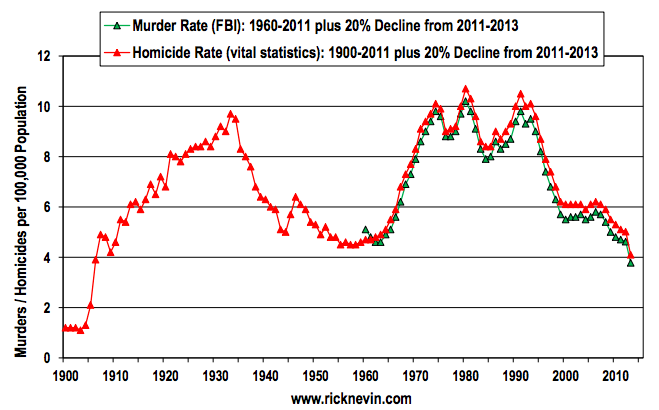
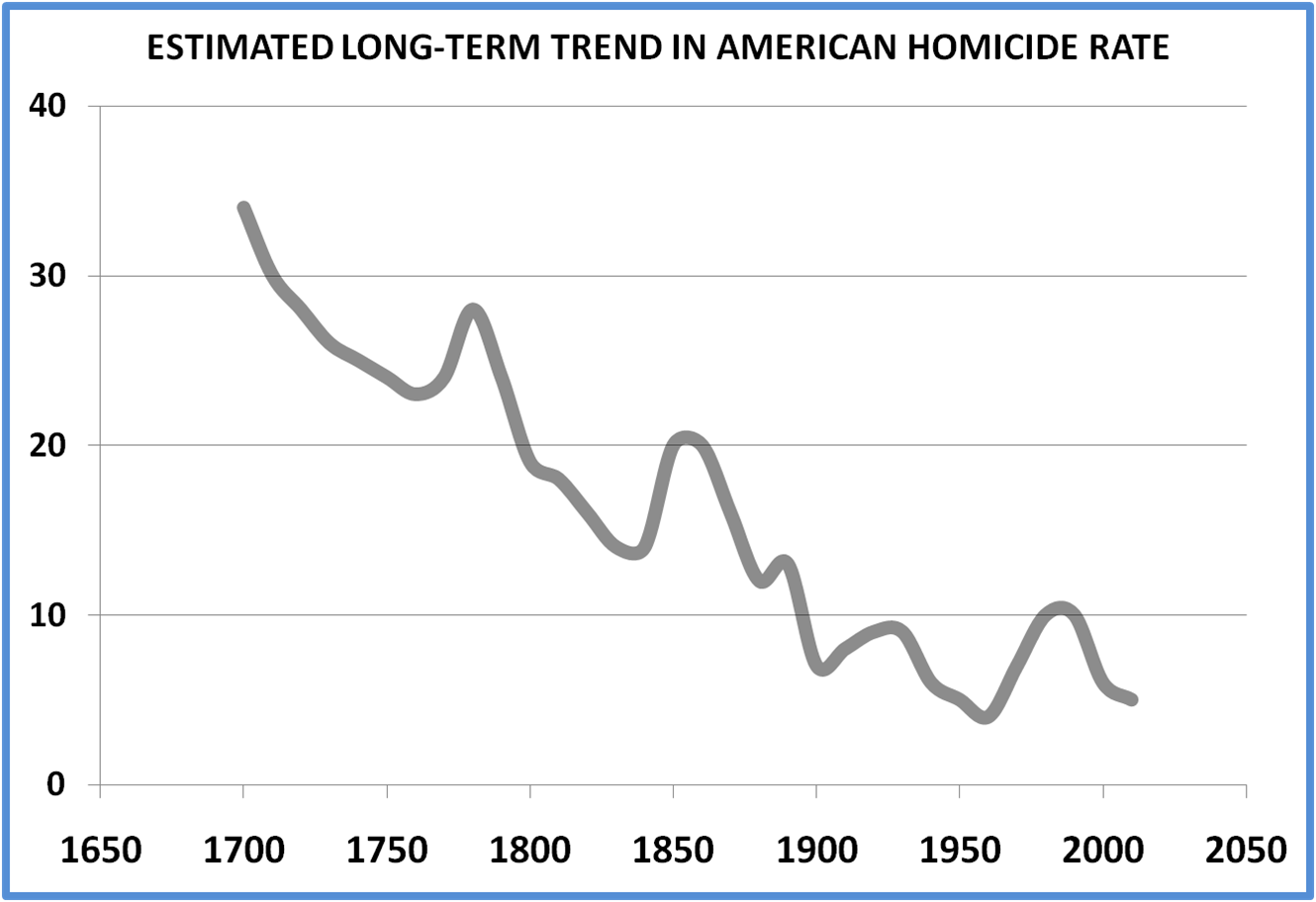
The shape of the curve matters. The late twentieth century was not the baseline. It was the anomaly.
Why “since 1900” is accurate — and fragile
The phrase survives scrutiny because homicide is the cleanest crime statistic across time. A body produces paperwork. Murder is difficult to ignore, redefine, or quietly erase. That makes it uniquely suitable for long-run comparison.
Still, this is not a laboratory experiment:
- Early data were reconstructed, not digitally logged.
- Reporting varied across states and cities.
- Medical advances matter: many assaults that would have been fatal in 1905 are survivable today.
- Definitions evolved, though less for homicide than for other crimes.
These limitations do not negate the claim. They simply mean the statement rests on recorded history, not perfect symmetry.
Why the drop is real (and not magical)
No serious analyst believes a single policy, politician, or police tactic “caused” the current low. Crime behaves like a system, not a switch. Several forces likely overlap:
- Post-pandemic normalization: 2020–2022 were historically abnormal stress years.
- Demographics: The high-risk young-male cohort is proportionally smaller than in the 1980s or 1990s.
- Emergency medicine: Faster trauma response quietly reduces homicide totals.
- Focused deterrence and technology: Less visible than mass incarceration, often more effective.
- Stabilized illicit markets: Violence spikes when underground economies are disrupted; stability reduces turf conflict.
The sharpness of the decline suggests correction from an abnormal spike rather than the sudden creation of a new social order.
What this moment does not mean
It does not mean:
- Violence is “solved.”
- All communities experience safety equally.
- The trend cannot reverse.
- Any single ideology has been vindicated.
Crime remains cyclical, sensitive to shocks, and unevenly distributed.
The quieter insight
The deeper lesson is not about 2025. It is about memory.
Many Americans unconsciously treat the violence of the late twentieth century as normal because it coincided with their formative years. In truth, those decades were among the most violent in modern U.S. history. The long decline since the mid-1990s — interrupted but not erased by the pandemic — represents a structural shift away from that era.
If the current figures hold, the United States has crossed below even its early-twentieth-century baseline. That is not a promise about the future. It is evidence that large, complex societies can bend violent behavior downward — slowly, unevenly, and often without noticing until the data force us to look.
History rarely moves in straight lines. But sometimes, over the span of a century, it does bend — quietly, and further than our instincts expect.
Appendix A
How We Know (and What We Can and Cannot Claim)
Data sources
- FBI Uniform Crime Reports (UCR) and preliminary National Incident-Based Reporting System (NIBRS) estimates (post-1930)
- Historical criminology reconstructions for pre-1930 homicide rates
- U.S. Census population normalization
- Large-city trend analyses (e.g., Council on Criminal Justice)
Why homicide is used
- Mandatory reporting
- Minimal undercount
- Stable legal definition
- Cross-century comparability superior to other crimes
Known limitations
- Early-20th-century figures are estimates
- Improvements in trauma care reduce deaths independent of violence levels
- City-level drops may exceed rural declines
- Final national figures may revise slightly upward or downward
What would invalidate the claim
- Final 2025 data significantly above ~4.3 per 100,000
- Discovery of systematic early-20th-century undercounts large enough to reverse rank order (unlikely given existing scholarship)
What remains unresolved
- Whether the decline stabilizes or rebounds
- How much credit belongs to policing, technology, culture, or demography
- Whether future shocks (economic, social, or political) reintroduce volatility
 Let's Talk About It, Lewis!