The 400-Year Handoff
A collaboration between Lewis McLain & AI
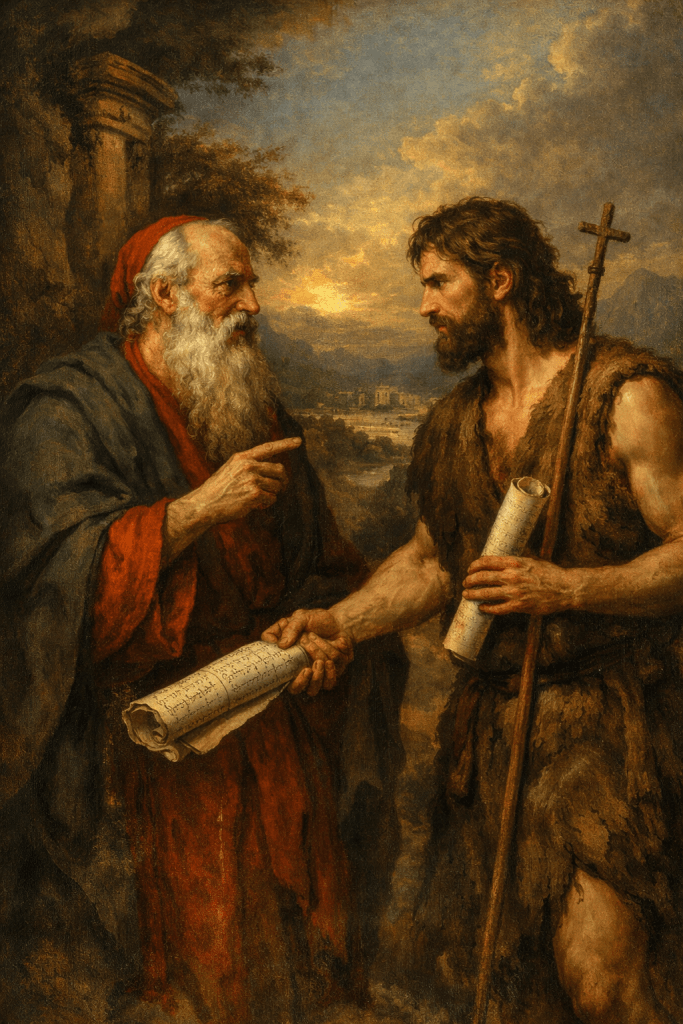
The space between Book of Malachi and John the Baptist is often called the 400 years of silence. That phrase is tidy—and misleading. Nothing about those centuries was empty. Empires rose and fell. Languages fused. Roads were laid. Synagogues multiplied. Expectations hardened. What fell silent was not history, but prophecy.
Malachi speaks at the far edge of the Old Testament, when the temple stands again but the heart has not returned with it. He diagnoses a subtler sickness than idolatry: weariness with God. Worship continues, but reverence has thinned. Obedience is procedural. Faith has become a habit rather than a hope. Malachi does not end with comfort. He ends with a hinge: remember the Law—and watch for the messenger. The sentence is left open on purpose.
Then the voice stops.
Four centuries pass. No canonical prophet stands up to finish Malachi’s thought. Instead, the world is quietly prepared. Persia yields to Greece; Greece yields to Rome. Greek becomes the common tongue; Roman roads knit the Mediterranean into a single nervous system. Israel learns to survive without a king, without a prophet, without obvious rescue. Scripture is read aloud in synagogues; law is studied; expectation migrates from repentance to anticipation. Judgment, many hope, will fall on others.
Into that long, loaded quiet steps a man in the wilderness.
John the Baptist does not sound new. That is the shock. He sounds ancient—abrasive, urgent, unmistakably prophetic. He does not flatter the faithful or soothe the powerful. He says what Malachi warned would need saying again: turn. Repentance first. Preparation before presence. The wilderness becomes the pulpit because the temple has grown too comfortable to hear.
To see the bridge clearly, imagine the handoff—not as a meeting in time, but as an exchange across it.
At the edge of silence, Malachi stands with the last word he was allowed to speak. Across the centuries, a voice gathers breath.
Malachi: I left the door open because it could not be closed with ink.
John: Then I will stand in the dust and finish the sentence.
Malachi: They mistook patience for absence.
John: Then I will tell them the waiting is over.
Malachi: I warned them the Lord would come suddenly.
John: And I will tell them to prepare—now.
Malachi: Fire is coming.
John: Then let it begin with cleansing.
The conversation is imagined, but the continuity is real. John does not introduce a new agenda; he reopens an unfinished one. Malachi promised a messenger “in the spirit of Elijah.” John arrives wearing that spirit plainly—unpolished, unafraid, uninterested in approval. He is not the destination; he is the threshold. His success will be measured by his disappearance.
And then comes the One John points to—Jesus Christ—the Lord Malachi said would come to His temple. Suddenly. Searching. Refining. The bridge does not end with John; it delivers history into its next act.
The genius of the 400-year handoff is that it reveals how God works when people stop listening. He does not shout louder. He prepares longer. When prophecy pauses, formation continues. When words cease, conditions ripen. The silence is not abandonment; it is orchestration.
Malachi closes the Old Testament facing backward and forward at once—anchored in Moses, aimed toward a messenger. John opens the New Testament doing the same—rooted in the prophets, pointing beyond himself. Between them stretches not a void, but a runway.
The handoff succeeds because it was never about eloquence or timing alone. It was about readiness. When John cries out, some hearts break instead of bristle. A remnant responds. The bridge holds.
And that is the quiet miracle of the 400 years: when the voice finally returns, it finds ears—scarce, imperfect, but ready enough for history to move again.
Who Wrote Book of Malachi if Not “Malachi”?
The short answer is: we don’t know—and many theologians think that’s intentional.
The longer answer is that scholars have proposed a few serious, restrained possibilities, none of which undermine the book’s authority or clarity.
The Main Scholarly Views
1. An Anonymous Prophet (“My Messenger” as a Title)
This is the majority scholarly position.
- Malachi means “my messenger”
- The book opens: “The oracle of the word of the Lord… by my messenger”
- The prophet never gives a personal name, genealogy, or origin (unusual for prophets)
Many theologians believe Malachi functions more like:
- “The Oracle according to the Messenger”
- or “The Message of the Lord, delivered by His messenger”
In this view, the prophet deliberately recedes so the focus stays on:
- God’s covenant lawsuit
- the coming future messenger
- the message rather than the man
This fits the book’s tone perfectly.
2. A Temple-Affiliated Prophet (Post-Exilic Reformer)
Another common view is that the author was:
- a known but unnamed prophetic figure
- closely tied to the Second Temple
- likely contemporary with Ezra and Nehemiah
The issues Malachi addresses—
corrupt priests, improper sacrifices, divorce, tithes—
line up almost exactly with the reforms described in Nehemiah 13.
Because of this overlap, scholars often say:
Malachi sounds like the prophetic voice behind Nehemiah’s reforms.
Not the governor. Not the scribe.
But the conscience pressing them.
3. A Prophetic “School” or Editorial Tradition (Minor View)
A smaller group of scholars suggest the book may reflect:
- a prophetic circle or school
- preserving and shaping the message of a known preacher
- similar to how some Psalms or wisdom texts developed
This view explains:
- the tight structure
- the disputation style (God speaks → people object → God answers)
- the lack of personal narrative
But even here, scholars agree the book reflects a single coherent prophetic voice, not a patchwork.
Who It Is Probably Not
- Not Ezra himself (different role, different literary style)
- Not Nehemiah (administrator, not prophet)
- Not a later Hellenistic editor (language and theology are firmly Persian-period)
Why the Anonymity May Be the Point
Malachi is the last prophetic voice before centuries of silence.
Ending the Old Testament with:
- an unnamed messenger
- promising another messenger
- pointing beyond himself
is almost certainly deliberate.
The book says, in effect:
Do not look for the prophet.
Look for the One he points to.
That makes Malachi less a signature and more a signpost.
In One Clear Sentence
Most theologians believe the Book of Malachi was written by an anonymous post-exilic prophet, likely connected to the temple reforms of Ezra and Nehemiah, with “Malachi” serving as a theological title—“my messenger”—rather than a personal name, fitting for the final prophetic voice before John the Baptist.
It’s a quiet ending—on purpose.
 Let's Talk About It, Lewis!