A collaboration between Lewis McLain & AI
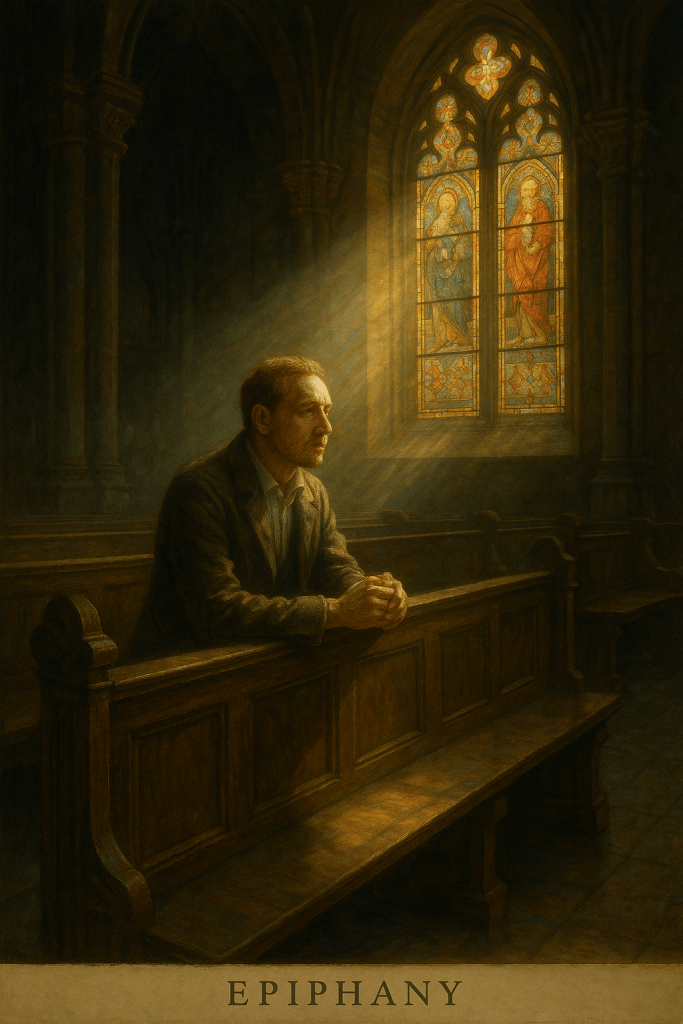
It began with the sound of rain.
Not the violent kind that rattles windows and demands attention, but the kind that seems to think—pausing, resuming, whispering to itself. The rain had followed him down the street and into the old stone church, where it softened into echoes and silence.
He had not planned to stay. The church was only a shortcut between the office and the parking lot, a dry passage through a wet afternoon. But something slowed him. He found himself in the back pew, coat still damp, listening to the hush settle around him as the last of the lights were switched off one row at a time.
The nave held the faint scent of incense and old stone—memory suspended in air. In the stillness, he could feel his own breathing again, and beneath it the steady, stubborn rhythm of his heart, like a clock that had kept time through disappointment without ever being consulted.
The week had been heavy in ways that never show up on calendars or balance sheets. A conversation delayed too long. A letter unopened on the kitchen table. A friendship fractured not by malice but by neglect. He had lived lately by screens and schedules, moving efficiently while drifting inwardly, performing life rather than inhabiting it.
When the rain began earlier that afternoon, it felt as though the world had decided to mourn first.
He looked toward the altar. It was plain—no ornament, no spectacle. A linen cloth folded with care. Above it, a wooden cross, worn smooth by time and eyes. The figure upon it was neither triumphant nor dramatic. It looked tired. Human.
In that weariness, he recognized something familiar.
Lightning flared suddenly through the stained glass, flooding the nave with color for a heartbeat—reds and blues and golds briefly made whole. In that instant, he noticed a woman kneeling several pews ahead of him.
She hadn’t been there before. Or perhaps she had, and he had not been ready to see her.
She wasn’t praying with folded hands but with palms open, resting lightly on her knees, as though offering something invisible. When the light faded and the thunder rolled, she did not move.
The storm continued its rhythm, and the building seemed to breathe with it: thunder, pause, rain, silence.
A word surfaced in his mind—epiphany. A word he remembered from long ago, defined as a sudden revelation, a moment when something hidden becomes visible. A manifestation. An appearing.
For the first time in years, he wondered whether such moments still happened—not in Scripture or spectacle, but quietly, woven into ordinary time.
He closed his eyes.
The air smelled of damp stone and candle wax. Images rose without invitation: his father’s laughter, the sterile light of a hospital room, the way a lake turned silver just before sunset. A stranger’s voice from years ago, saying, You look like someone still searching.
His life felt layered, translucent, as though meaning had always been present but partially obscured. One layer lifted, then another—not by effort, but by grace.
When he opened his eyes, the woman was gone.
Only her umbrella leaned against the front pew.
He stood and walked forward, intending to return it if she was still nearby. As he approached, something inside him loosened—a knot he hadn’t known how to name. The familiar tension between doing and being, between guilt and mercy, softened.
The umbrella was patterned with constellations. When he lifted it, droplets slid across the fabric like falling stars.
Outside, the storm had broken.
The air was sharp with ozone and freshness. Streetlights shimmered on wet pavement. Cars hissed past, ordinary and miraculous at once. Across the street, a diner sign flickered OPEN—half the letters burned out, yet unmistakable.
He laughed quietly. Even broken, it told the truth.
Inside, the waitress poured him coffee without asking. The woman from the church sat near the window, stirring her tea. She glanced up, smiled faintly, and nodded.
No words passed between them. None were required.
He sipped the coffee. The city hummed like an organ warming up. Outside, clouds thinned, and the first ribbon of sunrise touched the street. It caught the rim of his cup, the chrome of the jukebox, and the tear he hadn’t noticed had fallen.
Everything aligned—not as an explanation, but as a recognition.
The rain. The church. The cross. The lightning. The diner’s broken sign.
Not revelation in thunder. Not truth carved in stone.
Just the world, quietly saying: I am here.
When he left the diner, he didn’t take the umbrella.
He wanted to feel the light on his face.
The city resumed its noise—engines, voices, footsteps. Nothing had changed, and yet everything had. He carried no answers, no resolutions, no plans—only a stillness, warm and steady, glowing just behind his ribs.
He was no longer alone in the silence.
As he turned the corner, he thought again of the woman and the umbrella left behind.
Why hadn’t he given it back?
The question rose naturally, as it might in the reader’s own mind.
Perhaps because she hadn’t truly forgotten it.
Perhaps because some gifts aren’t meant to be returned.
The umbrella had done its work—a small constellation pointing toward a larger one, a reminder that revelation often leaves something behind.
Something you don’t need to keep
in order to remember.
Epilogue
Epiphany is a word that means “to appear.”
But perhaps its truer meaning is this:
to notice.
For the divine has always been appearing. The shepherds came to see the Baby.
It is we who, at last, learn to look.
 Let's Talk About It, Lewis!