A collaboration between Lewis McLain & AI
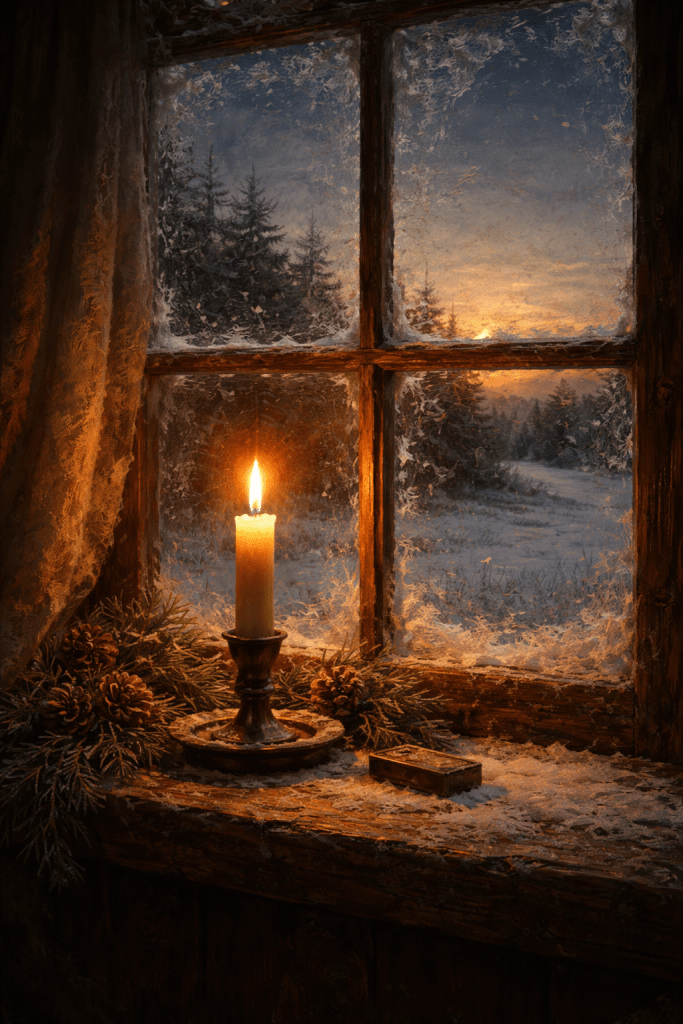
The winter solstice arrives quietly.
No fireworks. No countdown. No resolution list.
Just a long night—and then, almost imperceptibly, a turning.
The word solstice means the sun stands still. For a brief moment, the arc halts. The shortening days stop shortening. The light does not yet surge forward, but it no longer retreats. Civilizations across time noticed this pause and marked it—not because everything changed, but because nothing changed yet.
That detail matters.
We are accustomed to beginnings that announce themselves loudly. The solstice does not. It asks something rarer: attention.
The Gift of Limits
The shortest day of the year teaches a truth modern life resists: limits are not a malfunction. They are a design feature.
There is a boundary to daylight. A boundary to growth. A boundary to effort. Nature does not apologize for this. Winter does not rush to justify itself. It simply arrives and says, This is enough for now.
In economic life, we speak endlessly of expansion. In personal life, of optimization. In civic life, of acceleration. The solstice offers a counter-lesson: what makes renewal possible is not infinite motion, but a pause within a cycle.
Scarcity is not the enemy of meaning. Properly understood, it creates it.
Why Humanity Always Marked This Day
Long before electric light erased the night, people watched the sky closely. They aligned stones, carved calendars, rang bells, and lit fires—not out of superstition alone, but out of wisdom.
They understood that if the darkness kept deepening forever, it would mean the end. The solstice was proof that the world was still ordered, still held, still governed by rhythms larger than fear.
Marking the solstice was not about conquering winter. It was about surviving it together.
Modern life, insulated from seasons, rarely pauses. Production cycles ignore daylight. Notifications arrive at midnight. Yet anxiety rises—not falls—when we erase limits. We were not made for endless summer.
The Long Night Before the Turn
The solstice is not the return of light. It is the end of its retreat.
That distinction mirrors much of human experience. Often the most difficult moment is not when things are visibly worsening—but when nothing appears to be improving yet. The long night lingers. The cold remains. The evidence of change is microscopic.
Faith, endurance, and patience are forged here—not in visible victory, but in holding steady at the lowest point.
Many give up precisely when the arc has already turned.
Darkness Is Not the Enemy
We speak of darkness as if it were synonymous with evil or emptiness. Yet biologically, psychologically, and spiritually, darkness is where formation happens.
Seeds germinate underground. Muscles rebuild at rest. Insight arrives in silence. Grief, properly endured, deepens compassion. Winter does not kill life—it stores it.
The problem is not darkness itself, but the fear that it will never end.
The solstice addresses that fear directly: this darkness is real, but it is not final.
The Courage to Stand Still
To stand still is harder than it sounds.
Stillness exposes unanswered questions. It removes distraction. It asks us to take inventory—of work, of habits, of relationships, of motives. That is why we prefer motion. Motion feels like progress, even when it isn’t.
The solstice models a different discipline: intentional pause.
Not resignation. Not retreat. But attentiveness.
Before movement resumes, direction must be clarified.
Light Returns Slowly—And That Is the Point
After the solstice, daylight increases by seconds. Then minutes. You cannot feel it day to day. Only over time does the difference become undeniable.
This is how real change happens—personally, institutionally, culturally. Quietly. Incrementally. Without applause.
We live in an age impatient with slow improvement. But the solstice reminds us that enduring change does not announce itself; it accumulates.
The arc does not need encouragement. It only needs time.
Why a Candle Is Enough
On the longest night, humanity did not wait for dawn. It lit candles.
A single flame does not defeat darkness. But it testifies that darkness has not defeated us.
This is the moral heart of the solstice: small faithfulness matters. Modest goodness counts. One steady light—kept, protected, passed along—outlasts vast darkness that burns itself out.
Leadership, parenting, citizenship, belief: none require blinding brilliance. They require presence.
Solstice vs. Resolutions
The modern New Year demands reinvention on command. The solstice invites preparation instead.
One says, Change now.
The other says, Pay attention first.
One relies on willpower.
The other on wisdom.
The solstice does not ask what you will become tomorrow. It asks what you will carry through winter so that growth, when it comes, is sustainable.
The Day That Teaches Us How to Wait
The sun stands still only briefly. Soon, motion resumes. But the pause matters because it reminds us that movement without meaning is drift, and growth without rest is collapse.
The winter solstice is not a celebration of darkness. It is an affirmation of order. Of rhythm. Of trust that light returns—not because we force it, but because it is woven into the design of things.
The longest night is survivable.
The turning has already begun.
And sometimes, standing still is the bravest thing we can do.
And we give thanks to God, author of the universe, marvelous designer. More than just one more rotation of this planet around the sun upon which we stand in awe.
 Let's Talk About It, Lewis!