A collaboration between Lewis McLain & AI
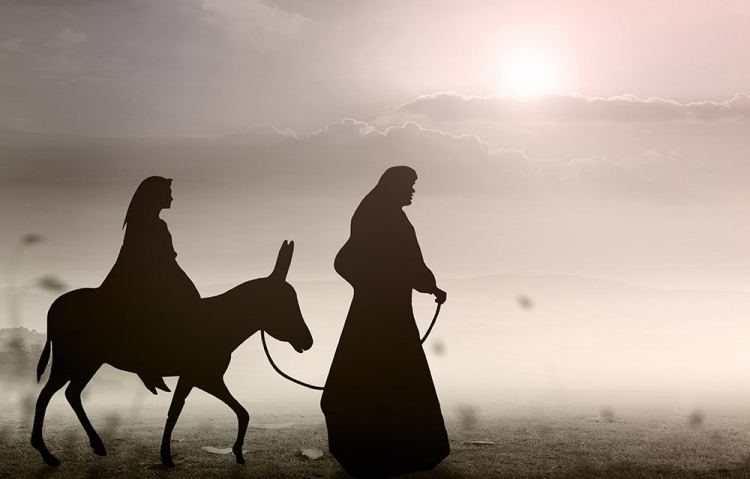
According to Luke 2:1–5, the Roman emperor Caesar Augustus ordered a census of the empire. Each person had to register in his ancestral town.
- Joseph, a descendant of King David, was required to go to Bethlehem, the city of David.
- He traveled from Nazareth in Galilee to Bethlehem in Judea.
- Mary, who was betrothed to Joseph and pregnant, went with him.
This was not a leisure trip—it was likely a difficult journey of roughly 70–90 miles, taken on foot or with a donkey, while Mary was late in her pregnancy.
Their Social and Personal Circumstances
At this time:
- Mary had already received the angel Gabriel’s announcement that she would bear the Son of God (Luke 1).
- Joseph had accepted Mary as his wife after an angel reassured him that the child was from the Holy Spirit (Matthew 1).
- They were obedient but socially vulnerable—a young couple under suspicion, traveling under imperial command, with limited resources.
What They Were Not Doing
They were not:
- Looking for a place for the baby to be born
- Expecting a royal reception
- Fully aware of how world-changing the moment was
They were simply complying with the law, trusting God one step at a time.
Theological Significance
Their journey fulfilled prophecy:
- Micah 5:2 foretold that the Messiah would be born in Bethlehem.
- God used a pagan emperor’s decree to move two faithful people exactly where they needed to be—at exactly the right time.
In Short
Before Jesus was born:
- Joseph and Mary were traveling under compulsion
- Trusting God without knowing the outcome
- Living ordinary, obedient lives—while history quietly turned
On the Road to Bethlehem
A reflective imagining rooted in Scripture
The road south was older than either of them—packed earth, stone, and dust pressed flat by generations who had walked before. Joseph knew the way by memory, by instinct, by the way the hills leaned and the stars corrected him at night. Mary followed at his side, sometimes on the animal, sometimes walking, her hand resting where the child moved.
They did not speak much at first.
Silence had become familiar since the angelic visitations—first hers, then his. Silence was safer. Words had a way of tumbling out and sounding either too small or too large for what God had done.
Joseph broke it eventually.
“Are you warm enough?” he asked, not looking at her, already knowing the answer and asking anyway.
Mary smiled. “I am. And He is restless tonight.”
Joseph nodded. He had learned to listen for that—her pauses, her breath, the way she said He now, not the child. Each time it startled him anew.
Joseph’s Thoughts
Joseph walked slightly ahead, as if the road were something he could shield her from. His mind moved constantly between duty and mystery.
He thought about the census—how Rome could compel a carpenter from Nazareth to walk days simply to be counted. He resented it, then caught himself. The angel had said David’s son. Bethlehem was David’s city. God had not needed Rome, but He had used it.
That troubled Joseph in a quiet way.
If God could use Caesar without Caesar knowing it, what else was God using? The dust? The fatigue? The whispers back home?
Joseph wondered if obedience always felt this fragile—like doing the next right thing while the ground shifted beneath your feet.
He also worried. About Mary. About finding shelter. About whether he would fail at the very moment history would remember forever.
Mostly, he wondered what kind of father he could possibly be to a child who did not truly belong to him—and yet had been entrusted to him.
Mary’s Thoughts
Mary, for her part, thought often of Elizabeth, and of the words she had spoken months earlier: “Blessed is she who has believed that the Lord would fulfill His promises to her.”
Belief, Mary had learned, was not a feeling. It was a posture.
She remembered Gabriel’s voice—not loud, not theatrical, but firm, like something that had always been true and had finally been spoken aloud. “The Lord is with you.”
She held that sentence like a stone in her pocket.
Mary felt the weight of the child and the weight of what no one could see. She wondered how the Holy One could be so near, pressing against her ribs, interrupting her sleep, making ordinary hunger and discomfort part of salvation.
She wondered if Joseph ever feared her silence meant doubt.
It did not.
Her silence meant awe.
What They Spoke About
When they did speak, it was ordinary.
“How much farther?”
“Not far now.”
“We’ll need water by morning.”
“I’ll find some.”
And then, sometimes, unexpectedly:
“Joseph,” Mary said once, as they rested under a sky scattered with stars, “do you think He knows where we are going?”
Joseph answered slowly. “I think He chose it.”
They sat with that.
Another night, Joseph said, almost to himself, “The prophets spoke of kings and deliverers. They never mentioned tired feet.”
Mary laughed softly. “Maybe they didn’t know how God likes to arrive.”
Fear, Faith, and the Unknown
They both feared the same thing but named it differently.
Joseph feared not being enough.
Mary feared being misunderstood.
Yet both trusted the same God.
They trusted Him with each step that did not yet explain itself. They trusted Him with a future that had been announced but not described. They trusted Him with a birth that would happen wherever the road ended.
Neither of them imagined angels filling the sky. Neither imagined shepherds. Neither imagined a story retold for centuries.
They imagined shelter. Warmth. A safe delivery.
God imagined redemption.
When Bethlehem Appeared
When the outline of Bethlehem finally rose ahead of them—small, unimpressive, crowded—Joseph felt relief and dread at once.
Mary felt peace.
This, she sensed, was the last stretch of walking. After this, something irrevocable would happen.
History had been moving toward this town without anyone noticing.
Rome thought it was counting citizens.
Joseph thought he was fulfilling an obligation.
Mary knew—somehow—that heaven was about to touch earth quietly.
And so they entered Bethlehem as they had traveled:
Tired. Obedient. Faithful.
Unaware that the road behind them would soon be remembered as the path by which God kept His promise—one careful step at a time.

 Let's Talk About It, Lewis!