A collaboration between Lewis McLain & AI
Editor’s Note / What Prompted This Essay
In a recent Free Press article, Nikki Haley argues that China is not waiting for a future war with the United States but is already engaged in a long-term, strategic campaign designed to weaken America without firing a shot. Rather than tanks or missiles, the tools are economic leverage, technological dependence, information manipulation, and political pressure—applied patiently over time to erode American confidence, unity, and resolve. The article’s most provocative insight is that Americans tend to think of war only as something declared and visible, while adversaries like China think in terms of psychological advantage, influence, and internal fracture.
That framing raised a deeper question to me: if the most effective way to weaken a democracy is to turn its citizens against one another, how vulnerable is the United States to hatred, distrust, and internal division—and what responsibility do citizens themselves bear in resisting it? Lastly, does this provide insight into events happening in our own back yard?
When the Enemy Wants You to Hate Your Neighbor
How Foreign Adversaries Exploit Division to Weaken American Institutions
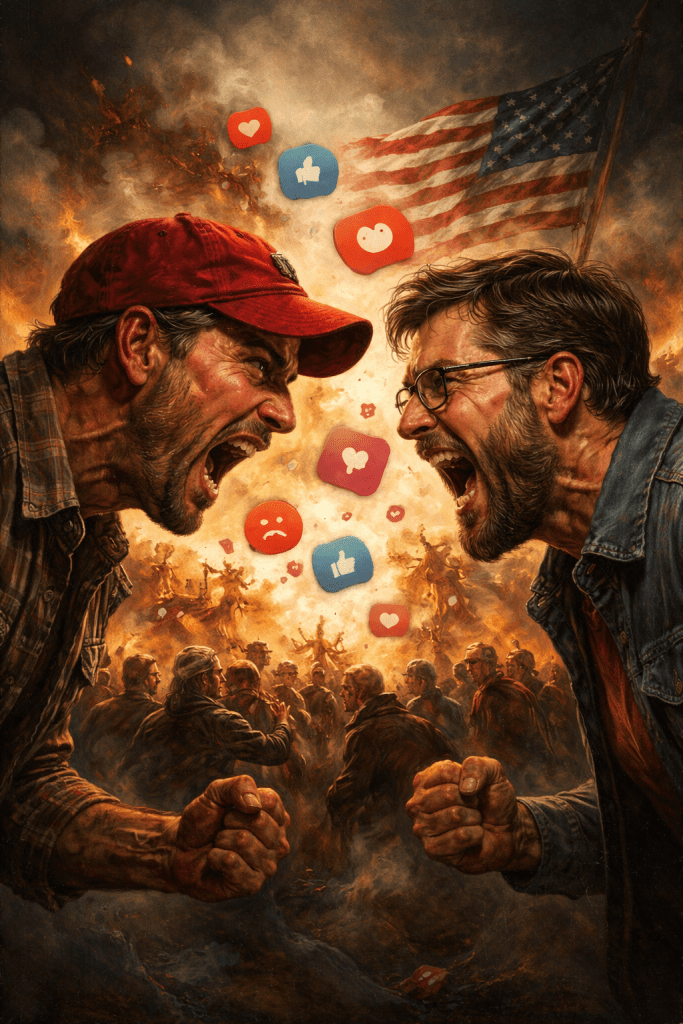
Introduction: The War That Doesn’t Look Like a War
For most of American history, threats to national security arrived in visible forms: armies, missiles, uniforms, borders crossed. Today, the most dangerous threats often arrive silently—through phones, feeds, narratives, and emotions. Even through blogs like mine.
China, along with other foreign adversaries, does not need to defeat the United States on the battlefield to weaken it. A far cheaper and safer strategy exists: encourage Americans to distrust one another, despise their institutions, and lose faith in the idea that shared rules and shared facts can still bind a diverse society together.
This is not a conspiracy theory, nor is it uniquely Chinese. It is a well-documented form of modern statecraft often called information warfare, influence operations, or gray-zone conflict—competition deliberately kept below the threshold of open war.
The danger is not that Americans will suddenly become loyal to a foreign power. The danger is that Americans will begin to see each other as enemies, and their own institutions as illegitimate. When that happens, a society weakens itself from the inside.
The Strategic Objective: Fracture, Don’t Conquer
Foreign adversaries pursuing this strategy are not trying to persuade Americans of a single ideology. Their objective is simpler and more corrosive:
- Reduce trust in elections
- Reduce trust in courts and law enforcement
- Reduce trust in journalism and expertise
- Reduce trust in fellow citizens’ good faith
A divided society expends enormous energy fighting itself. It becomes harder to govern, slower to respond to crises, and more vulnerable to paralysis or authoritarian temptation.
Importantly, this strategy does not require creating new grievances. It relies on identifying existing ones—racial tensions, economic inequality, cultural change, immigration, crime, public health, religion—and amplifying them until compromise feels immoral and disagreement feels existential.
How Influence Operations Actually Work
Amplification, Not Invention
Foreign actors rarely invent American problems. They amplify real ones.
If a topic already produces anger, resentment, or fear, it is useful. If it already divides Americans into camps, it is valuable. The operation succeeds when people believe:
“My opponents are not merely wrong — they are dangerous.”
“Both-Sides” Escalation
One of the most misunderstood aspects of modern influence operations is that opposing sides are often targeted simultaneously.
One group is fed content that reinforces grievance, victimhood, or moral urgency.
The opposing group is fed content that reinforces fear, resentment, or betrayal.
Each side becomes proof of the other side’s worst assumptions.
The goal is not ideological victory. The goal is maximum polarization.
Emotional Manipulation Over Persuasion
Facts matter less than feelings.
Content that spreads fastest tends to trigger anger, fear, humiliation, and moral outrage. Foreign influence campaigns exploit this reality. They do not aim to win debates; they aim to trigger reactions. Once emotion dominates, people share and escalate on behalf of the adversary—often unknowingly.
Erosion of the Referees
A healthy democracy depends on referees: election administrators, courts, professional journalism, and scientific expertise.
Foreign adversaries benefit when Americans believe all referees are corrupt or illegitimate. Once people conclude that elections are rigged, courts are political weapons, media lies by definition, and experts are propagandists, no outcome is accepted as fair. Only power remains.
Digital Architecture as a Force Multiplier
Modern platforms unintentionally reward the very behaviors foreign adversaries exploit. Outrage spreads faster than explanation. Certainty spreads faster than humility. Identity signaling spreads faster than evidence.
Foreign actors do not need to control these systems. They study them, learn what triggers Americans, and inject content accordingly.
Why the United States Is Especially Vulnerable
America’s greatest strengths—free expression, pluralism, open debate—also create vulnerability. Democracies must tolerate disagreement without letting it metastasize into hatred.
Foreign influence operations succeed only where fractures already exist. This leads to an uncomfortable truth: foreign adversaries do not create American divisions; they accelerate them.
As shared reality erodes, persuasion collapses. Only mobilization remains.
What “Success” Looks Like for the Adversary
Foreign influence is succeeding when:
- Bad faith becomes the default assumption
- Moderates withdraw from public discourse
- Institutions lose legitimacy permanently
- Violence begins to feel understandable
None of this requires a single decisive moment. It unfolds gradually through normalization.
What Actually Works as Defense
Broad censorship does not work. Government-decided “truth” does not work. Suppressing dissent backfires.
What works is resilience.
At the citizen level: pause before sharing, question emotional manipulation, distinguish outrage from importance, and practice restating opposing arguments fairly.
At the community level: real relationships, churches, civic groups, and local institutions reduce radicalization.
At the institutional level: transparency, humility, and consistent rule-following rebuild trust.
At the government level: exposing foreign operations, protecting elections, improving transparency, and investing in civic education—without policing viewpoints.
The Hard Truth
Foreign adversaries can encourage Americans to hate one another. They cannot force it.
They succeed only when Americans abandon restraint, humility, and shared rules.
A society capable of disagreement without dehumanization is extraordinarily difficult to destabilize.
Conclusion: The Strongest Defense Is Civic Character
The greatest threat to the United States today is not a foreign army crossing a border. It is the slow erosion of trust that makes self-government impossible.
China and other adversaries understand this. They study American psychology and culture not to convert Americans, but to divide them.
A republic survives not because it agrees, but because it argues without hatred.
Appendix A

A Christian Perspective on Division, Hatred, and the Subtle Work of the Enemy
Why a Christian Appendix Belongs Here
For Christians, the idea that an “enemy” seeks to divide people against one another is not metaphorical. It is foundational theology.
Scripture does not portray evil primarily as chaos or madness, but as order bent just enough to destroy love, trust, and truth. The Christian understanding of spiritual opposition is not that it invents sin from nothing, but that it twists what already exists—fear into hatred, conviction into self-righteousness, disagreement into contempt.
This appendix is not an attempt to spiritualize geopolitics. It is an acknowledgment that moral and spiritual realities operate alongside political ones, and that Christians, in particular, are warned repeatedly about becoming instruments of division while believing themselves righteous. Spiritual Warfare is as real to the Christian as military war games are to field commanders.
The Enemy’s Oldest Strategy: Divide and Accuse
In the Christian tradition, Satan is not merely a tempter but an accuser.
He accuses God to humanity.
He accuses humanity to God.
He accuses neighbor to neighbor.
Division is not collateral damage; it is the goal.
Jesus himself names this dynamic:
“Every kingdom divided against itself will be ruined, and every city or household divided against itself will not stand.”
(Matthew 12:25)
The warning is not about foreign invasion. It is about internal fracture.
Screwtape’s Lesson: Evil Prefers Gradual Corrosion
C. S. Lewis’s The Screwtape Letters reveals that evil is most effective when it is subtle.
The senior devil does not urge spectacular sin. He urges irritation, distraction, self-justification, and contempt disguised as clarity.
Scripture warns:
“If I have all knowledge, but have not love, I am nothing.”
(1 Corinthians 13:2)
Conviction without love multiplies evil rather than defeating it.
The Weekend That Gave Birth to Screwtape
In July 1940, Lewis listened to Adolf Hitler speak on the radio. He later admitted how unsettlingly persuasive the speech felt—not because he believed it, but because he sensed how easily emotion could be moved even against reason.
The next day, sitting in church, Lewis conceived the idea of a book: letters from a senior devil to a junior devil advising how to misguide a Christian. He first called it As One Devil to Another.
That book became The Screwtape Letters.
Lewis understood that evil rarely presents itself as evil. It presents itself as reasonable, urgent, and justified. It borrows the language of virtue while hollowing it out.
The Enemy does not need believers to abandon truth. He only needs them to abandon love while wielding truth as a weapon.
When Moral Certainty Becomes a Spiritual Trap
Christians are especially vulnerable to confusing righteousness with being right.
Jesus’ harshest rebukes were aimed not at pagans but at the religiously certain:
“You strain out a gnat but swallow a camel.”
(Matthew 23)
When disagreement feels like an attack on the soul, hatred begins to feel holy.
The Subtle Corruption of Truth
Christian theology teaches that Satan distorts truth rather than simply lying:
“Even Satan disguises himself as an angel of light.”
(2 Corinthians 11:14)
True facts can be arranged to deceive. Real injustices can be framed to inflame. Truth without love becomes a tool of destruction.
Loving One’s Neighbor as National Security
If foreign adversaries benefit when Americans hate each other, then love of neighbor is not merely spiritual virtue—it is civic resilience.
“Love your neighbor as yourself.”
(Matthew 22:39)
A society that refuses to dehumanize opponents is extraordinarily hard to fracture.
The Christian’s Temptation
“What does it profit a man to gain the whole world and forfeit his soul?”
(Mark 8:36)
Winning political battles by adopting the Enemy’s methods means the Enemy has already won.
A Rule of Discernment
Does this message move me toward love of neighbor—or toward contempt disguised as righteousness?
If the latter, it should be resisted.
“The anger of man does not produce the righteousness of God.”
(James 1:20)
Final Christian Reflection
Foreign adversaries may exploit division, but they are not the deepest threat.
The deeper threat is that believers, convinced they are fighting evil, may unknowingly serve it.
The Enemy does not require Christians to abandon their faith.
He only needs them to forget its hardest commands.
Go love your neighbor!
 Let's Talk About It, Lewis!