A collaboration between Lewis McLain & AI
How Music Becomes the Memory, Meaning, and Map of Who We Are
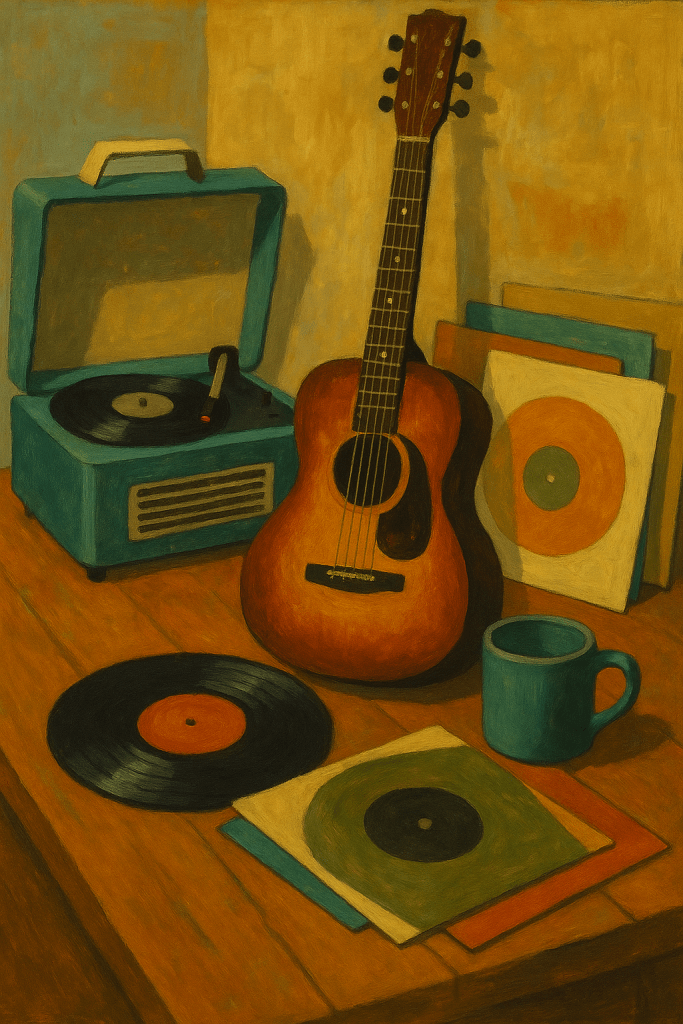
Linda and I met in the first week of college when we were only 18. To this day, we can hear a song and instantly recall when we first heard it. Some evenings we will call up a concert we have saved on DirecTV. Linda knows precisely where to fast-forward so we can listen to a favorite. So, the topic of this essay is very close to our hearts.
Most of the time we assume music is something we listen to — a pleasant accessory to the tasks and routines of the day. But if you pay attention, music is more like a hidden autobiography, quietly recording your inner life long before you are aware that a story is being written. The songs you return to, the ones that startle you when they play unexpectedly, the rare few that undo you in the quiet of a car or a grocery aisle — these are not just sound. They are memory in motion. They are identity with a rhythm.
Music does not simply accompany life; it arranges it. What memory loses, music preserves. What time distorts, music restores. And what emotion cannot articulate, music gives shape to with uncanny accuracy.
To understand this is to understand something profound about what it means to be human.
I. Music and the Mind’s First Language
Long before a child has words, they have rhythm. Infants calm at the steady cadence of a lullaby and recognize the pattern of a familiar voice long before understanding vocabulary. This is because the brain does not treat music as entertainment; it treats it as structure — a patterned, predictable, emotionally charged signal that is perfectly engineered for memory.
But music does something even deeper: it bypasses the intellectual filters adults use to sanitize emotion. A melody goes straight to the limbic system, sparking feelings before thought. That is why a song can make you cry before you even remember its meaning. The brain is reacting not to the information in the song, but to its emotional imprint.
Music, in this sense, is the first language of the inner life — the way feeling precedes understanding.
II. The Way Music Stores Time
Most memories fade, and many blur into general impressions. But not the memories attached to certain songs. These remain startlingly specific — not because the events were necessarily remarkable, but because music sealed them in.
What is remarkable is how effortless this process is. You do not choose to remember your first heartbreak through a particular ballad, or a college summer through a song that filled your roommate’s car. You do not choose the hymn that makes your throat tighten at a funeral, or the chorus that instantly brings back the living room of your childhood home. Music chooses for you.
There is something mysterious about the mind’s insistence on tethering emotion to sound. A song becomes a kind of timestamp. It gives the memory a fixed point in the otherwise loose fabric of time, and when the melody returns, the memory returns with it — intact, immediate, almost shockingly alive.
We often say a song “takes us back,” but the deeper truth is that the song allows the past to take hold of us again.
III. Music as Emotional Truth
There are emotions you can explain and emotions you can only feel. Music specializes in the latter. A melody can carry a complexity no sentence can hold. Consider the strange, tender ache of nostalgia — how a song can make you long for a life you no longer live or even one you never lived at all. Or consider the way a joyful song can suddenly reveal a sorrow you didn’t realize was sitting under the surface.
Music tells the truth of emotion without asking permission.
This is why people instinctively turn to it during grief, celebration, transition, or uncertainty. It steadies the self by restoring emotional coherence. In moments when language fails — when a prayer is wordless, when a loss is fresh, when a change is too large to understand — music becomes a way of anchoring the heart long enough for meaning to catch up.
IV. Why Some Songs Become Too Heavy to Carry
Everyone has songs they avoid — not because they dislike them, but because they are too full. A melody can carry the weight of a relationship, a season, or a dream that has since dissolved. Some songs hurt because they still tell the truth about who you were and who you loved, and the distance between then and now becomes too pronounced to bear.
But even these difficult songs serve a purpose. They remind us that the deepest chapters of our lives are rarely tidy. Music preserves the emotional residue of experiences that shaped us, even when we’d prefer to move on. The song remembers us more honestly than we sometimes remember ourselves.
And that honesty, however painful, is a form of reverence for what mattered.
V. Music as a Spiritual Technology
Even people who claim no religious belief often describe music in spiritual terms. It elevates, unites, quiets, or stirs the human spirit in ways that resemble prayer. Religious traditions have always understood this. Faith communities sing not because they need background noise, but because music allows meaning to move through people collectively, bypassing the intellectual hesitation that often dilutes belief.
A sung truth is felt before it is understood — and therefore becomes more deeply held.
Music is not a doctrine, but it delivers feeling with the force of revelation. It makes the invisible inner life audible.
VI. The Older We Grow, the More Our Soundtrack Solidifies
There is a moment in adulthood when you realize new music no longer imprints the way it once did. Songs still move you, but they do not become part of your inner architecture the way earlier ones did. Neurobiologists confirm this: the teenage and young adult years are when the brain is most porous to musical encoding, which is why those songs remain disproportionately powerful decades later.
By middle age, the soundtrack of your life is largely complete, and new music becomes something enjoyed but not absorbed. This is why older adults return to the songs they loved when they were young — not for nostalgia alone, but because those songs contain the memory of a self that time cannot fully dissolve.
Music becomes a way of maintaining continuity across the changing seasons of one’s identity.
VII. The Soundtrack We Become for Others
Most people think of their personal soundtrack as something private — the way certain songs follow them through life. What they often forget is that they have also become part of someone else’s soundtrack.
The lullaby you hummed.
The song you danced to at a wedding.
The hymn you sang beside a friend in a difficult season.
The album you played on a long drive with your child.
The record your mother played while cleaning the house.
Music is how we inhabit each other’s memories.
We rarely know which musical moments attach to the people we love. Years later, long after you’re gone, someone may hear a familiar song and be struck by a sudden, tender ache — not because of the music itself, but because it summoned your presence back into the room.
Music is one of the few ways we outlive ourselves without trying.
VIII. The Soundtrack as a Hidden Biography
A person’s life story includes far more than events.
It includes the emotional texture of those events — the inner landscape where meaning took shape. Music is the most faithful curator of that landscape.
If you were to line up the songs that have moved you most deeply, you could trace the entire shape of your life:
- When you felt safe
- When you felt lost
- When you fell in love
- When you learned resilience
- When you dreamed big
- When you let go
- When you grieved
- When you healed
Music is not a chronicle of facts.
It is a narrative of feeling — a record of who you became in the moments that mattered.
And because we never know which moments will matter most, the soundtrack evolves without our consent, revealing its meaning only in hindsight.
Conclusion: Listening Backward, Living Forward
Life changes, but the soundtrack remains.
We grow older, but the songs stay young.
We become different people, but music reintroduces us to every version we’ve ever been.
In the end, the soundtrack of your life is not merely a collection of songs. It is a map — a quiet, sensitive cartography of memory, identity, loss, love, change, and meaning. It tells the truth about you in ways you may not know how to express in words.
And the greatest mystery of all is this:
You did not choose most of it.
It chose you — and in doing so, it carried pieces of your life forward that time alone could never preserve.
If you listen closely enough,
you can hear your own story singing back to you.
 Let's Talk About It, Lewis!