When Jesus stood on the hillside overlooking the Sea of Galilee and spoke the words, “You are the salt of the earth,” He was speaking to ordinary people — fishermen, farmers, craftsmen, mothers, and children. And Apostles. These were not the powerful or the privileged; they were the humble, the teachable, and the hungry-hearted. Yet Jesus gave them a title that carried enormous dignity and responsibility. Salt was precious. It preserved life, enhanced flavor, and symbolized purity. To be called “the salt of the earth” was to be entrusted with the moral and spiritual preservation of the world.
2. The Ancient Meaning of Salt
In the first century, salt was not simply a seasoning. It was a preservative, preventing meat and fish from spoiling in a world without refrigeration. Salt was also a symbol of covenant. In Leviticus 2:13, God commanded that every grain offering be seasoned with salt — “the salt of the covenant of your God.” Salt therefore represented endurance, permanence, and incorruptibility. It was even used to seal agreements: “a covenant of salt” (Numbers 18:19, 2 Chronicles 13:5) meant a lasting promise.
When Jesus called His followers “the salt of the earth,” He meant they were to be the moral preservative in a decaying world and the living sign of God’s enduring covenant with humankind.
3. The Spiritual Metaphor
Salt enhances flavor. A meal without salt is bland, but the right touch brings out depth, sweetness, and savor. Likewise, a Christian’s presence should bring out the best in others — kindness, honesty, and hope. Our speech is to be “seasoned with salt” (Colossians 4:6), gracious and wise, able to heal and preserve relationships rather than corrode them.
But salt must maintain its distinctiveness. Jesus warns, “If the salt loses its saltiness, how can it be made salty again?” (Matthew 5:13b). When believers blend into the world’s corruption, they cease to preserve it. When we compromise truth, the flavor of grace fades.
4. Salt as Preservation and Witness
There is something sobering about this image. Salt was scattered to prevent decay; it was rubbed into meat to hold off rot. It was not merely decorative — it was sacrificial. So too, believers must sometimes go where decay is worst: into the world’s wounds, into places of injustice, loneliness, and fear. Salt works by contact. It cannot preserve from a distance.
To be “the salt of the earth” means entering the places where others have given up, bringing light, integrity, and compassion. It means being the quiet, steady presence that keeps the world from falling apart completely.
5. Losing Our Saltiness
Jesus’s warning about losing salt’s flavor was not theoretical. In ancient times, salt was often impure, mixed with sand or gypsum. When exposed to moisture, the actual sodium chloride could dissolve, leaving behind only tasteless residue. It looked like salt, but it had no power.
A believer can likewise retain the outward appearance of faith — the rituals, the phrases, the reputation — but lose the inward vitality that gives life meaning. True saltiness comes from staying close to the Source — Christ Himself. Without Him, our influence fades, and our witness grows stale.
6. Salt and Light Together
Jesus’s next words form a natural pair: “You are the light of the world.” (Matthew 5:14) Salt preserves from corruption; light reveals truth. One works quietly; the other shines openly. One prevents decay; the other dispels darkness. Together, they form the twofold mission of the disciple — to preserve what is good and to reveal what is true.
7. The Modern Application
Today’s world still needs salt. Truth has become relative, virtue negotiable, and compassion conditional. Our culture often values sensation over substance. Yet Jesus calls His followers not to withdraw, but to influence — to season and preserve society with moral courage, steady compassion, and quiet faithfulness. Every kind word, every honest act, every moment of forgiveness adds salt to the earth.
We do not need to be large in number to make a difference. Just as a small pinch of salt changes the whole flavor of a meal, even one faithful life can change a workplace, a neighborhood, or a family.
8. A Prayer for Saltiness
Lord, Keep me from losing my flavor. Preserve my heart from pride and weariness. Let my presence bring warmth, truth, and healing to those around me. And when the world feels spoiled beyond hope, remind me that even a grain of salt still matters to You. Amen.
When the University of Texas faculty released “The Texas Way: Academic Freedom and Its Responsibilities,” the intent was unmistakable. It was not a legal document, a political maneuver, or a coded message. It was a straightforward declaration of principle — that teachers should pursue truth, teach honestly, avoid indoctrination, and respect differing views. In an age that seems to doubt everything, that message should have been unifying. Instead, predictably, it became a target for some.
Almost as soon as it appeared, a familiar cycle began. Commentators dissected every phrase, searching for a hidden agenda. Lawyers and critics combed through the text, parsing its meaning like a contract instead of a creed. Words such as “balanced,” “germane,” and “indoctrination” were treated not as plain appeals to fairness but as traps waiting to be sprung. What should have been seen as a reaffirmation of trust was instead viewed with suspicion. The irony is that the statement itself warned against exactly that — the habit of turning open discussion into a minefield of motives. Why can’t a person say to another, “Be Good!” and more explanation be required?
There is a deeper issue here, and it goes far beyond one university document. We are living in a time when moral clarity itself is treated as a threat. The more plainly something is said, the more certain people become that it must be hiding something. Cynicism has become a reflex. Clarity invites attack, and sincerity is mistaken for strategy. The result is a culture where even the simplest affirmations of integrity are smothered under layers of analysis and doubt.
Reflection: The Spirit of the Texas Way
There is something discouraging about watching a plain statement of good sense be treated like a crime scene. The University of Texas faculty’s “Texas Way” declaration could hardly be clearer: pursue truth, teach honestly, avoid indoctrination, and respect differing views. That’s not controversial; that’s civilization. Yet the moment such a statement appears, a familiar pattern unfolds — analysts dissect every word as though it hides an ulterior motive, and critics line up to prove offense where none exists.
This reflex to litigate language before listening to meaning reveals more about the critics than the text. The urge to find fault, to anticipate grievance, to pre-arm for battle — these are habits of distrust, not of scholarship. They reduce moral principles to procedural puzzles. Academic freedom, like integrity, cannot be safeguarded by endless disclaimers; otherwise, it turns into an extended shelf of IRS-type regulations. It thrives when communities act in good faith, understand the plain meaning of words, and hold one another to standards of fairness and honesty without needing a lawyer present.
The “Texas Way” speaks to the better side of our civic character — one that assumes clarity of intent and answers good faith with good faith. The critics would do well to read it not as a legal brief, but as a declaration of shared trust: that we can teach, learn, and reason together without the perpetual suspicion that every word hides a trap. Common sense, not cynicism, is what keeps academic freedom alive. Is a professor who doesn’t know the difference between teaching and proselytizing really qualified to be in the position? Can they teach a course on Political Science and still have the students guessing their political affiliations by the end of the semester?
That reflection captures something essential — not only about the Texas Way but about the times in which we live. Academic freedom, like public trust, cannot be preserved by contracts alone. It depends on the willingness of people to take each other at their word. When faculty, students, and citizens stop doing that, no number of policies will save the principle. Legal language can define conduct, but only good faith sustains community.
The tendency to attack rather than understand reveals a deeper insecurity — a loss of confidence in our shared moral vocabulary. Once upon a time, we knew what words like integrity, fairness, and truth meant without needing to footnote them. We trusted that an honest statement of intent was just that: honest. Today, however, clarity is treated as provocation, and good intentions are met with preemptive suspicion. It’s a disease of doubt masquerading as vigilance.
The Texas Way stands as a modest antidote to that cynicism. It does not demand agreement on every issue; it asks only for honesty, humility, and respect in how disagreement occurs. It reminds educators — and the public — that freedom and responsibility are two sides of the same coin. One without the other leads to either tyranny or chaos. It also reminds us that universities, like democracies, depend on trust as their unseen infrastructure. When that trust collapses, rules multiply — and meaning drains away.
We would do well to recover the older Texas instinct: to take words at face value, to assume good faith until proven otherwise, and to remember that plain speech is not a flaw but a virtue. Texans once built towns, companies, and churches on a handshake — not because they were naïve, but because they believed a man’s word was his bond. That same cultural DNA can still guide the life of the mind.
The Texas Way doesn’t need to be “interpreted.” It needs to be lived. Its call to pursue truth, teach honestly, avoid indoctrination, and respect differing views is not a political statement. It is a cultural one — an appeal to rediscover our shared sense of fairness and restraint. If every reader applied those words in spirit, rather than searching for loopholes, the meaning would be self-evident and the controversy nonexistent.
Common sense is not beneath academia; it is its foundation. The more we replace trust with suspicion, the more we destroy the very freedom we claim to defend. Let the lawyers have their policies and the cynics have their doubts. The rest of us can still recognize a plain truth when we see it — and honor it for what it is.
A Celebration of Second Chances and Daily Miracles
There are days that mark birthdays, anniversaries, and holidays — and then there are days that mark survival. “Happy to Be Alive Day” is not found on any calendar, but it might be the most meaningful celebration of all. It is the day when someone realizes, in a flash of gratitude, that they are still here — still breathing, still capable of love, laughter, work, and wonder. It might come after illness, accident, heartbreak, or danger. Or it might simply arrive unannounced one morning, when the light through the window feels like grace.
The Quiet Miracle of Breath
Most days we take our breath for granted. We rush from one obligation to the next, forgetting that every inhalation is a gift. But those who have brushed close to death — whether through surgery, an accident, or even the despair of depression — know that each new morning is a mercy. They often speak of colors seeming brighter, of laughter sounding clearer, of ordinary life feeling extraordinary. Happy to Be Alive Day is the pause in which we remember that miracle.
The Joy of a Baby Laughing
There may be no sound in the world more contagious than the laughter of a baby. It is pure, uncalculated joy — the very sound of life itself discovering delight. A baby’s laugh is proof that happiness can exist without reason, that wonder still renews itself in every generation. It reminds us that joy is not something earned; it’s something we’re given, freely and unexpectedly, just for being here. When you hear that laughter, the world seems right again — as if creation itself is still good, and still unfolding.
From Survival to Renewal
For some, this day has a date: the day the doctors said “You’re in the clear,” the day the car stopped spinning, the day the phone call didn’t bring tragedy. For others, it’s simply today. To celebrate being alive is to choose renewal. It means deciding that the pain that nearly took you will not define you, but refine you. It’s the choice to turn trauma into testimony, and to see every scar as proof of endurance rather than defeat.
The Theology of Gratitude
Spiritually, this day echoes the psalmist’s cry: “This is the day the Lord has made; let us rejoice and be glad in it.” Gratitude is not a mood; it’s a declaration. It doesn’t deny the darkness — it insists that light still breaks through. Every time we whisper “thank You” — to God, to a friend, to the miracle of continued breath — we practice resurrection. Happy to Be Alive Day is an Easter that happens every morning.
How to Celebrate
There are no cards for this occasion, no songs on the radio. But you can still mark it in your own way:
Take a walk and notice how many things are alive around you.
Call someone you love and say the words you almost left unsaid.
Write down what you’re thankful for, not just the big miracles but the small mercies — a cup of coffee, a steady heartbeat, a laugh that returns after grief.
Forgive someone, including yourself.
And above all, tell your story — because someone else needs to know survival is possible.
The Communal Joy
When one person celebrates being alive, it reminds others of their own blessings. A survivor’s gratitude ripples outward. It brings perspective to a hurried world, warmth to those who have forgotten how to hope. The phrase “Happy to Be Alive Day” can be contagious; once spoken aloud, it invites everyone around to pause, breathe, and smile.
Closing Reflection
If life is a book, then every new day is a page the Author has not yet filled. You may not know what’s coming next, but you are still part of the story. So light a candle, pour some coffee, watch the sunrise, and declare without irony or shame: “Happy to be alive — today, and every day that follows.”
Poem: Alive Again
The morning breaks with silver light, And breath returns to me— A quiet pulse, a gift renewed, A soul set wandering free.
The sky, once gray, now softly glows, The trees begin to sing; The world I thought had passed me by Still holds each living thing.
The tears I shed are holy rain, That wash the ashes clean; The pain I knew now blooms as grace, In fields of evergreen.
So lift your heart, O fragile one, Let gratitude remain; For every dawn’s a whispered vow— “You’re here. Begin again.”
The election of a mayor in New York City who identifies as a democratic socialist signals a dramatic shift in the city’s political narrative. Proposals such as fare-free public transit, universal childcare, city-run grocery stores, and rent freezes have energized supporters who see them as necessary correctives to inequality and high living costs.
Yet beneath that enthusiasm lies a more sobering arithmetic: the city’s finances are already tight, its labor and pension obligations immense, and its economy increasingly dependent on a shrinking number of high-income taxpayers. The balance between compassion and solvency — between vision and viability — will determine whether this new era becomes an urban renewal or a fiscal unraveling.
I. New York City’s Financial Context
The latest Comprehensive Annual Financial Report (FY 2025) shows that the city closed the year with revenues of $117.66 billion and expenditures of $117.69 billion — essentially a balanced budget achieved by drawing modestly from restricted funds. After adjustments, a small $5 million surplus was credited to the Rainy Day Fund, raising it to $1.97 billion.
This appears healthy until one examines the trend lines. The City Comptroller and State Comptroller both forecast out-year deficits of $2.6 billion in FY 2026, widening to $7–10 billion by FY 2028–29. Pension obligations remain enormous despite an 89 percent funded ratio, labor costs are escalating, and COVID-era federal funds have largely expired.
In other words, New York is balancing its budget in a good year with almost no margin for error. A downturn, a real-estate correction, or an over-ambitious spending spree could easily tip it back into the red.
II. The Socialist Policy Agenda
The mayor’s policy wish-list targets affordability at its roots:
Free or low-cost mass transit
Universal childcare and pre-K
City-operated grocery stores in food deserts
Expanded tenant protections and rent freezes
Greater municipal ownership of infrastructure
Each of these goals carries moral appeal. But together, they represent billions of dollars in recurring obligations that will persist long after political enthusiasm fades. Implementing even half of these programs without new recurring revenues would expand the city’s structural deficit dramatically.
III. Revenue, Tax Base, and Business Climate
The proposed funding approach — raising taxes on high-income residents, large corporations, and real-estate speculation — will face both political and economic resistance.
Political resistance: Many of these measures require approval from Albany, where state lawmakers must balance suburban and upstate constituencies less receptive to urban redistribution.
Economic resistance: Roughly 1 percent of taxpayers provide nearly 40 percent of personal income-tax revenue in NYC. Even modest out-migration among high earners or firms could erase the expected gains from new tax rates.
Market perception: Wall Street, real-estate developers, and major employers watch credit outlooks closely. Higher taxes and heavy regulation could depress hiring, slow construction, and weaken commercial-property values — already under pressure from remote work and high vacancies.
These effects don’t occur overnight, but over several budget cycles they can hollow out the very tax base needed to sustain social programs.
IV. Bond Ratings and Borrowing Capacity
At present, New York City’s credit ratings remain high — Aa2 from Moody’s, AA from S&P, and AA from Fitch — all with stable outlooks. These ratings assume continued budget discipline, strong tax collections, and access to credit markets.
Should the city run persistent multi-billion-dollar deficits or fund recurring programs with one-time revenues, that stability could erode. Even a single-notch downgrade would increase borrowing costs by tens of millions of dollars per issuance. Plus, rating changes usually apply to all outstanding issues, meaning the largest consistency for all governments will get equally stiffed. Given the city’s dependence on annual borrowing of $12–14 billion for capital projects, that would quickly compound into hundreds of millions in added interest.
V. Legal Liabilities and Operational Costs
The city already pays roughly $1.4–1.5 billion annually in legal claims — police misconduct, labor disputes, civil-rights cases, and infrastructure accidents. A socialist administration likely to push faster hiring, expanded benefits, and new regulations may unintentionally increase exposure to lawsuits and administrative complexity.
These are not hypothetical: NYC’s risk portfolio is vast, and new programs create new compliance risks. Legal settlements and overtime overruns have quietly strained the budget for years — issues any mayor, socialist or not, must confront.
VI. The Broader Economic Setting
Even without policy shocks, New York’s economy is fragile in several sectors:
Finance and tech, the city’s fiscal engines, are cost-sensitive to regulatory or tax changes.
Layering aggressive redistribution atop those fragilities could dampen hiring or investment. While not catastrophic immediately, the cumulative effect would be slower growth, fewer jobs, and ultimately lower tax receipts — precisely when the city’s spending commitments rise.
VII. The National Ripple Effect
Other progressive cities — Chicago, Seattle, Boston, perhaps Austin — may watch New York closely. They will adopt pieces of this agenda (municipal grocery pilots, partial transit-fare relief) if results seem favorable. But few will gamble their bond ratings or business ecosystems on full replication.
In this sense, New York’s mayor becomes both pioneer and cautionary tale: admired for ambition, judged by execution.
VIII. The Realistic Risks Ahead
A sober appraisal must acknowledge what can realistically go wrong:
Revenue Shortfall Spiral: If tax hikes trigger out-migration or weak compliance, revenues could decline even as spending rises. Once bond markets sense erosion of the tax base, borrowing costs climb and confidence wanes.
Program Cost Overruns: City-run enterprises and free-service models are historically prone to inefficiency. Without strict oversight, projected costs could double, as seen in past housing and transit initiatives.
Labor and Pension Escalation: Expanding public programs often means expanding payrolls. Each new civil-service position brings long-term pension liabilities the city cannot easily reverse.
State Disputes: If Albany resists authorizing new taxes or programs, the city could face legal stalemates that delay funding while political promises remain unmet.
Economic Shock: A recession, commercial real-estate correction, or major loss in Wall Street profits could instantly erase the city’s narrow surplus and expose the fragility of its social agenda. Recessions are not if but when the next one occurs.
Credit Downgrade: Persistent deficits or fiscal gimmicks would lead rating agencies to shift outlooks to negative, forcing the city to cut spending, raise taxes further, or both — a cycle that can quickly turn populism into austerity. They are the only independent entity that cares not just about today but how the future bondholders are going to get paid.
IX. The Most Likely Scenario
The most realistic projection is a politically energized but fiscally constrained administration. The mayor will likely succeed in implementing a handful of visible programs — perhaps expanded childcare and targeted transit subsidies — but larger ambitions will stall amid budget shortfalls, business pushback, and credit scrutiny.
The public narrative may celebrate “bold change,” but the spreadsheets will show a city juggling rising obligations, marginal surpluses, and deepening long-term gaps.
In short: the dream will proceed, but only as far as the balance sheet allows.
X. The Black Swan Scenario — The Wrong Time for New York, the Right Time for Texas
While New York experiments with costly new commitments, Texas is quietly building the next great financial center. The Texas Stock Exchange (TXSE), headquartered in Dallas, is preparing to launch with backing from major investors such as BlackRock and Citadel Securities. Goldman Sachs is constructing a campus for 5,000 employees; JPMorgan Chase already employs more people in Texas than in New York; Nasdaq has announced a regional headquarters there.
If a black swan event hits — a financial-market crash, a sudden collapse in NYC commercial real-estate values, or a capital-gains exodus triggered by new taxation — the balance of power could shift rapidly. Texas, with no personal income tax, lower costs, abundant housing, and an open regulatory climate, would absorb the outflow of capital and talent. Texas could be the black swan event!
The timing could not be more opposite for the two states. New York is entering a period of fiscal experimentation with razor-thin margins, while Texas is in a period of economic expansion and institutional investment. A severe downturn would strike New York when it can least afford it — saddled with new spending and declining revenues — but it would strike Texas at a moment when it can capture opportunity.
In that worst-case but plausible scenario:
Wall Street decentralizes as firms expand or relocate to Texas, eroding NYC’s tax base.
Bond markets lose confidence and demand higher yields on NYC debt.
Layoffs and migration accelerate, reducing both population and purchasing power.
Property values decline, cutting the city’s largest revenue source.
Austerity returns, undoing the very social ambitions that inspired the movement.
It would be, in essence, a black swan reversal of roles — Texas ascending as New York falters, the right place meeting the right time while the old capital of finance learns how quickly vision can collide with math.
Conclusion: Vision Without Solvency Defies Common Sense
New York City’s socialist experiment will test whether progressive ideals can coexist with fiscal realism. The mayor’s heart may be with the working poor, but numbers are stubborn things: every new entitlement must be paid for in perpetuity, not just proclaimed at a press conference.
Without disciplined budgeting, credible revenue streams, and cooperation from the state, even noble ambitions could accelerate the city toward financial distress. Remember 1975? The world’s financial capital cannot thrive if it loses the confidence of those who fund it, employ it, or lend to it.
History teaches that great cities fall not from bold ideas but from ignoring basic arithmetic. Unless ideology bends to economic gravity, the risk is not revolution — it is regression.
A collaboration between Lewis McLain & AI (Please share my blog site with your friends and family and ask them to subscribe for free at http://www.citybaseblog.net)
A dialogue between a granddaughter and her grandmother
Scene: The kitchen is quiet now, the light outside turning golden. The teapot is empty, but the warmth between them lingers. The grandmother leans back, smiling softly at her granddaughter — the kind of smile that carries both memory and hope.
Granddaughter: Grandma, you’ve told me what love feels like when it’s real. But how do you really know if it’s right before you say “I do”?
Grandmother: That’s a wise question, sweetheart — wiser than most your age ask. Knowing isn’t about a single moment. It’s about the patterns you see when the emotions calm down.
Granddaughter: What kind of patterns?
Grandmother (counting gently on her fingers): Start with faith. If your heart is anchored in God, make sure his is, too. You can’t walk together if one’s following the light and the other’s still chasing shadows. Shared faith doesn’t guarantee an easy life, but it gives you the same foundation when the storms come.
Granddaughter: So religion really does matter?
Grandmother: It matters more than you think. It shapes how you forgive, how you raise children, how you see the world. Without that common ground, even small differences start to feel like miles.
Granddaughter: Okay… what else?
Grandmother: Money. Not how much he earns, but how he treats it. Does he plan, save, and give? Or does he spend like there’s no tomorrow? Marriage magnifies everything — especially money habits. You want to face life as partners, not as each other’s accountant.
Granddaughter: That’s practical, Grandma.
Grandmother (grinning): So is love, darling. It’s not all candlelight and violins. It’s budgets, calendars, and choosing to be kind when you’re both tired.
Granddaughter: And I guess it matters how you treat each other in public too?
Grandmother: Oh yes — never, never speak badly about each other to anyone. The minute you let criticism slip into someone else’s ears, you give them power over your marriage. Protect one another’s reputation like it’s your own.
Granddaughter: What about family?
Grandmother: You marry more than the person — you marry their whole world. Watch how he treats his parents and siblings, and how they treat him. Family is the soil that shaped him. And when you bring him home, see how he fits among your people. If there’s no respect both ways, there’ll be cracks later.
Granddaughter: That’s a lot to think about.
Grandmother: It should be. Also, watch how he treats strangers — the waitress, the cashier, the stray dog. The smallest gestures reveal the biggest truths.
Granddaughter: What about when life gets stressful?
Grandmother: That’s when the real person comes out. See how he reacts under pressure — with patience or temper, faith or fear. The right one won’t crumble at every hardship. He’ll steady you when you start to shake.
Granddaughter: And kids?
Grandmother: Talk about it early. Whether he wants them, how he imagines raising them, what he values in a home. You can’t build together if you’re dreaming in opposite directions. You will be married singles.
Granddaughter: You always say habits tell the truth.
Grandmother: They do. Look for balance. Someone who knows moderation — with food, drink, work, and even opinions. Extremes wear people out. Balance keeps peace alive.
Granddaughter: What about his purpose — like, his job or calling?
Grandmother: A man who feels called to something greater than himself carries a steadier joy. It doesn’t have to be glamorous. But it has to mean something. When life gets heavy, purpose keeps him from drifting. How does he handle disillusionment? It WILL come.
Granddaughter: Can he talk about emotions? Like fear, grief, or joy?
Grandmother: He needs to. If he can’t name what he feels, he’ll turn silence into walls. Find someone who can talk through pain, who can admit fear, who can celebrate joy without shame. That’s emotional honesty — and that’s love’s backbone.
Granddaughter: What about his heroes?
Grandmother: Ask who he admires. A man’s role models are the map to his values. If he looks up to people of integrity — who serve others quietly — that’s a good sign.
Granddaughter: And self-awareness?
Grandmother: Oh, that’s gold. Can he say, “I was wrong”? Can he admit when he’s hurt someone and try to make it right? Pride destroys more love stories than infidelity ever could.
Granddaughter (pausing): Grandma, this is a lot to remember.
Grandmother (smiling warmly): It is — because marriage isn’t luck. It’s wisdom, patience, and prayer. But I’ll tell you one last thing — maybe the most important of all.
Granddaughter: What’s that?
Grandmother (leaning close): If the boy — or the man — isn’t just as curious about you… your faith, your family, your hopes, your habits, your fears, your calling — if he doesn’t want to know your story and your soul — then make sure he knows without any doubt: you are not someone to be half-known. You are someone to be understood, cherished, and respected in full — or not at all.
Oh, one more thing: No regrets. Strive to make wise choices. The best thing you want to be able to say when you get to be my age is “No regrets!”
(The granddaughter nods slowly. The kettle whistles again, and her grandmother rises to refill it — calm, steady, radiant with the kind of wisdom only a lifetime of love can teach.)
Lewis McLain remanences; A collaboration with & AI
Introduction
Few experiences in the Louvre rival the breathtaking moment when a visitor rounds the corner and beholds her — the Winged Victory of Samothrace, radiant beneath the high glass vault, bathed in shifting light. She does not simply stand; she descends, wind-swept and alive, as though alighting on the prow of a ship returning from celestial seas. Though armless and headless, her presence silences the hall. Every stair feels like an ascent into reverence, as if one approaches not marble, but a living moment made immortal. The sight of her wings unfurling against the museum’s soft amber glow is more than art — it is revelation.
Historical Background
Carved around 190 B.C., the Winged Victory of Samothrace belongs to the Hellenistic period, a time when Greek sculptors abandoned the serene restraint of the Classical age and embraced passion, drama, and movement. The statue was discovered in 1863 on the island of Samothrace by French consul and archaeologist Charles Champoiseau, near the Sanctuary of the Great Gods — a place of mystery rites and devotion to divine protectors of sailors.
Scholars believe she was created by a sculptor of the Rhodian school, famous for its mastery of motion and theatricality, to commemorate a naval triumph, possibly of the Rhodians themselves. Where Classical art sought stillness and perfection, the Hellenistic mind pursued the moment after victory, the surge of wind in the sails, the shout of the crew, the instant before calm returns.
Description and Form
Standing over eight feet tall, Nike’s figure commands the marble prow of a ship as if borne aloft by the sea breeze. Her right leg presses forward, weight shifting through the hips and torso, while her left trails behind in poised suspension. The sculptor carved the figure in luminous Parian marble, with the base and prow of gray marble, a deliberate contrast suggesting light breaking over storm-dark waves.
Every surface breathes motion. The folds of her chiton cling to her abdomen and thighs like wet silk, while the heavier mantle billows outward, rippling like banners in the wind. The wings, carved separately and set into sockets behind her shoulders, surge backward with rhythmic grace. Light flows across these surfaces in waves — shadow and brilliance playing across her marble skin as though she still moves. Even headless, she has direction, purpose, and soul.
Style and Symbolism
In this work, motion becomes meaning. Nike — the divine embodiment of victory — descends not to rest, but to crown the victors of battle, to consecrate courage with immortality. The Greeks saw victory not merely as conquest, but as harmony between mortal daring and divine will. She represents that sacred intersection: the breath of heaven meeting the striving of humankind.
The sculptor’s genius lies in combining the naturalistic with the transcendent. Anatomical realism anchors her to the human plane; yet her wind-carved wings, twisting torso, and forward thrust lift her beyond it. The composition embodies a paradox — fierce energy within perfect balance, chaos tamed into grace. She is both storm and calm, triumph and transcendence.
Restoration and Display
When the fragments were shipped to Paris and reassembled in 1884, curators placed her atop the Daru staircase, turning the ascent itself into an act of worship. She appears to descend from eternity to meet each visitor halfway — a dialogue between heaven and earth. The Louvre’s decision to display her without reconstructing her head or arms accentuated her mystery and power; incompleteness became eloquence.
During the 2013–2014 restoration, conservators discovered traces of blue pigment on her wings and red on the ship’s prow, revealing that she once blazed with color and life. The cleaning revealed delicate tool marks — evidence of the sculptor’s precision — and strengthened the marble’s light-catching surface. Her rebirth was both scientific and spiritual: the revival of an ancient miracle. Today she seems almost airborne, gliding down the staircase with a breeze no one feels but all sense.
Interpretation
The Winged Victory of Samothrace is not only the goddess of triumph but a metaphor for the human condition. Her missing head universalizes her; she becomes the anonymous spirit of every triumph earned through adversity. Her forward motion embodies endurance — the refusal to yield.
She speaks of the cost of victory: that it often arrives tattered, incomplete, and yet radiant. Her power lies in her brokenness. Like humanity itself, she survives damage, yet still ascends. In her we see both the cry of the sailor sighting home and the prayer of the artist reaching toward the eternal. She is victory without vanity — exaltation through endurance.
Legacy and Influence
The Winged Victory has captivated centuries of artists, poets, and dreamers. Auguste Rodin studied her to capture motion in stillness; Umberto Boccioni hailed her as the ancestor of Futurist dynamism. She appears in Olympic medals, in fashion runways, in film montages that celebrate triumph. Even the modern Nike swoosh borrows her wing’s curve — a symbol of motion distilled into a single stroke.
Romantic painters saw her as a vision of hope amid ruin, while modernists admired her as abstraction before abstraction existed — the line of flight itself. She remains a muse not only of victory but of momentum: the eternal striving forward that defines both art and life.
Conclusion
In the Winged Victory of Samothrace, the Greeks achieved what art rarely dares — the fusion of human effort and divine motion. She has no face, yet she sees; no voice, yet she speaks; no arms, yet she embraces the wind. Her body is the language of triumph, her wings the punctuation of glory.
In every era, she reminds us that victory is not the absence of struggle, but its transcendence. Broken yet unbowed, she teaches that beauty can survive loss — and that movement, once born of spirit, can never be stilled. She is motion made eternal, the marble breath of triumph across the ages.
“I, the Wind”
Voice of the Winged Victory of Samothrace
I was carved from wind and stone, From stars and sailor cries. My maker gave me wings, not rest— For victory never dies.
I have no face, yet I have seen Empires rise, then fade. My eyes are wind that still recalls The form that gods once made.
They placed me high above your steps, Where pilgrims climb through air. You think you gaze in wonder’s hush, But I am watching there.
Your shoes resound like beating oars, Your breath becomes my breeze. You bear a ship within your heart, I guide it through the seas.
Do not lament my broken form, I am not less, but more. Where stone gives way, the spirit flies Beyond the temple door.
I am the hush before applause, The cry when battles cease, The curve of faith in unseen winds— I am your final peace.
When I was young, about 10, as I remember, a family on our street in Farmers Branch invited me to go to Galveston. There was no real highway like I-35 now, so we traveled down narrow Highway 75. No dividers between lanes. I remember that it was dark. I was sitting in the middle of the back seat with three of the family kids, leaning forward watching the bright headlights coming the opposite direction.
I think the crash happened in Center, Texas. All of a sudden, the movie froze like a broken reel in a theater. We had been hit by a car passing another car in our lane. I remember being stunned, getting out of the vehicle, and stumbling a few feet as I tried to make sense of what had just happened. Before long, emergency vehicles were everywhere. A man in the other car in the head-on collision was thrown through the windshield and was dead. The neighbor driving the car I was in was seriously injured when impelled by the steering wheel column.
The next thing I remember is that the mother went with the first responders to the hospital to be with her husband. All of us kids were taken to the home of someone in the community. I can’t remember if we stayed there one night or two. And I don’t know how we got back home to Farmer’s Branch.
What I do remember with perfect clarity is waking up to church bells on Sunday morning. If there were any churches with bells in Farmers Branch, they were too far off for me to hear. This was the first time I heard the wooing of the church bells. Soothing. Friendly. Assuring that everything was going to be okay. LFM
History, Meaning, and the Music of Bells
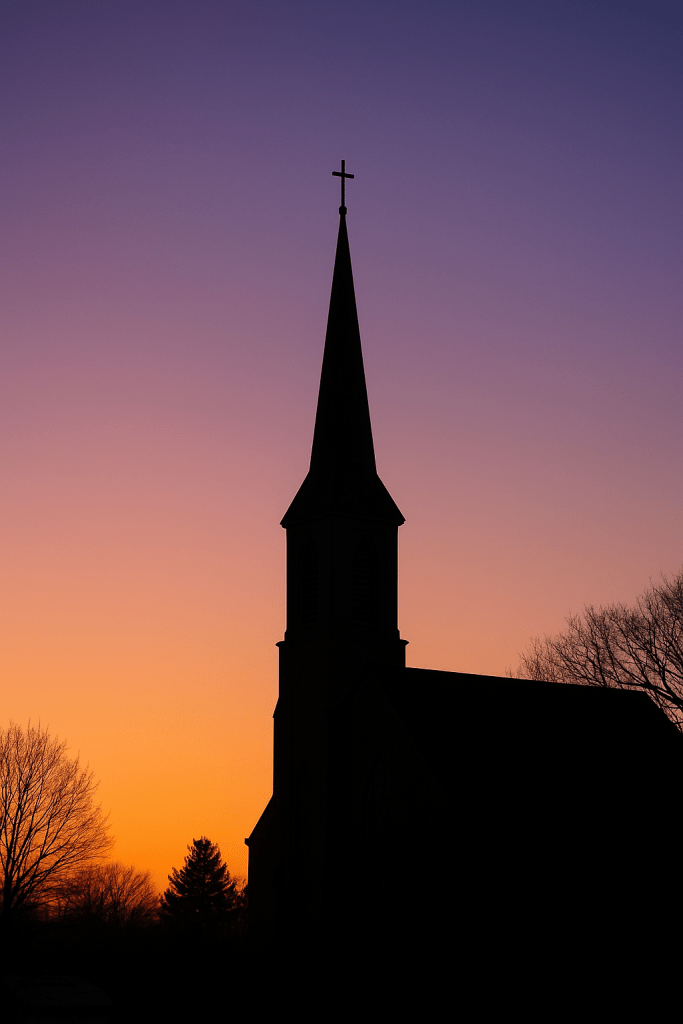
When you approach a village and see, beyond the trees and rooftops, a slender spire breaking the horizon, you are witnessing more than architecture. The church steeple is the meeting place of heaven and earth — a human hand raised upward, a prayer in timber and stone.
Long before skyscrapers and radio towers, the steeple was the tallest thing people knew. It marked the center of the community, both geographically and spiritually. From its belfry rang the sounds of life itself — wedding chimes, funeral tolls, and the daily hours that once kept an entire village in rhythm.
To hear the bells was to belong. Their sounds crossed class lines, carried through fog and rain, and reminded each listener that they were part of something enduring. In the stillness of dawn or the hush of dusk, a steeple’s toll was not just a summons to worship, but an assurance that civilization itself still stood watch.
The sight of a steeple from afar was equally moving. For travelers, it meant arrival — a promise of rest, bread, and fellowship. For locals, it was the vertical symbol of continuity: seasons may turn, but the church still stands, calling hearts homeward.
Through centuries of design — Romanesque solidity, Gothic aspiration, and Colonial simplicity — the steeple has remained both beacon and anchor. Its height draws the eyes upward; its bells draw the soul inward. Together they create that rare harmony of architecture and faith where the material world becomes a metaphor for eternity.
The Steeple’s Song
From the tower’s view above the town
I’ve watched your rooftops silvered dawn, Your children laughing on the lawn, Your lovers walking as shadows fall, And I have tolled the hour for all.
I’ve seen your seasons, year by year — Spring’s first bloom and winter’s tear; I’ve counted time in steady chime, And kept your faith when you lost mine.
From up where swallows weave their flight, I greet the day, I guard the night. When thunder rolls and sirens cry, My bells still sing to calm the sky.
I’ve heard your vows beneath my spire, Your whispered prayers, your heart’s desire. I’ve marked the birth, the ring, the rest — Your cradle, union, final guest.
I’ve seen the fields turn gold, then gray, The mills grow still, the children stray; Yet still I stand, though years may dim, A bridge between your world and Him.
For every soul that passes by, I lift my gaze to where hopes lie. My cross still gleams through storm and blue — A finger pointing Godward, true.
So when my bells across the vale Send echoes soft through hill and dale, Know this: I ring not just for prayer, But to remind you — Love is there.
Reflection
Every town needs a church with a steeple — not merely as a relic, but as a reminder. It is the one structure that insists on looking up.
In its shadow, generations have laughed, wept, married, and buried. Its bells do not ask for perfection; they call for presence. They tell us that civilization, at its best, is not measured by wealth or power, but by how faithfully we lift our eyes and our hearts beyond ourselves.
Three Famous Steeples of the World
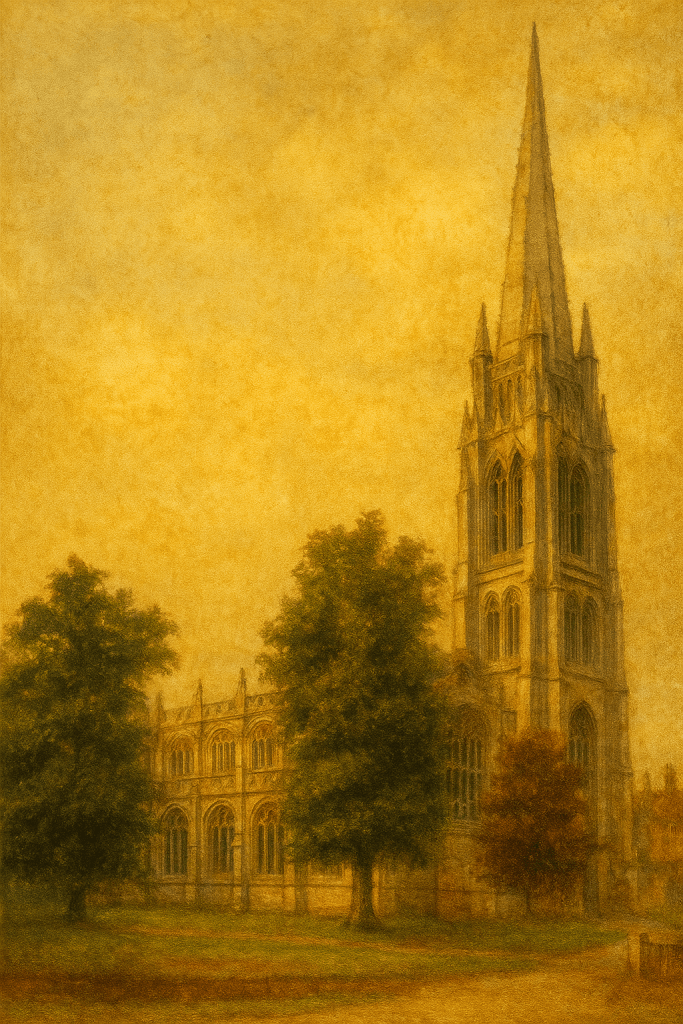
St. James’ Church, Louth (England)
Built: 15th–16th centuries Height: 287 ft
A Gothic marvel rising from a modest market town, it is known for its elegant pinnacles and sheer verticality — evoking both awe and aspiration in the quiet Lincolnshire countryside. Its daring height symbolizes the upward reach of faith within ordinary life, where everyday worshippers once built a tower that nearly touches the clouds.
Temple Saint-Étienne, Mulhouse (France)
Built: 1859–1866 Height: 318 ft
An Alsatian landmark often called the “Cathedral of the Reformed Faith,” it stands as a Protestant interpretation of Gothic grandeur. Its rose windows and tracery recall medieval cathedrals, yet the spirit within it is one of clarity and simplicity — grandeur made humble, devotion expressed in light and stone.
St. Patrick’s Cathedral, New York City (USA)
Built: 1858–1878 Twin Spires: 330 ft
A marble monument to faith amid steel skyscrapers, it was completed when Midtown Manhattan was still young. Its soaring spires now rise among towers of commerce and glass, reminding the modern city that heaven’s reach and human ambition can coexist — that even in the noise of New York, the bells still call souls home.
Passenger 2 (Student) — Philosophy fan with noise-canceling optimism.
Sky Marshal — Serious guardian who’s seen everything except this.
Scene 1 – At the Gate
The terminal bleeps. A monitor flashes “B12 → B72 → B12.” Socrates clutches a parchment like it’s a boarding pass.
Gate Agent: Sir, you cannot board with a scroll longer than our aircraft. It violates our overhead bin philosophy, which is minimalism with fees. If you like, we can check your wisdom to your final destination for a small fortune. I recommend the fortune; it travels better than wisdom these days.
Socrates: If wisdom must be checked, does that mean truth cannot be carried on? And if truth cannot be carried on, must it always be claimed after the journey like a battered suitcase? Perhaps this is why men leave airports grumbling that nothing they found inside was worth declaring. Tell me, do you also charge for the moral weight of a conscience?
Gate Agent: Only if it exceeds fifty pounds or your status level. Our elite members enjoy complimentary conscience allowance plus early boarding for their regrets. Basic economy travelers must compress guilt into a single personal item under the seat in front of them. You look like Group Nine, which is the group that boards when hope has already departed.
Socrates: Then today I shall learn humility, which I understand boards before all other virtues. If humility fits beneath the seat, I will keep it close to my feet where I can remember it. But if hope has already departed, I trust it will save me a seat in the heavens. Now, where does Group Nine stand to be told to stand somewhere else?
Scene 2 – Boarding the Aircraft
Bing! “Now boarding all livestock, musical instruments, and people who know a pilot.” Socrates steps aboard, eyes wide.
Flight Attendant: Welcome aboard! Please place your existential dread in the overhead bin and your carry-on under the seat. The laws of physics take off shortly; snacks will follow or possibly precede—time is a flat pretzel. Do you need help finding your seat or your purpose?
Socrates: I seek both: the seat because it is mine, and the purpose because I am told it is everyone’s. How is it that a ticket defines the worth of a place more than the person who fills it? And why do men scramble to claim twenty inches of sky-cushion like conquerors of a soft empire? Perhaps we should assign legroom according to virtue.
Flight Attendant: If virtue could buy an exit row, we’d be a monastery with seat belts. Instead, we have credit cards and loyalty tiers, which are like virtues you can swipe. For now, your purpose is 23B, which is the middle path between two armrests that will betray you. Philosophize facing forward, and try not to question the tray table’s truth value.
Socrates: Very well; I will accept the middle seat as the narrow way that leads to enlightenment or elbow wars. If I must share armrests, I shall be generous and claim them only in theory. Should turbulence arise, I will practice detachment from all things that rattle. And if the pretzels disappoint, I shall inquire whether disappointment is baked in salt.
Scene 3 – Takeoff
Taxiing. The plane hums like a beehive that studied engineering.
Passenger 1: Pardon me, would you mind fastening your seat belt before my blood pressure achieves cruising altitude? I find that physics works best when everyone agrees not to float. Besides, the captain gets nervous when philosophers test gravity without consent.
Socrates: If a strap saves me from the consequences of velocity, then I accept its embrace like a prudent friend. Still, I wonder: does safety spring from the belt itself, or from the shared promise that we will not attempt foolish leaps? Perhaps the belt is merely the visible sign of an invisible social contract. Either way, I will buckle up before truth becomes airborne.
Passenger 1: Excellent—thank you for your cooperation and your metaphor, which I’ll file under “in-flight entertainment.” While you’re at it, keep your seat upright so the laws of recline do not ruin my laptop. We can test your theories after we reach a place where my presentation isn’t the fragile thing between us and unemployment.
Socrates: I, too, will keep my back straight, because dignity is posture in moral form. I promise not to crush your productivity unless your productivity crushes justice. If the gods intended us to recline without consent, they would have issued us chaise lounges. For now, let us ascend in courtesy as well as altitude.
Scene 4 – In-Flight Dialogue
Ding! Seat-belt light off. People perform the ancient dance of the aisle shuffle.
Passenger 2: Master Socrates, I’ve read you in freshman comp where wisdom wrestled comma splices and lived. Is it true that the unexamined life is not worth living, or can one at least enjoy the peanuts? Also, is the Wi-Fi a form of knowledge or just a paid illusion that loads slowly?
Socrates: The unexamined life is like unsalted pretzels: chewable, but why? As for Wi-Fi, it is a tunnel of shadows in which men chase puppies and stock tips, believing the refresh wheel to be a god. Knowledge requires more than a signal; it demands the courage to ask your browser why it fears the truth. But I admit, a cat video properly framed can suggest the Forms.
Passenger 2: That’s comforting, because I just downloaded twelve lectures on metaphysics and one compilation of squirrels on jet bridges. I worry that I am a creature torn between Plato and autoplay. If you see me scroll too far into nonsense, please tug my sleeve like a gentle Socratic notification. I will resist, though the algorithm is persuasive like a free upgrade.
Socrates: I shall be your upgrade to reality, which includes legroom for the soul. When the algorithm whispers, ask it to define the Good without selling you a bundle. If it cannot, feed it peanuts and pat it on the head. Then return to your metaphysics, where squirrels fear the syllogism.
Scene 5 – The Interrogation
Whispers ripple: “He’s questioning aerodynamics.” The Sky Marshal appears with practiced calm.
Sky Marshal: Sir, I’m here to ensure that everyone arrives safely with their bodies, ideas, and armrests in original condition. I’m told you’ve been interrogating lift and drag like witnesses at a trial. Are you planning to disturb the peace, or just the definitions?
Socrates: I disturb only the pretense of knowledge, which I assure you multiplies faster than pretzel dust. If lift truly lifts, it will not fear my questions; if drag truly drags, it will not pout when I ask where it is going. I do not fight the air; I flirt with it until it tells me who it is. Should that be a crime, I request a window seat at my arraignment.
Sky Marshal: Understood—free speech is welcome as long as it remains seated with the seat belt fastened. Consider this a friendly advisory that metaphors can trigger turbulence in the susceptible. Please keep your inquiries inside your inside voice and outside the cockpit. When in doubt, imagine the captain grading your questions for extra credit and proceed accordingly.
Socrates: A wise limit—like speed, which is delightful until it is not. I will keep my questions buckled, stow my rhetoric, and remain upright in logic. Should my curiosity spill into the aisle, I will mop it up with irony. You have my word, which is the only carry-on I never check.
Scene 6 – The Captain Speaks
Intercom crackles with confident baritone.
Captain (voice): Ladies and gentlemen, this is your captain speaking from a small room full of buttons I pretend to understand. We’re flying over a geography quiz you can’t pass without the map, and conditions ahead are smoother than airport jazz. Also, to the philosopher in 23B: I appreciate the interest in first principles; we’ll be demonstrating Aristotelian final cause when we land. In the meantime, sit back, relax, and let necessity be the mother of invention and our on-time arrival.
Socrates: A fine ruler who conducts with both reason and rhythm. He admits his limits, jokes with grace, and promises what he can actually deliver—smooth air and a destination. Such men should govern cities, or at least their airspace. If he seeks a senate, I will nominate him while remaining loyal to my pretzels.
Passenger 2: He sounds like the kind of teacher who curves the grade and still makes you earn it. Imagine a city where the loudspeaker told the truth with charm and gave snacks. People might stop shouting and start chewing thoughtfully. I would vote for any politician who served complimentary honesty with a lime wedge.
Socrates: Then we agree that leadership is service with altitude. The captain commands by making trust feel natural, which is rarer than free checked bags. If only the Agora had seat belts and a beverage cart, Athens might have behaved. Alas, democracy never found a decent tray table.
Scene 7 – The Restroom Debate
Lavatory light goes from VACANT to OCCUPIED to a moral dilemma.
Flight Attendant: Sir, the lavatory queue is a fragile ecosystem balanced by patience and small talk. Please form a line like a polite question mark and not a chaotic exclamation. Also, the sink is a suggestion, the floor is a memory, and the door must lock or everyone will achieve unwanted enlightenment.
Socrates: Scarcity is the mother of manners; I see it now in stainless steel. When men share too few doors, they learn to knock gently on wisdom before barging in on truth. The lock is a covenant between vulnerability and civilization. I will honor it as if it were a treaty written on a tiny metal slide.
Passenger 1: And I will respect your treaty as long as you keep your closing arguments under two minutes. There is a line of citizens behind you with claims more urgent than syllogisms. May the soap dispense fairly and the faucet respond to human touch. If not, we’ll add plumbing to the list of things that need a philosopher-king.
Socrates: I shall be swift, for even arguments must yield to anatomy. If the faucet judges me unworthy, I will repent and try the other hand. Should the soap be stingy, I will appeal to its better angels. And if the fan roars, I will accept it as a chorus of hygienic furies.
Scene 8 – Approach and Landing
Seat-belt light on. Windows glow with civilized horizon.
Captain (voice): Folks, we’re beginning our descent into Dallas, the city that invented “almost there.” Weather is polite, winds are friendly, and the runway has agreed to meet us halfway. Please return tray tables to their natural law position and contemplate your choices.
Passenger 1: This is the moment I love: the gentle surrender of speed, the wheel’s quiet handshake with the earth, and the collective exhale when physics keeps its appointment. I forgive the middle seat, the Wi-Fi, and even your metaphors. If my bag shows up quickly, I will believe in providence.
Socrates: Landing is a parable about our lives pretending not to be a parable. We descend with trust, we align with hope, and we settle with a bump of reality that reminds us our wheels were made for ground. Today I learned that courage can have an aisle seat and patience can stow overhead. If providence brings your bag, let us tip our hats to the baggage handlers of fate.
Passenger 2: And if providence loses it, we will call it apatheia and rise above our material attachments. Still, I hope my socks made the trip; they’re not Stoics yet. When we stop, I’ll let you exit first because your briefcase looks like it has meetings tomorrow. Mine contains only ambition and a granola bar.
Scene 9 – Arrival
Ding! People stand too soon, achieving a brief illusion of progress.
Flight Attendant: Welcome to Dallas, where local time is whatever your watch says after the sprint to baggage claim. Please open overhead bins carefully, as your aspirations may have shifted during flight. If you enjoyed our service, tell your friends; if not, please tell your enemies to fly us instead.
Socrates: You have shepherded a sky-flock with grace, which is rarer than an on-time coffee. I will tell my friends and my enemies alike, for both need pretzels, and the plane is a floating seminar in patience. Should you ever tire of clouds, Athens would make you a hero with a whistle. Until then, keep ruling your aisle like a wise queen of narrow carpets.
Flight Attendant: Flattery will get you an extra napkin and the knowledge that you’re my favorite philosopher today. If you write a five-star review in iambic pentameter, we’ll name a beverage after you called “The Socra-Tea.” It’s just hot water with questions. Safe travels—and remember to take all truths and trash with you.
Socrates: I depart with my questions, which fit under any seat, and my gratitude, which does not. May the gods grant you short taxi times and generous armrest neighbors. If I ever return, I will bring more scroll and less carry-on. Farewell—may your skies be as smooth as your sarcasm.
Epilogue – “Reason’s Flight”
Terminal window. Socrates watches a plane lift like a well-timed punchline.
Socrates: I have discovered that airports are the gymnasiums of the soul, where patience does cardio and humility lifts other people’s bags. The gods hid wisdom in Group Nine to teach us to smile at futility and call it boarding. And though philosophy claims to love reason, it apparently loves peanuts more, which I respect in a system based on incentives. If truth flies business class, I am content in coach, because comedy sits everywhere—and laughs loudest on landing.






 Let's Talk About It, Lewis!
You must be logged in to post a comment.