A collaboration between Lewis McLain & AI
Suggestion: if you have kids or grandkids of the right age, read as a play to set the tone for tomorrow. Also, use the opportunity to teach them about the Caravaggio-style paintings. You can describe a scene to ChatGPT and ask for this style of painting. It does a really nice job! LFM
Plymouth Colony, late autumn, 1621.
A cold wind slides under the poorly sealed door of a small timber-framed house. A fire crackles. The smell of roasting cornmeal and dried herbs hangs in the air. A father, Thomas, mends a wooden plate near the hearth. A mother, Alice, stirs a pot of broth.
Their two children—John (12) and Elizabeth (10)—are bundled together under a wool blanket made from whatever scraps their mother could stitch together during the previous winter, the one that took half their company.
Outside, the colony gathers quietly, preparing for the great feast planned to begin the next day.
Dialogue
JOHN:
Mother, Father… is it true what everyone says? That tomorrow shall be a day of thanksgiving? A real feast? After everything?
ALICE:
Aye, John. ’Tis true. A feast to thank the Lord for what He hath provided—after such a year as we have endured.
ELIZABETH:
But why tomorrow? Why now? We have never had such a thing before.
THOMAS (smiling gently):
Because this harvest—modest as it is—came only through God’s mercy, long labor, and the kindness of our Wampanoag neighbors. And because Governor Bradford and Captain Standish wished for a time of rejoicing after months of toil. We sowed in the spring, we reaped in the fall, and now we pause to give thanks.
JOHN:
Who will come? Only our own people? Or… the Wampanoag too?
THOMAS:
Massasoit, their great sachem (leader), and many of his men shall join us. They helped us plant corn when we knew not how, and showed us what herbs might heal the sick. We invited them, for without their aid, we might all have perished as many did last winter.

ELIZABETH (softly):
Like Mistress Carver… and the young ones who came on the Mayflower but never saw the spring.
ALICE (puts a hand on her daughter’s shoulder):
Yes, my girl. We remember them tomorrow as well. A thankful heart remembers sorrow too. It gives thanks even through it.
JOHN:
Will we have enough to feed so many? I hear Governor Bradford asked for a day of “recreation,” but recreation requires a full belly, does it not?

THOMAS (laughs):
Recreation is but his word for shooting games, races, and displays of skill. As for food—well, we have what the land gave us. Not much bread, for wheat grows poorly here. But there is corn, venison, fowl, and perhaps wild turkey if we are blessed to catch one. And the Wampanoag come with what they will bring.
ELIZABETH:
Will there be pie? Mistress Alden says in England there was always pie.
ALICE (smiles):
Pie? Nay, sweetheart. Not without sugar, nor much butter, nor proper ovens. But we shall have stewed pumpkin, perhaps sweetened with what little maple we bartered for. A sort of pudding, if you wish it so.
JOHN:
And how long will this thanksgiving last?
THOMAS:
Some say one day. Others say three. Truth be told, none know for certain, for such a feast has never been held here before. Governor Bradford says we shall feast “after the harvest,” and that implies more than one meal. And if Massasoit brings ninety men—as rumor has it—then three days may hardly suffice!
ELIZABETH:
Ninety? All warriors?
THOMAS:
Warriors, hunters, friends. Men who stand with us. They come not for battle but fellowship. After the treaty we made with Massasoit in the spring, we owe one another peace and aid. And so far, that peace has held.
JOHN (leaning forward eagerly):
Will there be musket firing? Captain Standish promised a demonstration!

THOMAS:
Aye, he means to show the Wampanoag our marksmanship. Though I tell you, their scouts can track deer in the dark better than any Englishman. It will be sport, not contest.
ELIZABETH:
Mother, what do you look forward to tomorrow?
ALICE (pauses thoughtfully):
Seeing our people sit together, not mourning but rejoicing. Hearing laughter where there was once only coughing. Knowing that for one night, none shall go hungry. And seeing you two children grow in a land that is finally giving us hope.
JOHN:
Father, what do you expect?
THOMAS:
I expect gratitude. Not for a grand table—for our table will be modest. But for the simple truth that we lived to harvest this year. That God preserved us when the sickness swept through our homes. And that the Wampanoag, once strangers, now promise to stand with us.
ELIZABETH:
Will we pray?

ALICE:
We shall pray before the meal, after the meal, and whenever our hearts are moved to. We owe the Lord that much and more.
JOHN:
But why do we call it a thanksgiving? Is it because we are giving thanks to God for the food?
THOMAS:
For the food, yes—but more than that. For survival. For friendship. For peace. For the chance to build a life here. Our people left Leiden and England to worship freely. That longing cost us dearly. Tomorrow we honor that sacrifice.
ELIZABETH:
Mother… do you think we shall still be here next year? All of us?
ALICE (pulls her close):
If the Lord wills it. But listen, child: tomorrow is not about fear of what may come. It is about thanks for what has been given already. Every day we survive here is a kind of miracle.
JOHN:
Father… will you tell the story again? The story of how we came to be here?
THOMAS (sets aside the wooden plate, voice solemn):
Very well. One last time before the feast.
He clears his throat.
The Mayflower brought us across the sea for sixty and six days. Tempests tossed us, food spoiled, and sickness spread. When we reached Cape Cod, we thanked God though we were far from where we meant to settle. We found no houses built, no fields plowed—only the wilderness.

Half our company died that winter. Yet by spring, God sent Samoset to our door—speaking English! And through him came Squanto, who taught us how to plant corn in this poor soil, with fish for fertilizer, and how to find eels and clams. Through Squanto we met Massasoit, and peace was made.
This harvest—our first—is the fruit of all those mercies.
ELIZABETH (quietly):
So tomorrow we thank God… for all the ways He saw us through.
THOMAS:
Aye, my girl. That is the heart of it.
JOHN:
And will we feast like kings?
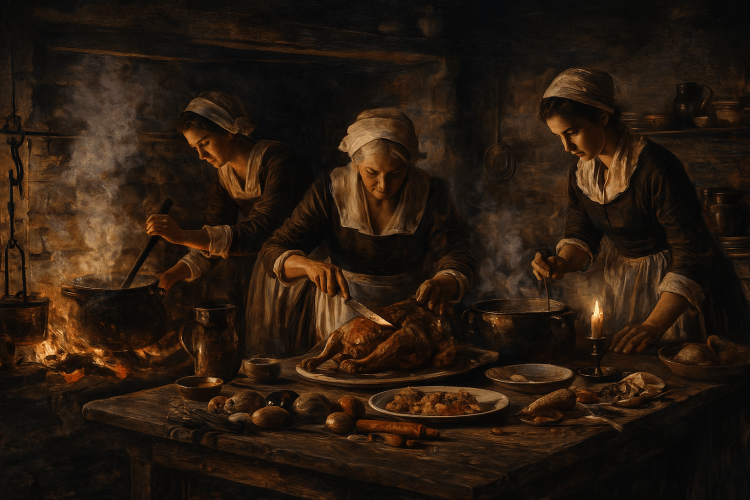
ALICE (laughs warmly):
Like pilgrims, my son. Which is to say—we shall feast gladly, even if not grandly.
ELIZABETH:
Will you sing, Mother?
ALICE:
If the spirit moves me. Perhaps Psalm 100. “Make a joyful noise unto the Lord, all ye lands.”
JOHN:
And what shall we children do?
THOMAS:
Eat. Play. Give thanks. And remember. One day, your children’s children may ask you what the first Thanksgiving was like. You shall tell them.
ELIZABETH:
Will they believe us?
THOMAS (with a grin):
Only if you describe it better than I ever could.
JOHN:
Then tomorrow, I will sit beside Massasoit himself and see how he smiles when he tastes roasted duck!
ALICE:
Mind your manners, John.
JOHN:
Yes, Mother.
ELIZABETH:
Father… do you think the Wampanoag give thanks too? Not just us?
THOMAS:
Oh yes. They thank the Creator for the harvest, the deer, the rivers, the berries, the corn. They celebrate their own harvest ceremonies. Tomorrow, in a way, both our peoples shall give thanks side by side.
ELIZABETH (leans against her mother):
That sounds… beautiful.
ALICE (softly):
It is.
A long, peaceful silence follows. Only the fire crackles.
THOMAS (whispering as he looks at his sleeping children):
Let them remember this night, Alice. The night before our first thanksgiving.
ALICE:
And let tomorrow be the beginning of many more.
The father places another log on the fire. Outside, the moon sits above the humble colony. Inside, the family sleeps—warm despite the cold—waiting for the dawn of a day that history will one day call The First Thanksgiving.
**After the Three Days:
What the Children Remember**
Three days later, the feast had ended. The fires had cooled. The sounds of musket volleys, laughter, drumming, and cheering had faded into memory. Plymouth had settled back into its quiet rhythm. But in the small timber house at the colony’s edge, the family gathered again near the hearth as the evening wind rattled the shutters.
JOHN (12) and ELIZABETH (10) sat cross-legged on the floor, shivering slightly in the early winter chill. Mother Alice was mending a torn sleeve. Father Thomas was binding two arrowheads to wooden shafts—gifts from a Wampanoag boy he’d met at the feast.
A comforting silence lingered, until Elizabeth finally spoke.
Dialogue: “What We Saw”
ELIZABETH:
Father… was that truly the end of it? The feast is done?

THOMAS:
Aye, sweetheart. Three days was enough for even the strongest among us. I dare say we shall not eat like that again until next year—if next year is as kind as this one.
JOHN (still full of restless excitement):
But Father—did you see Massasoit when he laughed at Standish’s musket misfire? He nearly dropped his plate! And the way his men cheered when the shooting contest was done!
THOMAS (smiling at the memory):
Aye, I saw it. ’Twas rare joy to see our peoples laugh together instead of watching one another in worry.
ELIZABETH:
The Wampanoag women brought so much food… more berries and corn cakes than I had ever seen. Why did they bring so much?
ALICE:
Because they wished to honor the peace between us. And perhaps because they saw our stores were not so plentiful as theirs. It was kindness, child. A generous kindness.
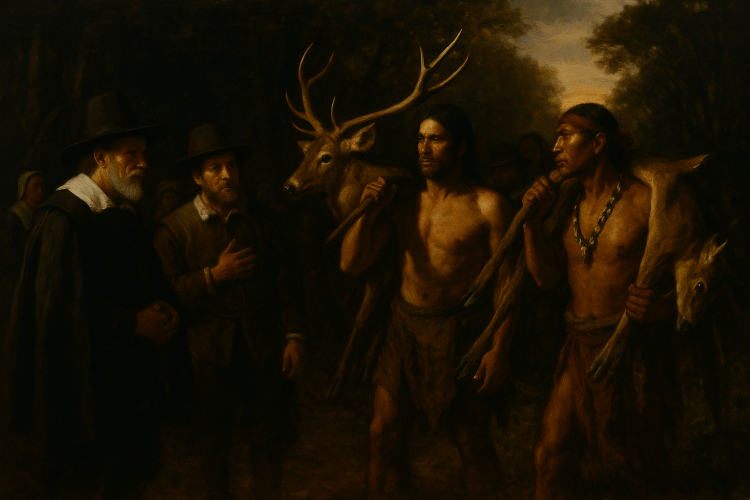
JOHN:
And the venison! I never saw so much meat in all my life. Five whole deer! They shared it freely.
THOMAS:
It is part of their custom. When a great meal is held, the hunters bring what they have. Hospitality, they call it—much like our own ways, though expressed differently.
ELIZABETH (looking into the fire):
I liked listening to their singing. It sounded like the wind through the trees.
ALICE (softly):
Yes. I thought it beautiful. Some said they sang thanks to the Creator, much as we did. Different words, different ways—but thanks all the same.
JOHN:
Father… do you think this peace will last?
THOMAS:
I pray it shall. Massasoit has kept his word. We have kept ours. We are two peoples sharing one land, and God willing, we shall find a way to live as neighbors.
ELIZABETH:
Do you think we will feast with them again next year?
THOMAS:
If the harvest is good, perhaps. But remember, my children—this first feast was not just celebration. It was relief. It was a breath drawn after hardship. It was the first time since we came here that joy outweighed sorrow.
ALICE (nodding):
These three days fed our spirits as much as our bodies.
JOHN:
I shall never forget it. The races, the shooting, the laughter, the dancing… I never thought so many people could smile at once.
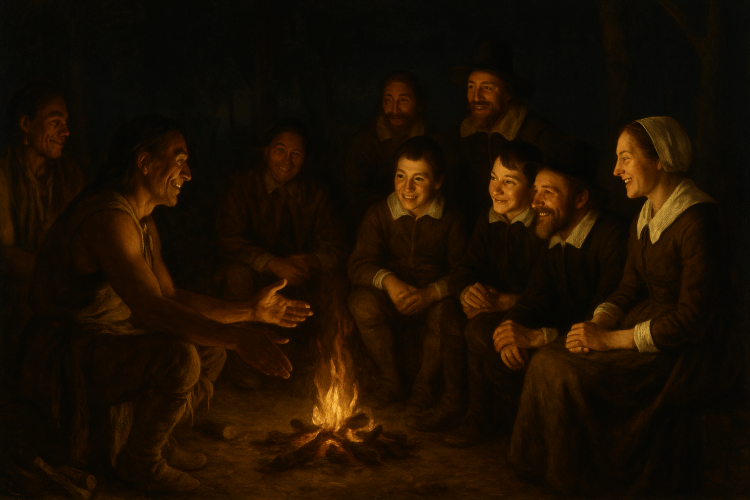
ELIZABETH (gazing dreamily):
Or that strangers could feel like friends.
ALICE:
Hold fast to that thought, my girl. In this wild new land, friendship may be the difference between life and death.
THOMAS:
And between fear and hope.
A soft wind whistled through the cracks as the fire hissed. The children leaned against their parents.
JOHN:
Father… will history remember this? Will they write of these days?
THOMAS (looking thoughtfully into the flames):
Perhaps. Or perhaps only families like ours will remember. But even if no one writes a single word, it was still worth living. And worth giving thanks for.
ELIZABETH:
I want to remember every moment.
ALICE:
You shall. And someday, when your own children ask, you will tell them of the time when Pilgrims and Wampanoag sat at one table, shared one fire, and gave thanks together.
The fire crackled, warming their tired faces. The children drifted to sleep with memories of laughter, feasting, and newfound friendship—memories that would stay with them long after the wilderness around them grew quiet again.
 Let's Talk About It, Lewis!