✨ Suggested by Dr Bobby Waite; Written by Lewis McLain & AI
A Study Edition Inspired by Dallas Willard
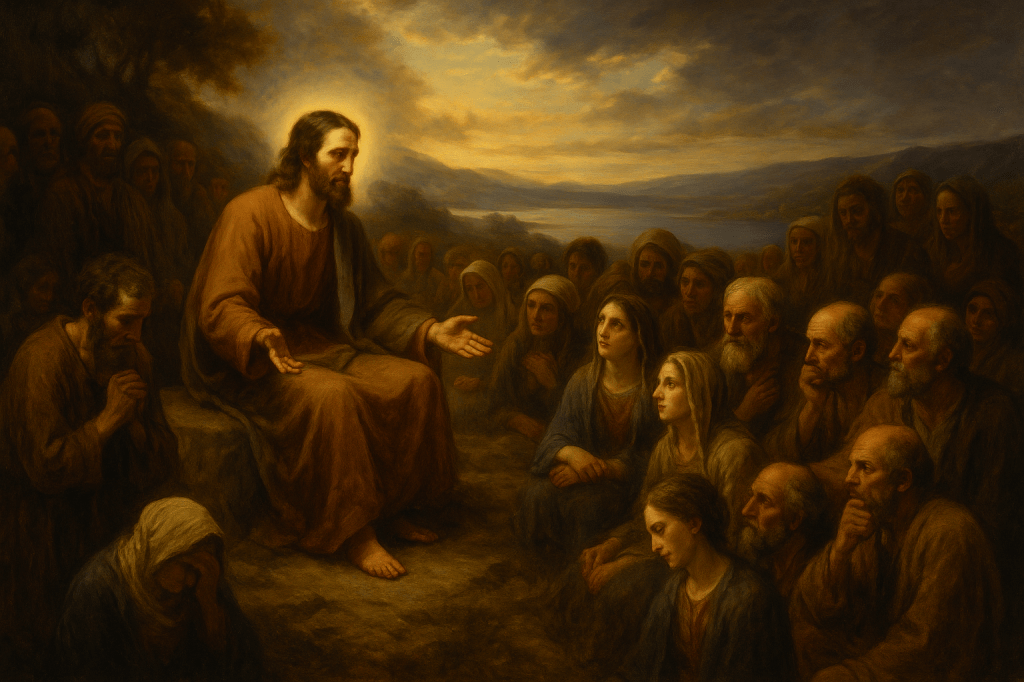
🌄 I. Setting the Scene — The Mountain and the Message
It was early in the ministry of Jesus. Word of His healings and authority had spread through Galilee. Crowds followed—farmers, fishermen, soldiers, widows, and scholars—all hungry for something more than spectacle.
When He saw them gathering by the Sea of Galilee, Jesus withdrew to a hillside. The slope formed a natural amphitheater where sound carried on the breeze. He sat down, the posture of a rabbi ready to teach, and His disciples drew near. Behind them stood the multitudes—hopeful, skeptical, wounded.
This is the setting of the Sermon on the Mount (Matthew 5–7), the heart of the Gospel story where the Teacher begins to describe life under the rule of God. Like Moses ascending Sinai, Jesus now delivers a new law—not on stone tablets, but upon human hearts. Yet this Lawgiver does not shout from thunderclouds; He speaks softly, face to face.
The sermon opens not with command but with blessing. The Master looks at His disciples—men and women of no special rank—and calls them the seed of a new creation.
“Seeing the crowds, He went up on a mountain, and when He sat down, His disciples came to Him. Then He began to teach them.” (Matthew 5:1–2)
Thus begins what Dallas Willard calls “the divine conspiracy”—the quiet, redemptive invasion of heaven into the ordinary world through those who choose to live as Christ’s apprentices.
🕊️ II. The Heart of the Divine Conspiracy
Willard writes that Jesus’ teaching unveils a simple but radical truth: the Kingdom of God is available now. It’s not about escape to heaven later, but participation with God in the present moment. The Sermon on the Mount is therefore the curriculum for life in the Kingdom—not rules for unreachable saints, but descriptions of ordinary people transformed by extraordinary grace.
“Jesus’ teaching about the kingdom is not an invitation to wait for heaven later; it’s a call to live under heaven’s rule now.” — Dallas Willard
📖 III. The Beatitudes — The Great Reversal
Each Beatitude opens with Blessed—the Greek makarios, meaning deeply happy, whole, or flourishing. Jesus pronounces God’s favor upon those the world overlooks or despises. Willard teaches that these are not virtues to attain, but conditions where grace appears. They describe what life looks like when heaven’s power meets human weakness.
1. “Blessed are the poor in spirit, for theirs is the kingdom of heaven.” (Matthew 5:3)
To be poor in spirit is to know your need of God.
The self-sufficient rely on their own strength; the poor in spirit rely on grace.
Willard’s Insight:
“The poor in spirit are those who have learned that their life is not manageable on their own. They stand ready to receive the Kingdom as a gift, not as a wage.”
Reflection:
When have you discovered that self-reliance is not enough?
How did that humility become a doorway to grace?
2. “Blessed are those who mourn, for they will be comforted.” (Matthew 5:4)
Mourning is not weakness—it is sacred honesty.
Those who grieve over loss, sin, or injustice open their hearts to God’s healing compassion.
Willard’s Insight:
“The world says, ‘Get over it.’ Jesus says, ‘Bring it to Me.’ Mourning becomes holy when it leads us into the arms of divine comfort.”
Reflection:
What sorrow has drawn you closer to God?
How might you become an instrument of comfort to others?
3. “Blessed are the meek, for they will inherit the earth.” (Matthew 5:5)
Meekness is not weakness but power under control.
The meek trust God’s care more than their own control.
Willard’s Insight:
“The meek live without the need to manage others. They inherit the earth because they are content to let God govern it.”
Reflection:
Where do you sense God calling you to release control and rest in His authority?
4. “Blessed are those who hunger and thirst for righteousness, for they will be filled.” (Matthew 5:6)
This is the longing for the world to be set right—within and without.
Willard’s Insight:
“This hunger is evidence of life with God already stirring within you. He alone satisfies the appetite He awakens.”
Reflection:
What injustices make your spirit ache?
How can you channel that hunger into faithful prayer and action?
5. “Blessed are the merciful, for they will be shown mercy.” (Matthew 5:7)
Mercy interrupts the world’s cycle of revenge.
Willard’s Insight:
“The merciful dwell in a rhythm of grace—they forgive because they live forgiven.”
Reflection:
Who in your life needs mercy from you today?
How can compassion replace resentment?
6. “Blessed are the pure in heart, for they will see God.” (Matthew 5:8)
Purity of heart means singleness of desire—the will set wholly toward God.
Willard’s Insight:
“To be pure in heart is to will one thing: the good of God. When the eye of the soul is clear, everything becomes luminous with His presence.”
Reflection:
What distractions divide your heart?
How can simplicity of purpose restore your spiritual sight?
7. “Blessed are the peacemakers, for they will be called children of God.” (Matthew 5:9)
Peacemakers are builders of reconciliation, bearers of God’s family likeness.
Willard’s Insight:
“The peace of Christ is not the absence of conflict but the presence of creative goodwill.”
Reflection:
Where can you build bridges instead of walls?
How might you embody the Father’s peace in tense spaces?
8. “Blessed are those who are persecuted because of righteousness, for theirs is the kingdom of heaven.” (Matthew 5:10)
Faithfulness invites friction with the world’s systems—but God’s presence sustains the faithful.
Willard’s Insight:
“Persecution is not failure; it is confirmation that the Kingdom has taken root.”
Reflection:
When has standing for truth cost you something?
What courage grows in hardship?
9. “Blessed are you when people insult you, persecute you and falsely say all kinds of evil against you because of Me. Rejoice and be glad, because great is your reward in heaven.” (Matthew 5:11–12)
Now the blessings become personal—addressed to every follower.
Willard’s Insight:
“Joy in persecution is not denial of pain but recognition of purpose. You are living from an eternal horizon.”
Reflection:
How can you keep joy alive when misunderstood or maligned?
What eternal perspective steadies your heart?
🧭 IV. Discipleship as Apprenticeship
To Willard, discipleship means apprenticeship—learning to live your actual life as Jesus would live it if He were you. It is not belief alone but training of the heart. He outlines three essentials:
- Vision – seeing the Kingdom as real and desirable.
- Intention – deciding to live as Christ’s student.
- Means – practicing disciplines that reshape the inner life (prayer, solitude, service, study).
This “curriculum for Christlikeness” transforms not just conduct but character.
🌿 V. The Hidden Life in God
The “divine conspiracy” is that God’s revolution happens quietly—from the inside out.
It unfolds in unseen obedience, ordinary kindness, unseen faithfulness. It is “hidden” because the Kingdom’s greatest victories are inward: forgiveness over hatred, humility over pride, patience over fury.
“The revolution of Jesus is one of character, and it proceeds in secret until it transforms everything.” — Willard
Those who live this way already share in eternal life—the with-God life that begins now and never ends.
💬 VI. Discussion & Application
- Which Beatitude most challenges your current view of “success”?
- How might the Kingdom of God reshape your response to suffering or insult?
- What practice could you begin this week to strengthen mercy, purity, or peace in your daily routine?
- How does Jesus’ personal instruction of His disciples encourage your own apprenticeship today?
🕊️ VII. Poetic Reflection — The Quiet Kingdom
On a hill above the waters, where Galilee’s winds still sigh,
He sat upon the green earth, as heaven leaned close by.
No trumpet sounded His Kingdom, no banners caught the sun—
Yet love began its quiet reign, and the world was being won.
He spoke not to princes or scholars, but to hearts that barely stand,
To fishermen, widows, wanderers—the dust of a weary land.
He called them blessed, not broken; He named them heirs of grace,
And light began to shimmer on each upturned face.
Blessed are the poor in spirit, who bring nothing but their need;
For God will clothe their emptiness and sow His living seed.
Blessed are the mourners, whose tears the Father keeps;
For He will bend beside them, and comfort while they weep.
Blessed are the meek, whose strength is calm and mild;
The earth will bloom beneath their hands, the humble reconciled.
Blessed are the hungry hearts, that crave for what is right;
They’ll taste the bread of justice baked in heaven’s light.
Blessed are the merciful, who let forgiveness flow;
They drink the cup of kindness only mercy knows.
Blessed are the pure in heart, whose eyes are clean and still;
They’ll see the face of God in every field and hill.
Blessed are the peacemakers, who end the ancient fight;
Children of the Father, they walk in holy light.
Blessed are the persecuted, whose faith the world disowns;
Their crowns are forged of suffering; their thrones are living stones.
And still He whispers softly above the clash and din:
“My Kingdom is among you; it grows from deep within.”
Not built of force or empire, not won by sword or gain—
It rises where the heart surrenders, and love alone shall reign.
The crowd went home in silence, but heaven had begun;
The meek looked tall, the mourners sang, the poor outshone the sun.
And though the ages darken, His promise still is true—
The Kingdom’s quiet power still moves in me and you.
🌅 VIII. Closing Thought
The Divine Conspiracy is the Gospel’s hidden heartbeat:
God’s Kingdom is not far away—it is available now.
To live as Jesus’ apprentice is to walk daily in the light of that reality,
to join the ongoing miracle of heaven quietly transforming earth.
 Let's Talk About It, Lewis!