A collaboration between Lewis McLain & AI
Oh, how I loved Cat Stevens from the first time I heard him. I saw him the first time when he performed in Fort Worth in the 1970s. It listened to his albums over and over. It was clear he was searching for spiritual clarity. He apparently found a solution for himself after his brother gave him a copy of the Quran. After his conversion, he gave away or destroyed all of his awards and guitars. He changed his name to Yusuf Islam. Decades later, his adult son found his guitar on the market and bought it. It is said that Yusuf immediately started playing. A few years ago, Linda and I flew to Washington, DC, where he played to an audience at the Kennedy Center. It was a wonderful trip back to hear his classics again. LFM

Morning Has Broken: The Song That Welcomed the Dawn
I. A Hymn Born in Simplicity (1931)
In 1931, British author Eleanor Farjeon was asked to craft new words for the traditional Scottish-Gaelic tune Bunessan (from the Isle of Mull). She wrote Morning Has Broken—three short stanzas that treat each sunrise as a fresh echo of Creation. Birds, dew, gardens, and “the Word” cast ordinary morning light as a sacrament of renewal. First printed in Songs of Praise (1931), the hymn traveled quietly through hymnals for decades.
II. Steven to Cat Stevens: Crisis, Silence, and Re-making (1968–1970)
Steven Demetre Georgiou—later known as Cat Stevens and today as Yusuf Islam—grew up over his father’s Greek-Cypriot restaurant in London, with a Swedish mother, a pencil and sketchpad never far from reach. By 18 he had a record deal; by 1967 he’d had pop hits and relentless touring. Then, in 1969, illness struck hard: tuberculosis with a collapsed lung. He was hospitalized for months and then sent into nearly a year of convalescence and isolation.
That enforced stillness became a hinge in his life. He read widely (mysticism, philosophy, scripture), sketched and wrote, questioned fame, and began composing the introspective songs that would define his second career: “Father and Son,” “Wild World,” “On the Road to Find Out,” “Into White.” When he returned, it was with a new sound—acoustic, intimate, spiritually searching—and a new partnership with producer Paul Samwell-Smith. The comeback albums followed in quick succession:
- Mona Bone Jakon (1970): the quiet re-entry.
- Tea for the Tillerman (1970): a masterpiece of spare folk-rock and spiritual longing.
- Teaser and the Firecat (1971): the companion volume—gentler, sunlit, and home to “Moonshadow,” “Peace Train,” and “Morning Has Broken.”
Stevens even painted the cover art—a child (Teaser) and a cat (Firecat)—an outward sign of the homemade sincerity of the era.
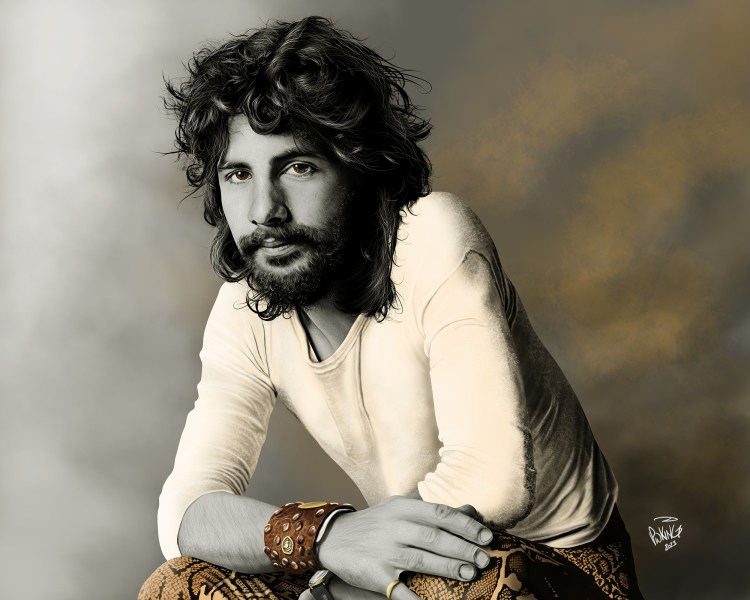
III. Finding a Hymn in a Hymnal (1971)
As Teaser and the Firecat neared completion, Stevens and Samwell-Smith wanted one more track that sounded like gratitude. Leafing through a hymnbook, Stevens found Farjeon’s Morning Has Broken. The text was brief, without a pop chorus, but it said exactly what his convalescent soul had learned: each day is a divine fresh start. “It fell into my lap,” he later said—less an idea than a gift arriving right on time.
IV. The Recording: Piano Like First Light
The arrangement needed light. Enter Rick Wakeman, a young session pianist (soon to join Yes). He improvised the now-famous piano prelude and interlude—those flowing, ascending figures that feel like sun lifting fog. Acoustic guitar, a modest rhythm bed, and Stevens’ hushed vocal kept the hymn’s humility while giving it living warmth. (Wakeman was initially uncredited, a footnote he’s mentioned ever since—ironically fitting for a song about unadorned grace.)
V. Release, Reception, and Reach (1971–present)
Issued late in 1971, the single bloomed slowly and then everywhere—Top-10 in the U.K., No. 6 on the U.S. Hot 100, and No. 1 on Adult Contemporary radio. It became a rare bridge between sacred hymnody and popular song, sung at school assemblies and charting on secular stations; used at weddings, dedications, and memorials; and re-introducing Farjeon’s text to churches that had forgotten it. For Stevens, the song sits on the arc that runs from illness → inward search → art as gratitude → later faith commitments and humanitarian work. For listeners, it proved a pop song can simply be thank you and still move the world.
VI. What the Verses Say (Paraphrased and Interpreted)
Verse 1 — The first morning, again
Morning opens like the world’s first dawn; birds break the silence like that first bird. Let all our singing and this very dawn become praise—new life springing from God’s speaking.
Verse 2 — Rain, light, and the garden
New rain gleams in sun; first dew pearls on fresh grass. Praise for sweetness in the watered garden—made whole where the Holy One has walked.
Verse 3 — Light we share, life we begin
Sunlight is ours; morning is ours—children of the same Light seen in Eden. So let joy rise with each dawn: every morning is God’s re-creation of the day.
Coda (Stevens’ reprise on record)
The album performance circles back to the opening stanza—musically and theologically saying: the first morning returns with every sunrise.
VII. Why It Endures
- Simplicity that shelters depth: Three small verses, vast theology—creation as ongoing gift.
- A voice recovered from silence: After TB and a season of doubt, Stevens chose wonder. You can hear recovery in the restraint.
- Piano that paints light: Wakeman’s intro has become the sound of “daybreak” for multiple generations.
- Common grace: It belongs equally to church pews and kitchen radios, to choirs and children.
VIII. Closing
Morning Has Broken is the sound of someone who nearly lost breath learning to love breath again. Farjeon’s parish hymn found its pilgrim singer; Stevens’ long quiet found its prayer. And the rest of us found a way to say, with the first bird and the last chord: thank You for today.

Morning has broken like the first morning
Blackbird has spoken like the first bird
Praise for the singing, praise for the morning
Praise for them springing fresh from the world
Sweet the rains new fall, sunlit from Heaven
Like the first dewfall on the first grass
Praise for the sweetness of the wet garden
Sprung in completeness where His feet pass
Mine is the sunlight, mine is the morning
Born of the one light, Eden saw play
Praise with elation, praise every morning
God’s recreation of the new day
Morning has broken like the first morning
Blackbird has spoken like the first bird
Praise for the singing, praise for the morning
Praise for them springing fresh from the world
 Let's Talk About It, Lewis!