A collaboration between Lewis McLain & AI

Introduction: The Most Disarming Invitation
Of all the invitations Jesus ever gave, none is more tender or more revealing than His call to “Let the little children come to Me.” In a world that prized power, rank, and age, Jesus placed a child in the midst of grown men and declared that the way into His Kingdom was not through merit, intellect, or strength—but through simplicity of heart. The Gospels record this lesson several times (Matthew 18:1-5; 19:13-15; Mark 10:13-16; Luke 18:15-17), which tells us how central it is to the heart of the Christian life.
The Scene: Greatness Redefined
In Matthew 18, the disciples were debating who would be greatest in heaven. Their conversation revealed an adult obsession with comparison and hierarchy. Jesus interrupted their ambitions by calling over a small child—someone overlooked, unranked, and powerless.
“Unless you change and become like little children, you will never enter the kingdom of heaven.” (Matthew 18:3)
In one sentence, Jesus inverted the value system of His listeners. Greatness, He said, begins with humility. To “become like children” is to admit dependence and trust rather than display status. The Kingdom of God is not climbed into; it is received with open hands.
Reflection Questions
- What ambitions or comparisons most distract you from a childlike faith?
- How do humility and dependence challenge our culture’s idea of success?
- In what ways might “becoming smaller” actually enlarge your soul?
The Heart of the Matter: Childlike, Not Childish
Jesus did not praise immaturity, ignorance, or naivety. He praised childlikeness—qualities of heart that adults tend to lose: trust, wonder, forgiveness, curiosity, and the ability to be taught. A child depends without shame, asks without hesitation, and forgives without keeping score. These traits mirror the faith that connects us to God.
When He said, “Anyone who will not receive the kingdom of God like a little child will never enter it” (Mark 10:15), Jesus was describing an approach, not an age. The requirement is not to remain small but to remain soft—humble enough to receive grace instead of earning it.
Reflection Questions
- Which childlike quality—trust, wonder, forgiveness, curiosity—do you find hardest to retain?
- How can you cultivate teachability before God this week?
- What would your worship look like if you came with that childlike heart?
The Blessing: His Hands on the Children
In both Mark 10 and Matthew 19, people brought children to Jesus, and the disciples tried to push them away. Perhaps they thought He had more important work to do. But Jesus became indignant—a rare word for His righteous anger. He insisted, “Do not hinder them.” He gathered the children into His arms, laid His hands on them, and blessed them.
That gesture still defines the heart of Christian ministry. To hinder a child—by neglect, cynicism, or hardness—is to obstruct the very image of faith God desires. Every time the Church welcomes the least, protects the vulnerable, or teaches with gentleness, it reenacts that moment of blessing.
Reflection Questions
- Who in your life might be “hindered” from coming to Jesus by neglect or discouragement?
- How can your words or presence become an open invitation instead?
- What practical steps could your church take to bless children and the childlike?
The Application: What It Means Today
1. Trust Over Control
Modern life prizes control—plans, schedules, data, mastery. Yet the Gospel calls us to trust. A child steps forward because the parent’s voice is enough. To follow Jesus is to release the illusion of control and to rest in His character.
2. Wonder Over Cynicism
Children see beauty where adults see routine. Faith flourishes when we regain our sense of wonder—when sunrise, Scripture, and song awaken gratitude instead of fatigue. Cynicism may sound sophisticated, but it cannot worship.
3. Relationship Over Performance
Children do not earn their place at the table; they belong by birth and love. In the same way, believers are accepted not by performance but by adoption into God’s family. Our worth is not negotiated—it is bestowed.
4. Presence Over Hurry
A child notices the moment; an adult is often elsewhere. Jesus invited children to come to Him—a call to be present. Prayer and worship are not tasks but encounters. To come as a child is to arrive unhurried, eager, and attentive.
Reflection Questions
- Where in your life are you trying to control what only God can direct?
- When was the last time you paused to experience pure wonder before God?
- How can you practice “presence over hurry” in your daily prayer or worship?
The Challenge: Becoming Small in a Big World
It is striking that Jesus did not tell the children to become like the disciples, but the disciples to become like the children. In every generation, the Church is tempted to mirror worldly hierarchies—titles, influence, eloquence, size. But the Kingdom belongs to those who kneel, not to those who climb. To be childlike is not to be weak but to be free from pretense. It is the posture that allows grace to enter.
Reflection Questions
- Where might pride or performance still keep you from kneeling?
- How does God invite you to rest in grace rather than achievement?
- What would your leadership, parenting, or ministry look like if shaped by childlike humility?
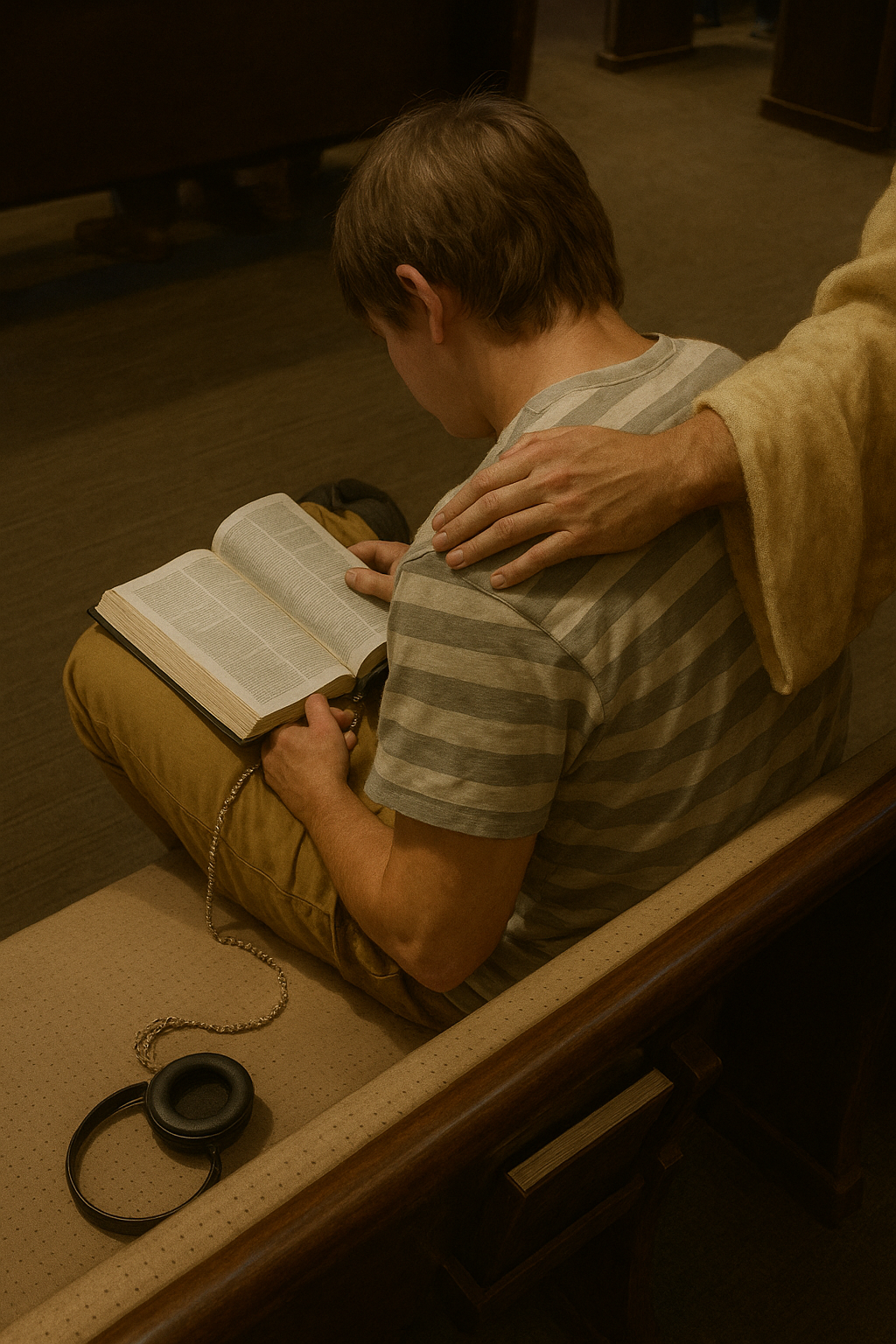
Conclusion: The Open Arms of Christ
When Jesus said, “Let the little children come to Me,” He was not limiting His invitation to a specific age. He was revealing the doorway of heaven. The arms that once cradled children on a Galilean hillside would soon stretch open on a cross to welcome all of God’s children home.
To come as a child is to come with empty hands, honest eyes, and an open heart. In that humility, we find not only the entrance to the Kingdom—but the embrace of the King Himself.
A Prayer of Childlike Faith
Lord Jesus,
Teach me to come to You not with pride but with peace,
not with credentials but with curiosity.
Make my heart soft again—able to wonder, to trust, to forgive.
Strip away the layers of cynicism that I have called wisdom,
and restore to me the joy of simple belief.
As a child finds rest in a father’s arms,
let me find rest in Yours.
Amen.
 Let's Talk About It, Lewis!