A collaboration between Lewis McLain & AI
Revisiting an influential book for me, fitting into the primary theme of my recent posts. LFM
Introduction: The Man Behind the Circles
William Oscar Thompson Jr. (1918–1980) lived a life that testified to the power of relationship. He was not a man of grand celebrity or global fame; rather, he was a pastor and evangelist whose impact spread quietly through students, parishioners, and colleagues who absorbed his conviction that the Christian life must be lived relationally, not institutionally.
After two decades of faithful pastoral work, Thompson became a professor of evangelism at Southwestern Baptist Theological Seminary in Fort Worth, Texas. It was there, during his own physical suffering and eventual battle with cancer, that he refined the model that would outlive him — a model that connected spiritual authenticity with human connection.
Thompson’s health declined even as his insight deepened. He realized that the gospel was never meant to travel primarily by microphone or mass event, but through people whose lives touched one another’s every day — in kitchens, workplaces, front porches, and hospital rooms. After his death in 1980, his wife, Carolyn Thompson Ritzmann, edited his unfinished manuscript, and evangelism teacher Claude V. King (best known for Experiencing God) later helped expand and republish it. The revised edition, Concentric Circles of Concern: Seven Stages for Making Disciples, was released in 1999 by Broadman & Holman, nearly two decades after the original 1981 publication.
The phrase “concentric circles” is not just a metaphor in Thompson’s hands; it is a theology of life. His belief was that the Christian’s influence for Christ begins not in distant mission fields but within the very relationships already entrusted to them. Evangelism, he argued, must ripple outward from the integrity of the inner life — from the soul that has been made right with God — until it touches every layer of community, from family to stranger. His framework provides a vision of discipleship that is both deeply personal and expansively missional, a reminder that faith spreads through people who love well.
The Concentric Circles and Their Living Logic
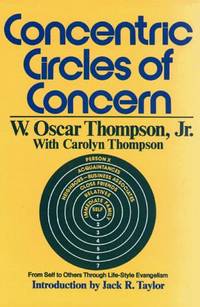
At the heart of the book lies a simple, unforgettable diagram: seven circles, each one nested inside the next, radiating outward from a center. The image, though deceptively modest, reshapes how one thinks about spiritual responsibility.
1. Self
The innermost circle, labeled Self, represents one’s own soul — the center of all relational and spiritual life. For Thompson, self-examination and humility before God are not indulgent acts but sacred ones. A Christian must first cultivate honesty with themselves and communion with their Creator. Spiritual neglect at this level produces hypocrisy; spiritual health here produces authenticity that naturally flows outward. He reminds his readers that “the most important word in the English language, apart from proper nouns, is relationship.” That relationship begins vertically — between oneself and God — and then extends horizontally into every human connection. Evangelism without integrity is noise; discipleship without inner renewal is hollow ritual.
2. Family
The second circle embraces one’s immediate family. It is easy, Thompson observed, to romanticize missions across oceans while ignoring ministry across the dinner table. The home is the first proving ground of grace. Faith that cannot be lived out among those who know us best will rarely stand in the wider world. A Christian who learns to forgive within marriage, to listen to their children, or to extend patience to aging parents is already practicing evangelism of the highest order. Family is the first “field” of discipleship, where love is tested daily and faith becomes tangible.
3. Relatives
The third circle includes extended family — the kin network that may stretch across states, generations, and emotional boundaries. These relationships are often complicated by history, misunderstanding, or absence. Thompson urges believers not to abandon these connections but to redeem them. The gospel’s reconciling power, he writes, often begins when a believer takes the initiative to heal an old wound or rekindle a neglected bond. A letter of apology, a phone call of encouragement, or an unexpected act of service within the extended family can become the spark of redemption.
4. Friends
Friends form the fourth circle — those we choose to walk beside in life. Unlike family, friendship is elective; it is built on mutual trust and shared affection. Thompson views friendship as one of the most powerful conduits of witness. Friends already see us unfiltered; they know our habits, hopes, and contradictions. When they witness genuine spiritual transformation in our character, they often feel it before they hear it. To live faithfully among friends is to let the gospel speak through laughter, loyalty, and long conversation.
5. Neighbors and Associates
Next come Neighbors and Associates — the people who share our routines but not necessarily our intimacy: colleagues, classmates, teammates, or the barista who knows our order by heart. Thompson believed these daily intersections were fertile soil for spiritual conversation, if approached with humility and care. Instead of seeing such relationships as mundane, he taught his students to see them as providential appointments. Every encounter, no matter how ordinary, carries the potential of divine significance.
6. Acquaintances
The sixth circle widens to include those we know only loosely — the casual relationships of community life. Here, evangelism takes the form of kindness and presence more than speech. Thompson often told his students that “you may be the only gospel someone ever reads,” meaning that one’s demeanor and compassion can preach where words cannot. Consistency — being gracious over time — often speaks louder than any tract or slogan.
7. Person X
Finally comes Person X — the unknown stranger, the person with no prior connection. Most evangelistic training begins here, teaching believers how to witness to strangers. Thompson deliberately places it last. He argues that the credibility built in inner circles prepares believers to approach outer ones with sincerity rather than anxiety. When a life already radiates peace and love, even a stranger senses authenticity. Evangelism to “Person X,” then, is not a special performance; it is the natural overflow of a life already aligned with God.
Thompson captured the urgency of this relational approach when he wrote, “Most of our lives are crucified between two thieves, yesterday and tomorrow. We never live today. But the time to live is now.” The concentric circles remind us that the mission field is not someday or somewhere else — it is here, in the people who already populate our lives.
The Seven Stages of Making Disciples
Thompson’s circles describe who we are called to influence; his seven stages explain how. The stages form a dynamic rhythm — not a rigid checklist but a living cycle of growth that repeats again and again.
Stage 1: Get Right
Spiritual influence begins with moral clarity. To “get right” is to confront sin, mend broken relationships, and align one’s will with God’s. Thompson likens unreconciled relationships to blockages in a pipe: until they are cleared, the Spirit’s flow is obstructed. Getting right means making amends, confessing pride, forgiving debts, and letting the Holy Spirit cleanse the inner life. This stage humbles the believer before they presume to guide another.
Stage 2: Survey
Once reconciled, the believer must “survey” their relational field — a prayerful mapping of the people God has already placed within reach. Thompson encouraged writing names in each circle, not as a project list but as a sacred responsibility list. The act of seeing these names laid out visually reawakens compassion. We begin to see that our lives are already mission fields bursting with divine opportunity.
Stage 3: Pray
Prayer, for Thompson, is the lifeblood of evangelism. He calls it “a guided missile — it always hits its target.” Prayer aligns the heart with God’s timing and opens doors that human persuasion cannot. The believer prays not only for conversion but for understanding, patience, and divine orchestration — that conversations will arise naturally, that the Spirit will prepare both speaker and listener. Without prayer, evangelism degenerates into salesmanship; with prayer, it becomes partnership with God.
Stage 4: Build Bridges
Bridge-building is the practical art of connection. It may involve hospitality, listening, volunteering, or sharing a meal. Thompson viewed every bridge as an act of incarnation — stepping into another’s world as Christ stepped into ours. Bridges require humility, empathy, and time. They often begin with small acts: remembering a name, showing up at a funeral, sending a card. Over time, these gestures form trust strong enough to carry the weight of truth.
Stage 5: Show Love
The fifth stage deepens bridge-building into tangible service. “Love that is not demonstrated is not credible,” Thompson warns. To show love means to meet needs: to feed the hungry, comfort the grieving, or simply listen without agenda. Genuine love expects nothing in return. When people experience that kind of care, they become open not merely to a message but to a Messenger. Thompson’s famous illustration of a student returning a stolen motorcycle mirror captures this stage perfectly: confession and restitution became a living sermon that words alone could not match.
Stage 6: Make Disciples
Having earned trust and demonstrated love, the believer can now share the gospel sincerely. But Thompson insists this is not the finish line — it is the midpoint. True discipleship involves walking with new believers as they learn to obey Christ, discover Scripture, and find community. Evangelism divorced from discipleship, he warned, produces orphans; discipleship joined with love produces heirs. Making disciples means nurturing growth until the new believer can, in turn, disciple others.
Stage 7: Begin Again
The cycle ends where it began — and then continues. The new disciple becomes a new center of concentric influence, applying the same seven stages to their own relationships. Thus, the gospel spreads organically, not by mass production but by multiplication — one circle at a time. Thompson’s model mirrors nature itself: seeds producing fruit that carries new seeds. Discipleship is the divine geometry of multiplication through love.
Theology and Heartbeat of the Model
At its core, Concentric Circles of Concern is a theology of incarnation. It declares that God’s mission moves through human relationships — not in spite of them. Christ entered history relationally, dwelling among us; His followers must do the same. The model ties spiritual maturity to relational responsibility. To be “right with God” without being reconciled to others is an illusion.
Thompson’s vision also bridges two great biblical commands: the Great Commission (“Go and make disciples”) and the Great Commandment (“Love your neighbor as yourself”). The circles remind believers that these are not separate mandates but two halves of the same calling. Evangelism divorced from love becomes manipulation; love without truth becomes sentimentality. The mature Christian practices both — speaking truth through relationships of genuine care.
Prayer anchors this balance. Thompson’s metaphor of prayer as a “guided missile” conveys both power and precision: prayer can reach where presence cannot. It can travel across distance, culture, and even hostility. When believers pray for those within each circle, their hearts become attuned to God’s compassion, and they see people not as projects but as souls.
Strengths, Challenges, and Contemporary Relevance
The enduring strength of Thompson’s model lies in its simplicity. It does not require technology, programs, or budgets — only attentiveness, humility, and perseverance. Yet its simplicity hides profound depth. The circles create a lifelong map for Christian influence, reminding believers that evangelism is less about campaigns and more about consistency.
In today’s world of fractured relationships and digital disconnection, Concentric Circles of Concern feels prophetic. Our social networks may have expanded, but our intimacy has shrunk. Thompson’s framework invites believers to slow down, notice, and invest. Modern adaptation can include digital circles — online friends, social followers, professional networks — but the principle remains unchanged: spiritual credibility flows through relationship.
Still, Thompson’s model demands balance. One must not become so inwardly focused that the outer circle, Person X, is forgotten. Nor should believers treat relationships as strategies for conversion. The goal is love, not leverage. When love is real, evangelism follows naturally. As Thompson might say, evangelism is not a project to complete but a person to become.
Memorable Quotations
“The most important word in the English language, apart from proper nouns, is relationship.”
“Intercessory prayer is like a guided missile — it always hits its target.”
“Most of our lives are crucified between two thieves, yesterday and tomorrow. We never live today.”
“Love that is not demonstrated is not credible.”
“You cannot lead someone closer to the Lord than you are yourself.”
These words capture his conviction that relational faith is both the method and the message of the gospel.
Reflective Poem — Ripples of Concern
I stand within the quiet center,
A soul restored, the heart made whole;
From this still place the circles widen,
Grace flows outward, soul to soul.My home becomes the first frontier,
Where love must bloom before it’s taught;
And every quarrel, every silence,
Is soil where mercy must be sought.Through friendship’s bridge and neighbor’s need,
Through acts of care that speak, not plead,
The gospel walks on human feet,
Love’s language stronger than a creed.Beyond the known, to stranger’s face,
The ripples travel, still by grace;
Till every heart, in widening span,
Feels heaven’s pulse through human hands.And when another life takes flame,
A new set of circles starts again;
From self to world, from love to light,
The pattern echoes Christ’s design.
Concentric Circles of Concern remains one of the clearest blueprints ever written for living out the Great Commission through the Great Commandment. Thompson’s wisdom continues to challenge believers to think relationally, act prayerfully, love tangibly, and live authentically — one circle at a time
 Let's Talk About It, Lewis!
You are a very busy boy! How do you find the time and motivation to do these every day?
B
LikeLiked by 1 person