A collaboration between Lewis McLain & AI
“The light shines in the darkness, and the darkness has not overcome it.” *
— John 1:5

LFM note: Paintings throughout do not necessarily align with lighthouses mentioned.
There is something profoundly stirring about a lighthouse. Rising solitary and steadfast at the edge of land and sea, it holds a mystique that transcends mere utility. For centuries, lighthouses have been both practical guardians of mariners’ lives and profound symbols of guidance, hope, and endurance. Their beauty lies not only in their structure but in the stories they whisper—of storms endured, ships saved, and the eternal human longing for light amid darkness.
The Architecture of Solitude
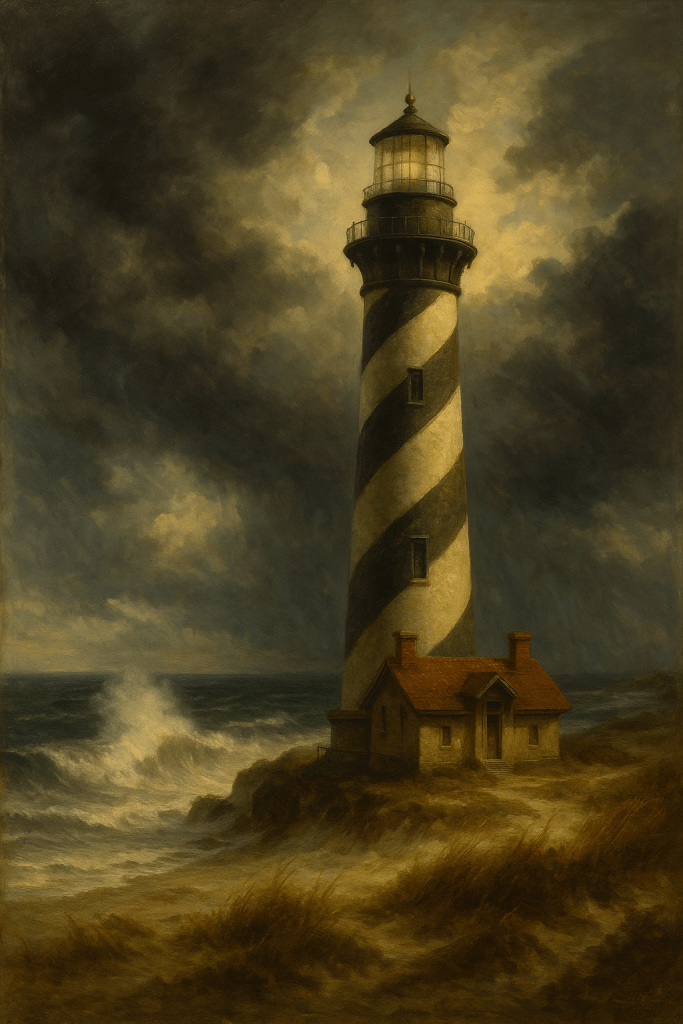
Lighthouses are born of necessity but shaped by poetry. They rise where no one would choose to live—on cliffs battered by spray, on reefs that vanish at high tide, on islands that taste of salt and wind.
The Cape Hatteras Lighthouse in North Carolina embodies that defiant grandeur. First built in 1803, rebuilt in 1870, and then—astonishingly—moved brick by brick in 1999 to escape the encroaching sea, it stands as both sentinel and survivor. Its black-and-white spiral stripes, gleaming above the dunes, seem to twist with time itself—a monument to human determination that the light must move, but it must never go out.
To gaze upon such a tower is to feel the romance of solitude—a reminder that even in the loneliest places, there can be purpose and dignity.
Light as Metaphor

Lighthouses are sermons in stone. They preach endurance without words, steadfastness without sound. Each lens, each turning prism of light, speaks the same message: I am here.
The ancients understood this. The Pharos of Alexandria, one of the Seven Wonders of the Ancient World, guided ships safely into Egypt’s harbor for nearly fifteen centuries before earthquakes brought it down. Yet its radiance lingers in language itself: pharos became the root for “lighthouse” in many tongues—a word that still glows with memory.
To tend the light, whether with oil lamp, Fresnel lens **, or electric beam, is to participate in the sacred act of pushing back the night.
Stories of Endurance
Behind every light stands a keeper—a human being who lived within its echoing walls, marking time not by clocks but by tides and storms.

Ida Lewis of Newport, Rhode Island, began her duties as a teenager at Lime Rock Light. Time and again she rowed through fog and fury to rescue those doomed by the sea. Newspapers hailed her as “America’s Bravest Woman,” and her lantern became a symbol of courage that outshone any medal.

Across the Atlantic, Grace Darling of the Farne Islands rowed with her father through hurricane winds in 1838 to save nine shipwrecked souls. Her quiet valor inspired poems, ballads, and generations of young women who learned that heroism can live in gentleness.
And far to the northwest, the keepers of Tillamook Rock Lighthouse—grimly nicknamed Terrible Tilly—faced isolation so absolute that supplies sometimes came only once a month. Waves shattered windows; lightning scorched its dome; yet through it all, the light endured until automation silenced it in 1957.
Each of these stories shines like the lanterns they kept: fragile, human, and eternal.
The Modern Fascination
Today, satellites trace invisible paths across the sky, but no digital signal can move the heart like a beam of light piercing the fog.

Tourists flock to Portland Head Light in Maine to feel its wind-whipped poetry, to Pigeon Point Light in California to watch the Pacific shimmer beneath its glass crown, or to Split Rock Lighthouse above Lake Superior, where the inland sea itself seems to bow in respect. Photographers chase those fleeting dawns when light, water, and memory merge into a single luminous chord.
Even in obsolescence, lighthouses command reverence. They remind us that guidance once required vigilance, and that safety once depended on someone staying awake.
The great Fresnel lens, invented in 1822, still feels miraculous—turning a single flame into an empire of light. Each concentric glass ring multiplied hope itself. **

A Symbol for the Soul
A lighthouse is a monument to faith—faith that light matters, faith that someone is out there searching for it. Its flame burns not for itself but for others.
We are, each of us, lighthouses in miniature—built to stand through storm, to offer direction, to keep a humble watch. We may never know the sailors who find safe harbor by our light, yet still we shine.

A Closing Hymn to the Lighthouse
On the edge of the world where the dark waves roar,
A tower stands, steady forevermore.
Its flame is a prayer in the midnight deep,
A vow it has sworn: the watch I will keep.
Through centuries long and tempests untold,
Through winds that howl and waters cold,
It whispers to sailors who wander the foam:
“Fear not the storm—you are guided home.”
So may we, like lighthouses, shine through the night,
Steadfast in truth, unwavering in light.
For though seas may rage and horizons bend,
The beacon endures till journey’s end.
Lessons from the Lightkeeper
- Constancy: Keep your post even when unseen.
- Selflessness: Shine for others, not for glory.
- Endurance: Weather the storm, not because it is easy, but because it is right.
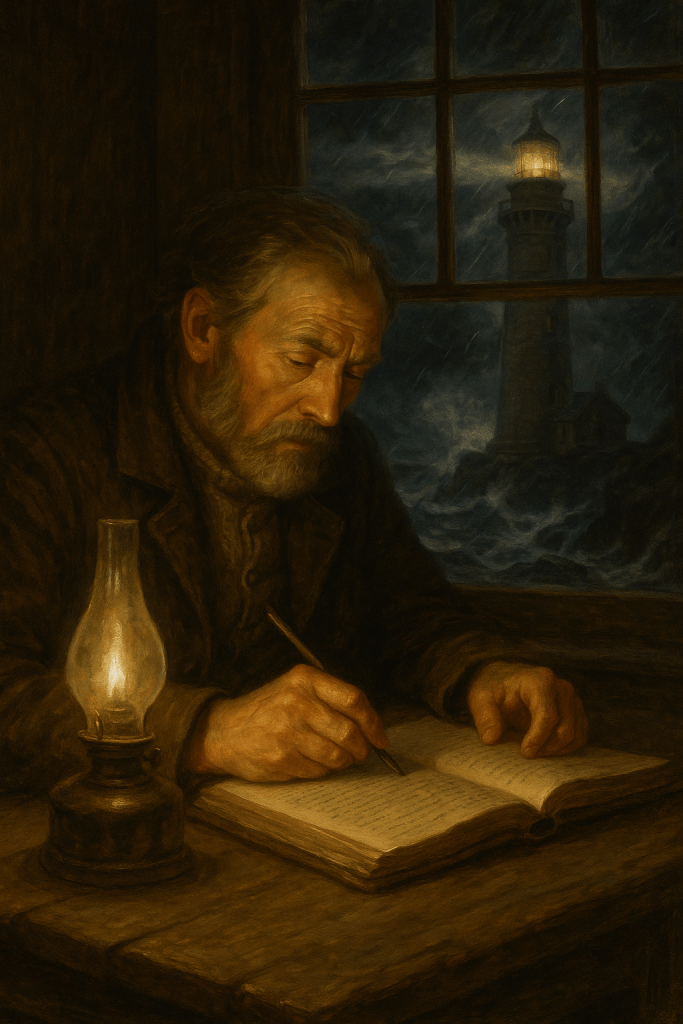
Keeper’s Log — November 12, 1898
(Written as a diary and love letter to the lighthouse)
My dearest Light,
The storm has come again. I can feel it before it arrives—the air thickens, the sea grows restless, and the lantern glass begins to quiver with a faint, trembling song. Now, as the wind batters the shutters and the surf claws at the rocks below, it is only you and I awake in this furious night.
You creak like an old soul when the wind strikes you just right—your timbers groan, your spiral stairs hum, and somewhere deep within your heart a low moan rises, as if you too feel the strain of standing against such wrath. But you do not bend, my steadfast one. You never do.
The rain lashes your windows like handfuls of nails, and yet your light keeps turning—faithful, calm, and sure. I’ve trimmed the wick twice already; the flame dances bravely in its glass crown. I swear it beats like a living pulse, and I feel it inside me, keeping time with my own heart.
I have known the company of many storms, but never one that felt like this—a symphony of roar and whisper, fury and devotion. The iron railing shudders under my hand, the stones breathe cold through my boots, and still, your light cuts through the blackness as if to say, “Here. I am still here.”
When I first came to tend you, I thought of you as duty—stone and oil and obligation. But tonight I know better. You are more than beacon; you are beloved. You hold me in your constant gaze as surely as I keep you alive with mine. The sea may rage, the thunder may roll, but within your circle of light, there is a holiness I cannot name.
If ever I am taken by these waves, let them find me reaching toward you, my tower of grace. For even when the world goes dark, you will shine—and we will always be one.
Your friend and partner,
— The Keeper
* Context of John 1:5 — This verse belongs to the prologue of the Gospel of John (1:1–18), where Christ is introduced as the eternal Word (Logos) of God —the divine source of life and light. “Light” in this passage refers to the revelation and holiness of God made visible in Jesus Himself; “darkness” signifies sin and separation from God. The verse affirms that the divine light of Christ entered a fallen world and that no power of evil or unbelief can extinguish or comprehend it. Using this verse symbolically in reference to a lighthouse honors its meaning only when the metaphor points back to Christ as the true and eternal Light of the world.
** The Fresnel Lens — Invented in 1822 by the French physicist Augustin-Jean Fresnel, this revolutionary lens transformed lighthouse illumination worldwide. Unlike a single thick piece of glass, the Fresnel lens used concentric rings of prismatic glass, each bent at a precise angle to capture and refract more light with less material. It could project a single flame’s glow over twenty miles of sea. Fresnel’s design was so efficient that mariners called it “the invention that saved a million ships.” Many keepers described its operation as almost sacred: tending the lamp within the great glass cathedral of prisms felt like standing in a temple of light.
One famous story comes from the first keeper at Cordouan Lighthouse (France), who said that when the new lens was lit, the entire tower “breathed differently” — the light shimmered across the ocean like a living thing. Modern restorers still marvel at the craftsmanship: thousands of individual glass segments, hand-ground and set with the precision of jewelry, revolving silently on mercury bearings so the beam never faltered. Even today, Fresnel lenses remain one of the most brilliant and elegant intersections of science, art, and devotion ever created.
Imaginary Job Position (hey, just for fun!): Lighthouse Keeper
Location: Edge of the world.
Hours: Continuous. The light never sleeps.
Summary:
Seeking a person of steady hand and quiet heart to tend a solitary light where sea meets sky. Must be able to endure long silences, fierce storms, and the company of one’s own thoughts. The successful applicant will be entrusted with the guardianship of the light — a flame that keeps ships from ruin and men from despair.
Responsibilities:
- Maintain the Beacon:
Trim wicks, polish lenses, refill oil, wind clockwork, and ensure the light never fails — not for wind, nor wave, nor weariness. - Keep the Watch:
Record weather, tides, and passing vessels. Note the comings and goings of fog and gull, the changing moods of sea and sky. - Stand Against the Storm:
Remain calm when the tower trembles. Maintain vigilance even when thunder deafens and waves strike the glass. - Preserve the Silence:
Live with dignity and patience amid isolation. Understand that some prayers are spoken with oil and flame rather than words.
Required Qualifications:
- Courage enough to stay when others would flee.
- Eyes that can read darkness as well as dawn.
- Hands steady enough to mend a lens and gentle enough to save a life.
- A heart attuned to rhythm of tides — faithful, unhurried, enduring.
Preferred Experience:
- Previous familiarity with solitude, reflection, or faith.
- Ability to distinguish between loneliness and peace.
- Experience keeping journals or writing letters never sent.
Compensation:
- Sunrises and sunsets without equal.
- The sound of the wind as hymn and companion.
- The knowledge that unseen lives are safer because of your light.
Closing Note:
This is not merely a job, but a calling. The keeper’s light is both duty and devotion — a sermon without words, a prayer that burns through the storm. Those who apply must be willing to give the sea their years, and in return, receive the quiet immortality of those who guard the light.
 Let's Talk About It, Lewis!