Suggested by Dr Bobby Waite / Written by Lewis McLain & AI
Introduction
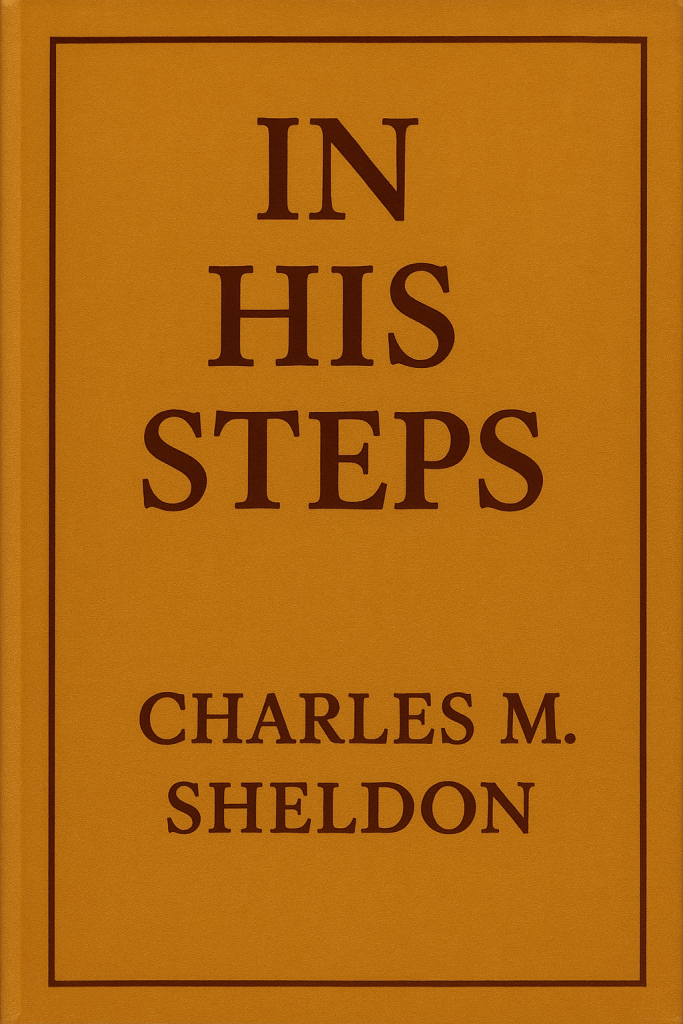
Charles Monroe Sheldon’s In His Steps (1896) is one of the most influential works of Christian fiction ever written. Its central phrase, “What would Jesus do?”, has inspired generations to think about moral choices in everyday life. While its story takes place in a fictional town, its themes are timeless: the cost of discipleship, the tension between faith and worldly demands, and the transformation of individuals and communities when Christ’s example is followed.
This essay explores Sheldon’s life, summarizes In His Steps in depth chapter by chapter, explains the modern revival of WWJD, and closes with reflections on the book’s enduring message.

The Author: Charles Monroe Sheldon
Sheldon (1857–1946) was a Congregational minister in Topeka, Kansas. Born in New York, he studied at Phillips Academy and Andover Theological Seminary, where he absorbed a passion for the “social gospel”—the idea that Christianity should directly address poverty, injustice, and inequality.
In Topeka, Sheldon pastored Central Congregational Church, where he pioneered a method of reading his novels aloud on Sunday nights, chapter by chapter. In His Steps was born this way, serialized in 1896 before becoming a published book that sold over 30 million copies.
Sheldon himself lived a life of quiet devotion. He advocated for racial equality, supported prohibition, and believed Christians must integrate faith into public and private life. His writing style—plain, earnest, accessible—allowed his message to spread far beyond theological circles.
Chapter 1 – The Unwelcome Stranger
The story opens in Raymond at First Church, where Rev. Henry Maxwell is preparing his Sunday sermon. As he polishes his manuscript, a gaunt, shabby man appears at his door. This man has been wandering the town, searching for work, and has found no one willing to hire him or even hear his story. During the morning service, he stands up and interrupts the congregation, voicing a heartfelt plea: How can Christians sing hymns about following Christ and yet ignore the struggles of the poor and unemployed all around them? His words sting, laying bare the gap between faith professed and faith lived. After speaking, he collapses. A few days later, despite some aid, he dies.
Maxwell is shaken. The preacher, once content with polished sermons, suddenly confronts the reality that words without action ring hollow. The stranger’s challenge becomes the seed of a deeper movement: What would it mean if Christians really followed Jesus in their daily lives, without compromise?
Reflection: Have we grown comfortable with religion as ritual rather than relationship? The stranger’s words force us to ask if discipleship is merely something we confess on Sunday or something we embody on Monday morning.
Chapter 2 – Rachel Winslow’s Decision
Among those moved by Maxwell’s challenge is Rachel Winslow, a gifted young singer. She receives an offer to perform professionally on the stage—a chance at fame, wealth, and admiration. But the minister’s call echoes in her heart: before making any choice, ask, “What would Jesus do?”
Rachel wrestles with the cost. She knows Jesus did not live for personal gain but to glorify the Father and serve the broken. Singing in theaters might enrich her purse but not her soul. She turns away from the contract, choosing instead to use her voice in mission halls and revival meetings. Her decision shocks her peers but inspires others in the church.
Reflection: How do we use our talents? Rachel’s struggle reminds us that every gift—whether musical, financial, or intellectual—can be employed for self-promotion or self-giving. What would Jesus have us do with what we have been entrusted?
Chapter 3 – Edward Norman and the Press
Edward Norman, the editor of Raymond’s leading newspaper, faces his own dilemma. His paper thrives on sensationalism and gossip, catering to popular taste. Yet Norman cannot escape the challenge: if Jesus were editor, what stories would He print?
He makes the radical decision to transform the paper into a source of truth, morality, and reform. No more scandal columns or lurid illustrations. Instead, he will give space to issues of justice, faith, and social need. At once, circulation drops. Advertisers threaten to withdraw. But Norman holds fast, convinced that Jesus would not exploit human sin for profit.
Reflection: How does media shape the soul of a community? Norman’s sacrifice invites us to consider our own consumption of news and entertainment. Do we value integrity over popularity? Do we measure success by revenue or righteousness?
Chapter 4 – Alexander Powers and the Railroad
Alexander Powers, superintendent of the railroad, uncovers corruption in the company’s management. To expose it would be to jeopardize his career, his income, and his standing. Yet again, the question cuts through: What would Jesus do?
He cannot remain silent. Powers decides to resign and make the wrongdoing known, even though it costs him dearly. His act is both protest and confession—a refusal to build comfort on a foundation of injustice.
Reflection: Integrity often comes at the cost of security. Are we willing, like Powers, to let go of worldly success in order to stand for truth? Or do we find ways to rationalize silence in the face of wrong?
Chapter 5 – The First Circle of Disciples
By now, Maxwell has gathered a small band of church members who commit themselves to the yearlong experiment: before any decision, personal or professional, they will sincerely ask, “What would Jesus do?” and follow through. The group includes Rachel the singer, Norman the editor, Powers the railroad man, and several others from varied walks of life.
This gathering feels fragile and daring. They know they will face ridicule, misunderstanding, and loss. Yet their eyes are opened to a higher joy: the possibility that their small acts of obedience might ripple outward to change their town.
Reflection: Discipleship is not a solo act. Maxwell’s circle shows the strength found in community. Who surrounds us to encourage our walk in Christ? Do we attempt faith alone, or do we covenant with others to walk together?
Chapter 6 – The Cost of Singing for Souls
Rachel Winslow begins singing regularly at the mission hall instead of concert halls. The mission is filled with the poor, the weary, and the broken—souls hungry for beauty and hope. Her songs move them in ways money and entertainment never could. Yet her friends and acquaintances shake their heads. They see her as wasting her talent, throwing away a promising career. Rachel feels the sting of criticism but also discovers a deeper joy: she is using her gift in direct service to God.
Reflection: What is true success? The world applauds stages and contracts, but Jesus measures hearts. Rachel’s choice asks us to reconsider what it means to use our gifts “successfully.”
Chapter 7 – The Strain of Sacrifice
The group of volunteers begins to face fatigue. Living out the principle of WWJD is harder than they expected. The cost is not only financial but emotional. They must endure gossip, misunderstandings, and the steady pressure of a culture that values ease over sacrifice. Rev. Maxwell himself feels the burden as some in the wider congregation grow restless. Is this movement too radical? Is it sustainable?
Reflection: Faith without cost is comfortable religion, but not discipleship. Do we expect Christianity to be easy? How do we respond when the path grows steep?
Chapter 8 – Norman’s Newspaper Suffers
Edward Norman’s paper continues to decline in circulation. Readers accustomed to scandal and flashy headlines desert it. Advertisers pull support. Friends urge him to moderate his position for the sake of financial solvency. But Norman holds to his conviction: Jesus would not print lies or exploit vice. The presses roll on, even at a loss. He discovers that faithfulness often means planting seeds without seeing immediate harvest.
Reflection: Are we willing to persist in obedience when results are discouraging? Norman reminds us that faithfulness is not measured in profit margins but in eternal impact.
Chapter 9 – Powers Confronts Rejection
Alexander Powers, who exposed corruption in the railroad, pays a high price. Former colleagues treat him as a traitor. Opportunities vanish. His once secure life becomes fragile. Yet he cannot escape a deeper peace: he has acted with a clean conscience. Still, his struggles reveal the harsh reality of living in integrity when the world rewards compromise.
Reflection: Would we rather be approved by men or by God? Powers forces us to face the loneliness that sometimes comes with obedience.
Chapter 10 – The Mission Expands
The mission hall, supported by Maxwell’s group, becomes a beacon for the town’s poor and downtrodden. Rachel’s music, combined with preaching and practical aid, transforms lives. Drunkards sober up, families reconcile, the hopeless find new footing. Yet such change unsettles some in Raymond’s comfortable class, who view the mission as distasteful and disruptive. For the first time, the church feels the tension of choosing between respectability and radical compassion.
Reflection: Do we prefer a tidy church that avoids “messy” people, or a living church that embraces the broken? The mission challenges our priorities.
Chapter 11 – The Circle is Tested
Within the fellowship, differences of opinion emerge. Not all interpret WWJD in the same way, and some doubt whether their sacrifices are truly worth it. Maxwell must remind them that discipleship is not about visible results or human approval but about obedience to Christ. The test of faith deepens their dependence on prayer.
Reflection: Unity is fragile without Christ at the center. When believers disagree, do we lean on prayer and humility, or do we fracture into self-will?
Chapter 12 – New Opportunities, New Opposition
As the mission continues, stories of changed lives reach further into the community. Yet opposition grows as well. Some businessmen resent the moral pressure. Some townspeople mock the fervor. Maxwell himself feels torn between his pastoral duties to the whole congregation and the radical demands of this new path. The chapter closes with a sense of tension: the seeds of transformation are taking root, but storms are gathering.
Reflection: The Kingdom of God is always both promise and provocation. Do we expect the gospel to be welcomed without resistance?
Chapter 13 – A Church Divided
The growing influence of Maxwell’s experiment stirs both admiration and unease. Some in the congregation are inspired by the sacrificial lives of Rachel, Norman, and Powers. Others feel alienated, fearing that the church has become too radical, too focused on “social issues” instead of respectable religion. Wealthier members, in particular, grow restless at the challenge to their comfortable faith. Maxwell is faced with the reality that following Jesus inevitably divides: some are drawn closer to Him, while others resist the cost.
Reflection: What does it mean when the gospel unsettles rather than comforts? Do we see division as failure, or as the natural result of light exposing darkness?
Chapter 14 – Rachel’s Song in the Slums
Rachel takes her music into the slums of Raymond, where crime, poverty, and despair run rampant. Her clear voice rings out in dingy halls and dirty streets, drawing crowds who might never enter a church. Hardened men weep. Broken families find hope. Yet critics scoff that such work is beneath her talent. Rachel discovers that the presence of Christ often shines brightest in the darkest places.
Reflection: Where is the Spirit calling us to sing? Are we willing to step into uncomfortable spaces if it means shining light where it is most needed?
Chapter 15 – Norman’s Courage Strengthened
Edward Norman continues publishing his “clean” paper. Though subscriptions lag, a loyal readership begins to grow—those who value integrity, families who welcome wholesome news, reformers who see the paper as an ally. Norman realizes that Jesus’ way is slow, often hidden, but steady. His paper becomes less a business and more a ministry.
Reflection: Do we measure impact by breadth or depth? Norman reminds us that influence may be smaller in number yet greater in lasting effect when rooted in truth.
Chapter 16 – Powers’ Quiet Witness
Though Alexander Powers has lost his position and prestige, his testimony spreads quietly. Younger men see in him an example of honesty and courage. His sacrifice becomes a seed planted in others, proving that one man’s faithfulness can inspire many. He begins to grasp that obedience has ripple effects beyond what we can see.
Reflection: Would we make hard choices if we never saw the results? Powers teaches us that obedience itself is victory, regardless of outcome.
Chapter 17 – The Mission Grows
The mission hall becomes a center of community renewal. Former drunkards now work to help others. Children find safety and instruction. Women once exploited find dignity. Rachel and others marvel at the slow but steady transformation. The once “respectable” church begins to look more like the body of Christ—a place where the least and the lost are welcomed.
Reflection: Is our faith attractive to the poor and hurting, or only to the comfortable? A true mission church draws those who most need hope.
Chapter 18 – Maxwell Under Fire
Rev. Maxwell himself faces sharp criticism. Some accuse him of stirring unrest, of pushing his church into impractical experiments. They argue that religion should comfort, not disrupt. Maxwell agonizes but finds strength in Christ’s words: “If anyone would come after Me, he must deny himself, take up his cross, and follow Me.” His own pastoral identity deepens: he is not just a preacher of words but a shepherd leading by costly example.
Reflection: Do we prefer leaders who soothe us or who challenge us? Maxwell’s courage reminds us that true shepherds sometimes lead through fire.
Chapter 19 – A New Spirit in Raymond
Slowly, the whole town of Raymond begins to feel the effects. Businesses are pressured to adopt fairer practices. The poor find greater assistance. Families reform. While resistance remains, there is no denying that a spirit of honesty, compassion, and justice is stirring. The WWJD movement proves that when even a handful take Jesus seriously, a community cannot remain the same.
Reflection: Can one town be changed by a few believers? Raymond suggests that transformation begins not with masses but with a faithful remnant.
Chapter 20 – Beyond the Town Walls
News of Raymond’s transformation begins to spread. Visitors come, curious to see what is happening. Maxwell realizes that this is no longer a local experiment but the beginning of a broader movement. The cost has been great, but the vision is widening. The Kingdom of God, once a whispered challenge, is becoming a visible witness.
Reflection: Do we see our obedience as isolated, or as part of a bigger story? Maxwell and his circle discover that faithfulness in one place can spark hope in many.
Chapter 21 – A Call to the City
The narrative shifts from the small town of Raymond to the bustling, broken city of Chicago. Here the needs are greater, the poverty more desperate, and the injustices more entrenched. Maxwell and his companions realize that the principle of What Would Jesus Do? cannot remain a local curiosity—it must confront the sprawling urban problems of the industrial age. The slums teem with children, the factories grind down workers, and greed drives wedges between classes. Chicago becomes a testing ground for whether the movement can scale beyond Raymond’s relative simplicity.
Reflection: Is our faith confined to safe spaces, or does it engage the complexity of the wider world?
Chapter 22 – Rachel Sings in the City
Rachel Winslow takes her voice to Chicago, singing in mission halls and crowded streets. The contrast between the opulence of the theaters and the desperation of the tenements pierces her heart. Her music becomes a balm to weary souls, lifting spirits in ways applause never could. Yet again she faces mockery from those who cannot fathom why she would choose such venues over fame. Her courage in the city shows that discipleship is not about the size of the stage but the depth of the service.
Reflection: Do we reserve our best efforts for audiences that can reward us, or do we give them freely to those who cannot pay us back?
Chapter 23 – Norman’s Paper Speaks to Injustice
Edward Norman sees in Chicago a wider canvas for his reformed newspaper. He writes against slum lords, factory abuses, and political corruption. His paper becomes a voice for the voiceless. Yet his stand draws the ire of powerful men who profit from the misery of the poor. Norman must endure not only financial strain but open threats. Still, he refuses to compromise the principle that the press must serve truth rather than exploitation.
Reflection: Is truth worth more than safety? Norman’s witness reminds us that media has the power to either sustain injustice or dismantle it.
Chapter 24 – Powers and the Labor Struggle
Alexander Powers, already scarred by his resignation in Raymond, observes the plight of workers in Chicago. Strikes, riots, and hunger mark the labor landscape. Powers recognizes that Jesus would stand with the oppressed rather than side with profit-driven interests. He lends his voice to the cause of justice, though it costs him even more of the little stability he has left. His journey highlights that obedience to Christ is often not a single sacrifice but a continual surrender.
Reflection: Do we expect discipleship to be a one-time decision, or are we prepared for a lifetime of costly choices?
Chapter 25 – Maxwell’s Preaching in Chicago
Rev. Maxwell preaches in Chicago with a new urgency. He does not deliver polished sermons to cushioned pews but passionate appeals in crowded halls where workers, drunkards, and the destitute gather. His words, grounded in the question WWJD, strike a chord with the disillusioned. Many are moved, but opposition is fierce. Established churches accuse him of undermining tradition; businessmen fear his influence. Maxwell discovers that preaching Christ faithfully in the city provokes both hunger and hostility.
Reflection: Does our preaching comfort the comfortable, or confront them? Maxwell’s courage asks whether we speak truth even when it unsettles the powerful.
Chapter 26 – Seeds of Reform
The Chicago mission begins to bear fruit. Small reforms take place: children receive schooling, workers are given aid, churches awaken to neglected neighborhoods. The change is incremental but real. Maxwell and his companions marvel at how obedience in small things can build momentum in large settings. Yet the work is overwhelming; the need is always greater than the supply. They learn that following Jesus means being faithful, even when the harvest seems beyond reach.
Reflection: Do we measure our calling by what we can accomplish, or by our willingness to serve where we are placed?
Chapter 27 – Struggles Within the Fellowship
As the mission stretches them thin, fatigue and discouragement threaten the fellowship. Some wonder if they have truly been called to such a vast, unending work. Others question whether the principle of WWJD is practical in the grit of city life. Maxwell reminds them again that the goal is not worldly success but obedience, step by step. The tension within the group mirrors the struggles of any Christian community striving to live faithfully in a hostile world.
Reflection: How do we guard unity when pressures mount? Do we hold fast to Christ or let weariness fracture our resolve?
Chapter 28 – Rachel’s Sacrifice Deepens
Rachel faces a renewed temptation: a lucrative offer to leave the mission and return to the professional stage. The glamour of a different life beckons, especially amid the weariness of slum work. Yet she remembers her vow: What would Jesus do? Again, she chooses the mission over fame. Her decision seals her identity not as an entertainer for crowds but as a servant for Christ.
Reflection: Are we willing to re-make the same sacrifice when the temptation returns? Rachel shows that obedience is not only once but often repeated.
Chapter 29 – A City Awakens
The message of WWJD spreads among workers, churches, and reformers. Though resistance remains, more Christians begin to take the question seriously. Chicago does not transform overnight, but a spirit of renewal begins to stir. The seeds planted by a handful of disciples in Raymond begin to take root in the soil of a great city.
Reflection: Can one small flame light a vast darkness? The story suggests it can—if that flame is Christ’s.
Chapter 30 – The Cost Counted Again
The circle of disciples looks back on all they have lost—careers, income, reputation, comfort. Yet they also see what they have gained: lives changed, truth spoken, faith deepened, hope restored. They realize that their sacrifices, though painful, have been investments in eternity.
Reflection: Do we weigh our lives in terms of comfort lost or souls touched?
Chapter 31 – The Call to the Reader
The novel closes by turning outward, from the fictional world to the real. Sheldon directs the challenge to us: Will we, like the Raymond fellowship, commit ourselves to live for one year by the question What would Jesus do? The reader cannot escape. The book refuses to remain story; it becomes summons.
Reflection: The final challenge is not about the past but the present. Will you take the next step in His steps?

The Epilogue: The Modern Revival of WWJD
The phrase “What Would Jesus Do?” re-emerged a century later. In the 1990s, Christian youth movements popularized WWJD bracelets—simple cloth bands worn as daily reminders. Millions of teenagers wore them, creating a wave of evangelical energy.
This revival traced directly back to Sheldon’s novel, though often stripped of its social-gospel edge. For some, it was a fashion trend; for others, a sincere daily compass. Whether whispered in prayer or emblazoned on a wristband, the question endured as a simple yet profound moral check.
Final Reflection
In His Steps is not great literature in style, but it is great in conviction. Sheldon forces readers to confront the gap between profession and practice. The story insists: Christianity is not just believing Jesus died for you, but living as He lived—for others, for truth, for God’s glory.
The enduring power of WWJD lies in its simplicity. The four words distill centuries of theology into a daily, personal, and practical call. It is a question that cuts across denominations, cultures, and generations. The reader cannot escape the final challenge: Will you take the next step—in His steps?
 Let's Talk About It, Lewis!
This is really good. I enjoyed all of it. Question: Today in 2025 with the world in crisis, would asking WWJD work for people? I think some people identify as Christians but do not do as Jesus would do. If only a few souls are brave enough to do what Jesus would do, the uphill battle would crush them. I’ve given corner beggars money before but I would be foolish to open my home to them. How do you know when to draw the line? Turning the other cheek can mean 2 black eyes instead of 1. There are so many horrors on this earth today that I think even Jesus wouldn’t know what to do. Anyway, this was a good one.
LikeLike