A collaboration between Lewis McLain & AI
In recent chapters, a recurring theme emerges as Paul preaches before being beaten, jailed, and run out of town, preventing further harm. However, the tension grows as the crowds now want him killed. We know something terrible is going to happen, but when, where, and how is still not known.
Section 1: Paul Before the Sanhedrin (vv. 1–11)
Summary
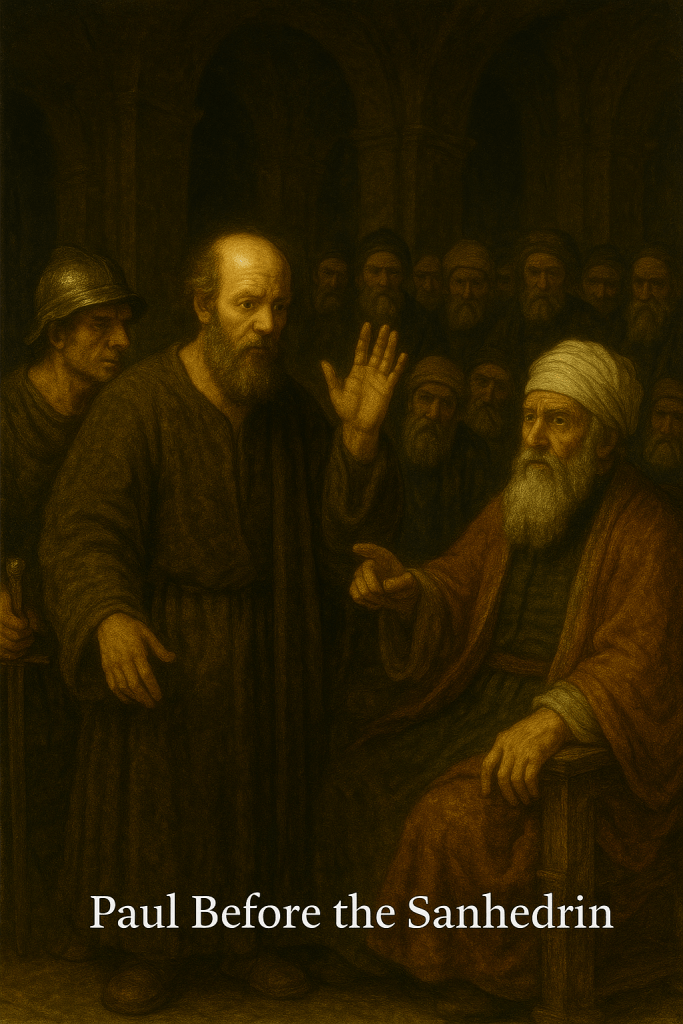
Paul, standing before the Sanhedrin (the Jewish ruling council composed of elders, priests, and scribes, functioning as the highest court in religious and civil matters), begins by declaring his clear conscience before God. The high priest Ananias orders him struck on the mouth, prompting Paul to call him a “whitewashed wall.”¹ Realizing afterward that he had spoken harshly against the high priest, Paul cites the law forbidding him from reviling a ruler of the people.³
Cleverly, Paul then shifts the focus by declaring his belief in the *hope of the resurrection of the dead.*² This phrase immediately divides the council. Some were Pharisees (a group devoted to strict observance of the Law of Moses, the oral traditions, and belief in resurrection, angels, and spirits), while others were Sadducees (a priestly, aristocratic group that rejected resurrection, angels, and spirits, accepting only the written Torah). This difference causes violent dissension, forcing the Roman commander to intervene and remove Paul by force. That night, the Lord appears to Paul, assuring him that just as he testified in Jerusalem, so he must also testify in Rome.
Text (NIV)
- Paul looked straight at the Sanhedrin and said, “My brothers, I have fulfilled my duty to God in all good conscience to this day.”
- At this the high priest Ananias ordered those standing near Paul to strike him on the mouth.
- Then Paul said to him, “God will strike you, you whitewashed wall!¹ You sit there to judge me according to the law, yet you yourself violate the law by commanding that I be struck!”
- Those who were standing near Paul said, “How dare you insult God’s high priest!”
- Paul replied, “Brothers, I did not realize that he was the high priest; for it is written: ‘Do not speak evil about the ruler of your people.’³”
- Then Paul, knowing that some of them were Sadducees and the others Pharisees, called out in the Sanhedrin, “My brothers, I am a Pharisee, descended from Pharisees. I stand on trial because of the hope of the resurrection of the dead.²”
- When he said this, a dispute broke out between the Pharisees and the Sadducees, and the assembly was divided.
- (The Sadducees say that there is no resurrection, and that there are neither angels nor spirits, but the Pharisees believe all these things.)
- There was a great uproar, and some of the teachers of the law who were Pharisees stood up and argued vigorously. “We find nothing wrong with this man,” they said. “What if a spirit or an angel has spoken to him?”
- The dispute became so violent that the commander was afraid Paul would be torn to pieces by them. He ordered the troops to go down and take him away from them by force and bring him into the barracks.
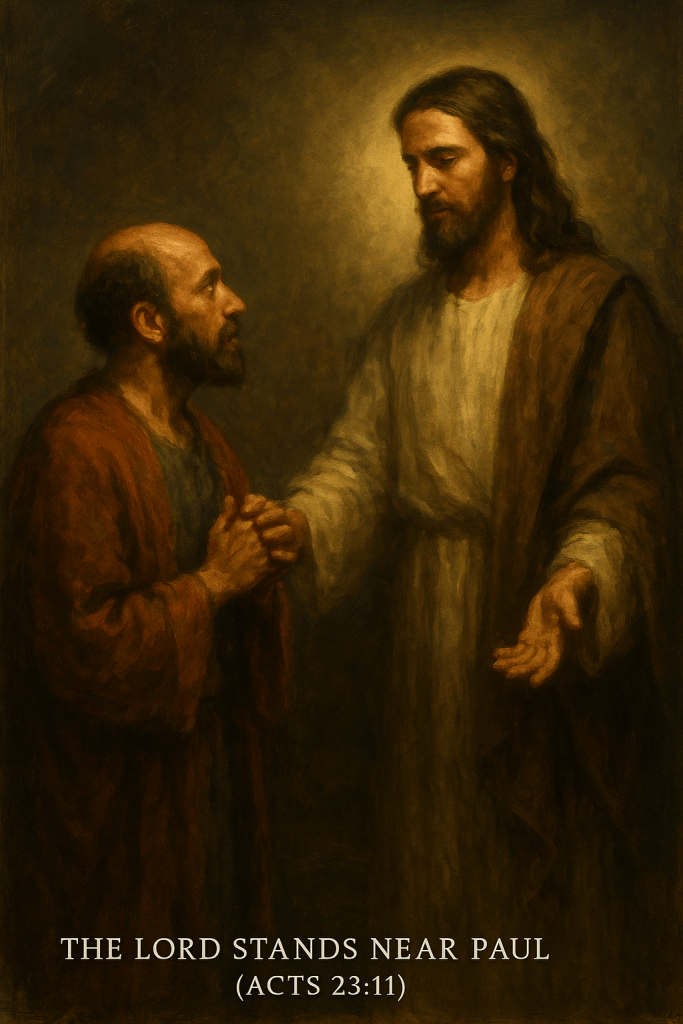
- The following night the Lord stood near Paul and said, “Take courage! As you have testified about me in Jerusalem, so you must also testify in Rome.”
¹ The phrase “whitewashed wall” draws from Ezekiel 13:10–15, where false prophets covered weak walls with plaster to hide their flaws, and from Jesus’ rebuke in Matthew 23:27 calling the Pharisees “whitewashed tombs.” Whitewashing made a wall or tomb look clean outwardly, but it could not change the corruption or weakness beneath. Paul applied this imagery to Ananias, exposing his hypocrisy as a judge of the law who violated the law.
² Paul uses the phrase “hope of the resurrection of the dead” not because he lacked certainty (he had seen the risen Christ and even witnessed resurrection miracles) but because “hope” in biblical usage means confident expectation rooted in God’s promise. It also strategically appealed to the Pharisees, who shared this doctrine, creating division with the Sadducees. The phrase reflects both the already of Christ’s resurrection and the not-yet of the final resurrection still to come (see 1 Corinthians 15:20–23).
³ Paul’s statement comes from Exodus 22:28: “Do not blaspheme God or curse the ruler of your people.” The Torah commanded respect for leaders as an extension of respect for God’s authority. Even David refused to curse or harm Saul, calling him “the Lord’s anointed” (1 Samuel 24:6). Paul quickly acknowledged that Scripture restrained his words, even when the high priest acted unjustly.
Reflection Questions
- How does Paul’s appeal to resurrection strategically divide his opponents?
- What can we learn from Paul’s correction after insulting the high priest?
- How does the Lord’s reassurance to Paul at night shape his courage for the trials ahead?

Section 2: The Plot to Kill Paul (vv. 12–22)
Summary
A group of Jews form a conspiracy, vowing neither to eat nor drink until they kill Paul. More than forty men join this plot, seeking the support of the chief priests and elders. But Paul’s nephew overhears the plan and reports it to Paul, who sends him to the Roman commander (Claudius Lysias). The commander hears him privately and warns the boy to tell no one that he has revealed this conspiracy.
Text (NIV)
- The next morning some Jews formed a conspiracy and bound themselves with an oath not to eat or drink until they had killed Paul.
- More than forty men were involved in this plot.
- They went to the chief priests and the elders and said, “We have taken a solemn oath not to eat anything until we have killed Paul.
- Now then, you and the Sanhedrin petition the commander to bring him before you on the pretext of wanting more accurate information about his case. We are ready to kill him before he gets here.”
- But when the son of Paul’s sister heard of this plot, he went into the barracks and told Paul.
- Then Paul called one of the centurions and said, “Take this young man to the commander; he has something to tell him.”
- So he took him to the commander. The centurion said, “Paul the prisoner sent for me and asked me to bring this young man to you because he has something to tell you.”
- The commander took the young man by the hand, drew him aside and asked, “What is it you want to tell me?”
- He said: “Some Jews have agreed to ask you to bring Paul before the Sanhedrin tomorrow on the pretext of wanting more accurate information about him.
- Don’t give in to them, because more than forty of them are waiting in ambush for him. They have taken an oath not to eat or drink until they have killed him. They are ready now, waiting for your consent to their request.”
- The commander dismissed the young man with this warning: “Don’t tell anyone that you have reported this to me.”
Reflection Questions
- What does this plot reveal about the depth of opposition to Paul?
- How does God’s providence work through Paul’s nephew?
- What lessons can believers take from the commander’s discretion with Paul’s nephew?

Section 3: Paul Sent to Governor Felix (vv. 23–35)

Summary
The commander arranges for Paul’s safe transfer to Caesarea under heavy guard, recognizing the seriousness of the plot against him. He writes a formal letter to Governor Felix, explaining Paul’s situation: that Paul is accused over religious disputes, not crimes deserving death or imprisonment. Paul is escorted with two hundred soldiers, seventy horsemen, and two hundred spearmen to Antipatris, then to Caesarea. There, Felix agrees to hear Paul’s case once his accusers arrive, and Paul is held in Herod’s palace.
Text (NIV)
- Then he called two of his centurions and ordered them, “Get ready a detachment of two hundred soldiers, seventy horsemen and two hundred spearmen to go to Caesarea at nine tonight.
- Provide horses for Paul so that he may be taken safely to Governor Felix.”
- He wrote a letter as follows:
- Claudius Lysias, To His Excellency, Governor Felix: Greetings.
- This man was seized by the Jews and they were about to kill him, but I came with my troops and rescued him, for I had learned that he is a Roman citizen.
- I wanted to know why they were accusing him, so I brought him to their Sanhedrin.
- I found that the accusation had to do with questions about their law, but there was no charge against him that deserved death or imprisonment.
- When I was informed of a plot to be carried out against the man, I sent him to you at once. I also ordered his accusers to present to you their case against him.
- So the soldiers, carrying out their orders, took Paul with them during the night and brought him as far as Antipatris.
- The next day they let the cavalry go on with him, while they returned to the barracks.
- When the cavalry arrived in Caesarea, they delivered the letter to the governor and handed Paul over to him.
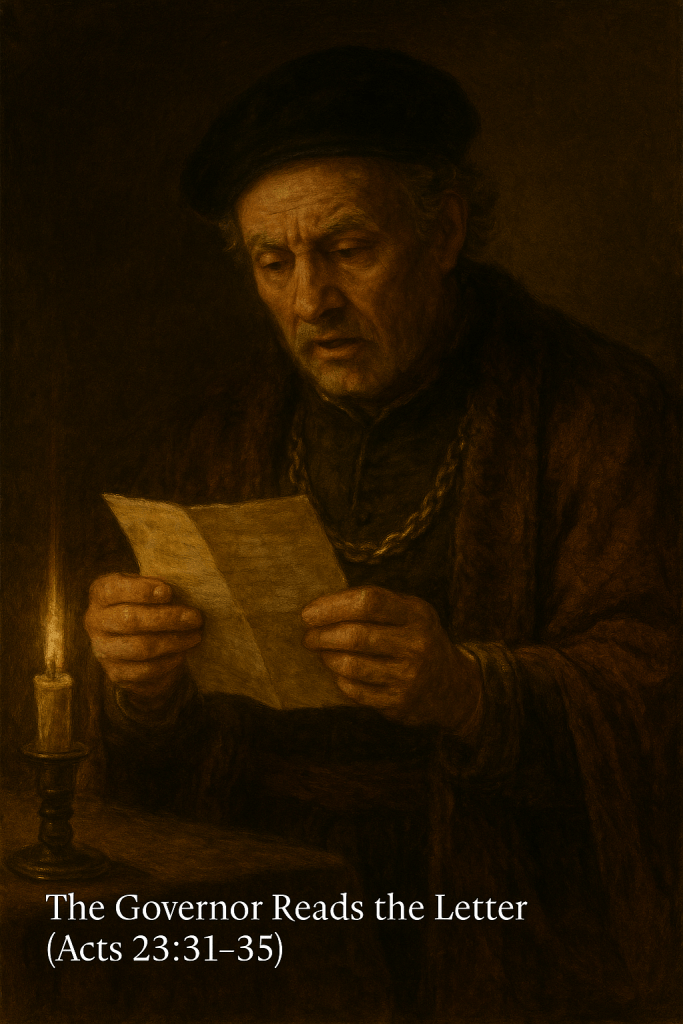
- The governor read the letter and asked what province he was from. Learning that he was from Cilicia, he said,
- “I will hear your case when your accusers get here.” Then he ordered that Paul be kept under guard in Herod’s palace.
Reflection Questions
- What does the military escort say about the seriousness of Paul’s situation?
- How does Claudius Lysias’s letter reveal Roman attitudes toward religious disputes?
- Why is it important that Paul ends up in Caesarea before Felix?
Expanded Poetic Conversation
Paul:
“The council rages, yet I stand,
My hope in God, not built on sand.
Through chains and threats, I will proclaim,
The risen Lord, His holy name.”
High Priest Ananias:
“Strike him down, this man of lies!
He mocks the law, he dares defy.
Yet law I bend for power’s gain,
A robe of white hides inward stain.”
Pharisees:
“Perhaps a spirit spoke his word,
Perhaps an angel he has heard.
The dead shall rise, the prophets say,
On such a hope we stake our way.”
Sadducees:
“No angel comes, no dead shall wake,
The Law is ours alone to take.
His words are smoke, his hope a snare,
No life awaits beyond the grave’s cold air.”
Paul’s Nephew:
“My heart beat fast, my voice was low,
A deadly plot I came to show.
O God who guards the weak and small,
Through me You chose to save Your Paul.”
Commander Claudius Lysias:
“A Roman citizen, I must defend,
From mob and oath that seek his end.
By night we ride, with torch and steel,
To guard this man of fervent zeal.”
Governor Felix:
“A letter comes, I read with care,
This Paul shall answer judgment here.
I’ll wait until accusers speak,
And weigh the strength of law they seek.”
The Lord (to Paul):
“Take courage, son, the night is mine,
In Rome your voice shall yet still shine.
Though plots may rise and chains may bind,
My sovereign hand directs mankind.”
 Let's Talk About It, Lewis!