Introduction: The City Gate as Civic Heart
In the ancient world, the city gate was more than a stone arch or wooden doors. It was the civic, social, and spiritual heart of the community. Here trade was conducted, disputes were resolved, leaders rendered decisions, and prophets raised their voices. In Ruth 4:1–2, Boaz sealed his redemption of Ruth at the city gate before witnesses. In Jeremiah 17:19–20, the prophet was commanded to proclaim God’s word at the gates of Jerusalem. Kings themselves often received news and judged cases at the gate (2 Samuel 18:24).
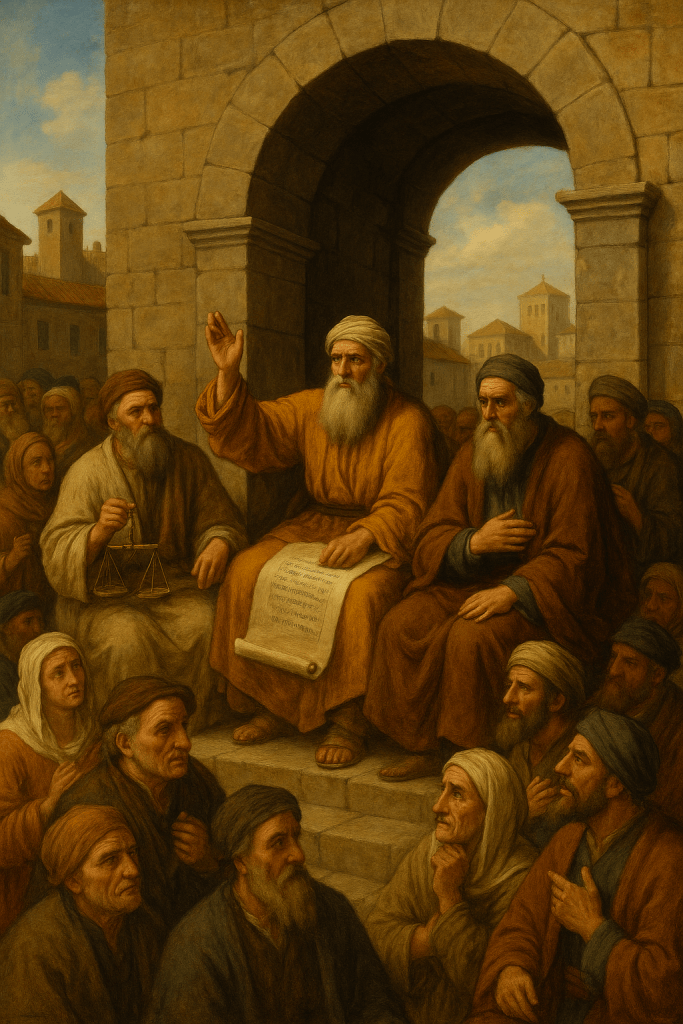
The gate symbolized more than access—it symbolized justice, accountability, and leadership. It was the visible intersection of daily life and divine law. To uphold justice at the gate was to keep a city strong; to allow corruption at the gate was to invite decay.
Today, while we no longer gather at fortified gates, our societies still have civic spaces—councils, courts, and public forums—where truth must be spoken and justice upheld. The biblical model offers timeless lessons for leaders and citizens alike.
Biblical Vision of Justice at the Gate
The Old Testament consistently emphasizes the link between justice and the gate:
- Ruth 4:1–2 — Boaz redeems Ruth at the gate, before the elders. Justice is made public and accountable.
- Deuteronomy 21:18–21 — Difficult family cases were brought to the elders at the gate. The community upheld standards openly.
- Proverbs 31:23 — The noble woman’s husband is known at the gates, sitting among respected leaders.
- Amos 5:12, 15 — The prophet condemns those who oppress the poor and take bribes at the gate, calling instead to “Hate evil, love good; maintain justice in the courts.”
Justice at the gate was not abstract philosophy. It was visible, daily, and local. It ensured that decisions were made before witnesses, that leaders were accountable to their people, and that God’s law was upheld in plain sight.
Historical Parallels: Public Squares Through the Ages
The civic gate in Israel parallels many other traditions:
- Greek Agora & Areopagus: Open-air marketplaces where trade mingled with debate. At the Areopagus in Athens (Acts 17), Paul proclaimed the gospel, demonstrating how truth entered the civic square.
- Roman Forum: A bustling center of speeches, trials, and decrees—visible governance rather than hidden chambers.
- Medieval Town Halls: Citizens gathered in open assemblies to make decisions and hold rulers accountable.
- American Town Halls: Early New England communities continued this biblical pattern of public, local, accountable governance.
Each of these models affirms the principle: justice thrives in the open and fails when hidden.

Christian and Conservative Reflections
Theologically, justice at the gate reflects God’s character. He is righteous, impartial, and merciful. Leaders are stewards of His justice, accountable to Him as much as to their people.
From a conservative viewpoint, the gate represents subsidiarity—the principle that decisions should be made at the lowest competent level, closest to the people affected. Local responsibility preserves accountability and resists the overreach of distant power. Just as the gate kept decisions grounded in daily life, so too should modern governance empower local families, churches, and councils.
When leadership drifts from the gate—when decisions are hidden in bureaucracies or swayed by special interests—the vulnerable suffer first. The widow, the orphan, and the foreigner—so often named in Scripture—lose their advocates. To restore justice at the gate is to restore confidence in society itself.
Modern “City Gates”
What are the equivalents today?
- City Councils and Courthouses: Our literal gates where ordinances, budgets, and verdicts shape daily life. Citizens must engage, not retreat, if justice is to remain upright.
- Media Platforms: Though virtual, they shape public thought. Like the gates of old, they are places of influence, yet vulnerable to manipulation.
- Churches and Families: The first gates of moral formation. If these falter, corruption soon seeps into public life.
The prophets’ words echo still: “Let justice roll on like a river, righteousness like a never-failing stream!” (Amos 5:24).
Responsibilities of Leaders and Citizens
- For Leaders: Uphold impartiality, refuse bribery, defend the weak, and ensure decisions are made openly. Insist on civility – more than demonstration – a change in the heart.
- For Citizens: Engage the gate. Speak truth, vote responsibly, serve in local roles, and refuse cynicism. Accept the call to genuine civility. Silence allows injustice to thrive.
Like Paul in Athens, Christians must enter the gate—whether physical council chambers or digital platforms—with both courage and humility, speaking truth in love but refusing compromise with corruption.
Reflection Questions
- What are the “gates” in your community where justice is shaped?
- Do you see signs of accountability or corruption at these gates?
- How can you and your family engage more intentionally at these civic gates?
- In what ways does your church help form values that influence public life?
- How can local governance reflect both biblical justice and conservative principles of accountability and subsidiarity?
Conclusion: Restoring Justice at the Gate
The city gate was never just architecture. It was the place where truth was tested, justice was upheld, and leaders proved their worth. When justice ruled there, the city flourished. When injustice crept in, prophets cried out, and judgment soon followed.
Our communities today need leaders who will guard the gates with integrity—and citizens who will not abandon their responsibility to watch, question, and participate. Justice at the gate is justice in the light, where truth cannot hide and power must answer to principle.
If nations are to endure, their gates must once again be strong. For it is at the gate, before the people and before God, that societies reveal their true character.
 Let's Talk About It, Lewis!