Introduction
From the opening chapters of Scripture, words hold power. God spoke creation into being: “And God said, ‘Let there be light,’ and there was light” (Genesis 1:3). The entire cosmos came into existence not by hammer or flame, but by a word. That same pattern continues throughout the biblical story—words bless, words curse, words bind, words heal.
Proverbs teaches: “Death and life are in the power of the tongue” (Proverbs 18:21). James calls the tongue “a restless evil, full of deadly poison” (James 3:8). Jesus warned, “By your words you will be acquitted, and by your words you will be condemned” (Matthew 12:37). In short, words are never neutral. They carry eternal weight.
In our age of microphones, cameras, podcasts, and viral clips, words travel faster and linger longer than at any point in history. The responsibility to use them wisely has never been greater.
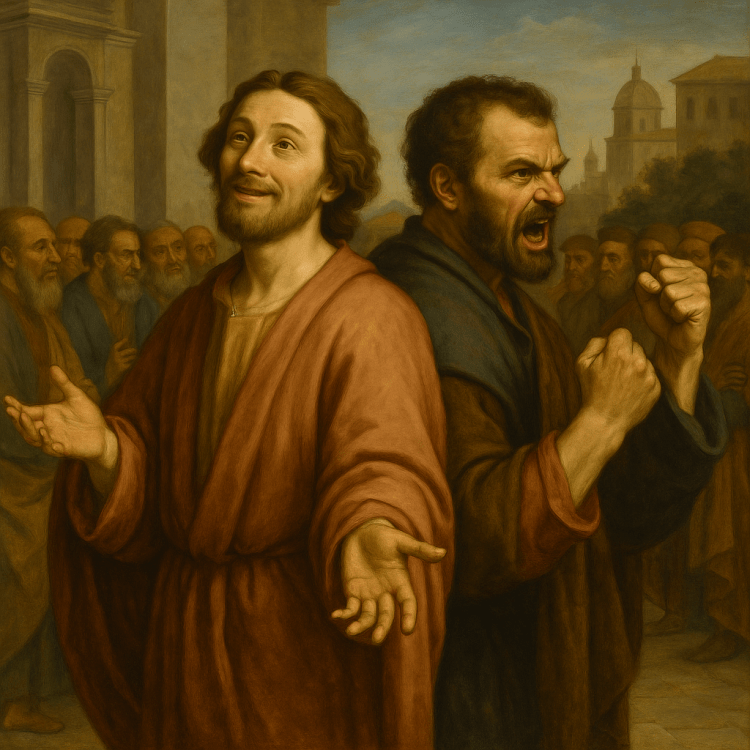
Words in Scripture: Creation, Covenant, and Consequence
The Bible presents a consistent theology of speech:
- Creation: God’s voice orders chaos into cosmos. His Word is life.
- Covenant: God binds His people through words—promises, commands, blessings. At Sinai, the Ten Commandments were not just laws but rather the terms of a covenant relationship.
- Consequence: Misuse of words brings judgment. The serpent’s lie in Eden unleashed sin. The Tower of Babel scattered humanity through the confusion of language. James compares the tongue to a spark that can ignite a forest fire.
Speech reveals the heart. What we say cannot be detached from who we are. When Christians speak, we bear witness—either faithfully or unfaithfully—to the One whose Word is truth.
The Double-Edged Sword of Rhetoric
Speech directs thought, shapes culture, and determines destiny.
Examples of Life-Giving Speech:
- Winston Churchill’s wartime speeches gave hope when Britain stood alone against Nazi aggression.
- Martin Luther King Jr.’s “I Have a Dream” speech elevated America’s conscience and called a nation to live up to its founding ideals.
- Ronald Reagan’s speeches framed freedom as a moral calling and helped inspire the end of the Cold War.
Examples of Destructive Speech:
- Adolf Hitler rose to power not through military might but through rhetoric that stirred resentment, fear, and blind loyalty.
- Communist regimes perfected propaganda—lies repeated until they reshaped whole nations.
- Today, misinformation spreads across the internet, dividing families, communities, and even churches.
Speech is a double-edged sword. It can build a nation or tear it apart. It can lead souls to God or away from Him.
The Christian Call to Speech
Christians are not free to use words carelessly. Paul exhorts believers: “Let your conversation be always full of grace, seasoned with salt, so that you may know how to answer everyone” (Colossians 4:6).
Key principles for Christian speech:
- Truth: Our words must align with God’s Word, not with convenience or fear.
- Grace: Even when confronting error, speech should aim to restore, not merely to win.
- Courage: Silence in the face of evil can be as destructive as outright lies.
- Order: Freedom of speech is a gift that requires responsibility. Christian liberty does not mean license to slander or manipulate.
The Political Call to Responsible Speech
Healthy republics depend on honest, principled speech just as the church depends on truthful proclamation. In a democracy, rhetoric is the bloodstream of self-government. Campaigns, debates, editorials, and legislative arguments all shape the direction of policy and the trust of citizens.
- Honesty: Political speech should inform rather than manipulate. Without truth, public trust erodes.
- Civility: Sharp disagreement is necessary in free societies, but respect must remain.
- Accountability: Leaders must remember that promises are words, and broken promises corrode confidence in institutions.
- Restraint: Free speech must be exercised with discipline—slander, exaggeration, and reckless accusations undermine liberty rather than protect it.
From a conservative perspective, the Founders understood this well. They enshrined free speech in the First Amendment not to encourage recklessness but to secure a space for truth, conscience, and accountability. The survival of liberty rests not only on what is said but how it is said.
Words in the Digital Square and the Areopagus
Today’s digital world multiplies the reach of speech. Tweets, podcasts, YouTube clips, and live streams have become the new “public square.” In biblical terms, it resembles the Areopagus of Athens—an open forum where thinkers, philosophers, and ordinary citizens gathered to debate ideas (see Acts 17:19–34).
When Paul stood at the Areopagus, he neither shrank back nor spoke recklessly. He engaged respectfully, quoting poets familiar to his audience, yet clearly proclaiming Christ as Lord. His model is instructive: engage culture on its own turf, but always direct the conversation back to truth.
Our digital Areopagus is chaotic—full of noise, competing voices, and sometimes hostility. Yet it remains a place where destinies are shaped daily by words. Christians and conservatives are called not to abandon it, but to enter it with wisdom, clarity, and courage.
Charlie Kirk and the Modern Rhetorical Arena
Figures like Charlie Kirk illustrate how modern rhetoric shapes culture. On college campuses, Kirk asks pointed questions that expose contradictions in progressive ideologies. His method—firm, articulate, unapologetic—shows the importance of confidence in public dialogue.
Yet his approach also raises questions. Strong rhetoric can embolden the like-minded but risk alienating opponents. The balance between conviction and persuasion, boldness and bridge-building, remains a challenge for all Christians engaging in public debate.
Kirk represents a broader principle: in a fragmented age, those willing to speak clearly and consistently often shape the direction of conversation. Silence cedes the field to others.
Reflection Questions
- Which words spoken to you—encouragements or criticisms—still shape your identity today?
- How do you test whether your speech reflects truth, grace, and responsibility?
- How can you use social media or digital platforms to build others up rather than tear them down?
- What examples of courageous, life-giving speech inspire you? How can you model them in your family, church, or community?
- Where are you tempted to remain silent when words of truth are most needed?
- In political conversations, do your words clarify truth and invite reasoned debate, or do they simply mimic the noise of partisanship?
Conclusion
Words are never weightless. They carry the power to create or destroy, to build up or to break down, to bless or to curse. Scripture reminds us that every careless word will be judged (Matthew 12:36). History testifies that nations rise and fall on the power of words. And our own lives bear the marks of things spoken long ago.
For Christians, the calling is to speak words of truth and grace that reflect Christ. For citizens, the calling is to speak responsibly, with honesty and civility, guarding the republic from the corruption of careless speech. In both spheres, the weight of words shapes destiny.
In a world drowning in noise, the faithful word—grounded in Scripture, shaped by love, disciplined by truth, and spoken with courage—can still change hearts and nations.
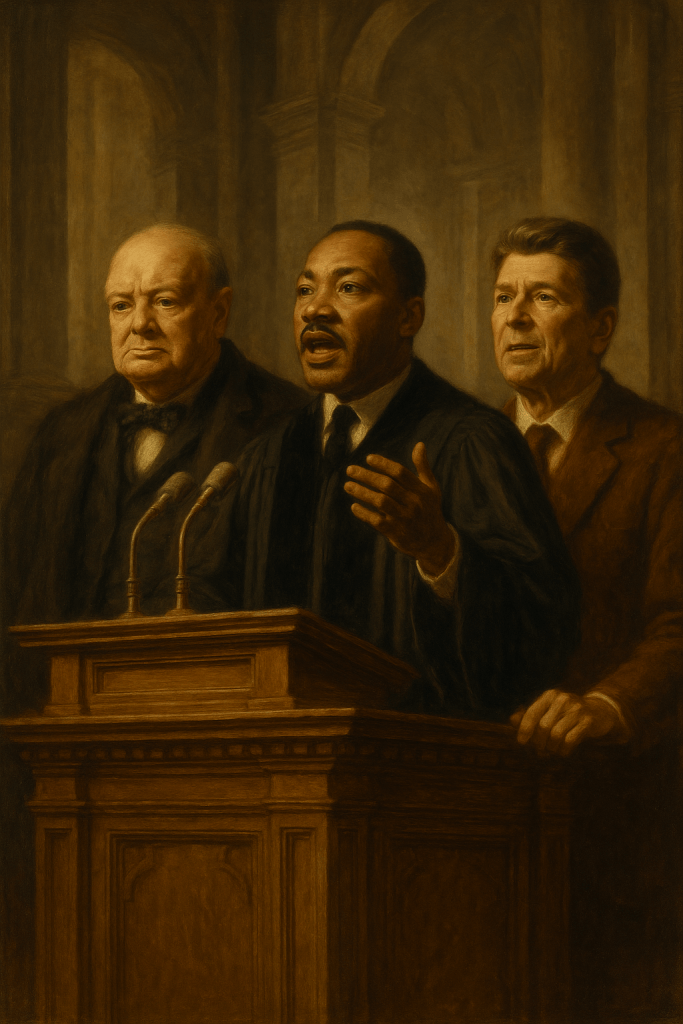
A Collaborative Plea: Churchill, King, and Reagan
Winston Churchill might thunder:
“In every age, civilization itself has hung upon the slender thread of speech. Words have been our armor and our rallying cry in the darkest hours. Let us, then, wield them with courage and precision—not as reckless shouts in the void, but as clarion calls to defend truth, freedom, and human dignity.”
Martin Luther King would then lift the vision higher:
“Yet words must be more than weapons. They must be instruments of justice and of love. A people divided by careless tongues cannot stand, but a people united by righteous speech can march together toward the Promised Land. Let us speak not only to win arguments but to awaken conscience, to stir compassion, to bend that long arc of the moral universe toward justice.”
Ronald Reagan would seal the appeal with hope:
“And let us never forget that words can light a candle in the darkest night. When spoken with faith and fidelity, they remind us that freedom is not fragile but enduring, because it rests upon truth. Let us speak in such a way that future generations say: here were men and women who did not waste their words, but used them to call a people back to God, back to courage, and back to hope.”
Closing Thought
Together, their voices would remind us: the weight of words is real. Spoken in fear, they can enslave. Spoken in truth and love, they can set a people free.
LFM Note: Even if I forgot to include. All of my posts of 2025 and beyond are collaborations between LFM and AI. While I am at it, please go to http://www.citybaseblog.net to see all of my posts in recent years.
 Let's Talk About It, Lewis!